
Group Coaching: Transform Leadership Teams at Scale
Organizations face unprecedented leadership challenges in 2026, from navigating hybrid work environments to addressing toxic workplace behaviors that erode team performance. Traditional one-on-one coaching delivers results but struggles to scale across entire leadership teams while maintaining cost efficiency. Group coaching emerges as the strategic solution that combines the personalized development of individual coaching with the collective intelligence and shared learning that accelerates organizational transformation.
The Strategic Advantage of Group Coaching for Corporate Leadership
Group coaching represents a structured intervention where multiple leaders engage simultaneously in a facilitated development process designed to address specific organizational challenges. Unlike team coaching, which focuses on improving collective team performance, group coaching targets individual growth within a peer learning environment. This distinction matters significantly for organizations seeking to develop leadership capabilities across multiple departments or hierarchical levels.
The business case for implementing group coaching centers on three compelling factors. First, cost efficiency allows organizations to develop 6-12 leaders simultaneously at a fraction of the investment required for individual executive coaching. Second, peer learning dynamics create powerful accountability mechanisms and diverse perspective-sharing that individual coaching cannot replicate. Third, cultural alignment strengthens when leaders across the organization develop shared language, frameworks, and commitments to behavioral change.
Research on evidence-based group coaching models demonstrates measurable improvements in individual well-being and leadership effectiveness when structured properly. Organizations implementing group coaching report enhanced psychological safety, accelerated problem-solving capabilities, and sustained behavioral change that persists beyond the coaching engagement.
Designing High-Impact Group Coaching Programs
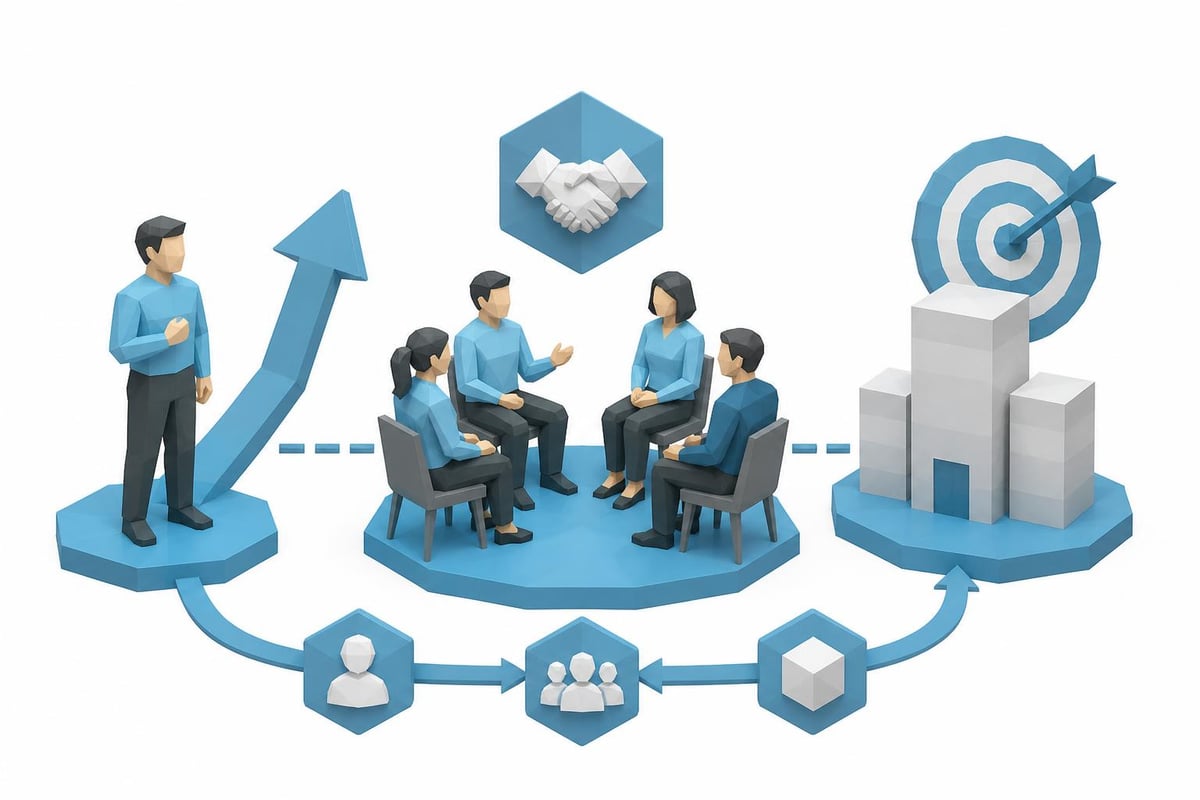
Effective group coaching programs require careful architectural planning that balances individual needs with collective learning objectives. The foundation begins with precise participant selection based on developmental needs, organizational level, and readiness for change. Mixing senior executives with mid-level managers typically undermines psychological safety and inhibits authentic sharing.
Program Structure and Duration
Successful group coaching initiatives follow proven structural frameworks:
- Session frequency: Bi-weekly 90-minute sessions over 4-6 months
- Group size: 6-10 participants for optimal interaction
- Format: Combination of taught content, peer consultation, and individual hot-seat coaching
- Homework assignments: Between-session practices that reinforce learning
- Assessment integration: Pre and post-program diagnostics to measure progress
The best practices for group coaching programs emphasize creating clear containers with explicit ground rules, confidentiality agreements, and participation expectations established during the first session.
Content Themes and Learning Objectives
Organizations achieve maximum ROI when group coaching addresses specific, measurable leadership competencies aligned with strategic priorities. Common themes include:
- Executive presence and communication for leaders transitioning to senior roles
- Conflict resolution and difficult conversations to address team dysfunction
- Strategic thinking and decision-making under uncertainty
- Leading through change during organizational transformation
- Building and sustaining high-performing teams with diverse talent
Each theme requires customized curriculum development that incorporates organizational context, industry-specific challenges, and current business imperatives. Generic leadership content fails to generate the behavioral shifts that justify program investment.
Navigating Common Implementation Challenges
Organizations encounter predictable obstacles when launching group coaching initiatives. Common challenges in group coaching implementation include participant resistance, scheduling conflicts, unequal engagement levels, and difficulty measuring ROI. Addressing these proactively determines program success.
Participant resistance often stems from skepticism about coaching value or fear of vulnerability in group settings. Mitigate this through executive sponsorship, clear communication of program objectives, and voluntary participation whenever possible. Mandatory group coaching rarely produces transformational outcomes when participants lack intrinsic motivation.
| Challenge | Root Cause | Solution Strategy |
|---|---|---|
| Low engagement | Unclear personal relevance | Individual pre-program interviews to identify specific goals |
| Scheduling conflicts | Competing priorities | Block time 6 months in advance with C-suite backing |
| Uneven participation | Personality differences | Structured facilitation with equitable speaking time |
| Limited vulnerability | Lack of psychological safety | Gradual trust-building exercises and confidentiality norms |
| Weak accountability | No follow-through systems | Peer accountability partners and progress tracking |
The relationship between managing and coaching becomes particularly complex when direct reports participate in the same group coaching cohort. Organizations must carefully structure programs to avoid power dynamics that inhibit authentic development conversations.
Facilitation Excellence Requirements
The coach facilitating group sessions requires specialized competencies beyond traditional one-on-one coaching skills. Effective group coaching facilitators demonstrate:
- Process management expertise to balance individual airtime with group learning objectives
- Conflict navigation skills when group dynamics surface tension or disagreement
- Conceptual teaching ability to introduce frameworks that serve multiple learning styles
- Assessment integration to connect individual insights with collective themes
- Organizational savvy to understand political dynamics and systemic constraints
Organizations achieve superior results when they invest in precision coach matching that pairs groups with facilitators who possess both coaching credentials and deep sector expertise relevant to participants' challenges.
Measuring ROI and Demonstrating Business Impact
Executive stakeholders increasingly demand quantifiable evidence that leadership development initiatives generate measurable business outcomes. Group coaching programs must incorporate robust measurement frameworks from inception, not as afterthoughts when budgets face scrutiny.
Leading and Lagging Indicators
Comprehensive measurement strategies track both immediate behavioral changes and longer-term organizational impact:
Leading Indicators (measured during program):
- Participation rates and engagement scores
- Self-assessment progress on targeted competencies
- 360-degree feedback trend analysis
- Peer accountability completion rates
- Application of learned frameworks to real work challenges
Lagging Indicators (measured 3-12 months post-program):
- Employee engagement scores for leaders' teams
- Retention rates of high-potential talent
- Leadership pipeline strength and succession readiness
- Cultural health metrics and psychological safety indicators
- Business performance metrics tied to coached leaders' areas
Organizations implementing group coaching for toxic leader transformation must establish baseline measurements of team dysfunction, turnover, and engagement before intervention to demonstrate the magnitude of positive change achieved.
Advanced Applications for Specific Leadership Challenges
Group coaching delivers exceptional value when deployed strategically against high-priority organizational challenges that affect multiple leaders simultaneously. Three applications demonstrate particularly strong ROI in 2026.
Addressing Impostor Phenomenon in Technical Leaders
Recent research on group coaching for impostor phenomenon among early-career software engineers reveals significant improvements in self-efficacy and reduced impostor feelings through structured peer support. This application extends powerfully to organizations promoting high-performing individual contributors into leadership roles without prior management experience.
Technical professionals transitioning to leadership often struggle with credibility anxiety, perfectionism, and reluctance to delegate. Group coaching creates safe spaces where these leaders discover their struggles are universal rather than personal deficiencies. Shared vulnerability accelerates learning and reduces the isolation that exacerbates impostor feelings.
Building Cross-Functional Leadership Alignment
Organizations pursuing digital transformation or market expansion require unprecedented collaboration across traditionally siloed functions. Group coaching programs that intentionally mix leaders from different departments create relationship capital and shared understanding that formal meetings cannot replicate.
These cross-functional cohorts develop common leadership language, practice perspective-taking, and build trust through authentic dialogue about challenges and failures. The informal networks formed during group coaching sessions often become the connective tissue that enables faster decision-making and conflict resolution when tensions arise in daily operations.
Developing Government and Public Sector Leadership
Government agencies face unique constraints around compliance, public accountability, and mission-driven cultures that commercial coaching approaches often overlook. Group coaching designed specifically for public sector leaders addresses:
- Navigating bureaucratic systems while driving innovation
- Leading without traditional corporate incentives or authority
- Maintaining resilience under political pressure and public scrutiny
- Building engagement in resource-constrained environments
- Balancing service excellence with regulatory requirements
The comprehensive guide to group coaching methodologies provides frameworks adaptable to government contexts where transparency, equity, and measurable public benefit must remain central to all development initiatives.
Integration with Organizational Development Systems
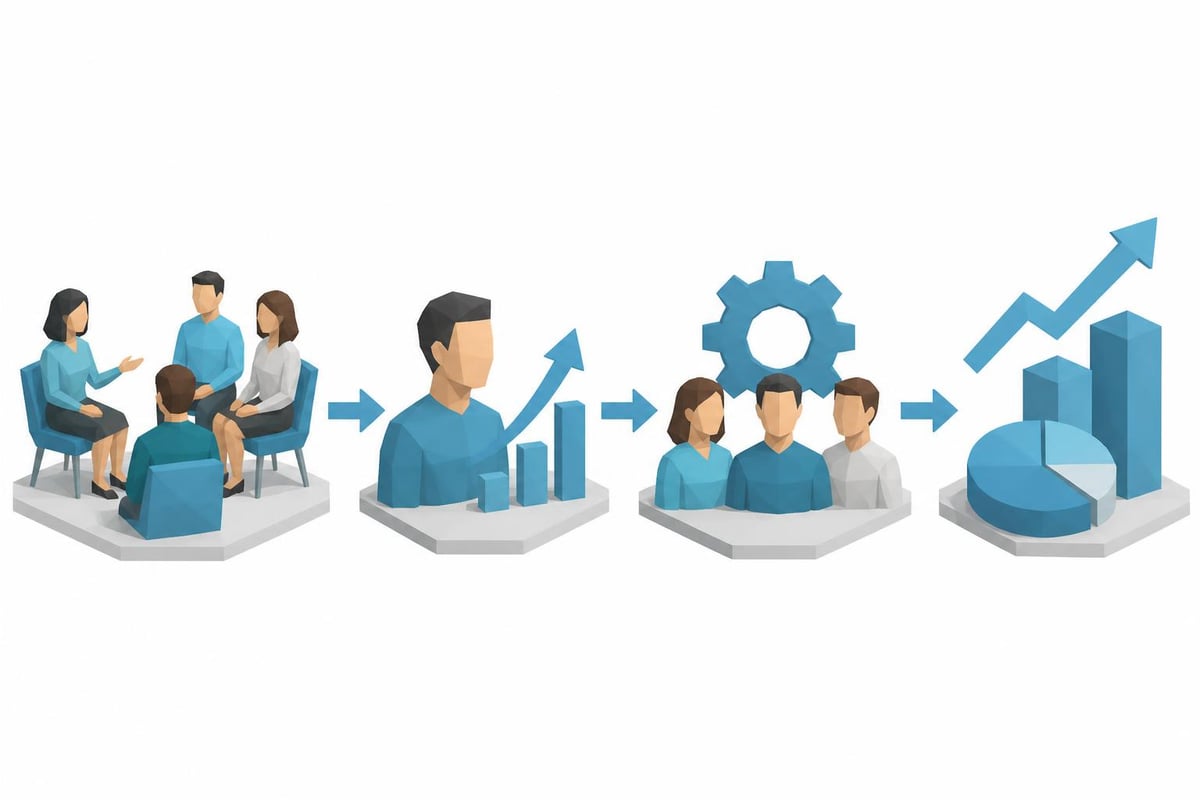
Group coaching generates maximum value when strategically integrated with broader talent management and organizational development architectures. Standalone programs produce individual insights but fail to create systemic change when disconnected from promotion criteria, performance management, and succession planning processes.
Alignment with Leadership Competency Models
Organizations should design group coaching themes and learning objectives that directly reinforce the leadership competencies defined in their talent frameworks. This alignment ensures participants recognize coaching as career-advancing professional development rather than remedial intervention. When leaders see coached competencies appear in promotion discussions and performance reviews, engagement and application intensity increase substantially.
Technology-Enhanced Coaching Delivery
The integration of AI tools in professional coaching workflows offers promising opportunities to extend group coaching impact between live sessions. AI-powered platforms can facilitate peer accountability check-ins, provide personalized practice scenarios, and aggregate insights across cohorts to identify emerging themes requiring facilitator attention.
Organizations exploring AI applications for business coaching should view technology as supplementary to human facilitation, not replacement. The relational depth and contextual wisdom that skilled coaches provide remain irreplaceable for navigating complex leadership challenges.
Running Engaging Group Coaching Sessions
The quality of individual coaching sessions directly determines program outcomes. Facilitators must create structured yet flexible containers that balance teaching, coaching, and peer consultation while maintaining psychological safety and forward momentum. Best practices for engaging group coaching sessions emphasize intentional design of opening rituals, transition moments, and closing commitments.
Session Flow Architecture
Effective 90-minute group coaching sessions typically follow this rhythm:
- Opening check-in (10 minutes): Brief sharing of wins, challenges, and current state
- Teaching input (15 minutes): Introduction of framework, model, or concept relevant to theme
- Individual application (5 minutes): Personal reflection on how concept applies to current challenges
- Peer consultation rounds (40 minutes): Structured coaching of 2-3 participants using hot-seat format
- Integration discussion (15 minutes): Group synthesis of learning themes and patterns
- Commitment and accountability (5 minutes): Public declaration of specific actions before next session
This structure prevents sessions from devolving into unstructured discussion while creating space for emergent insights and authentic connection. Skilled facilitators adjust timing based on group energy and learning needs without abandoning structural discipline entirely.
Creating Psychological Safety in Group Settings
Leaders will not engage vulnerability about failures, fears, or developmental gaps without strong psychological safety. Facilitators establish safety through explicit contracting, consistent boundary enforcement, and modeling vulnerability themselves. The principles outlined in Edmondson’s psychological safety framework apply directly to group coaching environments.
Specific practices that strengthen safety include:
- Confidentiality agreements signed by all participants with clear consequences for violations
- Round-robin sharing that ensures equitable participation rather than dominance by extroverts
- Opt-out options allowing participants to pass when topics feel too sensitive
- Separate learning from evaluation by excluding HR from sessions and not using content for performance reviews
- Celebrating failures as learning opportunities rather than stigmatizing mistakes
Organizations working with top executive coaching firms benefit from facilitators who understand these safety dynamics and can navigate the complex organizational politics that surround leadership development.
Specialized Group Coaching for Executive Teams
While group coaching typically serves individual development within peer cohorts, specialized applications support intact executive teams navigating specific inflection points. This approach combines elements of team coaching with individual development focus, creating powerful synergy for C-suite and senior leadership groups.
Executive team group coaching proves particularly valuable during:
- Leadership transitions when new executives join or roles significantly change
- Strategic pivots requiring fundamental shifts in decision-making approaches
- Conflict resolution after trust breakdowns or persistent dysfunction surface
- Culture transformation initiatives requiring visible executive alignment and behavior change
- Crisis response when external shocks demand coordinated leadership under extreme pressure
The investment in executive-level group coaching justifies higher coaching fees given the organizational impact and revenue responsibility these leaders carry. Organizations should budget appropriately rather than attempting to apply mid-manager program economics to C-suite development.
Scaling Group Coaching Across Global Organizations
Multinational corporations and geographically dispersed organizations face unique challenges implementing group coaching at scale. Time zones, language differences, and cultural norms around feedback and vulnerability require thoughtful adaptation of standard group coaching methodologies.
Virtual delivery has matured significantly since 2020, with sophisticated platforms enabling breakout discussions, whiteboard collaboration, and asynchronous engagement between live sessions. Organizations should not assume virtual group coaching represents a compromise compared to in-person delivery. When designed intentionally, virtual formats offer advantages including broader geographic participation, easier scheduling, and digital documentation of learning artifacts.
Cultural Adaptation Considerations
Group coaching programs deployed across multiple countries must account for cultural differences in:
| Cultural Dimension | Adaptation Strategy |
|---|---|
| Power distance | Adjust authority dynamics and facilitator positioning |
| Individualism vs. collectivism | Balance individual airtime with group harmony emphasis |
| Uncertainty avoidance | Provide more/less structure based on comfort with ambiguity |
| Communication style | Adapt directness of feedback and confrontation approaches |
| Time orientation | Adjust pacing and tolerance for emergent vs. planned agendas |
Organizations with global coaching needs benefit from facilitators with international experience and cultural intelligence who can navigate these dimensions with sophistication and respect.
Building Internal Group Coaching Capacity
Organizations committed to leadership development at scale increasingly invest in developing internal group coaching capabilities rather than relying exclusively on external providers. This approach offers cost advantages, deeper organizational context, and sustainable infrastructure for ongoing development.
Building internal capacity requires:
- Certification investment for selected HR professionals or internal coaches in group coaching methodologies
- Practice opportunities through pilot programs with lower-stakes participant groups
- Supervision and feedback from experienced external coaches during capability development
- Clear role boundaries separating coaching from performance management responsibilities
- Time allocation that protects internal coaches from competing operational demands
Internal coaches should receive the same precision matching consideration as external providers, assigned to groups where their expertise, credibility, and relational dynamics support optimal outcomes. The assumption that any skilled individual coach can automatically facilitate groups effectively leads to disappointing results.
Group coaching transforms organizational leadership development by combining cost efficiency with powerful peer learning dynamics that accelerate behavioral change and strengthen cultural alignment. When designed strategically with clear objectives, robust measurement, and expert facilitation, these programs deliver measurable ROI across individual capability, team performance, and business outcomes. Organizations seeking to address complex leadership challenges at scale should explore how Noomii Leadership Coaching leverages evidence-based diagnostics, precision coach matching, and proven methodologies to deliver group coaching programs aligned with strategic priorities and compliance standards. For leaders implementing these programs, maintaining clear accountability through resources like accountability frameworks ensures sustained impact beyond initial enthusiasm.



Leave a Reply
Want to join the discussion?Feel free to contribute!