
Agribusiness Courses: Leadership and Career Growth
The agricultural sector has evolved dramatically over the past decade, with modern agribusiness leaders facing complex challenges that demand both technical expertise and strong leadership capabilities. As mid-market companies in agriculture, food production, and supply chain management compete globally, investing in agribusiness courses has become essential for developing managers who can make faster decisions, communicate effectively, and execute on strategic priorities. The right educational foundation combined with practical coaching creates leaders who drive measurable business outcomes.
Why Agribusiness Education Matters for Corporate Leadership
Organizations between 25 and 500 employees operating in agricultural sectors face unique pressures. Market volatility, sustainability demands, and supply chain complexity require leaders who understand both business fundamentals and industry-specific challenges.
Agribusiness courses provide this dual foundation. Programs like Purdue’s Agribusiness major offer concentrations in management, finance, and food marketing that directly translate to corporate roles. However, education alone rarely produces the accountable leaders that mid-market companies need.
The gap between academic knowledge and practical application often widens without structured support. Managers learn theory in classrooms but struggle to implement frameworks during live meetings, quarterly planning sessions, or when coaching their own teams. This disconnect costs companies time, engagement, and competitive advantage.

Selecting the Right Educational Path
Different agribusiness courses serve different career stages and organizational needs. Understanding these distinctions helps companies invest in the right development opportunities.
| Program Type | Best For | Key Benefits | Time Commitment |
|---|---|---|---|
| Bachelor's Degree | Early-career professionals | Comprehensive foundation in business and agriculture | 4 years |
| Master's Degree | Mid-career managers | Advanced analytics and strategic thinking | 1-2 years |
| Graduate Certificate | Working professionals | Targeted skill development without full degree | 6-12 months |
| Executive Education | Senior leaders | Condensed, application-focused learning | Days to weeks |
Texas A&M’s Agribusiness program combines core business knowledge with agricultural challenges, preparing graduates for roles that require both skill sets. For professionals already in leadership positions, shorter programs deliver faster value.
The graduate certificate from LSU Online builds business and supply chain skills specifically for working professionals who cannot step away for traditional degree programs. These flexible options allow managers to learn while continuing to deliver results for their organizations.
Translating Education into Execution
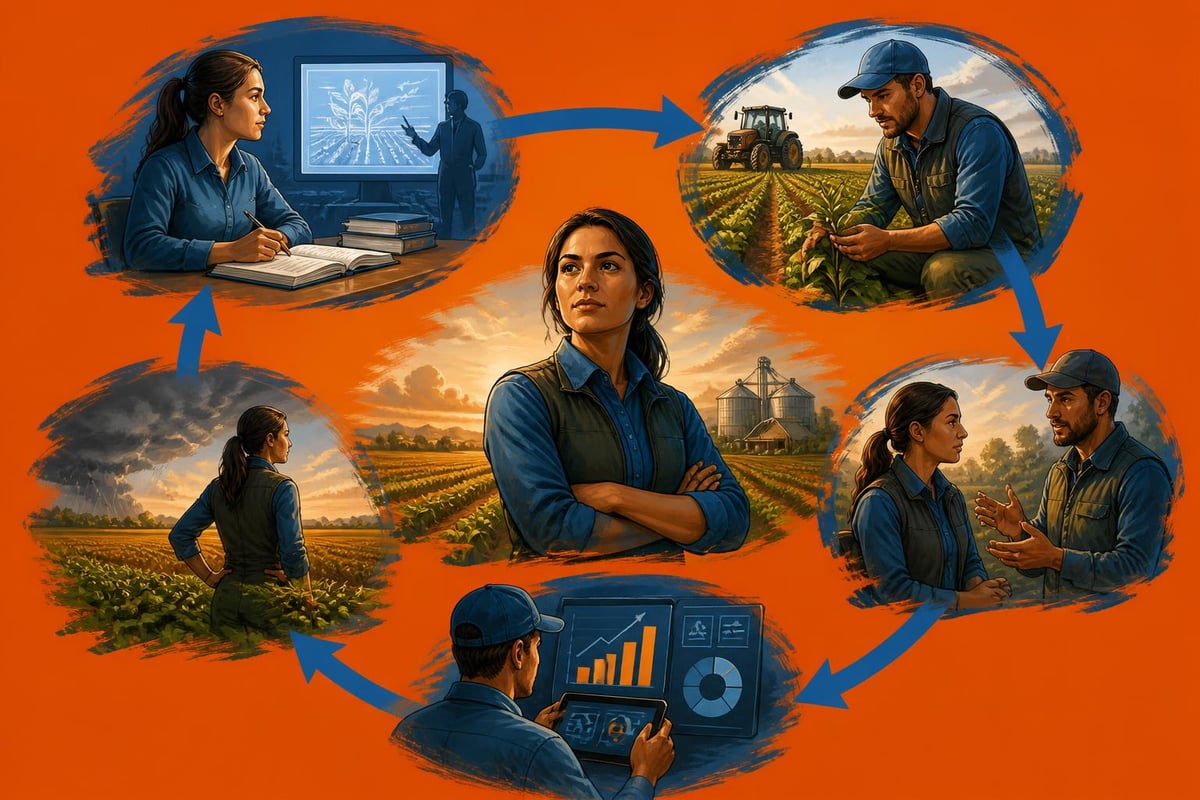
Completing agribusiness courses represents only the first step. The real challenge emerges when managers return to their organizations and attempt to apply new concepts to existing problems. Without accountability structures and ongoing support, knowledge rarely converts to changed behavior.
Effective implementation requires:
- Clear KPIs that measure progress on specific skills
- Regular practice opportunities during actual business meetings
- Feedback loops that identify gaps between intention and execution
- Coaching that reinforces learning in real-time situations
- Operating cadences that create rhythm for skill development
Mid-market companies cannot afford the luxury of slow adoption cycles. When a manager completes coursework in financial analysis or supply chain optimization, those skills must translate to better decisions within weeks, not months. This urgency demands a different approach than traditional education provides alone.
Organizations that combine formal education with practical coaching focused on measurable results see faster skill adoption and clearer ROI. The coaching doesn't replace education but rather accelerates its application to actual business challenges.
Building Leadership Capacity in Agricultural Organizations
Agricultural businesses face leadership challenges that extend beyond standard corporate training. Seasonal cycles, commodity price fluctuations, regulatory complexity, and sustainability pressures create unique stress points that test even experienced managers.
Core Competencies from Formal Programs
Programs like Arizona State’s Morrison School of Agribusiness emphasize experiential learning alongside core business curriculum. Students work on real industry problems, developing judgment that theoretical coursework alone cannot provide.
Essential competencies from agribusiness courses include:
- Financial modeling and capital allocation decisions
- Risk management across commodity markets and operations
- Supply chain optimization from farm to consumer
- Sustainability strategy and stakeholder communication
- Data analytics for precision agriculture and operational efficiency
These technical skills create the foundation for effective leadership. However, mid-market companies need more than individual competence. They require managers who can coach their own teams, facilitate productive meetings, communicate strategy clearly, and maintain engagement through difficult periods.
The Coaching Bridge to Performance
Educational credentials prove knowledge acquisition. Business results prove leadership capability. The distance between these two outcomes determines whether course investments generate ROI or simply pad resumes.
For companies exploring how to maximize their training investments, resources like AccountabilityNow offer frameworks for building accountability into development programs. However, frameworks alone don't substitute for live coaching during actual business situations.
Performance coaching that occurs during real meetings, planning sessions, and decision points creates immediate value. When a coach sits in on quarterly business reviews and provides feedback on how managers communicate priorities, set expectations, or handle conflict, learning accelerates dramatically. This approach ties directly to business outcomes rather than abstract leadership concepts.
Specialized Learning for Global Competition
As agricultural markets globalize, leadership requirements expand beyond domestic operations. Programs like Purdue’s online Master’s in International Agribusiness address these challenges through data analytics and quantitative decision-making frameworks designed for international contexts.
Mid-market companies competing globally need leaders who understand cultural differences, international regulations, and complex logistics. Yet knowledge without execution capability creates frustration rather than competitive advantage.
Advanced Specializations and Certificates
For working professionals, certificate programs offer targeted skill development. Virginia Tech’s Certificate in Agribusiness Fundamentals provides graduate-level education in management, marketing, finance, and policy without requiring a full master's degree commitment.
The University of Illinois certificate in Agribusiness and Sustainable Food Production Economics delivers specialized knowledge for global agriculture challenges. These programs recognize that mid-career professionals need flexibility and focused learning rather than broad academic exploration.
Certificate programs excel when:
- Employees need specific skills to address immediate business challenges
- Budget constraints prevent full degree program investments
- Time away from work must remain minimal
- Learning objectives align tightly with organizational priorities
- Companies provide support structures for application after completion
Maximizing Return on Educational Investment
Smart organizations don't send managers to agribusiness courses and hope for the best. They create deliberate plans for applying new skills to business priorities and measuring impact on performance metrics.
This requires coordination between educational content, organizational goals, and accountability mechanisms. Companies that excel at development investments typically assign coaches who work with managers both during and after formal education, ensuring concepts translate to changed behaviors and improved results.
Resources like Purdue’s Center for Food and Agricultural Business offer executive education and custom training designed for immediate application. These programs recognize that busy professionals need practical tools, not just theoretical frameworks.

Creating Sustainable Leadership Development
The most effective approach combines formal agribusiness courses with ongoing coaching that holds leaders accountable for applying what they learn. This hybrid model generates measurable improvements in decision quality, team engagement, and execution speed.
Mid-market companies need managers who can think strategically while executing tactically. Education builds the strategic foundation. Coaching ensures tactical excellence. Together, they create leaders who drive consistent results quarter after quarter.
When evaluating development options, consider programs that emphasize application over theory, provide flexibility for working professionals, and align with specific business challenges your organization faces. Then build accountability structures that turn knowledge into performance through regular coaching, clear KPIs, and operating cadences that reinforce new behaviors.
The agricultural sector rewards organizations that develop strong leadership pipelines. Investing in agribusiness courses positions your company to compete effectively, but only when combined with practical support that ensures learning translates to measurable business outcomes.
Agribusiness courses provide essential knowledge, but mid-market companies need leaders who execute, not just understand theory. The gap between education and results closes when organizations combine formal learning with practical coaching during actual business situations. If your agricultural or food production company needs managers who make faster decisions, communicate more effectively, and drive measurable performance improvements, Noomii delivers month-to-month corporate coaching tied to clear KPIs and visible ROI. We coach live in your meetings and share the risk through aligned incentives, ensuring your investment produces accountable leaders and stronger teams.



Leave a Reply
Want to join the discussion?Feel free to contribute!