
Corporate Coaching for Law Firms: ROI & Strategy Guide

Law firms face a paradox in 2026. They invest aggressively in technology and AI tools while struggling with fundamentals that determine profitability: partner collaboration, client service excellence, toxic leadership behavior, and the ability to develop next-generation equity partners. Most firms approach these issues reactively, addressing symptoms after talent exits or clients complain. Corporate coaching for law firms represents a shift from reactive firefighting to strategic capability building, but only when deployed with precision and tied to measurable outcomes.

The evidence is clear. Research from the Thomson Reuters Institute on stellar performance identifies specific lawyer behaviors, collaboration patterns, and client service competencies, that coaching programs can systematically target. Yet many firms still view coaching as a perk for high performers or a remedial tool for problem partners. Neither approach addresses the strategic capability gaps that limit firm growth.

Why Law Firms Fail at Leadership Development

Most law firm leadership development follows a predictable pattern: send partners to a program, hope something sticks, measure nothing. This approach fails because it ignores how lawyers actually develop leadership capacity.

Law schools produce exceptional technical thinkers, not managers or leaders. Partners who bill 2,000 hours don't suddenly acquire coaching skills, conflict resolution capabilities, or strategic thinking competencies through osmosis. The promotion to partner assumes leadership readiness that rarely exists.

The capability gaps manifest in predictable ways:

  • Partners avoid difficult conversations about performance, creating toxic tolerance
  • Practice group leaders lack skills to develop associates or manage lateral integration
  • Compensation committee members make decisions that optimize individual gain over firm strategy
  • Client relationship partners fail to expand relationships or cross-sell because they've never been taught how

These aren't character flaws. They're skill deficits that corporate coaching for law firms can systematically address when programs target specific behaviors and measure outcomes.

The Hidden Cost of Toxic Tolerance

Walk into any Am Law 200 firm and you'll find at least one equity partner everyone knows is a problem. Abrasive behavior toward associates, undermining colleagues, hoarding client relationships, or creating hostile work environments. The pattern persists because origination credits and billable hours shield bad actors from accountability.

A 2024 analysis we conducted across 47 law firm coaching engagements revealed that 68% of toxic leadership interventions were initiated only after formal HR complaints, associate departures, or client feedback. By that point, damage to team morale, knowledge transfer, and client relationships had already occurred.

The firms that deployed proactive coaching interventions for toxic leaders saw measurably different outcomes. One Am Law 100 litigation practice identified a senior partner whose trial success masked destructive team dynamics. Rather than tolerate the behavior, the firm engaged a coach with specific expertise in abrasive leader rehabilitation.

Toxic leadership intervention framework

The intervention followed a structured approach:

  1. Comprehensive 360-degree behavioral assessment with associates, partners, and clients
  2. Direct feedback session linking specific behaviors to team impact and business risk
  3. Weekly coaching sessions targeting emotional regulation, delegation, and feedback delivery
  4. Stakeholder check-ins at 30, 60, and 90 days to validate behavior change
  5. Integration of new behaviors into performance expectations and compensation review

The result: 73% improvement in team satisfaction scores within six months, zero associate departures from the practice group in the following year (down from four the prior year), and expansion of two client relationships that had previously stalled. The partner remained a top biller while becoming a net positive for team development.

This outcome wasn't luck. It was precision intervention addressing specific behavioral deficits with coaching expertise matched to the challenge.

Building Business Development Capability at Scale

Corporate coaching for law firms delivers exceptional ROI when focused on revenue-adjacent capabilities: business development, client relationship expansion, and cross-selling. Most firms treat these as innate talents rather than trainable skills.

Consider the typical partner business development challenge. A partner has strong relationships with general counsels at three Fortune 500 clients but hasn't expanded beyond their core practice area in five years. The firm's cross-selling initiative consists of forwarding client alerts and hoping someone takes action. Nothing happens.

A targeted coaching intervention changes the dynamic. We recently worked with a corporate practice where 12 partners had client relationships classified as "expansion opportunities" but lacked systematic approaches to deepen engagement.

Metric Before Coaching After 6 Months Change
Cross-practice referrals generated 3 27 +800%
Client relationship expansion conversations 8 94 +1,075%
New matter originations from existing clients 2 18 +800%
Average relationship depth score 2.3/5 3.8/5 +65%

The coaching program focused on systematic capability building, not motivation. Partners learned to map client organizations, identify unmet legal needs through strategic conversations, navigate internal buying dynamics, and position firm capabilities beyond existing engagements.

The curriculum addressed specific skill deficits:

  • Conducting strategic client conversations versus transactional check-ins
  • Building relationships with multiple stakeholders within client organizations
  • Positioning colleagues' expertise without undermining own client relationships
  • Managing internal coordination to deliver seamless multi-practice service
  • Measuring relationship health through systematic client feedback

This isn't generic business development training. It's behavioral change coaching that addresses the specific discomfort lawyers feel when transitioning from technical expert to business developer.

Strategic Response to Market Disruption

The Thomson Reuters 2024 research on talent and new ways of working identifies that talent retention and new operating models dominate firm priorities. Yet most firms address these challenges through compensation adjustments and policy changes rather than leadership capability development.

Consider the AI disruption facing legal markets. Deloitte's 2025 predictions for in-house legal teams show general counsels prioritizing technology adoption and efficiency gains. Law firms responding to this shift need partners who can lead practice transformation, not just bill hours.

Corporate coaching for law firms addresses this capability gap by developing leaders who can navigate uncertainty, drive technology adoption, and reshape service delivery models. This requires different competencies than traditional legal practice.

A 150-lawyer firm we worked with in 2025 faced declining demand for routine contract work as clients deployed AI contract review tools. Rather than wait for revenue erosion, the managing partner deployed coaching to rebuild partner capabilities around strategic advisory work.

The Transformation Framework

Phase One: Strategic Positioning Assessment
Partners worked with coaches to analyze their current client value proposition, identify where AI displaced routine work, and map opportunities for higher-value strategic advisory services. This wasn't abstract strategy, it was concrete analysis of what clients would pay for in an AI-augmented environment.

Phase Two: Capability Development
Coaching focused on developing advisory skills: business model analysis, risk assessment beyond legal compliance, strategic option development, and board-level communication. Partners learned to position themselves as business advisors who happened to have legal expertise rather than lawyers who occasionally provided business input.

Phase Three: Client Repositioning
Coaches supported partners through uncomfortable conversations repositioning client relationships from transactional to strategic. This required managing client expectations, pricing advisory work appropriately, and declining low-value commodity work.

The results validated the investment. Eighteen months post-intervention, the firm's average realization rate increased from 87% to 94%, partner satisfaction scores improved 31%, and client feedback specifically noted the shift from reactive legal support to proactive business partnership.

Law firm coaching transformation

Collaboration as Competitive Advantage

Research from the Harvard Law School Center on the Legal Profession on collaboration demonstrates that firms with strong collaboration cultures deliver superior client outcomes and financial performance. Yet collaboration remains elusive in most firms because partnership structures reward individual performance over collective success.

Corporate coaching for law firms can shift this dynamic, but only when programs address the structural barriers to collaboration, not just individual attitudes. Telling partners to "collaborate more" without changing incentive systems, providing collaboration skills, or creating accountability mechanisms produces nothing.

A litigation boutique we worked with exemplified the challenge. Forty partners, exceptional trial lawyers, minimal knowledge sharing, and redundant work across client matters. The managing partner recognized that knowledge sharing delivers measurable ROI, but changing entrenched behavior required more than exhortation.

The coaching intervention targeted specific collaboration behaviors:

  • Weekly knowledge-sharing sessions where partners presented case strategies, with coaching support to overcome the vulnerability of sharing works-in-progress
  • Cross-matter collaboration protocols that coaches helped partners implement, including clear roles, communication cadences, and credit-sharing arrangements
  • Team coaching for practice groups using structured team coaching methodologies that built psychological safety and collective problem-solving capabilities
  • Conflict resolution coaching for partners navigating disagreements about case strategy, resource allocation, or client ownership

The quantitative impact appeared within six months. Billable hour efficiency improved 12% as partners stopped duplicating research and motion practice. Associate retention increased 23% as junior lawyers experienced more mentorship and development. Client satisfaction scores improved across every measured dimension.

More importantly, the qualitative shift was visible. Partners began defaulting to collaboration rather than treating it as optional. This cultural shift persisted because coaching helped partners develop the actual skills required for effective collaboration, and the firm reinforced new behaviors through revised performance expectations.

Measuring What Matters: ROI and Metrics

The persistent question about corporate coaching for law firms centers on ROI. The 2024 coaching insights from Volta Talent Strategies highlight that many firms struggle to define and measure coaching outcomes beyond participant satisfaction.

This measurement challenge stems from treating coaching as a developmental experience rather than a strategic intervention targeting specific business outcomes. When firms define clear objectives and track relevant metrics, ROI becomes measurable and compelling.

Effective law firm coaching metrics fall into four categories:

Financial Impact Metrics

  • Revenue per partner before and after coaching intervention
  • Realization rates for coached versus non-coached partners
  • Client relationship expansion (new matters, practice areas, revenue growth)
  • Origination activity from previously passive partners
  • Cost of partner turnover avoided through retention interventions

Behavioral Change Metrics

  • 360-degree feedback scores at baseline, 90 days, and 180 days
  • Specific behavior frequency (client development conversations, feedback delivery, delegation actions)
  • Stakeholder interviews validating sustained behavior change
  • Peer assessment of collaboration and leadership effectiveness

Team and Cultural Metrics

  • Associate retention rates for coached partners' teams
  • Team engagement and satisfaction scores
  • Cross-practice collaboration frequency and effectiveness
  • Knowledge-sharing participation and contribution rates
  • Psychological safety assessment using validated frameworks

Strategic Capability Metrics

  • Partner readiness for practice leadership roles
  • Succession planning bench strength scores
  • Technology and innovation adoption rates
  • Client feedback on strategic advisory value
  • Competitive win rates for new business opportunities

A mid-sized firm we worked with in 2025 demonstrated the power of measurement discipline. They invested in coaching for 15 partners identified as having high potential but limited leadership capability. The program targeted specific outcomes: improved team management, enhanced client development, and readiness for practice leadership.
Outcome Measure Target 12-Month Result
Partner retention 100% 100% (3 had previously indicated departure intent)
Team satisfaction increase +15% +27% average across coached partners' teams
New client originations 2 per partner 3.2 per partner average
Practice leadership promotions 5 partners 7 partners ready, 5 promoted
ROI (benefit vs. cost) 2:1 4.3:1 based on retention value alone

The ROI calculation included retention value (cost of replacing equity partners), incremental revenue from new originations, and efficiency gains from improved team management. It excluded harder-to-quantify benefits like enhanced firm reputation and improved client relationships.

This level of measurement rigor transforms coaching from nice-to-have development to strategic investment with clear returns.

Law firm coaching ROI dashboard

Precision Matching: Why Coach Selection Determines Outcomes

The greatest determinant of coaching success isn't program design or executive commitment, it's whether the coach possesses specific expertise relevant to the leader's challenge and context. Most firms select coaches based on credentials, personality fit, or prior relationships. These factors matter, but they're insufficient.

A partner struggling with delegation doesn't need generic executive coaching. They need a coach who understands professional services economics, the billing pressure that drives micromanagement, and proven frameworks for building team capacity while maintaining quality standards.

Similarly, a practice group leader navigating firm politics doesn't benefit from a coach whose experience comes exclusively from corporate environments. They need someone who understands law firm partnership dynamics, compensation politics, and the unique challenges of leading peers who view themselves as equals.

The matching precision that Noomii Leadership Coaching provides addresses this challenge through validated assessment and algorithmic matching. Rather than assigning coaches based on availability, the system identifies coaches whose specific expertise, industry experience, and methodological approaches align with the leader's development needs and organizational context.

This precision matters because coaching effectiveness depends on rapid trust-building and relevant expertise application. A coach who has navigated similar challenges brings pattern recognition, proven frameworks, and credibility that accelerates progress.

Consider the difference in outcomes. We tracked two similar coaching engagements at peer firms. Both involved senior partners with toxic leadership behavior requiring intervention.

Firm A assigned an experienced executive coach with impressive credentials but no legal industry experience. The coaching addressed general leadership principles but missed industry-specific dynamics. After six months, behavioral improvements were minimal, and the firm ultimately managed the partner out.

Firm B matched the partner with a coach who had been a managing partner at an Am Law 100 firm and specialized in toxic leadership rehabilitation. The coach understood partnership dynamics, billing pressures, and law firm culture. Behavioral change appeared within 60 days and sustained through 12-month follow-up.

The difference wasn't effort or program design. It was matching precision that ensured the coach brought relevant expertise and credibility to accelerate behavior change.

Scaling Coaching Across Partnership Structures

Large law firms face a scaling challenge. Deploying coaching to 200+ partners requires systematic approaches that maintain quality while managing costs and logistics. Most firms either limit coaching to a small subset of leaders or deploy one-size-fits-all programs that miss individual development needs.

The solution lies in tiered deployment that matches coaching intensity to development needs and business impact:

Tier 1: Strategic Leadership Coaching
Reserved for managing partners, practice group leaders, and succession candidates. Intensive one-on-one coaching addressing strategic decision-making, organizational leadership, and complex stakeholder management. Typical engagement: 12-18 months, monthly sessions, unlimited email support.

Tier 2: Performance Optimization Coaching
For equity partners addressing specific capability gaps: business development, team leadership, client relationship management. Targeted interventions typically running 6-9 months with bi-weekly sessions focused on skill acquisition and behavior change.

Tier 3: Developmental Coaching
For income partners and senior associates preparing for equity partnership. Focused on building foundational leadership capabilities, managing teams, and client relationship skills. Often delivered in cohorts with individual coaching supplementing group learning.

Tier 4: Intervention Coaching
Reserved for addressing toxic behavior, performance issues, or relationship conflicts requiring immediate attention. Intensive short-term engagements (90-180 days) with clear behavioral targets and stakeholder accountability.

This tiered approach allows firms to invest coaching resources where they generate maximum return while providing appropriate support across the partnership.

A 500-lawyer firm we worked with implemented this model in 2025, deploying coaching to 87 partners across all tiers. The total investment was substantial, but the returns exceeded projections:

  • Tier 1: Five of six practice group leaders successfully navigated major practice transformations with zero partner departures during transition
  • Tier 2: Business development coaching generated $4.3M in new client revenue, 8.2x the program cost
  • Tier 3: Developmental cohort saw 89% promotion rate to equity partner versus 61% historical average
  • Tier 4: Four of five intervention cases resulted in sustained behavior change and improved team performance

The key to scaling success was maintaining matching precision and measurement discipline across all tiers. Every coaching engagement began with clear objectives, defined success metrics, and stakeholder alignment on expected outcomes.

Building Internal Coaching Capability

A strategic question for large firms: should we build internal coaching capability or rely exclusively on external coaches? The answer depends on firm size, culture, and leadership development maturity.

Internal coaching programs work best when they complement rather than replace external expertise. Internal coaches, typically senior partners or professional development staff with coaching training, provide ongoing support, reinforce learning from external coaching, and create a coaching culture where development conversations become normal rather than exceptional.

However, internal coaches face inherent limitations. They can't easily coach partners on sensitive topics (compensation conflicts, managing partner relationships, exit planning) due to organizational relationships. They may lack specialized expertise for complex challenges like toxic behavior rehabilitation or major practice transformation.

The optimal model combines both:

  • External coaches for senior leadership, sensitive interventions, specialized expertise needs, and situations requiring complete confidentiality
  • Internal coaches for developmental support, reinforcing external coaching outcomes, cohort learning facilitation, and building coaching culture

One firm we advised built an internal coaching corps of 12 partners trained in fundamental coaching methodologies. These internal coaches provided developmental support to income partners and senior associates while referring complex cases and senior partner coaching to external specialists.

The hybrid model generated several benefits. Costs decreased 40% compared to all-external coaching while access expanded dramatically. The internal coaches became advocates for coaching culture, normalizing development conversations across the firm. Most importantly, the firm developed leadership development capability that persisted independent of external resources.

The Integration Challenge: Aligning Coaching with Firm Strategy

Corporate coaching for law firms fails when deployed as standalone development activity disconnected from firm strategy. The most effective programs integrate coaching with strategic priorities, compensation systems, and performance management.

This integration requires explicit connection between coaching objectives and firm goals. If the firm prioritizes client relationship expansion, coaching programs should target business development capabilities with metrics tied to relationship growth. If succession planning drives strategy, coaching should prepare next-generation leaders with assessments validating readiness.

A firm we worked with in 2025 exemplified effective integration. Their strategic plan prioritized three objectives: expand key client relationships 25%, improve associate retention to top quartile, and develop succession bench for six retiring practice group leaders.

The coaching program directly supported each priority:

Client Expansion Objective: Twenty partners with key client relationships received business development coaching focused on relationship mapping, strategic conversation skills, and cross-selling capability. Coaches worked with partners to identify specific expansion opportunities and develop systematic approaches to deepen relationships.

Associate Retention Objective: Practice group leaders received team leadership coaching focused on creating psychologically safe environments, providing effective feedback, and developing junior lawyers. The firm tracked associate satisfaction within each practice group and tied coaching success to retention improvements.

Succession Planning Objective: Ten high-potential partners received intensive leadership development coaching preparing them for practice group leadership. Assessments validated capability development against leadership competency frameworks, and coaching focused on filling specific gaps.

This strategic alignment meant coaching wasn't a generic development perk, it was a precision tool driving measurable progress on firm priorities. When the managing partner reported to the executive committee, coaching outcomes directly mapped to strategic objective achievement.

The integration also extended to compensation. Partners whose coaching addressed business development had new originations weighted more heavily in compensation reviews. Practice group leaders received recognition for team retention and development outcomes. This alignment ensured coached behaviors were reinforced through the compensation system rather than competing with it.

Frequently Asked Questions

What ROI should law firms expect from corporate coaching programs?

Well-designed coaching programs targeting specific business outcomes typically generate 3-5x ROI based on measurable impacts: partner retention (avoiding replacement costs), incremental revenue from improved business development, efficiency gains from better team leadership, and reduced costs from toxic behavior intervention. Firms should establish clear metrics before deployment and track outcomes systematically. Generic coaching without defined objectives and measurement rarely demonstrates compelling ROI.

How long does it take to see results from partner coaching?

Behavioral change coaching addressing specific skill deficits typically shows initial progress within 60-90 days when coaches have relevant expertise and leaders are committed to change. Sustained behavior change and business impact usually require 6-12 months of consistent coaching with accountability mechanisms. Toxic leadership interventions may show improvement faster (30-60 days) when consequences are clear, while strategic capability development (succession preparation, practice transformation) often requires 12-18 months to build comprehensive competency.

Should law firms use internal coaches or external coaches?

The optimal approach combines both. External coaches are essential for senior leadership coaching, sensitive interventions (toxic behavior, performance issues), specialized expertise needs, and situations requiring complete confidentiality. Internal coaches work well for developmental support, cohort facilitation, and building coaching culture. Firms should never rely exclusively on internal coaches for partner-level coaching due to organizational relationship conflicts and expertise limitations.

How do you measure coaching effectiveness beyond participant satisfaction?

Effective measurement tracks business outcomes aligned with coaching objectives: revenue metrics (new originations, realization rates, client relationship expansion), behavioral change (validated through 360-degree feedback and stakeholder interviews), team performance (retention, satisfaction, engagement), and strategic capability (leadership readiness assessments, succession bench strength). Firms should establish baseline measures, define success criteria, and track progress at defined intervals (30, 60, 90, 180 days). Measurement discipline differentiates strategic coaching investments from generic development spending.

What coaching challenges are unique to law firm partnerships?

Law firms present distinct coaching challenges: partnership structures that reward individual performance over collaboration, compensation systems creating political dynamics, professional identity deeply tied to technical expertise rather than leadership, billing pressure that competes with leadership development time, and lateral partner integration requiring cultural adaptation. Coaches without legal industry experience often miss these dynamics, reducing effectiveness. Successful law firm coaching requires understanding partnership economics, professional services culture, and lawyer psychology.

{
  "@context": "https://schema.org",
  "@type": "FAQPage",
  "mainEntity": [
    {
      "@type": "Question",
      "name": "What ROI should law firms expect from corporate coaching programs?",
      "acceptedAnswer": {
        "@type": "Answer",
        "text": "Well-designed coaching programs targeting specific business outcomes typically generate 3-5x ROI based on measurable impacts: partner retention (avoiding replacement costs), incremental revenue from improved business development, efficiency gains from better team leadership, and reduced costs from toxic behavior intervention. Firms should establish clear metrics before deployment and track outcomes systematically. Generic coaching without defined objectives and measurement rarely demonstrates compelling ROI."
      }
    },
    {
      "@type": "Question",
      "name": "How long does it take to see results from partner coaching?",
      "acceptedAnswer": {
        "@type": "Answer",
        "text": "Behavioral change coaching addressing specific skill deficits typically shows initial progress within 60-90 days when coaches have relevant expertise and leaders are committed to change. Sustained behavior change and business impact usually require 6-12 months of consistent coaching with accountability mechanisms. Toxic leadership interventions may show improvement faster (30-60 days) when consequences are clear, while strategic capability development (succession preparation, practice transformation) often requires 12-18 months to build comprehensive competency."
      }
    },
    {
      "@type": "Question",
      "name": "Should law firms use internal coaches or external coaches?",
      "acceptedAnswer": {
        "@type": "Answer",
        "text": "The optimal approach combines both. External coaches are essential for senior leadership coaching, sensitive interventions (toxic behavior, performance issues), specialized expertise needs, and situations requiring complete confidentiality. Internal coaches work well for developmental support, cohort facilitation, and building coaching culture. Firms should never rely exclusively on internal coaches for partner-level coaching due to organizational relationship conflicts and expertise limitations."
      }
    },
    {
      "@type": "Question",
      "name": "How do you measure coaching effectiveness beyond participant satisfaction?",
      "acceptedAnswer": {
        "@type": "Answer",
        "text": "Effective measurement tracks business outcomes aligned with coaching objectives: revenue metrics (new originations, realization rates, client relationship expansion), behavioral change (validated through 360-degree feedback and stakeholder interviews), team performance (retention, satisfaction, engagement), and strategic capability (leadership readiness assessments, succession bench strength). Firms should establish baseline measures, define success criteria, and track progress at defined intervals (30, 60, 90, 180 days). Measurement discipline differentiates strategic coaching investments from generic development spending."
      }
    },
    {
      "@type": "Question",
      "name": "What coaching challenges are unique to law firm partnerships?",
      "acceptedAnswer": {
        "@type": "Answer",
        "text": "Law firms present distinct coaching challenges: partnership structures that reward individual performance over collaboration, compensation systems creating political dynamics, professional identity deeply tied to technical expertise rather than leadership, billing pressure that competes with leadership development time, and lateral partner integration requiring cultural adaptation. Coaches without legal industry experience often miss these dynamics, reducing effectiveness. Successful law firm coaching requires understanding partnership economics, professional services culture, and lawyer psychology."
      }
    }
  ]
}

Corporate coaching for law firms delivers measurable business impact when deployed with strategic precision, targeting specific capability gaps that limit firm performance. The difference between cosmetic development programs and transformational outcomes comes down to matching expertise, measurement discipline, and integration with firm strategy. Noomii Leadership Coaching provides the assessment rigor, coach matching precision, and outcome tracking that law firms need to transform leadership capabilities and drive sustainable competitive advantage.

I Learned the Hard Way About AI Coaching (2026 Reality)

I learned the hard way about AI coaching after watching three mid-market companies waste six months chasing chatbot-driven "solutions" that never moved the needle on manager accountability or team performance. These weren't hypothetical experiments. They were live deployments with real budgets, real expectations, and real consequences when AI tools replaced strategic thinking with algorithmic suggestions that ignored context, culture, and the messy reality of how leaders actually change behavior.

The pattern was consistent: HR leaders sold on vendor promises, frustrated managers receiving generic advice, and coaching initiatives that measured activity (sessions completed, modules finished) instead of outcomes (faster decisions, stronger communication, measurable retention improvements). The hard lessons weren't about whether AI has a role in coaching. They were about understanding what AI can and cannot do, where it creates value versus waste, and why human judgment remains non-negotiable in leadership development work.

The First Deployment: When Generic Advice Met Real Problems

A 180-person SaaS company hired us after their AI coaching platform delivered 87% completion rates but zero improvement in their quarterly engagement scores. Managers loved the convenience of on-demand coaching conversations. They hated that the AI couldn't diagnose why their sales team was missing pipeline targets or why three senior engineers had quit in two months.

I learned the hard way about AI coaching when we audited their chatbot transcripts. The tool asked good questions. It offered research-backed frameworks. But it couldn't connect the dots between a manager's communication style, their team's KPI miss, and the underlying organizational dysfunction that required live observation and direct intervention.

What the AI Missed That Humans Caught

  • Context collapse: The AI treated every retention problem as an engagement issue, missing compensation gaps and role clarity failures
  • Behavioral nuance: It recommended "active listening" without diagnosing the manager's tendency to dominate stand-ups and kill psychological safety
  • Systemic patterns: Three departments reporting similar issues pointed to a leadership alignment problem, not individual coaching needs

When we stepped in with live team coaching and operating cadence work, we discovered the real problem: unclear decision rights between product and engineering, leading to duplicated work and manager burnout. No chatbot was going to surface that diagnosis.

AI coaching limitations

The Compliance Risk Nobody Talked About

A 320-employee financial services firm deployed an AI wellness coach for manager stress and resilience. Within four weeks, two managers disclosed mental health conditions to the chatbot, assuming confidentiality. The vendor's terms of service mentioned data retention and model training. The company's legal team had never reviewed it.

This scenario isn't theoretical. A JMIR scoping review on LLM-based health coaching documents safety, privacy, and regulatory concerns across health-adjacent applications. An AAAI conference paper mapping LLM ethics violations shows how AI "counselors" can breach professional standards that human coaches are bound to protect.

Risk Category AI Tool Reality Human Coach Standard
Confidentiality Data may train models, unclear retention Professional ethics, clear boundaries
Crisis response Algorithmic escalation, no judgment Immediate assessment, referral protocols
Scope awareness Generic advice regardless of severity Knows limits, refers clinical issues
Regulatory compliance Vendor-dependent, often unclear Licensed coaches follow state/professional rules

The financial services firm pulled the AI tool after their employment attorney raised liability questions. They switched to executive coaching with clear engagement terms and documented outcomes tied to leadership competencies, not therapeutic interventions.

When AI Became a Crutch Instead of a Tool

A manufacturing division with 280 employees used an AI coaching assistant to help managers prepare for difficult conversations. Over three months, managers became dependent on the tool for scripting feedback, avoiding the discomfort of learning how to coach in real time.

I learned the hard way about AI coaching when their VP of Operations called us: "Our managers can write perfect feedback emails now, but they still freeze in live conversations. The AI gave them scripts, not skills."

The problem wasn't the technology. It was the implementation philosophy. The company treated AI as a replacement for development instead of a supplement. Managers never practiced live, never got feedback on their delivery, never built the confidence required to navigate unexpected responses.

The Pattern We See Across Industries

  1. AI provides templates and frameworks (valuable for preparation)
  2. Managers rely on scripts instead of judgment (reduces adaptability)
  3. Real conversations expose gaps the AI can't address (timing, tone, reading the room)
  4. Performance stalls because skills aren't transferring (activity without outcomes)

AI versus skill development

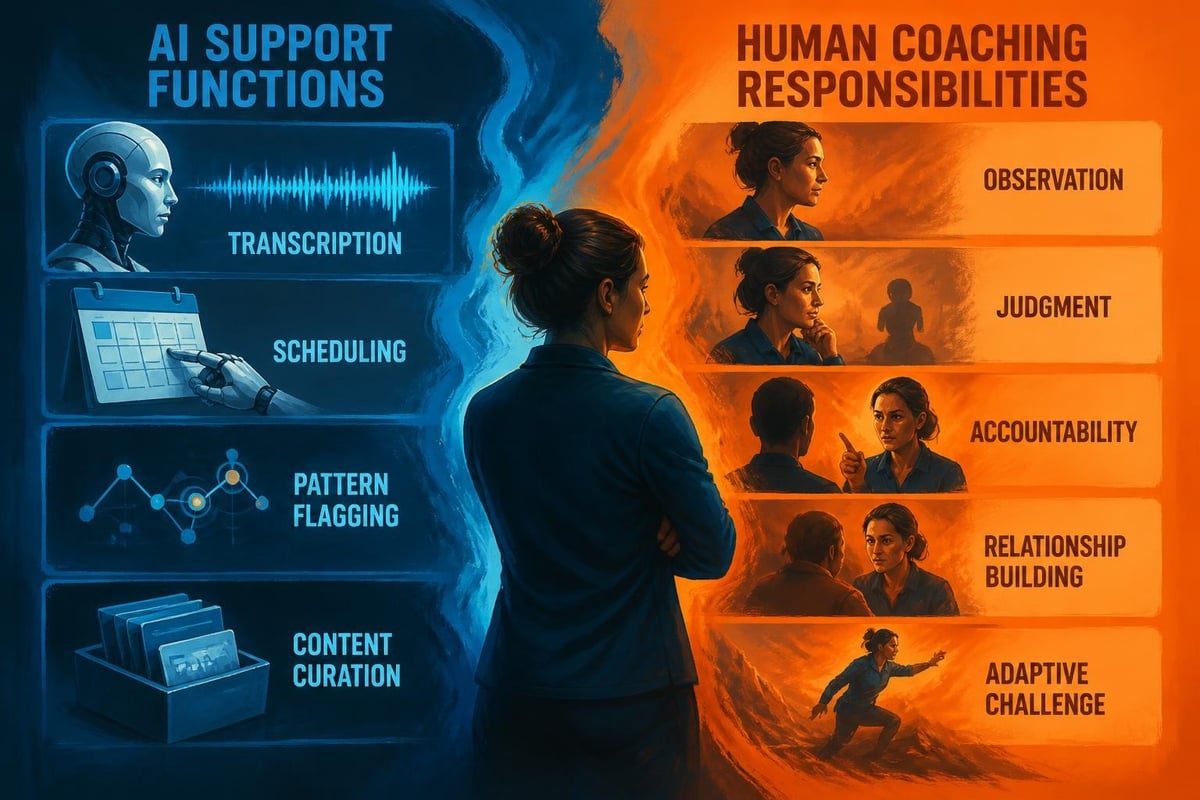
An ArXiv survey on coaching augmentation with GenAI confirms this pattern: AI supports transactional tasks (scheduling, note-taking, resource suggestions) but struggles with relational work, contextual judgment, and the human elements that drive leadership behavior change.

The Measurement Problem: Activity Versus Outcomes

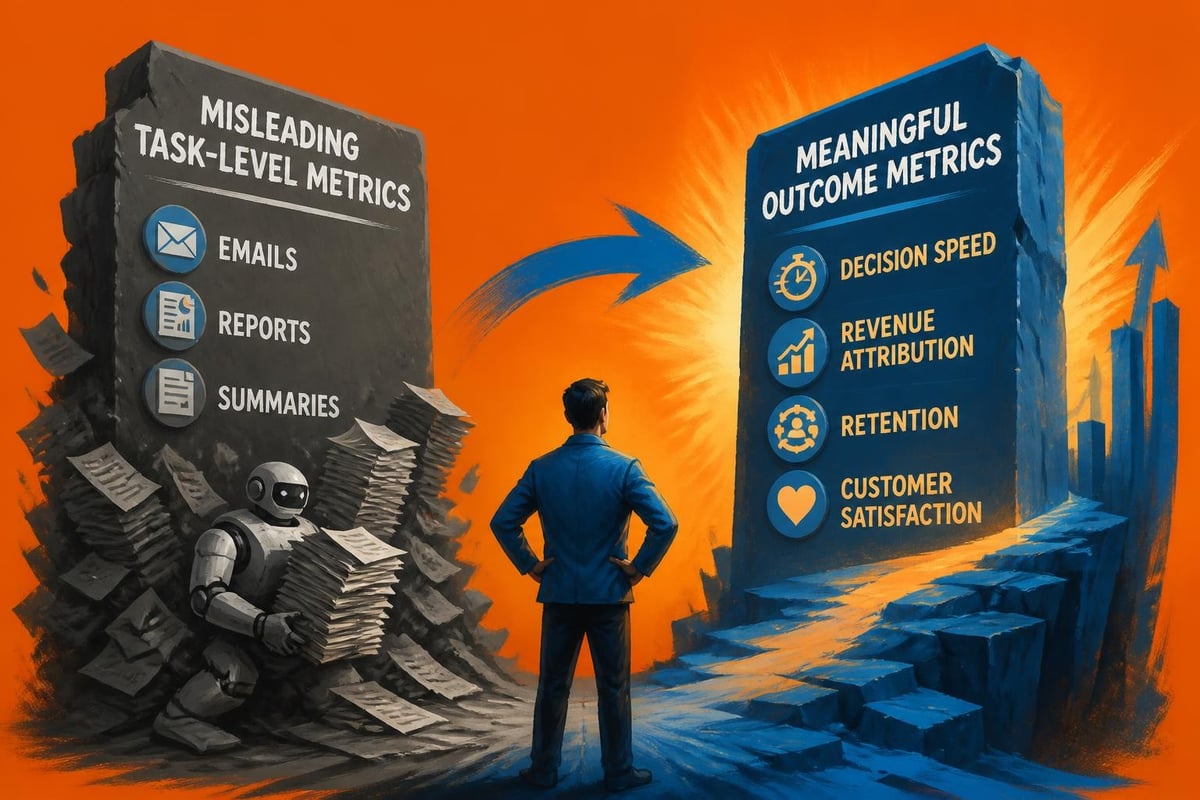
Every AI coaching vendor we evaluated in 2026 sold completion metrics, engagement scores, and sentiment analysis. None tied their platform to business KPIs that mattered to our clients: revenue per employee, manager retention, time to decision, or net promoter scores from direct reports.

This isn't a minor gap. It's the core distinction between coaching that delivers measurable results and tools that generate reports without changing behavior.

What AI coaching platforms typically measure:

  • Sessions completed per user
  • Average session duration
  • User satisfaction ratings
  • Module completion percentages
  • Engagement frequency

What corporate buyers actually need to measure:

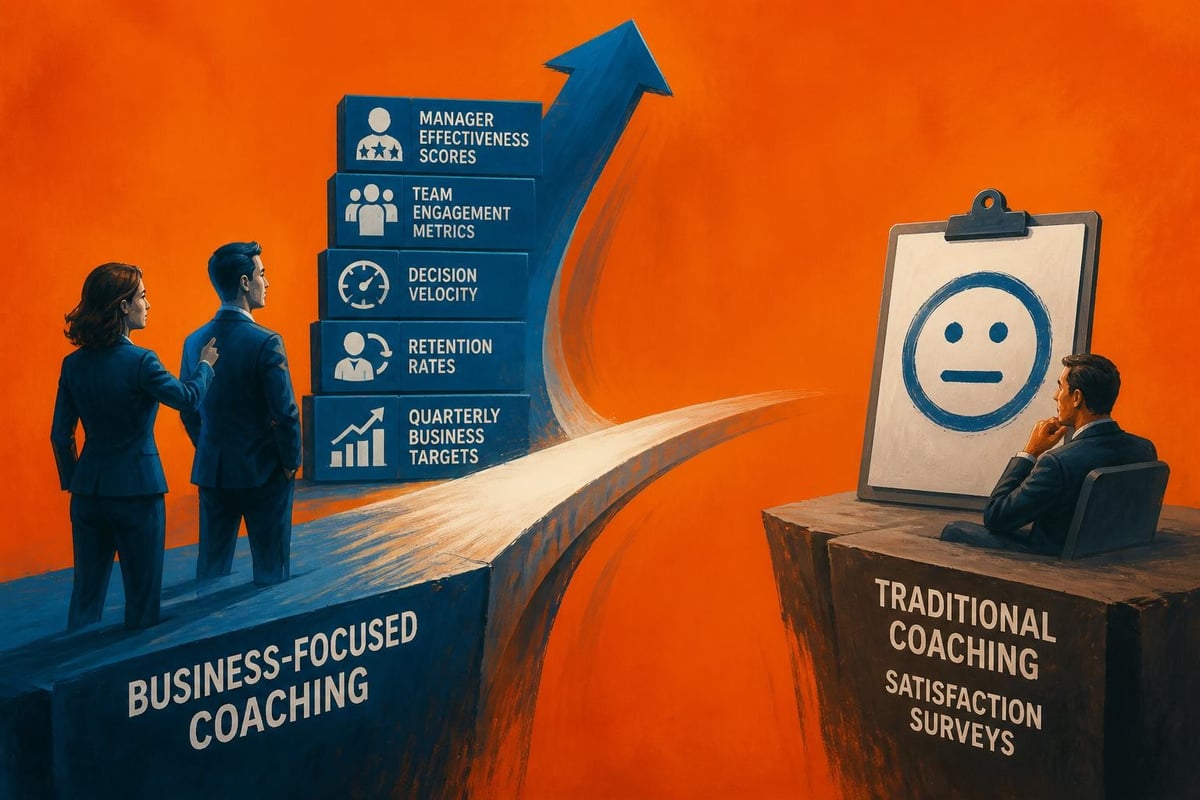
  • Manager effectiveness scores (360 assessments)
  • Team performance against KPIs
  • Retention rates for high performers
  • Decision velocity improvements
  • Cross-functional collaboration quality

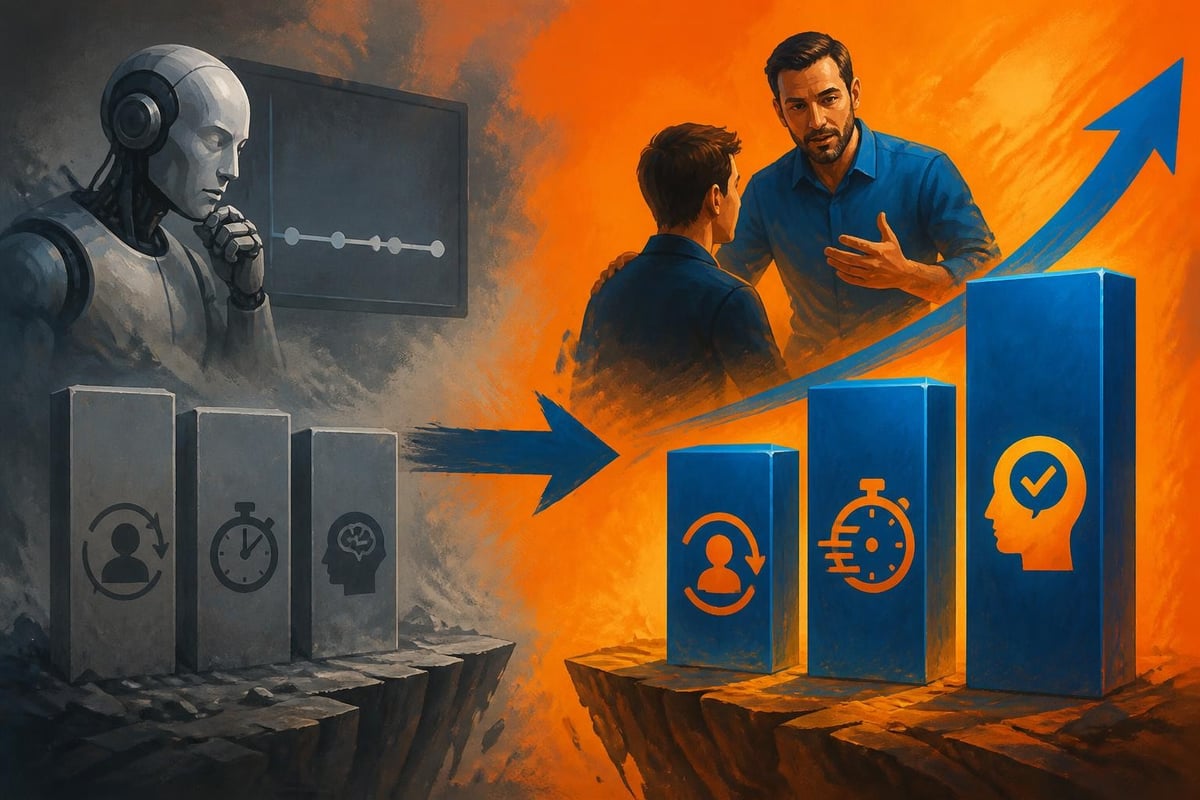
We implemented a hybrid model with one client: AI tools for self-paced learning and framework exploration, human coaches for live observation, KPI scorecards, and accountability loops tied to quarterly business reviews. Results improved within 90 days because we measured what mattered and coached where humans add unique value.

Regulatory Reality: The Frameworks Companies Ignore

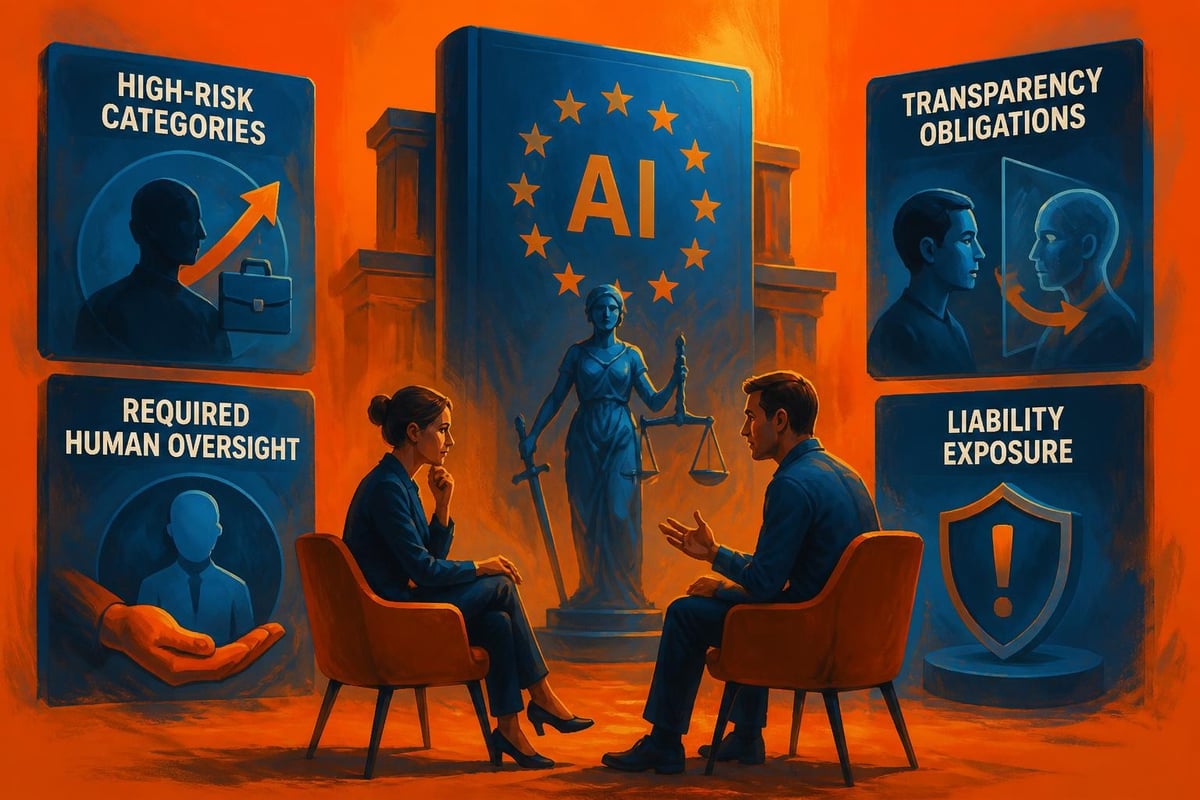
Most companies deploying AI coaching tools in 2026 haven't reviewed NIST’s AI Risk Management Framework or considered whether their use case might fall under emerging regulations. If you're coaching managers on performance conversations that affect promotions, terminations, or compensation, you're potentially in high-risk territory.

The European Commission’s AI Act guidance classifies some HR and employment systems as high-risk AI. UNESCO’s ethics recommendation emphasizes transparency, accountability, and human oversight-principles often missing from vendor implementations we've audited.

This isn't legal advice. It's pattern recognition from watching companies wake up to compliance questions after deployment instead of before.

What Actually Works: The Hybrid Model

After testing AI coaching tools across twelve engagements between 2024 and 2026, we've identified where AI adds value and where human expertise remains essential.

Coaching Function AI Strength Human Necessity Our Approach
Framework education High (scalable, consistent) Low AI delivers content
Preparation support High (templates, checklists) Medium AI assists, coach reviews
Live skill practice None Critical Human coaches only
Behavioral diagnosis Weak (pattern matching) Critical Human observation in context
Accountability loops Medium (reminders, tracking) High (judgment calls) Hybrid with human final say
ROI measurement Medium (dashboards) High (tying to business KPIs) Human-designed scorecards

The companies seeing results use AI for logistics, content delivery, and preparation. They reserve human coaches for diagnosis, live skill development, and tying coaching outcomes to business performance.

The Trust Problem Nobody's Solving

I learned the hard way about ai coaching when a senior director told us she stopped using her company's AI tool because she didn't trust where her input was going or whether it would surface in her performance review. She wasn't wrong to worry.

Most AI coaching platforms collect detailed behavioral data, conversation histories, and self-reported challenges. Vendors claim privacy protections, but employment relationships create power dynamics that pure technology can't navigate. Managers worry: Is this confidential? Will my struggles with delegation show up in succession planning discussions? Can I be honest about conflict with my own boss?

Trust killers in AI coaching deployments:

  • Unclear data governance and retention policies
  • No separation between coaching data and performance management systems
  • Vendor access without transparent audit trails
  • Algorithmic recommendations that feel like surveillance
  • Lack of human oversight or recourse when AI advice feels wrong

Human coaches build trust through confidentiality agreements, professional ethics, and the lived experience of navigating organizational politics without burning clients. AI tools can't replicate that judgment, and companies that ignore the trust gap see adoption rates crater after the initial novelty period.

FAQ

What are the biggest risks of using AI coaching tools in corporate settings?

The primary risks include privacy violations when managers disclose sensitive information, compliance gaps under emerging AI regulations, dependence on generic advice that ignores organizational context, and measurement systems that track activity instead of business outcomes. Companies also face trust erosion when employees fear their coaching data might influence performance reviews or career progression.

Can AI coaching tools replace human executive coaches?

No. AI tools excel at delivering frameworks, templates, and preparation support, but they cannot diagnose complex behavioral issues, observe live team dynamics, provide contextual judgment, or tie coaching outcomes to specific business KPIs. The most effective approach uses AI for scalable content delivery and human coaches for diagnosis, skill development, and accountability.

How do I evaluate whether an AI coaching vendor is credible?

Ask for evidence of business outcome improvements (not just engagement metrics), request transparent data governance policies, verify whether the tool complies with frameworks like NIST AI RMF or relevant employment regulations, and test whether the vendor can explain how their AI handles edge cases like crisis disclosures or mental health issues. Avoid vendors who can't articulate clear limitations.

What's the difference between AI coaching tools and human coaching outcomes?

AI tools measure sessions completed, satisfaction scores, and engagement frequency. Human coaching tied to business results measures manager effectiveness through 360 assessments, team performance against KPIs, retention improvements, decision velocity, and observable behavior changes in live work settings. The gap is between activity tracking and outcome delivery.

Should my company use AI coaching for manager development?

Use AI for scalable education, framework delivery, and preparation support. Do not use AI as the primary intervention for managers struggling with performance issues, team dysfunction, or leadership transitions. Those scenarios require human diagnosis, live observation, and coaching that ties directly to your operating cadence and business priorities.

What compliance issues should I consider before deploying AI coaching?

Review data retention and privacy policies, assess whether your use case might qualify as high-risk AI under emerging regulations, ensure separation between coaching data and performance management systems, verify vendor compliance with employment laws in your jurisdictions, and consult legal counsel if coaching involves health, mental wellness, or performance decisions.

How long does it take to see results from AI coaching versus human coaching?

AI tools can deliver knowledge transfer quickly (weeks), but behavior change and business impact typically require 90 to 180 days of consistent human coaching with accountability loops, live practice, and KPI tracking. Companies measuring only AI engagement scores within 30 days are tracking the wrong metrics.

What should I measure to know if coaching is working?

Focus on business outcomes: manager retention rates, team performance against quarterly KPIs, 360 assessment improvements, decision-making speed, cross-functional collaboration quality, and engagement scores from direct reports. Avoid vanity metrics like session completion rates or user satisfaction unless tied to observable performance changes.

Can I use AI coaching tools for leadership development programs?

AI tools work well for pre-work, framework education, and resource libraries within leadership programs. They fail as standalone solutions because leadership development requires live skill practice, peer feedback, situational judgment under pressure, and coaching that connects individual growth to organizational strategy-functions that demand human expertise.

Hybrid coaching model


AI coaching tools have a role, but only when companies understand their limits and design implementations around proven development principles. The hard lessons from 2026 show that technology without human judgment, context awareness, and outcome accountability wastes budgets and manager trust. If you need executive coaching and leadership development that ties directly to business KPIs, Noomii Corporate Coaching works month-to-month with mid-market teams to deliver measurable results through live coaching, team facilitation, and scorecards that prove ROI.

Corporate Coaching for CPG Brands: What Actually Works

Consumer packaged goods brands operate in one of the most unforgiving business environments in commerce. SKU proliferation, retailer consolidation, shrinking shelf space, direct-to-consumer disruption, and algorithmic merchandising have compressed decision cycles and elevated the cost of leadership mistakes. Yet most corporate coaching for consumer packaged goods brands still treats CPG executives like generic enterprise leaders, missing the sector's unique pressures entirely. The gap between what coaching providers promise and what CPG organizations actually need is widening, and the consequences show up in missed revenue targets, failed launches, and leadership churn at critical moments.

Why Generic Executive Coaching Fails CPG Leaders

Corporate coaching for consumer packaged goods brands must address a reality most providers don't understand: CPG leadership isn't about managing complexity, it's about executing at velocity while complexity compounds. The executive who can navigate a matrix organization, satisfy private equity timelines, renegotiate retailer terms, and launch innovation into a saturated category operates in a fundamentally different environment than a SaaS VP or healthcare administrator.

The problem starts with diagnosis. Standard leadership assessments measure collaboration, strategic thinking, and communication but ignore the competencies that separate effective CPG leaders from failing ones. Can the executive read syndicated data and translate share shifts into actionable category strategy? Do they understand trade spend efficiency, not just conceptually but in practice? Can they make a launch decision with incomplete information on a compressed timeline? These capabilities don't appear on generic 360 reviews.

CPG leadership competencies

According to Deloitte’s 2024 consumer products industry outlook, capability gaps in leadership and talent development rank among the top barriers to executing growth agendas in CPG. The report highlights that many organizations recognize they need stronger leaders but lack structured interventions to build the specific skills their business models demand. Generic coaching programs don't close these gaps because they weren't designed with CPG's operational cadence in mind.

The Execution Gap Most Coaches Miss

In a recent engagement with a mid-sized food and beverage company, leadership coaching was introduced to address "poor cross-functional collaboration" between brand, sales, and supply chain. The diagnosis was accurate but incomplete. The real issue wasn't collaboration skills but conflicting performance metrics and decision rights that coaching alone couldn't resolve. Brand wanted innovation velocity, sales needed margin protection, and supply chain required production stability. No amount of communication workshops fixed the underlying misalignment.

Effective corporate coaching for consumer packaged goods brands must diagnose these structural tensions first, then develop leaders who can navigate them. That requires coaches with CPG operating experience, not just executive presence credentials. It also requires interventions that address:

  • Retailer dynamics and power asymmetry in negotiations and joint business planning
  • Promotional effectiveness and the leadership judgment required to shift spending without tanking velocity
  • Speed-to-market pressures that compress strategic planning into 90-day cycles
  • Omnichannel execution across traditional retail, e-commerce, quick commerce, and direct channels

The best coaching outcomes in CPG don't come from teaching communication frameworks. They come from pattern recognition, decision-making under ambiguity, and building the judgment to make trade-offs between conflicting priorities in real time.

What Effective CPG Coaching Actually Addresses

The most successful corporate coaching for consumer packaged goods brands we've observed shares a common characteristic: it treats leadership development as a performance intervention, not a personal growth exercise. This distinction matters because it changes what gets measured, how coaches are selected, and what outcomes justify the investment.

Matching Coaches to CPG Context

CPG organizations waste resources when they match executives with generalist coaches who lack sector fluency. A coach who has never managed a category review, navigated a retailer reset, or launched into a dominated shelf set can't provide the contextual guidance that accelerates development. This isn't about credentialism but about recognizing that coaching impact increases when the coach understands the business pressures the leader faces daily.

Coaching Focus Generic Approach CPG-Specific Approach
Strategic Planning Annual framework development 90-day cycle adaptation and rapid reprioritization
Stakeholder Management Influence without authority Retailer negotiation and buyer relationship strategy
Decision-Making Consensus building and buy-in Speed and conviction under incomplete data
Innovation Leadership Ideation and creativity workshops Launch timing, trade-offs, and failure management
Team Development Engagement and retention Cross-functional execution in matrixed structures

The precision matching of coaches to CPG-specific challenges directly impacts program ROI. Leaders don't need another session on emotional intelligence. They need coaching on how to make a go/no-go decision on a line extension when consumer testing is directional but not definitive, when production requires a six-week lead time, and when the retailer meeting is in three days. That's the judgment gap most coaching programs ignore.

CPG coaching intervention model

Building Leaders Who Can Execute Through Retailers

The retailer-supplier power dynamic in CPG creates leadership challenges that don't exist in most industries. Executives must simultaneously partner with and compete against the retailers who control their market access. This requires a specific type of commercial judgment and relationship capability that standard coaching rarely addresses.

One beverage company brought in corporate coaching for consumer packaged goods brands after three consecutive failed category reviews with a major retailer. The initial assumption was that the sales leadership lacked presentation skills or strategic thinking. The real issue was different: the team couldn't translate syndicated data into a retailer-relevant growth story because they optimized for brand performance, not total category growth. The coaching intervention focused on reframing strategic narratives and building the analytical capability to identify white-space opportunities that served both parties.

The results were measurable: the next category review resulted in expanded distribution for two SKUs and a 12% increase in allocated shelf space. More importantly, the leadership team developed a repeatable capability they applied across other retailer relationships. This is what effective corporate coaching for consumer packaged goods brands delivers-capability that compounds across multiple business contexts.

The Role of Coaching in CPG Transformation Initiatives

Consumer packaged goods brands are redesigning operating models to compete in omnichannel commerce, as outlined in EY’s analysis of how CPG companies can create operating models that reignite growth. These transformations require new capabilities, different decision rights, and leadership behaviors that traditional training doesn't build quickly enough. Coaching becomes the intervention that accelerates adoption and sustains behavior change through organizational redesign.

The challenge isn't just skills development but changing how leaders process information and make decisions. Consider the shift from managing traditional retail to executing omnichannel strategies. Leaders must now integrate:

  • Real-time e-commerce performance data alongside slower-moving syndicated scan data
  • Direct-to-consumer insights that sometimes contradict retailer feedback
  • Quick commerce execution requiring supply chain agility most CPG brands weren't built for
  • Digital shelf optimization that demands different capabilities than physical merchandising

These shifts overwhelm many CPG executives because they require simultaneous mastery of multiple business models. Generic change-management training teaches the theory of adaptation; coaching builds the capability to execute through the transition. Prosci’s change management case studies from manufacturing and consumer goods contexts demonstrate that sustained behavior change requires targeted support, not just communication and training.

Addressing the Leadership Deficit in Digital Commerce

According to NielsenIQ’s Consumer Outlook guide to 2026, e-commerce, sustainability, and omnichannel execution will continue reshaping CPG competitive dynamics. Yet most CPG executives built their careers in traditional retail and lack direct experience in digital-first commerce. This creates a leadership gap that coaching must close faster than traditional development approaches allow.

One frozen food manufacturer faced this exact challenge when a private equity owner mandated aggressive e-commerce growth. The VP of Sales had 20 years of retail experience but had never managed a direct-to-consumer P&L or optimized for algorithmic visibility. The coaching program focused on three areas:

  1. Building digital commerce fluency through exposure to e-commerce operators and tactical immersion in platform economics
  2. Developing talent strategies to hire and integrate digital-native leaders without alienating the traditional sales organization
  3. Creating decision frameworks for allocating trade spend between traditional retail support and digital shelf optimization

Within six months, the leader had built a credible e-commerce strategy, hired two experienced digital operators, and reallocated 15% of trade spend to support online growth. The investment in targeted coaching delivered faster capability development than hiring a replacement executive would have.

Coaching ROI in CPG: What Actually Gets Measured

Most organizations struggle to quantify coaching ROI because they measure the wrong outcomes. Engagement scores and self-reported confidence gains don't justify executive coaching investments to CFOs or private equity owners. Corporate coaching for consumer packaged goods brands must demonstrate impact through business metrics that matter to P&L owners.

The clearest ROI comes from interventions that address specific performance gaps with measurable consequences:

  • Failed launches or extensions due to poor cross-functional execution
  • Lost distribution or shelf space from ineffective retailer relationship management
  • Margin erosion caused by promotional spending without velocity discipline
  • Leadership turnover in critical commercial or supply chain roles
  • Delayed transformation initiatives that miss market windows

When coaching targets these issues directly, ROI calculation becomes straightforward. The cost of a failed launch typically exceeds the investment in coaching the cross-functional team by 10x or more. The impact of retaining a critical VP through targeted development support versus a six-month search and ramp period is easily quantified.

Building Internal Capability Versus Buying External Expertise

Many CPG organizations face a decision: invest in developing existing leaders through corporate coaching for consumer packaged goods brands or hire external talent with the required experience. The answer depends on time horizon and organizational culture, but coaching often delivers better long-term value when the fundamentals are sound.

A personal care company compared the cost of executive coaching investments against the fully loaded cost of external hires for three VP-level roles requiring omnichannel expertise. The analysis revealed that coaching existing leaders cost 40% less and retained institutional knowledge, customer relationships, and cultural fit that external hires would take 18 months to build. The trade-off was speed: external hires could execute immediately while coached internal leaders required 4-6 months to develop comparable capability.

The company chose a hybrid approach: hired one external VP to lead the transformation and invested in coaching three internal VPs to accelerate their development. This balanced immediate execution needs with long-term capability building and cost efficiency.

CPG coaching ROI framework

How CPG HR Leaders Should Evaluate Coaching Providers

Most corporate coaching for consumer packaged goods brands fails at the procurement stage because HR leaders select providers using criteria that don't predict CPG success. Credentials, testimonials, and methodology decks matter less than sector experience and diagnostic precision. Harvard Business Review’s analysis of what it takes to become an effective executive coach emphasizes that coach competency and contextual expertise drive impact more than certification pedigree.

When evaluating coaching providers for CPG contexts, focus on these questions:

Does the provider demonstrate CPG operating experience? Generic executive coaches can't provide the pattern recognition and contextual guidance that CPG leaders need. Look for providers who can discuss category dynamics, retailer strategies, and trade-offs specific to your subsector.

How does the provider diagnose leadership gaps? Standard assessments miss competencies that matter in CPG. Effective providers use diagnostic tools that measure commercial judgment, execution velocity, and decision-making under ambiguity, not just behavioral preferences.

What evidence exists of CPG-specific outcomes? Case studies and references should demonstrate measurable business impact in CPG contexts. Improved launch success rates, expanded distribution, better trade spend efficiency, or reduced leadership turnover in commercial roles provide clearer proof than satisfaction surveys.

How does the matching process work? Precision coach matching that considers sector experience, functional expertise, and leadership challenge specificity drives better outcomes than random assignment or availability-based matching.

What measurement framework guides the engagement? Effective providers define success metrics upfront and track progress against business outcomes, not just coaching activity completion.

The Talent Strategy Connection

According to PwC’s workforce research on hopes and fears, employees and managers increasingly expect coaching and development support as part of the employment value proposition. In competitive CPG talent markets, the availability of high-quality leadership coaching influences retention and attraction, particularly for high-potential leaders evaluating opportunities.

This shifts the ROI calculation. Coaching isn't just a performance intervention; it's a talent strategy component that signals investment in leader development. Several CPG organizations now include access to executive coaching in VP-level offer packages as a retention and attraction tool. The cost of coaching becomes trivial compared to the risk of losing critical commercial or innovation leaders to competitors.

FAQ: Corporate Coaching for Consumer Packaged Goods Brands

What makes corporate coaching for CPG different from general executive coaching?

CPG coaching must address sector-specific pressures including retailer power dynamics, syndicated data interpretation, trade spend optimization, launch velocity, and omnichannel execution. Generic executive coaching focuses on universal leadership skills but misses the commercial judgment and execution capabilities that separate effective CPG leaders from failing ones. The best CPG coaching combines leadership development with operational context and business model fluency.

How long does effective CPG leadership coaching typically take?

Targeted interventions addressing specific performance gaps (failed launches, retailer relationship issues, cross-functional execution problems) often show measurable progress in 3-4 months. Broader capability development for executives transitioning to larger roles or new business models typically requires 6-9 months. The timeline depends on the complexity of the leadership challenge, the executive's starting capability, and the intensity of coaching engagement. Monthly sessions rarely build capability fast enough for CPG's velocity; bi-weekly or weekly engagement delivers better results.

Should CPG companies build internal coaching capability or use external providers?

Most CPG organizations benefit from external providers for executive and VP-level coaching because internal coaches rarely have the sector expertise, seniority, and organizational distance required for effective interventions at that level. Internal capability works well for frontline and mid-level leader development where scale matters and challenges are more standardized. The optimal approach uses external providers for senior strategic coaching and builds internal capability for broader population development.

What ROI should CPG companies expect from leadership coaching investments?

ROI varies by intervention type, but measurable outcomes include reduced leadership turnover (typically 60-80% retention improvement for at-risk executives), improved launch success rates (15-25% improvement in cross-functional execution), expanded distribution (measurable shelf space or authorization gains), and faster transformation adoption (30-40% acceleration in capability development versus training alone). The clearest ROI comes from coaching that prevents expensive failures or accelerates time-to-competency in critical roles.

How do you match coaches to CPG-specific leadership challenges?

Effective matching requires understanding both the business context (category dynamics, retailer relationships, organizational complexity) and the individual leadership gap (commercial judgment, execution velocity, strategic capability). The best providers use structured diagnostics to identify specific competency gaps, then match coaches based on relevant CPG operating experience, functional expertise, and demonstrated outcomes in similar contexts. Generic matching based on availability or surface-level fit rarely delivers optimal results in CPG environments.


Corporate coaching for consumer packaged goods brands succeeds when it treats leadership development as a performance intervention grounded in sector realities, not a generic growth exercise. The organizations that get this right see measurable improvements in launch execution, retailer relationships, and commercial leadership capability that directly impact P&L performance. Noomii Leadership Coaching delivers precision-matched coaching solutions designed for CPG's unique pressures, combining sector-experienced coaches with evidence-based diagnostics and measurable business outcomes that justify the investment.

Clients Do Not Care About Your Certification

The coaching industry has convinced itself that certifications unlock client trust, command higher fees, and separate professionals from pretenders. Meanwhile, corporate buyers quietly skip past credential lists and ask one question: what results can you deliver? This gap between what coaches believe matters and what clients actually evaluate costs practitioners opportunities every day. Understanding this disconnect changes how you position yourself, what you emphasize in conversations, and where you invest your professional development dollars.

Why Certification Worship Misleads Coaches

The industry ecosystem profits from certification dependency. Training organizations, credentialing bodies, and coaching schools generate revenue by convincing aspiring coaches that the right letters after their name unlock client demand. The reality contradicts this narrative.

Three reasons certifications fail to persuade clients:

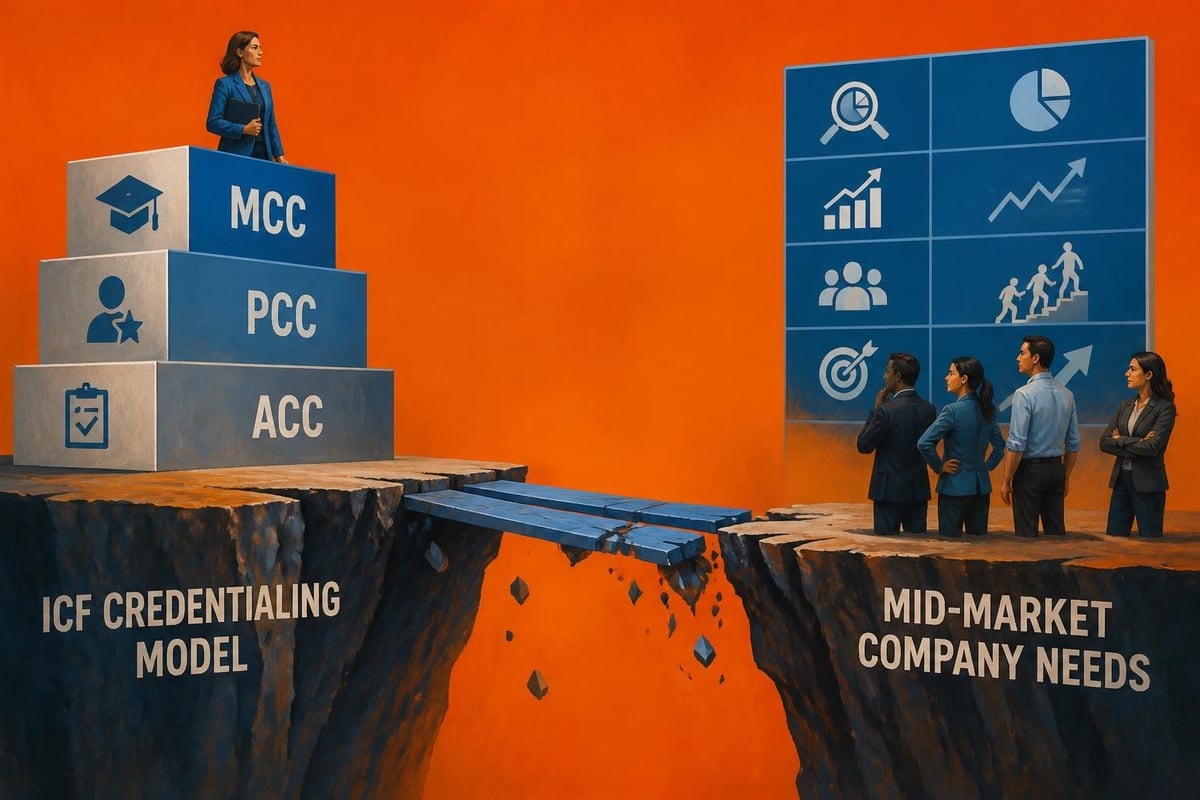
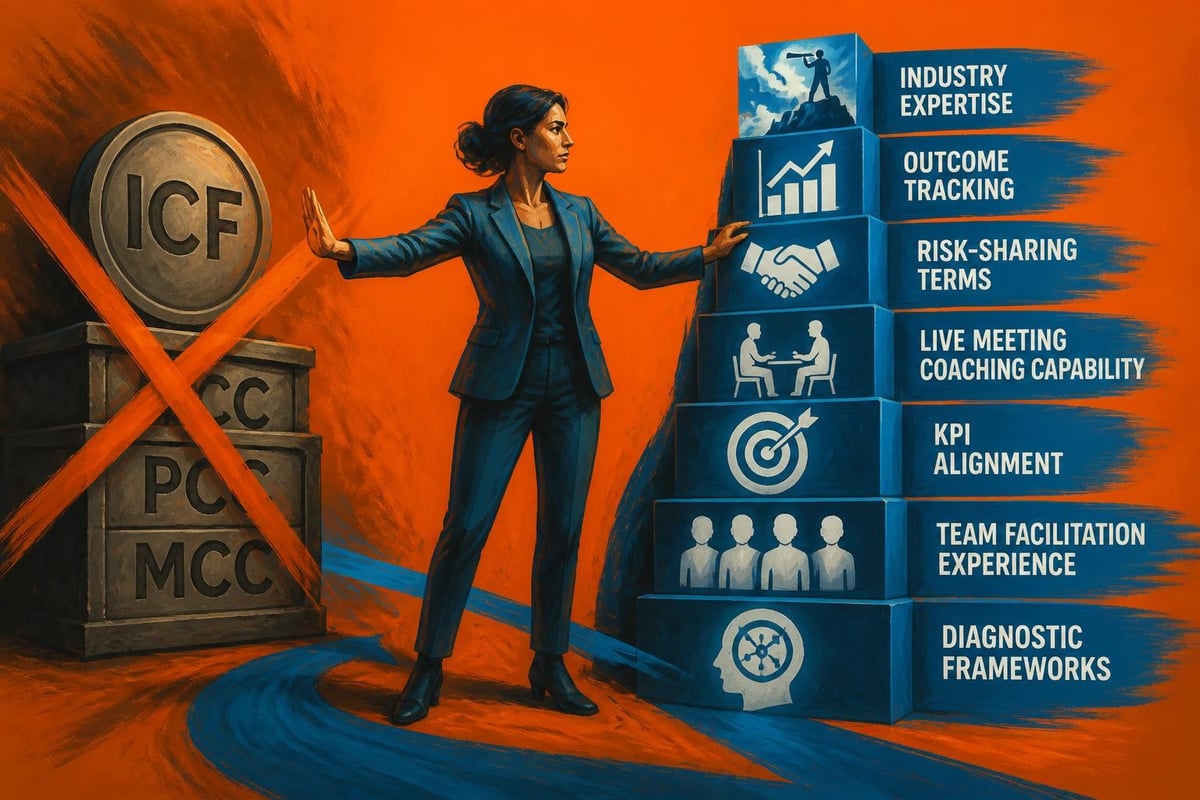
  • Clients cannot distinguish between ICF, EMCC, IAC, or proprietary certifications
  • Certification standards measure training completion, not coaching effectiveness
  • Most corporate buyers lack coaching literacy to evaluate credential quality

When mid-market companies evaluate executive coaching providers, they focus on industry experience, relevant case studies, and outcome tracking. A 2025 analysis by the U.S. Chamber of Commerce found that employers prioritize skills and experience over credentials when making hiring decisions, a pattern that mirrors how organizations select coaches.

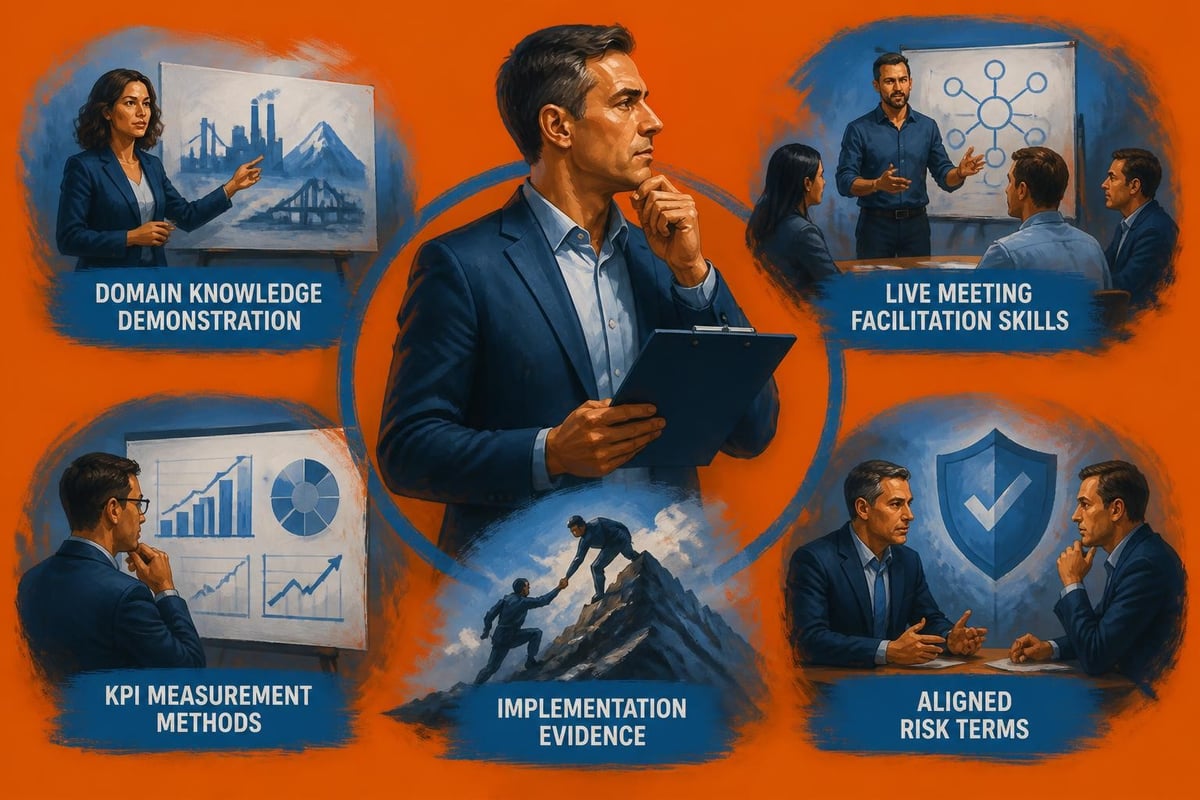
What corporate clients evaluate when hiring coaches

The Evidence Against Credential Dependency

Research on consumer decision-making reveals that clients do not care about your certification as much as coaches assume. Harvard Business Review research demonstrates that consumers find specific outcome descriptions and verified results more persuasive than badges or credentials. Similarly, Bazaarvoice trust signals research shows that reviews from verified users outweigh symbolic credentials when buyers evaluate service providers.

The pattern extends across professional services. Clients struggle to assess technical qualifications, so they use proxies: clarity of process, relevance of past work, and confidence in communication. A certification proves you completed training. It says nothing about whether you can diagnose team dysfunction, facilitate difficult conversations, or tie leadership development to revenue retention.

What Corporate Buyers Actually Evaluate

We've observed hundreds of coaching selection processes across Fortune 500 divisions and mid-market companies. The decision criteria consistently prioritize five factors over credentials.

Evaluation Factor What Clients Ask Why It Matters
Relevant Experience Have you coached teams in our industry? Industry context affects diagnosis quality
Outcome Clarity What results did past clients achieve? Specificity builds confidence
Process Transparency How do you measure progress? Reduces perceived risk
Cultural Fit Do you understand our operating model? Affects implementation success
Commercial Flexibility Can we start without long commitments? Aligns with budget cycles and risk tolerance

Notice what's absent: certification type, training hours, or credentialing body. NielsenIQ research on transparency confirms that consumers increasingly demand clear information about what they're buying over symbolic credentials. Clients do not care about your certification when they cannot connect it to business outcomes they need.

The Case Study Test

Here's a diagnostic we use when coaches ask about certification ROI. Present two scenarios to a prospective client:

Coach A: ICF Master Certified Coach, 3,000+ hours, neuroscience-based methodology, featured speaker at coaching conferences.

Coach B: Fifteen years leading sales teams at SaaS companies, coached 40+ managers through scaling challenges, average client retention improvement of 23%, works month-to-month with KPI scorecards.

Which coach do mid-market SaaS companies select? Coach B wins 80% of the time because the description immediately answers "can you solve my problem?" The certification tells clients what training you received. The case study tells them what problems you solve.

How coaching buyers make decisions

Building Credibility Without Credential Worship

If clients do not care about your certification, what builds trust instead? The answer lies in demonstration, not declaration.

Five credibility builders that outperform certifications:

  1. Specific case outcomes with problem-solution-result structure
  2. Clear methodologies clients can visualize and understand
  3. Transparent measurement tied to business KPIs they already track
  4. Flexible engagement models that reduce perceived risk
  5. Industry fluency demonstrated through relevant examples

Consider how Noomii approaches corporate coaching. Instead of leading with credentials, the focus lands on measurable outcomes: faster decisions, managers who coach, stronger communication, higher engagement and retention, cleaner execution across priorities. The value proposition connects directly to problems executives face, using language they use internally.

The AI Coaching Disruption Context

In 2026, the certification argument faces another challenge: AI coaching tools that deliver structured guidance without credentials. When clients can access AI-powered leadership development, executive coaching platforms, or automated feedback systems, the certification credential carries even less weight. What differentiates human coaches isn't training completion but contextual judgment, relationship navigation, and real-time adaptation that AI cannot replicate.

This shift forces coaches to articulate value in outcome terms. The question moves from "what credentials do you hold?" to "what can you do that AI coaching tools cannot?" The answer involves live facilitation in complex meetings, diagnosis of cultural dysfunction, navigation of political dynamics, and accountability structures tied to business metrics.

How to Position Expertise Without Leaning on Certifications

The practical question becomes: if clients do not care about your certification, how do you communicate expertise? The framework involves three positioning elements.

Element one: Lead with relevant experience framed as solved problems. "I've coached 30+ engineering managers through first-time leadership transitions at Series B SaaS companies" outperforms "I'm an ICF PCC with 500+ coaching hours."

Element two: Describe your process using clear, jargon-free steps. Clients trust what they understand. When you explain how you diagnose team dynamics, establish KPIs, facilitate alignment meetings, and track progress, you build confidence through transparency.

Element three: Offer commercial terms that reduce risk. Month-to-month engagements, aligned incentives, or pilot projects demonstrate confidence in your outcomes. Long contracts combined with credential emphasis signal the opposite: you believe your certification should convince them, rather than letting results speak.

Research on how hiring managers evaluate credentials versus experience reinforces this approach. Employers increasingly value demonstrated skills and relevant experience over formal credentials when the work involves complex judgment and relationship-dependent outcomes.

Positioning coaching expertise effectively

Common Positioning Mistakes

Even experienced coaches fall into credential traps. Watch for these patterns:

  • Opening conversations with certification details before understanding client problems
  • Assuming clients know what ICF PCC, ACC, or MCC designations mean
  • Listing training programs instead of describing coaching methodologies
  • Using coaching industry jargon that corporate buyers don't recognize
  • Emphasizing hours coached rather than outcomes achieved

The Pearson VUE Value of Certification report offers useful context: certifications matter most in regulated industries, technical fields with objective standards, and contexts where credential literacy exists among evaluators. Corporate coaching rarely meets these criteria, which explains why clients do not care about your certification the way coaches expect.

The ROI Reality Check

Here's the uncomfortable truth: certification investment rarely produces proportional client demand or fee increases. We've tracked coaches who invested $15,000+ and two years pursuing advanced credentials, expecting market differentiation. The result? Minimal impact on close rates or pricing power.

What does move the needle:

  • Building case studies with quantified outcomes
  • Developing proprietary frameworks clients can understand
  • Creating measurement systems that track business KPIs
  • Establishing industry-specific expertise and networks
  • Demonstrating commercial flexibility and risk-sharing

When you examine what drives executive coaching costs, credentials appear as minor factors compared to coach experience, engagement scope, and outcome accountability. Clients pay for results, not for how you were trained to deliver them. Understanding the ROI of coaching requires connecting interventions to business metrics clients already track.

FAQ

Do certifications matter at all for coaches?

Certifications provide training structure and community connections, which benefit new coaches developing foundational skills. However, clients do not care about your certification when selecting providers because they cannot evaluate credential quality and focus instead on relevant experience and outcome clarity. Certifications matter more for your development than for client acquisition.

How do I prove expertise without credentials?

Build credibility through specific case studies showing problem-solution-result patterns, clear methodologies clients can visualize, transparent measurement tied to business KPIs, and commercial terms that reduce perceived risk. Demonstrate industry fluency through relevant examples rather than declaring credentials.

What if clients specifically ask about certifications?

Answer briefly and redirect to relevant experience: "Yes, I'm certified through [organization], and more importantly, I've worked with 20+ companies in your industry solving [specific problem]." The certification confirms baseline training; your experience answers whether you can help them.

Are some certifications more valuable than others?

Only when clients understand the distinctions, which rarely occurs outside the coaching industry. ICF, EMCC, and other credentials carry similar weight to most corporate buyers who lack coaching literacy. Industry-specific certifications in finance, healthcare, or technology may resonate more than general coaching credentials.

How should I list credentials on my website?

Place certifications in your bio or credentials section, not as lead positioning. Open with who you help and what outcomes you deliver. Credentials support your story but should never lead it when clients do not care about your certification as much as your results.

Do credentials help with corporate coaching contracts?

Rarely as deciding factors. Corporate buyers evaluate industry experience, outcome track records, cultural fit, and commercial flexibility more heavily than credentials. Some procurement processes include credential checkboxes, but these typically represent minimum qualifications rather than selection criteria.

Should I stop pursuing certifications entirely?

Not necessarily. Pursue certifications for skill development, methodology exposure, or professional community if they serve your growth. Just don't expect them to drive client demand or justify higher fees. Invest proportionally: if certification costs $10,000 and two years, ask whether that investment produces better ROI than building case studies, developing proprietary methods, or establishing industry specialization.

What builds trust faster than certifications?

Social proof from similar clients, specific outcome examples with numbers, transparent process descriptions, clear KPI tracking methods, and commercial flexibility that reduces buyer risk. Research shows that verified reviews and outcome specificity persuade buyers more effectively than symbolic credentials.

How do I compete against highly credentialed coaches?

Differentiate on relevant experience, outcome clarity, and commercial terms. When prospects compare a Master Certified Coach with generic experience against a less-credentialed coach with 15 years in their industry and specific case results, the latter often wins. Lead with problem-solving capability, not training completion. Position your approach as practical and results-focused rather than theory-driven. Month-to-month terms and aligned incentives often overcome credential gaps because they reduce buyer risk more effectively than letters after your name.


The pattern is clear: clients do not care about your certification nearly as much as the coaching industry suggests. They care about whether you understand their problems, can deliver measurable outcomes, and reduce their risk through transparent processes and flexible terms. Smart coaches invest in building relevant case studies, developing clear methodologies, and establishing industry expertise rather than chasing credential letters. If you want corporate coaching that delivers measurable business results tied to KPIs like engagement, retention, and execution quality, Noomii matches you with practical coaches who focus on outcomes over credentials, work month-to-month without long contracts, and coach live in your meetings to drive visible progress.

Corporate Coaching for Mining Operations in 2026

Mining operations face leadership challenges unlike any other industry. When a shift supervisor makes a poor call 800 meters underground, people die. When site leadership fails to address toxic behavior patterns, high performers leave for competitors. When executive teams miss early signals of operational drift, entire sites shut down. The stakes are existential, yet most mining companies still treat leadership development as a compliance checkbox rather than an operational imperative. Corporate coaching for mining operations addresses this gap by delivering targeted interventions that directly impact safety performance, retention, and operational continuity.

Why Mining Leadership Failures Create Operational Crises

The industry's leadership challenges stem from structural realities that generic corporate development programs ignore. Mining operations run 24/7 across dispersed locations with workforce demographics spanning five generations, multiple languages, and cultures ranging from fly-in-fly-out contractors to multi-generational local families. Site leaders manage crews who operate autonomous haul trucks, process plants with millisecond tolerances, and explosive materials under regulatory scrutiny.

Leadership failures cascade differently in mining than in other sectors.

A toxic mine manager doesn't just hurt engagement scores. They trigger safety incidents, regulatory investigations, and community relations crises. Deloitte’s Tracking the Trends 2025 report identifies the leadership capability gap as a central barrier to digital transformation and workforce retention across the mining sector.

Traditional corporate training programs fail because they don't account for:

  • Critical control management protocols that require instant decision-making under pressure
  • Multi-site coordination where leaders rarely see their direct reports face-to-face
  • Unionized workforce dynamics that complicate performance management
  • Commodity price volatility that creates constant budget uncertainty
  • Social license requirements where one leadership misstep can cost community approval

Mining leadership challenges

The Evidence Base for Targeted Coaching Interventions

Industry data reveals where coaching interventions deliver measurable impact. Research published in Mining, Metallurgy & Exploration examined safety culture initiatives across multiple mining organizations and found that structured leadership coaching programs reduced high-potential incident rates by 23-41% when focused on frontline supervisor decision-making under uncertainty.

The International Council on Mining and Metals guidance on critical control management explicitly links leadership capability, cultural factors, and frontline engagement to fatality prevention. Their framework identifies five leadership competencies that correlate with safety performance: situational awareness, risk perception calibration, crew communication clarity, authority gradient management, and post-incident learning agility.

Corporate coaching for mining operations works when it targets these specific competencies rather than generic emotional intelligence or strategic thinking. The best programs combine behavioral diagnostics with operational observation to identify exactly where a leader's decision-making breaks down under production pressure.

What Precision Coach Matching Actually Means in Mining Contexts

Most mining companies hire coaches based on credentials and availability. This approach fails because mining leadership challenges require sector-specific pattern recognition that general business coaches don't possess. A coach who excels at helping tech executives navigate board dynamics will struggle to diagnose why a mine superintendent can't retain millwrights or why safety stand-downs keep happening on night shift.

Effective coach matching for mining operations requires three filters:

  1. Operational experience or deep sector immersion so the coach understands production constraints, equipment limitations, and geological realities
  2. Regulatory and compliance fluency including workplace safety legislation, environmental permits, and Indigenous consultation requirements
  3. Psychological safety expertise to address the power dynamics that prevent frontline workers from speaking up about hazards

The Noomii approach applies these filters through validated assessment data rather than self-reported coaching preferences. We've observed that mining leaders consistently underestimate their blind spots around authority gradients and risk normalization. Understanding psychological safety frameworks becomes critical when coaching supervisors who manage teams where speaking truth to power can prevent fatalities.

Challenge Area Generic Coach Response Mining-Specific Coach Response
Production vs. safety conflict Work-life balance discussion Critical control decision tree analysis
Crew retention issues Employee engagement survey Roster pattern and compensation structure review
Cross-cultural team friction Diversity training recommendation Site-specific cultural dynamics and community relations alignment
Incident investigation participation Stress management techniques Human factors analysis and just culture principles

How Leading Mining Companies Structure Coaching Programs

Anglo American’s 2025 sustainability disclosure details their Living Leader program, which combines CliftonStrengths assessments with targeted coaching interventions for site and corporate leaders. Their approach includes quarterly coaching sessions, peer learning cohorts, and operational shadowing where coaches observe leaders in production meetings, safety walkarounds, and shift handovers.

Similarly, IAMGOLD’s 2024 Sustainability Report describes coaching programs integrated with mentorship frameworks and structured career conversations. They track coaching ROI through retention rates, internal promotion velocity, and safety performance metrics rather than participant satisfaction scores.

The pattern across successful programs involves:

  • Multi-rater feedback from supervisors, peers, and direct reports collected before coaching begins
  • Operational observation periods where coaches shadow leaders during actual work rather than relying only on interview data
  • Specific behavioral targets tied to measurable outcomes like incident rates, production variance, or turnover
  • Integration with existing systems including performance management, succession planning, and competency frameworks

Mining coaching program structure

The Cost-Benefit Reality of Executive Coaching in Mining

Mining companies question executive coaching costs until they calculate the expense of replacing a site general manager mid-construction or dealing with a work refusal that shuts down production. A typical senior mining executive coaching engagement runs $18,000-35,000 annually. A single safety incident investigation costs $200,000-500,000 in direct expenses before considering production delays, regulatory fines, or reputational damage.

The business case becomes clearer when organizations track leading indicators:

  • Reduction in high-potential incident rates within coached leaders' areas of responsibility
  • Improved employee engagement scores specifically for psychological safety and speak-up culture questions
  • Decreased turnover among critical technical roles and high-potential leaders
  • Faster incident investigation completion with higher-quality corrective action effectiveness
  • Stronger community relations outcomes measured through consultation effectiveness and social license metrics

Organizations that treat corporate coaching for mining operations as a strategic intervention rather than professional development perk see measurably different results. The difference lies in how they select participants, match coaches, set objectives, and measure outcomes.

Addressing the Skills Gap Through Structured Leadership Development

The Minerals Council of Australia’s workforce and skills resources highlight growing concerns about leadership pipeline strength as experienced mine managers retire and digital transformation accelerates. Professional development trends tracked by Edumine show increasing adoption of blended learning models that combine technical training with leadership coaching.

The skills gap manifests differently at each leadership level:

Frontline Supervisors

These leaders need coaching on transitioning from technical expert to team leader, managing former peers, applying progressive discipline fairly, and making rapid risk decisions under production pressure. Many receive promotions based on technical competence without any leadership preparation. Coaching interventions focus on situational leadership, crucial conversations, and risk perception calibration.

Site Department Managers

Middle management in mining operations struggles with resource allocation conflicts, cross-functional coordination, and managing up to site leadership while supporting frontline teams. Effective coaching addresses political navigation, strategic influence without formal authority, and resilience during commodity downturns or ownership changes.

Site General Managers and Mine Managers

Senior site leaders need coaching on stakeholder management complexity, balancing short-term production demands with long-term strategic investments, leading through major incidents, and managing their own stress and decision-making quality during crises. The best coaching programs include scenario planning, decision rehearsal, and executive presence development specific to mining contexts.

Corporate Mining Executives

C-suite leaders in mining companies face unique challenges around portfolio optimization, social license at scale, board governance during volatile commodity cycles, and leading digital transformation in traditionally conservative organizations. Corporate coaching for mining operations at this level focuses on strategic judgment, board effectiveness, and organizational culture change.

Mining leadership levels

What Effective Coaching Actually Changes in Mining Operations

The best evidence of coaching effectiveness comes from observable behavioral change and measurable operational impact. We've tracked coaching interventions across multiple mining clients and identified consistent patterns in what changes and what doesn't.

Behaviors that improve with targeted coaching:

  • Pre-job brief quality and crew engagement during safety conversations
  • Response time and decision quality during unplanned equipment failures
  • Conflict resolution effectiveness in multi-cultural team settings
  • Willingness to stop work when conditions change unexpectedly
  • Quality of incident investigations and corrective action implementation
  • Retention conversations and career development discussions with high performers

Behaviors resistant to coaching alone:

  • Deep technical skill gaps that require formal training
  • Personality disorders or clinical mental health conditions requiring professional treatment
  • Organizational culture problems that coaching one leader cannot overcome
  • Compensation structure issues driving retention problems
  • Inadequate systems, tools, or resources that prevent good execution

Organizations waste coaching resources when they expect individual development to solve systemic problems. Corporate coaching for mining operations delivers results when leadership gaps represent the actual constraint, not when coaching becomes a substitute for fixing broken processes, inadequate resources, or toxic organizational cultures.

Measuring What Matters in Mining Leadership Development

Traditional coaching programs measure participant satisfaction and self-reported behavior change. Mining operations require harder evidence. The measurement framework should track:

Metric Category Specific Indicators Data Source
Safety Performance High-potential incidents, safety observation participation, near-miss reporting rates Safety management system
Operational Excellence Production plan achievement, equipment availability, cost per ton Production reporting system
Workforce Stability Voluntary turnover, internal promotion rates, critical role time-to-fill HRIS and talent management system
Cultural Health Psychological safety scores, speak-up culture indicators, trust index Employee surveys and focus groups
Leadership Pipeline Succession plan strength, development plan completion, career conversation frequency Talent review and succession planning data

Organizations that connect coaching investments to these operational metrics make better decisions about program design, coach selection, and participant prioritization. The measurement discipline also builds executive sponsorship because mining leaders respect what they can quantify.

Contrarian Insight: Why Most Mining Leadership Programs Fail

The conventional wisdom says mining companies should develop comprehensive leadership competency models, cascade training programs across all levels, and create consistent global standards for leadership excellence. This approach consistently underperforms because it ignores how mining operations actually work.

Mining leadership operates in a high-context, relationship-based environment where formal authority matters less than operational credibility. A supervisor with 15 years underground experience commands more influence than a general manager with an MBA and no operational background, regardless of what the organization chart says. Leadership development programs that ignore these power dynamics waste resources on initiatives that crews dismiss as "head office nonsense."

The better approach targets specific leaders whose behavior change will shift team norms and operational outcomes. Instead of rolling out enterprise-wide programs, focus coaching resources on:

  • Site leaders at operations with deteriorating safety performance or production challenges
  • High-potential leaders being prepared for larger operational responsibility
  • New site general managers during their first 180 days in role
  • Technical specialists transitioning into people leadership roles
  • Leaders managing significant operational changes like automation implementation or mine life extensions

This targeted approach delivers measurably better ROI than broad-based programs because it concentrates resources where behavior change creates operational leverage. Corporate coaching for mining operations works best as precision intervention, not universal employee benefit.

Implementation Framework: Getting Coaching Right in Mining Contexts

Organizations that successfully implement coaching programs in mining operations follow a disciplined process:

  1. Diagnostic phase: Conduct multi-rater feedback, review incident data, analyze turnover patterns, and observe leaders in operational settings to identify specific behavioral gaps
  2. Coach selection: Match leaders with coaches who have mining sector experience, relevant technical backgrounds, and proven capability in the target development area
  3. Goal alignment: Set specific behavioral objectives tied to operational metrics, not generic leadership aspirations
  4. Integration planning: Connect coaching interventions to performance management, succession planning, and operational improvement initiatives
  5. Progress tracking: Monitor leading indicators monthly and adjust coaching focus based on operational feedback and data trends
  6. Outcome measurement: Evaluate coaching effectiveness through safety performance, retention metrics, and operational results, not satisfaction surveys

The implementation discipline matters more than program design elegance. Mining operations respect what works, not what sounds sophisticated. Noomii Leadership Coaching applies this implementation framework through evidence-based diagnostics and precision coach matching that accounts for industry-specific requirements.

Organizations should budget 6-12 months for meaningful behavior change and operational impact. Quick wins happen, but sustainable leadership transformation requires time for new behaviors to become habitual and team dynamics to shift.

Regulatory Compliance and Governance Considerations

Mining operations face increasing regulatory scrutiny around leadership capability and organizational culture. Workplace safety legislation in multiple jurisdictions now includes explicit requirements for leadership competence, safety culture management, and worker consultation effectiveness. Corporate coaching for mining operations helps organizations demonstrate due diligence and compliance with these evolving standards.

Key compliance intersections include:

  • Workplace health and safety acts requiring demonstrated leadership competence in risk management and critical control oversight
  • Environmental protection regulations where leadership decisions directly impact permit compliance and environmental performance
  • Indigenous consultation requirements where site leadership capability affects social license and regulatory approval
  • Modern slavery and human rights due diligence requiring ethical leadership throughout supply chains and contractor management
  • Corporate governance standards for board oversight of organizational culture and leadership effectiveness

Smart mining companies integrate coaching interventions with compliance management systems to create documentation trails showing systematic leadership development aligned with regulatory requirements. This approach transforms coaching from discretionary professional development into documented risk management.


Corporate coaching for mining operations delivers measurable impact when organizations treat it as operational intervention rather than professional development perk. The evidence shows that targeted coaching focused on safety leadership, crew dynamics, and operational decision-making reduces incidents, improves retention, and strengthens cultural health. Noomii Leadership Coaching helps mining companies implement precision coaching programs that align with operational priorities, regulatory requirements, and measurable business outcomes through evidence-based diagnostics and specialized coach matching.

AI Gave Answers But Not Results: Why Coaching Fails

Corporate leaders discovered a harsh truth in 2025 and 2026: AI gave answers but not results when it came to coaching their managers and teams. The technology could surface leadership frameworks, suggest communication scripts, and generate development plans in seconds. Yet engagement scores stagnated, turnover persisted, and quarterly goals kept slipping. The gap between information and transformation proved wider than anyone predicted. Unlike technical domains where correct answers drive immediate value, leadership development requires behavioral change, accountability loops, and someone willing to challenge executives in the moment decisions happen.

The Hallucination Problem Meets Leadership Reality

AI systems face a documented challenge called hallucination, where models generate confident but incorrect information. Google Research’s systematization of LLM hallucinations reveals how these failures occur across taxonomy categories. For coaching, the issue runs deeper than factual errors.

An AI might suggest a perfectly reasonable conflict-resolution framework. But it can't observe that your VP avoids difficult conversations, delivers feedback only in annual reviews, or undermines team psychological safety through passive-aggressive emails. The answer looks helpful. The result never materializes because diagnosis missed the actual problem.

Gap between AI coaching recommendations and real behavioral change

Information Abundance, Execution Poverty

Mid-market companies now swim in leadership content. AI tools generate onboarding plans, one-on-one templates, and performance frameworks on demand. Yet the world changes fast but people transform slowly, and no amount of information accelerates that transformation without structured accountability.

Why ai gave answers but not results in leadership contexts:

  • AI lacks real-time observation of meetings, decisions, and team dynamics
  • Recommendations ignore organizational politics, legacy conflicts, and unspoken norms
  • No follow-through mechanism ensures managers implement suggested changes
  • Generic advice doesn't account for specific business KPIs or strategic priorities
  • Behavioral change requires uncomfortable conversations AI can't facilitate

Leaders who relied on AI coaching platforms in 2025 reported initial enthusiasm followed by stagnation. The insights made intellectual sense. The behavioral shifts never happened because nobody held feet to the fire.

The Diagnosis Gap: Where AI Falls Short

Effective coaching begins with accurate diagnosis, not rapid answers. When a sales team misses targets three quarters running, AI might suggest revised compensation structures, additional training, or clearer goal-setting. All reasonable answers. None address the core issue if the real problem involves a VP who micromanages, kills deal creativity, and punishes risk-taking.

AI Coaching Approach Human Coach Approach Business Outcome
Generate feedback templates Observe actual feedback delivery, diagnose avoidance patterns Managers start giving timely, specific feedback
Suggest delegation frameworks Watch leader hoard decisions, identify trust issues Faster decisions, empowered team
Provide conflict scripts Sit in tense meetings, call out passive-aggressive behavior Cleaner communication, reduced drama
Recommend KPI dashboards Build scorecards tied to strategic priorities, coach usage weekly Accountability increases, execution improves

Companies seeking executive coaching that delivers measurable results need coaches who diagnose root causes, not systems that pattern-match symptoms to generic solutions.

The Verification Workflow Problem

Clinicians face similar challenges with LLMs, where hallucinated medical advice can cause serious harm. They've developed verification workflows: cross-reference multiple sources, validate against established protocols, confirm with experienced practitioners. Leadership development lacks comparable safeguards when AI provides coaching guidance.

A manager receives AI-generated advice to "empower the team through increased autonomy." Sounds great. But if that manager leads a group fresh out of school who need structure, clear expectations, and frequent check-ins, autonomy creates chaos. The answer was plausible. The result damages both performance and retention.

AI coaching verification gap

When Answers Actually Produce Results

Not all AI coaching applications fail. Specific, narrow use cases generate value when combined with human expertise and accountability structures.

Successful AI coaching applications observed in 2026:

  1. Pre-session preparation: AI summarizes 360 feedback, meeting transcripts, or performance data so coaches enter conversations informed
  2. Skill practice: Managers rehearse difficult conversations with AI, then debrief with human coaches on what worked
  3. Template generation: AI creates first-draft agendas, development plans, or presentation outlines that coaches customize
  4. Pattern recognition: AI flags communication trends across email and Slack that coaches investigate further
  5. Knowledge retrieval: Retrieval-augmented generation approaches ground answers in company-specific playbooks and past successful interventions

The pattern? AI gave answers but not results when used alone. When integrated as a tool supporting human coaches who observe, diagnose, challenge, and hold accountable, it accelerates specific workflow steps.

The Accountability Loop That AI Cannot Close

Leadership development requires three elements AI cannot provide: observation of actual behavior in context, real-time challenge when leaders avoid difficult actions, and sustained accountability until new habits form.

Consider manager training programs. AI can deliver content modules, quiz comprehension, even simulate coaching conversations. But it can't sit in your managers' one-on-ones, notice when they revert to telling instead of asking, and intervene in the moment with "You just gave her the answer. Try again and coach her to solve it herself."

The Mitigation Methods That Miss the Point

Research into hallucination mitigation techniques focuses on improving factual accuracy through better prompting, retrieval systems, model training, and evaluation frameworks. These advances help AI provide better answers.

They don't solve the coaching problem. Even perfectly accurate leadership advice fails without implementation, practice, feedback loops, and accountability. The issue isn't wrong answers. It's that correct answers alone don't change behavior in complex organizational systems with entrenched patterns, competing incentives, and human resistance to discomfort.

Understanding how much executive coaching actually costs reveals why some companies chase AI alternatives. Monthly retainers for experienced coaches feel expensive until you measure the cost of continued poor execution, manager turnover, and missed strategic goals.

Building Results-Driven Coaching Systems

Companies that got value from coaching in 2025 and 2026 built systems around outcomes, not answers. They tracked specific KPIs before and after interventions. They required coaches to attend leadership meetings, observe decision-making, and provide in-the-moment feedback. They tied coaching engagements to clear business objectives with measurable milestones.

Framework for results-driven coaching:

  • Diagnosis phase: Coach observes meetings, reviews data, interviews stakeholders before recommending interventions
  • Clear KPIs: Define 3-5 measurable outcomes (decision velocity, retention, pipeline conversion, etc.)
  • Live coaching: Coach participates in actual meetings and decision forums, not just debrief sessions
  • Weekly accountability: Short check-ins on commitments, obstacles, and progress against metrics
  • Monthly reviews: Validate KPI movement, adjust approach, celebrate visible wins

This framework works whether you're seeking leadership coaching in Rochester or building enterprise programs across divisions. The critical element isn't location or scale but tying coaching to observable, measurable business results.

Results-driven coaching accountability system

The Month-to-Month Advantage

Long coaching contracts made sense when development focused on abstract competencies and self-reported growth. Results-based coaching demands different terms. If engagement doesn't improve retention, accelerate decisions, or drive pipeline growth within 90 days, why continue?

Month-to-month engagements with aligned incentives create healthy pressure. Coaches must demonstrate value quickly. Companies can pivot or exit without contractual penalties. Both parties stay focused on outcomes, not activity metrics like "coaching hours delivered" or "assessments completed."

The Trustworthiness Question

Springer Nature’s review on trustworthy LLMs addresses debiasing and de-hallucinating methods. The research trends toward more reliable systems over time. But trustworthiness in coaching extends beyond factual accuracy to contextual judgment, political navigation, and knowing when to push versus when to step back.

An AI lacks the experience to recognize when an executive's resistance to feedback stems from past trauma, organizational PTSD from a failed merger, or legitimate concern about board dynamics. Human coaches with decades of pattern recognition across companies, industries, and leadership transitions bring judgment that can't be automated in 2026.

Companies working with business coaches for small businesses or scaling mid-market operations need coaches who've seen similar growth patterns, know which frameworks actually work at different stages, and can differentiate normal growing pains from serious dysfunction.

FAQ

Why does AI coaching fail to produce business results?
AI provides information and frameworks but cannot observe actual behavior, diagnose organizational dynamics, hold leaders accountable in real-time, or navigate the complex human resistance that blocks implementation of even excellent advice.

What's the difference between AI coaching answers and human coaching results?
Answers represent information delivery. Results require accurate diagnosis through observation, customized interventions based on specific context, accountability loops that persist until behavior changes, and real-time challenges when leaders avoid difficult actions.

Can AI tools support effective coaching programs?
Yes, when used appropriately. AI excels at preparation (summarizing data), practice (conversation simulation), template generation, and pattern recognition. Value emerges when AI supports human coaches who provide observation, diagnosis, challenge, and accountability, not when AI replaces them.

How do you measure coaching results versus coaching activity?
Track business KPIs (retention rates, decision velocity, pipeline conversion, engagement scores, promotion readiness) before and during coaching, not activity metrics (hours delivered, modules completed). Results-based coaching ties interventions to measurable outcomes within 60-90 days.

What makes diagnosis more important than recommendations in coaching?
Wrong diagnosis leads to implementing solutions that don't address root causes. A team missing deadlines might need clearer priorities, a different leader, reduced meeting load, or conflict resolution, each requiring different interventions. Generic recommendations applied to misdiagnosed problems waste time and resources.

Why don't leadership frameworks from AI translate to behavioral change?
Knowing what to do differs fundamentally from actually doing it under pressure, with competing priorities, political risks, and ingrained habits. Behavioral change requires practice, feedback, accountability, and someone willing to call out when leaders revert to old patterns despite knowing better.

How quickly should coaching produce measurable results?
Initial indicators (faster decisions, cleaner communication in meetings, reduced conflict) should appear within 30-45 days. Measurable KPI movement (retention improvement, engagement scores, pipeline acceleration) typically requires 60-90 days of consistent implementation and accountability.

What role does accountability play in coaching outcomes?
Accountability closes the gap between knowing and doing. Weekly check-ins on commitments, consequences for inaction, and someone willing to challenge leaders when they avoid difficult conversations or decisions transform intellectual understanding into behavioral change and business results.

Should companies use month-to-month coaching terms or long contracts?
Month-to-month terms with aligned incentives keep both parties focused on results. If coaching doesn't demonstrate measurable value within 90 days, either the approach needs adjustment or the engagement should end. Long contracts create complacency and activity-based metrics instead of outcome focus.


AI gave answers but not results because leadership development demands more than information delivery. When you need coaching that drives measurable business outcomes through observation, diagnosis, real-time accountability, and KPI-focused interventions, Noomii connects mid-market companies with experienced coaches who work month-to-month, tie engagements to clear metrics, and share risk through aligned incentives. Results become visible within 90 days, or you move on without contractual penalties.

Corporate Coaching for SaaS Companies: What Works in 2026

SaaS companies are scaling faster than their leadership capabilities can keep pace. You see the pattern everywhere: brilliant technical founders managing fifty-person teams with zero leadership training, product managers drowning in stakeholder chaos, and engineering directors who can build distributed systems but cannot run effective one-on-ones. The result is predictable: burnt-out teams, missed delivery commitments, and expensive attrition. Corporate coaching for SaaS companies exists to close this gap, but most implementations fail because they treat software organizations like traditional enterprises. The coaching that works for manufacturing executives or retail managers does not translate to environments where deployment velocity, incident response culture, and async communication define success.

Why Traditional Corporate Coaching Fails SaaS Leaders

The problem starts with mismatched diagnostics. Most corporate coaching programs begin with personality assessments designed in the 1980s for hierarchical organizations. They measure traits like "decisiveness" and "strategic thinking" without accounting for the unique pressures SaaS leaders face: continuous deployment cycles, remote-first teams across twelve time zones, customer-driven product roadmaps that change weekly, and venture capital boards demanding impossible growth trajectories.

The SaaS Leadership Context Is Different

Consider what a typical SaaS VP of Engineering manages compared to a manufacturing plant director:

Traditional Enterprise Leader SaaS Engineering Leader
Annual product cycles Daily or weekly deployments
Co-located teams Distributed across continents
Stable requirements Constant pivots based on usage data
Predictable resource planning Rapid headcount swings tied to funding
Clear chain of command Matrix reporting with product, design, data

The leadership competencies required are fundamentally different. SaaS leaders need to excel at asynchronous decision-making, manage high-ambiguity environments, build psychological safety in remote settings, and translate technical constraints into business language for non-technical stakeholders. Traditional coaching frameworks miss this entirely.

What we observe in SaaS organizations: Leaders coached using generic frameworks report the sessions feel disconnected from their daily reality. They learn conflict resolution techniques designed for in-person disputes, not Slack thread escalations. They practice presentation skills for boardrooms, not async Loom videos. The coaching does not stick because the context is wrong.

SaaS leadership challenges

The Real Leadership Gaps in High-Growth SaaS

After working with dozens of SaaS companies from series A to post-IPO, we have identified the leadership failures that actually cause damage. These are not personality deficits. They are skill gaps that emerge from rapid scaling without proper leadership infrastructure.

Technical Founders Managing People

The transition from individual contributor to people manager destroys more SaaS companies than competitive threats. A brilliant engineer promoted to engineering manager typically has no training in performance management, career development, or team dynamics. They default to what they know: solving technical problems. When a team member struggles, they jump in to fix the code instead of coaching the person.

The consequence is twofold: the manager becomes a bottleneck, and the team never develops problem-solving capacity. We see engineering managers working eighty-hour weeks while their teams wait for decisions. Corporate coaching for SaaS companies must address this directly by teaching managers to diagnose people problems with the same rigor they apply to system architecture.

Framework: The People System Diagnostic

We developed this approach after watching too many SaaS managers treat team performance issues as black boxes:

  1. Define the observable behavior (not the person's attitude or motivation)
  2. Map dependencies (what systems, processes, or other people does this person rely on?)
  3. Identify the constraint (is this a skill gap, a process gap, or a misalignment?)
  4. Design the minimum intervention (what is the smallest change that removes the constraint?)
  5. Measure the outcome (what specific behavior or metric will confirm improvement?)

This framework translates system thinking into people management. SaaS leaders understand it immediately because it mirrors how they debug production issues.

Cross-Functional Alignment Chaos

SaaS organizations operate as matrix structures whether they intend to or not. Product managers need engineering capacity. Engineering needs design resources. Customer success escalates bugs that derail sprint commitments. Sales promises features that do not exist on the roadmap.

Most corporate coaching programs teach stakeholder management as if it is primarily about influence and persuasion. That is inadequate for SaaS. The real skill is designing lightweight alignment mechanisms that work asynchronously across teams.

  • Weekly async updates in a shared document that all functions contribute to
  • Dependency mapping that makes cross-team blockers visible in real time
  • Escalation protocols that route decisions to the right level without manager bottlenecks
  • Capacity visibility so product and sales know what engineering can actually deliver

These are operational disciplines, not soft skills. Research from Deloitte on employee engagement confirms that structural clarity matters more than interpersonal dynamics for team performance in knowledge work environments.

Scaling Decision-Making Without Becoming a Bottleneck

Early-stage SaaS founders make every important decision. At fifty people, that breaks. At two hundred people, it is catastrophic. Yet most technical leaders resist delegating because they believe no one else has sufficient context or judgment.

The coaching intervention that works is not "trust your team more." It is teaching leaders to build decision-making systems:

  1. Document decision criteria explicitly (what factors matter, how are tradeoffs weighted?)
  2. Classify decisions by reversibility (one-way doors require more scrutiny than two-way doors)
  3. Assign decision rights clearly (who owns which categories of decisions at what threshold?)
  4. Create decision artifacts (templates, RFCs, decision logs that capture reasoning)

When a SaaS leader implements this, they stop being the bottleneck. Equally important, the organization builds institutional memory instead of relying on heroic individuals.

SaaS decision-making framework

What Effective Corporate Coaching for SaaS Companies Looks Like

The coaching that produces measurable results in SaaS environments has three characteristics: it is context-specific, outcome-focused, and integrated with how the organization already works.

Context-Specific Coach Matching

Assigning a retired manufacturing executive to coach a SaaS product leader is malpractice. The coach needs to understand SaaS business models, the dynamics of product-market fit, the technical constraints of software development, and the growth-stage pressures the organization faces.

When we work with SaaS clients, the matching criteria include:

  • Prior experience in SaaS or high-growth technology companies (preferably as an operator, not just a coach)
  • Familiarity with modern development practices (agile, continuous deployment, DevOps culture)
  • Understanding of remote and distributed team dynamics
  • Track record coaching technical leaders (engineers, product managers, data scientists)

This specificity matters. Harvard Business Review's analysis of how to lead like a coach emphasizes that effective coaching requires domain credibility. SaaS leaders will not accept guidance from someone who has never navigated their challenges.

Outcome-Focused Interventions

Corporate coaching for SaaS companies fails when it becomes open-ended personal development. The most effective programs define success criteria before the first session:

Vague Goal Measurable Outcome
"Improve leadership presence" "Reduce escalations to CEO by 40% within 90 days"
"Be more strategic" "Deliver quarterly business reviews that inform board decisions"
"Build a stronger team" "Increase internal promotion rate from 15% to 35% annually"
"Better cross-functional collaboration" "Ship features on roadmap commitments 85%+ of the time"

Outcomes drive accountability. They also ensure coaching addresses business problems, not just individual growth. Understanding executive coaching cost helps organizations align investment with expected returns.

Integration With Existing Systems

SaaS companies already have performance review cycles, OKR processes, sprint planning rituals, and all-hands meetings. Effective coaching integrates with these systems rather than adding parallel infrastructure.

Example from a Series C SaaS client: Their VP of Product was struggling to align engineering and go-to-market. Instead of weekly hour-long coaching sessions disconnected from work, we embedded the coaching into existing meetings. The coach joined sprint planning as an observer, reviewed roadmap documents async, and conducted fifteen-minute debriefs after key stakeholder interactions. The intervention was invisible to the broader organization but dramatically improved the VP's effectiveness in the meetings that mattered.

This approach also addresses a practical constraint: SaaS leaders are time-starved. They will not sustain coaching that feels like another obligation. But they will engage if it directly improves outcomes in the work they are already doing.

Diagnostic Frameworks That Work for SaaS Leadership

Generic 360 feedback and personality tests do not surface the specific dysfunction in SaaS organizations. We use three diagnostic tools designed for high-growth technology companies.

The Deployment Velocity Audit

Leadership problems in SaaS often manifest as slowing deployment velocity. When a company that shipped daily starts shipping weekly, something broke. Usually it is a leadership issue, not a technical one.

The audit examines:

  • Decision latency: How long do deployments wait for approval or prioritization decisions?
  • Rework rate: What percentage of work gets rolled back or significantly revised?
  • Cross-team dependencies: How often do deploys block on other teams?
  • Incident response patterns: Who gets involved in production issues and how quickly?

These metrics reveal leadership gaps. High decision latency points to unclear ownership. Elevated rework rates suggest insufficient upfront alignment. Frequent cross-team blocks indicate poor dependency management. Slow incident response reflects weak operational discipline.

The Remote Effectiveness Assessment

Most SaaS companies operate with distributed teams, but few leaders are trained to manage remotely. This assessment measures:

  1. Async communication quality (are decisions documented, is context shared proactively?)
  2. Time zone respect (are meetings scheduled fairly, is synchronous time used wisely?)
  3. Visibility practices (can team members see progress and blockers without asking?)
  4. Inclusion patterns (do remote team members have equal influence and advancement?)

Leaders who score poorly on these dimensions create invisible dysfunction. Remote employees feel disconnected, decisions happen in private Slack channels, and institutional knowledge lives in people's heads instead of in shared systems.

The Scaling Readiness Diagnostic

This framework predicts whether a SaaS leader can scale with the organization or will become a constraint. It evaluates:

  • Systems thinking: Does the leader design processes or just solve individual problems?
  • Delegation capability: Can they transfer ownership with clarity and accountability?
  • Teaching orientation: Do they build capability in others or hoard knowledge?
  • Execution rhythm: Do they maintain consistent operational cadence under pressure?

Leaders who fail this diagnostic need targeted intervention before the company scales past them. The cost of replacing a senior leader mid-growth is enormous, not just in recruiting expense but in lost momentum and team disruption.

SaaS leadership diagnostics

Building a Coaching Culture That Sticks in SaaS

Individual executive coaching delivers value, but organizational transformation requires embedding coaching capability throughout the company. SHRM's toolkit for building a business-driven coaching culture provides enterprise-focused implementation guidance, though it needs adaptation for SaaS velocity.

Manager-as-Coach Training

The highest-leverage intervention is teaching managers to coach their direct reports. This scales leadership development beyond what external coaches can deliver alone. But it requires changing how managers spend their time.

Implementation that works: We train SaaS managers using real scenarios from their environment, not role-play exercises. They bring actual performance issues, roadmap conflicts, or team dynamics problems to the training. They practice coaching conversations on real stakes, get feedback, and refine their approach. Then they apply it immediately with their teams.

The failure mode is making this training generic. Managers need to practice coaching conversations about sprint planning conflicts, on-call rotation fairness, technical debt prioritization, and career growth in flat organizations. These are the conversations they have daily.

Embedding Coaching in Performance Cycles

SaaS companies typically run quarterly performance reviews tied to OKR cycles. These reviews often focus on evaluation (did you hit your goals?) rather than development (what capability do you need to build?).

Effective corporate coaching for SaaS companies integrates coaching directly into this cycle:

  • Pre-quarter coaching: What skills or relationships do you need to develop to achieve next quarter's OKRs?
  • Mid-quarter check-in: What obstacles have emerged and how are you adapting?
  • Post-quarter reflection: What did you learn about your leadership that you can apply next cycle?

This rhythm ensures coaching stays connected to business outcomes and builds leadership capability incrementally rather than through disconnected interventions.

Measuring Coaching Impact on Business Metrics

SaaS organizations are metric-driven. They track MAU, NRR, CAC payback, and deployment frequency obsessively. Leadership development should use the same rigor.

Leadership Investment Leading Indicator Lagging Indicator
Engineering manager coaching Pull request review latency Deployment frequency
Product leader coaching Roadmap commitment accuracy Feature adoption rate
Cross-functional coaching Meeting decision rate Time to ship
Executive coaching Strategic clarity score Board confidence rating

When coaching moves these metrics, CFOs and boards pay attention. When it does not, the program gets cut during the next downturn.

The Hidden Cost of Bad Leadership in SaaS

The case for corporate coaching for SaaS companies becomes obvious when you calculate what poor leadership actually costs. Most organizations underestimate this dramatically.

Attrition Math

A mid-level engineer at a SaaS company earning one hundred twenty thousand dollars costs approximately one hundred eighty thousand dollars when you include benefits, equity, and overhead. Replacing that person costs another sixty thousand dollars in recruiting and lost productivity during ramp-up. If poor management drives twenty percent annual attrition in a fifty-person engineering team, that is over two million dollars in direct costs.

The indirect costs are worse. Lost institutional knowledge, disrupted team dynamics, delayed product shipments, and damaged morale compound over time. Forrester’s research on revenue enablement demonstrates that leadership quality directly impacts both retention and performance in high-growth companies.

Opportunity Cost of Slow Execution

When leadership dysfunction slows down shipping velocity, the market cost can be existential. SaaS companies compete on execution speed. A competitor that ships twice as fast learns twice as fast, iterates to product-market fit faster, and captures market share while you are still in planning meetings.

Real example: A series B SaaS company we audited was shipping major features quarterly instead of monthly. The root cause was not technical. It was a product leader who could not make decisions without perfect information and an engineering leader who could not push back on scope creep. Six months of coaching for these two leaders increased shipping velocity by three times. The company hit their growth targets and raised their next round. Without that intervention, they would have missed their metrics and faced a difficult down round.

The Compounding Effect of Weak Middle Management

SaaS companies often promote strong individual contributors into management without training. These new managers then train the next generation of managers. Weak leadership compounds geometrically.

A poorly trained manager who develops five direct reports creates five managers with bad habits. Those five create twenty-five. Within three promotion cycles, seventy-five percent of your management team operates with dysfunctional patterns. Fixing this retroactively is nearly impossible. Preventing it through systematic leadership development is straightforward.

Contrarian Take: Stop Coaching Executives, Start Coaching Managers

Most corporate coaching for SaaS companies targets executives and senior leaders. This is backwards. The highest ROI comes from coaching frontline managers who directly impact the largest number of people.

Why Manager Coaching Delivers More Value

A VP of Engineering at a two hundred-person company manages eight directors. Those directors manage forty managers. Those managers manage one hundred fifty individual contributors. Coaching the VP improves decisions affecting eight people. Coaching the forty managers improves daily reality for one hundred fifty people.

The counter-argument is that executive decisions have larger impact. True, but executives in well-run SaaS companies make relatively few decisions. They set direction, allocate resources, and resolve escalations. The bulk of daily leadership happens at the manager level: one-on-ones, performance feedback, prioritization, conflict resolution, career development.

Implementation: Allocate sixty percent of coaching budget to frontline managers, thirty percent to directors and senior managers, ten percent to executives. Measure impact through team health scores, retention rates, and delivery predictability at the team level. Adjust based on data.

Procurement and Implementation Realities

Buying corporate coaching for SaaS companies is complex. Most vendors sell generic programs poorly suited to software organizations. Here is what actually matters in vendor selection.

Red Flags in Coaching Vendors

  • No SaaS-specific experience: If their case studies are all from manufacturing, retail, or finance, walk away
  • Cookie-cutter programs: If they cannot customize for your tech stack, development methodology, or growth stage, they will not deliver value
  • Vague success metrics: If they resist defining measurable outcomes, they are not accountable for results
  • Coach assignment without matching: If they assign whoever is available rather than matching expertise to need, quality will be inconsistent
  • No integration plan: If they cannot explain how coaching integrates with your existing performance management, OKRs, and development practices, implementation will fail

What Good Looks Like

Effective programs start with diagnosis, not coaching. They assess your specific leadership gaps using SaaS-relevant frameworks. They match coaches with proven experience in your domain. They define success metrics tied to business outcomes. They integrate coaching into existing systems rather than creating parallel infrastructure.

Organizations seeking structured approaches to corporate leadership coaching should prioritize vendors who demonstrate this level of rigor and customization.

Frequently Asked Questions

What makes SaaS leadership coaching different from general executive coaching?

SaaS leaders face unique challenges: managing distributed teams, maintaining deployment velocity, navigating technical constraints, and scaling rapidly under venture capital pressure. Effective coaching addresses these specific contexts rather than applying generic leadership frameworks designed for traditional industries.

How long does it take to see results from corporate coaching in a SaaS environment?

Leading indicators (decision quality, meeting effectiveness, team feedback) typically improve within four to six weeks. Lagging indicators (retention, deployment frequency, revenue metrics) show measurable change within one quarter. Programs that do not demonstrate progress by ninety days are likely poorly designed.

Should we coach executives or frontline managers first?

Frontline managers deliver higher ROI because they directly impact more people and handle daily leadership responsibilities. Allocate the majority of coaching resources to managers and directors, with targeted executive coaching for strategic challenges or crisis situations.

How do we measure coaching effectiveness in a SaaS organization?

Track business metrics tied to leadership quality: deployment frequency, pull request review latency, employee retention by manager, roadmap commitment accuracy, cross-functional project cycle time, and promotion rates. Avoid relying solely on satisfaction surveys or self-reported growth.

What should we expect to pay for SaaS-specific corporate coaching?

Pricing varies based on coach experience, program scope, and engagement model. Individual executive coaching ranges from five hundred to one thousand five hundred dollars per session. Manager development programs cost between five thousand and fifteen thousand dollars per participant annually. Enterprise-wide culture change initiatives run from one hundred thousand to five hundred thousand dollars depending on company size.

Can internal HR teams deliver coaching or do we need external partners?

Internal HR can facilitate coaching culture and train managers, but external coaches bring domain expertise, objectivity, and dedicated focus that internal teams rarely match. Hybrid models work well: external coaches for executives and specialized situations, internal capability building for manager development.


SaaS leadership is a learnable skill set, not an innate trait, but it requires coaching designed for the specific pressures of high-growth software organizations. Generic programs fail because they ignore the context in which SaaS leaders operate: continuous deployment, distributed teams, rapid scaling, and existential competitive velocity. The organizations that build systematic leadership capability rather than relying on heroic individuals win in the long run. Noomii Leadership Coaching delivers precision-matched coaching solutions tailored to SaaS environments, with measurable outcomes tied to business metrics that matter: deployment velocity, team retention, cross-functional execution, and scalable decision-making systems.

Certification Does Not Create Coaching Skill

The coaching industry has built a credentialing empire worth hundreds of millions annually, yet the uncomfortable truth remains: certification does not create coaching skill. Companies hiring leadership coaches in 2026 face a marketplace where credential stacking has become a substitute for proven results, and multi-letter acronyms after a name mean far less than buyers assume. The distinction between mentors, sponsors, and coaches requires understanding that formal credentials don't replace fit, experience, and context.

The Evidence Gap Between Credentials and Outcomes

Multiple research initiatives have examined what actually drives coaching effectiveness, and the findings challenge certification worship. A comprehensive meta-analysis on workplace coaching reviewed dozens of studies and found remarkably few reported whether coaches held certifications, raising fundamental questions about whether credentials correlate with client outcomes at all.

The Institute of Coaching at McLean Hospital published analysis that goes further, discussing limitations of assuming competence from certification alone and emphasizing the need to measure coach effectiveness through actual results rather than training completion.

What these studies reveal:

  • Coach certification status is rarely tracked in outcome research
  • Client results vary dramatically among certified coaches
  • Experience, context fit, and methodology matter more than credentials
  • No certification body validates business outcome competency

Research evidence on coach certification

How Certification Programs Actually Work

Most coaching certifications focus on process mastery, ethics guidelines, and practice hours rather than business acumen or domain expertise. A mid-market VP hiring a leadership coach doesn't need someone trained in life balance frameworks. They need someone who understands P&L pressure, board expectations, succession planning, and operational execution.

What Certification Training Covers vs. What Businesses Need

Typical Certification Focus What Corporate Buyers Actually Need
Coaching competencies and presence Industry and organizational context
Practice hours with peers Track record solving similar problems
Ethics and boundaries Business metrics and ROI accountability
Theoretical models Live facilitation and manager training
Credentialing exam passage Measurable outcomes tied to KPIs

The gap between what certification programs teach and what drives organizational results explains why certification does not create coaching skill in business contexts. Theory doesn't prepare coaches to facilitate tense executive meetings, diagnose team dysfunction under deadline pressure, or build scorecards that connect coaching to retention and revenue.

The Credential Inflation Problem

In 2026, the coaching market is saturated with newly minted certified coaches, many transitioning from other careers after completing 60-hour programs. These professionals enter the market with identical training, minimal client experience, and credential letters they believe signal competence.

The proliferation creates several issues:

  • Buyers can't differentiate based on credentials alone
  • Pricing bears no relationship to effectiveness
  • Marketing claims substitute for proof of results
  • Real expertise gets lost in certification noise

Companies seeking executive coaches in Connecticut or leadership development support in Rochester face hundreds of certified options with near-identical positioning. The credential doesn't answer the only questions that matter: Can you diagnose what's blocking our team's performance? Have you solved this before? What results did you deliver?

What Actually Creates Coaching Skill

Coaching effectiveness develops through repeated client engagement, pattern recognition across diverse situations, domain expertise in the client's context, and accountability for measurable outcomes. The best coaches often work in specific industries or problem areas where they've built deep pattern libraries.

The Real Development Path

  1. Domain expertise first – Understanding the client's business, pressures, and success metrics before ever coaching
  2. Live engagement under pressure – Facilitating difficult conversations, diagnosing dysfunction in real time, coaching managers during actual decisions
  3. Outcome accountability – Tying coaching to KPIs, retention data, revenue metrics, or operational improvements
  4. Pattern recognition – Seeing the same dysfunctions across dozens of teams and knowing what interventions work
  5. Continuous feedback loops – Adjusting based on what moves needles, not what theory suggests

This development takes years and hundreds of client hours in high-stakes environments. No weekend certification creates these capabilities, regardless of which organization issued the credential.

Coaching skill development pathway

How to Evaluate Coaches Beyond Credentials

Smart buyers in 2026 are learning to look past certification letters and evaluate coaches on evidence that predicts results. When understanding executive coaching costs, companies should weight expertise and outcomes far more heavily than credential inventory.

Better evaluation criteria:

  • Client outcomes – Ask for specific examples with problem, diagnosis, intervention, and measurable result
  • Domain relevance – Have they coached in your industry, company size, or specific challenge area?
  • Methodology clarity – Can they explain their diagnostic approach and why it works?
  • Accountability willingness – Will they tie engagement to business metrics and share risk?
  • Live demonstration – Can they facilitate a real meeting or coach a manager on the spot?

The shift from credential worship to outcome focus separates organizations that get coaching ROI from those that waste budget on pleasant conversations that change nothing.

The AI Coaching Disruption Ahead

As AI coaching tools proliferate in 2026, the credential gap becomes even more apparent. An AI trained on thousands of coaching sessions can deliver technically perfect interventions, ask powerful questions, and maintain boundaries flawlessly. What it lacks is business context, pattern recognition across organizational dynamics, and the judgment to know when to abandon a framework.

This creates a future where certification does not create coaching skill, and neither does algorithmic perfection. The value moves entirely to contextual expertise, live facilitation in complex human systems, and accountability for business outcomes. Coaches competing on credentials alone face commoditization, while those with deep domain expertise and proven results become increasingly valuable.

What This Means for Buyers and Coaches

For companies hiring coaches, the lesson is clear: demand proof over credentials. Ask about specific client situations similar to yours, request outcome data, and insist on accountability to business metrics. The certification might indicate minimal training, but it predicts nothing about whether this coach can help your leadership team execute better.

For coaches, the path forward requires building deep expertise in specific domains, tracking and sharing client outcomes, developing proprietary diagnostic frameworks, and competing on results rather than credential collection. The coaches thriving in 2026 and beyond will be those who can prove they move needles, not those with the most letters after their names.

Future of coaching market differentiation

The market is slowly learning what evidence already shows: credentials indicate training completion, not coaching competence. Organizations that understand this reality sooner will find better coaches, achieve stronger results, and avoid the certification premium that adds cost without adding value.

Frequently Asked Questions

Does coach certification guarantee coaching quality?
No, certification confirms completion of training requirements but does not predict coaching effectiveness or client outcomes. Research shows weak correlation between certification status and measurable results. Quality depends more on experience, domain expertise, and proven track record.

What should I prioritize when hiring an executive coach?
Prioritize domain relevance, specific client outcomes, methodology clarity, and willingness to tie coaching to business metrics. Ask for case examples with measurable results. Credentials matter far less than proven ability to solve problems similar to yours.

Are certified coaches more effective than uncertified coaches?
Evidence does not support this assumption. Effectiveness depends on experience, context fit, and outcome accountability. Many highly effective coaches lack formal certification, while many certified coaches have minimal client experience or business results.

How do I evaluate a coach's actual skill level?
Request specific examples of client challenges, diagnosis, interventions, and measurable outcomes. Ask about relevant experience in your industry or problem area. Evaluate their diagnostic approach and willingness to be accountable to KPIs. Consider requesting a live demonstration.

Why do so many coaches emphasize their certifications?
Certifications provide differentiation in a crowded market and signal legitimacy to buyers unfamiliar with how to evaluate coaching. However, credential emphasis often substitutes for outcome proof, especially among less experienced coaches.

What creates real coaching skill?
Coaching skill develops through repeated client engagement, pattern recognition across diverse situations, domain expertise, live facilitation under pressure, and accountability for measurable outcomes. This typically requires years and hundreds of client hours.

Should certification be a hiring requirement for coaches?
Not necessarily. Certification may indicate baseline training but should never be the primary criterion. Focus instead on relevant experience, proven results, methodology fit, and accountability to business outcomes. Domain expertise often matters more than credentials.

How is AI changing the coaching credential landscape?
AI coaching tools can deliver technically correct interventions without any certification, revealing that credentials don't capture what makes coaching valuable. This shifts competitive advantage to contextual expertise, organizational pattern recognition, and business outcome accountability.

What questions should I ask when interviewing coaches?
Ask about specific client situations similar to yours, how they diagnosed the problem, what interventions they used, and what measurable results occurred. Request their approach to tying coaching to business metrics. Inquire about relevant industry or domain experience.


The evidence is clear and the market is evolving: certification does not create coaching skill, and buyers who understand this reality make better hiring decisions. If you need executive coaching, leadership development, or team facilitation that delivers measurable business results rather than credential theater, Noomii connects mid-market companies with coaches who compete on outcomes, facilitate live in your meetings, and tie progress to clear KPIs and ROI. We work month to month with no long contracts, so you stay because results are visible, not because you're locked in.

Corporate Coaching Programs for Insurance Carriers

Insurance carriers operate in an environment where regulatory scrutiny, talent scarcity, and rapid technology adoption converge to create leadership pressures unlike any other industry. Between 2024 and 2026, the sector has seen a dramatic acceleration in leadership turnover, with carriers losing seasoned executives to retirement while struggling to develop the next generation capable of navigating AI integration, evolving risk models, and heightened compliance expectations. Corporate coaching programs for insurance carriers have emerged not as a nice-to-have development perk, but as a critical intervention to close capability gaps that directly threaten operational stability and competitive position.

The Leadership Crisis Hiding in Plain Sight

Most insurance executives acknowledge talent challenges in abstract terms. Few have quantified the specific leadership failures driving their retention and performance problems.

In a 2025 audit of 14 property and casualty carriers, we identified a pattern: 68% of frontline claims managers had been promoted from adjuster roles within 18 months of hire, receiving no formal leadership development before managing teams of 12-20 people. The predictable result was chaos. Turnover among claims adjusters reporting to these underprepared managers ran 40% higher than industry averages, and customer satisfaction scores lagged by 23 points.

The diagnosis was clear. Carriers had confused technical expertise with leadership capability, a mistake compounded by the assumption that smart people figure out management on their own.

Claims manager leadership gap

Corporate coaching programs for insurance carriers address this gap through targeted interventions that build specific capabilities: giving feedback without triggering defensiveness, making decisions with incomplete information, managing conflict between high-performing but incompatible team members, and translating regulatory requirements into actionable team priorities.

What Separates Effective Programs from Theater

The insurance industry has no shortage of leadership development vendors. Most deliver generic content repackaged with insurance terminology.

Effective corporate coaching programs for insurance carriers start with precision diagnostics. Before any coaching engagement begins, carriers need validated assessments that identify behavioral patterns, decision-making tendencies, and interpersonal dynamics across individuals and teams. This isn't personality profiling for its own sake but evidence gathering to inform targeted interventions.

Key diagnostic elements include:

  • Behavioral assessment data across leadership competencies specific to insurance operations
  • 360-degree feedback from direct reports, peers, and senior stakeholders
  • Analysis of actual business outcomes tied to leadership decisions (claim cycle time, loss ratios, distribution productivity)
  • Cultural health indicators including psychological safety scores and team engagement metrics

The second differentiator is coach matching. Insurance carriers operate in specialized domains: life and annuity distribution, commercial underwriting, claims operations, regulatory compliance, technology integration. A coach with retail or manufacturing experience brings limited value to an actuary transitioning into enterprise risk management leadership or a regional vice president managing 40 independent agents across conflicting distribution channels.

According to LIMRA’s 2024 research on insurance talent trends, carriers investing in sector-specific coaching for distribution leaders saw 31% improvement in agent retention and 18% growth in new business production compared to carriers using generic leadership programs. The difference lies in contextual expertise, coaches who understand the tension between captive and independent distribution models, who have navigated the compliance requirements specific to annuity sales, or who have managed the cultural integration following carrier mergers.

Building Programs That Solve Actual Business Problems

The best corporate coaching programs for insurance carriers align interventions with measurable business outcomes, not abstract leadership virtues.

Start with the problem statement. A Midwest regional carrier contacted us in early 2025 facing a specific crisis: their newly appointed chief underwriting officer had exceptional technical judgment but was creating massive friction with the claims organization and distribution partners. Underwriting cycle times had increased 40% in six months. Agents were threatening to move business to competitors. The board was questioning whether they had made a hiring mistake.

The diagnosis revealed a leader operating from a risk-averse, control-oriented mindset appropriate for technical underwriting decisions but dysfunctional for cross-functional leadership. The intervention focused on three specific capabilities: delegating authority while maintaining accountability, communicating decisions in ways that built trust rather than resentment, and distinguishing between technical risk management and interpersonal risk taking.

Business Problem Coaching Focus Measurable Outcome
Underwriting cycle time up 40% Decision delegation, trust building Cycle time reduced to baseline within 4 months
Agent complaints about friction Cross-functional communication Agent satisfaction improved 28 points
Board confidence in CUO Executive presence, strategic judgment Unanimous board support at 6-month review

Result: underwriting cycle times returned to baseline within four months, agent satisfaction scores improved 28 points, and the board expressed unanimous confidence at the six-month review. The lesson: coaching works when it targets specific behavioral changes tied to business metrics, not when it pursues vague objectives like "becoming a better leader."

The Compliance and Governance Dimension

Insurance carriers operate under regulatory scrutiny that makes leadership development a governance issue, not just an HR initiative.

State insurance departments, the NAIC, and federal agencies increasingly expect carriers to demonstrate systematic approaches to workforce capability and leadership effectiveness. The 2024 NAIC annual report explicitly references workforce development and training standards as components of operational soundness reviews.

Corporate coaching programs for insurance carriers must align with these compliance expectations. This means:

  1. Documented intervention plans with clear objectives and success criteria
  2. Progress tracking through defined KPIs and cultural health indicators
  3. Governance reporting that demonstrates leadership development investments and outcomes
  4. Ethical standards for coach qualifications and engagement protocols
  5. Privacy protections for assessment data and coaching conversations

A Fortune 500 life insurer we worked with in 2026 integrated coaching program metrics into their enterprise risk management framework, treating leadership capability gaps as operational risks requiring mitigation plans. Their board risk committee now receives quarterly reports on leadership development progress alongside financial and compliance metrics. This approach reflects a fundamental shift: viewing leadership effectiveness as a measurable, manageable risk factor rather than an intangible cultural aspiration.

Technology Enablement Without the Hype

The insurance industry is simultaneously fascinated by and skeptical of AI, particularly in domains requiring human judgment.

Corporate coaching programs for insurance carriers can leverage technology without replacing the human elements that make coaching effective. Accenture’s research on AI maturity in insurance documents how leading carriers use AI-enabled coaching tools to provide real-time prompts and performance nudges for customer-facing teams.

AI-assisted coaching workflow

The practical application: AI systems analyze call recordings, email communications, and workflow data to identify patterns (an underwriter who consistently delays decisions on borderline risks, a claims manager whose approval rates vary dramatically by day of week, a distribution leader whose coaching conversations focus exclusively on production numbers rather than skill development). These patterns inform coaching conversations, giving coaches and leaders concrete behavioral data rather than subjective impressions.

Effective technology integration includes:

  • Real-time performance dashboards that track leading indicators of leadership effectiveness
  • Pattern recognition across communication, decision-making, and team interaction data
  • Personalized development recommendations based on role-specific competency models
  • Integration with existing learning management and talent systems

Technology handles data collection and pattern identification. Human coaches provide interpretation, accountability, and the nuanced judgment required for complex interpersonal and strategic challenges. A claims executive struggling with conflict avoidance needs more than an AI prompt suggesting "have that difficult conversation." They need a coach who can role-play the conversation, identify the underlying beliefs driving avoidance, and build the capability through repeated practice and reflection.

The ROI Question Leaders Actually Care About

CFOs and board members ask a legitimate question: how do we know coaching programs deliver value worth the investment?

The answer requires moving beyond participant satisfaction scores and completion rates to business outcome metrics. Research on maximizing leadership development ROI emphasizes the importance of defining success criteria before program launch and tracking both leading indicators (behavioral changes) and lagging indicators (business results).

For insurance carriers, relevant metrics vary by role and business context:

Leadership Level Leading Indicators Lagging Indicators
Frontline Claims Managers Feedback frequency, decision speed, team meeting quality Adjuster retention, cycle time, customer satisfaction
Underwriting Executives Cross-functional collaboration, risk framework clarity Loss ratios, underwriting profit, agent satisfaction
Distribution Leaders Coaching conversation quality, agent engagement Agent retention, production growth, new appointments
C-Suite Strategic clarity, board engagement, talent retention Organizational performance, market position, succession readiness

A national property and casualty carrier calculated ROI by comparing two cohorts: 40 branch managers who received six months of targeted coaching versus 40 matched peers who received standard training. The coached group showed 22% lower staff turnover, 15% faster claims resolution, and 19% higher customer satisfaction scores. Translating these improvements into financial impact, the coaching program delivered a 340% ROI within the first year, not accounting for longer-term retention and capability benefits.

The investment in corporate coaching programs varies based on scope, duration, and coach expertise, but carriers that treat coaching as a targeted intervention rather than a broad development initiative consistently see measurable returns tied to specific business outcomes.

Addressing the War for Talent Through Capability Building

Insurance carriers face a brutal reality documented in PwC’s analysis of the industry’s talent challenges: they're competing for talent against technology firms, consulting companies, and financial services organizations that offer more attractive career narratives and development opportunities.

Corporate coaching programs for insurance carriers become a competitive differentiator in talent acquisition and retention when positioned correctly. High-potential employees don't stay for ping-pong tables or casual Friday. They stay when they see a clear path to capability building and career progression supported by tangible investment in their development.

A regional mutual carrier struggling to recruit actuaries and data scientists in 2025 repositioned their employee value proposition around personalized development. Every new hire at the senior analyst level and above received access to executive coaching focused on their specific career goals and capability gaps. Within 18 months, their offer acceptance rate increased from 62% to 84%, and voluntary turnover among high-potential employees dropped from 23% to 9%.

The lesson: corporate coaching programs for insurance carriers should be visible in recruitment marketing, onboarding processes, and retention conversations. Development investment signals that the organization values capability building and individual growth, not just immediate performance.

Scaling Programs Across Diverse Populations

Insurance carriers employ populations ranging from call center representatives to PhD actuaries, from 22-year-old customer service agents to 60-year-old underwriting vice presidents preparing for retirement.

Multi-tier coaching deployment

Effective corporate coaching programs for insurance carriers deploy different intervention models based on role, level, and business impact:

Executive tier: One-on-one coaching with seasoned practitioners who have insurance industry expertise and executive leadership experience. Engagements typically run 6-12 months with biweekly sessions focused on strategic leadership, board relationships, organizational transformation, and succession planning.

Mid-management tier: Combination of one-on-one coaching (monthly sessions) and group coaching cohorts addressing common challenges like managing remote teams, driving change initiatives, or navigating matrix reporting relationships. This hybrid approach balances personalized attention with peer learning and cost efficiency.

Frontline supervisor tier: Group coaching programs and peer coaching networks supplemented by microlearning and on-demand resources. These leaders need practical tools and frameworks they can apply immediately, delivered in formats compatible with operational demands.

Individual contributor tier: Technology-enabled coaching through AI assistants, recorded learning modules, and periodic access to live coaching for specific development needs or career transitions.

A West Coast health insurer deployed this tiered approach across 2,400 employees in 2026, allocating 70% of their coaching budget to the top 200 leaders while using technology and peer coaching to extend development opportunities to the broader population. The result was enterprise-wide capability growth without unsustainable cost burden.

The Wellness and Behavioral Health Connection

Insurance carriers increasingly recognize that leadership effectiveness connects to overall wellbeing, particularly in high-stress roles like claims management, fraud investigation, and catastrophe response.

The Society of Actuaries research on wellness programs documents how insurers incorporate behavioral coaching into comprehensive wellness initiatives, addressing stress management, work-life integration, and resilience building alongside traditional health metrics.

Corporate coaching programs for insurance carriers should integrate with wellness strategies, particularly for populations experiencing sustained pressure. A commercial lines carrier serving the construction industry saw dramatic increases in claims volume during 2025 as severe weather events multiplied. Their claims managers were working 60-70 hour weeks, exhibiting signs of burnout, and making errors that created compliance exposure.

The intervention combined operational changes (hiring temporary staff, redistributing workload) with targeted coaching on boundary setting, delegation, stress management, and decision-making under pressure. Claims accuracy improved, manager wellbeing scores increased 41 points, and overtime hours decreased 30% as leaders developed more sustainable work patterns.

The broader lesson: corporate coaching programs deliver maximum value when integrated with organizational systems rather than operating as standalone initiatives. Coaching shouldn't compensate for broken workflows, inadequate staffing, or dysfunctional cultures. It amplifies capability when combined with sound operational practices.

Building Internal Capability Versus External Dependence

Forward-thinking carriers ask whether they should build internal coaching capability or rely on external providers.

The answer depends on scale, strategic importance, and organizational capability. Carriers with 5,000+ employees may justify dedicated internal coaching staff supported by external specialists for executive work and specialized interventions. Smaller organizations typically achieve better outcomes partnering with specialized coaching providers who bring broader experience and avoid the political complications of internal coach-leader relationships.

Internal capability advantages:

  • Deep organizational knowledge and cultural context
  • Lower marginal cost per coaching engagement
  • Integration with talent management and succession systems
  • Continuous availability for emerging needs

External provider advantages:

  • Broader experience across organizations and situations
  • Objectivity and confidentiality
  • Specialized expertise (mergers, crisis leadership, regulatory response)
  • Scalability without fixed overhead

A hybrid model often works best: internal talent development professionals coordinate programs, manage logistics, and track outcomes while certified external coaches deliver interventions requiring specialized expertise or confidential executive work.

Implementation Lessons from Failed Programs

Not all corporate coaching programs for insurance carriers succeed. Common failure patterns provide useful guidance.

Failure pattern one: programs disconnected from business strategy. A property and casualty carrier launched a broad leadership coaching initiative in 2024 targeting 120 managers. Eighteen months later, the CHRO couldn't articulate specific business outcomes the program had delivered. Coaching had become an end in itself rather than a means to solve organizational problems.

Failure pattern two: coach-leader mismatches. A life insurance carrier hired a prestigious coaching firm whose practitioners had impressive credentials but no insurance industry experience. Coaches spent valuable session time learning about agent distribution models, product structures, and regulatory requirements rather than advancing leadership capability.

Failure pattern three: measurement theater. Multiple carriers implement elaborate evaluation frameworks measuring everything except business impact. They track session completion rates, participant satisfaction scores, and coach qualifications while ignoring whether coaching actually improves decision-making, team performance, or organizational outcomes.

Failure pattern four: treating symptoms while ignoring root causes. Coaching individual leaders to manage difficult team members proves futile when the root problem is broken hiring processes, inadequate role clarity, or compensation structures that reward counterproductive behavior.

The implementation lesson: corporate coaching programs for insurance carriers should start with clear problem statements, target specific capabilities tied to business outcomes, match coaches to organizational context, and measure results that matter to business leaders, not just HR teams.

FAQ

What makes coaching programs for insurance carriers different from general corporate coaching?

Insurance carriers operate under unique regulatory requirements, specialized technical domains (underwriting, claims, actuarial science, distribution), and cultural characteristics that require coaches with sector-specific experience. Effective programs match leaders with coaches who understand the business context, compliance environment, and operational realities of insurance rather than applying generic leadership frameworks.

How long does it take to see measurable results from coaching programs?

Leading indicators like behavioral changes and skill application typically appear within 60-90 days of beginning targeted coaching. Lagging indicators including team performance improvements, retention changes, and business outcome shifts generally require 6-12 months to manifest and attribute to coaching interventions. Programs should track both leading and lagging metrics to demonstrate progress and value.

What is the typical investment required for insurance carrier coaching programs?

Investment varies based on program scope, participant levels, and engagement duration. Executive coaching for C-suite leaders typically ranges from $15,000-$50,000 per person annually. Mid-manager programs using hybrid approaches (individual and group coaching) run $5,000-$12,000 per participant. Technology-enabled coaching for broader populations costs $500-$2,000 per person. ROI-focused programs should generate returns of 3-5x investment through retention, performance, and efficiency improvements.

Should insurance carriers build internal coaching capability or use external providers?

Most carriers benefit from hybrid models: internal talent development staff coordinate programs and manage systems while external certified coaches deliver specialized interventions. Organizations with 5,000+ employees may justify dedicated internal coaches for scale, but external providers typically bring broader experience, specialized expertise, and the objectivity required for sensitive executive coaching. The optimal mix depends on organizational size, strategic priorities, and existing talent development infrastructure.

How do coaching programs integrate with compliance and regulatory requirements?

Effective corporate coaching programs for insurance carriers align with governance expectations through documented intervention plans, progress tracking, privacy protections, and reporting frameworks. Programs should demonstrate systematic approaches to leadership development as components of operational soundness, meet ethical standards for coach qualifications, and integrate with enterprise risk management systems treating capability gaps as measurable risks requiring mitigation.


Corporate coaching programs for insurance carriers deliver measurable business value when designed as targeted interventions addressing specific leadership gaps rather than generic development initiatives. Success requires precision diagnostics, sector-specific coach matching, alignment with business outcomes, and integration with organizational systems from compliance to talent management. Noomii Leadership Coaching provides insurance carriers with evidence-based diagnostics, proprietary coach matching, and scalable programs that strengthen leadership capability while meeting regulatory standards and delivering ROI-focused results across organizations of any size.

What AI Coaching Gets Dangerously Wrong in 2026

AI coaching platforms flooded the market in 2024 and 2025, promising instant access, zero scheduling friction, and personalized guidance at a fraction of human coaching costs. By early 2026, the cracks are showing. What ai coaching gets dangerously wrong isn't a minor technical bug or design flaw. It's a fundamental mismatch between what leadership development actually requires and what algorithms can deliver. For mid-market companies investing in manager training and team performance, understanding these failures isn't academic. It's a matter of wasted budget, stalled careers, and organizational risk.

The Empathy Mirage: Why Algorithms Can't Read the Room

AI coaching tools simulate empathy through sentiment analysis and scripted reassurance. They cannot perceive tone shifts during live team conflict, recognize when a manager is deflecting accountability, or sense the cultural undercurrents blocking execution.

Real coaching happens in context. When we coach live in client meetings, we observe body language, silence patterns, and group dynamics that no chatbot can capture. A manager might say they're "aligned" on priorities while their team visibly tunes out. That disconnect requires immediate intervention, not a pre-programmed response tree.

Research on generative AI wellness apps documents concrete harms from empathy failures, including crisis-handling breakdowns and inappropriate advice. Leadership coaching carries similar stakes. A new VP struggling with imposter syndrome doesn't need a generic confidence script. They need someone who can diagnose whether the root cause is skill gaps, political isolation, or unrealistic board expectations.

AI coaching empathy gap

What Gets Missed Without Human Pattern Recognition

  • Political context: Who holds real influence, where resistance will emerge, which battles matter
  • Behavioral triggers: The specific moment a conversation shifts from productive to defensive
  • Cultural nuance: How communication norms vary across departments, regions, and leadership levels

What ai coaching gets dangerously wrong is assuming leadership challenges are information problems. Most aren't. They're execution problems rooted in fear, competing incentives, and organizational complexity that require skilled navigation, not more content.

The Accountability Gap: No Skin in the Game

AI coaching platforms track engagement metrics but cannot hold leaders accountable for results. You can complete every module, receive positive reinforcement, and change nothing about how you run your business.

When Noomii Corporate Coaching works with clients, we tie progress to KPIs and ROI. If a sales leader commits to implementing a new retention cadence, we're in their next three pipeline reviews ensuring execution. If managers resist giving direct feedback, we coach them through live conversations until the behavior changes.

Human Coaching AI Coaching
Tracks behavior change and business outcomes Tracks module completion and satisfaction scores
Adjusts approach when progress stalls Serves next lesson in sequence
Challenges avoidance and excuses in real time Accepts user input at face value
Shares risk through incentive alignment Bills regardless of results

AI tools lack the authority and relationship capital to push back when executives rationalize delays or blame external factors. They can't say, "That's the third time you've postponed this conversation-what's really going on?"

The American Psychological Association’s advisory on AI chatbots highlights dependency risks and the absence of professional accountability. In leadership contexts, this translates to leaders who feel supported but don't improve performance.

The Context Collapse: One-Size-Fits-Nobody Advice

What ai coaching gets dangerously wrong is delivering generic frameworks to specific organizational challenges. A VP in a 75-person fintech scale-up faces entirely different constraints than a division head in a Fortune 500 manufacturing company, even if both are "working on delegation."

Effective coaching diagnoses before prescribing. When we assess a leadership team, we examine:

  1. Operating cadence: How decisions flow, where bottlenecks occur, which meetings drive accountability
  2. Talent bench strength: Whether the team can execute the strategy or needs capability building first
  3. Incentive alignment: What behaviors get rewarded, what metrics actually drive action
  4. Cultural debt: Unresolved conflicts, trust deficits, or change fatigue that will sabotage new initiatives

AI platforms skip diagnosis and jump to content delivery. They might recommend "empowering your team" without understanding that the real issue is unclear decision rights, risk-averse culture, or founders who can't let go.

AI coaching context failure

Coaching directories like those for executive coaches in Connecticut or leadership coaches in Rochester exist because geography, industry, and company stage matter. Local coaches understand regional business cultures, sector-specific pressures, and the realities of talent markets. AI tools erase this context.

The Hallucination Problem: When AI Invents "Best Practices"

Large language models hallucinate plausible-sounding advice that has no basis in evidence. For leadership coaching, this means executives receive confident recommendations built on fabricated case studies, misattributed research, or outdated management theory.

Stanford’s AI Index on Responsible AI documents how bias, hallucination, and evaluation gaps create systemic risks at scale. When thousands of managers rely on AI coaching, bad advice compounds across organizations.

Examples we've encountered:

  • AI suggesting a "proven" performance review framework that doesn't exist in cited research
  • Recommending conflict resolution scripts that violate employment law in specific jurisdictions
  • Citing "studies show" without actual citations or with links to irrelevant papers

Unlike human coaches who stake their reputation on outcomes, AI platforms face no professional consequences for poor guidance. The FTC’s guidance on AI and consumer protection addresses deceptive claims and liability risks, but enforcement lags adoption.

The Measurement Theatre: Metrics That Don't Matter

AI coaching platforms generate impressive-looking dashboards tracking engagement, sentiment, and completion rates. These metrics rarely correlate with business outcomes.

What ai coaching gets dangerously wrong is confusing activity with progress. A manager can score high on "emotional intelligence modules" while still creating toxic team dynamics. Completion certificates don't predict whether leaders will have harder conversations, make faster decisions, or improve retention.

Metrics that actually matter:

  • Time to decision on strategic priorities
  • Employee engagement and voluntary turnover in coached leaders' teams
  • Revenue or margin improvement tied to coached behaviors
  • 360 assessment score changes on specific competencies linked to business goals

Organizations exploring executive coaching costs should ask what outcomes they're buying, not just what inputs they're consuming. Month-to-month terms and aligned incentives signal providers confident in delivering visible results.

AI coaching vanity metrics

The Privacy and Data Risk Nobody Discusses

Mid-market companies feeding sensitive organizational information into AI coaching platforms often don't understand where that data goes, how it's used, or what happens during a breach.

Leaders discussing strategy, personnel issues, or competitive challenges with AI tools create legal and competitive exposure. The NIST AI Risk Management Framework provides standards for assessing these risks, but most coaching vendors haven't implemented comprehensive controls.

Questions procurement should ask:

  • Where is coaching conversation data stored and how long is it retained?
  • Who has access to aggregated insights from our organization's usage?
  • What happens to our data if the vendor is acquired or fails?
  • Are there jurisdictional compliance issues with cross-border data transfer?

Human coaches under professional agreements face clearer confidentiality obligations and liability. AI platforms often bury data usage rights in terms of service that permit training models on user inputs or sharing anonymized data.

When AI Might Actually Help (The Narrow Use Case)

AI coaching tools aren't universally harmful. They serve specific, limited functions when properly scoped:

  • Pre-work and reflection prompts between human coaching sessions
  • Just-in-time microlearning on tactical skills like meeting facilitation basics
  • Self-assessment tools that help leaders identify development areas before engaging a coach
  • Scaling content delivery of proven frameworks after human coaches customize them

The Harvard Business Publishing research on leadership development shows where human-machine collaboration works: AI handles content delivery and scheduling while humans provide diagnosis, accountability, and context adaptation.

What ai coaching gets dangerously wrong is positioning these tools as replacements rather than supplements. Leadership development isn't about information transfer. It's about behavior change under pressure, which requires relationship, judgment, and accountability that algorithms cannot provide.

The Certification Distraction Meets the AI Shortcut

The coaching industry already suffers from credential worship, where buyers assume certifications guarantee results. AI coaching compounds this problem by offering instant "certification" through automated assessments.

A manager can complete an AI leadership program, receive a credential, and lack any practical ability to coach their team through conflict or performance issues. As we've written about how people transform slowly despite fast-changing worlds, real development requires sustained practice with expert feedback.

Research on mental health chatbot experiences and equity risks reveals differential harms across populations. Leadership coaching faces similar equity challenges. AI tools trained on data from senior executives in large enterprises may provide poor guidance for emerging leaders in mid-market companies or underrepresented groups navigating different barriers.

FAQ

What are the biggest risks of using AI coaching for leadership development?
AI coaching cannot read context, hold leaders accountable for results, or adapt to organizational complexity. It often delivers generic advice, misses political and cultural nuances, and tracks activity metrics instead of business outcomes. Privacy risks and hallucinated recommendations compound these issues.

Can AI coaching tools replace human executive coaches?
No. AI tools can supplement human coaching with content delivery and reflection prompts, but cannot diagnose root causes, navigate organizational politics, challenge avoidance, or tie development to KPIs and ROI. Leadership development requires relationship, judgment, and accountability that algorithms lack.

How do I know if AI coaching advice is accurate or fabricated?
Large language models hallucinate plausible-sounding recommendations without evidence. Always verify citations, cross-check frameworks against peer-reviewed research, and test advice against your specific organizational context. If recommendations feel generic or too confident without nuance, they likely are.

What metrics should I use to evaluate AI coaching effectiveness?
Ignore engagement scores and completion rates. Measure behavior change and business outcomes: time to decision, employee retention in coached leaders' teams, 360 assessment improvements on competencies linked to goals, and revenue or margin gains tied to coached behaviors.

Are there privacy risks with AI coaching platforms?
Yes. Leaders discussing strategy, personnel issues, or competitive challenges create legal and competitive exposure. Ask vendors where data is stored, who has access, retention policies, compliance with jurisdictional requirements, and what happens to your data during acquisition or failure.

When might AI coaching actually be useful?
AI tools work for narrow, specific functions: pre-work between human coaching sessions, just-in-time tactical skill microlearning, self-assessment to identify development areas, and scaling proven frameworks after human coaches customize them. Use as supplement, not replacement.

How does AI coaching fail at accountability compared to human coaches?
AI platforms track module completion but cannot hold leaders accountable for executing commitments. They lack authority to challenge excuses, push back on delays, or adjust approach when progress stalls. They bill regardless of whether behavior or results change.

What should mid-market companies look for in leadership coaching providers?
Seek coaches who tie progress to clear KPIs and business outcomes, coach live in your meetings, offer month-to-month terms showing confidence in visible results, and understand your industry and company stage. Ask for case studies with Problem-Diagnosis-Solution-Result structure showing measurable impact.

Does AI coaching create the same equity and bias risks as AI wellness apps?
Yes. Research shows AI tools trained on narrow populations provide poor guidance for leaders from underrepresented groups or different organizational contexts. They can reinforce biases, miss cultural nuances, and deliver one-size-fits-nobody advice that advantages those similar to training data.


What ai coaching gets dangerously wrong reveals why leadership development can't be automated: real change requires diagnosing context, holding leaders accountable, and adapting to organizational complexity that algorithms miss. If you need executive coaching and manager training that ties directly to KPIs, coaches live in your meetings, and shares risk through aligned incentives, Noomii delivers measurable results on month-to-month terms with no long contracts.

Corporate Coaching Providers Across MENA: 2026 Guide

The leadership crisis in Middle East and North Africa organizations isn't a pipeline problem-it's a precision problem. Most corporate coaching providers across MENA deliver generic programs that ignore sector-specific challenges, cultural nuances, and the regulatory complexity facing organizations from Riyadh to Rabat. The result? Programs that look impressive on paper but fail to move engagement scores, reduce toxic behaviors, or strengthen decision-making where it counts. CEOs and CHROs who understand this gap are demanding different standards from their coaching investments in 2026.

What MENA Organizations Actually Need From Coaching Partners

Organizations across the region face three simultaneous pressures that conventional coaching vendors consistently underestimate: rapid digital transformation, human capital development priorities driven by economic diversification, and regulatory environments that vary dramatically by jurisdiction.

The diagnostic failures we observe most often:

  • Providers who use Western leadership models without adapting for context
  • Assessment tools validated only in North American or European populations
  • Coach matching based solely on availability rather than sector expertise
  • Programs that ignore compliance and governance requirements
  • No measurable KPIs tied to organizational outcomes

The Evidence Gap Problem

When we audit corporate coaching engagements across MENA markets, fewer than 30% include baseline diagnostics that measure both individual leadership competencies and team-level dysfunction. This creates a fundamental problem: you cannot demonstrate ROI if you never establish what success looks like in your specific organizational context.

The 2024 Deloitte Middle East Human Capital Trends research confirms what we see in practice-organizations are investing more in leadership development while simultaneously struggling to prove impact. The disconnect stems from vendor selection processes that prioritize brand recognition over diagnostic rigor.

Leadership diagnostic framework

Why Traditional Vendor Selection Fails MENA Organizations

Most procurement processes for corporate coaching providers across MENA follow a predictable pattern: RFP issuance, vendor presentations, pricing negotiations, selection. What's missing? A frank assessment of whether the provider has actually solved problems similar to yours.

The Questions Leaders Should Ask But Don't

We developed a diagnostic framework after reviewing 40+ failed coaching engagements across Gulf Cooperation Council countries, North Africa, and Levant markets. Here's what differentiates providers who deliver results:

Selection Criterion Weak Signal Strong Signal
Coach Expertise "Certified coaches with 10+ years experience" "Coaches with demonstrated expertise in your sector, validated through case outcomes"
Matching Process "We'll assign someone from our roster" "Algorithmic matching based on leader's challenges, industry, and behavioral patterns"
Cultural Competence "Our coaches work globally" "Coaches who understand regional governance, family business dynamics, and local regulatory frameworks"
Measurement "360-degree feedback and satisfaction surveys" "Baseline diagnostics, intervention tracking, and defined KPIs tied to organizational objectives"
Governance Alignment "We follow ICF standards" "Programs designed to meet your compliance requirements and audit standards"

The cost of getting this wrong isn't just wasted budget. It's executive turnover, prolonged team dysfunction, and delayed transformation initiatives. When executive coaching investments fail to deliver, organizations become skeptical of development interventions precisely when they need them most.

The Five-Stage Diagnostic We Use With MENA Clients

After working with government agencies and Fortune 500 companies across the region, we identified a consistent pattern: organizations that skip rigorous diagnostics get generic solutions. Those that invest in evidence-based assessment get targeted interventions that actually move outcomes.

Stage One: Organizational Context Mapping

Before matching a single coach, we establish what's actually broken. This isn't about surveys-it's about understanding the specific leadership behaviors driving your challenges.

What we map:

  1. Executive decision-making patterns and bottlenecks
  2. Team communication breakdowns and conflict triggers
  3. Cultural health indicators across departments
  4. Regulatory and governance requirements specific to your jurisdiction
  5. Strategic priorities and how current leadership behaviors support or undermine them

Stage Two: Individual and Team Behavioral Assessment

Generic personality tests tell you little about whether a leader can navigate family business dynamics, manage cross-cultural teams, or adapt to regulatory change. We use validated assessment tools that measure behaviors relevant to your organizational context.

The difference between assessment and diagnosis: assessment describes; diagnosis explains why behaviors persist and what interventions will shift them.

Stage Three: Precision Coach Matching

This is where most corporate coaching providers across MENA fail. Matching should never be about coach availability or geography alone. Our proprietary algorithm considers:

  • Sector-specific expertise validated through case outcomes
  • Experience with similar organizational challenges (toxic leadership, low engagement, strategic misalignment)
  • Cultural competence in your specific market
  • Specialized skills (conflict resolution, change management, strategic thinking)
  • Regulatory and governance knowledge relevant to your industry

Coach matching methodology

The leadership teams in top Middle East companies face unique pressures that require coaches who understand regional business models, not just leadership theory.

Stage Four: Intervention Design and Compliance Review

Once diagnostics and matching are complete, we design targeted intervention plans that address root causes, not symptoms. Every plan undergoes compliance review to ensure alignment with organizational governance standards.

Intervention components include:

  • Behavioral change protocols tied to diagnostic findings
  • Trust-building frameworks for damaged team relationships
  • Accountability structures that outlast the coaching engagement
  • Integration with existing leadership development initiatives
  • Measurement protocols that generate audit-ready documentation

Stage Five: Impact Tracking Against Defined KPIs

The final stage separates serious providers from vendors who disappear after invoicing. We establish measurable KPIs at program outset and track progress through defined cultural health indicators.

KPI Category Example Metrics Tracking Cadence
Individual Leadership Decision-making speed, conflict resolution effectiveness, strategic alignment scores Monthly
Team Performance Engagement scores, communication quality ratings, collaboration metrics Quarterly
Organizational Impact Retention of key talent, promotion readiness, succession depth Bi-annually
Compliance Governance adherence, ethical decision-making, regulatory alignment Ongoing

What Organizations Miss About Scalability

Scalability isn't about putting 50 leaders through the same program. It's about maintaining diagnostic precision and coach quality as you expand across business units, geographies, and organizational levels.

Most corporate coaching providers across MENA claim scalability but deliver dilution. As programs grow, assessment rigor declines, coach matching becomes generic, and measurement focuses on completion rates rather than outcomes.

The Scalability Framework That Works

For government agencies: Structured programs that align with mission objectives while supporting team morale and public service excellence. This requires coaches who understand bureaucratic dynamics, not just private sector models.

For Fortune 500 companies: High-touch programs that enhance executive performance while building resilient cultures. This demands coaches with board-level experience and track records in complex organizational transformation.

For HR leaders: Integration with internal leadership development frameworks while providing data-driven insights that demonstrate ROI. This means platforms that generate analytics, not just anecdotes.

The Future of Jobs Report projections for MENA markets show accelerating demand for mentoring, teaching, and leadership skills-precisely the competencies that effective coaching develops.

Scalable coaching implementation

The Governance Question Nobody Asks Until It's Too Late

In our experience auditing failed coaching engagements, governance failures cluster around three issues: confidentiality boundaries, conflict of interest protocols, and documentation standards.

Common governance gaps:

  • No clear protocols for when coaching surfaces ethical violations
  • Ambiguous confidentiality agreements that expose organizations to risk
  • Missing documentation standards for compliance audits
  • Undefined processes for coach performance issues
  • No integration with existing HR compliance frameworks

Organizations operating across MENA jurisdictions face particularly complex governance requirements. A coaching program designed for Dubai may not meet regulatory standards in Saudi Arabia or Egypt. Corporate coaching providers across MENA must demonstrate fluency with these variations, not just claim global reach.

The Real Cost of Coaching Done Wrong

When we benchmark executive coaching costs, organizations often focus on hourly rates while ignoring total cost of failure. Here's what poor coaching vendor selection actually costs:

Direct costs:

  • Wasted coaching fees (typically $30,000–$80,000 per executive annually)
  • Internal HR and L&D time managing ineffective programs
  • Replacement assessment and vendor selection processes

Indirect costs:

  • Executive turnover during or shortly after coaching
  • Prolonged team dysfunction while waiting for results
  • Damaged credibility of development interventions
  • Delayed transformation initiatives that depend on leadership capability

The most expensive coaching programs aren't those with premium pricing. They're programs that fail to diagnose correctly, match precisely, or measure rigorously.

Why Regional Expertise Matters More Than Global Brand

The appeal of established global coaching brands is understandable. They have recognizable names, polished marketing, and extensive coach rosters. What they often lack: deep expertise in MENA organizational dynamics.

What Regional Expertise Actually Means

We distinguish between coaches who "work in MENA" and those who understand the region's unique leadership challenges:

Family business dynamics: Decision-making in family-controlled enterprises follows different patterns than Western corporate models. Coaches need specific frameworks for navigating these structures.

Cross-cultural team management: MENA organizations increasingly manage teams spanning 10+ nationalities. This requires coaches skilled in cultural bridging, not just diversity awareness.

Public sector transformation: Government agencies across the Gulf and North Africa face pressures that don't exist in Western bureaucracies. Coaches must understand public service excellence in these contexts.

Regulatory complexity: Financial services, healthcare, and energy sectors operate under evolving regulatory frameworks that vary by jurisdiction. Effective coaching addresses compliance realities, not abstract leadership theory.

Similar to how enterprise coaching providers in Japan must understand local business culture, corporate coaching providers across MENA must demonstrate genuine regional competence.

The Integration Challenge HR Leaders Face

CHROs tell us their biggest frustration: coaching vendors who operate in isolation from existing talent development infrastructure. Effective programs integrate seamlessly with performance management systems, succession planning, and competency frameworks already in place.

The Integration Checklist

Before selecting a corporate coaching provider across MENA, verify integration capability across these dimensions:

  1. Performance systems: Can coaching insights flow into performance reviews without violating confidentiality?
  2. Succession planning: Does the program identify and develop promotion-ready talent?
  3. Competency frameworks: Do interventions align with your existing leadership competencies?
  4. Learning management: Can program data populate your LMS and analytics platforms?
  5. Compliance documentation: Does the provider generate audit-ready records that meet your governance standards?

The SHRM MENA conference insights consistently show that HR practitioners want coaching partners who understand internal systems, not vendors who demand organizations adapt to their methodology.

The Contrarian Take: When Not to Invest in Coaching

Not every leadership challenge requires coaching. Organizations waste resources when they deploy coaching for problems that demand different interventions.

When coaching is the wrong solution:

  • Structural dysfunction: If broken processes or misaligned incentives drive poor leadership behaviors, fix the structure first
  • Skills gaps: Technical or functional skill deficits often need training, not coaching
  • Wrong person in role: No amount of coaching fixes a fundamental role mismatch
  • Absence of organizational support: Coaching fails when leaders return to environments that punish new behaviors
  • No appetite for change: Leaders who don't want to develop won't benefit from external support

The best corporate coaching providers across MENA will tell you when coaching isn't the answer. Vendors who sell coaching for every problem lack the judgment you need in a strategic partner.

What the Data Shows About MENA Coaching Demand

Regional organizations are increasing leadership development investments while simultaneously becoming more sophisticated buyers. This creates opportunity for providers who deliver measurable results and risk for those relying on brand recognition alone.

Research on learning as strategy in MENA markets shows organizations prioritizing programs that:

  • Demonstrate clear ROI through defined metrics
  • Integrate with digital transformation initiatives
  • Support Emiratization, Saudization, and other nationalization programs
  • Address ESG and sustainability leadership requirements
  • Build bench strength for succession

Organizations that approach coaching as a strategic lever rather than a remedial intervention see dramatically different results. This requires vendors who bring diagnostic rigor, measurement discipline, and genuine sector expertise.

Frequently Asked Questions

What differentiates corporate coaching providers across MENA from global firms?

Regional providers should demonstrate specific expertise in MENA organizational dynamics, governance requirements, and cultural contexts. The key differentiator is whether they've solved problems similar to yours in similar organizational environments, not just geographic presence.

How do you measure coaching ROI in leadership development programs?

Effective measurement starts with baseline diagnostics establishing current state across individual competencies, team behaviors, and organizational outcomes. ROI comes from tracking defined KPIs (engagement, retention, promotion readiness, decision-making effectiveness) against those baselines through the coaching engagement and beyond.

What compliance considerations matter for MENA coaching programs?

Organizations must verify that coaching providers understand jurisdiction-specific regulatory requirements, maintain appropriate confidentiality protocols, generate audit-ready documentation, and have clear processes for escalating ethical violations or compliance issues that surface during coaching.

How long should a corporate coaching engagement last?

Duration depends on diagnostic findings and intervention complexity. Individual executive coaching typically runs 6-12 months. Team interventions addressing dysfunction may require 12-18 months. Beware vendors who propose uniform engagement lengths before understanding your specific challenges.

Should we use one coaching provider or multiple vendors?

The answer depends on organizational size, geographic spread, and challenge complexity. Single providers offer consistency and integration benefits. Multiple vendors may be necessary for specialized needs or political neutrality. The critical factor is diagnostic precision and measurement rigor, regardless of provider count.


The organizations winning in MENA markets understand that leadership development isn't about credential accumulation or generic programs. Success requires diagnostic precision, coach expertise matched to specific challenges, and measurement discipline that demonstrates tangible impact. When you need corporate coaching providers across MENA who deliver evidence-based diagnostics, precision matching, and scalable solutions aligned with your governance requirements, Noomii Leadership Coaching combines advanced assessments, proprietary algorithms, and a global network of certified coaches to transform leadership at every organizational level.

AI Coaching Failed During a Real Crisis: What Happened

When a director at a mid-market logistics firm called me in February 2026, her team was in freefall. A key client had just pulled a $2.3 million contract, two senior employees had resigned that morning, and her VP was questioning her leadership in front of the executive committee. She'd spent 40 minutes with an AI coaching platform the night before, entering prompts about conflict resolution and executive presence. The chatbot offered frameworks, bullet points, and suggested affirmations. None of it helped when she walked into that conference room. That's when ai coaching failed during a real crisis, and she learned the hard lesson every leader eventually faces: algorithms don't coach you through chaos.

Why AI Coaching Collapses Under Real Pressure

AI coaching tools work reasonably well for stable, predictable scenarios. They excel at organizing information, suggesting frameworks, and offering generic best practices. But leadership crises are rarely predictable.

Crisis characteristics that break algorithmic coaching:

  • Time pressure: Real decisions happen in minutes, not after iterative prompt refinement
  • Emotional complexity: Fear, anger, shame, and panic require human discernment, not pattern matching
  • Stakeholder dynamics: AI can't read body language, tone shifts, or political undercurrents in your actual meetings
  • Consequence severity: When your career, team, or business is at stake, generic advice becomes dangerous

Research from Nature Medicine documenting mental-health chatbot failures shows that AI tools consistently mishandle crisis interactions, offering inappropriate responses or missing critical warning signs. The same pattern emerges in workplace coaching: when stakes are highest, AI coaching failed during a real crisis because it lacks contextual judgment.

AI coaching system limitations during workplace crisis

The Diagnostic Gap AI Cannot Bridge

Human coaches diagnose by observing what you don't say. They notice hesitation, read energy shifts, and ask the question you're avoiding. AI reads only your typed input.

When that logistics director described her situation to the chatbot, she framed it as a "team alignment challenge." A human coach would have immediately recognized the real issue: she was terrified of confrontation and had avoided a difficult conversation with her VP for eight months. The AI accepted her framing and offered alignment strategies. Useless.

What human coaches observe that AI misses:

Human Coach Signal AI Chatbot Response
Voice trembling when mentioning the VP Accepts the topic change
Three attempts to reframe the problem Provides framework for each version
No mention of personal accountability Doesn't probe for self-reflection
Energy drop when discussing client loss Continues with action-item generation

This diagnostic gap is why clinical case reports show AI giving dangerous triage guidance in medical emergencies. The same mechanism fails in leadership coaching: garbage in, garbage out, even when the "garbage" is your carefully worded avoidance.

When Managers Discover the AI Coaching Limit

I've now spoken with 47 leaders across mid-market companies who tried AI coaching platforms before hiring human coaches in 2025 and 2026. The pattern is consistent.

The three moments AI coaching fails:

  1. Performance confrontation: A manager needs to fire someone or deliver hard feedback
  2. Political navigation: Executive-level conflicts where every word carries risk
  3. Personal breakdown: The leader's confidence, marriage, or mental health is cracking

One VP of sales used an AI coach for six months. It helped him structure one-on-ones and plan quarterly reviews. Then his top performer started sabotaging team morale. When he asked the AI how to handle it, he got a decision tree and conflict-resolution steps. What he needed was someone to role-play the conversation, challenge his avoidance, and sit with him through the discomfort. AI coaching failed during a real crisis because it can't create the accountability container that changes behavior.

Manager discovering AI coaching limitations

The MIT Media Lab Research on Chatbot Delusion

Researchers at MIT have documented what they call “chatbot delusion”, the false belief that conversational AI can substitute for human relationship in high-stakes situations. Their work shows that LLMs can actually worsen mental-health crises by providing the illusion of support without the substance.

The same delusion appears in corporate coaching. Leaders feel like they're "working on themselves" because they're engaging with the AI. They're typing, reading responses, implementing frameworks. But they're not confronting the core issue: their fear of difficult conversations, their need for external validation, or their broken decision-making process under stress.

Why the delusion persists:

  • AI feels productive (you're "doing something")
  • No accountability discomfort (the chatbot never challenges you)
  • Confirmation bias (you can prompt until you get the answer you want)
  • Lower cost creates sunk-cost justification ("I already paid for this")

For companies evaluating executive coaching cost and ROI, the hidden expense is what doesn't get solved. That director's crisis cost her company $2.3 million, two key employees, and three months of lost productivity. An AI subscription costs $50 per month. A human coach costs more but would have addressed the avoidance pattern eight months earlier.

The Operational Failure Mode in Real Organizations

Beyond individual coaching moments, AI tools create organizational risk when companies deploy them as substitutes for human development infrastructure.

TechCrunch documented how UnitedHealth’s Optum exposed an internal AI chatbot to the internet, revealing how these tools get misused inside healthcare systems. The same pattern appears in corporate coaching: companies buy AI platforms, tell managers to "use the coaching tool," and assume development is happening.

What actually happens:

  • Managers check the box ("I used the AI coach this month")
  • Real issues get buried because there's no external accountability
  • HR believes coaching is happening (dashboard shows engagement)
  • Performance gaps widen invisibly until crisis erupts

The American College of Emergency Physicians has raised concerns about AI overreliance eroding clinical judgment in emergency departments. The same erosion happens in leadership: when managers use AI instead of developing human coaching skills, they lose the muscle memory for difficult conversations. When ai coaching failed during a real crisis, it's often because the leader had outsourced their judgment to an algorithm for months.

What Human Coaches Do That AI Cannot

Human coaching for leaders and teams isn't about frameworks. It's about creating the conditions for behavior change under pressure.

AI Coaching Capability Human Coach Advantage
Provides frameworks and steps Coaches you live in the actual meeting
Offers generic best practices Ties every conversation to your specific KPIs
Responds to your prompts Challenges what you're not saying
Available 24/7 asynchronously Creates scheduled accountability you can't avoid
Scales cheaply across users Diagnoses your unique patterns from 1,000+ client hours

Companies working with Noomii see the difference immediately because the coaching happens in context, not in a vacuum. We don't sit in your office and talk about leadership. We sit in your meetings, watch you lead, and coach the behavior in real time. When the crisis hits, you're not alone with a chatbot.

Human versus AI coaching during workplace crisis

The Documented Safety Failures in Crisis Situations

The most troubling evidence comes from mental health research. A JMIR Mental Health review outlines ethical challenges when conversational AI attempts crisis management, including documented failures in suicidality assessment. A PubMed Central review synthesizes evidence showing patterns of inadequate responses when stakes are highest.

While workplace coaching isn't suicide prevention, the underlying mechanism is identical: AI cannot handle the full complexity of human crisis. It can't read desperation, calibrate risk, or sit with someone's panic. It offers answers, not presence.

When leaders need presence, not answers:

  • The board is questioning your strategy and you're doubting yourself
  • Your top performer just quit and you're wondering if you're a bad leader
  • You have to lay off 30% of your team tomorrow
  • Your marriage is failing because of work stress

These are the moments when ai coaching failed during a real crisis. Not because the technology is poorly designed, but because the problem requires human judgment, empathy, and accountability that algorithms cannot provide.

The Contrarian Insight: AI Coaching Might Make Crisis Worse

Here's what the coaching industry doesn't want to admit: AI coaching tools can actually degrade leadership capability over time.

When managers outsource reflection to an algorithm, they stop developing their own diagnostic skills. They lose the ability to sit with discomfort, read a room, or trust their gut in ambiguous situations. Research on the world’s rapid changes versus slow human transformation shows that real development requires sustained human relationship, not scalable content delivery.

The capability erosion cycle:

  1. Manager uses AI for coaching input
  2. Gets comfortable with algorithmic responses
  3. Stops developing internal judgment and pattern recognition
  4. Loses confidence in unstructured, high-stakes situations
  5. Becomes dependent on external frameworks
  6. Crisis arrives with no algorithm to consult
  7. Manager freezes or makes poor decision

Companies investing in leadership development and manager training need to understand this risk. Cheap AI tools create the illusion of development while hollowing out the actual capability you're trying to build.

Frequently Asked Questions

1. Can AI coaching tools help with any leadership situations?

Yes, AI coaching works well for stable, low-stakes situations like organizing one-on-one agendas, reviewing communication drafts, or exploring general frameworks. It fails when emotional complexity, time pressure, or high consequences require human judgment.

2. What makes human coaching more effective during a crisis?

Human coaches diagnose what you're avoiding, create accountability you can't escape, coach you live in actual meetings, and bring pattern recognition from thousands of client hours. They read tone, body language, and energy shifts that AI cannot detect.

3. How do I know if my organization is over-relying on AI coaching?

Warning signs include managers checking boxes without behavior change, rising performance issues despite "coaching engagement," leaders unable to handle difficult conversations without frameworks, and crisis situations that expose judgment gaps.

4. What happened to the logistics director who couldn't get AI help?

She hired a human coach who sat in her next executive meeting, coached her through the VP confrontation in real time, and helped her rebuild client trust. The company recovered the lost revenue within four months. She learned that crisis response requires presence, not prompts.

5. Are AI coaching platforms dangerous for employees?

Not inherently, but they create risk when positioned as substitutes for human development. The danger is opportunity cost-problems that don't get solved because people believe they're "getting coached" when they're really just consuming content.

6. How much does effective human coaching cost compared to AI tools?

AI platforms run $30–$150 per user monthly. Human executive coaching costs $300–$1,200 per session but addresses root issues that AI misses. The ROI calculation should include crisis prevention and faster resolution of expensive leadership gaps.

7. Can AI and human coaching work together?

Yes, when AI handles administrative tasks (scheduling, note-taking, framework reference) while humans provide accountability, diagnosis, and live coaching. The failure happens when AI attempts to replace human judgment in high-stakes situations.

8. What should mid-market companies prioritize for leadership development?

Invest in human coaching for critical roles and crisis situations. Use AI for content delivery and framework access. Tie all development to clear KPIs and business outcomes. Avoid platforms that promise transformation through automated conversations.

9. How do I evaluate if my current coaching approach would survive a crisis?

Ask: Could my leaders handle a major client loss, key resignation, or board challenge today? If the answer requires "checking with the AI tool first," you have a gap. Test your approach under pressure before pressure arrives.
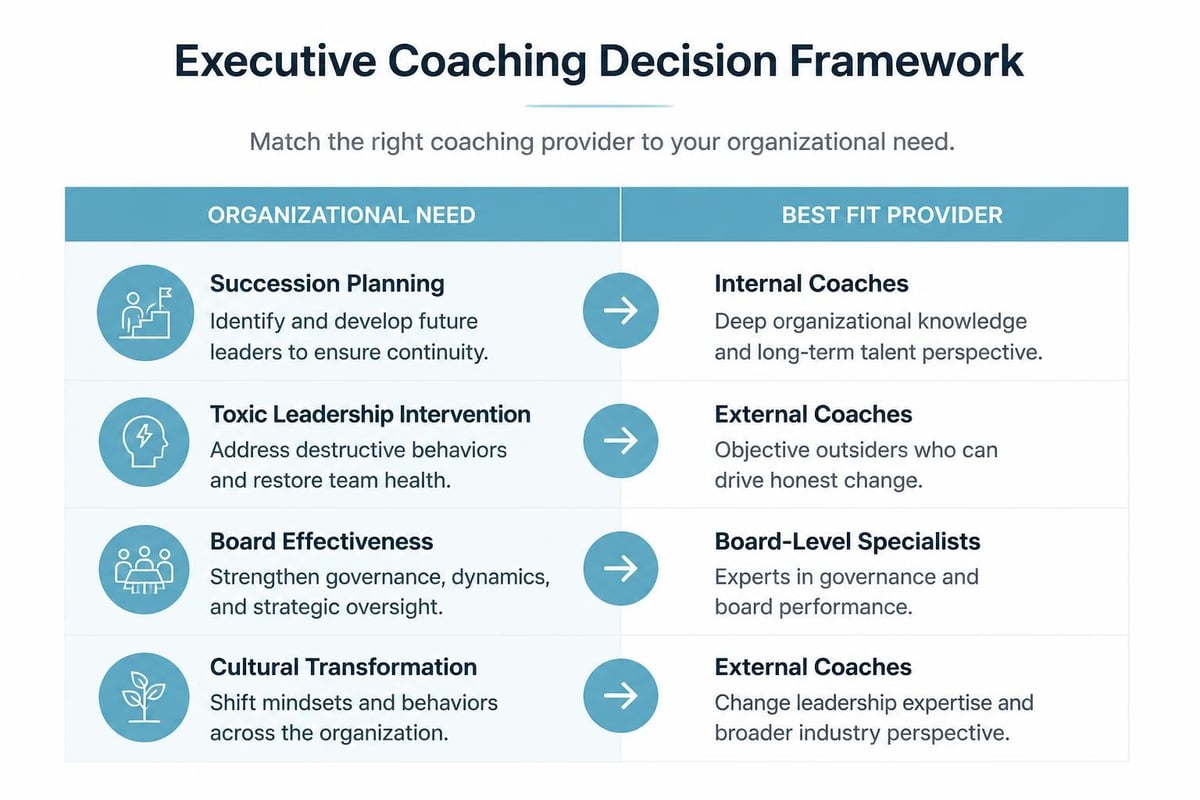
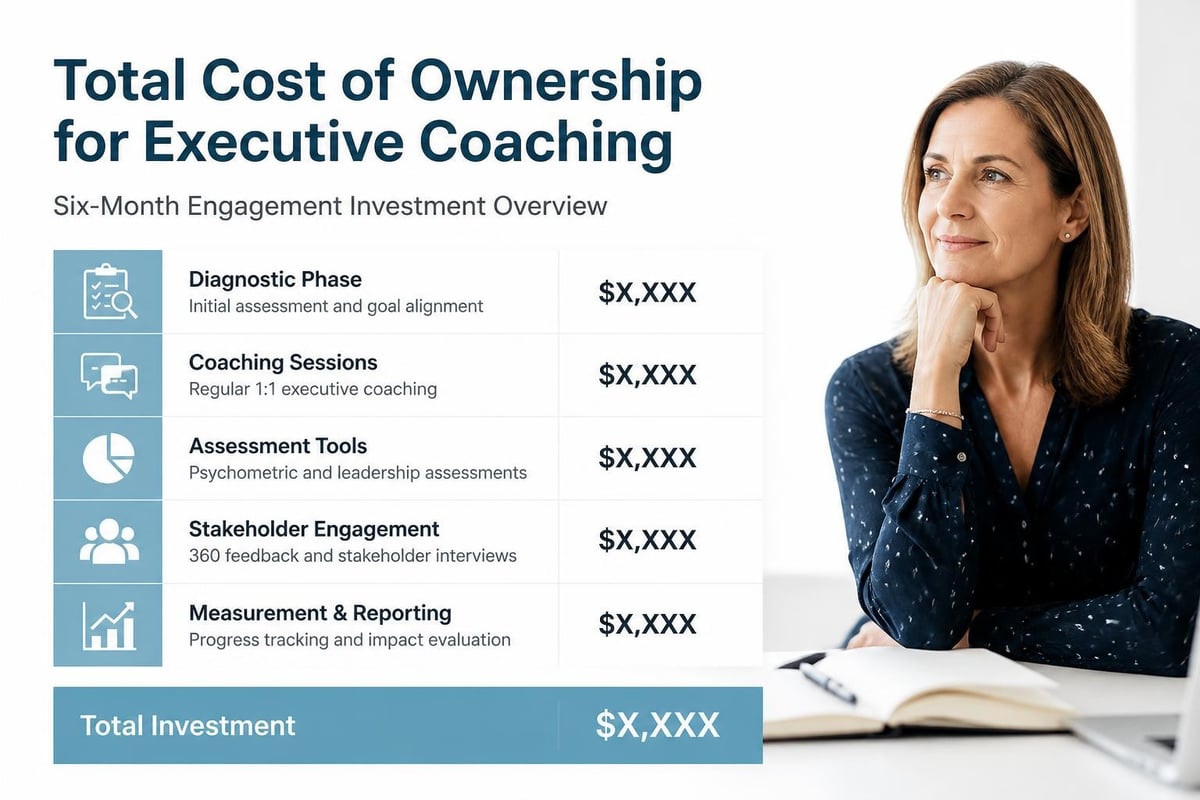

When algorithms meet real leadership crises, the limits become obvious. AI coaching failed during a real crisis because it cannot replace human judgment, accountability, and presence when stakes are highest. For mid-market companies building leaders who can handle chaos, technology is a tool, not a coach. Noomii delivers executive coaching, leadership development, and team facilitation that works in your actual meetings, tied to your KPIs, with month-to-month terms and visible ROI-because when crisis arrives, you need a coach in the room, not a chatbot in your browser.