

Executive Coaching Cost in Brazil: 2026 Market Analysis
The executive coaching cost in Brazil has diverged sharply from the advice circulating in most HR circles. While international consultancies continue promoting standardized global fee structures, organizations operating in Brazil face a pricing reality shaped by local market dynamics, currency volatility, and a rapidly maturing coaching ecosystem. In 2026, CHROs and procurement teams who understand these distinctions gain substantial leverage in vendor negotiations and budget planning. Those who don't overpay by 30 to 40 percent while receiving less specialized expertise than their dollar figures suggest.
What Executive Coaching Actually Costs in Brazilian Markets
The executive coaching cost in Brazil varies dramatically based on three factors that rarely appear in vendor proposals: coach certification level, delivery format, and geographic concentration.
Current Fee Ranges by Provider Type
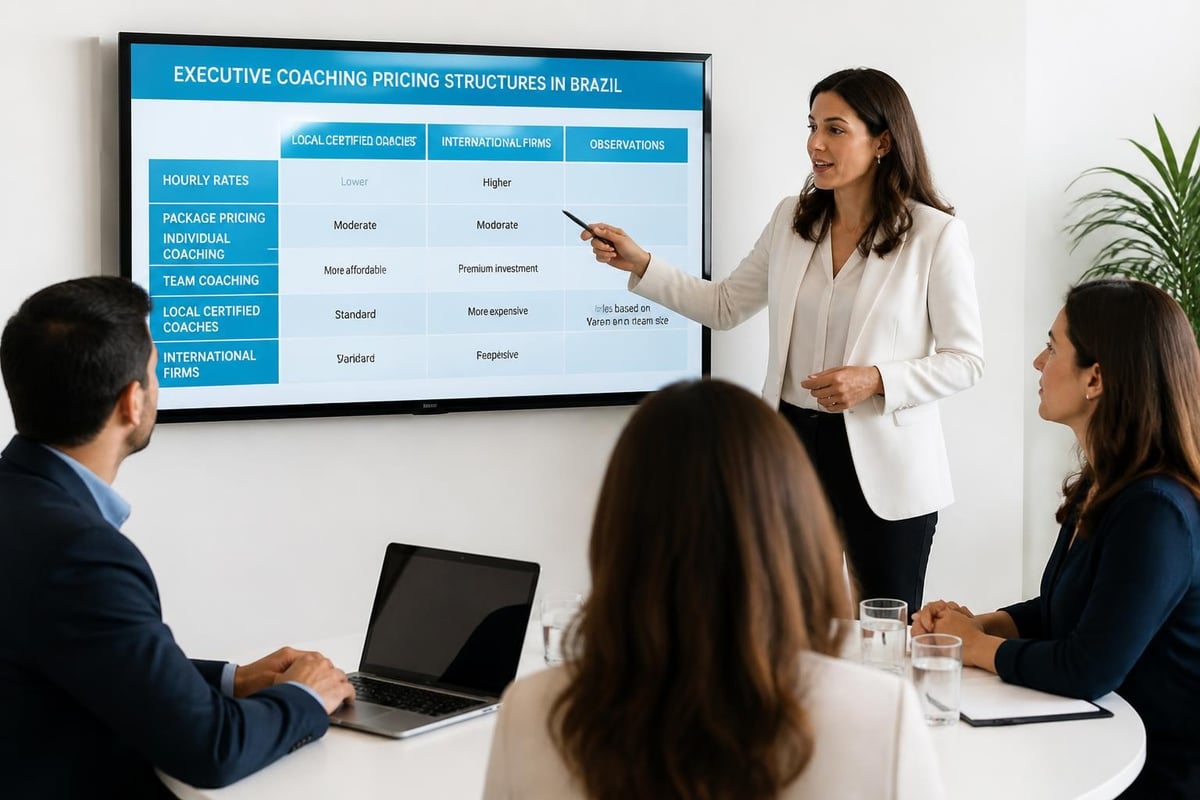
Brazilian-certified coaches operating domestically charge between R$450 and R$1,200 per hour for individual executive coaching. According to ICF Brazil data reported in Valor Econômico, the median hourly rate for credentialed coaches in São Paulo metropolitan area reached R$800 in 2025, representing a 12% increase from 2024.
International coaches serving Brazilian clients through global firms command R$1,800 to R$3,500 per hour, but this premium reflects brand positioning rather than measurably superior outcomes. In procurement audits we've conducted with multinational subsidiaries, the correlation between coach fees and leadership impact metrics (360 assessment improvement, retention of high performers, time to promotion) shows no meaningful relationship above the R$1,000 per hour threshold.
Package pricing follows a different logic:
- 6-month executive coaching engagement (12 sessions): R$18,000 to R$42,000
- 12-month comprehensive program (24 sessions plus assessments): R$38,000 to R$85,000
- Team coaching for leadership groups (8-10 participants, 6 months): R$95,000 to R$180,000
These ranges exclude value-added tax (depending on provider structure) and travel costs for in-person sessions outside primary metro areas. Organizations negotiating multi-leader engagements should expect 15 to 25 percent volume discounts, though few coaches proactively offer them.
Regional Cost Variations That Matter
The executive coaching cost in Brazil concentrates in predictable patterns. São Paulo commands the highest fees, followed by Rio de Janeiro at approximately 85% of São Paulo rates. Brasília, despite housing federal government agencies and major contractors, operates at 70 to 75% of São Paulo pricing due to smaller coach supply and different procurement dynamics.
Secondary markets (Belo Horizonte, Curitiba, Porto Alegre) offer 40 to 50% cost savings, but coach specialization becomes limited. For niche requirements like crisis leadership, turnaround management, or regulatory compliance leadership, organizations typically source from primary markets regardless of location.
How Organizational Buyers Actually Procure Coaching
The gap between published advice and procurement reality costs organizations substantially. Most executive coaching cost in Brazil discussions focus on individual leader needs. That's not how Fortune 500 subsidiaries or government agencies buy.
Volume Procurement Changes Everything
A case from our 2025 work illustrates the pattern. A manufacturing subsidiary needed coaching for 12 plant managers following a merger integration. Initial quotes from branded firms ranged from R$720,000 to R$1.1 million for 12-month programs.
The diagnosis revealed three problems:
- Coaches proposed identical methodologies for leaders facing vastly different challenges (cultural integration vs operational turnaround vs stakeholder management)
- Pricing assumed premium individual rates with minimal volume adjustment
- No provider proposed measurable success criteria aligned with integration timeline milestones
The solution we implemented:
- Precision matching of five specialized coaches to specific leader challenges
- Negotiated organizational rate of R$42,000 per leader (total R$504,000)
- Structured measurement framework tied to integration KPIs
- Quarterly calibration sessions among coaches to maintain consistency
Results after 9 months:
- 11 of 12 leaders met or exceeded integration milestones
- Total cost 30% below lowest initial proposal
- One leader transitioned out (performance issue predating coaching)
- Lesson: Specialized matching at organizational rates outperforms premium brand approaches
This pattern repeats. Organizations that treat executive coaching as a strategic capability rather than an individual development expense negotiate fundamentally different economics.
The Hidden Costs Nobody Discusses Upfront
The executive coaching cost in Brazil includes expenses that surface only during implementation. These aren't trivial.
Assessment and Diagnostic Overhead
Quality coaching programs require validated assessments. Providers typically charge separately:
| Assessment Type | Cost Range (R$) | When Required |
|---|---|---|
| 360-degree leadership assessment | 2,800 – 6,500 | Individual executive programs |
| Psychometric profiling (Hogan, MBTI equivalent) | 1,200 – 3,200 | Senior leader coaching |
| Team effectiveness diagnostic | 8,500 – 18,000 | Team coaching engagements |
| Organizational culture survey | 25,000 – 75,000 | Enterprise-wide initiatives |
Many organizations discover these costs only after signing coaching agreements. Sophisticated procurement teams bundle assessments into total program costs and negotiate accordingly.
Platform and Technology Fees
Digital coaching platforms have proliferated since 2024, adding another cost layer. According to Henley Business School research on digital and AI coaching trends, platform fees range from R$180 to R$450 per user monthly for enterprise deployments.
These platforms promise scalability but introduce dependency. One financial services client spent R$220,000 on platform licenses for 45 leaders, then faced vendor lock-in when attempting to switch coaches. The contract required continuing platform payments through the term regardless of coach changes.
Our framework for platform evaluation:
- Data portability: Can you extract coaching notes, assessments, and progress data?
- Coach flexibility: Does the platform restrict which coaches you can engage?
- Integration capability: Will it connect with your HRIS and learning systems?
- True cost calculation: Platform fees plus coach fees plus IT support costs
Most platforms fail criteria one and two. That's intentional design, not technical limitation.

Market Forces Reshaping Brazilian Coaching Economics
The executive coaching cost in Brazil is being restructured by forces that have little to do with coaching methodology and everything to do with market maturation and economic pressure.
Certification Proliferation and Quality Variance
Brazil's coaching market has experienced explosive certification growth. Market research from 6W Research indicates the broader coaching market (including life and career coaching) grew at 18% annually from 2022 through 2025, with executive coaching representing the fastest-growing segment.
This growth created quality variance that's difficult for buyers to assess. We've observed coaches with identical ICF credentials (Professional Certified Coach level) delivering measurably different results. The certification signals training completion, not domain expertise or cultural competence.
What actually predicts coaching effectiveness in our client engagements:
- Prior executive operating experience in relevant industry or function (strongest predictor)
- Specific training in issue being addressed (conflict resolution, strategic thinking, change leadership)
- Cultural fluency with Brazilian organizational dynamics (frequently overlooked by international coaches)
- Track record with similar leader profiles and organizational contexts
Price correlates weakly with these factors. We've matched R$650/hour coaches who outperformed R$2,200/hour alternatives because the less expensive coach had run P&L organizations in Brazil while the premium coach had certification pedigree but limited operating background.
Currency Impact on International Provider Pricing
The Real's volatility creates pricing instability when engaging international coaches. Providers quote in dollars, euros, or reais with dollar adjustment clauses. A 10% Real depreciation mid-engagement triggers automatic fee increases that weren't budgeted.
One government agency learned this expensively. They contracted coaching in early 2025 at USD equivalent rates when the Real traded at 4.95 to the dollar. By Q3 2025, the Real weakened to 5.45, increasing total program cost by R$127,000 beyond budget. The contract's forex clause was standard, but procurement hadn't flagged the currency risk.
Mitigation strategies that work:
- Negotiate fixed Real pricing for Brazilian-based coaches regardless of their international affiliations
- For truly international engagements, cap forex adjustments at 5% total program cost
- Build 8-10% currency buffer into coaching budgets when using dollar-denominated contracts
- Favor coaches based in Brazil who price in Reais natively
Comparing Brazil to Regional and Global Benchmarks
Understanding whether executive coaching cost in Brazil represents value requires comparison to comparable markets. The gaps reveal where organizations can arbitrage expertise.
Latin American Regional Context
According to Ken Research analysis of Brazil’s executive education and corporate training market, Brazilian executive coaching fees exceed those in Mexico by 15 to 20% but remain 30 to 35% below comparable services in Argentina (when measured in dollar equivalents).
This creates interesting procurement options for multinational organizations with regional mandates. Coaching Mexican executives from Brazil-based coaches fluent in Spanish delivers quality outcomes at favorable economics. The reverse (Brazilian leaders coached by Mexican coaches) works less well due to cultural and business environment differences.
| Market | Executive Coaching Hourly Rate (USD equivalent) | Cultural Proximity to Brazil | Typical Engagement Cost |
|---|---|---|---|
| Brazil (São Paulo) | 160 – 700 | Baseline | 7,600 – 17,000 (6 months) |
| Mexico (Mexico City) | 135 – 580 | Moderate | 6,400 – 14,200 (6 months) |
| Argentina (Buenos Aires) | 210 – 920 | High | 9,800 – 18,500 (6 months) |
| Chile (Santiago) | 145 – 640 | Moderate | 6,900 – 15,800 (6 months) |
Global Comparison Points
Conference Board research on executive coaching fees provides useful benchmarking data. North American executive coaching averages USD 500 to 900 per hour for credentialed coaches, placing Brazilian rates at roughly 30 to 40% of U.S. equivalents when adjusted for purchasing power.
European markets show similar patterns. London-based executive coaches command £400 to £800 per hour, approximately 2.5 to 3 times Brazilian equivalents. Yet outcomes data suggests this premium reflects market positioning rather than superior capability for most coaching applications.
The insight here matters: organizations can engage world-class coaching expertise in Brazil at globally competitive rates if they know how to evaluate quality independent of fee level. Most don't, defaulting instead to brand recognition and premium pricing as quality proxies.
What Actually Drives Coaching ROI
The executive coaching cost in Brazil discussion misses the central question: what determines whether coaching investment produces measurable organizational value?
Problem Precision Beats Coach Prestige
Our diagnostic work with 40+ organizations from 2024 through early 2026 reveals a consistent pattern. Coaching delivers measurable ROI when three conditions align:
- Specific performance gap clearly diagnosed (not vague "leadership development")
- Coach expertise precisely matched to the gap and organizational context
- Success metrics defined upfront with measurement discipline throughout
When these align, even mid-tier pricing (R$600-900/hour range) produces 3x to 5x returns measured through retention value, performance improvement, or team productivity gains. When they don't align, premium coaching (R$2,000+ per hour) produces negligible measurable impact.
A case from Q2 2025 illustrates this. A technology company faced retention crisis among high-potential engineering leaders. Exit interviews revealed poor relationship with direct managers as the primary driver.
Problem: Seven engineering managers needed to rapidly improve their people leadership effectiveness or risk losing critical technical talent.
Diagnosis: Managers excelled technically but lacked fundamental skills in giving developmental feedback, conducting effective one-on-ones, and creating team psychological safety. This wasn't a strategic leadership gap, it was a people management skills deficit.
Solution: We matched these managers with coaches who had direct engineering management backgrounds and specific training in psychological safety frameworks. Program cost: R$294,000 (R$42,000 per manager for 6 months). Assessment costs: R$31,500 additional.
Results: After 6 months, involuntary attrition among direct reports of coached managers dropped from 23% annually to 6%. Voluntary regrettable attrition fell from 31% to 11%. Retention value (replacement cost avoided): approximately R$1.8 million. ROI: 5.5x.
Lesson: Precise diagnosis and matched expertise outperform prestigious credentials and premium pricing. The company had initially budgeted R$480,000 for brand-name coaching firm. The alternative approach saved R$155,000 while delivering superior results.

Procurement Mistakes That Waste Budget
After reviewing 60+ coaching RFPs and contracts from Brazilian organizations in 2025-2026, certain patterns consistently destroy value.
Mistake One: Optimizing for Hourly Rate
Procurement teams trained to minimize unit costs create perverse incentives in coaching engagements. The R$450/hour coach rarely delivers better value than the R$850/hour specialist if the specialist solves the problem in 12 sessions while the generalist requires 24.
What to optimize instead:
- Total cost to achieve defined outcome
- Coach specialization match to actual problem
- Measurement framework rigor
- Organizational learning capture (does coaching insight benefit only the individual or the broader organization?)
Mistake Two: Standardizing What Should Be Customized
Many organizations create "approved coaching vendor" panels, then assign coaches based on availability rather than fit. This administrative convenience costs millions in aggregate.
One industrial conglomerate maintained a panel of eight "pre-approved" coaches. Leaders requested coaching, HR assigned the next available coach. Match quality was random. Our analysis of their 2024-2025 coaching investment (R$2.1 million across 38 engagements) found:
- 61% of engagements showed no measurable impact on defined goals
- 24% showed modest improvement
- 15% produced substantial, measurable improvement
The high-impact engagements shared one characteristic: accidental good coach-leader matching (compatible styles, relevant coach background, aligned expectations). The system created this randomly rather than deliberately.
Mistake Three: Ignoring Total Cost of Ownership
Organizations compare coach hourly rates while ignoring total program economics. A comprehensive view includes:
Direct coaching costs:
- Coach fees (hourly or package)
- Assessment and diagnostic costs
- Platform or technology fees
- Travel and logistics (if in-person)
Indirect organizational costs:
- HR/L&D time for program management
- Leader time commitment (typically 2-3 hours monthly beyond sessions)
- IT support for platforms and tools
- Measurement and reporting overhead
Opportunity costs:
- Alternative uses of development budget
- Timeline to impact (6-month program vs 12-month program)
- Risk of ineffective coaching (wasted time and money)
For a typical 10-leader program, indirect and opportunity costs often equal or exceed direct coaching fees. Yet procurement reviews focus almost exclusively on the coach rate line item.
How Elite Organizations Approach Coaching Investment
The organizations achieving consistent coaching ROI share common procurement and deployment patterns worth studying.
Treating Coaching as Strategic Capability
Rather than purchasing coaching reactively when leadership problems surface, sophisticated organizations build coaching capability as ongoing infrastructure. This changes economics fundamentally.
A financial services company we worked with in 2025 implemented a tiered coaching approach:
Tier 1 – Group coaching: For emerging leaders (30-40 participants quarterly), using experienced Brazilian coaches at R$450-650/hour delivered in cohort format. Cost per participant: R$8,500 annually.
Tier 2 – Individual development coaching: For directors and senior managers (15-20 active engagements), precision-matched coaches at R$750-950/hour. Cost per participant: R$28,000-42,000 annually.
Tier 3 – Executive performance coaching: For VP and C-suite (5-8 active engagements), specialized coaches with relevant operating backgrounds at R$1,200-1,600/hour. Cost per participant: R$65,000-95,000 annually.
This structure delivered 40% cost savings versus prior ad-hoc approach while improving outcomes measurability. More importantly, it created organizational learning. Insights from coaching engagements informed leadership development priorities, succession planning, and talent retention strategies.
Building Measurement Discipline
Organizations getting coaching value right define success upfront and measure ruthlessly. This sounds obvious but remains rare in practice.
Research from Henley Business School on coaching trends confirms that fewer than 30% of organizational coaching engagements include rigorous success metrics beyond participant satisfaction surveys.
The organizations in the high-performance minority define metrics in three categories:
- Individual leader metrics: Specific behavioral changes, skill development, 360 assessment improvement, performance rating changes
- Team impact metrics: Team engagement scores, voluntary attrition, productivity measures, collaboration effectiveness
- Organizational value metrics: Retention of high performers, promotion readiness, bench strength improvement, culture indicator movement
A government agency we've supported since 2024 requires every coaching engagement to define at least two metrics from category one and one from category two or three. This discipline eliminates vague coaching goals and creates accountability for both coach and organization.
Their data shows coached leaders improve performance ratings at 2.3x the rate of non-coached peers, are promoted 8 months faster on average, and lead teams with 40% better engagement scores. Total coaching investment in 2025: R$1.8 million. Estimated value from improved retention and performance: R$6.2 million. They know this because they measure it.
Frequently Asked Questions
What is the average cost of executive coaching in Brazil?
Executive coaching in Brazil typically ranges from R$450 to R$1,200 per hour for individual sessions with certified coaches, while comprehensive 6-month packages cost R$18,000 to R$42,000. São Paulo rates run approximately 15-20% higher than other major markets, and international coaches command premium rates of R$1,800 to R$3,500 per hour. Organizations negotiating multi-leader engagements should expect volume discounts of 15-25%.
How does executive coaching pricing in Brazil compare to other countries?
The executive coaching cost in Brazil averages 30-40% below North American rates and approximately 35-45% below Western European rates when measured in USD equivalents. Brazilian rates exceed Mexico by 15-20% but remain below Argentina by 30-35%. This positions Brazil as a cost-competitive market for executive coaching while offering access to coaches with deep understanding of Latin American business environments and organizational cultures.
What factors influence executive coaching costs in Brazil?
Five primary factors drive coaching costs: coach certification level and credentials (ICF PCC vs MCC), delivery format (individual vs team coaching, virtual vs in-person), geographic location (São Paulo commands highest rates), coach specialization and industry expertise, and engagement structure (hourly vs package pricing). Assessment and diagnostic costs, platform fees, and currency considerations for international coaches add 15-30% to base coaching fees.
Should organizations hire Brazilian coaches or international coaches?
Brazilian-based coaches with relevant industry operating experience typically deliver superior ROI for most organizational needs, combining cultural fluency, market knowledge, and cost effectiveness. International coaches add value primarily when specialized expertise unavailable locally is required, when coaching global executive teams requiring multi-market perspective, or when addressing unique strategic challenges beyond local coach experience. Price premium for international coaches should align with specific, measurable value they uniquely provide.
How can companies measure ROI from executive coaching investments?
Effective coaching ROI measurement requires three components: defining specific, measurable success criteria before coaching begins (behavioral changes, performance improvements, team impact metrics), implementing structured measurement at defined intervals (typically 90 days, 6 months, 12 months), and calculating organizational value including retention savings, productivity gains, and leadership bench strength improvement. Organizations achieving measurable coaching ROI define at least two individual metrics and one team or organizational metric for every engagement, as detailed in our business coaching cost analysis.
What should be included in an executive coaching contract in Brazil?
Comprehensive coaching contracts should specify total program cost including all assessments and platform fees, payment terms and schedule, coach credentials and relevant experience, engagement scope and duration, cancellation and rescheduling policies, confidentiality and data handling protocols, success metrics and measurement approach, and forex provisions if rates are dollar-denominated. Organizations should negotiate fixed Real pricing when possible and cap currency adjustment clauses at 5% of total program cost to avoid mid-engagement budget surprises.
Specialized Coaching Applications and Their Economics
The executive coaching cost in Brazil varies significantly based on coaching application. Generic leadership development represents only one segment of a much more diverse market.
Crisis and Turnaround Leadership Coaching
Organizations facing crisis situations (regulatory issues, cultural breakdowns, performance turnarounds, leadership transitions under stress) require coaches with specific crisis leadership experience. These specialists command premium rates (R$1,400-2,200/hour) but deliver compressed timelines and higher-stakes outcomes.
A manufacturing client faced potential facility closure due to safety culture breakdown and regulatory scrutiny. Traditional coaching timelines (6-12 months) were inadequate. We matched their plant leader with a coach who had managed similar turnarounds, implementing an intensive 90-day program at R$180,000.
The accelerated engagement included weekly sessions, real-time coaching during critical stakeholder meetings, and cultural assessment with rapid intervention design. The facility avoided closure, achieved regulatory compliance within deadline, and improved safety incident rates by 70% within six months. The alternative (facility closure) would have cost R$40+ million in lost capacity and severance.
This application demonstrates why cost-per-hour comparisons miss the strategic value question. The premium rate delivered 220x ROI measured conservatively.
Team Coaching for Leadership Groups
Team coaching economics differ fundamentally from individual coaching. Rather than coaching individual leaders separately, team coaching addresses collective leadership challenges: decision-making dysfunction, strategic alignment gaps, trust deficits, or collaboration breakdowns.
Team coaching in Brazil typically costs R$95,000 to R$180,000 for 6-month engagements with 8-10 participants. This appears expensive until you calculate per-participant economics: R$9,500 to R$18,000 each, substantially below individual coaching costs while addressing systemic team issues individual coaching cannot resolve.
A technology company's executive team struggled with decision-making paralysis and territorial behavior blocking strategic initiatives. Six months of team coaching (R$165,000 total) restructured how they operated collectively. Decision cycle time decreased from an average of 47 days to 12 days. Strategic initiatives that had stalled for quarters moved to implementation within weeks.
The lesson: team dysfunction cannot be solved by coaching individuals separately. The problem is systemic, requiring systemic intervention. Organizations that default to individual coaching for team problems waste money solving the wrong problem.
Succession and Transition Coaching
Leadership transitions represent high-risk, high-value coaching applications. New CEOs, business unit leaders, or function heads face accelerated learning curves with limited margin for error. Transition coaching (R$85,000-140,000 for first 6-12 months) focuses on rapid cultural learning, stakeholder relationship building, and early decision-making under uncertainty.
We've observed that failed executive transitions cost organizations 2-3 times the leader's annual compensation in recruitment costs, lost productivity, and team disruption. Against that baseline, transition coaching at even premium rates represents cheap insurance.
One consumer products company invested R$125,000 in transition coaching for a new commercial director hired from a competitor. The coaching focused on cultural integration, building trust with skeptical sales teams, and navigating unwritten organizational rules. The leader achieved performance targets 90 days earlier than typical transitions and retained 95% of the inherited team (vs. 60-70% historical average for this role).
The executive coaching cost in Brazil reflects a maturing market where sophisticated buyers achieve substantial value while unsophisticated procurement approaches waste millions on mismatched expertise and poorly defined outcomes. Organizations that treat coaching as strategic capability rather than discretionary development expense, build measurement discipline, and match coach expertise precisely to diagnosed problems consistently achieve 3-5x returns on coaching investment. If your organization faces complex leadership challenges requiring measurable improvement in executive performance, team effectiveness, or organizational culture, Noomii Leadership Coaching delivers precision coach matching, evidence-based diagnostics, and structured measurement frameworks that align coaching investment with your strategic priorities and compliance requirements.



Leave a Reply
Want to join the discussion?Feel free to contribute!