
Can Coaching Improve Leadership? Evidence & ROI in 2026
The question "can coaching improve leadership" surfaces every quarter in budget meetings, HR planning sessions, and when retention numbers sag. Behind the question sits a deeper concern: whether investing in leadership coaching delivers measurable business outcomes or becomes another checkbox program that sounds impressive but changes nothing. The answer depends entirely on how coaching is structured, measured, and integrated into daily operations. Certification-obsessed programs that treat coaching as a credential to display rarely move performance needles. Coaching that operates live in meetings, ties to KPIs, and holds leaders accountable for behavior change consistently delivers results that show up in engagement scores, retention rates, and execution quality.
The Evidence Behind Leadership Coaching Effectiveness
Research confirms what practitioners observe in the field: coaching can improve leadership when designed around outcomes rather than theory. A peer-reviewed study in PLoS ONE demonstrates clear relationships between coaching interventions and authentic, change-oriented leadership behaviors that correlate with measurable effectiveness.
Meta-analysis published in Frontiers in Psychology examined randomized and quasi-experimental evidence across executive coaching engagements, finding statistically significant impacts on leader behaviors, attitudes, and specific leadership characteristics. The data supports what selective buyers already know: coaching works when it targets specific behaviors tied to business outcomes.
But here's what the research doesn't tell you: most coaching engagements still fail because they prioritize credential worship over expertise, comfort over challenge, and theory over live application. Organizations spend millions on certified coaches who never step into actual meetings, never review actual KPIs, and never confront the leadership gaps visible to every team member.

What Actually Changes When Leadership Coaching Works
When companies ask "can coaching improve leadership," they're really asking whether coaching changes behaviors that matter to the business. The gap between feel-good sessions and measurable improvement comes down to structure and accountability.
Observable Leadership Shifts
Effective coaching produces visible changes:
- Decision velocity increases because leaders develop frameworks for evaluating options under uncertainty
- Delegation improves as leaders distinguish between tasks requiring their expertise and work that develops team capacity
- Communication becomes more direct with less hedging, clearer expectations, and faster conflict resolution
- Accountability cascades when leaders model ownership rather than deflection
- Strategic thinking separates from tactical firefighting through operating cadences that protect focus time
Gallup’s manager development research connects these behavioral shifts to engagement and performance metrics organizations actually track. The coaching that moves those numbers operates differently than traditional development programs.
Case Study: Manager Training That Measured
Problem: A 180-person technology services firm struggled with inconsistent manager quality. Top performers left within 18 months, citing "lack of leadership" in exit interviews. Engagement scores for managers ranked bottom quartile.
Diagnosis: Managers received promotions based on technical skill but no systematic development. They avoided difficult conversations, made decisions too slowly, and failed to differentiate performance. No operating cadence existed to track progress or hold priorities visible.
Solution: Three-month intensive combining weekly live coaching during actual team meetings, monthly 360 feedback loops, and KPI scorecards tracking decision quality, one-on-one frequency, and team retention. Coaches challenged managers in real time rather than discussing situations abstractly later.
Results: Six-month retention improved 34%, engagement scores moved to 68th percentile, decision cycles shortened from 2.3 weeks to 4.2 days (measured across 47 decisions), and managers reported 89% confidence in handling difficult conversations versus 31% baseline.
Lesson: Coaching improves leadership when it occurs during the work, not in isolated reflection sessions disconnected from daily operations.
The Coaching Approaches That Drive Leadership Growth
Not all coaching methodologies deliver equivalent outcomes. Harvard Business Review identifies four distinct coaching styles leaders can deploy depending on context and development needs. The question becomes which approaches work for mid-market companies balancing speed, cost, and measurable improvement.
| Coaching Approach | Best Use Case | Typical Duration | ROI Visibility |
|---|---|---|---|
| Live in-meeting coaching | Manager skill gaps affecting team performance | 3-6 months | Immediate (1-2 weeks) |
| Traditional 1:1 executive coaching | Strategic thinking, career transitions | 6-12 months | Moderate (2-3 months) |
| Group/cohort leadership development | Building consistent leadership culture | 4-9 months | Delayed (4-6 months) |
| Peer coaching circles | Sustaining growth, cross-functional learning | Ongoing | Variable |
The table reveals an uncomfortable truth: the coaching with the fastest ROI visibility-live in-meeting work-remains the least common in practice. Most organizations default to comfortable 1:1 sessions that feel less intrusive but deliver slower, harder-to-measure results.
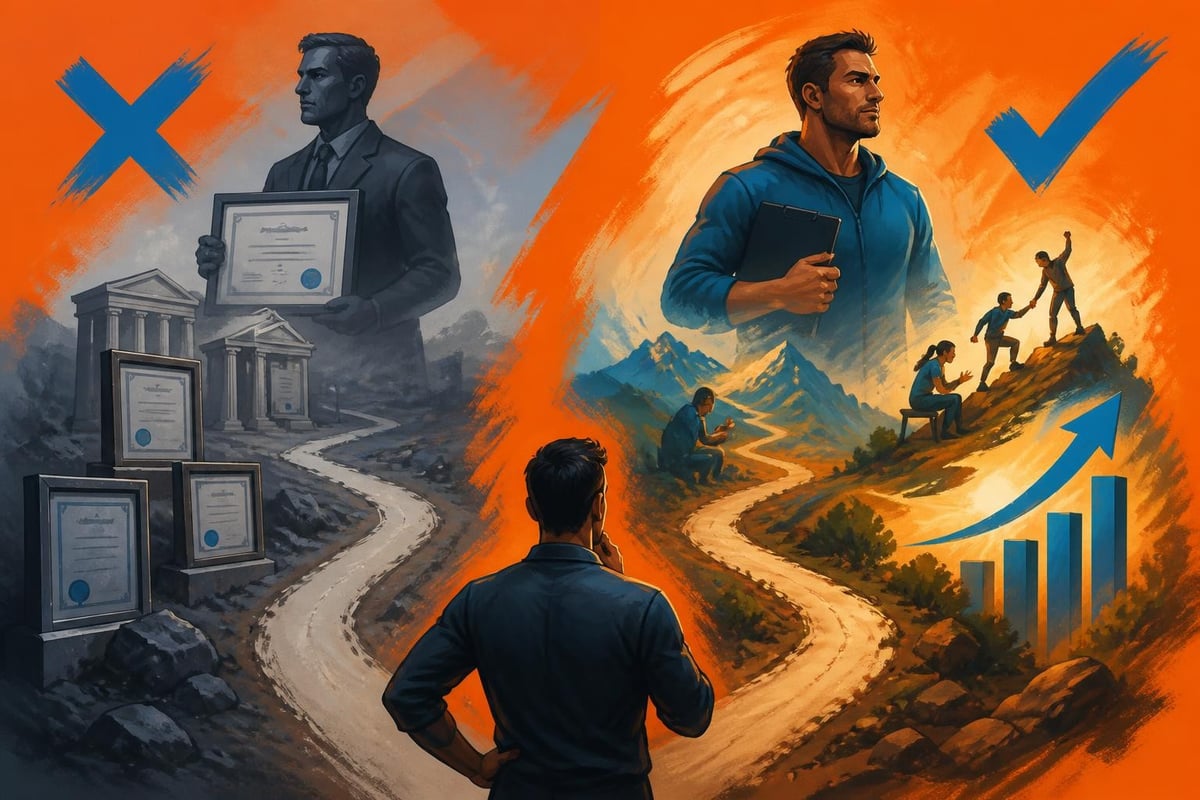
Contrarian Reality: Credentials Don't Predict Coaching Outcomes
The coaching industry perpetuates a myth that certification quality determines coaching effectiveness. Can coaching improve leadership when the coach holds an ICF credential? Sometimes. Can it improve leadership when the coach lacks formal certification but brings 20 years of operational experience? Absolutely.
The credential obsession creates two problems:
- Buyers select coaches based on letters after names rather than track record with similar challenges in comparable organizations
- Certified coaches often lack business context to recognize when leadership gaps stem from structural problems rather than individual behavior
A certified coach might explore a leader's "relationship with decision-making" through reflective exercises. An experienced practitioner recognizes that slow decisions often trace to unclear authority boundaries, missing data dashboards, or fear of repercussions from previous executives. They fix the structure, not just the psychology.
This doesn't mean all certifications are worthless. It means experience solving similar problems in similar contexts predicts results better than certification status. When evaluating whether coaching can improve leadership in your organization, ask about outcomes the coach has delivered, not where they studied.
The ROI Question: Measuring Leadership Coaching Impact
CFOs and budget owners want numbers. "Can coaching improve leadership?" becomes "Can we prove it improved leadership by March?" Fair question. Terrible answers dominate the market.
Metrics That Actually Matter
Stop tracking:
- Session completion rates
- Self-reported satisfaction scores
- Hours of coaching consumed
Start tracking:
- Decision cycle time (days from issue identification to resolution)
- Direct report retention (12-month rolling by manager)
- Delegation ratio (hours spent on manager-only work versus delegable tasks)
- Meeting efficiency (decisions per meeting hour, agenda adherence)
- Development velocity (promotion-ready candidates identified per quarter)
Deloitte’s research on human performance places coaching within broader organizational design strategies, emphasizing measurement systems that connect individual development to business outcomes. The firms seeing ROI from leadership coaching build these measurement systems before engagement begins, not as an afterthought.
Framework: The Leadership Velocity Index
We developed a proprietary scoring system that quantifies leadership effectiveness across five dimensions:
- Decision Quality (accuracy, speed, stakeholder alignment)
- Team Output (throughput, quality, autonomy growth)
- Communication Efficiency (clarity, frequency, conflict resolution)
- Strategic Focus (time allocation, priority discipline)
- Development Pipeline (succession depth, capability growth)
Each dimension receives 0-20 points based on specific, observable criteria. Baseline scores at engagement start establish the improvement trajectory. Monthly rescoring creates accountability and reveals which interventions work.
Leaders averaging 65+ points demonstrate consistent high performance. Those below 50 show clear deficits requiring targeted intervention. The score matters less than movement-coaching that improves leadership produces measurable score increases within 60 days.
When Leadership Coaching Fails (And Why)
Can coaching improve leadership when organizations sabotage the process? No. Five failure patterns appear repeatedly:
- No consequences for ignoring coaching (leaders skip sessions, ignore feedback, behavior unchanged)
- Coaching disconnected from actual work (theoretical discussions about hypothetical situations)
- Goals defined as feelings rather than outcomes ("feel more confident" versus "reduce decision time 40%")
- Engagement ends before behavior solidifies (8-week programs for habit changes requiring 16+ weeks)
- Coach lacks authority to challenge (politeness prioritized over truth-telling)
Organizations serious about whether coaching can improve leadership address these failure modes proactively. They choose month-to-month engagements that allow course correction, demand visible progress against defined metrics, and grant coaches permission to deliver uncomfortable truths.
The World Economic Forum’s analysis of leadership for sustainable growth identifies this inner work and external accountability balance as essential for developing future-ready leadership capabilities. The comfortable coaching that avoids challenge produces comfortable mediocrity.

Building Coaching Into Operating Cadence
The most effective answer to "can coaching improve leadership" comes from organizations that embed coaching into routine operations rather than treating it as a separate development activity.
The Integration Model
Weekly: Coaches attend one leadership team meeting, one manager 1:1, observe decision patterns, provide real-time feedback
Monthly: Review KPI scorecards, update Leadership Velocity Index scores, identify skill gaps blocking progress
Quarterly: 360 assessments, strategic planning participation, culture audit against stated values
This cadence transforms coaching from an event into a system. Leaders receive feedback in context, at decision points, when patterns are fresh and changeable. The approach works particularly well for team coaching and facilitation where group dynamics require intervention in the moment.
The Future: AI, Human Coaching, and Leadership Development
By 2026, AI coaching tools claim to replace human coaches for routine leadership development. Can they? Partially. Should organizations rely on them exclusively? Rarely.
AI tools excel at:
- Pattern recognition across meeting transcripts
- Suggesting communication improvements
- Tracking goal progress
- Providing 24/7 availability
AI tools fail at:
- Reading political dynamics in complex organizations
- Challenging deeply held assumptions compassionately
- Adapting coaching style to individual learning patterns
- Providing accountability beyond algorithmic nudges
The organizations seeing the best results use AI for routine feedback and human coaches for strategic challenges, interpersonal conflicts, and culture shifts. This hybrid model costs less than full human coaching while delivering better outcomes than AI alone.
What Mid-Market Companies Need
Organizations with 25-500 employees face unique leadership challenges. Too large for informal mentoring to scale, too small for enterprise-scale development programs. Can coaching improve leadership in this context?
Absolutely-when structured appropriately:
- Focus on manager development (biggest leverage point for mid-market growth)
- Tie coaching to retention and engagement metrics (losses hurt disproportionately at this scale)
- Demand operational integration (can't afford coaching disconnected from work)
- Require short-term visible wins (credibility established in 60-90 days)
- Month-to-month flexibility (budget constraints require exit options)
Finding the right coaching partner means looking for practitioners who understand mid-market constraints, bring operational experience, and structure engagements around business outcomes rather than coaching session quotas. Noomii’s directory includes coaches with demonstrated mid-market experience across industries.
FAQ: Leadership Coaching Questions Answered
Can coaching improve leadership skills in managers who've never managed before?
Yes, particularly when coaching occurs during actual management situations rather than theoretical preparation. New managers benefit most from live feedback during team meetings, 1:1s, and difficult conversations. Expect 3-4 months before new behaviors solidify.
How long does it take to see measurable leadership improvement from coaching?
Behavioral changes appear within 2-3 weeks if coaching focuses on specific, observable actions. Business outcome improvements (retention, engagement, decision speed) typically surface within 60-90 days. Cultural shifts require 6-12 months minimum.
What's the difference between leadership coaching and leadership training?
Training transfers knowledge and frameworks. Coaching develops skills through practice, feedback, and accountability. Training answers "what should I do?" Coaching addresses "why am I not doing it?" Most leaders need both, but lack of action stems from coaching gaps, not knowledge deficits.
Does executive coaching work better than group leadership development programs?
Neither works "better" universally. Executive coaching delivers faster results for individual behavioral change. Group programs build consistent leadership culture and cost less per participant. Best approach: group programs for foundational skills, individual coaching for specific performance gaps.
How do you measure ROI from leadership coaching investments?
Track business metrics the leader influences: team retention rates, decision cycle times, engagement scores, promotion-ready pipeline depth, meeting efficiency, and delegation ratios. Compare baseline (pre-coaching) to current state monthly. Positive ROI shows up as improvement in these metrics exceeding coaching costs.
What makes leadership coaching fail to deliver results?
Five primary failures: no accountability for applying coaching, sessions disconnected from actual work, goals defined as feelings rather than outcomes, engagement too short for behavior change, or coach lacks permission to challenge. Any one of these undermines effectiveness.
Can coaching improve leadership for technical experts promoted to management?
This transition represents one of coaching's highest-impact applications. Technical experts typically struggle with delegation, conflict avoidance, and strategic versus tactical balance. Coaching that addresses these specific gaps (not generic leadership theory) produces dramatic improvements within 90 days.
How often should leadership coaching sessions occur to be effective?
Frequency depends on goals and urgency. For behavior change during active challenges: weekly or twice-monthly. For strategic development: biweekly or monthly. Less than monthly rarely creates enough momentum for sustainable change. More than weekly risks dependency rather than autonomy.
What credentials should I look for when hiring a leadership coach?
Prioritize demonstrated results with similar challenges in comparable organizations over certification credentials. Ask for specific outcome examples, client references, and approach to measurement. ICF credentials indicate training completion, not effectiveness. Operational leadership experience often predicts better results than coaching certification alone.
Leadership coaching improves measurable business outcomes when structured around accountability, integrated into daily operations, and tied to specific KPIs rather than abstract development goals. Noomii Corporate Coaching helps mid-market companies build accountable leaders through live in-meeting coaching, 360 assessments, and KPI scorecards that connect development to visible business results. If you need practical leadership development that delivers faster decisions, stronger communication, and cleaner execution across priorities, Noomii offers month-to-month engagements with aligned incentives and measurable outcomes.



Leave a Reply
Want to join the discussion?Feel free to contribute!