

ICF Is Solving the Wrong Problem (And Why That Matters)
The coaching industry has a fundamental problem. Organizations need coaches who deliver measurable business outcomes. They need managers who make faster decisions, teams that execute with clarity, and leaders who drive engagement and retention. Yet the International Coach Federation (ICF), the industry's largest credentialing body, has spent decades perfecting a system that prioritizes training hours, competency assessments, and membership tiers over what actually produces results in corporate environments. In 2026, as mid-market companies face unprecedented pressure to justify every investment, this misalignment has never been more costly.
The Credential Trap: What ICF Optimizes For
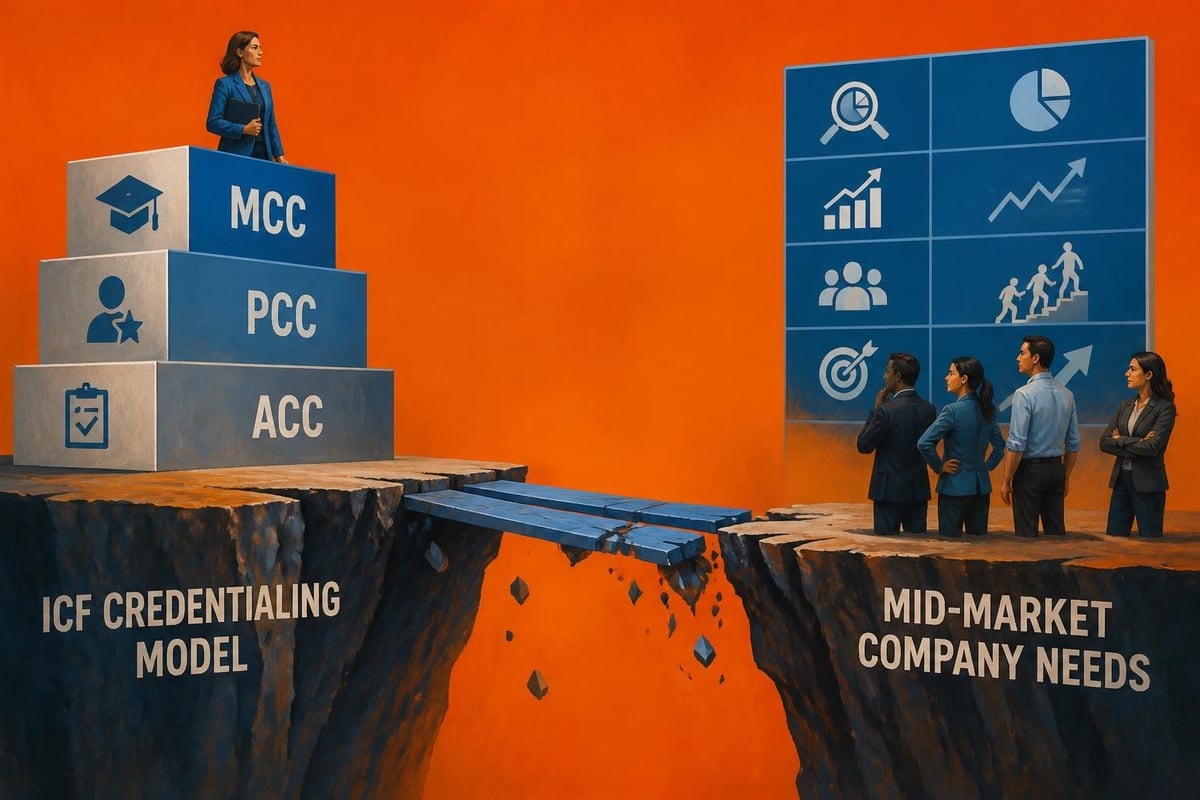
ICF is solving the wrong problem when it defines coaching quality primarily through accumulated training hours and adherence to core competencies. The organization's credentialing pyramid (ACC, PCC, MCC) measures inputs (hours logged, observed sessions, mentor coaching) rather than outputs (client outcomes, business impact, measurable performance improvement).
The ICF system prioritizes:
- 60 to 200+ hours of coach-specific training
- Demonstrated competency in ICF's framework during observed sessions
- Continuing education credits and renewal fees
- Membership in good standing and adherence to code of ethics
What corporate buyers actually need:
- Coaches who understand P&L, KPIs, and operating rhythms
- Practitioners who can diagnose team dysfunction and fix it
- Advisors who tie coaching interventions to retention and revenue
- Partners who share risk and prove ROI month to month
The ICF Coaching Futures report demonstrates how the organization frames market growth and stakeholder trust around credentialing infrastructure. But this framing assumes credentials equal capability, a leap the evidence doesn't support.
What Research Reveals About Coaching Effectiveness
Recent meta-analyses expose the gap between ICF's credentialing focus and evidence-based drivers of coaching impact. A comprehensive 2023 review in Frontiers in Psychology examined workplace coaching research and found inconsistent reporting on coach credentials. The studies that demonstrated strong outcomes focused on relationship quality, context-specific expertise, and clear goal alignment, not certification levels.
Another meta-analysis of executive coaching RCTs showed that coaching effectiveness depends more on the coach's ability to understand organizational context and adapt interventions than on standardized competency frameworks. Yet ICF is solving the wrong problem by treating coaching as a uniform skill set applicable across all contexts, from life coaching to turnaround leadership in manufacturing divisions.
| What Drives Coaching Impact | ICF Credentialing Focus |
|---|---|
| Business acumen and industry experience | Generic competency framework |
| Ability to diagnose root causes | Observed coaching conversations |
| ROI tracking and KPI alignment | Training hours completed |
| Stakeholder management skills | Continuing education credits |
| Risk-sharing and accountability | Membership renewal fees |
The contrast is stark. Organizations hire coaches to solve business problems, but ICF credentials certify something else entirely: the ability to demonstrate coaching behaviors in controlled settings.
The Real Problem: Coaching Disconnected From Business Outcomes
When you hire a coach with impressive credentials but no understanding of how to improve manager effectiveness, you've bought a solution to the wrong problem. When that coach runs engaging sessions but can't connect the work to retention metrics, quarterly targets, or operational execution, you've invested in activity without accountability.
ICF is solving the wrong problem because it treats coaching as an isolated profession rather than a business intervention. The organization has built an entire infrastructure around coach development, ethics, and professional standards while largely ignoring the buyer's perspective: Does this coaching engagement make my business better?
Consider three scenarios we see repeatedly:
-
The Certified Coach Who Can't Read a P&L: An MCC-credentialed coach with 2,500 hours works with a sales director. Sessions are rich in reflection and goal-setting. Six months later, the director's team still misses targets because the coach never addressed pipeline management, forecast accuracy, or accountability systems.
-
The Competency Expert Who Misses Dysfunction: A PCC coach facilitates leadership team sessions using perfect coaching presence. The team rates sessions highly. But the coach doesn't diagnose that the real issue is unclear decision rights and a weak operating cadence, so dysfunction persists.
-
The Ethical Practitioner With No Skin in the Game: An ACC coach follows ICF ethics meticulously, never crossing into consulting. The organization needs someone who will coach live in meetings, challenge poor decisions in real time, and track whether managers actually improve. The coach stays in traditional boundaries while business problems compound.
These aren't failures of ethics or intent. They're structural failures of a system that optimizes for the wrong outcomes.
Alternative Models: What Happens When You Solve the Right Problem
Organizations that prioritize business results over credentials take a different approach. They look for coaches who:
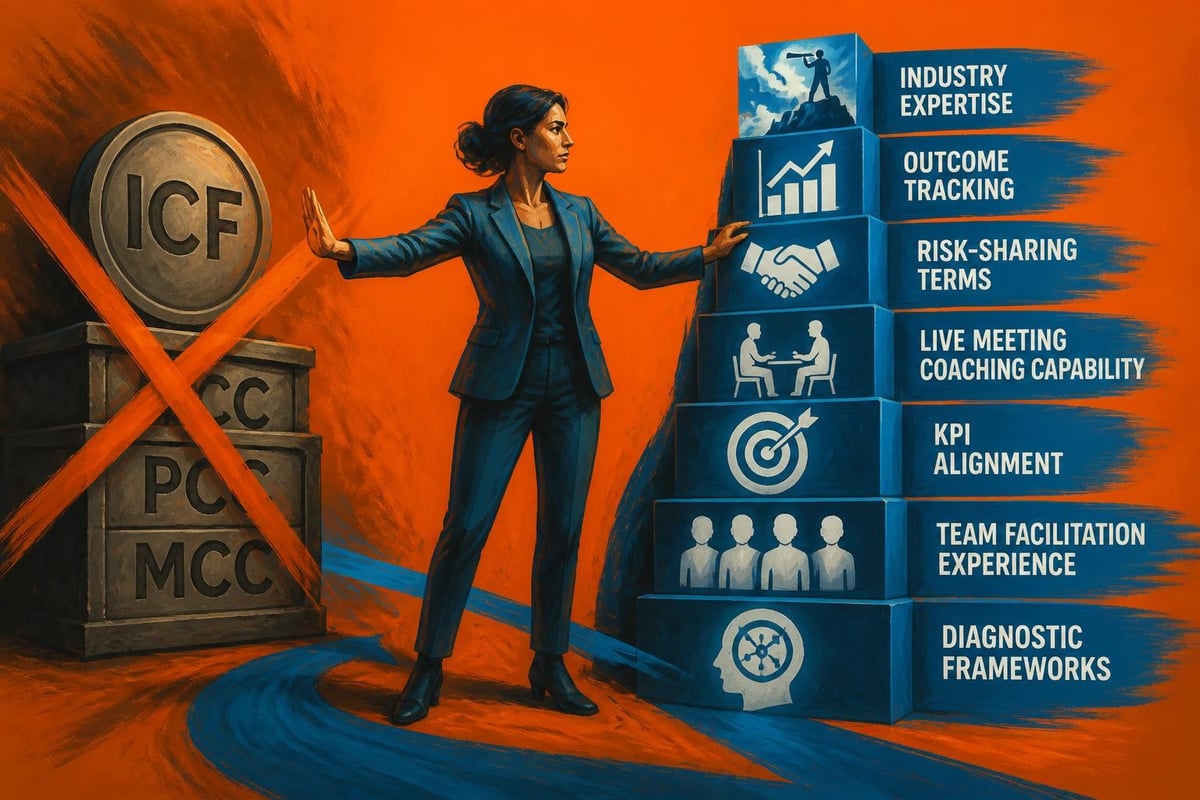
- Demonstrate expertise in their industry or function, not generic coaching skills
- Share accountability through month-to-month terms and aligned incentives
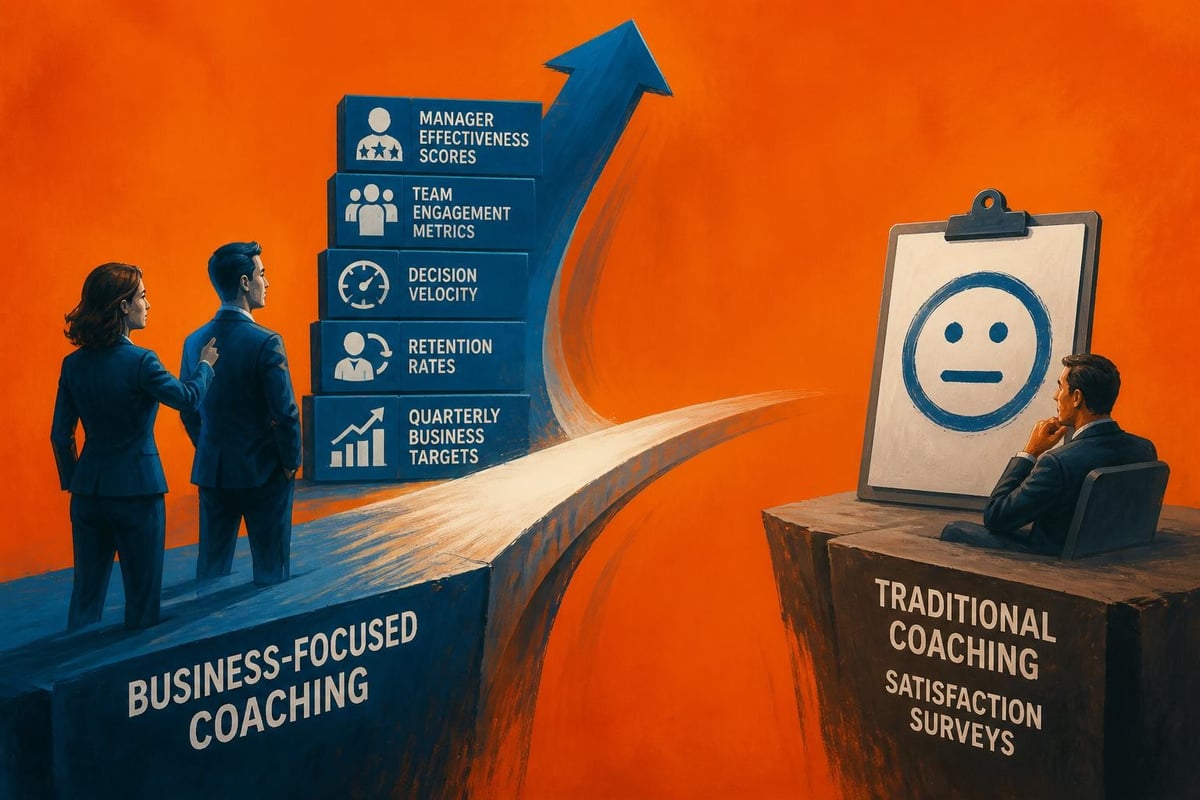
- Track progress using KPIs and operational metrics, not just client satisfaction
- Coach live in meetings and real situations, not just in scheduled sessions
- Combine coaching with consulting, facilitation, and diagnostic work as needed
Noomii’s directory includes practitioners who bring deep functional expertise, industry knowledge, and outcome focus. Some hold ICF credentials. Many don't. What matters is their track record of driving measurable improvement in leadership effectiveness, team performance, and business execution.
What executive coaching truly requires goes far beyond credentialing. It demands business judgment, pattern recognition across dozens of client situations, the courage to challenge executives in real time, and the humility to adjust when interventions aren't working.
The Credential Worship Problem in Corporate Procurement
ICF is solving the wrong problem, but buyers enable it when they default to credentials as a quality proxy. HR leaders and L&D teams often require ICF credentials in RFPs because it's the safest, most defensible choice. No one gets fired for hiring a PCC-credentialed coach, even if that coach delivers no measurable business impact.
This dynamic creates a market failure:
- Coaches invest time and money in credentials that signal "professional" but not "effective"
- Buyers pay premium rates for credentials while actual coaching quality varies wildly
- Organizations struggle to demonstrate ROI because coaching interventions aren't tied to business metrics
- The industry fragments into camps: credential-focused practitioners versus outcome-driven consultants
Meanwhile, alternative credentialing bodies like EMCC Global take different approaches to regulation and ethics, demonstrating that ICF's model isn't the only path to professional standards. But the fundamental question remains: are we standardizing the right things?
What Mid-Market Companies Should Demand Instead
If ICF is solving the wrong problem, what's the right one? For mid-market companies (25 to 500 employees) and Fortune 500 divisions, the right problem is this: How do we build accountable leaders and high-performing teams that execute our strategy with clarity and speed?
Solving that problem requires coaches who:
- Diagnose organizational and team dysfunction accurately
- Design interventions tied to specific business outcomes
- Coach managers to become better coaches themselves
- Track progress through KPIs, engagement scores, and retention data
- Adjust quickly when something isn't working
- Share risk through flexible terms and aligned incentives
None of these capabilities are guaranteed by ICF credentials. Some credentialed coaches deliver them brilliantly. Many don't. The credential tells you the coach completed training and demonstrated competencies in observed sessions. It doesn't tell you whether they can improve your managers' effectiveness or help your leadership team execute with discipline.
A critical 2024 industry survey questioned whether current coach development approaches, including competency frameworks and credentialing, are fit for purpose. The authors argue that coaching education may be "getting it wrong" by emphasizing standardization over context-specific mastery.
Building a Better Coaching Engagement Model
Organizations that want coaching to deliver measurable results should structure engagements around accountability:
Month-to-month terms instead of long contracts mean coaches stay because results are visible, not because you're locked in. If a coach isn't improving manager effectiveness or team performance within 90 days, you should see evidence. If you don't, you should have the flexibility to change direction.
KPI scorecards and operating cadence work integrate coaching into how the business actually runs. When coaches help leadership teams build effective weekly and quarterly operating rhythms, coaching becomes part of execution, not separate from it.
Shared risk through aligned incentives (where feasible) means coaches care about outcomes as much as you do. Not every engagement allows this, but when a coach's compensation ties partially to retention improvement or team performance metrics, incentives align.
Live coaching in real meetings accelerates improvement. Watching a leadership team struggle with decision-making, then coaching through it in real time, produces faster results than discussing the issue in a one-on-one session weeks later.
This approach doesn't ignore ethics, professionalism, or coaching skill. It reorients everything around business outcomes and shared accountability. Some of the most effective practitioners on Noomii’s platform combine coaching certifications with deep industry expertise. Others bring decades of operational leadership and have learned coaching skills through practice. What unites them is commitment to measurable improvement.
The Industry's Future: Credentials or Results?
The coaching industry stands at a crossroads. One path continues ICF's trajectory: more credentialing tiers, stricter competency requirements, continued professionalization around inputs. The other path prioritizes outcomes: demonstrable business impact, client results, expertise, and accountability.
ICF is solving the wrong problem because it assumed coaching quality could be standardized through training hours and competency frameworks. Two decades of experience show this assumption is incomplete. Coaching quality in corporate settings depends on business acumen, diagnostic ability, industry knowledge, and willingness to be accountable for results. These capabilities can't be credentialed easily, but they can be demonstrated, tracked, and rewarded.
For organizations investing in leadership development and executive coaching, the lesson is clear: look past credentials to evidence of results. Ask prospective coaches about their diagnostic frameworks, how they track progress, what KPIs improved in recent engagements, and whether they're willing to work month-to-month with shared accountability.
The coaches who thrive in the next decade won't be those with the most letters after their names. They'll be those who solve the right problem: making organizations measurably better at execution, leadership, and performance.
FAQ: Understanding the Credential vs. Outcome Debate
What specific problem is ICF solving that doesn't align with corporate needs?
ICF optimizes for standardized coaching competencies and training hour accumulation rather than business outcome delivery. The credentialing system measures whether coaches can demonstrate specific behaviors in observed sessions, not whether they can diagnose team dysfunction, align interventions with KPIs, or drive measurable performance improvement. Corporate buyers need coaches who understand P&L dynamics, operating rhythms, and stakeholder management, capabilities that ICF credentials don't guarantee.
Do ICF credentials have any value for corporate coaching engagements?
ICF credentials signal that a coach has completed structured training and demonstrated baseline competencies, which provides some quality floor. However, they don't differentiate between coaches who can deliver business results and those who cannot. Many excellent corporate coaches hold ICF credentials alongside deep industry expertise. The credential becomes problematic only when buyers treat it as sufficient proof of capability or when coaches invest heavily in credentials while neglecting business acumen and outcome tracking skills.
What should mid-market companies look for instead of credentials when hiring coaches?
Prioritize evidence of measurable outcomes in similar contexts. Ask candidates to describe their diagnostic frameworks, how they track progress using business KPIs, whether they've improved manager effectiveness or team retention in recent engagements, and if they're willing to work month-to-month with accountability tied to results. Look for industry or functional expertise relevant to your challenges. The best coaches combine coaching skill with deep business knowledge and willingness to share risk.
How do you measure coaching ROI when working with outcome-focused coaches?
Effective coaches help you identify the right KPIs before engagement begins. For leadership development, track decision velocity, manager effectiveness scores, and team engagement metrics. For team coaching, measure meeting effectiveness, clarity on priorities, and cross-functional collaboration quality. For sales coaching, track pipeline accuracy, close rates, and retention of top performers. The coach should help build scorecards that connect coaching activities to business outcomes, with quarterly reviews to assess progress.
Are there legitimate reasons to require ICF credentials in coaching RFPs?
Some organizations use ICF credentials as a screening tool to ensure baseline professionalism and ethics training, which can be defensible for procurement purposes. However, making credentials a requirement rather than one factor among many excludes highly effective practitioners who built expertise through operational leadership or consulting. A better approach treats credentials as one signal alongside industry experience, outcome evidence, diagnostic capabilities, and willingness to work on accountable terms.
What alternative credentialing bodies exist and do they solve the right problem?
EMCC Global offers an alternative approach emphasizing broader professional development and ethics. Other bodies include the Center for Credentialing & Education (BCC) and various specialty organizations. However, most credentialing systems face the same fundamental challenge: they measure inputs (training, competencies, adherence to standards) rather than outputs (client results, business impact, measurable performance improvement). No credential guarantees effectiveness in corporate contexts.
How can coaches build credibility without relying primarily on certifications?
Document results systematically. Track KPIs before and after engagements, collect specific outcome data (retention improvement, promotion rates, team performance metrics), develop proprietary diagnostic frameworks, publish case studies showing problem-diagnosis-solution-result-lesson patterns, and build deep expertise in specific industries or functions. Offer month-to-month terms and aligned incentives to demonstrate confidence. Over time, demonstrated results create stronger credibility than credentials alone.
What risks do organizations face when they ignore credentials entirely?
Without any quality signals, buyers may struggle to differentiate serious practitioners from untrained enthusiasts. Credentials provide baseline assurance of ethics training and professional development. The risk isn't in considering credentials but in over-weighting them relative to evidence of business impact. A balanced approach examines credentials alongside expertise, outcomes, diagnostic ability, and accountability willingness. Organizations should never hire based solely on impressive certifications or solely on charisma and sales pitch.
Why do so many coaching engagements fail to deliver measurable business results?
Most engagements fail because they're structured around coaching activity rather than business outcomes. Coaches schedule regular sessions, clients find them valuable, but no one tracks whether managers are making better decisions, teams are executing more effectively, or retention is improving. Long contracts remove accountability pressure. Lack of integration with operating rhythms keeps coaching separate from real work. And when coaches lack business acumen or diagnostic frameworks, sessions remain at the surface level rather than addressing root causes of dysfunction.
The coaching industry's credentialing focus creates a costly disconnect between what gets certified and what actually drives business results. Organizations need coaches who diagnose dysfunction, align interventions with KPIs, and take accountability for measurable improvement. Noomii connects mid-market companies with practitioners who prioritize outcomes over credentials, offering month-to-month terms, live meeting coaching, and clear tracking against business metrics. When you're ready for coaching that delivers visible results rather than impressive certifications, we're here to help.



Leave a Reply
Want to join the discussion?Feel free to contribute!