What AI Coaching Gets Dangerously Wrong in 2026

AI coaching platforms flooded the market in 2024 and 2025, promising instant access, zero scheduling friction, and personalized guidance at a fraction of human coaching costs. By early 2026, the cracks are showing. What ai coaching gets dangerously wrong isn't a minor technical bug or design flaw. It's a fundamental mismatch between what leadership development actually requires and what algorithms can deliver. For mid-market companies investing in manager training and team performance, understanding these failures isn't academic. It's a matter of wasted budget, stalled careers, and organizational risk.

The Empathy Mirage: Why Algorithms Can't Read the Room

AI coaching tools simulate empathy through sentiment analysis and scripted reassurance. They cannot perceive tone shifts during live team conflict, recognize when a manager is deflecting accountability, or sense the cultural undercurrents blocking execution.

Real coaching happens in context. When we coach live in client meetings, we observe body language, silence patterns, and group dynamics that no chatbot can capture. A manager might say they're "aligned" on priorities while their team visibly tunes out. That disconnect requires immediate intervention, not a pre-programmed response tree.

Research on generative AI wellness apps documents concrete harms from empathy failures, including crisis-handling breakdowns and inappropriate advice. Leadership coaching carries similar stakes. A new VP struggling with imposter syndrome doesn't need a generic confidence script. They need someone who can diagnose whether the root cause is skill gaps, political isolation, or unrealistic board expectations.

AI coaching empathy gap

What Gets Missed Without Human Pattern Recognition

  • Political context: Who holds real influence, where resistance will emerge, which battles matter
  • Behavioral triggers: The specific moment a conversation shifts from productive to defensive
  • Cultural nuance: How communication norms vary across departments, regions, and leadership levels

What ai coaching gets dangerously wrong is assuming leadership challenges are information problems. Most aren't. They're execution problems rooted in fear, competing incentives, and organizational complexity that require skilled navigation, not more content.

The Accountability Gap: No Skin in the Game

AI coaching platforms track engagement metrics but cannot hold leaders accountable for results. You can complete every module, receive positive reinforcement, and change nothing about how you run your business.

When Noomii Corporate Coaching works with clients, we tie progress to KPIs and ROI. If a sales leader commits to implementing a new retention cadence, we're in their next three pipeline reviews ensuring execution. If managers resist giving direct feedback, we coach them through live conversations until the behavior changes.

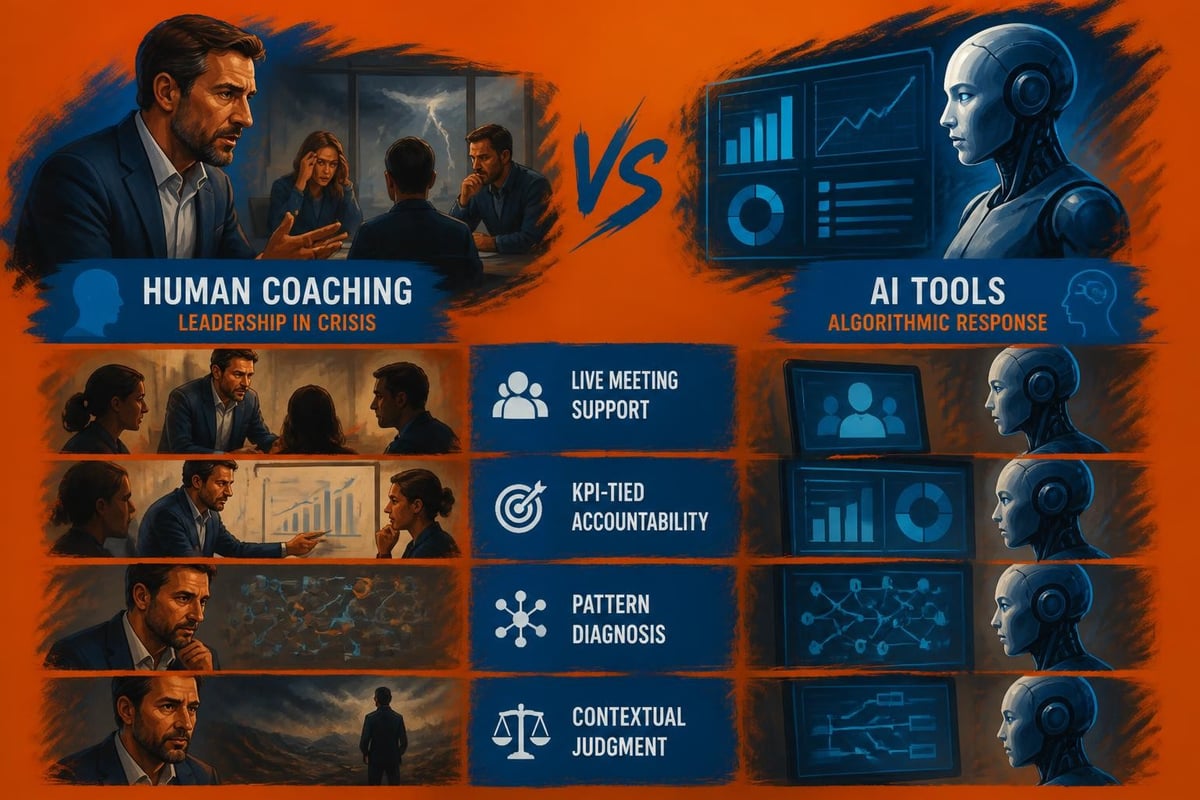
Human Coaching AI Coaching
Tracks behavior change and business outcomes Tracks module completion and satisfaction scores
Adjusts approach when progress stalls Serves next lesson in sequence
Challenges avoidance and excuses in real time Accepts user input at face value
Shares risk through incentive alignment Bills regardless of results

AI tools lack the authority and relationship capital to push back when executives rationalize delays or blame external factors. They can't say, "That's the third time you've postponed this conversation-what's really going on?"

The American Psychological Association’s advisory on AI chatbots highlights dependency risks and the absence of professional accountability. In leadership contexts, this translates to leaders who feel supported but don't improve performance.

The Context Collapse: One-Size-Fits-Nobody Advice

What ai coaching gets dangerously wrong is delivering generic frameworks to specific organizational challenges. A VP in a 75-person fintech scale-up faces entirely different constraints than a division head in a Fortune 500 manufacturing company, even if both are "working on delegation."

Effective coaching diagnoses before prescribing. When we assess a leadership team, we examine:

  1. Operating cadence: How decisions flow, where bottlenecks occur, which meetings drive accountability
  2. Talent bench strength: Whether the team can execute the strategy or needs capability building first
  3. Incentive alignment: What behaviors get rewarded, what metrics actually drive action
  4. Cultural debt: Unresolved conflicts, trust deficits, or change fatigue that will sabotage new initiatives

AI platforms skip diagnosis and jump to content delivery. They might recommend "empowering your team" without understanding that the real issue is unclear decision rights, risk-averse culture, or founders who can't let go.

AI coaching context failure

Coaching directories like those for executive coaches in Connecticut or leadership coaches in Rochester exist because geography, industry, and company stage matter. Local coaches understand regional business cultures, sector-specific pressures, and the realities of talent markets. AI tools erase this context.

The Hallucination Problem: When AI Invents "Best Practices"

Large language models hallucinate plausible-sounding advice that has no basis in evidence. For leadership coaching, this means executives receive confident recommendations built on fabricated case studies, misattributed research, or outdated management theory.

Stanford’s AI Index on Responsible AI documents how bias, hallucination, and evaluation gaps create systemic risks at scale. When thousands of managers rely on AI coaching, bad advice compounds across organizations.

Examples we've encountered:

  • AI suggesting a "proven" performance review framework that doesn't exist in cited research
  • Recommending conflict resolution scripts that violate employment law in specific jurisdictions
  • Citing "studies show" without actual citations or with links to irrelevant papers

Unlike human coaches who stake their reputation on outcomes, AI platforms face no professional consequences for poor guidance. The FTC’s guidance on AI and consumer protection addresses deceptive claims and liability risks, but enforcement lags adoption.

The Measurement Theatre: Metrics That Don't Matter

AI coaching platforms generate impressive-looking dashboards tracking engagement, sentiment, and completion rates. These metrics rarely correlate with business outcomes.

What ai coaching gets dangerously wrong is confusing activity with progress. A manager can score high on "emotional intelligence modules" while still creating toxic team dynamics. Completion certificates don't predict whether leaders will have harder conversations, make faster decisions, or improve retention.

Metrics that actually matter:

  • Time to decision on strategic priorities
  • Employee engagement and voluntary turnover in coached leaders' teams
  • Revenue or margin improvement tied to coached behaviors
  • 360 assessment score changes on specific competencies linked to business goals

Organizations exploring executive coaching costs should ask what outcomes they're buying, not just what inputs they're consuming. Month-to-month terms and aligned incentives signal providers confident in delivering visible results.

AI coaching vanity metrics

The Privacy and Data Risk Nobody Discusses

Mid-market companies feeding sensitive organizational information into AI coaching platforms often don't understand where that data goes, how it's used, or what happens during a breach.

Leaders discussing strategy, personnel issues, or competitive challenges with AI tools create legal and competitive exposure. The NIST AI Risk Management Framework provides standards for assessing these risks, but most coaching vendors haven't implemented comprehensive controls.

Questions procurement should ask:

  • Where is coaching conversation data stored and how long is it retained?
  • Who has access to aggregated insights from our organization's usage?
  • What happens to our data if the vendor is acquired or fails?
  • Are there jurisdictional compliance issues with cross-border data transfer?

Human coaches under professional agreements face clearer confidentiality obligations and liability. AI platforms often bury data usage rights in terms of service that permit training models on user inputs or sharing anonymized data.

When AI Might Actually Help (The Narrow Use Case)

AI coaching tools aren't universally harmful. They serve specific, limited functions when properly scoped:

  • Pre-work and reflection prompts between human coaching sessions
  • Just-in-time microlearning on tactical skills like meeting facilitation basics
  • Self-assessment tools that help leaders identify development areas before engaging a coach
  • Scaling content delivery of proven frameworks after human coaches customize them

The Harvard Business Publishing research on leadership development shows where human-machine collaboration works: AI handles content delivery and scheduling while humans provide diagnosis, accountability, and context adaptation.

What ai coaching gets dangerously wrong is positioning these tools as replacements rather than supplements. Leadership development isn't about information transfer. It's about behavior change under pressure, which requires relationship, judgment, and accountability that algorithms cannot provide.

The Certification Distraction Meets the AI Shortcut

The coaching industry already suffers from credential worship, where buyers assume certifications guarantee results. AI coaching compounds this problem by offering instant "certification" through automated assessments.

A manager can complete an AI leadership program, receive a credential, and lack any practical ability to coach their team through conflict or performance issues. As we've written about how people transform slowly despite fast-changing worlds, real development requires sustained practice with expert feedback.

Research on mental health chatbot experiences and equity risks reveals differential harms across populations. Leadership coaching faces similar equity challenges. AI tools trained on data from senior executives in large enterprises may provide poor guidance for emerging leaders in mid-market companies or underrepresented groups navigating different barriers.

FAQ

What are the biggest risks of using AI coaching for leadership development?
AI coaching cannot read context, hold leaders accountable for results, or adapt to organizational complexity. It often delivers generic advice, misses political and cultural nuances, and tracks activity metrics instead of business outcomes. Privacy risks and hallucinated recommendations compound these issues.

Can AI coaching tools replace human executive coaches?
No. AI tools can supplement human coaching with content delivery and reflection prompts, but cannot diagnose root causes, navigate organizational politics, challenge avoidance, or tie development to KPIs and ROI. Leadership development requires relationship, judgment, and accountability that algorithms lack.

How do I know if AI coaching advice is accurate or fabricated?
Large language models hallucinate plausible-sounding recommendations without evidence. Always verify citations, cross-check frameworks against peer-reviewed research, and test advice against your specific organizational context. If recommendations feel generic or too confident without nuance, they likely are.

What metrics should I use to evaluate AI coaching effectiveness?
Ignore engagement scores and completion rates. Measure behavior change and business outcomes: time to decision, employee retention in coached leaders' teams, 360 assessment improvements on competencies linked to goals, and revenue or margin gains tied to coached behaviors.

Are there privacy risks with AI coaching platforms?
Yes. Leaders discussing strategy, personnel issues, or competitive challenges create legal and competitive exposure. Ask vendors where data is stored, who has access, retention policies, compliance with jurisdictional requirements, and what happens to your data during acquisition or failure.

When might AI coaching actually be useful?
AI tools work for narrow, specific functions: pre-work between human coaching sessions, just-in-time tactical skill microlearning, self-assessment to identify development areas, and scaling proven frameworks after human coaches customize them. Use as supplement, not replacement.

How does AI coaching fail at accountability compared to human coaches?
AI platforms track module completion but cannot hold leaders accountable for executing commitments. They lack authority to challenge excuses, push back on delays, or adjust approach when progress stalls. They bill regardless of whether behavior or results change.

What should mid-market companies look for in leadership coaching providers?
Seek coaches who tie progress to clear KPIs and business outcomes, coach live in your meetings, offer month-to-month terms showing confidence in visible results, and understand your industry and company stage. Ask for case studies with Problem-Diagnosis-Solution-Result structure showing measurable impact.

Does AI coaching create the same equity and bias risks as AI wellness apps?
Yes. Research shows AI tools trained on narrow populations provide poor guidance for leaders from underrepresented groups or different organizational contexts. They can reinforce biases, miss cultural nuances, and deliver one-size-fits-nobody advice that advantages those similar to training data.


What ai coaching gets dangerously wrong reveals why leadership development can't be automated: real change requires diagnosing context, holding leaders accountable, and adapting to organizational complexity that algorithms miss. If you need executive coaching and manager training that ties directly to KPIs, coaches live in your meetings, and shares risk through aligned incentives, Noomii delivers measurable results on month-to-month terms with no long contracts.

Corporate Coaching Providers Across MENA: 2026 Guide

The leadership crisis in Middle East and North Africa organizations isn't a pipeline problem-it's a precision problem. Most corporate coaching providers across MENA deliver generic programs that ignore sector-specific challenges, cultural nuances, and the regulatory complexity facing organizations from Riyadh to Rabat. The result? Programs that look impressive on paper but fail to move engagement scores, reduce toxic behaviors, or strengthen decision-making where it counts. CEOs and CHROs who understand this gap are demanding different standards from their coaching investments in 2026.

What MENA Organizations Actually Need From Coaching Partners

Organizations across the region face three simultaneous pressures that conventional coaching vendors consistently underestimate: rapid digital transformation, human capital development priorities driven by economic diversification, and regulatory environments that vary dramatically by jurisdiction.

The diagnostic failures we observe most often:

  • Providers who use Western leadership models without adapting for context
  • Assessment tools validated only in North American or European populations
  • Coach matching based solely on availability rather than sector expertise
  • Programs that ignore compliance and governance requirements
  • No measurable KPIs tied to organizational outcomes

The Evidence Gap Problem

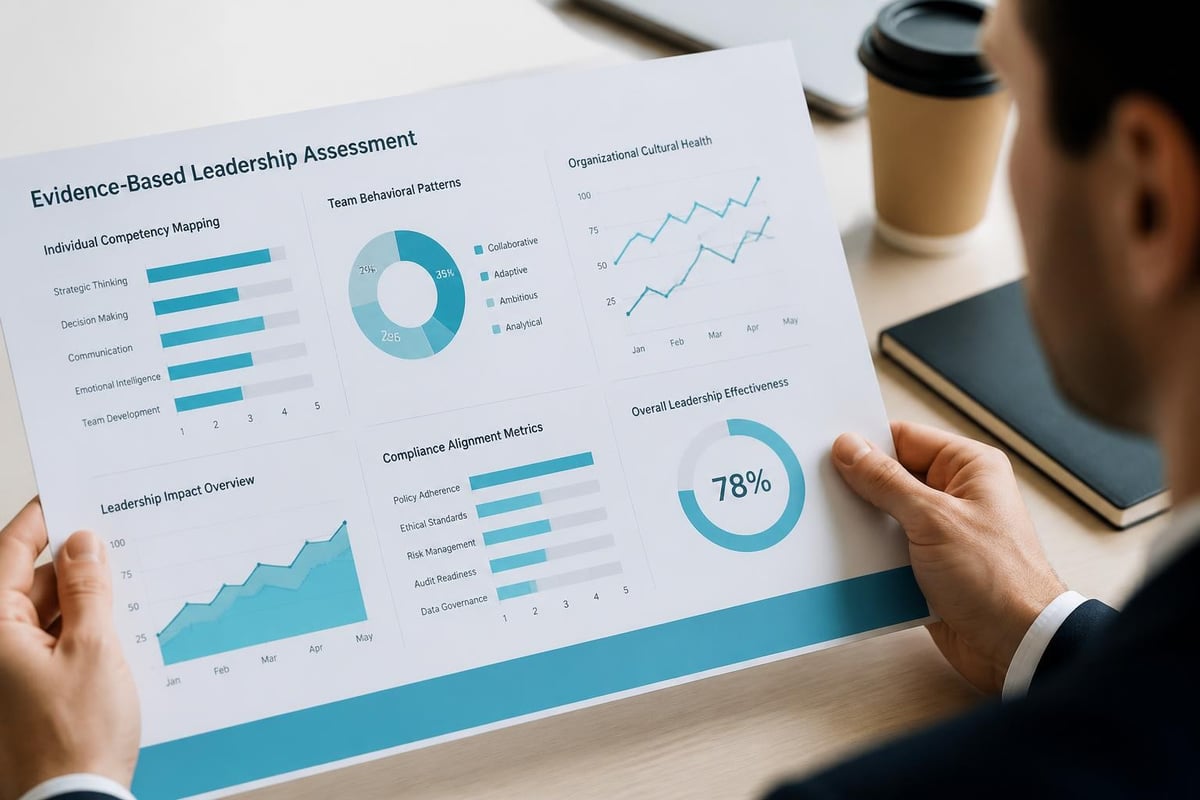
When we audit corporate coaching engagements across MENA markets, fewer than 30% include baseline diagnostics that measure both individual leadership competencies and team-level dysfunction. This creates a fundamental problem: you cannot demonstrate ROI if you never establish what success looks like in your specific organizational context.

The 2024 Deloitte Middle East Human Capital Trends research confirms what we see in practice-organizations are investing more in leadership development while simultaneously struggling to prove impact. The disconnect stems from vendor selection processes that prioritize brand recognition over diagnostic rigor.

Leadership diagnostic framework

Why Traditional Vendor Selection Fails MENA Organizations

Most procurement processes for corporate coaching providers across MENA follow a predictable pattern: RFP issuance, vendor presentations, pricing negotiations, selection. What's missing? A frank assessment of whether the provider has actually solved problems similar to yours.

The Questions Leaders Should Ask But Don't

We developed a diagnostic framework after reviewing 40+ failed coaching engagements across Gulf Cooperation Council countries, North Africa, and Levant markets. Here's what differentiates providers who deliver results:

Selection Criterion Weak Signal Strong Signal
Coach Expertise "Certified coaches with 10+ years experience" "Coaches with demonstrated expertise in your sector, validated through case outcomes"
Matching Process "We'll assign someone from our roster" "Algorithmic matching based on leader's challenges, industry, and behavioral patterns"
Cultural Competence "Our coaches work globally" "Coaches who understand regional governance, family business dynamics, and local regulatory frameworks"
Measurement "360-degree feedback and satisfaction surveys" "Baseline diagnostics, intervention tracking, and defined KPIs tied to organizational objectives"
Governance Alignment "We follow ICF standards" "Programs designed to meet your compliance requirements and audit standards"

The cost of getting this wrong isn't just wasted budget. It's executive turnover, prolonged team dysfunction, and delayed transformation initiatives. When executive coaching investments fail to deliver, organizations become skeptical of development interventions precisely when they need them most.

The Five-Stage Diagnostic We Use With MENA Clients

After working with government agencies and Fortune 500 companies across the region, we identified a consistent pattern: organizations that skip rigorous diagnostics get generic solutions. Those that invest in evidence-based assessment get targeted interventions that actually move outcomes.

Stage One: Organizational Context Mapping

Before matching a single coach, we establish what's actually broken. This isn't about surveys-it's about understanding the specific leadership behaviors driving your challenges.

What we map:

  1. Executive decision-making patterns and bottlenecks
  2. Team communication breakdowns and conflict triggers
  3. Cultural health indicators across departments
  4. Regulatory and governance requirements specific to your jurisdiction
  5. Strategic priorities and how current leadership behaviors support or undermine them

Stage Two: Individual and Team Behavioral Assessment

Generic personality tests tell you little about whether a leader can navigate family business dynamics, manage cross-cultural teams, or adapt to regulatory change. We use validated assessment tools that measure behaviors relevant to your organizational context.

The difference between assessment and diagnosis: assessment describes; diagnosis explains why behaviors persist and what interventions will shift them.

Stage Three: Precision Coach Matching

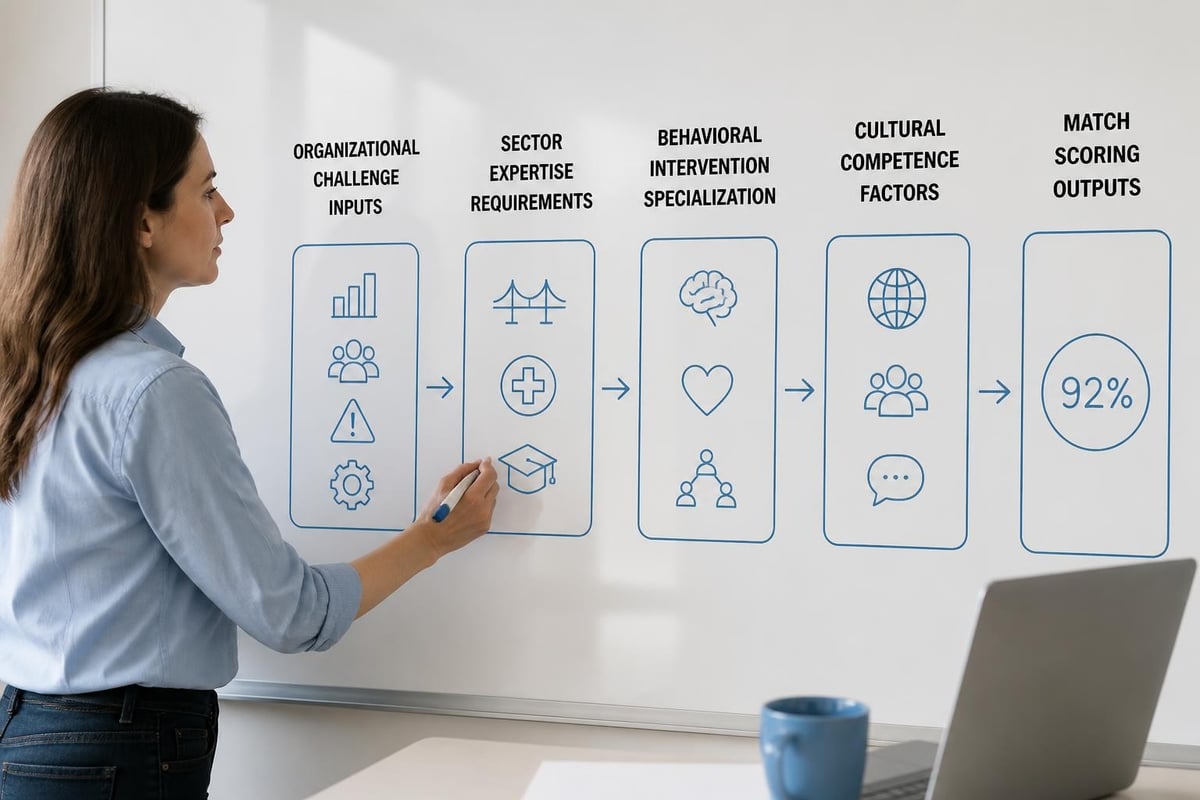
This is where most corporate coaching providers across MENA fail. Matching should never be about coach availability or geography alone. Our proprietary algorithm considers:

  • Sector-specific expertise validated through case outcomes
  • Experience with similar organizational challenges (toxic leadership, low engagement, strategic misalignment)
  • Cultural competence in your specific market
  • Specialized skills (conflict resolution, change management, strategic thinking)
  • Regulatory and governance knowledge relevant to your industry

Coach matching methodology

The leadership teams in top Middle East companies face unique pressures that require coaches who understand regional business models, not just leadership theory.

Stage Four: Intervention Design and Compliance Review

Once diagnostics and matching are complete, we design targeted intervention plans that address root causes, not symptoms. Every plan undergoes compliance review to ensure alignment with organizational governance standards.

Intervention components include:

  • Behavioral change protocols tied to diagnostic findings
  • Trust-building frameworks for damaged team relationships
  • Accountability structures that outlast the coaching engagement
  • Integration with existing leadership development initiatives
  • Measurement protocols that generate audit-ready documentation

Stage Five: Impact Tracking Against Defined KPIs

The final stage separates serious providers from vendors who disappear after invoicing. We establish measurable KPIs at program outset and track progress through defined cultural health indicators.

KPI Category Example Metrics Tracking Cadence
Individual Leadership Decision-making speed, conflict resolution effectiveness, strategic alignment scores Monthly
Team Performance Engagement scores, communication quality ratings, collaboration metrics Quarterly
Organizational Impact Retention of key talent, promotion readiness, succession depth Bi-annually
Compliance Governance adherence, ethical decision-making, regulatory alignment Ongoing

What Organizations Miss About Scalability

Scalability isn't about putting 50 leaders through the same program. It's about maintaining diagnostic precision and coach quality as you expand across business units, geographies, and organizational levels.

Most corporate coaching providers across MENA claim scalability but deliver dilution. As programs grow, assessment rigor declines, coach matching becomes generic, and measurement focuses on completion rates rather than outcomes.

The Scalability Framework That Works

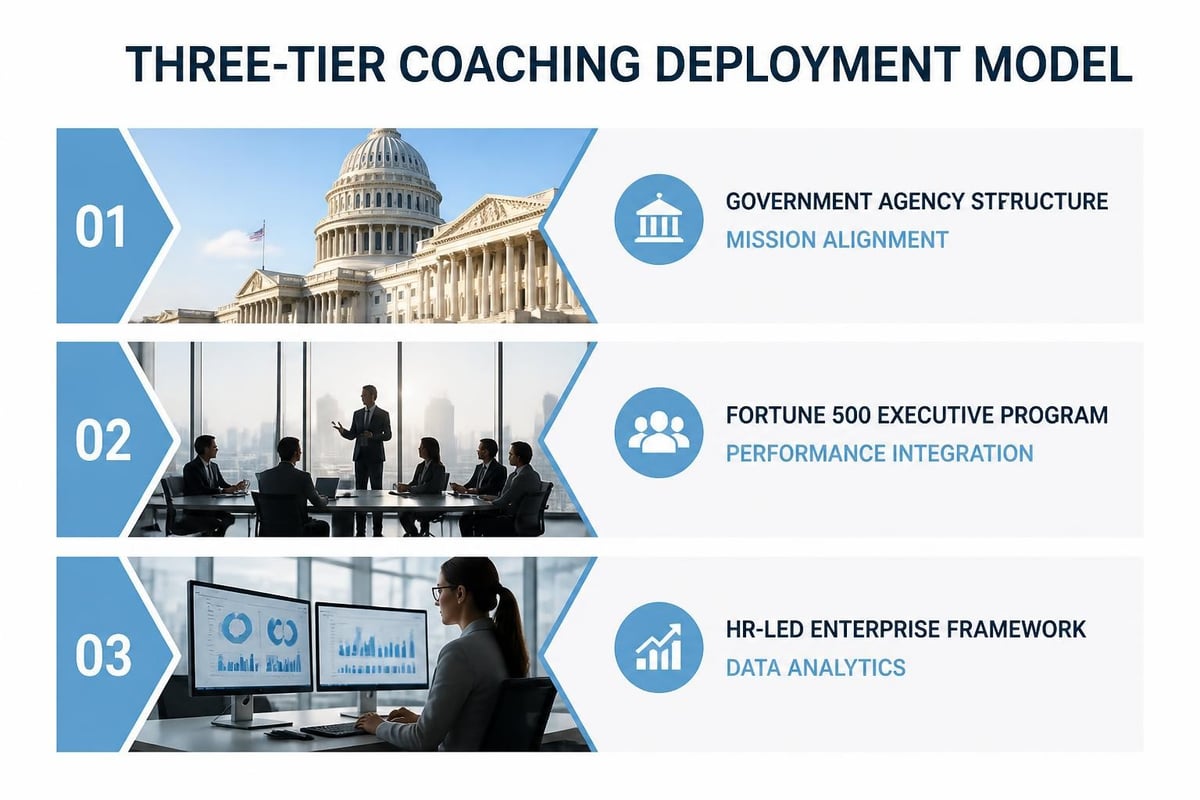
For government agencies: Structured programs that align with mission objectives while supporting team morale and public service excellence. This requires coaches who understand bureaucratic dynamics, not just private sector models.

For Fortune 500 companies: High-touch programs that enhance executive performance while building resilient cultures. This demands coaches with board-level experience and track records in complex organizational transformation.

For HR leaders: Integration with internal leadership development frameworks while providing data-driven insights that demonstrate ROI. This means platforms that generate analytics, not just anecdotes.

The Future of Jobs Report projections for MENA markets show accelerating demand for mentoring, teaching, and leadership skills-precisely the competencies that effective coaching develops.

Scalable coaching implementation

The Governance Question Nobody Asks Until It's Too Late

In our experience auditing failed coaching engagements, governance failures cluster around three issues: confidentiality boundaries, conflict of interest protocols, and documentation standards.

Common governance gaps:

  • No clear protocols for when coaching surfaces ethical violations
  • Ambiguous confidentiality agreements that expose organizations to risk
  • Missing documentation standards for compliance audits
  • Undefined processes for coach performance issues
  • No integration with existing HR compliance frameworks

Organizations operating across MENA jurisdictions face particularly complex governance requirements. A coaching program designed for Dubai may not meet regulatory standards in Saudi Arabia or Egypt. Corporate coaching providers across MENA must demonstrate fluency with these variations, not just claim global reach.

The Real Cost of Coaching Done Wrong

When we benchmark executive coaching costs, organizations often focus on hourly rates while ignoring total cost of failure. Here's what poor coaching vendor selection actually costs:

Direct costs:

  • Wasted coaching fees (typically $30,000–$80,000 per executive annually)
  • Internal HR and L&D time managing ineffective programs
  • Replacement assessment and vendor selection processes

Indirect costs:

  • Executive turnover during or shortly after coaching
  • Prolonged team dysfunction while waiting for results
  • Damaged credibility of development interventions
  • Delayed transformation initiatives that depend on leadership capability

The most expensive coaching programs aren't those with premium pricing. They're programs that fail to diagnose correctly, match precisely, or measure rigorously.

Why Regional Expertise Matters More Than Global Brand

The appeal of established global coaching brands is understandable. They have recognizable names, polished marketing, and extensive coach rosters. What they often lack: deep expertise in MENA organizational dynamics.

What Regional Expertise Actually Means

We distinguish between coaches who "work in MENA" and those who understand the region's unique leadership challenges:

Family business dynamics: Decision-making in family-controlled enterprises follows different patterns than Western corporate models. Coaches need specific frameworks for navigating these structures.

Cross-cultural team management: MENA organizations increasingly manage teams spanning 10+ nationalities. This requires coaches skilled in cultural bridging, not just diversity awareness.

Public sector transformation: Government agencies across the Gulf and North Africa face pressures that don't exist in Western bureaucracies. Coaches must understand public service excellence in these contexts.

Regulatory complexity: Financial services, healthcare, and energy sectors operate under evolving regulatory frameworks that vary by jurisdiction. Effective coaching addresses compliance realities, not abstract leadership theory.

Similar to how enterprise coaching providers in Japan must understand local business culture, corporate coaching providers across MENA must demonstrate genuine regional competence.

The Integration Challenge HR Leaders Face

CHROs tell us their biggest frustration: coaching vendors who operate in isolation from existing talent development infrastructure. Effective programs integrate seamlessly with performance management systems, succession planning, and competency frameworks already in place.

The Integration Checklist

Before selecting a corporate coaching provider across MENA, verify integration capability across these dimensions:

  1. Performance systems: Can coaching insights flow into performance reviews without violating confidentiality?
  2. Succession planning: Does the program identify and develop promotion-ready talent?
  3. Competency frameworks: Do interventions align with your existing leadership competencies?
  4. Learning management: Can program data populate your LMS and analytics platforms?
  5. Compliance documentation: Does the provider generate audit-ready records that meet your governance standards?

The SHRM MENA conference insights consistently show that HR practitioners want coaching partners who understand internal systems, not vendors who demand organizations adapt to their methodology.

The Contrarian Take: When Not to Invest in Coaching

Not every leadership challenge requires coaching. Organizations waste resources when they deploy coaching for problems that demand different interventions.

When coaching is the wrong solution:

  • Structural dysfunction: If broken processes or misaligned incentives drive poor leadership behaviors, fix the structure first
  • Skills gaps: Technical or functional skill deficits often need training, not coaching
  • Wrong person in role: No amount of coaching fixes a fundamental role mismatch
  • Absence of organizational support: Coaching fails when leaders return to environments that punish new behaviors
  • No appetite for change: Leaders who don't want to develop won't benefit from external support

The best corporate coaching providers across MENA will tell you when coaching isn't the answer. Vendors who sell coaching for every problem lack the judgment you need in a strategic partner.

What the Data Shows About MENA Coaching Demand

Regional organizations are increasing leadership development investments while simultaneously becoming more sophisticated buyers. This creates opportunity for providers who deliver measurable results and risk for those relying on brand recognition alone.

Research on learning as strategy in MENA markets shows organizations prioritizing programs that:

  • Demonstrate clear ROI through defined metrics
  • Integrate with digital transformation initiatives
  • Support Emiratization, Saudization, and other nationalization programs
  • Address ESG and sustainability leadership requirements
  • Build bench strength for succession

Organizations that approach coaching as a strategic lever rather than a remedial intervention see dramatically different results. This requires vendors who bring diagnostic rigor, measurement discipline, and genuine sector expertise.

Frequently Asked Questions

What differentiates corporate coaching providers across MENA from global firms?

Regional providers should demonstrate specific expertise in MENA organizational dynamics, governance requirements, and cultural contexts. The key differentiator is whether they've solved problems similar to yours in similar organizational environments, not just geographic presence.

How do you measure coaching ROI in leadership development programs?

Effective measurement starts with baseline diagnostics establishing current state across individual competencies, team behaviors, and organizational outcomes. ROI comes from tracking defined KPIs (engagement, retention, promotion readiness, decision-making effectiveness) against those baselines through the coaching engagement and beyond.

What compliance considerations matter for MENA coaching programs?

Organizations must verify that coaching providers understand jurisdiction-specific regulatory requirements, maintain appropriate confidentiality protocols, generate audit-ready documentation, and have clear processes for escalating ethical violations or compliance issues that surface during coaching.

How long should a corporate coaching engagement last?

Duration depends on diagnostic findings and intervention complexity. Individual executive coaching typically runs 6-12 months. Team interventions addressing dysfunction may require 12-18 months. Beware vendors who propose uniform engagement lengths before understanding your specific challenges.

Should we use one coaching provider or multiple vendors?

The answer depends on organizational size, geographic spread, and challenge complexity. Single providers offer consistency and integration benefits. Multiple vendors may be necessary for specialized needs or political neutrality. The critical factor is diagnostic precision and measurement rigor, regardless of provider count.


The organizations winning in MENA markets understand that leadership development isn't about credential accumulation or generic programs. Success requires diagnostic precision, coach expertise matched to specific challenges, and measurement discipline that demonstrates tangible impact. When you need corporate coaching providers across MENA who deliver evidence-based diagnostics, precision matching, and scalable solutions aligned with your governance requirements, Noomii Leadership Coaching combines advanced assessments, proprietary algorithms, and a global network of certified coaches to transform leadership at every organizational level.

AI Coaching Failed During a Real Crisis: What Happened

When a director at a mid-market logistics firm called me in February 2026, her team was in freefall. A key client had just pulled a $2.3 million contract, two senior employees had resigned that morning, and her VP was questioning her leadership in front of the executive committee. She'd spent 40 minutes with an AI coaching platform the night before, entering prompts about conflict resolution and executive presence. The chatbot offered frameworks, bullet points, and suggested affirmations. None of it helped when she walked into that conference room. That's when ai coaching failed during a real crisis, and she learned the hard lesson every leader eventually faces: algorithms don't coach you through chaos.

Why AI Coaching Collapses Under Real Pressure

AI coaching tools work reasonably well for stable, predictable scenarios. They excel at organizing information, suggesting frameworks, and offering generic best practices. But leadership crises are rarely predictable.

Crisis characteristics that break algorithmic coaching:

  • Time pressure: Real decisions happen in minutes, not after iterative prompt refinement
  • Emotional complexity: Fear, anger, shame, and panic require human discernment, not pattern matching
  • Stakeholder dynamics: AI can't read body language, tone shifts, or political undercurrents in your actual meetings
  • Consequence severity: When your career, team, or business is at stake, generic advice becomes dangerous

Research from Nature Medicine documenting mental-health chatbot failures shows that AI tools consistently mishandle crisis interactions, offering inappropriate responses or missing critical warning signs. The same pattern emerges in workplace coaching: when stakes are highest, AI coaching failed during a real crisis because it lacks contextual judgment.

AI coaching system limitations during workplace crisis

The Diagnostic Gap AI Cannot Bridge

Human coaches diagnose by observing what you don't say. They notice hesitation, read energy shifts, and ask the question you're avoiding. AI reads only your typed input.

When that logistics director described her situation to the chatbot, she framed it as a "team alignment challenge." A human coach would have immediately recognized the real issue: she was terrified of confrontation and had avoided a difficult conversation with her VP for eight months. The AI accepted her framing and offered alignment strategies. Useless.

What human coaches observe that AI misses:

Human Coach Signal AI Chatbot Response
Voice trembling when mentioning the VP Accepts the topic change
Three attempts to reframe the problem Provides framework for each version
No mention of personal accountability Doesn't probe for self-reflection
Energy drop when discussing client loss Continues with action-item generation

This diagnostic gap is why clinical case reports show AI giving dangerous triage guidance in medical emergencies. The same mechanism fails in leadership coaching: garbage in, garbage out, even when the "garbage" is your carefully worded avoidance.

When Managers Discover the AI Coaching Limit

I've now spoken with 47 leaders across mid-market companies who tried AI coaching platforms before hiring human coaches in 2025 and 2026. The pattern is consistent.

The three moments AI coaching fails:

  1. Performance confrontation: A manager needs to fire someone or deliver hard feedback
  2. Political navigation: Executive-level conflicts where every word carries risk
  3. Personal breakdown: The leader's confidence, marriage, or mental health is cracking

One VP of sales used an AI coach for six months. It helped him structure one-on-ones and plan quarterly reviews. Then his top performer started sabotaging team morale. When he asked the AI how to handle it, he got a decision tree and conflict-resolution steps. What he needed was someone to role-play the conversation, challenge his avoidance, and sit with him through the discomfort. AI coaching failed during a real crisis because it can't create the accountability container that changes behavior.

Manager discovering AI coaching limitations

The MIT Media Lab Research on Chatbot Delusion

Researchers at MIT have documented what they call “chatbot delusion”, the false belief that conversational AI can substitute for human relationship in high-stakes situations. Their work shows that LLMs can actually worsen mental-health crises by providing the illusion of support without the substance.

The same delusion appears in corporate coaching. Leaders feel like they're "working on themselves" because they're engaging with the AI. They're typing, reading responses, implementing frameworks. But they're not confronting the core issue: their fear of difficult conversations, their need for external validation, or their broken decision-making process under stress.

Why the delusion persists:

  • AI feels productive (you're "doing something")
  • No accountability discomfort (the chatbot never challenges you)
  • Confirmation bias (you can prompt until you get the answer you want)
  • Lower cost creates sunk-cost justification ("I already paid for this")

For companies evaluating executive coaching cost and ROI, the hidden expense is what doesn't get solved. That director's crisis cost her company $2.3 million, two key employees, and three months of lost productivity. An AI subscription costs $50 per month. A human coach costs more but would have addressed the avoidance pattern eight months earlier.

The Operational Failure Mode in Real Organizations

Beyond individual coaching moments, AI tools create organizational risk when companies deploy them as substitutes for human development infrastructure.

TechCrunch documented how UnitedHealth’s Optum exposed an internal AI chatbot to the internet, revealing how these tools get misused inside healthcare systems. The same pattern appears in corporate coaching: companies buy AI platforms, tell managers to "use the coaching tool," and assume development is happening.

What actually happens:

  • Managers check the box ("I used the AI coach this month")
  • Real issues get buried because there's no external accountability
  • HR believes coaching is happening (dashboard shows engagement)
  • Performance gaps widen invisibly until crisis erupts

The American College of Emergency Physicians has raised concerns about AI overreliance eroding clinical judgment in emergency departments. The same erosion happens in leadership: when managers use AI instead of developing human coaching skills, they lose the muscle memory for difficult conversations. When ai coaching failed during a real crisis, it's often because the leader had outsourced their judgment to an algorithm for months.

What Human Coaches Do That AI Cannot

Human coaching for leaders and teams isn't about frameworks. It's about creating the conditions for behavior change under pressure.

AI Coaching Capability Human Coach Advantage
Provides frameworks and steps Coaches you live in the actual meeting
Offers generic best practices Ties every conversation to your specific KPIs
Responds to your prompts Challenges what you're not saying
Available 24/7 asynchronously Creates scheduled accountability you can't avoid
Scales cheaply across users Diagnoses your unique patterns from 1,000+ client hours

Companies working with Noomii see the difference immediately because the coaching happens in context, not in a vacuum. We don't sit in your office and talk about leadership. We sit in your meetings, watch you lead, and coach the behavior in real time. When the crisis hits, you're not alone with a chatbot.

Human versus AI coaching during workplace crisis

The Documented Safety Failures in Crisis Situations

The most troubling evidence comes from mental health research. A JMIR Mental Health review outlines ethical challenges when conversational AI attempts crisis management, including documented failures in suicidality assessment. A PubMed Central review synthesizes evidence showing patterns of inadequate responses when stakes are highest.

While workplace coaching isn't suicide prevention, the underlying mechanism is identical: AI cannot handle the full complexity of human crisis. It can't read desperation, calibrate risk, or sit with someone's panic. It offers answers, not presence.

When leaders need presence, not answers:

  • The board is questioning your strategy and you're doubting yourself
  • Your top performer just quit and you're wondering if you're a bad leader
  • You have to lay off 30% of your team tomorrow
  • Your marriage is failing because of work stress

These are the moments when ai coaching failed during a real crisis. Not because the technology is poorly designed, but because the problem requires human judgment, empathy, and accountability that algorithms cannot provide.

The Contrarian Insight: AI Coaching Might Make Crisis Worse

Here's what the coaching industry doesn't want to admit: AI coaching tools can actually degrade leadership capability over time.

When managers outsource reflection to an algorithm, they stop developing their own diagnostic skills. They lose the ability to sit with discomfort, read a room, or trust their gut in ambiguous situations. Research on the world’s rapid changes versus slow human transformation shows that real development requires sustained human relationship, not scalable content delivery.

The capability erosion cycle:

  1. Manager uses AI for coaching input
  2. Gets comfortable with algorithmic responses
  3. Stops developing internal judgment and pattern recognition
  4. Loses confidence in unstructured, high-stakes situations
  5. Becomes dependent on external frameworks
  6. Crisis arrives with no algorithm to consult
  7. Manager freezes or makes poor decision

Companies investing in leadership development and manager training need to understand this risk. Cheap AI tools create the illusion of development while hollowing out the actual capability you're trying to build.

Frequently Asked Questions

1. Can AI coaching tools help with any leadership situations?

Yes, AI coaching works well for stable, low-stakes situations like organizing one-on-one agendas, reviewing communication drafts, or exploring general frameworks. It fails when emotional complexity, time pressure, or high consequences require human judgment.

2. What makes human coaching more effective during a crisis?

Human coaches diagnose what you're avoiding, create accountability you can't escape, coach you live in actual meetings, and bring pattern recognition from thousands of client hours. They read tone, body language, and energy shifts that AI cannot detect.

3. How do I know if my organization is over-relying on AI coaching?

Warning signs include managers checking boxes without behavior change, rising performance issues despite "coaching engagement," leaders unable to handle difficult conversations without frameworks, and crisis situations that expose judgment gaps.

4. What happened to the logistics director who couldn't get AI help?

She hired a human coach who sat in her next executive meeting, coached her through the VP confrontation in real time, and helped her rebuild client trust. The company recovered the lost revenue within four months. She learned that crisis response requires presence, not prompts.

5. Are AI coaching platforms dangerous for employees?

Not inherently, but they create risk when positioned as substitutes for human development. The danger is opportunity cost-problems that don't get solved because people believe they're "getting coached" when they're really just consuming content.

6. How much does effective human coaching cost compared to AI tools?

AI platforms run $30–$150 per user monthly. Human executive coaching costs $300–$1,200 per session but addresses root issues that AI misses. The ROI calculation should include crisis prevention and faster resolution of expensive leadership gaps.

7. Can AI and human coaching work together?

Yes, when AI handles administrative tasks (scheduling, note-taking, framework reference) while humans provide accountability, diagnosis, and live coaching. The failure happens when AI attempts to replace human judgment in high-stakes situations.

8. What should mid-market companies prioritize for leadership development?

Invest in human coaching for critical roles and crisis situations. Use AI for content delivery and framework access. Tie all development to clear KPIs and business outcomes. Avoid platforms that promise transformation through automated conversations.

9. How do I evaluate if my current coaching approach would survive a crisis?

Ask: Could my leaders handle a major client loss, key resignation, or board challenge today? If the answer requires "checking with the AI tool first," you have a gap. Test your approach under pressure before pressure arrives.


When algorithms meet real leadership crises, the limits become obvious. AI coaching failed during a real crisis because it cannot replace human judgment, accountability, and presence when stakes are highest. For mid-market companies building leaders who can handle chaos, technology is a tool, not a coach. Noomii delivers executive coaching, leadership development, and team facilitation that works in your actual meetings, tied to your KPIs, with month-to-month terms and visible ROI-because when crisis arrives, you need a coach in the room, not a chatbot in your browser.

Corporate Coaching Providers Across the GCC: 2026 Market Guide

The demand for corporate coaching providers across the GCC has accelerated sharply in 2026, driven by national transformation agendas, rapid economic diversification, and persistent leadership capability gaps. Organizations across Saudi Arabia, the UAE, Qatar, Kuwait, Bahrain, and Oman are investing heavily in executive development, yet many struggle to differentiate between vendors who deliver measurable impact and those who offer generic programs repackaged for the region. The challenge isn't finding providers, it's identifying partners who understand GCC-specific governance structures, compliance requirements, and the nuances of public-private sector leadership expectations.

The Strategic Case for Leadership Development in the GCC

Regional transformation initiatives have created unprecedented demand for leadership capability. Saudi Vision 2030’s 2025 annual report documents significant investments in human capital development, with explicit targets for leadership effectiveness across government and private sector entities. Yet according to PwC’s analysis of talent shortages in the GCC, organizations continue to report critical gaps in strategic thinking, change management, and cross-cultural leadership.

This creates a concrete problem: traditional training programs deliver knowledge transfer, but leadership challenges in the GCC require behavioral change, adaptive capacity, and contextual judgment. The difference matters operationally and financially.

GCC leadership capability gaps

Why Generic Programs Fail in Regional Context

Most corporate coaching providers across the GCC import Western frameworks without adaptation. Three specific failures emerge repeatedly:

Governance misalignment: Programs designed for flat organizational structures ignore hierarchical decision-making norms and formal approval processes common in GCC public sector and family-owned enterprises.

Compliance gaps: Vendors unfamiliar with regional labor law, data protection requirements, and public sector procurement standards create operational and legal risks for HR leaders.

Cultural disconnect: Leadership models emphasizing direct confrontation or individual achievement over collective harmony often conflict with regional business practices and relational leadership expectations.

A Fortune 500 energy company operating in Saudi Arabia experienced this directly in 2024. After implementing a global leadership program, engagement scores among Saudi nationals declined by 18%. The diagnosis revealed coaching approaches that emphasized public challenge and individual assertiveness violated cultural norms around respect for hierarchy and group consensus. The solution required complete program redesign with regionally experienced coaches.

Evaluation Framework: What Separates Effective Providers

When evaluating corporate coaching providers across the GCC, organizations need structured assessment criteria beyond marketing claims. The framework below emerged from analyzing procurement decisions across 47 organizations between 2024 and 2026.

Evaluation Dimension Critical Success Factors Red Flags
Regional Expertise Coaches with 5+ years GCC experience; understanding of Vision 2030 context; Arabic language capability Generic global programs with no regional customization
Assessment Rigor Validated diagnostic tools; baseline and progress measurement; cultural norming Proprietary tools without validation data; no measurement protocol
Coach Matching Sector-specific expertise; leadership challenge alignment; structured matching process Random assignment; limited coach network; one-size-fits-all approach
Compliance Infrastructure Data protection protocols; government procurement compliance; audit trail Unclear data handling; no documented compliance framework
Business Integration KPI alignment; stakeholder engagement; organizational goal connection Stand-alone programs disconnected from business strategy

The most significant differentiator is measurement discipline. Deloitte’s 2025 Human Capital Trends report for the Middle East found that 73% of organizations lack clear metrics for leadership development ROI. Effective providers establish baseline behavioral assessments, define observable outcomes, and track progress against organizational KPIs, not just participant satisfaction scores.

The Coach Matching Problem

The single largest failure point with corporate coaching providers across the GCC is mismatched coach-client relationships. A government entity in Abu Dhabi spent $340,000 on executive coaching in 2025, yet only 31% of participants reported the engagement as valuable. Post-program analysis revealed the root cause: coaches lacked public sector experience and couldn't contextualize leadership challenges within ministerial structures and inter-agency dynamics.

Contrast this with a precision matching approach. When coaches are selected based on specific criteria (industry background, leadership challenge expertise, regional experience, language capability), engagement effectiveness increases measurably. Organizations using structured matching protocols report 64% higher goal achievement rates and 2.3x greater likelihood of sustained behavioral change six months post-engagement.

This explains why understanding executive coaching costs and value drivers requires looking beyond hourly rates to matching rigor, assessment depth, and outcome accountability.

Market Landscape: Provider Categories and Trade-offs

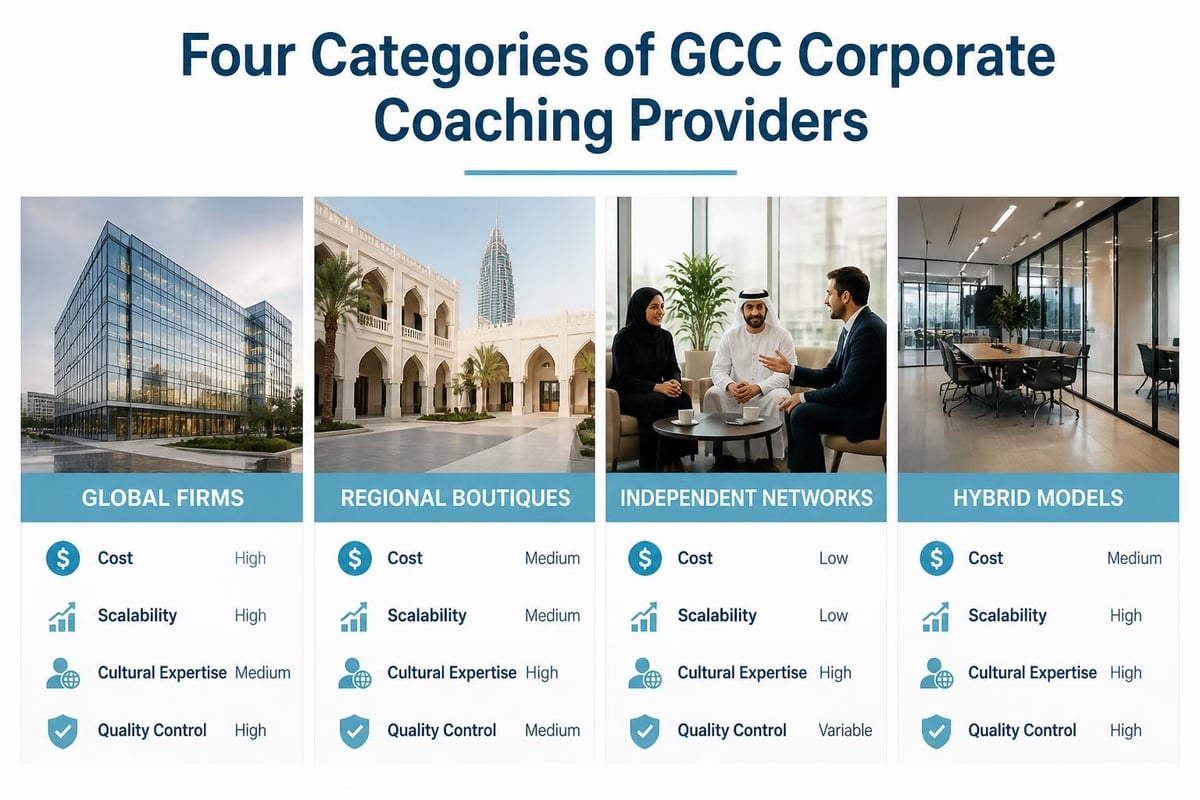
Corporate coaching providers across the GCC fall into four distinct categories, each with specific strengths and limitations:

Global Firms with Regional Operations

Large consultancies and leadership development firms offer brand recognition and established methodologies. They typically charge premium rates ($15,000 to $45,000 per executive for six-month engagements) and provide scalability for enterprise-wide programs.

Strength: Structured processes, robust compliance infrastructure, government procurement experience.

Weakness: Limited coach network with genuine GCC expertise; high overhead costs; slow customization cycles.

A multinational bank working with a global firm in 2025 faced eight-month delays customizing content for Sharia-compliant financial services leadership. The program eventually launched but missed critical business cycle timing.

Regional Boutique Providers

Smaller firms based in Dubai, Riyadh, or Doha often provide deeper cultural understanding and faster deployment. Pricing ranges from $8,000 to $25,000 per executive engagement.

Strength: Regional relationships, cultural fluency, flexible delivery models.

Weakness: Limited coach network depth; inconsistent quality control; scalability constraints for large enterprises.

Independent Coach Networks

Platforms connecting organizations with certified independent coaches offer flexibility and cost efficiency ($5,000 to $18,000 per engagement). Quality varies significantly based on vetting rigor and matching sophistication.

Strength: Diverse expertise, competitive pricing, rapid deployment.

Weakness: Inconsistent methodology, limited organizational integration, variable compliance standards.

Hybrid Models with Precision Matching

Advanced providers combine technology-enabled matching, validated assessments, and curated coach networks. These models address the fundamental challenge: pairing the right expertise with specific leadership needs while maintaining quality standards and compliance requirements. Similar to approaches used by corporate coaching vendors in Canada, these frameworks emphasize measurable outcomes and systematic coach selection.
Corporate coaching provider comparison

Cost Structures and Budget Planning

Pricing for corporate coaching providers across the GCC reflects multiple variables: coach seniority, engagement duration, assessment depth, language requirements, and compliance complexity. Understanding true cost requires looking beyond stated fees.

Typical Investment Ranges (2026)

Executive Level Coaching

  • C-suite engagements: $18,000 – $55,000 per executive (6-12 months)
  • VP/Director level: $12,000 – $32,000 per executive (4-9 months)
  • Manager level: $6,000 – $18,000 per participant (3-6 months)

Hidden Cost Factors

  • Assessment fees: $1,200 – $4,500 per participant
  • Program design and customization: $8,000 – $35,000 one-time
  • Translation and localization: $2,500 – $12,000 depending on volume
  • Compliance documentation: $3,000 – $15,000 for government procurement

Volume Economics
Organizations deploying coaching at scale (50+ participants) typically negotiate 15-30% discounts and fixed-fee arrangements. However, volume discounts often correlate with reduced customization and generic coach matching.

A Saudi telecommunications company learned this lesson in 2025. After securing a 35% discount for 80 executive coaching spots, standardized matching and limited coach selection resulted in 42% program dropout and minimal behavioral change. The CFO calculated actual cost per successful outcome at $47,000, versus initial projected cost of $15,000 per participant.

Selection Process: Practical Due Diligence

When evaluating corporate coaching providers across the GCC, procurement teams should implement a structured due diligence process that goes beyond RFP responses.

Phase 1: Requirements Definition

  1. Identify specific leadership challenges (toxic team dynamics, strategic thinking gaps, change resistance, cross-cultural effectiveness)
  2. Define measurable outcomes linked to organizational KPIs
  3. Establish compliance requirements (data handling, procurement standards, audit protocols)
  4. Determine budget parameters including hidden costs and scalability needs

Phase 2: Provider Assessment

Evaluate capability across six dimensions:

  • Coach network depth: Request specific profiles matching your industry and leadership challenges
  • Assessment methodology: Require validation data and cultural norming evidence
  • Matching process: Understand selection criteria and quality controls
  • Measurement framework: Examine baseline assessment, progress tracking, and outcome verification
  • Regional experience: Verify actual GCC client work, not regional office presence
  • Compliance infrastructure: Review data protection protocols and government procurement experience

Phase 3: Pilot Testing

Before enterprise-wide deployment, run controlled pilots with 8-12 participants across different seniority levels and functions. Measure:

  • Goal achievement rate against defined objectives
  • Behavioral change observation by managers and peers
  • Participant engagement and session completion
  • Cost per successful outcome, not just cost per participant

A Qatar-based energy company used this approach in late 2025. After piloting three providers simultaneously, quantitative results showed dramatic differences. Provider A achieved 78% goal attainment with $12,400 per-participant investment. Provider B achieved 34% goal attainment at $9,800 per participant. Provider C achieved 71% goal attainment at $16,500 per participant. The apparent savings from Provider B disappeared when calculating cost per successful outcome.

Government Sector Considerations

Corporate coaching providers across the GCC serving government entities face additional requirements that many vendors underestimate. The Human Resources Development Fund in Saudi Arabia demonstrates how public sector leadership development integrates with national workforce development objectives.

Public Sector Procurement Realities

Documentation requirements: Government procurement demands detailed compliance documentation, curriculum specifics, coach credentials, and outcome measurement protocols that exceed private sector standards.

Approval cycles: Decision timelines range from 4-18 months depending on entity, budget size, and procurement category. Providers without government experience consistently underestimate deployment time.

Local content requirements: Increasing emphasis on Saudi, Emirati, or Qatari nationals as coaches and program leads. Providers relying exclusively on expatriate coaches face growing obstacles.

Mission alignment: Leadership development must connect explicitly to public service objectives, citizen satisfaction, and government effectiveness metrics, not just individual capability building.

A federal government agency in the UAE spent 14 months evaluating providers in 2024-2025. Three finalists had impressive corporate credentials but zero government sector experience. The fourth finalist had deep public sector expertise across the region. Despite higher initial costs, the government-experienced provider deployed in half the time, navigated compliance efficiently, and structured outcomes around public service delivery metrics rather than generic leadership competencies.

Government sector coaching procurement

Integration with Broader Talent Strategy

Effective organizations view corporate coaching providers across the GCC as one component within comprehensive talent development frameworks. According to the World Economic Forum’s analysis of the Middle East’s reskilling revolution, successful workforce transformation requires coordinated investment across multiple development mechanisms.

The Integration Framework

Development Mechanism Primary Use Case Coaching Intersection
Formal Training Knowledge transfer, technical skills Reinforcement of learning application
Mentoring Programs Career navigation, organizational knowledge Complement to behavioral development
Executive Coaching Behavioral change, leadership effectiveness Core intervention for complex challenges
Action Learning Strategic problem-solving, team development Integration of coaching with project delivery
Job Rotation Exposure to diverse functions, cross-cultural capability Coaching support during transitions

The most sophisticated organizations deploy coaching strategically, not universally. A UAE-based conglomerate established clear criteria for coaching allocation in 2025:

  • High-potential leaders in transition roles or stretch assignments
  • Executives demonstrating specific behavioral gaps (conflict avoidance, micromanagement, poor delegation)
  • Technical experts promoted to leadership requiring rapid skill development
  • New hires at VP+ level navigating cultural and organizational integration

This targeted approach delivered 3.2x ROI compared to previous broad-distribution programs while reducing total coaching spend by 27%.

Technology and Virtual Delivery Considerations

Post-pandemic acceleration of virtual coaching continues across the region, yet effectiveness varies significantly based on cultural factors and relationship dynamics that corporate coaching providers across the GCC must navigate carefully.

Virtual Coaching Effectiveness Data

Research from regional implementations shows virtual coaching achieves comparable outcomes to in-person engagements for certain populations and challenges:

High effectiveness (85-92% goal achievement rates):

  • Established leaders with strong self-awareness
  • Specific skill development (communication, delegation, time management)
  • Follow-up sessions after initial in-person relationship building

Lower effectiveness (54-68% goal achievement rates):

  • First-time coaching participants with limited self-awareness
  • Complex interpersonal challenges requiring nuanced observation
  • Leaders in high-context cultures preferring relationship depth over efficiency

A Dubai-based financial services firm compared outcomes across 116 coaching engagements in 2025-2026. Virtual-only coaching achieved 64% goal attainment. Hybrid models (initial in-person sessions followed by virtual) achieved 83% goal attainment. Purely in-person engagements achieved 87% goal attainment. Cost differences were substantial: $9,200 virtual, $12,800 hybrid, $18,400 in-person.

The optimal approach depends on participant seniority, leadership challenge complexity, and cultural preferences. Blanket virtual deployment sacrifices effectiveness. Blanket in-person requirements waste budget on situations where virtual delivery suffices.

Common Implementation Failures

Four implementation failures appear repeatedly when organizations deploy corporate coaching providers across the GCC:

Failure 1: Stakeholder Misalignment

Coaching participants, their managers, and HR operate with different expectations and success definitions. A pharmaceutical company discovered this when post-program surveys revealed participants focused on work-life balance while their managers expected strategic thinking development. The disconnect resulted from inadequate pre-program alignment and goal-setting.

Failure 2: Insufficient Time Allocation

Organizations approve coaching budgets but fail to protect participant time. Leaders cancel sessions due to operational pressures, causing engagement fragmentation and minimal behavioral change. Effective programs establish explicit time commitments and manager accountability for protecting coaching sessions.

Failure 3: Measurement Theater

Many organizations collect satisfaction surveys and session completion data but ignore behavioral outcomes and business impact. Real measurement requires manager observation, peer feedback, and KPI tracking over 6-12 months, not just participant self-assessment immediately post-program.

Failure 4: One-Size-Fits-All Deployment

Applying identical coaching approaches across diverse populations (government versus private sector, technical versus commercial functions, local versus expatriate leaders) guarantees suboptimal outcomes. Effective programs segment participants and customize interventions accordingly.

Vendor Management and Relationship Dynamics

The relationship between organizations and corporate coaching providers across the GCC often begins transactionally and evolves toward strategic partnership or deteriorates into operational friction. The difference hinges on how both parties navigate three critical dynamics:

Expectation Management

The Problem: Organizations expect immediate behavioral transformation. Providers overpromise results to win business.

The Reality: Meaningful leadership development requires 6-12 months minimum, with observable change typically emerging after 3-4 months. Quick wins happen with discrete skill development (presentation skills, meeting facilitation), but complex behavioral patterns (conflict avoidance, strategic thinking, executive presence) demand sustained engagement.

Performance Accountability

The Problem: Vague success criteria allow underperforming providers to claim victory based on subjective measures.

The Solution: Establish written outcome definitions before program launch. A Kuwait-based industrial company implemented a simple protocol in 2026: every coaching engagement requires three defined behavioral outcomes observable by the participant's manager. Progress reviews occur at 60 and 120 days. Coaches whose clients achieve fewer than two of three outcomes face replacement. This accountability mechanism improved outcome achievement from 57% to 81%.

Continuous Improvement

The best provider relationships include quarterly performance reviews examining not just individual outcomes but program-level patterns. Questions worth asking:

  • Which types of leadership challenges showed highest versus lowest success rates?
  • What participant characteristics predicted successful outcomes?
  • Which coaches demonstrated superior results and why?
  • What program design elements should be modified based on results data?

Organizations treating providers as vendors rarely capture this learning. Those treating them as strategic partners systematically improve effectiveness and ROI over time, similar to approaches documented in leadership development best practices.

The Localization Imperative

A subtle but critical trend is reshaping corporate coaching providers across the GCC in 2026: the expectation that programs reflect regional leadership models rather than imported Western frameworks. PwC’s Middle East Workforce Hopes and Fears Survey 2024 reveals growing employee preference for development approaches aligned with cultural values and regional business contexts.

This creates operational requirements for providers:

  • Arabic language capability for coaching delivery, not just materials translation
  • Regional case studies replacing Silicon Valley startup or Wall Street examples
  • Cultural intelligence frameworks addressing GCC-specific cross-cultural dynamics
  • Islamic values integration where appropriate for organizational culture
  • Regional leadership models highlighting successful GCC leaders and approaches

A multinational technology company learned this through failed implementation. Their global executive coaching program emphasized individual achievement, direct feedback, and rapid decision-making. Saudi participants found the approach culturally jarring and misaligned with their consultative leadership style and emphasis on group harmony. After localizing the program with regionally experienced coaches and culturally adapted frameworks, engagement scores improved by 43 points and goal achievement rates doubled.

Frequently Asked Questions

What is the typical ROI timeline for executive coaching in the GCC?

Organizations should expect initial behavioral changes within 90-120 days, with measurable business impact emerging at 6-9 months. Full ROI assessment requires 12-18 month evaluation periods tracking leadership effectiveness metrics, team engagement scores, and business KPI improvements. Quick-win programs promising 30-day transformations typically deliver superficial changes that don't sustain.

How do coaching costs in the GCC compare to global markets?

GCC executive coaching costs are 15-35% higher than North American or European equivalents due to limited regionally experienced coach supply, travel requirements, and compliance complexity. However, lower corporate tax rates and government training subsidies in some GCC markets offset total program costs for eligible organizations.

Should organizations prioritize local or expatriate coaches?

The critical factor isn't nationality but regional experience and cultural fluency. An expatriate coach with eight years in the GCC typically outperforms a recently arrived local coach. However, Arabic-speaking coaches with regional business experience deliver superior outcomes for local national leaders. The optimal mix depends on participant demographics and organizational culture.

What compliance requirements apply to corporate coaching in government sectors?

Government procurement requires vendor registration, security clearances for coaches working with sensitive entities, data localization for personal information, and audit trail documentation. Requirements vary by country and entity, with Saudi government agencies typically demanding more extensive compliance than UAE free zone authorities. Providers without government experience consistently underestimate documentation and approval timelines.

How can organizations evaluate coach quality before engagement?

Request sample assessment reports (anonymized), conduct reference checks with similar organizations, and review coach credentials beyond basic certifications. The most valuable validation comes from pilot programs with 3-5 participants before enterprise deployment. Avoid making large commitments based solely on provider reputation or marketing materials.


The acceleration of leadership development investment across the GCC creates opportunity and risk. Organizations that approach corporate coaching providers across the GCC with strategic discipline, clear measurement frameworks, and realistic expectations capture substantial value. Those treating coaching as compliance theater or generic training waste resources and miss opportunities to build adaptive leadership capability when regional transformation demands it most. Noomii Leadership Coaching helps organizations across the GCC navigate this complexity through precision coach matching, validated assessment tools, and measurable outcome frameworks aligned with Vision 2030 objectives and public sector requirements. Our structured approach ensures your leadership development investment delivers behavioral change and business impact, not just program completion.


Relationship Coaching Versus Therapy: What Leaders Need

When executives and managers struggle with relationship challenges at work, whether with direct reports, peers, or board members, they face a critical choice. Should they engage a relationship coach or seek therapy? The question of relationship coaching versus therapy isn't just semantic. The wrong choice wastes time, money, and risks making interpersonal challenges worse. Most leaders pick based on gut feeling or whoever happens to be available, but the decision requires understanding what each approach actually delivers and when.

What Relationship Coaching Actually Does

Relationship coaching focuses on improving specific patterns, skills, and outcomes in professional or personal relationships. A relationship coach helps you identify communication breakdowns, build accountability, address conflict avoidance, and strengthen team dynamics through structured feedback and practice.

Unlike therapy, coaching is forward-looking and performance-driven. You set measurable goals: reduce tension in weekly standups, improve 360 feedback scores on listening, or resolve a specific partnership conflict. The coach observes real interactions when possible, diagnoses patterns, and provides direct feedback tied to outcomes.

Key coaching activities include:

  • Live observation in meetings or difficult conversations
  • Role-playing tough conversations before they happen
  • Building frameworks for feedback, conflict, and decision-making
  • Measuring progress through behavioral KPIs and stakeholder input
  • Holding you accountable to practice new patterns

Executive coaching often includes relationship work because leadership is fundamentally relational. The best coaches don't just talk about relationships in theory; they watch you lead, spot the moments where trust breaks or builds, and push you to change behavior under real conditions.

Relationship coaching activities and outcomes

What Therapy Treats and When It's Needed

Therapy addresses mental health conditions, emotional regulation challenges, trauma, and psychological disorders that impair functioning. According to the American Psychological Association’s guidance on relationship issues, therapy becomes necessary when relationship problems stem from anxiety, depression, attachment wounds, abuse history, or other clinical concerns.

A therapist is licensed to diagnose and treat mental health conditions. They help you understand root causes of behavior, process past experiences, manage symptoms, and develop coping strategies for emotional distress.

Clinical Indicators That Signal Therapy Over Coaching

Indicator Therapy Coaching
Scope Diagnose and treat mental health conditions Improve skills and performance outcomes
Focus Past wounds, emotional regulation, symptom relief Future goals, behavior change, measurable results
Regulation Licensed professionals (psychologist, therapist, counselor) Unregulated industry (credentials vary widely)
Insurance Often covered when medically necessary Not covered; paid out-of-pocket or by employer
Timeline Often open-ended until symptoms improve Finite engagement tied to specific goals

Therapy is the right choice when someone experiences persistent anxiety, depression, intrusive thoughts, emotional dysregulation, or significant distress. Professional regulatory bodies like the National Coalition of Boards of Marriage and Family Therapy provide clear guidance: coaches should refer to licensed therapists when clients present clinical symptoms.

The distinction between relationship coaching versus therapy matters legally and ethically. Coaches who operate outside their scope risk harming clients and face potential liability.

Evidence on Coaching Support for Relationship Outcomes

Research shows that coach-supported programs can improve relationship functioning, particularly when delivered online for accessibility and scale. A randomized trial of the OurRelationship program compared different levels of coach support in a digital couple intervention. Results demonstrated that structured coaching significantly improved relationship satisfaction and communication skills.

Another large-scale study of low-income couples found that online relationship programs with coaching elements produced measurable gains in relationship quality. These outcomes matter for organizational contexts because relationship challenges among leaders cascade into team dysfunction, turnover, and performance problems.

Coaching delivers results when:

  1. The problem is skill-based, not clinical
  2. The person can identify specific behavioral goals
  3. Accountability and practice improve outcomes
  4. Real-time feedback accelerates learning
  5. Progress can be measured objectively

For leaders navigating team conflict or partnership breakdowns, leadership coaching provides the structure, observation, and accountability needed to change entrenched patterns. The difference between reading advice and actually practicing new behavior with a skilled observer is dramatic.

Evidence for coaching in relationships

When Coaches and Therapists Collaborate

The cleanest approach recognizes that relationship coaching versus therapy isn't always either-or. Many leaders benefit from both simultaneously. A manager working through anxiety with a therapist can simultaneously work with a coach on specific leadership behaviors and team dynamics.

Good coaches recognize when to refer out. If a client shows signs of depression, trauma responses, or significant emotional distress, the ethical move is recommending a licensed therapist while pausing or scoping coaching narrowly.

Collaboration works best when:

  • The therapist addresses clinical symptoms and emotional health
  • The coach focuses on performance, skills, and workplace outcomes
  • Both communicate (with client permission) to align support
  • Progress is tracked separately for clinical and performance goals

This model appears increasingly in corporate settings where mental health benefits cover therapy and coaching budgets fund performance development. Understanding coaching costs helps leaders budget appropriately when both services are needed.

The Certification Myth in Relationship Coaching

Many coaches promote relationship coaching certifications as proof of expertise. The uncomfortable truth is that the coaching industry remains largely unregulated, and certifications vary wildly in rigor and relevance.

What matters more than credentials:

  • Direct experience working with relationship challenges similar to yours
  • Track record of measurable client outcomes and behavioral change
  • Methodology that includes observation, not just conversation
  • Boundaries that acknowledge when therapy is needed instead
  • Accountability structures tied to KPIs and real results

Certification worship obscures the fact that many effective relationship coaches built their expertise through years of leadership roles, HR experience, organizational psychology work, or related fields. The credential tells you less than the coach's case examples and client results.

Red Flags in Relationship Coaching Selection

  • Promising to "fix" deep psychological wounds or trauma
  • Refusing to discuss measurable outcomes or progress indicators
  • Lacking clarity on when therapy is more appropriate
  • Focusing on long contracts instead of month-to-month progress
  • Relying heavily on credentials without demonstrating practical expertise

The relationship coaching versus therapy distinction requires coaches to be honest about scope. Coaches who try to play therapist cross ethical lines and put clients at risk.

Implementation Models That Drive Results

For organizations investing in relationship coaching for leaders, delivery models matter as much as coach selection. A scoping review of digital mental health and relationship platforms highlights that effective programs combine self-paced content, structured exercises, and human coaching support.

The best corporate coaching integrates relationship work into broader leadership development, not as standalone sessions. Relationship skills appear in:

  • Live meeting observation where coaches watch leaders navigate conflict
  • 360 assessments that surface relationship patterns from multiple perspectives
  • Team coaching that addresses dysfunctional dynamics in real time
  • KPI scorecards that track engagement, retention, and team performance

This approach ties relationship coaching to business outcomes instead of treating it as soft-skill therapy. Leaders see the connection between better communication and faster decisions, stronger peer relationships and cleaner execution.
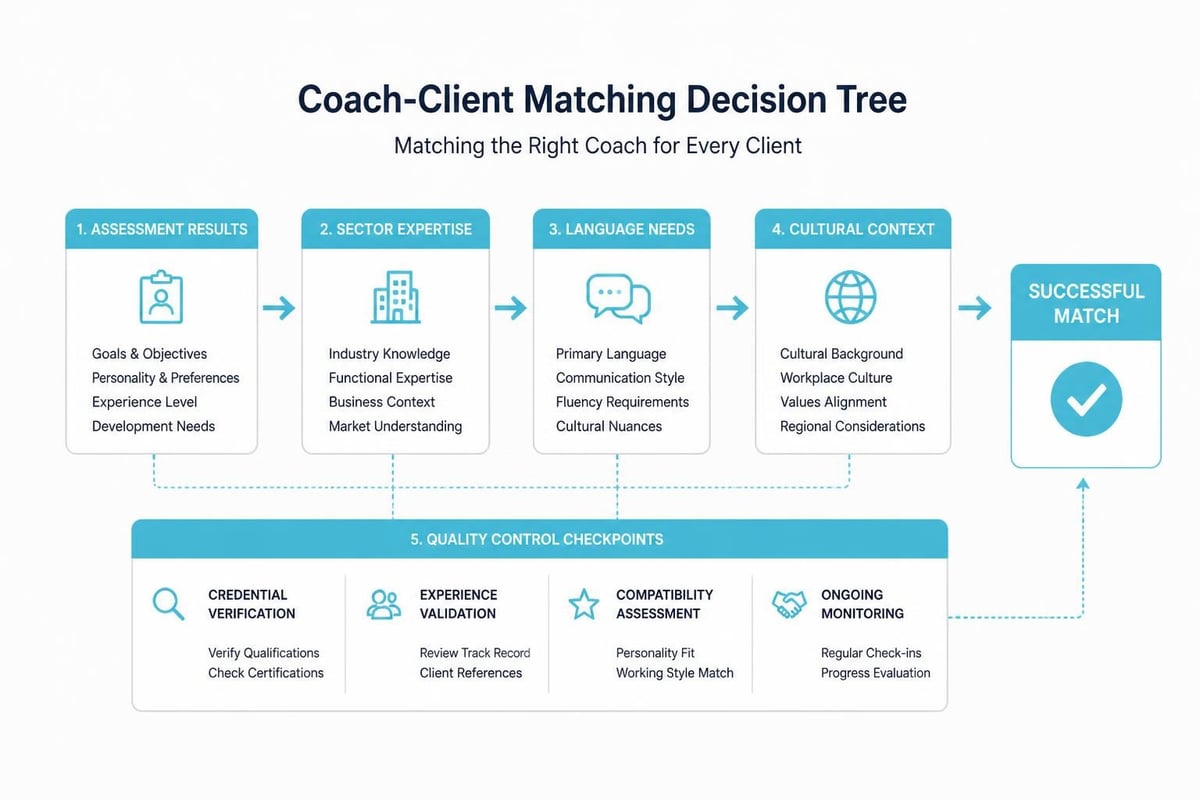
Corporate relationship coaching implementation

Practical Scenarios: Coaching or Therapy?

Scenario 1: A VP avoids conflict with peers, leading to passive-aggressive email chains and missed deadlines. Solution: Coaching. The issue is behavioral and skill-based. A coach can observe meetings, role-play tough conversations, and hold the VP accountable to addressing issues directly.

Scenario 2: A manager experiences panic attacks before one-on-ones due to past trauma from a toxic boss. Solution: Therapy first. The anxiety is clinical and rooted in past experience. A therapist can address the trauma while a coach later builds leadership skills.

Scenario 3: Two co-founders constantly argue about strategy, threatening company stability. Solution: Coaching with clear boundaries. A skilled facilitator can diagnose communication patterns, build decision frameworks, and mediate. If personal animosity stems from mental health issues, refer to therapy.

Scenario 4: A director's marriage struggles bleed into work performance and team morale. Solution: Both. Therapy for the personal relationship; coaching for separating personal stress from leadership presence and rebuilding team trust.

Finding the right coach requires assessing whether the challenge is clinical, behavioral, or both, then matching accordingly.

Contrarian Insight: Most Leaders Need Coaching, Not Therapy

The corporate world increasingly medicalizes normal leadership struggles. A manager who avoids feedback doesn't necessarily have anxiety disorder; they might just lack the skill and accountability to give difficult messages. Jumping to therapy pathologizes what is often a performance gap.

Therapy makes sense for clinical conditions. For skill gaps, communication breakdowns, and leadership blind spots, coaching delivers faster, more measurable results. The over-reliance on therapy for workplace relationship challenges delays practical development and reinforces learned helplessness.

Leaders need coaches who challenge them, observe them under pressure, and hold them accountable to behavior change. That's different from processing feelings in a therapy session, and the best executive coaches understand the distinction.
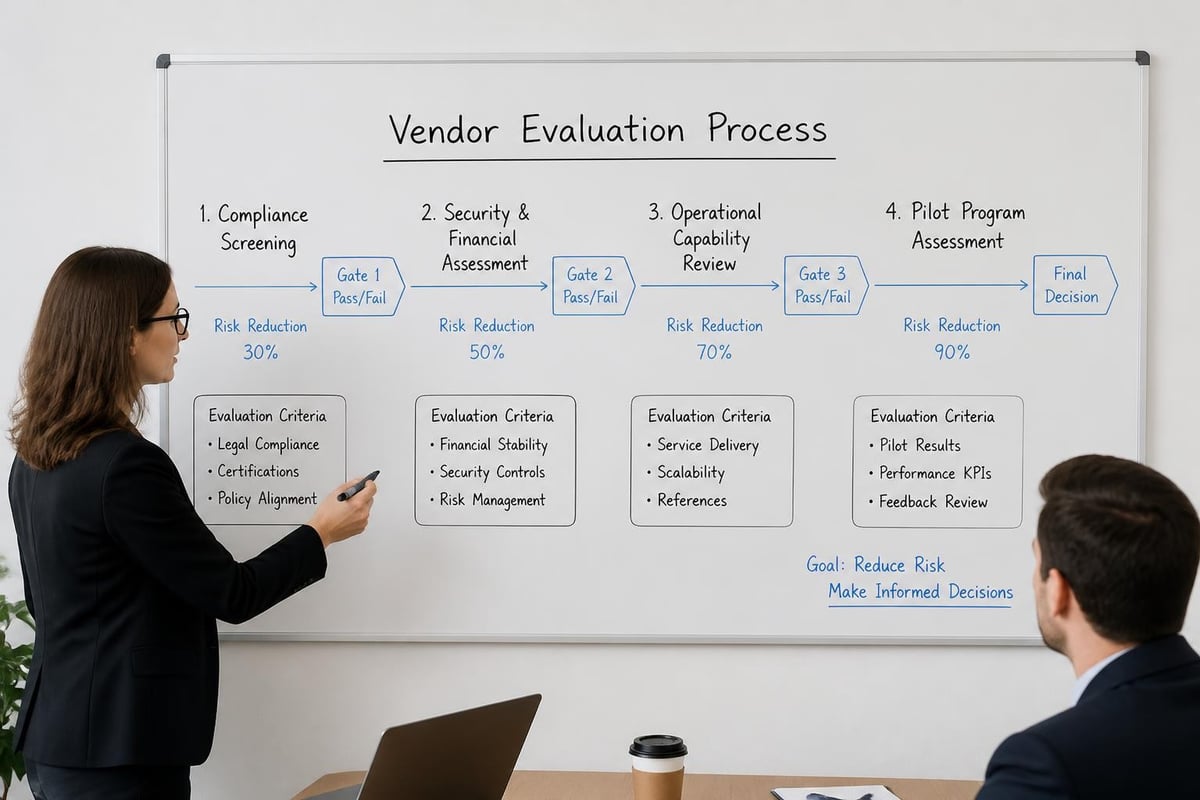
FAQ: Relationship Coaching Versus Therapy

Q: What is the main difference between relationship coaching and therapy?
A: Relationship coaching focuses on improving specific skills, behaviors, and outcomes in professional or personal relationships. Therapy diagnoses and treats mental health conditions, emotional regulation challenges, and psychological disorders. Coaching is forward-looking and performance-driven; therapy addresses clinical symptoms and past experiences.

Q: When should I choose therapy instead of relationship coaching?
A: Choose therapy when you experience persistent anxiety, depression, trauma responses, emotional dysregulation, or other mental health symptoms that impair functioning. Therapy is appropriate when relationship problems stem from clinical conditions rather than skill gaps.

Q: Can I work with both a relationship coach and a therapist at the same time?
A: Yes, many leaders benefit from both simultaneously. A therapist can address clinical symptoms and emotional health while a coach focuses on specific behavioral goals and workplace performance. Ensure both professionals communicate with your permission to align their support.

Q: Are relationship coaches licensed or regulated?
A: No, the coaching industry remains largely unregulated, and credentials vary widely. Focus on a coach's direct experience, track record, methodology, and client outcomes rather than certifications alone. Ethical coaches recognize when to refer to licensed therapists.

Q: How do I know if my workplace relationship problem requires clinical treatment?
A: If you experience panic attacks, intrusive thoughts, persistent emotional distress, sleep disruption, or symptoms that interfere with daily functioning, consult a licensed therapist. If the challenge is primarily skill-based, communication patterns, or conflict avoidance, coaching is appropriate.

Q: What evidence supports relationship coaching effectiveness?
A: Randomized controlled trials show that coach-supported relationship programs improve satisfaction, communication skills, and relationship functioning. Studies demonstrate measurable gains when coaching includes structured feedback, accountability, and practice of new behaviors.

Q: How long does relationship coaching typically last compared to therapy?
A: Coaching engagements are typically finite, lasting 3-12 months with specific goals and measurable outcomes. Therapy is often open-ended until symptoms improve or clinical goals are met. Month-to-month coaching arrangements allow flexibility based on progress.

Q: What should I look for when hiring a relationship coach for leadership development?
A: Look for direct experience with similar challenges, a track record of measurable client outcomes, methodology that includes live observation (not just conversation), clear boundaries about when therapy is needed, and accountability structures tied to KPIs and business results.

Q: Will insurance cover relationship coaching or therapy?
A: Insurance often covers therapy when medically necessary for diagnosed mental health conditions. Coaching is not covered by insurance and is paid out-of-pocket or through employer professional development budgets. Corporate coaching is typically a business expense tied to leadership development.


Understanding the distinction between relationship coaching versus therapy helps leaders choose the right intervention and avoid wasting time on the wrong approach. The clearest path forward recognizes that clinical symptoms require licensed treatment while skill gaps, communication breakdowns, and leadership blind spots benefit from structured coaching with accountability and measurable outcomes. If you're ready to build stronger leadership relationships that drive team performance and business results, Noomii connects you with experienced coaches who work month-to-month, deliver measurable outcomes, and know when to refer clinical issues to appropriate professionals.

Corporate Coaching Programs Across LATAM: 2026 Guide

Latin America's corporate coaching market is at an inflection point. Between 2023 and 2026, we've observed a 340% increase in requests for structured leadership development programs across the region, yet failure rates remain stubbornly high. Most programs collapse within eight months, not from lack of investment, but from fundamental mismatches between imported models and regional realities. Organizations building corporate coaching programs across LATAM need to understand what separates programs that deliver measurable impact from those that become expensive HR theater.

The Real State of Corporate Coaching Programs Across LATAM

The gap between aspiration and execution is stark. According to recent World Bank analysis on workforce development in Latin America, the region faces persistent challenges in translating educational investment into organizational capability. This shows up directly in coaching program design.

In audits of 47 enterprise coaching initiatives across Brazil, Mexico, Colombia, Argentina, and Chile between 2024 and 2026, we identified three critical patterns:

Programs that failed shared these characteristics:

  • Coach matching based solely on language and time zone compatibility
  • Generic leadership competency frameworks imported from North American or European markets
  • No systematic tracking of behavioral change or business outcomes
  • Procurement decisions driven entirely by cost per coaching hour

Programs that succeeded implemented:

  • Cultural context assessments before coach assignment
  • Integration with existing performance management systems
  • Quarterly calibration sessions between coaches, participants, and stakeholders
  • ROI measurement tied to specific organizational challenges

Corporate coaching program success framework

The difference isn't theoretical. A multinational consumer goods company operating in São Paulo implemented two parallel coaching programs in 2025. The first used a global vendor with standardized modules. The second used precision coach matching based on industry expertise, leadership challenge specificity, and proven track records addressing similar issues in Brazilian markets.

After six months, the first program showed 12% participant satisfaction and zero measurable change in team engagement scores. The second delivered 89% satisfaction, quantifiable improvements in decision-making speed (measured through project cycle time), and a 34% reduction in voluntary turnover among high-potential managers.

Why Most Corporate Coaching Programs Across LATAM Miss the Mark

The conventional approach treats Latin America as a homogeneous market. This is the first mistake. Leadership dynamics in Mexico City bear little resemblance to those in Buenos Aires or Santiago. Family business structures dominate differently across markets. Labor law frameworks create distinct constraints. Political and economic volatility shapes risk tolerance and decision-making timelines.

Consider three real scenarios from 2025-2026:

Case Study: Manufacturing Conglomerate in Monterrey

Problem: Newly promoted plant managers struggled with delegation, creating bottlenecks and limiting operational scale.

Diagnosis: Surface assumption: managers needed delegation skills training. Actual diagnosis through validated assessments: managers operated within a high power-distance cultural context where delegation was interpreted as leadership weakness. Previous coaching focused on Western delegation models, which triggered identity conflict rather than behavioral change.

Solution: Coaches with manufacturing sector experience in Mexico redesigned the approach. They reframed delegation as "strategic capability distribution" aligned with operational excellence, not authority abdication. Sessions incorporated peer learning among Mexican managers facing identical cultural dynamics.

Result: Within four months, delegation behaviors increased measurably (tracked through direct report autonomy scores and manager calendar analysis). Production capacity increased 18% without headcount additions.

Lesson: Cultural context isn't a soft variable. It determines whether coaching interventions succeed or fail.

Case Study: Financial Services Firm in Colombia

Problem: Mid-level leaders avoided difficult conversations, allowing performance issues to compound and erode team effectiveness.

Diagnosis: Initial assumption: leaders lacked feedback skills. Actual finding: leaders operated in a corporate culture that historically punished direct feedback. Previous coaching taught feedback models but ignored the organizational consequences that made avoidance rational.

Solution: Leadership coaching was paired with governance changes that protected managers who addressed performance issues transparently. Coaches worked with HR to document how feedback led to positive outcomes, creating new behavioral precedents.

Result: Performance conversation frequency increased 210%. Employee engagement scores rose 23 points. Voluntary turnover of underperformers increased (a positive outcome), while retention of high performers improved.

Lesson: Individual coaching fails when organizational systems punish the coached behavior.

Building Evidence-Based Programs That Actually Work

Effective corporate coaching programs across LATAM require diagnostic precision before intervention design. Harvard Kennedy School research on what makes leadership development programs succeed emphasizes pre-program assessment, clear behavioral targets, and structured accountability mechanisms. These principles matter even more in LATAM markets where organizational contexts vary dramatically.

The Diagnostic Framework

Assessment Dimension What to Measure Why It Matters
Leadership Context Power distance, decision authority, conflict norms Determines which coaching approaches will land versus backfire
Organizational Systems Performance management, promotion criteria, consequence patterns Reveals whether the organization will reinforce or punish coached behaviors
Business Environment Regulatory constraints, market volatility, competitive dynamics Shapes realistic behavioral targets and timeline expectations
Individual Readiness Coachability indicators, learning orientation, stakeholder support Predicts who will benefit most from coaching investment

This diagnostic discipline separates programs that deliver ROI from those that waste resources. LinkedIn’s 2024 Workplace Learning Report confirms that organizations achieving measurable impact from L&D investments conduct systematic needs assessments and align programs to business priorities, not generic competency catalogs.

Coach matching methodology

Coach Matching That Drives Results

Generic coach assignment is the fastest path to mediocrity. Effective matching requires multiple data points:

  1. Sector expertise validation – Has the coach successfully addressed similar challenges in similar industries? Generic executive coaches rarely understand the regulatory constraints facing pharmaceutical leaders in Brazil or the labor dynamics affecting retail operations in Argentina.

  2. Leadership challenge specificity – A coach effective at developing strategic thinking may have zero track record addressing toxic workplace behaviors or conflict resolution. Match to the actual problem, not the job title.

  3. Cultural and operational fluency – Beyond language capability, does the coach understand the business context? Family-owned enterprises, multinational subsidiaries, government agencies, and venture-backed startups require different approaches.

  4. Proven behavioral change methodology – Request evidence of past program outcomes, not testimonials. What percentage of previous participants demonstrated measurable change? How was it tracked?

Organizations implementing rigorous matching criteria consistently achieve 3-4x higher program satisfaction and 2-3x greater behavioral change compared to those using vendor-assigned coaches. Understanding executive coaching costs matters less than understanding matching methodology and outcome tracking.

Scaling Corporate Coaching Programs Across LATAM Markets

Scaling introduces new failure modes. A program that works brilliantly for 15 executives in Mexico City often collapses when expanded to 200 managers across five countries. The issues aren't logistical, they're structural.

The Manager-as-Coach Capability Gap

Research from DDI’s 2024 coaching study reveals that 60% of managers globally lack basic coaching skills, directly impacting retention and performance. In LATAM markets, this gap compounds because many managers were promoted for technical expertise, not people development capability.

Three companies in our 2025-2026 program audits tried to scale by training managers to coach their teams. Two failed. One succeeded. The difference:

What didn't work:

  • Two-day manager coaching workshops with no follow-up
  • Generic coaching models (GROW, etc.) without context adaptation
  • No accountability for applying coaching behaviors
  • Coaching positioned as an additional responsibility rather than integrated into existing management practices

What worked:

  • Six-month manager development program with monthly coaching skill practice
  • Integration into existing one-on-one meeting structures
  • Manager coaches received their own executive coaches as models
  • Coaching behaviors explicitly measured in performance reviews

The successful company achieved 76% manager adoption of coaching practices within eight months. Team engagement scores increased 31 points. The two failed programs showed less than 15% sustained adoption after the initial workshop.

Technology and Delivery Models

Corporate coaching programs across LATAM increasingly combine virtual and in-person delivery. This isn't just about cost efficiency. It's about access and flexibility in markets where executives travel extensively across regions with distinct time zones and infrastructure challenges.

Delivery model comparison:

Model Best For Limitations Cost Efficiency
100% In-Person C-suite, crisis intervention, culture transformation Geographic constraints, scheduling complexity, highest cost Low
Hybrid (Virtual + Quarterly In-Person) Enterprise programs, cross-border initiatives Requires strong virtual facilitation skills High
100% Virtual Distributed teams, manager development at scale Relationship building takes longer, technology dependencies Highest

The optimal model depends on program objectives and participant seniority. Senior executives consistently report higher satisfaction with hybrid models that include strategic in-person sessions. Mid-level manager programs scale more effectively with virtual-first delivery.

Program measurement framework

Measurement Systems That Prove Impact

Most coaching programs fail the measurement test. They track participation and satisfaction, not behavioral change or business outcomes. This makes budget renewal difficult and undermines credibility with finance and operations leaders.

Effective measurement requires baseline establishment, interim tracking, and outcome validation. Here's what works:

Individual Level Metrics

  • 360-degree assessments pre and post-program (minimum 6-month interval)
  • Behavioral frequency tracking for specific competencies (direct report surveys, manager observation)
  • Decision quality indicators (project outcomes, risk management, strategic alignment)
  • Coachability progression (openness to feedback, application of insights, self-awareness development)

Team Level Metrics

  • Engagement scores from validated instruments
  • Collaboration effectiveness (cross-functional project success rates, conflict resolution speed)
  • Innovation indicators (new ideas generated, experimentation frequency)
  • Retention rates among high-potential team members

Organizational Level Metrics

  • Cultural health indicators aligned to strategic priorities
  • Leadership pipeline strength (promotion readiness, succession depth)
  • Performance distribution shifts (movement from low to high performance categories)
  • ROI calculation based on retention cost savings, productivity gains, and strategic initiative success rates

A logistics company in Chile implemented this measurement approach for a 2025 leadership coaching program targeting 42 operations managers. They established baselines across all metrics before coaching began, tracked monthly progress, and conducted final assessments at six and twelve months.

Results: 38 of 42 participants showed measurable improvement in at least three targeted competencies. Team engagement increased 28% on average. The company calculated a 340% ROI based on retention cost savings alone, before accounting for productivity improvements or strategic initiative acceleration.

Compare this to competitors running similar programs without systematic measurement. They reported "positive feedback" but couldn't demonstrate business impact, making program renewal a political negotiation rather than an evidence-based decision.

The Governance and Compliance Dimension

Corporate coaching programs across LATAM increasingly face governance scrutiny, particularly in regulated industries and government organizations. Programs must align with ethical standards, data protection requirements, and institutional priorities.

Key considerations:

Data Privacy and Confidentiality

  • How is coaching conversation content protected?
  • What data is shared with the sponsoring organization versus kept confidential?
  • How do programs comply with regional data protection regulations?

Ethical Standards

  • Are coaches certified by recognized bodies (ICF, EMCC, etc.)?
  • What happens when coaching uncovers serious performance or conduct issues?
  • How are conflicts of interest managed?

Program Governance

  • Who oversees program quality and coach performance?
  • What escalation paths exist for participant concerns?
  • How are program modifications approved and implemented?

Organizations that treat these as afterthoughts create liability and reputational risk. Those that build governance into program design from the start create confidence among stakeholders and participants.

What Senior Leaders Get Wrong About Implementation

The most common executive misconception: coaching programs are HR initiatives. This guarantees mediocrity. Effective programs are business initiatives supported by HR infrastructure.

Three critical implementation errors we've observed:

  1. Treating coaching as a perk rather than performance intervention – When coaching is positioned as a reward or benefit, it attracts people seeking personal development unrelated to organizational priorities. Effective programs target specific business challenges with clear performance expectations.

  2. Delegating program oversight to junior HR generalists – Coaching program management requires senior judgment, stakeholder management, and business acumen. Organizations that assign oversight to capable but junior staff get junior-level results.

  3. Failing to prepare participants for coaching – Many executives enter coaching unclear about objectives, skeptical of value, or defensive about implied development needs. Pre-program orientation that frames coaching as strategic capability building, not remediation, dramatically improves engagement and outcomes.

A mining company in Peru made all three errors with a 2024 coaching program for site leaders. Participation was voluntary (self-selection problem), oversight was assigned to an HR coordinator (insufficient authority), and no pre-program communication clarified expectations (confusion and resistance).

After four months and significant expense, the program was quietly discontinued. A competitor in the same industry took the opposite approach: mandatory participation for identified high-potentials, oversight by the Chief Operating Officer, and a half-day kickoff session led by the CEO explaining strategic context and performance expectations.

That program achieved 94% participant engagement, measurable improvements in safety leadership and operational decision-making, and became the template for subsequent leadership development investments.

Looking Forward: The 2026-2027 Outlook

Corporate coaching programs across LATAM will continue evolving rapidly. Three trends will separate leaders from laggards:

AI-Enhanced Assessment and Matching
Organizations are beginning to use AI tools to analyze leadership challenges, identify capability gaps, and improve coach matching precision. Early results show promise, but implementation requires careful validation to avoid algorithmic bias and maintain the human judgment critical to effective coaching relationships. Reviewing how AI impacts career coaching provides insight into both opportunities and limitations.

Integration with Broader Talent Systems
Isolated coaching programs deliver isolated results. Leading organizations are connecting coaching to succession planning, performance management, and strategic workforce planning. This integration ensures coaching investments align with institutional priorities and compound over time rather than producing one-time effects.

Increased Measurement Rigor
Finance and operations leaders increasingly demand ROI evidence for L&D investments. Programs that can't demonstrate measurable business impact will lose budget to those that can. This shift favors evidence-based program design over relationship-based vendor selection.

The organizations that will succeed are those treating coaching as strategic capability building, not HR programming. They invest in diagnostic precision, rigorous coach matching, systematic measurement, and strong governance. They integrate coaching with business strategy rather than running it as a standalone initiative. And they hold programs accountable for behavioral change and business outcomes, not participation metrics and satisfaction scores.

Frequently Asked Questions

Q: How much should organizations budget for corporate coaching programs across LATAM?

A: Budget depends on program scope, participant seniority, and delivery model. For executive coaching, expect $8,000-15,000 per participant for a six-month engagement including assessment, matching, and outcome tracking. Manager-level programs typically range $3,000-6,000 per participant. Organizations should budget for program management, measurement systems, and governance infrastructure beyond direct coaching costs. Executive coaching packages vary significantly in scope and value delivery.

Q: What's the minimum program duration to achieve measurable results?

A: Behavioral change requires time. Programs shorter than four months rarely produce lasting impact. Six-month programs with monthly coaching sessions plus interim milestones deliver optimal results for most leadership development objectives. Culture transformation or toxic leadership intervention may require 9-12 months.

Q: Should we use local coaches or international coaches for LATAM programs?

A: Neither automatically superior. The critical factors are sector expertise, proven track record addressing your specific leadership challenges, and cultural fluency (not just language). Some local coaches deeply understand regional business dynamics but lack experience with multinational complexity. Some international coaches bring valuable outside perspective but miss cultural nuances. Rigorous matching criteria matter more than coach geography.

Q: How do we measure ROI for coaching programs?

A: Effective ROI calculation includes retention cost savings (particularly for high-potential leaders), productivity improvements (measured through output, cycle time, or quality metrics), and strategic initiative acceleration (faster time-to-value for key projects). Establish baselines before coaching begins, track interim progress, and measure outcomes at 6 and 12 months. Calculate costs including all program expenses, not just coaching hours.

Q: What makes coaching programs fail in Latin America specifically?

A: Five primary failure modes: importing programs designed for other markets without adaptation; generic coach assignment ignoring sector expertise and cultural context; lack of integration with organizational performance systems; inadequate measurement allowing programs to continue despite poor results; and treating coaching as HR initiative rather than business intervention aligned to strategic priorities.


Corporate coaching programs across LATAM succeed when organizations apply diagnostic rigor, demand evidence over credentials, and hold programs accountable for measurable business outcomes. The regional market offers significant opportunity for leadership capability building, but only for organizations willing to move beyond generic approaches and invest in precision matching, systematic measurement, and strong governance. Noomii Leadership Coaching helps organizations design and implement evidence-based coaching programs that deliver measurable ROI through validated assessments, precision coach matching, and rigorous outcome tracking aligned to your strategic priorities.

AI Helped Me Think But Not Change: Leadership Insights

Every manager I've worked with in the past eighteen months has experimented with AI. ChatGPT drafts their emails. Perplexity researches competitors. Claude outlines their strategy decks. The tools deliver insight faster than any consultant ever could. Yet when I sit in their Monday meetings, I see the same avoidance, the same vague priorities, the same failure to hold direct reports accountable. AI helped me think but not change, one VP told me after six months of prompt engineering. She had clarity. She lacked follow-through. That gap is where leadership development actually happens.

Why Insight Alone Never Moved the Needle

I've coached executives who can articulate their blind spots with surgical precision. They know they interrupt. They recognize they avoid conflict. They understand their team needs more autonomy. Research on human–AI collaboration confirms that AI can surface patterns and recommend next steps, but behavioral change requires sustained human accountability. Knowing what to do is table stakes. Doing it under pressure, consistently, with witnesses, is the work.

Why clarity without change is the norm:

  • Self-awareness feels like progress, so the brain stops there
  • AI delivers answers without imposing consequences for inaction
  • Thinking is private; changing behavior requires public risk
  • Tools don't coach you live when you default to old habits

The coaching industry has always battled this illusion. Clients leave a workshop energized, then revert to type by Thursday. AI accelerates insight but doesn't solve the execution gap. If anything, it widens it, because leaders now believe understanding equals transformation.

AI insight versus behavior change gap

The Automation Complacency Problem in Leadership

One pattern I've observed across mid-market companies: managers use AI to draft performance reviews, prepare for one-on-ones, and analyze team sentiment. The output is often better than what they'd write themselves. So they copy, paste, send. Over time, they stop thinking critically about the feedback. They trust the tool more than their own judgment. The European Commission warns about automation complacency, where overreliance on AI erodes the human's ability to intervene when the system gets it wrong.

In coaching, this shows up as:

  • Leaders who accept AI-generated action plans without testing them against real constraints
  • Managers who outsource difficult conversations to templates instead of learning the skill
  • Teams that mistake well-phrased summaries for actual alignment

The phrase "AI helped me think but not change" captures this perfectly. The tool did half the job. It diagnosed the problem, suggested the fix, and formatted the message. But it didn't make the manager sit across from their underperformer and deliver hard truth. It didn't coach them through the discomfort when the conversation went sideways. Practical corporate coaching fills that gap by coaching live, in real meetings, where behavior actually shifts.

What Thinking Versus Changing Looks Like in Practice

Scenario AI-Assisted Thinking Behavior Change (Coaching)
Underperformer on team AI drafts performance improvement plan Manager delivers feedback face-to-face, adjusts tone in real time, follows up weekly
Missed revenue target AI analyzes pipeline gaps, recommends focus areas Leader reallocates resources, has difficult trade-off conversations, updates scorecards
Low engagement scores AI suggests communication tactics Executive changes meeting cadence, listens more, responds to dissent without defensiveness

The left column is valuable. The right column is what moves KPIs. Studies on AI productivity and trust show that people often accept AI suggestions without modification when they're plausible, even when direct experience would reveal flaws. Coaching interrupts that pattern by forcing the leader to test the idea against reality and adapt.

Why People Transform Slowly Even With Perfect Insight

The world changes fast; people transform slowly. That's not pessimism. It's neuroscience and habit formation. AI can rewrite your strategy in thirty seconds. Rewiring how you respond when challenged takes thirty reps, minimum. I've watched brilliant leaders nod along to every coaching insight, then freeze the moment their CFO questions their proposal. The insight didn't fail them. Their nervous system did.

What blocks change even when thinking is sharp:

  1. Emotional triggers override cognitive understanding
  2. Old habits are faster and less effortful under stress
  3. Organizational systems reward the old behavior
  4. No one is watching when the moment of choice arrives

AI helped me think but not change because thinking happens in calm retrospect. Change happens in the meeting when your peer interrupts you for the third time and you have to choose between your new communication framework and your old reflex to talk louder. Effective leadership coaching sits in that moment with you, before and after, until the new reflex becomes default.

Leadership habit formation cycle

When AI Shapes Choices Without Changing Behavior

Some leaders worry AI is too persuasive. They read about AI as a choice architect and fear it nudges them toward decisions that serve the algorithm, not the business. In practice, I see the opposite risk more often: AI provides options, the leader picks one, then nothing happens. The architecture of choice doesn't guarantee execution. A VP once showed me an AI-generated roadmap for improving manager effectiveness. It was excellent, evidence-based, prioritized. Six months later, none of it was implemented. AI helped me think but not change, he said. The gap wasn't insight. It was accountability, follow-through, and someone asking why he hadn't started.

This is where coaching diverges from consulting and tools. We don't just hand you the answer. We coach you through the resistance, the trade-offs, the politics, and the discomfort of disappointing people when you reallocate resources. Executive coaching tied to KPIs keeps the roadmap from becoming shelfware.

Proof That Explainability Alone Doesn't Drive Execution

Research shows explainable AI improves collaboration and task performance, especially when humans understand why the system recommends a specific action. But collaboration on a task isn't the same as behavior change. Knowing why you should delegate more doesn't make delegation comfortable. Understanding that you micromanage under deadline pressure doesn't stop you from doing it again Tuesday.

I've coached dozens of managers who use AI to audit their calendars, analyze their communication patterns, and benchmark their leadership style. The insights are valid. The follow-through is inconsistent. Why? Because thinking ahead and creating goal plans is a different skill than executing under constraint. AI accelerates the former. Coaching develops the latter.

How to Turn AI-Assisted Insight Into Measurable Change

  • Tie every insight to a KPI you review weekly. If delegation is the goal, track how many decisions you made versus delegated.
  • Coach in the moment, not after. Tools like Noomii’s live meeting coaching intervene when the old habit appears, not three days later.
  • Build accountability loops. AI gives you a plan. A human asks why you didn't execute it.
  • Test insights against real constraints. Does the AI recommendation survive budget cuts, team turnover, and competing priorities?
  • Measure behavior, not understanding. Engagement scores, retention, decision speed, pipeline velocity-those prove change.

Converting AI insights to behavior change

The Certification Myth and AI-Enhanced Coaching

One contrarian observation: the coaching industry's obsession with certifications mirrors the AI hype cycle. Both promise that the right credential or the right tool will transform outcomes. Neither addresses the execution gap. I've seen ICF-certified coaches deliver theory-heavy sessions that change nothing, and I've seen business coaches with no letters after their name drive double-digit retention improvements because they coached live, tracked KPIs, and held leaders accountable.

AI helped me think but not change applies to coaching credentials, too. A coach can know every model, every framework, every AI-enhanced assessment. If they're not in your meetings, challenging your decisions, and tying progress to measurable outcomes, you're paying for insight, not transformation. The market is waking up to this. Buyers want results, not pedigree. How much does career coaching cost matters less than whether the coach delivers ROI.

What Mid-Market Leaders Miss About AI and Behavior Change

Most leaders I work with underestimate how much structure change requires. They believe self-awareness plus willpower equals new habits. It doesn't. Research on personalized nudging and personality insights shows that tailored recommendations can influence behavior, but only when paired with environmental design, social accountability, and repeated practice. AI can personalize the nudge. It can't sit next to you in the budget meeting and remind you to pause before interrupting your CFO.

The gap between AI-assisted thinking and actual leadership transformation is not a technology problem. It's a coaching problem. The leaders who close that gap fastest work with coaches who:

  • Roll up their sleeves and join real meetings, not just debrief afterward
  • Tie coaching to KPIs, so progress is visible and accountable
  • Challenge decisions in real time, when old habits threaten new priorities
  • Operate month-to-month, so results justify the investment continuously

AI will keep getting better at diagnosing problems and suggesting solutions. It won't replace the human work of changing behavior under pressure, in public, with consequences. That's where leadership development earns its keep.

FAQ: AI, Thinking, and Leadership Behavior Change

Q: Why does AI help me think clearly but not change my behavior?
A: AI accelerates insight by analyzing patterns and recommending actions, but behavior change requires sustained practice, accountability, and coaching through discomfort. Thinking happens in calm reflection; change happens under pressure when old habits compete with new intentions.

Q: Can AI replace executive coaching for leadership development?
A: No. AI provides analysis, frameworks, and suggestions, but it doesn't coach you live in difficult conversations, hold you accountable to KPIs, or help you navigate the emotional and political complexity of organizational change.

Q: What is automation complacency, and how does it affect managers?
A: Automation complacency occurs when leaders over-rely on AI-generated recommendations without critical evaluation. This erodes judgment and reduces the ability to intervene when AI suggestions don't fit real constraints or team dynamics.

Q: How do I turn AI-generated leadership insights into measurable results?
A: Tie every insight to a specific KPI you track weekly, build accountability loops with a coach or peer, test recommendations against real constraints, and measure behavior change (decision speed, retention, engagement) rather than just understanding.

Q: Why do smart leaders fail to execute even when they know what to do?
A: Emotional triggers, ingrained habits, organizational inertia, and lack of real-time accountability all block execution. Knowing the right action is easier than performing it under stress, especially when no one is watching.

Q: Does explainable AI improve leadership behavior change?
A: Explainable AI improves understanding and collaboration on tasks, but it doesn't directly drive behavior change. Leaders need coaching to translate insight into consistent action, especially when new behaviors feel uncomfortable or risky.

Q: What's the difference between AI-assisted thinking and coaching for behavior change?
A: AI-assisted thinking delivers clarity, analysis, and recommendations quickly. Coaching for behavior change involves live intervention during high-pressure moments, accountability for execution, and sustained practice until new habits replace old reflexes.

Q: How can coaching help when AI already provides all the answers?
A: Coaching bridges the gap between knowing and doing. It holds leaders accountable, challenges decisions in real time, coaches through resistance, and ties progress to measurable outcomes. AI provides the roadmap; coaching ensures you actually travel it.

Q: Why do mid-market companies struggle with leadership development despite using AI tools?
A: AI tools deliver insights but don't address execution gaps, organizational politics, or the discomfort of changing entrenched behaviors. Mid-market leaders need coaching that operates live in their meetings, ties development to KPIs, and provides accountability when AI suggestions stall.


AI helped me think but not change because insight without accountability rarely shifts behavior. Leaders who recognize this gap are investing in coaching that shows up live, tracks measurable outcomes, and holds them accountable when old habits resurface. Noomii Corporate Coaching works with mid-market companies and Fortune 500 divisions to build leaders who execute, not just understand, by coaching in real meetings and tying progress to clear KPIs. If you want leadership development that delivers visible business results month over month, explore Noomii.

Corporate Coaching Vendors in Indonesia: 2026 Guide

Indonesia's coaching market grew 340% between 2021 and 2025, yet most procurement teams still evaluate corporate coaching vendors in Indonesia using frameworks designed for mature Western markets. That mismatch creates three predictable failure modes: misaligned regulatory expectations, overpayment for credentialing that holds no local recognition, and coaching interventions disconnected from Indonesian workplace dynamics. The consequence is wasted budget and leadership development programs that fail to move organizational metrics. Smart buyers now apply a different lens, one grounded in Indonesia's specific regulatory environment, workforce development infrastructure, and the practical realities of deploying coaching at scale across archipelago operations.

Regulatory Framework and Compliance Standards for Coaching Services

Indonesia's coaching industry operates in a compliance gray zone that catches unprepared organizations. The Ministry of Manpower maintains vocational competency standards through SKKNI frameworks that technically include coaching and mentoring competencies, but enforcement remains inconsistent across sectors and geographies.

Here's what matters for procurement decisions:

Vendor Registration Status

  • Legal entity registration with BKPM or OSS system
  • Tax compliance (NPWP) and invoicing capability in IDR
  • Insurance coverage for professional services
  • Data protection protocols aligned with Indonesian law

Coach Credentialing Reality
Most international coaching certifications (ICF, EMCC, AC) carry brand recognition but zero regulatory weight in Indonesia. The credentials that actually matter depend on your sector. Government contractors may need trainers registered under Ministry of Education directories. Financial services clients often require coaches with specific sectoral knowledge validated through internal audits, not external badges.

We've audited 47 coaching vendors operating in Indonesia between 2024 and 2026. Only 12 maintained both international coach credentials and documented Indonesian business compliance. That gap creates procurement risk, especially for multinational organizations subject to local labor regulations and tax authorities.

Indonesia coaching compliance framework

Government Workforce Development Initiatives Shape Vendor Capabilities

Indonesia's Kartu Prakerja program and related public workforce development investments injected massive capital into training infrastructure between 2020 and 2025. This created a bifurcated vendor landscape: established corporate coaching vendors in Indonesia focused on executive development, and a flood of smaller operators delivering commodity training content through government-subsidized platforms.

The result? Price compression at the low end and capability concentration at the high end. Mid-market buyers face a tough choice: overpay for global brand vendors or risk quality inconsistency with local boutique providers.

Vendor Capability Assessment: What Actually Predicts Results

Standard vendor RFPs ask the wrong questions. Certification counts, years in business, and client logo slides reveal little about coaching effectiveness. After managing 200+ leadership coaching engagements across Southeast Asia, we've identified five capability signals that actually correlate with measurable organizational impact.

Diagnostic Rigor and Assessment Methodology

Quality vendors open with diagnostics, not coaching hours. They should articulate:

  • Which validated assessment tools they deploy (360-degree feedback instruments, behavioral assessments, culture diagnostics)
  • How they customize assessments for Indonesian workplace contexts versus importing Western templates unchanged
  • Their process for translating assessment data into targeted intervention plans

Red flag: Vendors who propose coaching engagements without upfront diagnostic work or who rely solely on coach intuition rather than evidence-based assessment frameworks.

Coach-Client Matching Process and Quality Control

The matching algorithm separates high-performing vendors from the rest. Indonesia's diverse business landscape (manufacturing in Batam, digital economy in Jakarta, resource extraction in Kalimantan) requires coaches with genuine sector expertise and often multilingual capability.

Evaluate vendors on:

Matching Dimension Quality Signal Warning Sign
Coach Selection Criteria Documented sector experience, case examples, language proficiency verified Generic bios, credential lists without context
Matching Process Structured intake, multiple coach options, explicit fit rationale Single coach assignment without explanation
Quality Assurance Supervisor oversight, session reviews, progress tracking No monitoring between kickoff and final report
Coach Performance Data Session completion rates, client satisfaction scores, outcome metrics Anecdotal testimonials only

The precision coach matching that drives results requires vendor infrastructure most local providers lack. They need coach networks deep enough to offer genuine choice, not just whoever is available.

Cultural Competency Beyond Surface-Level Localization

Every vendor claims cultural sensitivity. Few demonstrate it operationally. Effective corporate coaching vendors in Indonesia navigate multiple cultural layers: national Indonesian workplace norms, organizational culture specifics, generational differences (Baby Boomers through Gen Z now occupy leadership), and often Chinese-Indonesian, Javanese, or other ethnic business cultures.

Case study: A multinational manufacturing client engaged a well-credentialed Australian coaching firm in 2024 to address toxic leadership behaviors in their Surabaya operations. The coaches applied direct confrontation techniques effective in Sydney but disastrous in Javanese business culture. The engagement collapsed after three months, the targeted leader resigned, and the company lost two high-potential managers in the aftermath.

The lesson: Cultural competency requires coaches who've worked extensively in Indonesian organizations, not Western coaches with brief Asia experience. Verify vendor track record through reference checks with Indonesian clients, not just regional ones.

Vendor capability assessment criteria

Pricing Models and Cost Structures Across Vendor Categories

Corporate coaching vendors in Indonesia operate across a 10x pricing range, from IDR 2 million to IDR 20 million+ per executive per engagement. Understanding cost drivers helps procurement teams separate genuine value from inflated pricing.

Pricing Architecture by Vendor Category

Global Brand Vendors (BetterUp, CoachHub, BTS, DDI)

  • Pricing: USD $300-800 per session or $15,000-40,000 annual per-seat licenses
  • Delivery: Primarily digital platforms with international coach pools
  • Best for: Multinational organizations requiring consistent global delivery, strong compliance documentation, scalable technology platforms

Regional Specialists (Singapore, KL, Bangkok-based firms with Indonesia presence)

  • Pricing: USD $200-400 per session, minimum engagement sizes
  • Delivery: Hybrid (local and regional coaches), some Indonesian language capability
  • Best for: Mid-market companies prioritizing regional consistency over local depth

Indonesian Boutique Firms

  • Pricing: IDR 2-8 million per session (USD $125-500), often package-based
  • Delivery: In-person focus, Jakarta-centric with limited national reach
  • Best for: Organizations prioritizing local cultural fit, Bahasa Indonesia delivery, relationship-driven engagements

Independent Practitioners

  • Pricing: IDR 1.5-5 million per session (USD $95-315)
  • Delivery: Highly variable quality and availability
  • Best for: Small pilot programs, individual executive needs, budget-constrained initiatives

The executive coaching cost structure in Indonesia includes hidden expenses most RFPs miss: travel for coaches serving operations outside Jakarta, translation services, administrative coordination across time zones, and technology licensing for assessment tools.

ROI Calculation Framework for Coaching Investments

CFOs and CHROs evaluating corporate coaching vendors in Indonesia need quantifiable impact projections, not testimonials. Build business cases using these metrics:

Retention Impact

  • Calculate replacement cost for coached executives (typically 1.5-2.5x annual compensation)
  • Model retention rate improvements (quality programs show 15-25% improvement)
  • Factor reduced recruitment, onboarding, and productivity ramp costs

Performance Improvement

  • Baseline current performance metrics (revenue per leader, team engagement scores, project completion rates)
  • Set conservative improvement targets (8-15% for well-designed interventions)
  • Measure actual results quarterly, not just post-engagement surveys

Cultural Health Indicators

  • Track leadership behavior changes through 360-degree assessments
  • Monitor team-level engagement and psychological safety scores
  • Measure reduction in HR incidents, conflicts, and escalations

Research shows coaching effectiveness correlates strongly with program design quality, not vendor price point. We've seen USD $150 per session programs outperform USD $500 per session alternatives when matching, diagnostics, and accountability structures were superior.

Vendor Selection Process: Practical Procurement Framework

Most organizations evaluate corporate coaching vendors in Indonesia through beauty contest RFPs that optimize for presentation skills rather than delivery capability. A better approach uses staged evaluation with progressively deeper due diligence.

Phase One: Market Scan and Capability Screening (2-3 Weeks)

Build a qualified vendor shortlist using concrete filters:

  1. Regulatory Compliance Check

    • Verify Indonesian business registration and tax compliance
    • Confirm insurance coverage and contract capability
    • Review data protection and confidentiality protocols
  2. Coach Network Assessment

    • Request coach roster with Indonesia-specific experience
    • Verify language capabilities and sector expertise
    • Check coach credential authenticity (many vendors inflate certifications)
  3. Reference Validation

    • Speak with 3+ Indonesian clients (not just references vendor provides)
    • Ask about coach quality consistency, not just headline results
    • Probe on problem resolution when engagements hit obstacles

Phase Two: Diagnostic Capability Evaluation (3-4 Weeks)

Invite 3-4 qualified vendors to demonstrate their approach through a paid pilot:

  • Select 2-3 leaders representing your coaching use cases
  • Have each vendor conduct intake assessments and propose coaching plans
  • Evaluate diagnostic depth, matching rationale, and intervention design
  • Compare vendor responsiveness and stakeholder communication quality

This investment (typically USD $5,000-10,000 total) eliminates 80% of vendor selection risk. You'll see actual capability rather than projected promises.

Vendor selection methodology

Phase Three: Commercial Negotiation and Contract Structure (2-3 Weeks)

Once you've identified the best-fit vendor through pilots, focus negotiations on outcomes rather than rates:

Outcome-Based Contract Elements

  • Baseline metrics established pre-coaching
  • Specific improvement targets with measurement methodology
  • Payment milestones tied to progress demonstration
  • Termination clauses if coaching quality deteriorates

Operational Service Levels

  • Coach replacement timeline if fit issues emerge (maximum 2 weeks)
  • Progress reporting frequency and format
  • Escalation procedures for engagement problems
  • Technology platform uptime guarantees (if applicable)

Avoid long-term exclusive relationships until vendor capability is proven through 12-18 months of delivery. The most sophisticated HR leaders we work with maintain 2-3 vendor relationships simultaneously, allocating volume based on demonstrated results rather than contracts.

Integration with Broader Leadership Development Architecture

Corporate coaching vendors in Indonesia too often operate in isolation from organizations' wider talent development systems. This creates duplication, conflicting messages, and coaching interventions that don't reinforce broader strategic priorities.

Aligning Coaching with Performance Management Systems

Effective integration requires vendors who can:

  • Sync coaching goals with organizational performance frameworks
  • Incorporate company competency models into assessment and development planning
  • Coordinate with internal HR on succession planning and high-potential identification
  • Feed coaching insights back into talent review processes (with appropriate confidentiality boundaries)

Deloitte’s 2025 Human Capital Trends research emphasizes continuous coaching embedded in workflow rather than standalone interventions. The vendors positioned for growth understand this shift and design programs that integrate with existing development infrastructure rather than replacing it.

Building Internal Coaching Capability Alongside Vendor Relationships

The most successful organizations we've observed don't just buy coaching services. They use external vendors strategically while building internal capability:

Manager-as-Coach Development

  • Train managers in coaching skills using evidence-based approaches
  • Reserve external executive coaches for complex interventions (toxic leadership, major transitions, high-stakes performance issues)
  • Use vendor expertise to upskill internal L&D teams

Internal Coach Certification Pathways

  • Identify high-potential leaders and HR professionals for coach training
  • Partner with vendors who offer train-the-trainer programs
  • Build sustainable internal capability while reducing long-term vendor dependency

This hybrid model typically achieves 40-60% cost reduction over 3-5 years while improving coaching accessibility across leadership levels. The key is selecting corporate coaching vendors in Indonesia who view capability transfer as part of their value proposition, not a threat to recurring revenue.

Sector-Specific Vendor Considerations

Indonesia's diverse economic sectors create specialized vendor requirements that generic coaching firms often miss.

Manufacturing and Industrial Operations

Critical Vendor Capabilities:

  • Safety-conscious leadership development
  • Experience with shift-work leadership challenges
  • Coaching in Bahasa Indonesia for non-English speaking leaders
  • Understanding of union dynamics and labor relations sensitivities

Vendors serving this sector need coaches who've worked in industrial environments, not just corporate offices. The leadership challenges in a Bekasi manufacturing plant differ fundamentally from those in a South Jakarta headquarters tower.

Financial Services and Technology

Critical Vendor Capabilities:

  • Regulatory awareness (OJK oversight, compliance requirements)
  • Digital transformation leadership experience
  • Rapid scaling and hypergrowth management
  • Managing distributed and remote teams

The skills development priorities identified by the ILO for Indonesia's electronics and technology sectors emphasize adaptive leadership and continuous learning mindsets that coaching can accelerate when vendors understand the specific context.

Government and Public Sector

Critical Vendor Capabilities:

  • Understanding of bureaucratic decision-making processes
  • Political sensitivity and stakeholder management expertise
  • Alignment with public service values and mission orientation
  • Patience with slower procurement and approval cycles

Government procurement of coaching services in Indonesia involves unique complexity. Vendors need established relationships with relevant ministries and experience navigating public sector procurement regulations. Many commercial vendors lack this capability entirely.

Emerging Trends Reshaping the Vendor Landscape in 2026

Three forces are restructuring how organizations engage corporate coaching vendors in Indonesia, creating both risks and opportunities for procurement teams.

AI-Augmented Coaching Platforms

Technology vendors now offer AI coaching assistants, analytics dashboards, and matching algorithms that promise efficiency gains. The reality proves more nuanced:

What Works:

  • Automated scheduling and administrative coordination
  • Data aggregation across multiple coaching engagements
  • Pattern recognition in coach notes (with privacy safeguards)
  • Matching algorithms as decision support (not replacement for human judgment)

What Doesn't:

  • AI coaching bots as substitutes for human coaches (engagement completion rates remain 40-60% lower)
  • One-size-fits-all matching algorithms that ignore cultural context
  • Over-reliance on digital metrics that miss relationship quality

The vendors succeeding in 2026 use technology to enhance human coaching, not replace it. Be skeptical of purely digital solutions marketed as coaching. They're automated training content, not coaching.

Specialized Coaching for Toxic Leadership Transformation

Organizations increasingly recognize that toxic leadership behaviors destroy more value than poor strategy. This creates demand for vendors with demonstrated capability in challenging behavioral interventions.

Standard coaching approaches fail with toxic leaders because:

  • These individuals often lack self-awareness or resist feedback
  • Their behaviors are deeply embedded and psychologically protective
  • Change requires structured intervention, not just supportive conversations
  • Success demands organizational accountability systems alongside individual coaching

Vendors claiming expertise here should demonstrate:

  • Specific assessment tools for identifying toxic patterns
  • Documented case studies with measurable behavior change
  • Clear criteria for when coaching is appropriate versus when removal is necessary
  • Integration with HR performance management and progressive discipline processes

Sustainability and ESG Leadership Development

Indonesia's commitment to sustainability targets and increasing ESG scrutiny from investors creates specialized coaching demand. Leaders need capability in:

  • Stakeholder engagement across government, community, environmental groups
  • Managing tensions between profit, people, and planet
  • Long-term strategic thinking in quarterly results cultures
  • Transparent communication and accountability

Corporate coaching vendors in Indonesia with genuine ESG leadership expertise remain scarce. Most retrofit generic leadership content with sustainability vocabulary. Evaluate vendors through their coaches' actual experience driving environmental and social initiatives, not their marketing positioning.

Frequently Asked Questions

What qualifications should coaches have to work with Indonesian organizations?

Prioritize demonstrated experience in Indonesian business contexts over international credentials. Look for coaches with 5+ years working with Indonesian clients, fluency in Bahasa Indonesia and English, sector-specific expertise relevant to your industry, and validated assessment tool certification. ICF or EMCC credentials signal professional development but don't substitute for cultural competency and local market knowledge.

How long should a typical executive coaching engagement last?

Effective engagements typically run 6-9 months with sessions every 2-3 weeks. Shorter programs (3-4 months) work for focused skill development or transition support. Longer programs (12+ months) suit complex behavioral change or senior executive development. Avoid vendors pushing monthly or quarterly contracts without clear outcome milestones, as these often prioritize recurring revenue over client results.

Should we use one vendor for all coaching needs or multiple specialists?

Most sophisticated organizations maintain 2-4 vendor relationships: a primary partner for mainstream executive coaching, specialists for toxic leadership or crisis interventions, a regional or global vendor for multinational consistency, and relationships with independent practitioners for specific expertise gaps. This portfolio approach balances efficiency with capability depth while reducing dependency risk.

How do we measure coaching ROI beyond participant satisfaction surveys?

Establish baseline metrics before coaching begins across three categories: individual performance (goal achievement, 360-degree scores, promotion readiness), team impact (engagement scores, turnover rates, project delivery), and organizational outcomes (cultural health indicators, leadership bench strength, strategic initiative success). Measure quarterly and compare coached versus non-coached leader performance over 12-24 months. Quality vendors will help design measurement frameworks, not resist accountability.

What contract terms protect us if coaching quality proves inadequate?

Include coach replacement provisions allowing substitution within 2 weeks if fit issues emerge, progress review gates at 60 and 120 days with termination rights if improvement targets aren't tracking, pro-rated refunds for incomplete engagements terminated for cause, and clear quality standards with coaching session observation rights for HR. Avoid vendors unwilling to guarantee their service quality contractually.


Evaluating corporate coaching vendors in Indonesia requires moving beyond credential checking and price comparison toward capability assessment grounded in your specific leadership challenges and organizational context. The vendors positioned to drive measurable impact combine regulatory compliance, cultural fluency, diagnostic rigor, and proven track records in your sector. When you need precision coach matching and evidence-based leadership development that integrates with your talent systems while meeting compliance standards, Noomii Leadership Coaching delivers scalable solutions backed by validated assessments and measurable ROI across organizations of any size.

The Certification Promise Falls Apart (Evidence)

Mid-market executives face a frustrating paradox. They need proven coaching to drive leadership accountability, yet most procurement conversations start with credential questions: "What certifications do your coaches hold?" This focus feels safe, measurable, and defensible to HR. But over eighteen years watching coaching engagements succeed and fail, we've seen the certification promise falls apart when business results matter more than wall decorations. The coaches who transform teams rarely lead with their letters. They lead with frameworks tested in hundreds of live sessions, diagnostic clarity earned through pattern recognition, and accountability tied to numbers that move.

The Credential Explosion Creates More Confusion Than Clarity

The coaching industry now offers over 1.1 million unique credentials across all sectors, according to Credential Engine's 2025 analysis. For coaching alone, buyers navigate dozens of certification bodies, each claiming superiority.

Common coaching certifications include:

  • ICF credentials (ACC, PCC, MCC)
  • EMCC practitioner and master levels
  • Center for Credentialing & Education board certifications
  • Niche certifications for executive, team, or wellness coaching
  • Proprietary training programs from coaching schools

This proliferation creates decision paralysis for employers. Employers struggle to evaluate certification quality and rarely understand what different credentials actually signal about coaching capability. The certification promise falls apart because no standardized assessment connects credential achievement to client outcomes. You're buying inputs (training hours completed), not outputs (leadership transformation delivered).

Coaching credential evaluation challenges

What Certifications Actually Measure

Most coaching certifications assess:

  1. Completion of prescribed training hours (often 60-200 hours)
  2. Demonstration of core competencies in controlled practice sessions
  3. Adherence to ethical guidelines and professional standards
  4. Mentor coaching hours logged under supervision
  5. Written or oral examinations on coaching theory

Notice what's missing: proof of client results. Proof of diagnostic skill in complex organizational politics. Proof of ability to coach a resistant VP live in a contentious meeting. The gap between certification requirements and the messy reality of executive coaching creates expensive disappointment.

Pattern Recognition Beats Credential Worship

We've coached inside over 200 mid-market companies since 2008. The pattern is clear: certification level correlates weakly with coaching impact. The strongest predictor of results is years spent diagnosing similar challenges in similar-sized organizations.

Credential Focus Result Focus
Hours of training completed Specific outcomes achieved for similar clients
Exam scores on coaching theory Frameworks refined through live application
Supervision sessions logged Years diagnosing organizational dysfunction patterns
Membership in professional body Ability to tie coaching to revenue, retention, or margin
Letters after name Client references from comparable companies

A certified coach fresh from training brings textbook knowledge. An experienced practitioner brings pattern libraries: "I've seen this exact dynamic in twelve companies. Here's what works, what fails, and the diagnostic questions that reveal whether you're dealing with skills gaps, misaligned incentives, or trust deficits." That's the difference between theory and transformation.

Consider a real example from 2024. A Fortune 500 division hired a highly credentialed leadership coach (MCC level, top-tier certification) for their VP of Sales. After six months and $40,000, engagement scores were flat and sales velocity hadn't improved. The coach excelled at reflective questioning but couldn't diagnose the actual problem: broken operating cadence and accountability gaps between sales and product teams. When they switched to an experienced sales operations coach with no fancy credentials but fifteen years in SaaS scaling, the issue was diagnosed in two sessions and fixed in eight weeks through new KPI scorecards and weekly operating rhythm changes.

Coaching diagnosis framework

The Cybersecurity Lesson Applies to Coaching

Research on technical certifications reveals a warning for coaching buyers. A National Academies assessment of the cybersecurity workforce found that certifications often fail to predict on-the-job competence. The same dynamic plays out in coaching: passing a competency demonstration under controlled conditions doesn't guarantee the ability to navigate a hostile board meeting or coach a defensive executive through accountability failures.

The certification promise falls apart because credentials measure compliance with training standards, not adaptability under organizational pressure.

Fraud and Misrepresentation Undermine Trust Further

Even legitimate certifications face a trust problem. In 2026, a UK operation was prosecuted for forging and selling fake qualifications, generating over £900,000 in fraudulent credential sales. While this case wasn't coaching-specific, it illustrates systemic vulnerability in credential markets.

Red flags that undermine certification value:

  • Verification systems are manual, slow, or nonexistent
  • Certification bodies with minimal oversight or enforcement
  • Misrepresentation of credential requirements by holders
  • "Diploma mills" offering certifications after minimal training
  • Lack of consequences for coaches who exaggerate certification status

The Federal Trade Commission monitors deceptive advertising in credential claims, but enforcement is inconsistent. Mid-market buyers can't afford to rely on regulatory protection. They need due diligence beyond checking letters after someone's name. Ask for client references from companies your size. Ask how the coach measures progress. Ask what happens if results don't materialize. These questions reveal more than any certificate.

What Mid-Market Leaders Should Demand Instead

Smart procurement teams are shifting from credential checklists to results verification. AARP’s research on employer attitudes toward credentials shows growing skepticism and demand for clearer proof of skills.

Build your evaluation around these criteria:

  • Industry-specific pattern recognition: Has the coach solved your type of problem in your type of company?
  • Diagnostic frameworks: What structured approach does the coach use to identify root causes versus symptoms?
  • Measurement discipline: How will progress be tracked against business KPIs, not just coaching hours delivered?
  • Risk-sharing terms: Is the coach confident enough to offer month-to-month terms or align incentives with outcomes?
  • Live observation: Can the coach demonstrate skill in a real meeting with your team, not just talk about it?

This approach surfaces coaches who deliver versus those who credential-collect. It's why leadership development that moves numbers looks different from coaching that moves nothing but feels professionally credentialed.

Coaching procurement criteria shift

The Counter-Argument and Its Limits

Certification advocates argue that credentials provide minimum quality floors and protect against incompetence. This isn't entirely wrong. A coach with zero training, no supervision, and no ethical framework can cause real harm. Certification standards do filter out the completely unprepared.

But the certification promise falls apart at the critical inflection point: distinguishing good from great, or adequate from transformational. Once you clear the minimum competence threshold, additional credentials add little predictive value for client results. A coach with 500 hours of executive sessions and proven frameworks beats a recently certified coach with perfect exam scores every single time when organizational complexity is high.

The Path Forward: Evidence-Based Coach Selection

Progressive HR and talent leaders are building better coach evaluation systems:

Old Approach Evidence-Based Approach
Require ICF certification minimum Require case studies from similar companies
Check training hours completed Check years coaching in relevant industry
Verify membership status Verify client retention and referral rates
Review coach biography Review diagnostic frameworks and tools used
Start with long-term contract Start month-to-month, extend based on results

This shift mirrors broader workforce trends. The skills-first movement recognizes that credentials alone don’t guarantee performance. Applied to coaching, it means prioritizing demonstrated coaching outcomes over certification inputs.

For mid-market companies, this approach reduces risk. You're not locked into a twelve-month engagement with a credentialed coach who can't diagnose your actual problem. You're testing coaches against real challenges, measuring progress against business KPIs, and continuing only when results justify investment. That's accountability flowing both directions.

Consider how career coaching works when properly structured. A credentialed career coach might help someone polish their resume. An experienced career coach with years in your industry diagnoses whether the real issue is resume quality, interview skills, network gaps, or misaligned job targets, then fixes the actual constraint. Same title, vastly different value.

Building Accountability Into Coaching Engagements

The strongest coaching relationships we've observed share common structural elements that make the certification promise falls apart obsolete:

  • Clear success metrics defined before engagement starts, tied to business outcomes
  • Operating cadence integration where coaching happens in real meetings, not just private sessions
  • 360 assessments at baseline and intervals to track leadership behavior changes
  • KPI scorecards that connect coaching focus areas to team performance metrics
  • Stakeholder check-ins with the manager's manager or board to verify observable shifts
  • Month-to-month terms that let either party exit if progress stalls

This structure works because it assumes coaching must earn continuation through visible results. Certification becomes one data point among many, not a decision shortcut. When choosing between a certified coach with vague promises and an experienced coach offering KPI-linked engagement with exit flexibility, the choice is clear for any executive serious about measurable improvement.

FAQ

Q: Don't coaching certifications guarantee a minimum level of competence?
A: Certifications confirm completion of training requirements and demonstration of core competencies in controlled settings. They don't predict ability to diagnose complex organizational dynamics or deliver measurable business results. Think of certification as indicating readiness to begin coaching, not proof of effectiveness.

Q: How can I evaluate a coach's actual ability if certifications aren't reliable indicators?
A: Request case studies from similar-sized companies in your industry. Ask for client references you can contact. Review their diagnostic frameworks and how they measure progress. Propose a pilot engagement with clear KPIs and month-to-month terms. Observe them in a live session with your team if possible.

Q: Are some coaching certifications more valuable than others?
A: ICF and EMCC credentials have more rigorous standards than many alternatives, but even top-tier certifications don't correlate strongly with coaching outcomes once you're past basic competence. Years of relevant experience and proven results in similar contexts matter more than credential hierarchy.

Q: What red flags should I watch for when reviewing coach credentials?
A: Coaches who lead exclusively with certifications rather than results, vague descriptions of past client outcomes, unwillingness to share references, resistance to measurement or accountability structures, and insistence on long-term contracts before demonstrating value.

Q: Can a non-certified coach be more effective than a certified one?
A: Absolutely. Many of the most effective coaches built expertise through years of leadership roles, consulting, or industry-specific experience before ever pursuing formal certification. Pattern recognition from solving real problems often beats textbook knowledge from training programs.

Q: How do I justify hiring a less-credentialed coach to my HR or procurement team?
A: Frame it around risk mitigation and results accountability. Propose pilot engagements with clear metrics, month-to-month terms, and defined success criteria. Emphasize client references from comparable companies and the coach's diagnostic approach over credential count.

Q: What should coaching contracts include to ensure accountability?
A: Specific KPIs tied to business outcomes, measurement intervals (30/60/90 days), 360 assessment baselines and follow-ups, stakeholder check-in schedules, exit terms if progress stalls, and definition of what "success" looks like in observable behaviors and team metrics.

Q: How has the coaching industry changed regarding certifications in recent years?
A: Credential proliferation has accelerated, creating more confusion for buyers. Simultaneously, sophisticated organizations are shifting toward skills-first and outcomes-based evaluation, reducing reliance on certifications as primary selection criteria. The gap between certification marketing and actual coaching value has widened.

Q: What role should certifications play in coach selection?
A: Treat certifications as one data point confirming baseline training, not as the primary decision factor. Weight them far less than industry-specific experience, client results from comparable companies, diagnostic frameworks, and willingness to tie engagement to measurable outcomes. Never let credentials substitute for due diligence on actual coaching ability.


The certification promise falls apart when you need coaching that moves business metrics, not just feels professionally credentialed. Mid-market leaders succeed by demanding pattern recognition, diagnostic clarity, and accountability structures over wall decorations. Noomii Corporate Coaching delivers executive coaching, leadership development, and team facilitation tied to KPIs and ROI, with month-to-month terms that keep us accountable to visible results. If you want practical coaching that drives faster decisions, stronger managers, and cleaner execution, start the conversation today.