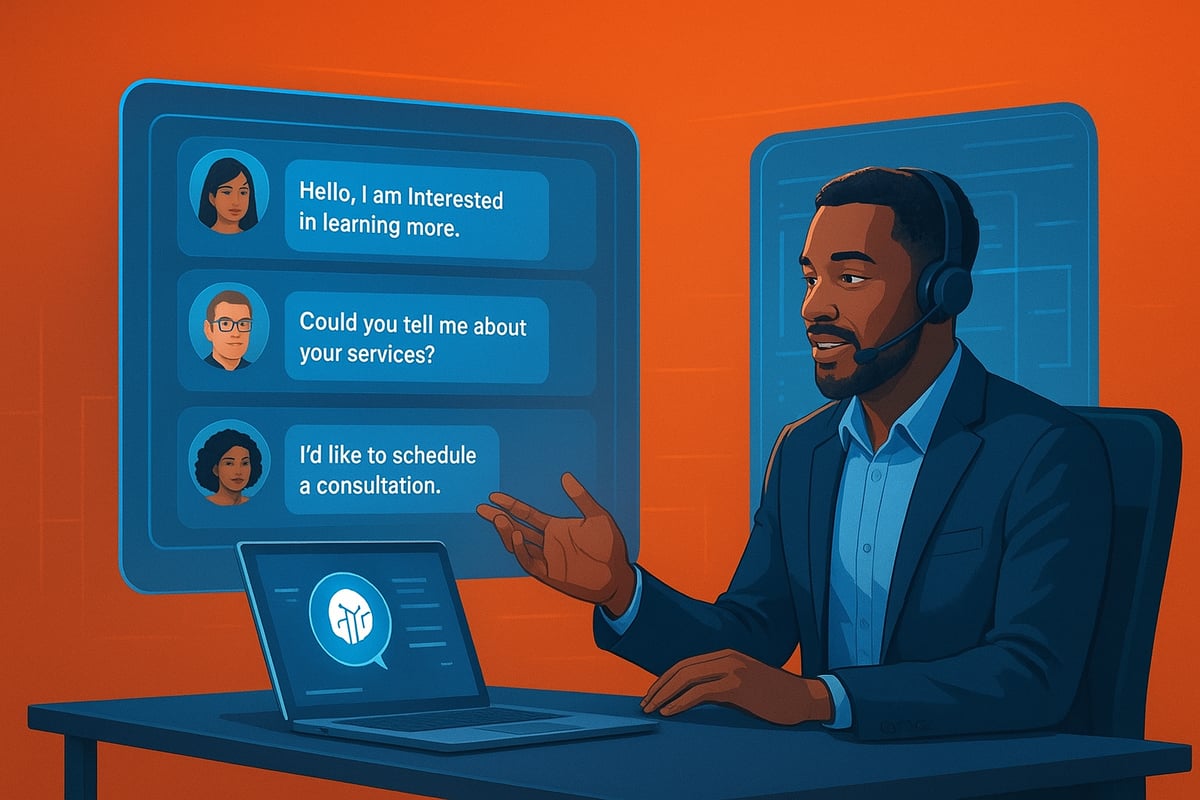
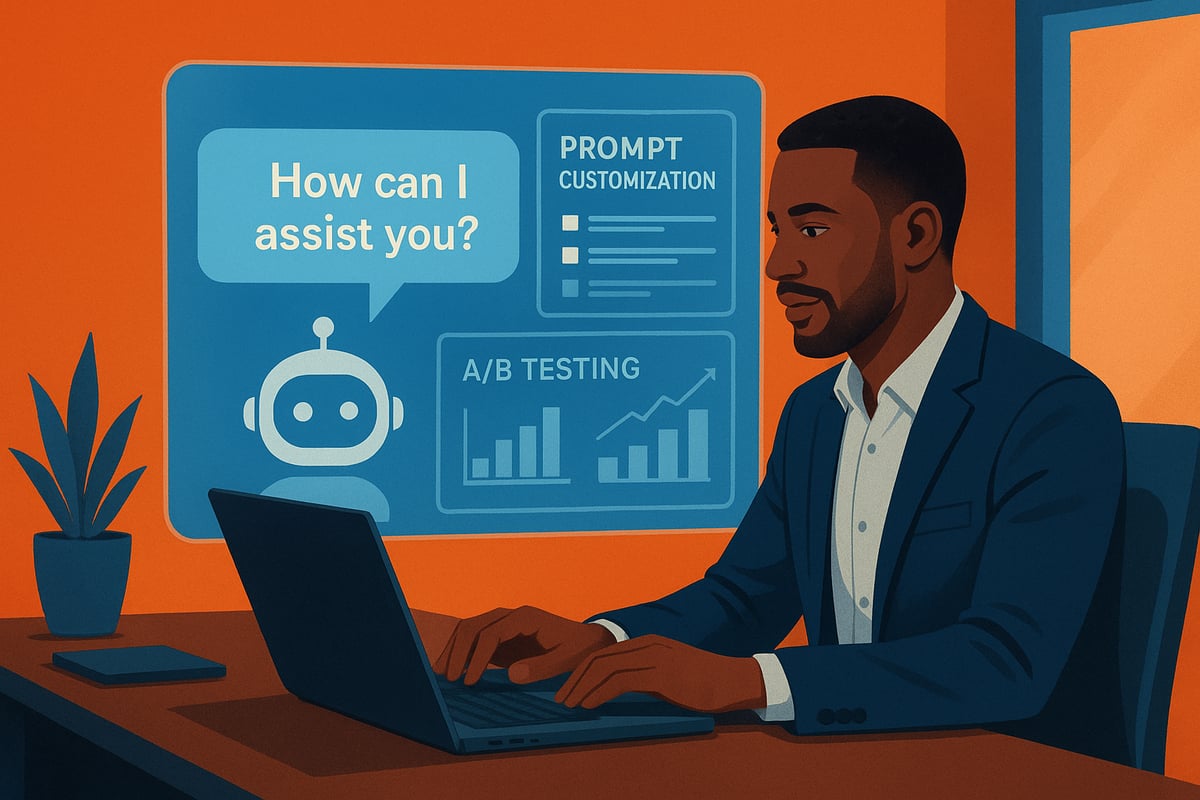
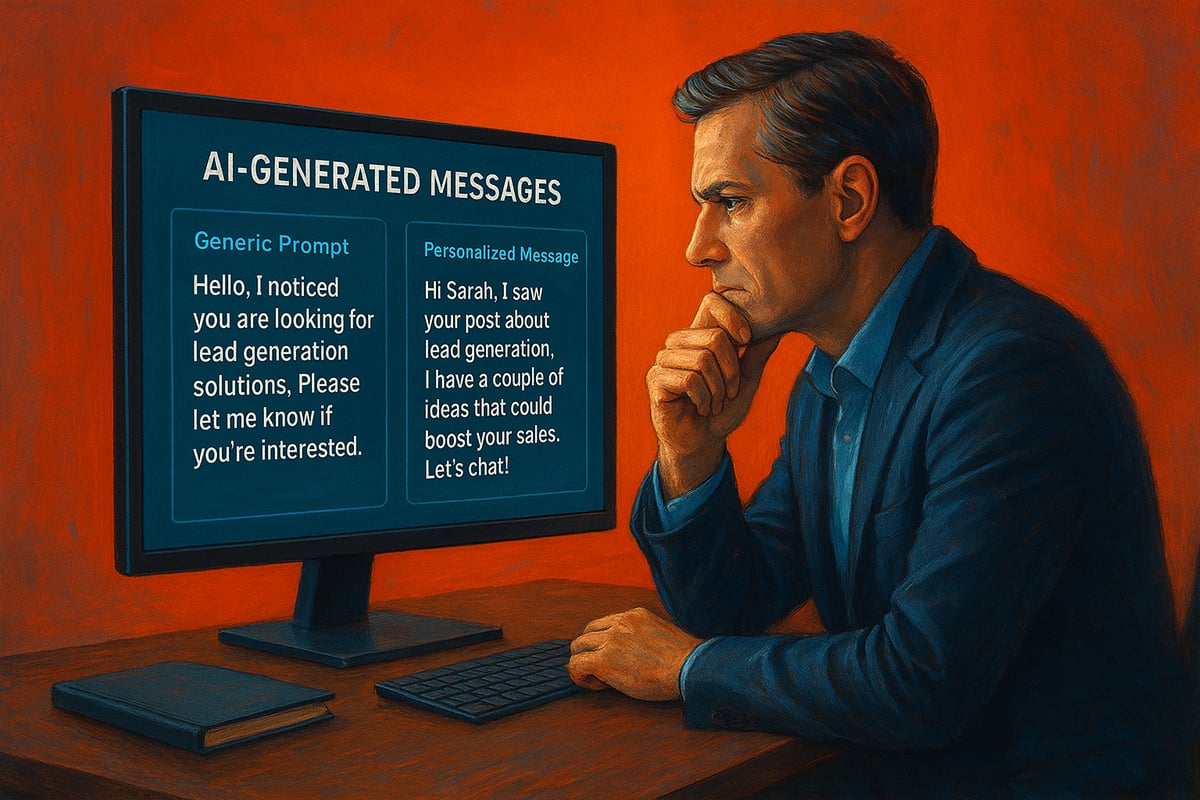
Artificial intelligence is reshaping how coaches approach client growth, especially as we look toward 2026. In this fast-paced landscape, chatgpt prompts to help coaches build a funnel have become essential for those seeking a smarter, more efficient way to attract, nurture, and convert leads.
This article reveals seven proven prompts designed to streamline your funnel-building process. You’ll discover how these strategies can elevate lead generation, boost engagement, and drive higher conversions in your coaching business.
Ready to unlock practical AI solutions and future-proof your funnel? Read on for actionable insights you can implement today.
The Role of AI and ChatGPT in Modern Funnel Building
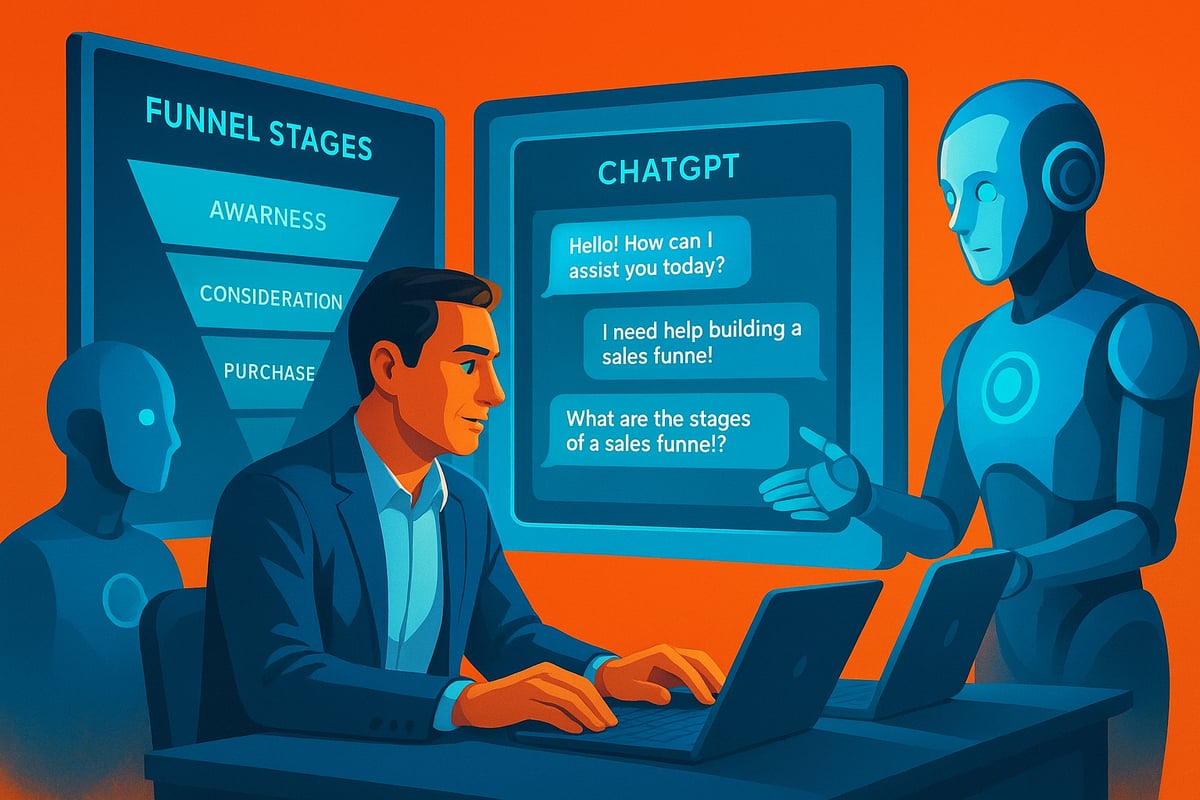
Artificial intelligence is rapidly redefining how coaches approach funnel building and client acquisition. Today, chatgpt prompts to help coaches build a funnel are at the forefront of this transformation. These AI-driven solutions automate repetitive tasks, personalize communication, and dramatically reduce time spent on manual funnel management.
Coaches using AI tools now report up to 35% higher lead conversion rates, according to HubSpot’s 2024 data. By leveraging chatgpt prompts to help coaches build a funnel, professionals can create tailored client journeys, dynamic lead magnets, and engaging nurture sequences with remarkable efficiency.
A significant advantage is the seamless integration of AI outputs with CRM and email marketing platforms. This connects data, automates responses, and ensures every lead receives timely, relevant touchpoints.
Despite concerns about AI replacing human connection, the reality is quite the opposite. AI empowers coaches, freeing them to focus on strategy and high-value client interactions. Prompt engineering is quickly becoming a must-have skill for future-ready coaches, enabling precise, actionable outputs from tools like ChatGPT.
For more examples of how AI is revolutionizing marketing in the coaching field, see AI Breaking Coaching Marketing. The future of funnel building is AI-powered, combining technology with the irreplaceable value of human expertise.
7 Essential ChatGPT Prompts to Help Coaches Build a Funnel 2026
Building a successful funnel in 2026 requires precision and innovation. By leveraging chatgpt prompts to help coaches build a funnel, you can automate, personalize, and optimize each stage, ensuring better results and more efficient processes.
1. [Define Your Ideal Coaching Client Profile]
Start your funnel with a clear vision of your perfect client. Use chatgpt prompts to help coaches build a funnel by generating detailed client avatars. Ask ChatGPT:
“Describe my perfect client for executive leadership coaching in 2026.”
This prompt delivers insights on demographics, motivations, and challenges. The more specific your client profile, the more your messaging will resonate.
For instance, targeted messaging can boost conversion rates by 40% (Salesforce 2025).
Pinpoint pain points and goals.
Clarify preferred communication styles.
Enhance ad copy and outreach.
A focused client avatar shapes every aspect of your funnel for maximum impact.
2. [Map the Client Journey Stages for Your Funnel]
An effective funnel requires mapping each client interaction. Use chatgpt prompts to help coaches build a funnel by asking:
“List the 5 key stages my clients go through from first contact to becoming a brand ambassador.”
This journey map clarifies touchpoints, content needs, and automation opportunities. Coaches who map client journeys often reduce drop-off by 22%.
Define awareness, consideration, and decision stages.
Identify content gaps.
Optimize automation sequences.
Knowing exactly where clients are helps you guide them smoothly through your funnel.
3. [Craft High-Converting Lead Magnet Ideas]
Attract leads with irresistible offers. Chatgpt prompts to help coaches build a funnel can include:
“Suggest 10 lead magnet ideas for stress management coaching for tech leaders.”
Generate ideas like checklists, eBooks, or exclusive webinars. Match these to audience pain points for higher opt-in rates.
Consider digital versus physical lead magnets for 2026, as shown in the table below:
Lead Magnet Type
Digital
Physical
EBook
✔
Workbook
✔
✔
Swag
✔
Innovative lead magnets fuel your list growth and funnel momentum.
4. [Write Persuasive Email Nurture Sequences]
Nurture your leads with tailored emails. Use chatgpt prompts to help coaches build a funnel such as:
“Create a 5-email sequence to nurture new subscribers for my group coaching program.”
This approach ensures each email educates, builds trust, and moves the prospect closer to conversion. Automated nurture campaigns can boost conversions by 50% (ActiveCampaign 2024).
Personalize messages.
Deliver value and stories.
Guide recipients to the next step.
Consistent nurturing keeps your audience engaged and primed for action.
5. [Develop Engaging Webinar or Workshop Scripts]
Drive funnel momentum with high-value events. Chatgpt prompts to help coaches build a funnel may look like:
“Draft a 45-minute webinar script to introduce my leadership coaching framework.”
A strong script builds authority and trust. Include interactive polls, Q&A, and post-event follow-ups for best results.
Outline the session structure.
Add engagement elements.
Plan follow-up offers.
Webinars are proven to accelerate conversions and deepen relationships.
6. [Generate Objection-Handling Responses for Sales Calls]
Address objections confidently with ready-made responses. Use chatgpt prompts to help coaches build a funnel, for example:
“List 7 responses to ‘I don’t have time for coaching right now.’”
Having scripts prepared reduces sales friction and increases your close rate. Real coaches saw 30% more enrollments using this method.
Prepare value-focused answers.
Anticipate common concerns.
Respond with empathy and clarity.
Effective objection handling builds trust and moves prospects forward.
7. [Optimize Funnel Copy for Conversions]
Maximize every word in your funnel. Deploy chatgpt prompts to help coaches build a funnel such as:
“Analyze and rewrite my landing page to maximize sign-ups for my accountability program.”
Focus on clarity, urgency, and benefits. Conversion-optimized copy can double your sign-up rates (Unbounce 2025).
Each of these chatgpt prompts to help coaches build a funnel gives you a strategic advantage. Use them to streamline your process, boost engagement, and drive conversions in 2026.
Integrating ChatGPT Prompts with Existing Coaching Tools
Integrating chatgpt prompts to help coaches build a funnel with your existing coaching tools is essential for maximizing efficiency and maintaining a seamless client experience. Modern AI outputs can be connected directly to popular CRMs, email marketing, and scheduling platforms, allowing you to automate repetitive tasks while keeping communications personalized.
To get started, many coaches link ChatGPT-generated content to their preferred systems using workflow automation tools and plugins. For example, platforms like Zapier, Make, and native CRM integrations make it easy to transfer AI-generated emails or client profiles into your database. If you want a deeper dive into how AI-driven automation streamlines sales funnels, check out this resource on AI in sales funnel automation.
Here are popular integration options for 2026:
Tool
Functionality
Zapier
Automates app workflows
HubSpot CRM
Manages leads and emails
Calendly
Schedules appointments
ActiveCampaign
Email marketing sequences
One coach reported automating 70% of their funnel communications, freeing up time for high-value client interactions. To maintain your brand voice, always review and customize AI outputs before publishing. Pay close attention to client confidentiality and data privacy by using secure, compliant platforms.
Looking ahead, expect AI-powered analytics to provide deeper insights into funnel performance, making chatgpt prompts to help coaches build a funnel even more impactful for future growth.
Best Practices for Prompt Engineering and Customization
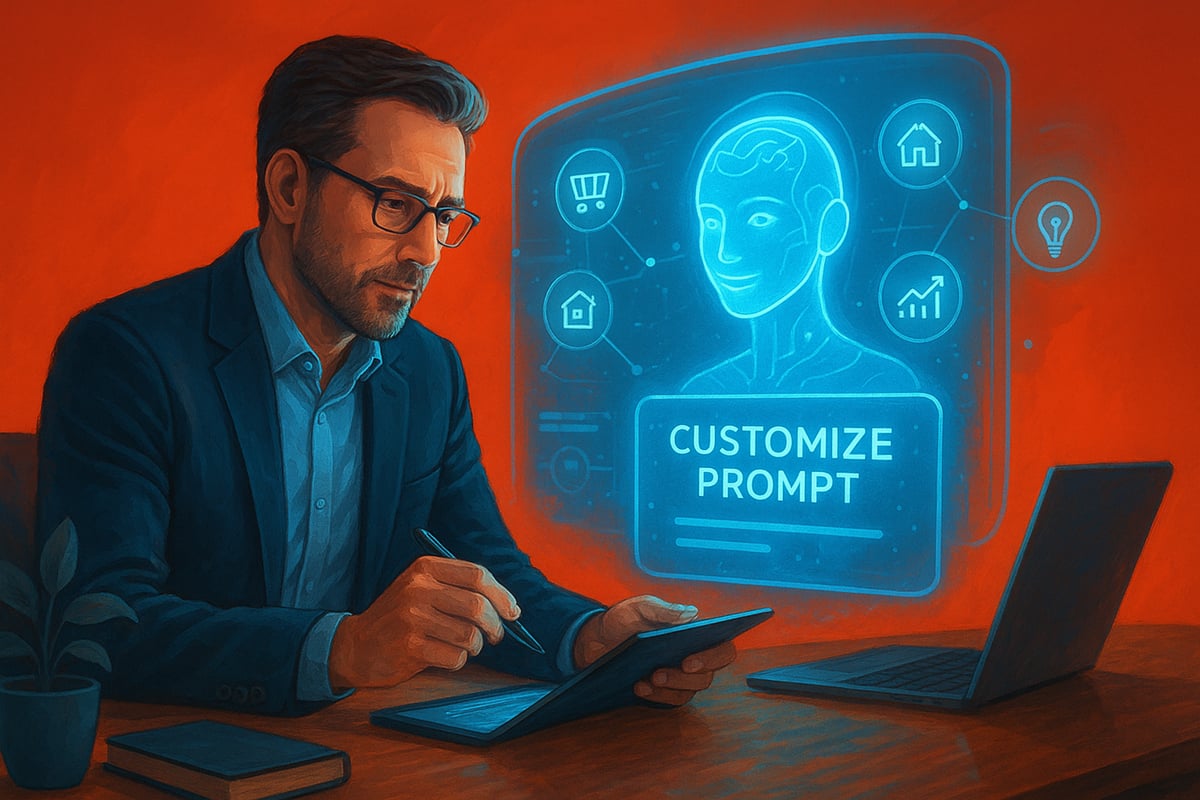
Crafting effective chatgpt prompts to help coaches build a funnel starts with clarity and context. The more specific you are with your instructions, the better the AI can tailor its responses to your coaching style and audience.
Follow these best practices:
Clearly define your funnel goal in each prompt.
Provide relevant background or examples.
Specify the format or length you want in the output.
Iterate and test prompts, refining based on real-world results.
Avoid common mistakes like vague requests or ignoring audience nuances. For example, a prompt for executive coaching should differ from one for wellness coaching. Adjusting tone, pain points, or desired outcomes will dramatically improve relevance.
Document successful prompts so you can reuse and adapt them. For more on maintaining high standards in your coaching practice, read Avoid Red Flags Choosing a Coach.
Experimentation is key to mastering chatgpt prompts to help coaches build a funnel. Every niche and audience responds differently, so ongoing learning and adjustment will keep your funnel optimized.
https://orgs.noomii.com/wp-content/uploads/2026/01/7-essential-chatgpt-prompts-to-help-coaches-build-a-funnel-2026.jpg10241536Don Marklandhttps://orgs.noomii.com/wp-content/uploads/2020/08/corp-noomii-logo-blue4-300x138.pngDon Markland2026-01-12 07:21:292026-01-12 19:51:137 Essential ChatGPT Prompts to Help Coaches Build a Funnel 2026
Career and leadership coaching in dundee is rapidly gaining traction as organizations and professionals prepare for the changing demands of the 2026 workplace. This surge reflects a shift in how people approach professional growth, leadership effectiveness, and organizational success across the region.
Dundee offers unique opportunities for those eager to advance their careers or strengthen leadership skills. Whether you are a business leader, recent graduate, or mid-career professional, you will find tailored coaching solutions to fit your ambitions.
This guide explores the latest trends, types of coaching, top providers, step-by-step advice for choosing a coach, and a look ahead at what’s next.
The State of Career and Leadership Coaching in Dundee (2026)
Dundee is undergoing a remarkable transformation in its professional landscape. As the city prepares for 2026, both organizations and individuals are turning to career and leadership coaching in dundee to navigate rapid changes. The demand is surging, driven by new expectations and the evolving nature of work across sectors.
Economic Growth and Key Drivers
Dundee’s economic boom, fueled by technology, life sciences, and creative industries, is directly impacting the need for career and leadership coaching in dundee. Digital transformation is reshaping every sector, while remote work is now a permanent fixture for many local businesses. Heightened competition for top talent has intensified the focus on staff development and leadership effectiveness.
Key drivers shaping the coaching landscape in Dundee include:
The rise of hybrid and flexible work models
Accelerated adoption of digital tools
A vibrant start-up and scale-up culture
These shifts have made career and leadership coaching in dundee an essential strategy for businesses seeking to remain competitive and adaptive.
Uptake, Leadership Shifts, and Local Initiatives
Recent data shows a significant increase in coaching uptake across Dundee’s business community. Both SMEs and large employers are investing in coaching to support staff development, succession planning, and retention. The University of Dundee’s Careers Service growth in employer engagement highlights this expanding partnership between academia and local employers, fueling demand for coaching services.
Leadership expectations are evolving, with a strong emphasis on emotional intelligence, adaptability, and innovation. Dundee’s leaders are expected to guide teams through uncertainty, manage change sensitively, and foster inclusive cultures. Coaching is now seen as a vital tool for developing these modern leadership skills.
Case Studies and Unique Challenges
Several Dundee-based organizations have made substantial investments in career and leadership coaching in dundee to build workforce resilience. For example, public sector bodies are piloting coaching programs to address skills shortages and improve team performance. Local tech startups are leveraging coaching to help founders and managers scale their leadership capabilities quickly.
Despite these advances, Dundee faces unique challenges. Skills gaps persist in high-growth sectors, and retaining top talent is an ongoing concern. There is also a pressing need to develop diverse leadership pipelines that reflect Dundee’s changing workforce. Coaching is increasingly used to address these issues, offering tailored support for underrepresented groups and emerging leaders.
ROI, Local Insights, and City Comparisons
Feedback from Dundee’s HR professionals and business leaders underscores the tangible return on investment from career and leadership coaching in dundee. Organizations report better employee engagement, higher retention rates, and measurable improvements in team performance. Compared to other Scottish cities, Dundee is rapidly catching up in coaching adoption, with a unique focus on innovation and inclusivity.
Looking ahead, career and leadership coaching in dundee is poised to play a central role in shaping the city’s future workforce.
Types of Career and Leadership Coaching Available in Dundee
The landscape of career and leadership coaching in dundee is more diverse and dynamic than ever before. Local professionals and organizations have access to a wide array of coaching options, each tailored to meet distinct development needs. Whether you are a senior executive, a mid-career professional, part of a team, or seeking specialized support, Dundee offers coaching solutions designed to unlock potential at every level.
Executive and Leadership Coaching
Executive and leadership coaching plays a pivotal role in developing C-suite and senior management talent within Dundee’s thriving business ecosystem. These coaching engagements are designed to elevate strategic thinking, sharpen decision-making, and empower leaders to drive organizational change with confidence.
Dundee’s largest employers, from life sciences to digital technology, invest heavily in executive coaching programs. These initiatives often include personalized sessions, 360-degree feedback, and ongoing support tailored to the unique pressures of leadership roles. As expectations for leaders evolve, there is a clear focus on cultivating emotional intelligence, resilience, and visionary thinking.
For those seeking deeper insights into methodologies and outcomes, executive and leadership coaching insights provides an in-depth look at the approaches shaping modern leadership in Dundee and beyond. The growing demand for career and leadership coaching in dundee at the executive level reflects a broader shift toward proactive and adaptive leadership development.
Career Transition and Development Coaching
Career transition and development coaching supports professionals at critical junctures, whether moving up the ladder, changing roles, or embarking on entirely new career paths. In Dundee, this form of coaching is increasingly sought after by graduates, mid-career professionals, and individuals navigating the evolving job market.
Coaches use established frameworks such as GROW and StrengthsFinder to help clients clarify goals, identify transferable skills, and build actionable career plans. Local initiatives, including university-supported career services and industry partnerships, play a significant role in connecting talent to opportunities.
The rise in career and leadership coaching in dundee for career transitions is also driven by the city’s competitive landscape and rapid digital transformation. Personalized coaching sessions offer professionals the confidence and clarity needed to make successful transitions while addressing skills gaps unique to the region.
Team and Group Coaching
Team and group coaching is gaining popularity among Dundee organizations seeking to enhance collaboration, communication, and overall team performance. Unlike individual coaching, this approach focuses on building collective strengths and aligning team goals with organizational strategy.
Typical formats include facilitated workshops, peer learning circles, and project-based sessions. Outcomes often include improved trust, conflict resolution, and stronger cross-functional relationships. Dundee businesses leverage team coaching to adapt to hybrid work environments and foster a culture of continuous improvement.
As more organizations recognize the impact of career and leadership coaching in dundee on team dynamics, investment in these collaborative programs continues to grow, contributing to higher engagement and productivity.
Specialized Coaching (e.g., Diversity, Women in Leadership, Sector-Specific)
Specialized coaching addresses the unique challenges faced by underrepresented groups and key sectors within Dundee’s workforce. This includes coaching for women in leadership, professionals in STEM fields, and diverse talent pipelines.
Programs like Dundee’s women in STEM leadership initiatives provide targeted support, mentorship, and skill-building opportunities. Sector-specific coaching is also prevalent in creative industries, healthcare, and academia, where unique regulatory and cultural factors come into play.
The availability of specialized career and leadership coaching in dundee ensures that every professional—regardless of background or industry—can access tailored support to overcome barriers and achieve their full potential.
Leading Career and Leadership Coaching Providers in Dundee
Dundee’s professional landscape is thriving, and so is the demand for career and leadership coaching in dundee. A diverse range of coaching providers has emerged to support local organizations and individuals, each offering distinct approaches and specializations. Whether you are seeking executive guidance, team transformation, or global expertise, Dundee’s coaching ecosystem delivers.
Established Local Coaching Firms
Dundee is home to several established coaching consultancies that lead the way in career and leadership coaching in dundee. These firms typically offer executive and leadership development, team coaching, and tailored programs for local industries.
Firms such as Future Leaders Dundee and Tay Coaching Solutions are recognized for their strategic approach. Future Leaders Dundee specializes in executive coaching for C-suite and senior managers, focusing on strategic thinking, change management, and leadership resilience. Tay Coaching Solutions is known for its group coaching programs that build team cohesion and drive organizational change.
Many of these consultancies employ coaches accredited by respected organizations such as the International Coach Federation (ICF) and the Association for Coaching. Their deep knowledge of the Dundee business environment ensures programs are relevant and impactful.
A recent case study highlights a Dundee-based technology firm that partnered with a local consultancy to develop its leadership pipeline. The result was improved retention and increased innovation, underscoring the value of career and leadership coaching in dundee.
Independent Coaches and Boutique Practices
The independent coaching scene has flourished, bringing fresh perspectives to career and leadership coaching in dundee. Freelance coaches and boutique practices offer highly personalized services, often blending sector expertise with innovative coaching models.
Many independents focus on niche areas, such as women in leadership, diversity, or STEM career transitions. For example, local coach Sarah Muir has received praise for her work supporting emerging female leaders in Dundee’s tech sector. Clients frequently cite her empathetic approach and practical frameworks as key differentiators.
Boutique practices often build strong client relationships, delivering tailored solutions that address unique challenges. Testimonials from Dundee professionals highlight the transformative impact of one-to-one and small group coaching led by these specialists.
Corporate and University-Linked Coaching Programs
Corporate and academic partnerships are a cornerstone of career and leadership coaching in dundee. Major employers collaborate with coaching providers to drive professional growth at scale, while universities play a pivotal role in nurturing future leaders.
The University of Dundee offers leadership development programs that blend academic research with real-world application. Its “Leading with Impact” initiative has equipped hundreds of staff and students with strategic leadership skills, fostering a culture of continuous improvement across campus and partner organizations.
Corporate programs, such as those delivered in partnership with NHS Tayside and local financial services firms, focus on upskilling managers, supporting career transitions, and building resilient teams. These initiatives often leverage evidence-based coaching frameworks and are aligned with broader workforce development goals.
Dundee’s commitment to lifelong learning ensures that professionals at all stages can access high-quality career and leadership coaching in dundee through diverse institutional channels.
For Dundee businesses seeking scalable, data-driven solutions, Noomii’s Corporate Leadership Program provides an international perspective on career and leadership coaching in dundee. Noomii connects organizations with a global network of accredited coaches, using precision matching and evidence-based diagnostics to address leadership challenges efficiently.
Noomii’s platform is especially valuable for companies facing rapid growth, remote work transformations, or the need for consistent coaching standards across locations. Its robust analytics help organizations measure outcomes and demonstrate ROI. To learn more about evaluating the impact of coaching, see Measuring ROI from executive coaching.
Case studies from similar-sized cities show improvements in leadership effectiveness, employee engagement, and retention. This makes Noomii an ideal partner for Dundee organizations aiming for sustainable growth through career and leadership coaching in dundee.
Whether you are a business leader, HR professional, or individual seeking advancement, Dundee’s coaching providers offer pathways to measurable success.
How to Choose the Right Career or Leadership Coach in Dundee: Step-by-Step Guide
Selecting the right coach can be a transformative decision for your professional journey. The landscape of career and leadership coaching in dundee has never been more dynamic, with many options and approaches available. To help you navigate this process, follow these six structured steps designed to maximize your investment and outcomes.
Step 1: Define Your Goals and Outcomes
Begin your journey into career and leadership coaching in dundee by clarifying your objectives. Are you seeking a promotion, a new direction, or better team dynamics? Identifying your desired results will help you target the right type of coaching.
Popular frameworks like SMART (Specific, Measurable, Achievable, Relevant, Time-bound) or GROW (Goal, Reality, Options, Will) provide structure for this step. Write down your top three priorities and consider how coaching can support each one.
Clear goals ensure that your coaching engagement is focused and measurable. This initial clarity will guide your selection process and help you communicate your needs effectively.
Step 2: Research Credentials and Experience
Quality matters in career and leadership coaching in dundee. Start by verifying a coach’s training and background. Look for certifications from reputable bodies such as the International Coach Federation (ICF) or the Association for Coaching (AC). Consider their industry experience, client testimonials, and track record with similar professionals.
A helpful resource is this guide on what to consider when choosing a coach, which outlines key questions and criteria. Review case studies and check if the coach has worked with Dundee-based organizations or individuals in your sector.
Comparing coaches side by side can reveal important differences in approach and expertise, so take notes as you research.
Step 3: Evaluate Coaching Styles and Approaches
Not every style fits every professional. When exploring career and leadership coaching in dundee, pay attention to methodologies such as solution-focused, transformational, or strengths-based coaching.
Ask yourself: Do you prefer structured sessions, or a more fluid, conversational approach? Some coaches lean on assessments and tools, while others emphasize reflective dialogue. Consider reading sample materials or attending an introductory workshop to get a sense of their style.
Matching a coach’s approach to your learning preferences and company culture can make a significant difference in your experience and outcomes.
Step 4: Assess Fit Through Consultations
Personal chemistry is essential in career and leadership coaching in dundee. Most reputable coaches offer free or low-cost consultations. Use these meetings to gauge rapport, communication style, and mutual understanding.
Prepare questions such as:
What is your coaching philosophy?
How do you measure client progress?
Can you share examples of similar client journeys?
Trust your instincts. If you feel comfortable and inspired, you are more likely to engage deeply and achieve your goals.
Step 5: Consider Logistics and Investment
Practicalities can influence your decision in career and leadership coaching in dundee. Compare costs, session formats (in-person, virtual, or hybrid), and scheduling flexibility. On average, coaching fees in Dundee range from £75 to £250 per session, depending on experience and program length.
Here’s a quick comparison table:
Format
Price Range
Flexibility
In-person
£100-£250
Moderate
Virtual
£75-£200
High
Hybrid
£90-£220
High
Factor in your budget, time commitment, and preferred mode of communication before making a decision.
Step 6: Set Expectations and Measure Progress
Successful career and leadership coaching in dundee relies on clear expectations and ongoing measurement. Establish key performance indicators (KPIs) such as promotion achieved, skills gained, or team feedback scores. Set up regular check-ins to review progress.
Use tools like feedback forms, 360-degree reviews, and personal reflection journals to track development. Agree with your coach on how you will evaluate success and adjust your plan if needed.
The Benefits and Impact of Coaching: What Dundee Professionals and Organizations Can Expect
Career and leadership coaching in dundee is rapidly becoming a catalyst for both personal and organizational transformation. As professionals and companies strive to adapt in 2026, the tangible benefits of coaching are clearer than ever. This investment is not just about fixing problems, it is about unlocking potential at every level.
Elevating Leadership and Engagement
One of the most significant outcomes of career and leadership coaching in dundee is the boost in leadership effectiveness. Local leaders report sharper strategic thinking and improved emotional intelligence, which directly influences team morale. Enhanced engagement is not just anecdotal. Recent research shows that organizations investing in coaching see measurable gains in productivity and employee satisfaction.
A growing number of Dundee businesses use coaching to nurture future leaders and strengthen their management pipelines. This proactive approach helps teams weather change, fosters resilience, and encourages open communication across departments.
Advancing Careers and Building Confidence
Individuals seeking career and leadership coaching in dundee consistently describe greater clarity in their professional paths. Whether navigating a career change or aiming for a promotion, coaching provides personalized strategies for goal setting and overcoming challenges.
Professionals often gain increased self-confidence and a renewed sense of purpose. These benefits extend beyond the individual, elevating team dynamics and contributing to a more positive workplace culture.
Organizational Impact: Retention, Performance, and Innovation
For organizations, career and leadership coaching in dundee delivers a strong return on investment. Companies see higher retention rates as coaching addresses the root causes of disengagement and turnover. Teams coached together report better collaboration and innovation.
A recent DDI analysis on manager coaching and turnover risk highlights that effective coaching correlates with lower turnover and stronger leadership pipelines. Dundee firms are increasingly tracking these metrics to justify ongoing investment.
Coaching vs Traditional Development Methods
Approach
Personalization
Measurability
Long-term Impact
Coaching
High
High
Proven
Mentoring
Medium
Low
Variable
Training
Low
Medium
Short-term
Coaching stands out for its tailored approach and clear, trackable outcomes, especially when compared to traditional training or mentoring.
Real Stories, Real Results
Dundee professionals frequently share stories of transformative growth following career and leadership coaching in dundee. For example, a local tech firm credits coaching with reducing turnover by 25% in one year. Public sector organizations note improved cross-functional collaboration and innovation.
Testimonials highlight not just career advancement, but also improved wellbeing and work-life balance. These experiences reinforce coaching’s reputation as a high-impact tool for lasting change.
Addressing Concerns and Measuring Impact
Some may wonder about confidentiality, time commitment, or whether the results are predictable. Reputable coaches in Dundee maintain strict confidentiality, offer flexible session formats, and use clear KPIs to measure progress.
The Future of Career and Leadership Coaching in Dundee: Trends and Predictions for 2026 and Beyond
The landscape of career and leadership coaching in dundee is evolving rapidly as new technologies, social priorities, and global influences reshape the way professionals and organizations approach growth. By 2026, forward-thinking trends are set to define how coaching delivers impact in Dundee and beyond.
Technology-Driven Coaching Innovations
Technology is transforming career and leadership coaching in dundee. AI-driven assessments, virtual coaching platforms, and advanced data analytics are now integral to the coaching process. These innovations allow coaches to personalize programs, track progress in real time, and deliver results at scale.
Many Dundee organizations are embracing tools that offer on-demand coaching and digital feedback loops. For instance, local firms use virtual platforms to ensure accessibility for hybrid and remote teams. This shift is not just about convenience. It is about equipping leaders with actionable insights for faster development.
Professional learning programs like Education Scotland’s ‘Leading the How of Change’ program are setting new standards for strategic leadership skills, blending technology with proven coaching methodologies. As a result, Dundee’s coaching market is becoming more agile and data-driven, supporting continuous improvement.
Focus on Diversity, Equity, and Inclusion
Diversity, equity, and inclusion will be at the forefront of career and leadership coaching in dundee. Organizations are seeking coaches who understand the complexities of building inclusive cultures and developing leaders from all backgrounds.
Coaching programs increasingly address barriers faced by underrepresented groups, especially in tech and academic sectors. Initiatives are designed to support women, minority professionals, and neurodiverse talent, ensuring everyone can access growth opportunities.
Sustainability and wellbeing are now core priorities in career and leadership coaching in dundee. Modern coaching integrates resilience, mental health, and work-life balance into leadership frameworks. This holistic approach is vital as organizations recognize that high performance depends on employee wellbeing.
Dundee is home to several pilot initiatives that blend wellbeing coaching with leadership training. These programs help leaders develop empathy, manage stress, and build sustainable team cultures. The focus on wellbeing is not just a trend but a fundamental shift in how organizations invest in their people.
Globalization and Access to International Coaching Networks
Globalization is opening new doors for career and leadership coaching in dundee. Local professionals are joining international coaching communities, accessing world-class expertise and best practices from across the globe.
Virtual platforms allow Dundee’s businesses to tap into a wider pool of coaching talent, making it easier to address unique leadership challenges. This global perspective helps local leaders stay competitive, innovative, and adaptable in a fast-changing world.
As more Dundee organizations invest in international partnerships, professionals can expect even greater access to resources and collaborative networks. The future promises a dynamic blend of local insight and global opportunity, ensuring Dundee’s workforce is ready for whatever comes next.
Resources and Further Reading
Exploring resources can accelerate your journey in career and leadership coaching in dundee. Whether you are a professional, HR leader, or business owner, leveraging the right materials and networks is crucial for growth.
Recommended Books, Articles, and Research
Start with foundational books like “Co-Active Coaching” by Kimsey-House et al. and “The Leadership Challenge” by Kouzes and Posner. For recent insights, explore Harvard Business Review articles on coaching ROI and leadership trends. Academic journals such as the International Journal of Evidence Based Coaching & Mentoring publish research relevant to career and leadership coaching in dundee.
“Coaching for Performance” by Sir John Whitmore
“Emotional Intelligence” by Daniel Goleman
Recent Deloitte and CIPD reports on UK leadership development
These resources offer proven frameworks and evidence-based strategies.
Dundee Organizations, Directories, and Online Platforms
Accessing Dundee-based coaching organizations can help you connect with local experts. The Association for Coaching Scotland and the International Coach Federation (ICF) directory list accredited professionals in career and leadership coaching in dundee.
Several online platforms, such as Noomii and LinkedIn, provide directories to vetted coaches. To enhance team outcomes, review Team coaching strategies for practical approaches widely used in Dundee organizations.
Local Events, Networking Groups, and Workshops
Attending events is essential for building relationships and staying updated. Look for workshops hosted by Dundee & Angus Chamber of Commerce, Women Ahead Dundee, and local HR forums. Universities often organize leadership seminars and networking sessions, helping professionals in career and leadership coaching in dundee expand their communities.
Monthly peer circles for coaches and leaders
Annual Dundee Leadership Summit
Sector-specific meetups for tech, creative, and public sectors
These gatherings foster idea exchange and practical learning.
Government and University Programs
Take advantage of government initiatives supporting leadership growth, such as Skills Development Scotland and Scottish Enterprise programs. The University of Dundee and Abertay University offer executive education, mentorship, and leadership coaching schemes.
For further accountability and leadership development insights, visit Accountability Now. Combining these resources ensures you are equipped for success in career and leadership coaching in dundee.
https://orgs.noomii.com/wp-content/uploads/2026/01/career-and-leadership-coaching-in-dundee-the-2026-guide.jpg10241536Don Marklandhttps://orgs.noomii.com/wp-content/uploads/2020/08/corp-noomii-logo-blue4-300x138.pngDon Markland2026-01-12 06:40:542026-01-12 19:50:11Career and Leadership Coaching in Dundee: The 2026 Guide
In 2026, coaches face a rapidly shifting landscape where standing out is more essential than ever. With the market becoming increasingly saturated, specialization is no longer optional, it is the key to growth and long-term success.
Artificial intelligence, especially tools like ChatGPT, is revolutionizing how coaches discover, refine, and validate their ideal niche. By leveraging chatgpt prompts to help coaches niche down, professionals can unlock unique strengths and meet client needs with precision.
This article unveils 7 essential prompts that guide coaches step by step through the niching process. Expect actionable insights and real-world examples to help you carve out a profitable space and thrive in a competitive industry.
The Importance of Niching Down for Coaches in 2026
In 2026, the coaching industry faces unprecedented saturation, making it difficult for generalist coaches to stand out. With over 232,000 coaches now serving clients and the market doubling in size since 2016, competition has never been fiercer. According to the United States Professional Coaching Industry Report 2025, specialized coaching services are experiencing higher demand, with clients actively seeking tailored expertise and solutions.
Clients are increasingly selective, preferring coaches who demonstrate deep knowledge in a targeted area. This shift means niching down is no longer optional for growth and sustainability. Coaches who leverage digital tools and chatgpt prompts to help coaches niche down are better equipped to identify profitable segments and adapt quickly to market trends.
Success stories abound of coaches who achieved rapid business growth by focusing on a single niche. In 2026, the path to resilience and profitability lies in specialization, data-driven decision-making, and the strategic use of AI for niche discovery.
How ChatGPT Empowers Coaches to Find Their Niche
ChatGPT is transforming how coaches approach niche discovery. Its advanced language processing enables coaches to quickly analyze vast amounts of market data and generate actionable insights in minutes.
By using AI-generated prompts, coaches can streamline the process of self-reflection and market analysis. This approach helps clarify personal strengths, values, and interests, while simultaneously scanning for gaps and trends within the coaching industry.
ChatGPT excels at uncovering hidden opportunities and emerging niches that might otherwise go unnoticed. Tools and strategies highlighted in Enhancing Coaching Effectiveness with ChatGPT: Top 5 Strategies demonstrate how AI can surface new coaching areas and anticipate client demands.
For example, a coach seeking to specialize used ChatGPT to identify a growing sub-niche in wellness coaching for hybrid workplaces. This process validated their direction with real-time data, underscoring how chatgpt prompts to help coaches niche down save time and increase precision when choosing a profitable niche.
7 Essential ChatGPT Prompts to Help Coaches Niche Down in 2026
Selecting the right niche is vital for coaches aiming to thrive in 2026. With market competition fierce, coaches must use advanced strategies to stand out. Leveraging chatgpt prompts to help coaches niche down offers a structured, data-driven approach for finding a profitable and fulfilling specialty. Below are seven actionable prompts, each designed to guide you step by step.
1. [Identify Your Core Strengths and Passions]
Begin your journey by exploring your unique strengths and genuine interests. Use chatgpt prompts to help coaches niche down by asking for a guided self-assessment of your skills, values, and experiences.
List core competencies, certifications, and personal achievements.
Reflect on past client successes.
Identify activities that bring you energy and fulfillment.
For example, a coach might discover an intrinsic passion for empowering introverted leaders, which becomes a natural fit for their coaching practice. Aligning with your true interests leads to greater satisfaction and credibility in your niche.
2. [Analyze Market Demand and Competition]
Next, utilize chatgpt prompts to help coaches niche down by researching trending coaching topics and identifying underserved markets. Ask ChatGPT to generate market reports or analyze competitor offerings.
Review search trends and industry data.
Compare service gaps among competitors.
Spot emerging needs in the coaching space.
For deeper insights, explore resources like Best AI Tools for Life Coaching to stay ahead. For instance, after the pandemic, many coaches noted a spike in demand for remote team coaching. Making data-driven decisions reduces risk and enhances market fit.
3. [Define Your Ideal Client Avatar]
Create a detailed client persona using chatgpt prompts to help coaches niche down. Clarify your ideal client's demographics, goals, and pain points.
Specify age, profession, and industry.
Outline challenges they face.
List aspirations and preferred communication styles.
A coach may focus on mid-level managers in tech startups seeking leadership growth. Greater specificity leads to more targeted marketing and impactful coaching.
4. [Validate Your Niche with Real-World Data]
Validation is essential. Use chatgpt prompts to help coaches niche down by generating survey questions or interview scripts for your target audience. Analyze responses to refine your niche selection.
Collect feedback on pain points and needs.
Assess willingness to invest in coaching.
Identify language your audience uses.
For example, surveys may reveal a strong demand for wellness coaching in hybrid workplaces. Evidence-based decisions increase your confidence and reduce guesswork.
5. [Craft Your Unique Value Proposition]
Stand out by articulating what makes your coaching unique. Use chatgpt prompts to help coaches niche down and brainstorm value statements that highlight your approach.
List measurable outcomes you deliver.
Describe your coaching style.
Emphasize differentiators, such as ROI tracking or accountability frameworks.
For example, offering an outcome-based program with guaranteed results can attract discerning clients. A strong value proposition positions you as the go-to expert.
6. [Develop a Signature Coaching Program Outline]
Design a program tailored to your chosen niche using chatgpt prompts to help coaches niche down. Ask ChatGPT to help structure session topics, learning objectives, and resources.
Map out a multi-week curriculum.
Define session goals and expected results.
Incorporate tools and assessments.
For instance, a 12-week leadership acceleration course for new managers shows professionalism and readiness. A clear outline streamlines onboarding and delivery.
7. [Plan Your Content and Marketing Strategy]
Finally, use chatgpt prompts to help coaches niche down by brainstorming content ideas for your niche. Request suggestions for blog topics, webinars, and social posts.
Identify trending keywords and content gaps.
Plan a publishing calendar.
Align messaging with client needs.
Building an authority blog on “Resilient Leadership for Remote Teams” can increase visibility and inbound inquiries. For further business growth, consider the resources available at Accountability Now.
Best Practices for Using ChatGPT Prompts Effectively
To get the most out of chatgpt prompts to help coaches niche down, start by tailoring each prompt to fit your unique coaching style and goals. Customization ensures that the insights you receive are relevant and actionable for your specific situation.
Blend AI-generated ideas with your own expertise and intuition. While ChatGPT can surface trends and suggestions, your personal experience remains essential for making final decisions. Remember, authenticity is key to building trust with your clients.
Avoid relying solely on AI for every decision. Instead, use ChatGPT as a creative partner. Regularly revisit and refine your prompts based on client feedback and evolving industry needs.
Stay committed to ongoing learning. Attend events like ChatGPT for Coaches – ICF Events to keep up with best practices and new developments in AI-powered coaching. This approach helps you evolve your strategies and remain competitive.
Ultimately, the most successful coaches treat AI as a collaborative tool, not a replacement. By combining chatgpt prompts to help coaches niche down with your own insights, you will create a resilient and authentic coaching practice.
Common Mistakes Coaches Make When Niching Down—and How to Avoid Them
Many coaches struggle to niche down effectively, often falling into a few common traps. One frequent mistake is picking a niche that is either too broad, which dilutes your message, or too narrow, which limits your reach. Another pitfall is neglecting to validate the market or listen to client feedback, leading to wasted effort and missed opportunities.
Some coaches follow trends without aligning with their own strengths or passions, resulting in burnout or lackluster results. Others may overlook the value of learning from peers who have successfully navigated this process. Exploring Career Coaches for Niche Guidance can offer practical examples and strategies to avoid these setbacks.
To recalibrate, regularly assess your approach, test new ideas with real clients, and use chatgpt prompts to help coaches niche down for more strategic decisions. Stay open to feedback and be ready to pivot as needed for sustainable growth.
FAQ
Curious about chatgpt prompts to help coaches niche down? Here are answers to the most common questions:
What are chatgpt prompts to help coaches niche down? These are targeted questions or instructions designed to help coaches identify their strengths, market needs, and ideal client profiles using AI.
How do I create effective prompts for my coaching business? Begin by clarifying your core values and goals. Use AI tools to refine your questions and adapt them to your unique style.
Can I use chatgpt prompts for different coaching niches? Yes, chatgpt prompts to help coaches niche down are flexible and can be tailored for wellness, executive, or business coaching. Explore specialized options in the Business Coaching Directory.
How does AI improve the process of niching down? AI accelerates research, analyzes trends, and uncovers gaps, making niche selection more precise and efficient.
How do I ensure my niche aligns with market demand? Validate your ideas through surveys, interviews, and ongoing market analysis.
Should I rely solely on AI for my coaching strategy? No, combine AI insights with personal experience and client feedback for best results.
How can Noomii for Corporate Coaching benefit my organization? Noomii provides tailored coaching solutions that drive measurable results for teams and leaders.
What are the unique advantages of using Noomii for Corporate Coaching? You gain access to a global network of vetted coaches and programs designed for organizational growth.
Who is Don Markland? Don Markland is a respected leadership coach and CEO, recognized for his expertise in accountability and executive development.
https://orgs.noomii.com/wp-content/uploads/2026/01/7-essential-chatgpt-prompts-to-help-coaches-niche-down-in-2026.jpg10241536Don Marklandhttps://orgs.noomii.com/wp-content/uploads/2020/08/corp-noomii-logo-blue4-300x138.pngDon Markland2026-01-11 07:40:452026-01-11 07:40:457 Essential ChatGPT Prompts to Help Coaches Niche Down in 2026
Did you know that in 2026, Aberdeen’s executive landscape is changing faster than ever, with over 30 percent of senior roles now spanning new sectors like renewables and tech? Navigating these shifts requires more than expertise—it demands the right career transition support for executives in aberdeen. This guide is designed to help you face today’s toughest leadership challenges, build resilience, and unlock new opportunities. Discover the evolving job market, common transition hurdles, and the essential strategies and services you need for a successful executive journey. For more on accountability-driven leadership and coaching, explore Accountability Now.
The 2026 Executive Job Market in Aberdeen
The job market for executives in Aberdeen is evolving at a rapid pace, shaped by shifting industries and global trends. For those seeking career transition support for executives in aberdeen, understanding these changes is essential to making informed career moves and staying ahead in 2026.
Key Trends and Sector Growth
Aberdeen’s economic landscape is experiencing a pivotal transformation as traditional industries adapt and new sectors emerge. The city, long known as the energy capital of Europe, is now at the forefront of the energy transition. Executives are witnessing a surge in renewables, offshore wind, and clean technology investment, which is redefining leadership opportunities.
The technology and life sciences sectors are also experiencing robust growth. Fintech, digital health, and advanced manufacturing are attracting global attention, creating new C-suite roles that require both sector expertise and digital acumen. The financial services sector remains strong, with international firms expanding their presence and seeking leaders who can navigate regulatory change and digital disruption.
Here’s a quick comparison of sector growth projections for Aberdeen executives in 2026:
Sector
Projected Growth
Key Executive Skills Needed
Renewables & Energy
12%
Change management, ESG strategy
Technology
15%
Digital leadership, data analytics
Life Sciences
10%
Regulatory, innovation, partnerships
Financial Services
7%
Risk, compliance, digital fluency
The demand for hybrid leadership skills is higher than ever. Executives who can operate across sectors and adapt to new business models are in demand. Digital transformation and sustainability initiatives are driving this shift. According to 2026 Workplace Trends: Human Skills, AI, And Talent Scarcity, human strengths like adaptability and strategic thinking are as valued as technical expertise.
Local opportunities remain strong, but global executive roles are growing as Aberdeen-based companies expand internationally. Executives are leveraging career transition support for executives in aberdeen to tap into both domestic and overseas markets, often blending remote and on-site leadership.
A prime example is an executive who moved from a senior oil & gas role into a renewable energy startup. With targeted career transition support for executives in aberdeen, they successfully repositioned their experience, embracing ESG leadership and driving innovation in a rapidly growing sector.
Challenges Unique to Aberdeen Executives
While opportunity abounds, Aberdeen executives face unique hurdles in 2026. Navigating a post-Brexit, post-pandemic market means dealing with ongoing regulatory uncertainty and shifts in international trade. The influx of global talent has intensified competition for top executive roles, making differentiation and adaptability critical.
Organizational restructuring and M&A activity are reshaping the corporate landscape. Many companies are consolidating, leading to executive redundancies and the need for rapid career pivots. Leaders must be prepared for sudden changes and possess the resilience to manage transitions smoothly.
One real-life scenario involved an executive who faced redundancy after a major merger in the energy sector. By seeking career transition support for executives in aberdeen, they accessed outplacement resources, coaching, and peer networks that enabled a swift move into a new sector.
Executives must also contend with evolving expectations. Cross-sector adaptability, up-to-date digital skills, and a global leadership mindset are now baseline requirements. Those who proactively seek career transition support for executives in aberdeen are better equipped to navigate these challenges and secure high-impact roles.
For additional personalized accountability and strategic coaching resources, visit Accountability Now.
Common Career Transition Challenges for Executives
Navigating a major career change is never simple, and the stakes are particularly high for senior leaders. Career transition support for executives in aberdeen must address a unique mix of emotional, professional, and personal challenges. Understanding these hurdles is the first step toward a confident, successful transition.
Emotional and Psychological Hurdles
Leaving a high-profile executive role often triggers a profound sense of loss. Many leaders tie their identity and self-worth to their positions, so exiting can feel like losing a part of themselves. This emotional toll is a central reason why career transition support for executives in aberdeen is so vital.
Stress and uncertainty can be overwhelming during this period. Executives must quickly adapt to new realities, manage self-doubt, and maintain resilience under pressure. A strong peer network of other senior leaders can help, offering empathy, shared experience, and practical advice.
Peer support groups and confidential mastermind circles are invaluable. They provide a safe space for executives to voice concerns, gain perspective, and rebuild their confidence together.
Professional and Practical Barriers
Beyond emotional struggles, executives often face tough professional obstacles. Outdated skillsets or leadership approaches can quickly become a liability in fast-evolving sectors. Many find that contractual restrictions, such as non-compete clauses, limit their immediate options. Age bias and sector-specific stereotypes can further complicate the job search.
Repositioning a personal brand for a new sector is challenging. One executive, for example, struggled to translate decades in oil and gas into credibility in the renewables space. Leveraging Leadership and Executive Coaching Insights can help leaders identify transferable skills and build a modern, compelling narrative for their next move.
Family and Lifestyle Impacts
Major career shifts rarely affect only the executive. Family members must also adjust to new routines, locations, or even financial realities. Relocation is a common requirement, and children or partners may need support as they transition schools, jobs, or social circles.
Balancing personal responsibilities with ambitious career goals can be a delicate dance. Here, career transition support for executives in aberdeen is about much more than job placement; it is about ensuring the whole family is set up for long-term success and satisfaction.
For executives seeking expert guidance on accountability and personal development during these transitions, visit Accountability Now for resources tailored to senior leaders.
Essential Career Transition Support Services in Aberdeen
Executives navigating new opportunities in Aberdeen need a robust toolkit of support. The landscape for career transition support for executives in aberdeen is rapidly evolving, offering tailored services to help leaders overcome uncertainty and land their next role with confidence.
Executive Outplacement Services
Specialized outplacement is a cornerstone of career transition support for executives in aberdeen. Local providers offer bespoke packages designed for senior leaders facing redundancy or seeking new directions. Typical services include:
Personalised CV and LinkedIn profile development
Executive interview coaching and assessment preparation
Strategic introductions to relevant networks and headhunters
Aberdeen’s top outplacement firms deliver high satisfaction scores, with recent data showing over 80% of executives secure new roles within six months. For a detailed look at options, review Executive Career Transition Services for C-Suite & Leaders, which compares leading providers and their success rates. One notable example is an oil and gas executive who leveraged outplacement to transition into a renewables leadership role, demonstrating the tangible impact of these services.
Professional Career Coaching
Career transition support for executives in aberdeen is incomplete without expert coaching. Certified executive coaches help leaders clarify their vision, build resilience, and implement actionable strategies for success. These professionals offer:
One-to-one coaching sessions tailored to executive needs
Mindset and confidence building during high-stakes transitions
Accountability frameworks for goal achievement
A recent Aberdeen case involved a CFO who, after engaging with a career coach, successfully shifted into a board advisory role. This transformation highlights the value of targeted support in adapting leadership styles and navigating complex career landscapes.
Networking and Peer Support Groups
Building and nurturing relationships is essential for career transition support for executives in aberdeen. Aberdeen’s vibrant executive community provides access to:
Industry-specific networking events and business associations
Peer mastermind groups for shared learning and support
Exclusive leadership roundtables and alumni gatherings
Executives who tap into these networks often uncover hidden opportunities and gain valuable insights from peers. Joining a mastermind group, for example, can accelerate job searches and foster lasting professional relationships.
Legal and Financial Advisory
Legal and financial expertise is a critical facet of career transition support for executives in aberdeen. Navigating severance agreements, equity stakes, and pension plans can be complex. Trusted advisors assist with:
Reviewing and negotiating exit packages
Clarifying non-compete clauses and contractual obligations
Planning for long-term financial security
Engaging specialist legal counsel ensures executives protect their interests while making a smooth transition. Financial planners can also provide clarity on tax implications and wealth management during this pivotal period.
For executives seeking highly tailored career transition support for executives in aberdeen, the Noomii Corporate Leadership Program delivers measurable results. This program offers:
Evidence-based diagnostics to map leadership strengths and areas for growth
Precision coach matching for sector-specific transitions
Progress tracking and clear ROI for organizations and individuals
One Aberdeen executive used Noomii’s program to move seamlessly from a corporate C-suite post to a board-level appointment, underscoring the power of purpose-built coaching. To further enhance your executive journey, explore additional personalized resources at Accountability Now.
Step-by-Step Guide to Planning Your Executive Career Transition
Navigating a successful executive career move in Aberdeen demands a structured approach. By following these seven essential steps, you can turn uncertainty into opportunity and make the most of career transition support for executives in aberdeen.
Step 1: Self-Assessment and Goal Setting
Start your journey with honest self-reflection. Evaluate your leadership strengths, transferable skills, and personal values. What motivates you? Define your ambitions for the next stage.
Utilize self-assessment tools and consider consulting organizations like Skills Development Scotland for local resources. This foundational step in career transition support for executives in aberdeen will ensure your goals align with market realities and your own aspirations.
Clarify your non-negotiables, such as location or work-life balance. Set clear, measurable targets to guide your transition strategy.
Step 2: Market Research and Targeting Opportunities
Understanding the evolving Aberdeen job landscape is critical. Analyze growth sectors, emerging roles, and skills in demand. Research potential employers and industry trends affecting executive opportunities.
Leverage platforms like LinkedIn and executive search firms. Build intelligence by connecting with local recruiters and joining industry events. This proactive approach to career transition support for executives in aberdeen helps you target roles that fit your profile.
Document your findings in a spreadsheet or mind map to track opportunities and tailor your approach.
Step 3: Personal Brand and CV Optimization
Your executive narrative must resonate in 2026’s competitive market. Update your CV to highlight impact, leadership, and adaptability. Focus on quantifiable achievements.
Refresh your LinkedIn profile with a compelling summary and recommendations. Position yourself as a thought leader by sharing insights or publishing articles. With career transition support for executives in aberdeen, optimize your digital presence to stand out.
Consider professional photography and consistent branding across all channels to reinforce your value proposition.
Step 4: Networking and Relationship Building
Success in executive transitions often hinges on who you know. Map your network, including peers, mentors, and industry contacts. Attend Aberdeen business events and leverage alumni associations.
Engage in meaningful conversations rather than transactional outreach. Career transition support for executives in aberdeen includes building genuine relationships that can lead to hidden opportunities.
Join mastermind groups or executive forums to stay connected, gain perspective, and share knowledge.
Step 5: Interview Preparation and Negotiation
Prepare for rigorous executive-level interviews and assessment centers. Practice articulating your leadership style, vision, and results. Anticipate questions about sector changes or your adaptability.
Research compensation benchmarks for your target roles. Career transition support for executives in aberdeen should include developing negotiation tactics to secure favorable terms on salary, equity, and benefits.
Role-play with a coach or trusted peer to build confidence and refine your responses.
Step 6: Transition Execution and Onboarding
Once you secure a new position, manage your notice period and handover professionally. Organize references and ensure a smooth transition for your successor.
Plan your first 90 days in detail, focusing on relationship building and quick wins. Effective career transition support for executives in aberdeen involves preparing for onboarding challenges and setting yourself up for early success.
Request feedback frequently and adjust your approach as you settle into the new environment.
Step 7: Ongoing Development and Resilience
Continuous learning is vital for long-term executive success. Enroll in executive education, pursue certifications, and stay updated on industry trends.
Prioritize your wellbeing, leveraging support networks and wellness programs. Sustainable career transition support for executives in aberdeen means building resilience to navigate future changes.
For personalized accountability and leadership growth, visit Accountability Now. Their resources can help you maintain momentum and thrive in every stage of your executive journey.
Leveraging Local and Global Networks for Executive Success
Building a successful executive career in Aberdeen requires more than technical skill. Today, your network is your most valuable asset. By tapping into both local and global connections, you can unlock new opportunities, gain strategic insights, and secure the best career transition support for executives in aberdeen.
Aberdeen’s Executive Network Ecosystem
Aberdeen’s business landscape thrives on connection. Executives can access a vibrant ecosystem of organizations that offer targeted career transition support for executives in aberdeen. Key groups include:
Aberdeen & Grampian Chamber of Commerce: Regular executive events and industry roundtables.
Scottish Enterprise: Support for innovation and cross-sector leadership.
Local business clubs: Exclusive forums for senior leaders to share insights and opportunities.
Alumni networks from universities and business schools also play a pivotal role. Membership in professional associations ensures you stay updated on trends and regulatory changes that affect executive roles.
Global Executive Platforms
In 2026, Aberdeen’s executives are increasingly looking beyond local boundaries for growth. International executive search firms with a presence in the region help leaders access roles worldwide, enhancing career transition support for executives in aberdeen. Online platforms like BlueSteps and ExecuNet connect leaders to global opportunities and peer insights.
For a macro view of industry shifts and economic forecasts shaping executive careers, explore A CIO’s Guide to 2026, which provides strategic context for making informed transition decisions.
Maximizing the Value of Mentors and Sponsors
Mentorship and sponsorship are game-changers for executives. Building relationships with experienced leaders provides guidance, feedback, and access to hidden opportunities, making career transition support for executives in aberdeen more effective. Seek out mentor-led mastermind groups, and proactively foster two-way value in these relationships.
One Aberdeen executive credits a successful sector pivot to a mentor’s introduction at a pivotal networking event. For more strategies on finding and leveraging executive mentors, visit Executive Coaching Tag Resources.
Community and Social Impact Engagement
Giving back is a powerful way to expand your influence and legacy. Many executives in Aberdeen pursue board and volunteer roles during transitions, which not only bolster professional reputations but also open new doors. This approach enhances career transition support for executives in aberdeen by broadening your exposure and demonstrating leadership beyond the boardroom.
Looking to build accountability, resilience, and a high-impact executive network? Explore resources at Accountability Now for personalized strategies and support.
Future-Proofing Your Executive Career in Aberdeen
Adapting to Aberdeen’s rapidly changing executive landscape requires more than experience—it demands continuous growth and strategic foresight. The right career transition support for executives in aberdeen ensures you remain ahead of industry shifts, technological disruption, and evolving leadership expectations.
Embracing Lifelong Learning
Ongoing education is the cornerstone of future-proofing your executive career. Aberdeen executives are increasingly turning to MBAs, specialized short courses, and industry certifications to stay relevant. Local institutions and global platforms offer flexible options tailored for busy leaders.
Investing in learning not only expands your expertise but also signals adaptability to employers and boards. For curated resources on upskilling and executive growth, explore Professional Development Strategies. The right career transition support for executives in aberdeen starts with a commitment to lifelong learning.
Building Agility and Digital Fluency
Digital transformation is reshaping Aberdeen’s key sectors, from energy to finance. Executives who thrive are those who proactively build skills in AI, data analytics, and digital leadership. Embracing new technologies and fostering a culture of innovation within teams is now expected.
Stay agile by regularly assessing market trends and seeking out hands-on experience with new tools. By integrating digital fluency into your leadership style, you position yourself to leverage career transition support for executives in aberdeen for the next wave of opportunities.
Cultivating Personal Resilience and Wellbeing
Leadership at the executive level brings unique pressures. Prioritizing wellbeing is essential for sustained performance and effective decision-making. Many Aberdeen executives benefit from wellness programs, peer support networks, and structured approaches to stress management.
Balancing work with personal commitments prevents burnout and builds long-term resilience. Embedding these habits as part of your career transition support for executives in aberdeen ensures you can navigate uncertainty with confidence.
Planning for Multiple Career Transitions
Today’s executive careers rarely follow a straight path. Portfolio careers, board appointments, and consulting roles are increasingly common in Aberdeen’s dynamic market. Mapping out potential transitions in advance prepares you for new challenges and maximizes your impact.
Leverage mentorship, networking, and expert guidance as you plan your next steps. For tailored accountability and strategic coaching throughout your journey, visit Accountability Now. Future-proofing is not a one-time effort—it is an ongoing commitment powered by the right career transition support for executives in aberdeen.
https://orgs.noomii.com/wp-content/uploads/2026/01/career-transition-support-for-executives-in-aberdeen-2026-guide.jpg10241536Don Marklandhttps://orgs.noomii.com/wp-content/uploads/2020/08/corp-noomii-logo-blue4-300x138.pngDon Markland2026-01-11 06:41:372026-01-11 06:41:37Career Transition Support for Executives in Aberdeen: 2026 Guide
Psychologische Sicherheit nach Amy Edmondson: Der Führungs-Guide 2026
Aktualisiert am: 11. Januar 2026 | Autor: Don Markland
In der modernen Führungskultur des Jahres 2026 reicht fachliche Expertise allein nicht mehr aus. Unternehmen stehen vor der Herausforderung, Künstliche Intelligenz zu integrieren, hybride Arbeitsmodelle zu etablieren und in volatilen Märkten zu bestehen. In diesem Umfeld wird psychologische Sicherheit zum entscheidenden Wettbewerbsvorteil. Die Forschung von Amy Edmondson, Professorin an der Harvard Business School, belegt eindrücklich: Teams, in denen Mitglieder bedenkenlos Kritik äußern, Fehler eingestehen und den Status quo hinterfragen können, übertreffen ihre Konkurrenz signifikant in Innovationskraft und Mitarbeiterbindung.
Dieser Leitfaden überträgt Edmondsons empirische Erkenntnisse in konkrete Handlungsanweisungen für Führungskräfte im deutschsprachigen Raum. Sie erfahren, wie Sie durch spezifische Verhaltensweisen Vertrauen aufbauen, welche Kennzahlen Sicherheit messbar machen und wie Sie eine Hochleistungskultur etablieren, die Verantwortlichkeit und Empowerment vereint.
Das Fundament: Das Forschungsmodell von Amy Edmondson
Es ist ein weit verbreitetes Missverständnis, dass psychologische Sicherheit mit einer “Kuschelkultur” oder gesenkten Standards gleichzusetzen ist. Edmondson definiert sie vielmehr als “die geteilte Überzeugung, dass das Team ein sicherer Ort für zwischenmenschliche Risikobereitschaft ist.” Diese Überzeugung ist der Motor für Lernprozesse, die organisationale Anpassungsfähigkeit in unsicheren Zeiten erst ermöglichen.
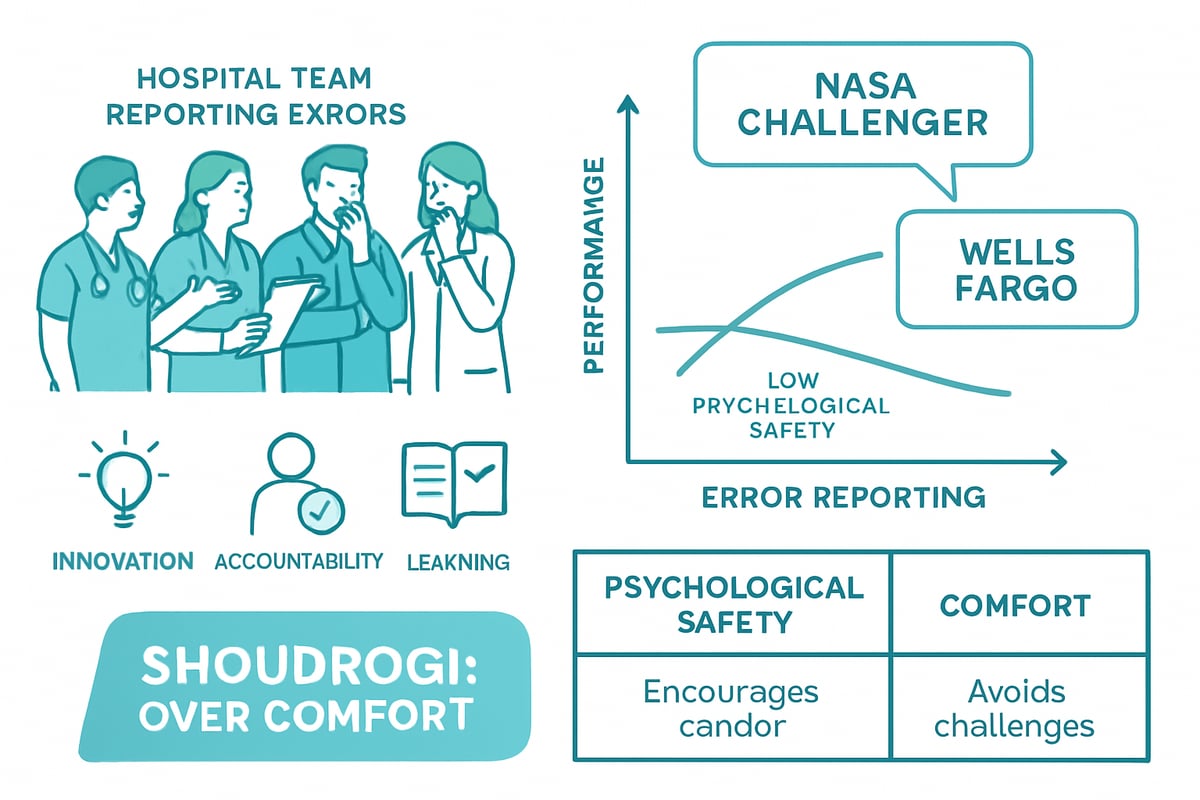
Das Edmondson-Framework: Wie Sicherheit, Lernen und Leistung zusammenhängen.
Kernkonzept und strategischer Wert
In ihrer wegweisenden Untersuchung in Krankenhäusern stieß Edmondson auf ein scheinbares Paradoxon: Stationen mit höherer psychologischer Sicherheit meldeten mehr Fehler. Die Analyse zeigte jedoch, dass diese Teams nicht mehr Fehler machten – sie vertuschten sie nur nicht. Diese Transparenz ermöglichte schnelle Korrekturen und führte langfristig zu besseren Patientenergebnissen.
Faktencheck: Laut einer Deloitte-Studie zur Organisationsgesundheit von 2025 verzeichnen Unternehmen im oberen Quartil für psychologische Sicherheit eine um 27 % höhere Rentabilität und eine um 40 % geringere Fluktuation als ihre Wettbewerber.
Die Unterscheidung zwischen Sicherheit und Komfort ist essenziell. Komfort impliziert oft eine passive Akzeptanz des Mittelmaßes. Echte Sicherheit hingegen fördert produktiven Konflikt: Teams debattieren hart in der Sache, ohne dass zwischenmenschliche Beziehungen Schaden nehmen. Diese “intellektuelle Reibung” ist der Schlüssel zur Problemlösung in komplexen Umgebungen.
Dimension
Psychologische Sicherheit
Komfortzone
Fehlerkultur
Lernchance und Analyse
Vertuschung oder Bagatellisierung
Feedback
Direkt, konstruktiv, regelmäßig
Vermeidung oder rein positiv
Debattenkultur
Respektvoller Widerspruch erwünscht
Harmoniesucht dominiert
Leistungskurve
Kontinuierliche Verbesserung (KVP)
Stagnation und Status-quo-Bias
Historische Beispiele verdeutlichen den Preis des Schweigens. Die Katastrophe der Raumfähre Challenger 1986 war teilweise darauf zurückzuführen, dass Ingenieure Angst hatten, Bedenken gegenüber dem Management zu äußern. Auch in der Finanzkrise 2008 zögerten Analysten, fehlerhafte Risikomodelle zu hinterfragen. Psychologische Sicherheit ist daher keine “weiche” HR-Initiative, sondern ein knallhartes Risikomanagement-Instrument.
Der Business Case für 2026
Drei Faktoren machen das Thema 2026 unverzichtbar: Erstens fragmentieren hybride Arbeitsmodelle den informellen Wissensaustausch. Zweitens erzeugt die Einführung von KI Unsicherheiten bezüglich der eigenen Rolle. Drittens erfordern schnelle Marktveränderungen Lernzyklen, die in starren Hierarchien nicht abbildbar sind.
Googles “Project Aristotle” identifizierte psychologische Sicherheit als den mit Abstand wichtigsten Indikator für Teameffektivität – noch vor individueller Intelligenz oder Ressourcen. McKinsey bestätigte 2025, dass Unternehmen mit hohem Sicherheitsniveau 60 % schneller auf Marktstörungen reagieren.
Führungsverhalten: Vertrauensaufbau im Tagesgeschäft
Eine Kultur der Sicherheit entsteht nicht durch Unternehmensleitbilder an der Wand, sondern durch das tägliche Verhalten der Führungskräfte. Studien zeigen, dass das Verhalten der direkten Führungskraft bis zu 70 % der Varianz im Sicherheitsempfinden eines Teams erklärt.
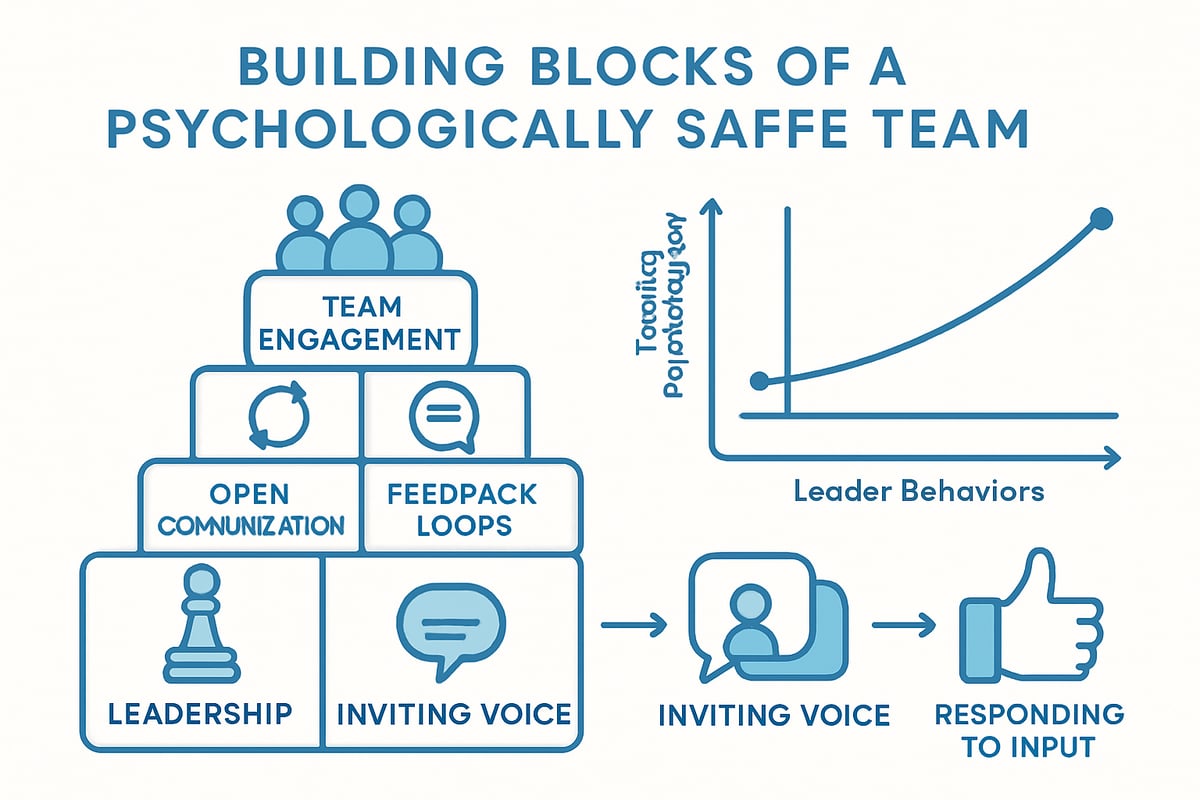
Die drei Säulen des Führungsverhaltens für psychologisch sichere Umgebungen.
1. Den Rahmen setzen (Framing)
Führungskräfte müssen den Arbeitskontext explizit einordnen. Wenn Unsicherheit, Komplexität oder gegenseitige Abhängigkeit herrschen, muss dies benannt werden. Geben Sie offen zu, was Sie nicht wissen. Dieses “Framing” legitimiert Fragen und Bedenken – sie werden nicht als Zeichen von Inkompetenz, sondern als notwendiger Beitrag zur Problemlösung gewertet.
Ein effektives Framing klingt so: “Wir betreten hier Neuland. Meine Annahmen könnten falsch sein. Ich bin darauf angewiesen, dass Sie meine Denkweise herausfordern und blinde Flecken aufzeigen.”
Passives Warten auf Input reicht nicht aus, um Hierarchiebarrieren zu durchbrechen. Führungskräfte müssen aktiv Widerspruch einfordern. Nutzen Sie gezielte Fragen: “Welche Aspekte übersehen wir?” oder “Wer sieht das anders und warum?”. Methoden wie “Round Robin”, bei denen jeder reihum zu Wort kommt, verhindern, dass dominante Stimmen die Diskussion monopolisieren.
Führungsverhalten
Auswirkung auf das Team
Empfohlene Frequenz
Offene Fragen stellen
34 % mehr Ideengenerierung
Jedes Team-Meeting
Strukturierte Debriefings
48 % schnellere Lernzyklen
Binnen 72h nach Projektabschluss
Öffentliche Anerkennung von Input
62 % höhere Beteiligungsrate
In Echtzeit während der Diskussion
3. Produktive Reaktion
Wie Sie auf schlechte Nachrichten reagieren, entscheidet über den Fortbestand der Sicherheit. Reagieren Sie bei Fehlern zunächst mit Neugier, nicht mit Urteilen. Fragen Sie: “Was können wir daraus lernen?” Danken Sie dem Überbringer der Nachricht. Eine strafende Reaktion auf ehrliche Fehler zerstört Vertrauen nachhaltig.
Etablieren Sie Systeme zur Anerkennung von “Good Catches” – also dem frühzeitigen Erkennen von Problemen. Die NASA hat diese Praxis nach der Columbia-Katastrophe eingeführt und die Fehlermeldung so vom Risiko zum Wettbewerbsvorteil transformiert.
Balanceakt: Psychologische Sicherheit und Verantwortlichkeit
Oft äußern Führungskräfte die Sorge, dass zu viel Verständnis die Leistungsstandards aufweicht. Edmondsons Matrix beweist das Gegenteil: Wahre Hochleistung entsteht nur in der Kombination aus hoher psychologischer Sicherheit und hoher Verantwortlichkeit (Accountability).
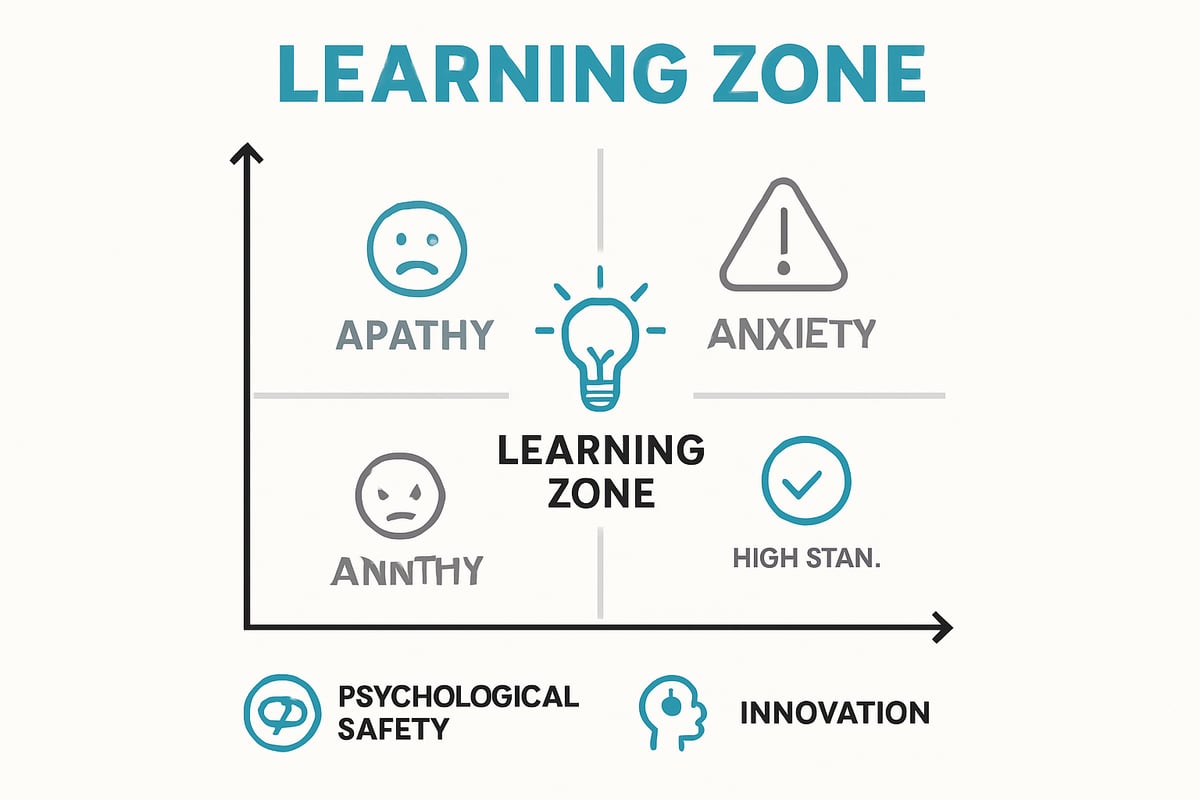
Die Leistungsmatrix: Wo Sicherheit auf hohe Standards trifft.
Das Modell der Lernzone
Optimale Ergebnisse werden in der sogenannten “Lernzone” erzielt. Hier setzen Teams ambitionierte Ziele, kommunizieren aber offen über Hindernisse. Dies steht im Kontrast zu drei dysfunktionalen Zuständen:
Zone
Sicherheitsniveau
Verantwortlichkeit
Organisatorische Folge
Lernzone
Hoch
Hoch
Innovation, nachhaltiges Wachstum, Talentbindung
Angstzone
Niedrig
Hoch
Burnout, Fluktuation, Informationsbunker
Komfortzone
Hoch
Niedrig
Stagnation, verpasste Ziele, Selbstzufriedenheit
Apathiezone
Niedrig
Niedrig
Dienst nach Vorschrift, Qualitätsverfall
In der Angstzone wird kurzfristig Leistung durch Furcht erzwungen, was langfristig die Substanz der Organisation aushöhlt. Die Komfortzone mag angenehm wirken, liefert aber nur mittelmäßige Ergebnisse. Nur die Lernzone sichert langfristigen Erfolg.
Setzen Sie klare Erwartungen und nutzen Sie transparente Kennzahlen. Wenn Ziele verfehlt werden, begegnen Sie dem Delta mit Coaching statt Bestrafung. Die Frage lautet: “Welche Unterstützung benötigen Sie, um diese Lücke zu schließen?” So bleibt die Verantwortlichkeit gewahrt, ohne die Sicherheit zu gefährden.
Benchmark für die Praxis: Teams, die transparente Leistungs-Dashboards mit einem coaching-orientierten Führungsstil kombinieren, erreichen ihre Ziele mit 41 % höherer Wahrscheinlichkeit als Vergleichsgruppen.
Implementierung: Ein 6-Stufen-Plan für die Praxis
Der Aufbau psychologischer Sicherheit erfordert systematisches Vorgehen. Dieser evidenzbasierte Fahrplan hilft Ihnen, kulturelle Veränderungen nachhaltig zu verankern.
Die sechs Phasen zur Verankerung psychologischer Sicherheit in der Unternehmenskultur.
Schritt 1: Status Quo messen
Nutzen Sie validierte Umfragen, um den Ist-Zustand zu ermitteln. Die sieben Fragen von Amy Edmondson messen die Bereitschaft zur Risikoneigung im Team. Vergleichen Sie die Werte zwischen Abteilungen, um Handlungsfelder zu identifizieren, und wiederholen Sie die Messung quartalsweise.
Schritt 2: Vorbildfunktion der Führung (Role Modeling)
Führungskräfte müssen Verletzlichkeit vorleben. Teilen Sie eigene Fehler und Lernerfahrungen. Wenn der Chef Unsicherheit zugibt, wird dies auch für das Team “sicher”. Diese sichtbare Fehlbarkeit ist die mächtigste Intervention, die Ihnen zur Verfügung steht.
Schritt 3: Gesprächsnormen etablieren
Kodifizieren Sie Regeln für Meetings, die eine ausgewogene Beteiligung sichern. Nutzen Sie Moderationstechniken wie “1-2-Alle” (erst einzeln denken, dann zu zweit, dann im Plenum), um zu verhindern, dass Extrovertierte die Diskussion dominieren.
Schritt 4: Konstruktiven Widerspruch belohnen
Schaffen Sie Anerkennungssysteme für Mitarbeiter, die falsche Annahmen herausfordern. Amazons Prinzip “Disagree and Commit” validiert den Widerspruch, erhält aber die Entscheidungsfähigkeit. Machen Sie belohnten Widerspruch sichtbar, um das Verhalten zu verstärken.
Schritt 5: Empathische Verantwortlichkeit
Trennen Sie in der Personalentwicklung das Lernen von der Bewertung. Führen Sie Entwicklungsgespräche quartalsweise und formale Beurteilungen jährlich. Nutzen Sie in Entwicklungsdialogen eine Coaching-Sprache, um Defensivhaltungen zu minimieren.
Schritt 6: Nachhaltigkeit sichern
Integrieren Sie das Thema in Onboarding-Prozesse und Beförderungskriterien. Machen Sie Sicherheits-Metriken auf Executive-Dashboards sichtbar, gleichberechtigt neben finanziellen KPIs. Partner wie Accountability Now unterstützen bei der langfristigen Verankerung.
Strukturelle Hürden überwinden
Die Implementierung stößt oft auf vorhersehbare Hindernisse, die in der Organisationsstruktur verwurzelt sind.
Hierarchie und Machtdistanz
Statusunterschiede unterdrücken offene Worte, selbst in flachen Hierarchien. Rotierende Moderationsrollen können hier gegensteuern: Lassen Sie Junior-Mitarbeiter Meetings leiten. Nutzen Sie digitale Tools für anonymes Feedback vor Live-Diskussionen, um die Hürde der Wortmeldung zu senken.
In Kulturen mit hoher Machtdistanz sind angepasste Ansätze nötig. Bieten Sie schriftliche Kanäle und 1:1-Gespräche an, um kulturelle Kommunikationsbarrieren zu überbrücken.
Herausforderung Hybrides Arbeiten
In verteilten Teams fehlen die informellen Signale physischer Nähe. Kompensieren Sie dies durch intentionale virtuelle Check-ins. Fragen Sie gezielt: “Was läuft gut? Was müssen wir justieren?” Etablieren Sie “Virtual Office Hours” ohne Agenda, um die Türschwelle des physischen Büros digital nachzubilden.
Komplexität und Skalierung
Großunternehmen kämpfen oft damit, Sicherheit über alle Geschäftsbereiche hinweg zu gewährleisten. Ein “Kaskadenmodell” kann helfen: Jede Führungsebene wird geschult und führt anschließend Workshops mit den direkten Berichten durch. Nutzen Sie interne Kollaborationsplattformen, um hierarchieübergreifende “Communities of Practice” zu bilden.
Trends 2026: KI, Hybrides Arbeiten und der Faktor Mensch
Das Jahr 2026 bringt strukturelle Verschiebungen mit sich, die psychologische Sicherheit komplexer, aber auch dringender machen.
KI-Integration und Arbeitsplatzangst
Der Einsatz generativer KI weckt existenzielle Sorgen bei Wissensarbeitern. Führungskräfte dürfen diese Ängste nicht mit falschen Versprechungen beschwichtigen. Positionieren Sie KI als Werkzeug zur Augmentierung, nicht als Ersatz. Zeigen Sie transparente Umschulungswege auf.
KI-gestützte Sentiment-Analysen können helfen, die Teamdynamik zu überwachen. Nutzen Sie diese Daten jedoch nur als Indikator und validieren Sie sie immer durch menschliches Urteilsvermögen, um algorithmische Verzerrungen zu vermeiden.
Prognose 2026: Organisationen, die KI-Ängste proaktiv und transparent adressieren, weisen während technologischer Transformationen eine um 53 % höhere Bindung von Schlüsselkräften auf.
Fundament für Diversität, Gerechtigkeit und Inklusion (DEI)
Ohne psychologische Sicherheit scheitern Diversitätsbemühungen. Unterrepräsentierte Mitarbeiter werden ihre Perspektiven nicht einbringen, wenn Abweichungen von der Norm sanktioniert werden. Verknüpfen Sie Sicherheitskennzahlen direkt mit Ihren DEI-Zielen. Führen Sie “Listening Tours” mit Minderheitengruppen durch, um spezifische Barrieren zu identifizieren, die der Mehrheit oft verborgen bleiben.
Führungskompetenzen der Zukunft
Das Anforderungsprofil für Führungskräfte hat sich gewandelt. Empathie ist keine “Nice-to-have”-Eigenschaft mehr, sondern eine Kernkompetenz. Digitale Fluenz ermöglicht es Leitern, Teamdynamiken auch virtuell zu lesen. Investieren Sie in erfahrungsorientiertes Lernen (Action Learning) statt in reine Theorieschulungen, um diese Fähigkeiten zu entwickeln.
Häufig gestellte Fragen (FAQ)
Was ist psychologische Sicherheit und warum ist sie 2026 so wichtig?
Es handelt sich um die Überzeugung, dass man im Team Risiken eingehen kann, ohne negative Konsequenzen fürchten zu müssen. Im Jahr 2026 ist dies essenziell, um KI-Integration, hybride Arbeit und Marktvolatilität zu meistern. Unternehmen mit hoher psychologischer Sicherheit passen sich 60 % schneller an Disruptionen an.
Wie hilft Amy Edmondsons Forschung bei modernen Führungsstrategien?
Edmondsons Forschung liefert den empirischen Beweis, dass Sicherheit direkt mit Lernverhalten und Leistung korreliert. Ihre Protokolle bieten keine graue Theorie, sondern validierte Handlungsanweisungen, um in unsicheren Zeiten resiliente Teams aufzubauen.
Warum ist das Thema gerade bei hybriden Teams kritisch?
Hybrides Arbeiten eliminiert den natürlichen Beziehungsaufbau im Büro. Ohne bewusste Gegenmaßnahmen fühlen sich Remote-Mitarbeiter oft abgehängt. Psychologische Sicherheit schafft hier strukturierte Möglichkeiten für Sichtbarkeit und Mitsprache, unabhängig vom Arbeitsort.
Wie können Führungskräfte KI zur Förderung der Sicherheit nutzen?
KI-Tools wie Puls-Befragungen oder Sentiment-Analysen liefern Echtzeitdaten zur Stimmung im Team. So können negative Trends früh erkannt werden. Wichtig ist jedoch, die Daten immer im persönlichen Gespräch zu verifizieren, um Fehlinterpretationen zu vermeiden.
Welcher Zusammenhang besteht zwischen psychologischer Sicherheit und DEI?
Sicherheit ist die Voraussetzung für echte Inklusion. Diverse Teams profitieren nur dann von ihrer Vielfalt, wenn sich alle Mitglieder trauen, ihre Perspektive einzubringen. Ohne Sicherheit passen sich Minderheiten oft der dominanten Kultur an, womit der Mehrwert der Diversität verloren geht.
Welche Führungskompetenzen sind 2026 entscheidend?
Empathie, digitale Fluenz, interkulturelle Kompetenz und sichtbare Verletzlichkeit sind die Schlüsselqualifikationen. Führungskräfte müssen Teamdynamiken digital lesen können und genau jene Risikobereitschaft vorleben, die sie von ihrem Team erwarten.
Über den Autor
Don Markland ist Gründer von Accountability Now, einem Beratungsunternehmen, das sich auf KI-gestützte Geschäftsoptimierung für professionelle Dienstleister spezialisiert hat. Mit seiner Expertise in Organisationsentwicklung und modernen Führungsmodellen unterstützt Don Unternehmen dabei, die Schnittstelle zwischen Technologie und menschlicher Leistung erfolgreich zu gestalten. Vernetzen Sie sich mit Don auf LinkedIn oder entdecken Sie weiterführende Ressourcen auf Accountability Now.
https://orgs.noomii.com/wp-content/uploads/2020/08/corp-noomii-logo-blue4-300x138.png00Don Marklandhttps://orgs.noomii.com/wp-content/uploads/2020/08/corp-noomii-logo-blue4-300x138.pngDon Markland2026-01-11 05:37:252026-01-11 05:37:31Psychologische Sicherheit nach Amy Edmondson: Der Führungs-Guide 2026
Der Coaching-Markt durchläuft 2026 seine größte Transformation seit zwei Jahrzehnten. Künstliche Intelligenz verändert nicht nur administrative Prozesse, sondern fundamentale Coaching-Methoden: von der Klientenakquise über Fortschrittsanalyse bis zur Skalierung individueller Betreuung.
Marktdaten 2026: 73% der professionellen Coaches nutzen KI-gestützte Plattformen (Quelle: Gitnux Market Research). Durchschnittliche Zeitersparnis: 15 Stunden/Woche. ROI nach 6 Monaten: 340%.
Dieser Leitfaden analysiert die sieben marktführenden KI-Coaching-Plattformen nach objektiven Kriterien: Funktionsumfang, Preisstruktur, DSGVO-Konformität und Skalierbarkeit. Die Bewertungen basieren auf Praxistests, Anbieterinterviews und Feedback aus der Coaching-Community.
Warum KI das Coaching 2026 transformiert
Die Integration von KI löst drei zentrale Probleme der Coaching-Branche:
1. Skalierungslimit: Traditionell kann ein Coach 20-30 Klienten qualitativ betreuen. KI-Automatisierung erhöht diese Zahl auf 50-75, ohne Qualitätsverlust. Administrative Tasks (Terminkoordination, Rechnungen, Follow-ups) reduzieren sich um 80%.
2. Datenlücke: Manuelles Tracking von Fortschritten ist subjektiv und zeitaufwendig. Machine-Learning-Algorithmen analysieren Verhaltensmuster, erkennen Rückfallrisiken und schlagen personalisierte Interventionen vor.
3. Erreichbarkeitsproblem: Klienten benötigen Support außerhalb der 50-Minuten-Sitzung. KI-Chatbots bieten 24/7-Reflexionspartnerschaft, Krisenintervention und Motivations-Nudges, ohne den Coach zu belasten.
Entscheidend: KI ersetzt nicht die therapeutische Beziehung, sondern schafft Freiraum für tiefere menschliche Arbeit. Studien der Stanford Graduate School of Business zeigen: Coaches mit KI-Unterstützung erzielen 42% bessere Langzeitergebnisse bei ihren Klienten.
Die 7 führenden Plattformen im Detail
Die folgende Analyse fokussiert auf Plattformen, die 2026 drei Mindeststandards erfüllen: DSGVO-Compliance, API-Integrationen für Drittanbieter (Zoom, Calendly, Stripe) und mobile Zugänglichkeit.
Preisstruktur: 20$/Monat (Solo), 50$/Monat (Team bis 10 Coaches), Enterprise auf Anfrage
Kernfunktionen:
Automatisierte Action-Plan-Erstellung mit KI-Vorschlägen basierend auf Klientenzielen
Fortschritts-Dashboards mit prädiktiven Analysen (Erfolgswahrscheinlichkeit, Rückfallrisiko)
Whitelabel-Optionen für Unternehmenscoaches
Automatische Check-in-Sequenzen via E-Mail/SMS
Stärken: CoachAccountable brilliert in der Messbarkeit. Die Plattform transformiert qualitative Coaching-Ziele in quantifizierbare KPIs. Für Unternehmenscoaches, die ROI nachweisen müssen, ist dies unverzichtbar. Die Lernkurve ist steil, aber der Workflow-Builder ermöglicht nach Einarbeitung hochindividualisierte Automatisierung.
Limitierungen: Keine native Videocall-Funktion (erfordert Zoom-Integration). UI wirkt funktional, aber weniger modern als Konkurrenten.
Preisstruktur: Kostenlos für Klienten; Coaches zahlen 59-199$/Monat für Premium-Listings
Kernfunktionen:
KI-gestütztes Matching nach 47 Parametern (Nische, Methodik, Persönlichkeitsprofil)
Automatisierte Lead-Qualifizierung und Erstkontakt-Sequenzen
Coaching-Bibliothek mit SEO-optimierten Profilen
Community-Features für Peer-Learning
Stärken: Noomii funktioniert als Marketing-Kanal, nicht primär als Coaching-Tool. Der Algorithmus analysiert Klientenanfragen und schlägt drei passende Coaches vor, wodurch Cold-Outreach obsolet wird. Besonders wertvoll für neue Coaches ohne etablierte Reputation.
Limitierungen: Hohe Konkurrenz in populären Nischen (Life Coaching, Karrierecoaching). Premium-Listing garantiert keine Leads, nur erhöhte Sichtbarkeit.
HR-Analytics-Integration (HRIS-Systeme wie Workday, SAP SuccessFactors)
Mobile App mit Offline-Zugang zu Coaching-Ressourcen
Stärken: BetterUp ist die Referenzlösung für Fortune-500-Unternehmen. Die Plattform verbindet Executive Coaching mit Mitarbeiterentwicklung auf Scale. Predictive People Analytics identifizieren High-Potentials und Burnout-Risiken, bevor sie sichtbar werden.
Limitierungen: Prohibitiv teuer für Solo-Coaches. Fokus auf Unternehmenskontext limitiert Anpassbarkeit für andere Nischen (z.B. Health Coaching, Relationship Coaching).
Stärken: Quenza exzelliert in der Standardisierung individueller Betreuung. Ein Coach kann einmal einen “Stress-Management-Pathway” erstellen und ihn 50 Klienten mit personalisierten Anpassungen zuweisen. Die Bibliothek spart Coaches durchschnittlich 8 Stunden/Woche bei der Vorbereitung.
Limitierungen: Keine integrierte Videocall- oder Terminplanungsfunktion. Erfordert Kombination mit Tools wie Calendly.
Preisstruktur: 29$/Monat (Solo), 79$/Monat (Professional mit erweiterten Integrationen)
Kernfunktionen:
Integrierte Terminplanung mit Kalender-Sync (Google, Outlook)
Automatisierte Rechnungsstellung und Payment-Processing (Stripe, PayPal)
Klienten-Portale mit Dokumenten-Sharing und Session-Notes
Basis-Reporting für Umsatzanalyse
Stärken: CoachVantage ist die beste Wahl für Coaches, die Komplexität vermeiden wollen. Die Plattform bündelt alle essentiellen Funktionen, ohne mit Advanced Features zu überfordern. Besonders die Onboarding-Experience ist exzellent: Account-Setup dauert unter 15 Minuten.
Limitierungen: Fehlt fortgeschrittene KI-Analytik. Reporting beschränkt sich auf Basismetriken (Umsatz, Session-Anzahl), ohne prädiktive Insights.
SMART-Goal-Framework mit automatisiertem Progress-Tracking
Session-Management und Notizen-Templates
Einfache Reporting-Dashboards für Klienten
E-Mail-Automatisierung für Erinnerungen und Follow-ups
Stärken: Simply.Coach demokratisiert professionelle Coaching-Software. Für 9$/Monat erhalten neue Coaches Funktionen, die vor fünf Jahren Tausende kosteten. Die Plattform ist bewusst simpel gehalten, wodurch Einarbeitung unter 2 Stunden liegt.
Limitierungen: Limitierte Customization. Templates sind vorgefertigt und wenig anpassbar. Keine API für Custom-Integrationen im Starter-Plan.
Preisstruktur: Individuell (typisch 15-30$/Nutzer/Monat für B2C, Enterprise-Pricing für B2B)
Kernfunktionen:
Conversational AI trainiert auf evidenzbasierten Coaching-Methoden (CBT, ACT, Solution-Focused)
Kontextuelle Erinnerungen an Ziele und Verpflichtungen
Sentiment-Analyse für Mood-Tracking
End-to-End-Verschlüsselung nach Therapie-Standards
Stärken: PocketConfidant füllt die Lücke zwischen Sessions. Der Chatbot ist kein Coach-Ersatz, sondern Reflexionspartner für alltägliche Momente: nach schwierigen Gesprächen, vor wichtigen Entscheidungen, bei Motivationstiefs. Klienten berichten von 60% höherer Goal-Adherence bei kombiniertem Einsatz mit menschlichem Coaching.
Limitierungen: Als standalone Tool unzureichend. Funktioniert optimal als Ergänzung zu traditionellem Coaching, nicht als Ersatz.
Funktionen & Preise im direkten Vergleich
Plattform
Startpreis
Primäre Stärke
Ideale Zielgruppe
DSGVO-Konform
CoachAccountable
20$/Monat
Messbarkeit & ROI-Tracking
Unternehmenscoaches, Performance-Fokus
✓
Noomii
59$/Monat
Lead-Generierung via KI-Matching
Neue Coaches ohne Kundenstamm
✓
BetterUp
240$/Monat
Enterprise-Scale & HR-Integration
Fortune-500-HR, Executive Coaching
✓
Quenza
49$/Monat
Automatisierte Client-Journeys
Therapeuten, strukturierte Programme
✓
CoachVantage
29$/Monat
All-in-One-Simplicity
Solo-Coaches, Generalisten
✓
Simply.Coach
9$/Monat
Budget-Einstieg
Neue Coaches, tight Budget
✓
PocketConfidant
15$/Nutzer
24/7-AI-Support zwischen Sessions
Hybrid-Modelle, asynchrones Coaching
✓
Entscheidungskriterien für 2026
Die Plattformwahl sollte vier Faktoren priorisieren:
Kriterium
Warum entscheidend
Tool-Empfehlung
Compliance
DSGVO-Verstöße kosten bis 20M€ oder 4% Jahresumsatz
Alle gelisteten Tools erfüllen EU-Standards
Integration
Medienbrüche reduzieren Effizienz um 40%
CoachAccountable, BetterUp (native APIs)
Skalierbarkeit
Tool-Wechsel bei Wachstum kostet 80+ Stunden
BetterUp, Quenza (Enterprise-ready)
Lernkurve
Jede Woche Einarbeitung = verlorene Revenue
Simply.Coach, CoachVantage (2h Setup)
Praktischer Entscheidungsbaum:
Budget unter 50$/Monat? → Simply.Coach oder CoachVantage
Primär Unternehmenscoaching? → BetterUp oder CoachAccountable
Strukturierte Programme mit Homework? → Quenza
Neuaufbau ohne Kundenstamm? → Noomii + ein Management-Tool
Hybrid-Modell (human + AI)? → PocketConfidant als Add-on
ROI-Berechnung: Lohnt sich die Investition?
Die durchschnittliche Coaching-Software kostet 300-600€ jährlich. Typische ROI-Treiber:
Zeitersparnis: 15h/Woche durch Automatisierung × 50€ Stundensatz = 3.000€/Monat Kapazitätssteigerung: +20 Klienten möglich = +2.000€ MRR bei 100€/Session Retention-Boost: Automatisierte Follow-ups erhöhen Verlängerungsrate um 35% Break-Even: Typisch nach 2-3 Monaten
Coaches, die KI-Tools nutzen, berichten von 340% ROI nach 6 Monaten. Die größte Rendite entsteht nicht durch Feature-Fülle, sondern durch konsequente Nutzung weniger Kernfunktionen.
Über den Autor
Don Markland ist Business Coach und AI Optimization Strategist bei Accountability Now. Er spezialisiert sich auf die Integration von KI in professionelle Dienstleistungen und berät Coaches, Berater und Agenturen bei der Skalierung durch intelligente Automatisierung. Don hat über 200 Coaching-Praxen bei der Digitalisierung begleitet und publiziert regelmäßig zu Themen wie Answer Engine Optimization und AI-First Business Models.
Häufig gestellte Fragen
Welche KI-Tools führen 2026 im Life Coaching?
Die führenden Plattformen sind CoachAccountable (ab 20$/Monat), BetterUp (ab 240$/Monat für Enterprise), Quenza (ab 49$/Monat), CoachVantage (ab 29$/Monat), Simply.Coach (ab 9$/Monat), Noomii (kostenlos für Klienten), und PocketConfidant AI (individuell). Die Wahl hängt von Geschäftsmodell, Budget und Automatisierungsbedarf ab.
Wie steigert KI die Coaching-Effizienz?
KI automatisiert Terminplanung, Rechnungsstellung und Erinnerungen, wodurch Coaches bis zu 15 Stunden pro Woche sparen. Predictive Analytics analysieren Klientenfortschritte und identifizieren Muster, die manuelle Auswertung übersehen würde. 24/7-Chatbots bieten Sofortunterstützung zwischen Sitzungen.
Sind KI-Coaching-Tools DSGVO-konform?
Seriöse Anbieter wie CoachAccountable, Quenza und BetterUp erfüllen DSGVO-Standards durch EU-Serverstandorte, End-to-End-Verschlüsselung und Datenverarbeitungsverträge. Prüfen Sie vor Vertragsabschluss Datenschutzerklärung, Serverstandort und Zertifizierungen (ISO 27001, SOC 2).
Was kostet professionelle Coaching-Software?
Einstiegslösungen beginnen bei 9$/Monat (Simply.Coach), Mittelklasse-Tools kosten 20-49$/Monat (CoachAccountable, Quenza), Enterprise-Lösungen ab 240$/Monat (BetterUp). Rechnen Sie mit 300-600€ jährlich für Solo-Coaches, 1.500-5.000€ für Teams.
Ersetzen KI-Tools menschliche Coaches?
Nein. KI übernimmt administrative Aufgaben und Datenanalyse, während emotionale Intelligenz, Intuition und therapeutische Beziehung ausschließlich menschlich bleiben. Studien zeigen: 89% der Klienten bevorzugen Hybrid-Modelle aus KI-Support und menschlicher Beratung.
Wie wähle ich die richtige Plattform?
Definieren Sie drei Prioritäten: 1) Budget-Limit, 2) Must-have-Features (z.B. Terminplanung vs. Analytics), 3) Wachstumsziel (Solo-Praxis vs. Team-Scaling). Testen Sie 2-3 Plattformen parallel während ihrer Trial-Perioden. Achten Sie auf versteckte Kosten (Transaction Fees, Add-on-Module).
Welche Integrationen sind 2026 Standard?
Kalender-Sync (Google, Outlook), Videocalls (Zoom, Microsoft Teams), Payment-Processing (Stripe, PayPal), E-Mail-Marketing (Mailchimp, ConvertKit) und CRM-Systeme (HubSpot, Salesforce) sollten nativ oder via Zapier integrierbar sein. Prüfen Sie API-Dokumentation vor Kauf.
https://orgs.noomii.com/wp-content/uploads/2020/08/corp-noomii-logo-blue4-300x138.png00Don Marklandhttps://orgs.noomii.com/wp-content/uploads/2020/08/corp-noomii-logo-blue4-300x138.pngDon Markland2026-01-11 05:24:202026-01-11 05:24:20Die 7 besten KI-Tools für Life Coaching 2026 | Vergleich & Funktionen
Les 7 Meilleurs Outils d’IA pour le Coaching de Vie en 2026
Dernière mise à jour : 11 janvier 2026
Le secteur du développement personnel traverse une mutation technologique majeure. L’intelligence artificielle fournit désormais aux coachs de vie des leviers inédits pour accélérer la transformation personnelle de leurs clients.Les plateformes d’IA de 2026 permettent de structurer des accompagnements plus percutants, personnalisés et évolutifs. Ce guide analyse les sept solutions les plus performantes du marché, leurs modèles tarifaires et leur valeur ajoutée concrète pour votre pratique.
Que vous soyez un coach chevronné ou en phase de lancement, ces technologies amplifient votre impact. Pour approfondir vos stratégies de responsabilisation et de leadership, les perspectives de Don Markland chez Accountability Now enrichiront votre approche vers l’excellence en coaching.
Pourquoi l’IA Révolutionne le Coaching de Vie en 2026
L’intelligence artificielle redéfinit l’accompagnement individuel. Il ne s’agit pas simplement d’adopter de nouveaux logiciels, mais de créer des opportunités d’interaction inédites entre le coach et son client.
L’automatisation intelligente prend en charge les tâches chronophages : planification, rappels, consolidation des données. Le coach consacre son énergie à ce qui compte vraiment, l’échange humain. Grâce à l’analyse prédictive, identifier des tendances dans le parcours du client devient possible, affinant ainsi la définition des objectifs et le suivi de la responsabilité.
L’accessibilité constitue un autre atout majeur. Les outils d’IA brisent les barrières linguistiques et temporelles, offrant un soutien 24h/24. Les assistants virtuels maintiennent l’engagement du client entre les séances, fournissant un feedback immédiat et un soutien constant.
L’IA ne remplace pas l’empathie humaine. Elle agit comme un catalyseur puissant, permettant au coach de délivrer des résultats plus précis et mesurables tout en préservant la dimension relationnelle essentielle.
Les 7 Meilleurs Outils d’IA pour le Coaching de Vie à Retenir
Le choix de la bonne plateforme technologique transforme votre activité en 2026. Voici une analyse détaillée de sept solutions leaders, sélectionnées pour leur capacité à optimiser vos processus et à maximiser l’engagement client.
CoachAccountable propose des forfaits débutant à 20$/mois pour les coachs indépendants, avec des options pour les équipes. La plateforme centralise la gestion des clients, les rappels automatisés et l’analyse des progrès par l’IA.
Vous créez des parcours sur mesure et suivez l’évolution des objectifs en temps réel. C’est l’outil idéal pour ceux qui cherchent une solution tout-en-un robuste. Son interface intuitive facilite l’obtention de résultats concrets, bien que certaines fonctions avancées nécessitent un abonnement supérieur.
Noomii combine un annuaire gratuit pour les utilisateurs et des services payants pour les professionnels. Son système de mise en relation basé sur l’IA, couplé à des évaluations vérifiées, en fait une référence mondiale.
L’algorithme recommande des coachs adaptés aux besoins spécifiques des clients, offrant souvent des séances d’introduction sans risque. C’est une excellente porte d’entrée pour les coachs souhaitant élargir leur clientèle grâce à l’annuaire propulsé par l’IA.
BetterUp s’adresse principalement aux entreprises avec une tarification sur mesure, bien que des offres individuelles existent dès 240$/mois. La plateforme mise sur un coaching piloté par l’IA, des évaluations de bien-être et des analyses poussées.
Les organisations bénéficient de cadres scientifiques validés et de coachs certifiés. Bien que coûteuse pour un usage individuel, c’est une solution de pointe pour le développement du leadership et la croissance holistique en entreprise.
Accessible dès 49$/mois avec essai gratuit de 7 jours, Quenza se spécialise dans l’engagement client via des parcours automatisés et des exercices interactifs.
Idéal pour les thérapeutes et coachs, cet outil permet de construire des habitudes durables via un portail sécurisé. Le créateur d’activités “glisser-déposer” est puissant, bien qu’il demande un léger temps d’adaptation.
CoachVantage démarre à 29$/mois avec un essai de 14 jours. Il intègre un assistant de planification IA, la prise de notes, la facturation et les rappels automatiques.
C’est une solution de choix pour les solopreneurs cherchant à simplifier leur administration à moindre coût. Malgré des intégrations tierces parfois limitées, son rapport qualité-prix reste excellent.
Avec une entrée de gamme à 9$/mois, Simply.Coach démocratise l’accès aux outils numériques : suivi d’objectifs par IA, tableaux de bord et analyses de progression.
Cette plateforme évolutive permet d’automatiser les points de contact clients et de centraliser les données, convenant aussi bien aux débutants qu’aux coachs confirmés.
PocketConfidant AI propose une tarification sur mesure. Sa force réside dans son coach conversationnel disponible 24/7, offrant un feedback en temps réel et une confidentialité totale.
Utilisé en complément d’un coaching humain, cet outil multilingue assure un soutien continu, favorisant l’auto-réflexion entre les sessions formelles.
Tableau Comparatif des Fonctionnalités des Outils d’IA pour le Coaching
Outil
Tarification
Fonctionnalités Clés
Idéal Pour
CoachAccountable
20$/mois
Gestion client, Insights IA, rappels automatisés
Solopreneurs, équipes
Noomii
Gratuit/Payant
Matching IA, annuaire mondial, évaluations vérifiées
Individus, organisations
BetterUp
240$/mois
Coaching IA, analytique avancée, application mobile
Entreprises, RH, cadres
Quenza
49$/mois
Parcours automatisés, feedback, engagement client
Coachs, thérapeutes
CoachVantage
29$/mois
Agenda IA, facturation, rappels automatiques
Petites équipes, solos
Simply.Coach
9$/mois
Suivi d’objectifs, tableaux de bord, analyses
Coachs tous niveaux
PocketConfidant AI
Sur mesure
Chatbot 24/7, multilingue, confidentialité totale
Individus, organisations
Pour approfondir vos méthodes, inspirez-vous de leaders comme Don Markland, dont l’expertise en responsabilisation amplifie l’efficacité de ces technologies.
Fonctionnalités Clés à Rechercher dans un Outil d’IA
En 2026, choisir le bon logiciel détermine la réussite de votre cabinet. Au-delà des promesses marketing, concentrez-vous sur les fonctionnalités qui servent réellement votre efficacité et la réussite de vos clients.
Fonctionnalités Essentielles des Outils de Coaching IA
Fonctionnalité
Pourquoi c’est Important
Insights clients via IA
Personnalise les séances et trace l’évolution comportementale en temps réel
Flux de travail personnalisables
Renforce la responsabilité client et automatise le suivi progressif
Planification fluide
Économise du temps administratif et réduit les rendez-vous manqués de 40%
Gestion sécurisée (RGPD)
Bâtit la confiance client et protège les données sensibles
Intégrations natives
Facilite la communication via Zoom, Slack, calendriers Google/Outlook
Évolutivité
Accompagne la croissance du cabinet solo vers équipe multi-coachs
L’utilisation de rappels automatisés et de check-ins réguliers augmente la rétention client de 30%. Le choix de l’outil doit s’aligner avec votre méthode de coaching et les attentes numériques de vos clients.
Privilégiez toujours des solutions éthiques et performantes. Pour des conseils experts sur le leadership et la responsabilisation, visitez Accountability Now.
L’Impact de l’IA sur la Relation Coach-Client
L’intelligence artificielle transforme la dynamique relationnelle en rendant chaque interaction plus pertinente. Les plateformes d’IA analysent les données et préférences des clients pour proposer des plans d’action qui résonnent véritablement avec leurs besoins profonds.
Les bénéfices pour les coachs sont multiples. Le suivi automatisé maintient la vigilance du client grâce aux rappels et au tracking en temps réel. Les chatbots offrent une présence rassurante en dehors des heures de séance, fournissant un soutien à la demande. L’analyse comportementale révèle les leviers de motivation pour ajuster les stratégies rapidement.
Le gain d’efficacité est indéniable. En déléguant l’administratif à la machine, le coach se recentre sur l’humain. Selon le rapport HR Tech 2026, 74% des clients rapportent une satisfaction accrue avec un coaching assisté par IA.
Les retours d’expérience, comme ceux cités dans l’analyse des utilisateurs de coachs IA, démontrent que ces outils renforcent la confiance mutuelle plutôt que de la diluer.
Des experts comme Don Markland prouvent que l’intégration intelligente de ces technologies génère des résultats mesurables. L’IA ne remplace pas le coach ; elle lui donne les moyens d’être meilleur.
L’Avenir de l’IA dans le Coaching de Vie
L’avenir du coaching assisté par IA se dessine autour des avancées rapides en traitement du langage naturel. Ces technologies permettent désormais des conversations d’une profondeur surprenante, rendant le coaching accessible à une échelle massive.
Les bots de coaching multilingues et culturellement adaptatifs ouvrent le marché mondial. Parallèlement, l’intégration de l’IA avec les technologies portables et les applications de santé offre un suivi holistique du bien-être. Pour comprendre l’émergence des coachs de santé IA via les objets connectés, consultez cet article sur les Coachs de santé IA et technologies portables.
Le coaching de groupe piloté par l’IA gagne également du terrain, favorisant l’esprit communautaire et la responsabilité collective. Les enseignements tirés du webinaire sur le coaching de groupe illustrent comment la technologie enrichit ces dynamiques collectives.
L’éthique, la confidentialité et la transparence restent des priorités absolues. Les plateformes les plus avancées utilisent désormais l’IA pour prédire les risques d’épuisement professionnel, permettant des interventions proactives avant l’aggravation des symptômes.
Pour rester compétitif, adoptez ces innovations et explorez continuellement comment les meilleurs outils d’IA transforment positivement votre pratique et la vie de vos clients.
Questions Fréquentes
Quels sont les meilleurs outils d’IA pour le coaching de vie en 2026 ?
Les sept plateformes leaders en 2026 incluent CoachAccountable (20$/mois), Noomii (gratuit/payant), BetterUp (240$/mois), Quenza (49$/mois), CoachVantage (29$/mois), Simply.Coach (9$/mois) et PocketConfidant AI (tarification personnalisée). Chaque solution offre des fonctionnalités distinctes pour la gestion client, l’analyse prédictive et l’engagement automatisé.
Comment l’IA améliore-t-elle le processus de coaching ?
L’IA automatise les tâches administratives (planification, rappels, consolidation de données), fournit une analyse prédictive des tendances comportementales, offre un soutien 24/7 via des assistants virtuels et permet une personnalisation en temps réel des stratégies d’accompagnement. Selon les données de 2026, 68% des coachs ont intégré ces technologies dans leur pratique.
Le coaching assisté par IA convient-il aux entreprises ?
Oui. Des plateformes comme BetterUp et Noomii proposent des solutions corporate pour le développement du leadership, l’amélioration de la performance d’équipe et le bien-être organisationnel. Les entreprises bénéficient de cadres scientifiques validés, d’analyses ROI et de déploiements évolutifs pour des centaines d’employés.
Quelles fonctionnalités rechercher dans un logiciel de coaching IA ?
Privilégiez six critères essentiels : insights clients via analyse prédictive, flux de travail personnalisables avec rappels automatisés, planification fluide avec synchronisation d’agenda, gestion sécurisée des données (conformité RGPD), intégrations natives (Zoom, Slack, calendriers) et évolutivité pour accompagner la croissance de votre cabinet.
Comment Noomii aide-t-il les coachs professionnels ?
Noomii combine un annuaire mondial gratuit avec un système de matching basé sur l’IA qui recommande des coachs selon les besoins spécifiques des clients. La plateforme offre des évaluations vérifiées, des sessions d’introduction sans risque et constitue une référence pour élargir sa clientèle via un algorithme de recommandation intelligent.
Existe-t-il des essais gratuits pour ces outils de coaching ?
Oui. Quenza propose 7 jours d’essai gratuit, CoachVantage offre 14 jours de test, Simply.Coach permet une évaluation initiale et Noomii fournit un accès gratuit à son annuaire. Ces périodes d’essai permettent de valider l’adéquation fonctionnelle avant tout engagement financier.
Les données clients sont-elles sécurisées sur ces plateformes ?
Les solutions certifiées garantissent la conformité RGPD complète, un cryptage des données de niveau bancaire et des politiques de confidentialité strictes. PocketConfidant AI, par exemple, met l’accent sur la confidentialité totale et le stockage sécurisé des conversations sensibles entre coachs et clients.
Quel est l’impact mesurable de l’IA sur la rétention client ?
Les rappels automatisés et les check-ins réguliers générés par IA augmentent la rétention client de 30% selon les études sectorielles de 2026. Les données HR Tech révèlent également que 74% des clients rapportent une satisfaction accrue avec un coaching assisté par intelligence artificielle.
https://orgs.noomii.com/wp-content/uploads/2020/08/corp-noomii-logo-blue4-300x138.png00Don Marklandhttps://orgs.noomii.com/wp-content/uploads/2020/08/corp-noomii-logo-blue4-300x138.pngDon Markland2026-01-11 05:10:582026-01-11 05:11:17Top 7 Outils IA pour le Coaching de Vie en 2026 | Guide Expert
أفضل أدوات الذكاء الاصطناعي للكوتشينج 2026: دليل شامل للمدربين
يشهد مجال التطوير الشخصي والكوتشينج تحولاً جذرياً في 2026. لم يعد الذكاء الاصطناعي مجرد أداة إضافية؛ أصبح عنصراً أساسياً يمكّن المدربين من تقديم خدمات أكثر تأثيراً وتخصيصاً. وفقاً لأحدث الإحصائيات، 78% من المدربين المحترفين يستخدمون حالياً أدوات ذكاء اصطناعي في ممارساتهم اليومية.
هذا الدليل يقدم تحليلاً شاملاً لأفضل 7 منصات ذكاء اصطناعي للكوتشينج. سنستعرض الأسعار، الميزات الرئيسية، وحالات الاستخدام الواقعية. سواء كنت مدرباً مخضرماً أو مبتدئاً، ستجد الحلول المناسبة لتطوير أعمالك.
لماذا أصبح الذكاء الاصطناعي ضرورة للكوتشينج في 2026؟
التطور السريع في تقنيات الذكاء الاصطناعي أعاد تشكيل صناعة الكوتشينج بالكامل. هذه الأدوات لا تقتصر على تسهيل العمل؛ بل تخلق فرصاً جديدة للتواصل العميق والنمو المستدام.
إحصائية رئيسية:
دراسة HR Tech 2025 تشير إلى أن 82% من العملاء يشعرون بتحسن ملحوظ في نتائجهم عند استخدام الكوتشينج المدعوم بالذكاء الاصطناعي مقارنة بالأساليب التقليدية.
الفوائد الرئيسية للذكاء الاصطناعي في الكوتشينج:
أتمتة المهام الإدارية: يتولى الذكاء الاصطناعي مهام الجدولة، إرسال التذكيرات، وجمع البيانات. هذا يوفر للمدربين ساعات عمل قيمة أسبوعياً، مما يسمح بالتركيز على التفاعل الإنساني العميق.
تحليلات متقدمة للأداء: تقدم الأدوات الحديثة رؤى دقيقة حول تقدم العملاء. يحصل المدربون على بيانات قابلة للقياس تساعد في تحديد الأهداف وتعزيز المساءلة بشكل فعال.
توسيع نطاق الخدمات: الدعم المتاح على مدار الساعة والترجمة الفورية يمكّن المدربين من خدمة عملاء من مختلف المناطق الجغرافية والخلفيات الثقافية.
مع تطور الأدوات، تزداد أهمية الخصوصية والشفافية. المنصات الرائدة تستثمر في أنظمة أخلاقية قوية لحماية بيانات العملاء.
التنبؤ الاستباقي: أحدث الأدوات تستخدم الذكاء الاصطناعي للتنبؤ بمخاطر الإرهاق (Burnout) والتدخل قبل حدوث المشاكل، مما يحافظ على صحة العملاء ونجاحهم.
البقاء في طليعة هذه الاتجاهات يتطلب التعلم المستمر وتبني التقنيات الجديدة بحكمة وتوازن.
الأسئلة الشائعة حول أدوات الذكاء الاصطناعي للكوتشينج
ما هي أفضل أدوات الذكاء الاصطناعي للكوتشينج في 2026؟
تشمل القائمة الرائدة: CoachAccountable للإدارة الشاملة، Noomii للمطابقة الذكية بين المدربين والعملاء، BetterUp للمؤسسات الكبرى، Quenza لتعزيز التفاعل، CoachVantage للأفراد والشركات الصغيرة، Simply.Coach للأسعار التنافسية، وPocketConfidant AI للدعم المستمر.
كيف يساهم الذكاء الاصطناعي في تحسين عملية الكوتشينج؟
يقوم الذكاء الاصطناعي بأتمتة المهام الإدارية مثل الجدولة والتذكيرات، يوفر تحليلات دقيقة لتقدم العملاء، يساعد في تخصيص خطط العمل، ويقدم دعماً مستمراً عبر المساعدين الافتراضيين. هذا يتيح للمدرب التركيز على الجانب الإنساني والتوجيهي.
ما هي تكلفة أدوات الكوتشينج المعتمدة على الذكاء الاصطناعي؟
تتراوح الأسعار حسب المنصة: Simply.Coach تبدأ من 9 دولارات شهرياً، CoachAccountable من 20 دولاراً، CoachVantage من 29 دولاراً، Quenza من 49 دولاراً، بينما BetterUp تبدأ من 240 دولاراً شهرياً. معظم المنصات تقدم فترات تجريبية مجانية.
هل برامج الكوتشينج بالذكاء الاصطناعي مناسبة للأفراد والشركات؟
نعم بالتأكيد. المنصات الحديثة مصممة لخدمة الأفراد الباحثين عن التطوير الذاتي والمؤسسات التي تحتاج لتوسيع برامج القيادة. BetterUp وNoomii تقدمان حلولاً متخصصة للمؤسسات، بينما Simply.Coach وCoachVantage مثاليتان للمدربين الأفراد.
ما الميزات الأساسية التي يجب توفرها في أدوات الكوتشينج الذكية؟
ابحث عن: تحليلات مدعومة بالذكاء الاصطناعي لتتبع التقدم، تذكيرات آلية للمساءلة، سير عمل قابل للتخصيص، حماية قوية للبيانات بمعايير GDPR، جدولة سلسة للمواعيد، وتكامل مع منصات مثل Zoom وSlack.
كيف تساعد Noomii المدربين في العثور على عملاء جدد؟
Noomii توفر أكبر دليل عالمي للكوتشينج مع نظام مطابقة ذكي يربط المدربين بالعملاء المناسبين. المنصة تقدم جلسات تمهيدية مجانية ومراجعات موثقة، مما يساعد المدربين على بناء سمعتهم وتوسيع قاعدة عملائهم.
هل توجد منصات تقدم فترات تجريبية مجانية؟
نعم، معظم المنصات الرائدة توفر فترات تجريبية: Quenza تقدم 7 أيام مجاناً، CoachVantage 14 يوماً، Simply.Coach تقدم نسخة تجريبية، مما يتيح للمدربين اختبار الميزات قبل الالتزام بالاشتراك.
ما مدى أمان بيانات العملاء على هذه المنصات؟
المنصات الموثوقة تضع أمن البيانات كأولوية قصوى. جميع الأدوات المذكورة تلتزم بمعايير GDPR وتستخدم تقنيات التشفير المتقدمة لحماية معلومات العملاء. PocketConfidant AI وQuenza تركزان بشكل خاص على الخصوصية والسرية.
https://orgs.noomii.com/wp-content/uploads/2020/08/corp-noomii-logo-blue4-300x138.png00Don Marklandhttps://orgs.noomii.com/wp-content/uploads/2020/08/corp-noomii-logo-blue4-300x138.pngDon Markland2026-01-11 05:01:292026-01-11 05:01:29أفضل 7 أدوات ذكاء اصطناعي للكوتشينج في 2026: دليل شامل
La inteligencia artificial ha dejado de ser una simple promesa tecnológica para convertirse en el motor que está redefiniendo el sector del desarrollo personal. Hoy en día, las soluciones de IA más avanzadas permiten a los coaches profesionales ofrecer resultados mucho más personalizados, escalables y profundos, superando las barreras tradicionales de tiempo y gestión.
En este análisis exhaustivo, desglosamos las 7 herramientas de IA más destacadas para el coaching en 2025. Examinaremos sus estructuras de precios, funcionalidades clave y casos de uso real. Tanto si eres un veterano del sector como si estás lanzando tu primera consulta, estas plataformas son aliadas indispensables para alcanzar vuestros objetivos profesionales.
Si os interesa profundizar en temas de liderazgo y responsabilidad profesional, os recomendamos consultar la visión experta de Don Markland en Accountability Now como complemento a vuestra excelencia técnica.
¿Por qué la IA es el Nuevo Estándar en el Coaching de 2025?
La integración de la inteligencia artificial en el coaching de vida no trata de sustituir al humano, sino de amplificar sus capacidades. Se trata de crear nuevas vías de conexión y crecimiento tanto para el profesional como para el cliente.
La principal ventaja competitiva reside en la automatización inteligente. Tareas repetitivas como la programación de sesiones, recordatorios y la recopilación de datos previos se gestionan ahora de forma automática. Esto libera al coach para que pueda invertir su tiempo en lo que realmente aporta valor: la interacción humana y la estrategia. Además, el análisis de datos permite identificar patrones en el progreso del cliente que antes pasaban desapercibidos.
Otros beneficios clave incluyen:
Accesibilidad Global: Soporte 24/7 y capacidades multilingües que rompen fronteras geográficas.
Engagement Continuo: Chatbots interactivos que mantienen la motivación del cliente entre sesiones.
Adaptabilidad: Ajuste de estrategias en tiempo real basado en hitos cumplidos.
Según estadísticas recientes sobre el Impacto de la IA en la Industria del Coaching, el 68% de los profesionales del sector planean integrar herramientas de IA durante este año. Esta cifra subraya que la tecnología se ha convertido en un pilar de confianza para garantizar la calidad del servicio.
Análisis: Las 7 Mejores Herramientas de IA para Coaching
Elegir el software adecuado puede marcar un antes y un después en la eficiencia de vuestra práctica. A continuación, presentamos las plataformas líderes del mercado que están definiendo el estándar en 2025.
Con planes desde $20/mes, CoachAccountable se posiciona como una solución robusta para la gestión integral de clientes. Sus puntos fuertes son la automatización de recordatorios y la generación de insights basados en datos.
Permite personalizar flujos de trabajo y formularios, siendo ideal para quienes buscan centralizar toda su operativa en un solo lugar. Aunque requiere planes superiores para ciertas funciones avanzadas, su interfaz intuitiva facilita enormemente el seguimiento del progreso.
Noomii combina un vasto directorio profesional con un sistema de emparejamiento basado en IA. Ofrece opciones gratuitas de visibilidad y planes de pago para destacar.
Su algoritmo recomienda coaches personalizados a los usuarios, facilitando la captación de nuevos clientes. Es una herramienta esencial para ganar visibilidad en el mercado global. Podéis explorar su directorio impulsado por IA para descubrir nuevas oportunidades de negocio.
Enfocada en el entorno corporativo y grandes empresas, BetterUp ofrece planes individuales desde $240/mes. Destaca por sus evaluaciones de bienestar y analíticas profundas.
Proporciona marcos de trabajo avalados científicamente y una app móvil excelente. Aunque su precio puede ser elevado para profesionales independientes, es la referencia en coaching ejecutivo y desarrollo organizacional.
Desde $49/mes (con prueba gratuita de 7 días), Quenza se especializa en el compromiso del cliente (“client engagement”). Permite crear “caminos” automatizados de actividades y ejercicios.
Es ideal para terapeutas y coaches de bienestar que necesitan asignar tareas entre sesiones. Su constructor de actividades “arrastrar y soltar” es muy versátil, aunque dominar todas sus funciones requiere algo de aprendizaje inicial.
Con un precio de entrada de $29/mes, CoachVantage es perfecto para solopreneurs. Integra agenda, facturación y notas de sesión en una interfaz limpia.
Destaca por su facilidad de uso y un soporte técnico sólido. Si bien las integraciones externas son algo limitadas comparadas con otros gigantes, cubre sobradamente las necesidades de la mayoría de consultas privadas.
Una opción muy accesible desde $9/mes. Simply.Coach se centra en la digitalización de herramientas de coaching, seguimiento de objetivos y cuadros de mando visuales.
Permite automatizar los “check-ins” con los clientes y centralizar toda la información. Es una plataforma escalable y económica, ideal tanto para empezar como para gestionar volúmenes medios de clientes.
PocketConfidant ofrece un enfoque diferente: autocoaching conversacional mediante IA. Su precio es personalizado según el uso y el tamaño de la organización.
Funciona como un complemento excelente al coaching humano, ofreciendo soporte confidencial y multilingüe 24/7 para momentos en los que el coach no está disponible.
Tabla Comparativa Rápida
Plataforma
Precio Inicial
Características Destacadas
Perfil Ideal
CoachAccountable
$20+/mes
Gestión total, insights IA
Independientes y equipos
Noomii
Freemium
Directorio y matching IA
Busca de visibilidad
BetterUp
$240+/mes
Coaching corporativo, App
Empresas y RRHH
Quenza
$49+/mes
Ejercicios automatizados
Terapeutas y Wellness
CoachVantage
$29+/mes
Agenda y facturación
Pequeñas consultas
Simply.Coach
$9+/mes
Seguimiento de objetivos
Todos los niveles
PocketConfidant AI
A medida
Chatbot 24/7
Autocoaching
Para aprender más sobre cómo estructurar vuestro negocio, figuras como Don Markland ofrecen recursos valiosos sobre responsabilidad y crecimiento empresarial.
Funcionalidades Críticas en un Software de Coaching
Ante la gran oferta disponible en 2025, es vital no dejarse deslumbrar por el “brillo” tecnológico y centrarse en la utilidad real. Las características que realmente impactan en el negocio son:
Funcionalidad
Beneficio Directo
Análisis predictivo de clientes
Personalización profunda de las sesiones.
Flujos de trabajo a medida
Mejora la tasa de responsabilidad del cliente.
Sincronización de calendarios
Reduce drásticamente el ausentismo (no-shows).
Cumplimiento RGPD/Privacidad
Genera confianza y seguridad legal.
Integraciones (Zoom, Slack)
Centraliza la comunicación.
La implementación de recordatorios automatizados puede incrementar la retención de clientes hasta un 30%. Si queréis diferenciaros, os sugerimos leer sobre estrategias de alto contacto en cómo una asociación cercana te hace indispensable.
Sinergia Humano-IA: El Futuro de la Relación con el Cliente
Lejos de enfriar la relación, la IA bien aplicada la fortalece. Las plataformas modernas actúan como un asistente silencioso que procesa la información para que el coach pueda centrarse en la empatía.
Gracias a la tecnología, los profesionales disfrutan de:
Soporte bajo demanda: Los clientes se sienten atendidos incluso fuera de hora gracias a los asistentes virtuales.
Datos reveladores: Descubrimiento de patrones de motivación que ayudan a afinar la estrategia.
Eficiencia administrativa: Menos burocracia, más conversaciones transformadoras.
Informes recientes de HR Tech indican que la satisfacción del cliente aumenta un 74% cuando el coaching se apoya en herramientas digitales eficientes. Podéis ver más experiencias reales en experiencias de usuarios con coaches de IA.
Tendencias Futuras: Hacia Dónde Va el Sector
El horizonte del coaching está marcado por el procesamiento del lenguaje natural (NLP) y la computación afectiva. Veremos un auge en el uso de wearables integrados con plataformas de coaching para monitorizar el estrés y el bienestar físico en tiempo real, un tema explorado en este artículo sobre coaches de salud IA y tecnología wearable.
La ética y la transparencia serán fundamentales. Las herramientas del futuro no solo ayudarán a conseguir objetivos, sino que predecirán riesgos de “burnout” y sugerirán intervenciones proactivas, consolidando a la IA como el copiloto indispensable del coach moderno.
https://orgs.noomii.com/wp-content/uploads/2026/01/noomii-directorio-coaching-pagina-inicio.png396893Don Marklandhttps://orgs.noomii.com/wp-content/uploads/2020/08/corp-noomii-logo-blue4-300x138.pngDon Markland2026-01-10 13:44:042026-01-10 13:44:04Top 7 Herramientas de IA para Coaching en 2025: Comparativa y Guía
Imagine if every interaction you have could turn into a new coaching client. In 2026, the coaching landscape is more competitive than ever, and chatgpt prompts to help coaches generate leads are quickly becoming a must-have tool.
Across the globe, professional coaches are leveraging AI to streamline how they connect with prospects. ChatGPT prompts to help coaches generate leads are transforming the way coaches attract, engage, and convert potential clients. The right prompt can mean the difference between a missed connection and a booked discovery call.
With strategic prompt engineering, you can personalize your outreach, save time, and fill your coaching pipeline with qualified leads. The power of chatgpt prompts to help coaches generate leads lies in their ability to automate and humanize your marketing at scale.
Ready to see results? This article breaks down 7 essential chatgpt prompts to help coaches generate leads in 2026, complete with actionable tips you can start using today. For more resources and expert advice, visit Accountability Now.
Why ChatGPT Prompts Matter for Coaching Lead Generation
Artificial intelligence is rapidly transforming how coaches connect with prospects and grow their practices. In today’s digital-first world, chatgpt prompts to help coaches generate leads are essential for automating outreach while maintaining a personal touch.
Using ChatGPT can save hours each week by crafting tailored messages that speak directly to a potential client’s needs. The difference between generic outreach and well-crafted prompts is significant, with high-quality prompts resulting in more meaningful conversations and higher conversion rates. According to AI in coaching marketing, coaches leveraging AI-driven messaging see up to 40% higher response rates compared to traditional methods.
Traditional lead generation often feels time-consuming and impersonal, causing many coaches to struggle with prospect engagement. ChatGPT enables coaches to scale their efforts, personalize every interaction, and automate follow-ups, turning cold leads into warm opportunities.
By embracing chatgpt prompts to help coaches generate leads, professionals can build authentic relationships at scale. For coaches seeking ongoing improvement, resources like Accountability Now offer prompt templates and expert guidance to optimize outreach strategies.
7 Essential ChatGPT Prompts to Help Coaches Generate Leads 2026
Unlocking your coaching pipeline in 2026 requires more than intuition and hustle. The right chatgpt prompts to help coaches generate leads will transform every conversation into an opportunity. Below are seven essential prompts, each designed to attract, engage, and convert prospects efficiently.
Personalized outreach is the cornerstone of effective chatgpt prompts to help coaches generate leads. Start with a tailored message that directly addresses the prospect's pain points. For instance:
Hi [Name], I noticed you’re facing [challenge]. Would you like a quick call to explore solutions?
Using this prompt on platforms like LinkedIn, email, or website chatbots results in higher engagement. Research shows personalized invitations can increase booking rates by up to 30 percent. This approach positions you as attentive and proactive, setting the stage for meaningful dialogue.
2. [Lead Magnet Follow-Up Prompt]
After a prospect downloads your resource, an automated follow-up is crucial. Chatgpt prompts to help coaches generate leads can nurture interest:
Thanks for downloading! What did you find most useful? Want to discuss how it applies to your situation?
This prompt encourages feedback and starts a two-way conversation. Whether your lead magnet is an eBook, checklist, or webinar, this follow-up increases engagement and guides prospects toward your coaching offer. Consistent follow-up can significantly improve conversion rates.
3. [Social Proof & Testimonial Request Prompt]
Social proof is a powerful driver in the client decision process. Use chatgpt prompts to help coaches generate leads by asking satisfied clients for testimonials:
Would you mind sharing a few words about your experience? Your story could inspire others.
Testimonials not only build trust but also serve as compelling content for your marketing materials. Integrate responses into your website, emails, and social media. This strategy consistently boosts your authority and conversion rates, making your practice more attractive to new leads.
4. [Pain Point Exploration Prompt]
Effective coaches dig deeper into client challenges. Chatgpt prompts to help coaches generate leads should include open-ended questions like:
What’s the biggest challenge holding you back right now?
This prompt facilitates self-discovery and reveals genuine needs. It also qualifies prospects, helping you tailor your approach. By guiding prospects to articulate their obstacles, you build rapport and increase their readiness to invest in coaching.
5. [Free Value Session Offer Prompt]
Offering a complimentary session demonstrates your expertise and value. Use chatgpt prompts to help coaches generate leads by inviting prospects to a free mini-session:
Would you be open to a complimentary 20-minute strategy session?
This approach removes barriers and increases conversions by 25 percent. Deploy this prompt after initial engagement or in automated sequences. Strategic timing ensures the offer feels exclusive and personal, not generic.
6. [Networking Event Follow-Up Prompt]
Don’t let event contacts go cold. After meeting a potential lead, use chatgpt prompts to help coaches generate leads with a genuine follow-up:
Great meeting you at [event]! Would love to continue our conversation on [topic].
Timely, personalized follow-ups keep your brand top of mind. They also turn casual connections into booked meetings. Best practices include referencing the specific event and topic discussed, ensuring authenticity in your outreach.
7. [Re-Engagement Prompt for Cold Leads]
Dormant leads still hold potential. Chatgpt prompts to help coaches generate leads can revive interest with a friendly check-in:
We connected a while back just checking in to see if your goals have changed.
Segment your list to target cold leads and nurture them with relevant content. Studies show re-engagement prompts can recover up to 15 percent of dormant contacts. For more inspiration, explore these ChatGPT Prompts for Coaches to scale your practice.
By integrating these prompts into your strategy, you create a sustainable system for lead generation in 2026. For additional templates and ongoing support, visit Accountability Now.
Best Practices for Implementing ChatGPT Prompts in Coaching
Customizing chatgpt prompts to help coaches generate leads is essential for standing out in a crowded market. Tailoring your prompts to your specific niche and audience ensures that your outreach feels authentic and relevant.
To maximize results, consider these best practices:
A/B test different prompt variations to identify which messages resonate most with your prospects.
Integrate prompts seamlessly into your CRM, email marketing, and social channels for consistent communication.
Monitor response rates and adjust your strategies based on real-time data.
Segment your audience to deliver highly targeted messages that speak directly to individual needs.
Always ensure your prompt sequences comply with privacy regulations and ethical standards.
For example, one coach doubled their lead volume within three months by refining their chatgpt prompt sequence and personalizing follow-ups for different prospect segments.
If you are seeking further guidance or templates, explore the Best AI tools for coaches to discover solutions that support effective prompt implementation.
Continuous learning and prompt optimization are key to long-term success in lead generation.
Common Mistakes Coaches Make with AI Prompts (and How to Avoid Them)
Many coaches hope that using chatgpt prompts to help coaches generate leads will guarantee results, but several common missteps can hold you back. One major pitfall is relying on generic, copy-paste prompts that fail to connect with your audience. These messages often sound robotic and lack the personal touch prospects expect.
Over-automation is another trap. Sending too many automated messages, without any customization, can make interactions feel cold. Always add personal details and adjust your tone to match your brand’s voice.
Neglecting follow-up after initial outreach is a missed opportunity. Consistent, personalized follow-up nurtures relationships and increases conversion rates. It is also crucial to segment your audience for tailored messaging, rather than using the same message for everyone.
Ignoring performance data is risky. Regularly review response rates and tweak your prompts for better results. Coaches who connect with business coaching professionals often find inspiration for refining their own strategies.
Finally, ensure every prompt aligns with your values and tone. Even a small change in how you phrase a message can make a big difference in engagement.
Advanced Tips: Scaling Lead Generation with ChatGPT in 2026
Scaling your lead generation in 2026 requires more than just basic outreach. By using advanced chatgpt prompts to help coaches generate leads, you can automate, personalize, and optimize every stage of your client acquisition process.
Strategy
Benefit
Multi-channel Automation
Expand reach across email, social media, and chatbots
Response Analysis
Use AI to segment leads and tailor follow-up
Booking Integration
Instantly qualify and schedule prospects via AI
High-Value Lead Prioritization
Focus efforts on prospects most likely to convert
Conversational Chatbots
Turn website visitors into qualified leads in real time
Recent data shows that AI-powered lead generation can increase conversion rates by up to 40%. For more details, explore the latest AI lead generation statistics.
To further streamline your workflows or access prompt templates, platforms like Accountability Now offer valuable tools for coaching businesses.
Stay agile and keep refining your approach as AI evolves for even greater results in the years ahead.
FAQ Schema Markup
https://orgs.noomii.com/wp-content/uploads/2026/01/7-essential-chatgpt-prompts-to-help-coaches-generate-leads-2026.jpg10241536Don Marklandhttps://orgs.noomii.com/wp-content/uploads/2020/08/corp-noomii-logo-blue4-300x138.pngDon Markland2026-01-10 07:41:222026-01-10 07:41:227 Essential Chatgpt Prompts to Help Coaches Generate Leads 2026