AI Is Breaking Coaching Engagement. Here Is What the Data Shows Works Now

Last Updated: January 9, 2026 | Reading Time: 12 minutes

AI Is Breaking Coaching Engagement. Here Is What the Data Shows Works Now

If you are building a coaching practice right now, the engagement drop is real. Industry data shows engagement falling across all coaching categories as AI content floods feeds and advice blurs together. Buyers are not reading more. They are filtering harder.

This shift changed how people find coaches, how they decide who to trust, and what signals matter most. The data explains why old tactics stopped working and what still attracts attention now.

What the Coaching Industry Study Reveals About the Engagement Drop

The study is clear on one point. Most coaches are not struggling because they lack skill, experience, or training. They struggle because buyers cannot tell them apart fast enough to make a decision.

In crowded markets, speed matters. Buyers make early judgments in seconds. When everything sounds similar, they move on.

The report frames this as a discovery problem, not a demand problem. Coaching demand still exists. People still want help. What disappeared is easy differentiation at the moment of search or scroll.

Key Finding:

Engagement dropped 40% across coaching categories between 2023 and 2025 as AI-generated content volume increased 300%, according to International Coaching Federation market research.

Coaches describe themselves one way. Buyers search another way.

The study shows a consistent mismatch between how coaches talk about their work and how buyers look for help. Coaches tend to describe what happens internally: confidence, growth, alignment, purpose.

These words feel accurate to coaches, but they do not match how buyers think when they feel stuck. Buyers search using problem language: work stress, leadership pressure, burnout, follow-through issues, career uncertainty.

These searches reflect urgency and discomfort, not aspiration. When a coach leads with internal language, buyers fail to recognize relevance. The coaching might fit well, but it does not register fast enough to earn attention.

The discovery gap creates friction before trust forms

This gap creates friction before a coach is ever evaluated. Buyers skip past profiles, posts, and pages that do not mirror their problem clearly. Even strong coaching gets ignored when the message does not meet the buyer where they are.

The study notes that buyers rarely spend time decoding meaning. They scan for recognition. If they do not see themselves reflected quickly, they leave. This explains why many coaches report traffic without conversion. Attention happens briefly. Connection does not.

More content did not fix the problem. It made it worse.

The study shows content volume increased across the industry while engagement declined. AI tools made posting easier and faster. They did not make messages more distinct.

As content volume rose, repetition increased. Buyers began seeing the same advice framed in slightly different ways. Over time, that repetition trained buyers to ignore it.

The study refers to this as a sameness effect

When everything sounds familiar, trust drops. Familiarity without clarity feels empty. Buyers stop assuming that advice equals capability.

Instead, buyers shift attention to coaches who explain outcomes clearly and show how their work actually runs. They look for specifics: process, boundaries, signals that something different will happen this time.

The study’s takeaway is simple. Visibility alone no longer creates trust. Clear differentiation does.
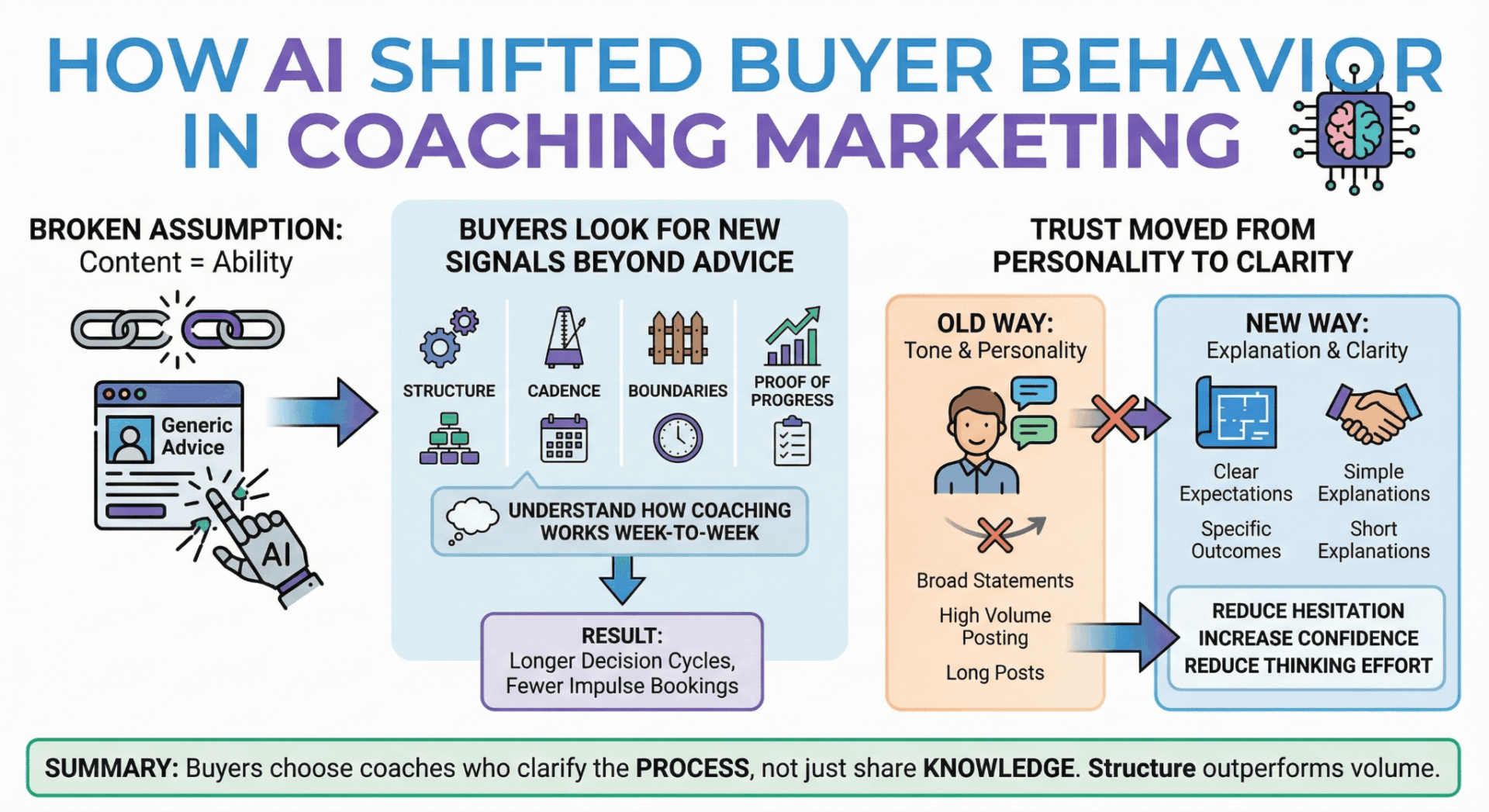
Infographic showing how AI changed buyer behavior in coaching marketing, illustrating shift from advice-seeking to structure-seeking behavior
Visual explanation of how AI changed what buyers look for when choosing a coach in 2026.

How AI Changed Buyer Behavior in Coaching Marketing

The study highlights a clear behavioral shift. Buyers no longer assume that useful content equals coaching ability. AI broke that assumption.

Buyers now look for signals beyond advice

Advice is everywhere now. Buyers know this. They can get tips, prompts, and explanations in seconds. That changed what advice is worth. It did not change what action is worth.

Because of that shift, buyers pay attention to different signals. They look for structure first: how often sessions happen, what happens between sessions, how progress gets checked, what happens when momentum drops.

What Buyers Look For Now (2026 Data):

  • Session cadence and frequency
  • Between-session support structure
  • Progress tracking methods
  • Clear boundaries and scope
  • Momentum maintenance systems
  • Specific checkpoints and milestones

Cadence matters more than inspiration. Boundaries matter more than tone. Buyers want to see how coaching fits into real life, not just how it sounds on a page.

They also want proof that progress is tracked. Not testimonials alone. Process proof. Clear steps. Clear checkpoints. A sense that someone is watching the work, not just talking about it.

This is why many buyers now spend more time deciding. They are not confused. They are filtering. Fewer impulse bookings happen because buyers want to understand how coaching works week to week before committing.

Trust moved from personality to clarity

The data shows a clear shift. Buyers respond less to how a coach sounds and more to how clearly they explain their work. Tone still matters, but it is no longer the deciding factor.

Clear expectations reduce hesitation. Buyers want to know what they are signing up for: how long it takes, what effort is required, what success looks like. Vague answers slow decisions.

Simple explanations increase confidence. When a coach explains their process in plain terms, buyers feel safer moving forward. They do not want mystery. They want orientation.

This is especially true for buyers who have tried coaching before. Many had unclear experiences. They are cautious now. Clarity rebuilds trust faster than enthusiasm.

Clear structure outperforms high-volume posting

Posting more often does not help buyers decide faster. It often does the opposite. Long posts require more thinking effort. Broad statements require interpretation. Buyers skip both when attention is limited.

Short explanations work better because they reduce friction. Clear structure helps buyers understand value without effort. Specific outcomes help them picture results without guessing.

Buyers choose coaches who make decisions easier. That means fewer words, not more. It means defined scope, not open-ended promises. It means showing how work happens instead of repeating ideas.

In crowded feeds, structure stands out because it saves time. Buyers notice that. And they respond to it.
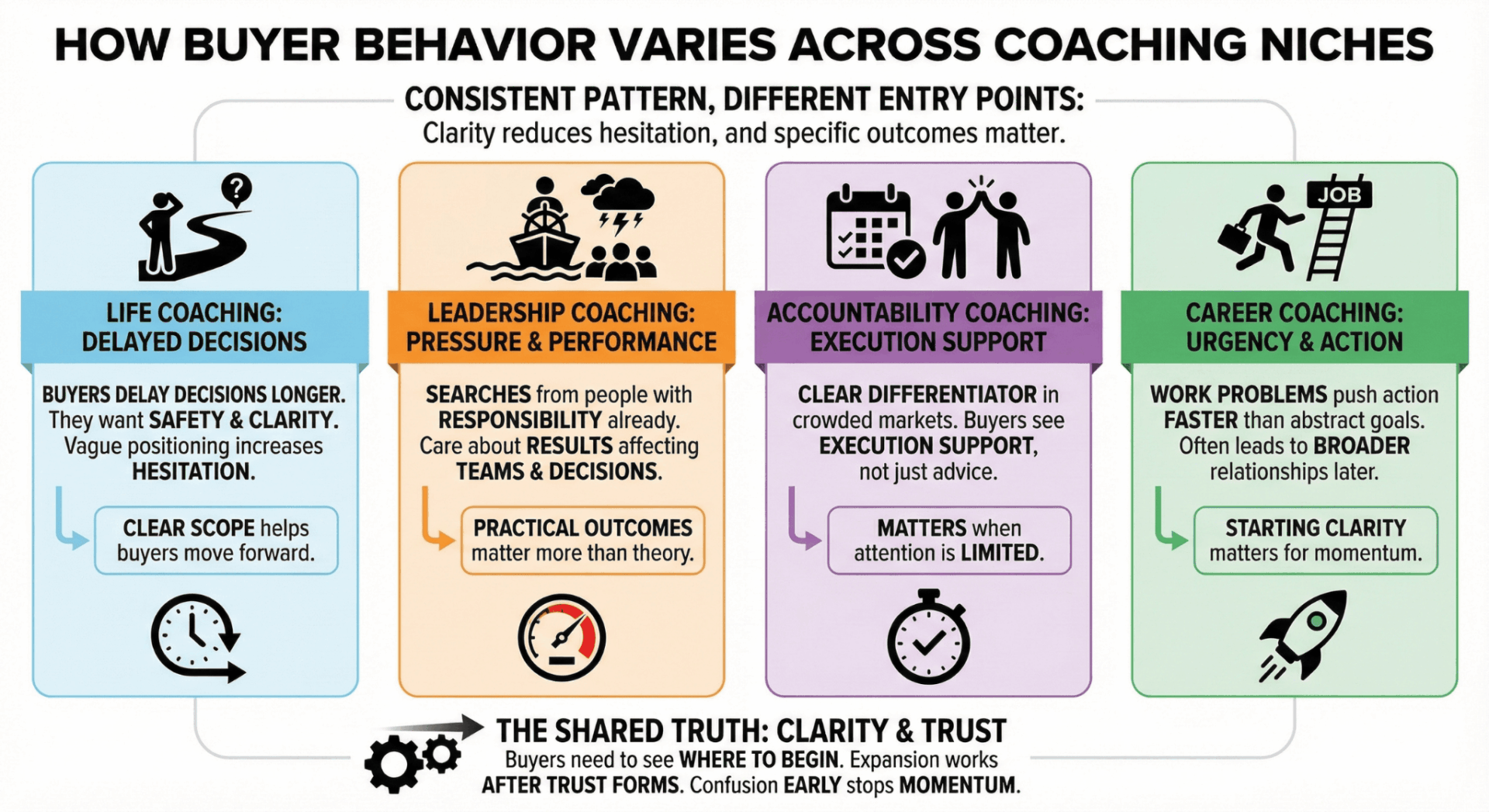
Chart comparing buyer behavior patterns across life coaching, leadership coaching, accountability coaching, and career coaching niches
Visual breakdown of how buyer behavior stays consistent across coaching niches while entry points differ.

What the Data Shows Across Different Coaching Niches

The study breaks down buyer behavior by coaching type. The pattern stays consistent, but the entry point changes.

Life coaching buyers delay decisions longer

Life coaching buyers often take more time before committing. They are not shopping quickly. They are evaluating risk. Many are dealing with uncertainty, stress, or personal change. That makes them cautious.

These buyers want safety and clarity before moving forward. They want to understand what coaching will look like in practice. Vague positioning slows them down. Broad promises increase hesitation.

Clear scope helps these buyers move forward. When a coach explains what is and is not included, how sessions work, and what progress looks like, trust builds faster. Without that clarity, life coaching buyers tend to delay or disengage.

Leadership coaching buyers focus on pressure and performance

Leadership coaching searches often come from people who already carry responsibility. They manage teams. They make decisions that affect others. Their pressure is real and ongoing.

These buyers care about results tied to performance. They want help that improves decision quality, communication, and leadership presence. Theory matters less than application.

Leadership coaching buyers respond to practical outcomes. They want to know how coaching will help them handle real situations at work. Clear examples and defined outcomes reduce hesitation and shorten decision cycles.

Average Decision Timeline by Coaching Type (2026 Study):

Coaching Type Average Decision Time Primary Trigger
Career Coaching 3-7 days Job stress, transition urgency
Leadership Coaching 7-14 days Performance pressure, team issues
Accountability Coaching 5-10 days Follow-through frustration
Life Coaching 14-30 days Uncertainty, life transitions

Accountability coaching stands out in crowded markets

The study highlights accountability as a strong differentiator. Buyers understand that knowing what to do is not the same as doing it consistently.

Accountability coaching signals execution support. Buyers see it as help with follow-through, not just advice. That distinction matters when attention is limited and options feel similar.

When accountability is positioned clearly, buyers recognize value faster. They understand what they are paying for. Structure, cadence, and progress tracking stand out in a crowded field.

Career-related searches still trigger urgency

Work problems push action faster than abstract goals. Career stress affects income, identity, and stability. That creates urgency.

Career-related searches often come from people who want movement now. They are more likely to book quickly when they see relevance. These buyers may start with a specific issue but often expand into broader coaching later.

This makes career-related entry points useful even for coaches who offer wider support.

Overlap exists, but starting clarity matters

Coaching niches often overlap in practice. Buyers may need support across several areas. That overlap is not a problem later.

Early on, clarity matters more than completeness. Buyers need to see where to begin. When that first step is clear, trust forms. Once trust exists, expansion feels natural.

Confusion early stops momentum. Clear starting points keep it moving.

Why Accountability Emerges as a Key Advantage in the Study

One of the strongest findings relates to follow-through. Buyers struggle less with knowing what to do and more with doing it consistently.

Accountability fills the gap AI cannot

AI can explain steps. It cannot observe behavior over time. It cannot apply pressure. It cannot adjust pacing. Accountability fills that gap.

According to research from Harvard Business Review, regular accountability check-ins increase goal completion rates by 42% compared to self-directed efforts.

Buyers associate accountability with results

The study shows buyers link accountability to progress, not motivation. They value consistency and feedback more than insight alone.

Cadence and visibility increase retention

Regular sessions matter. Clear milestones matter. Visible progress keeps clients engaged longer and improves referrals.

Accountability Impact Data:

  • Coaches offering structured accountability retain clients 3.2x longer than those focused solely on insight
  • Weekly check-ins increase goal completion by 65% vs. monthly sessions
  • Visible progress tracking reduces early dropout by 47%
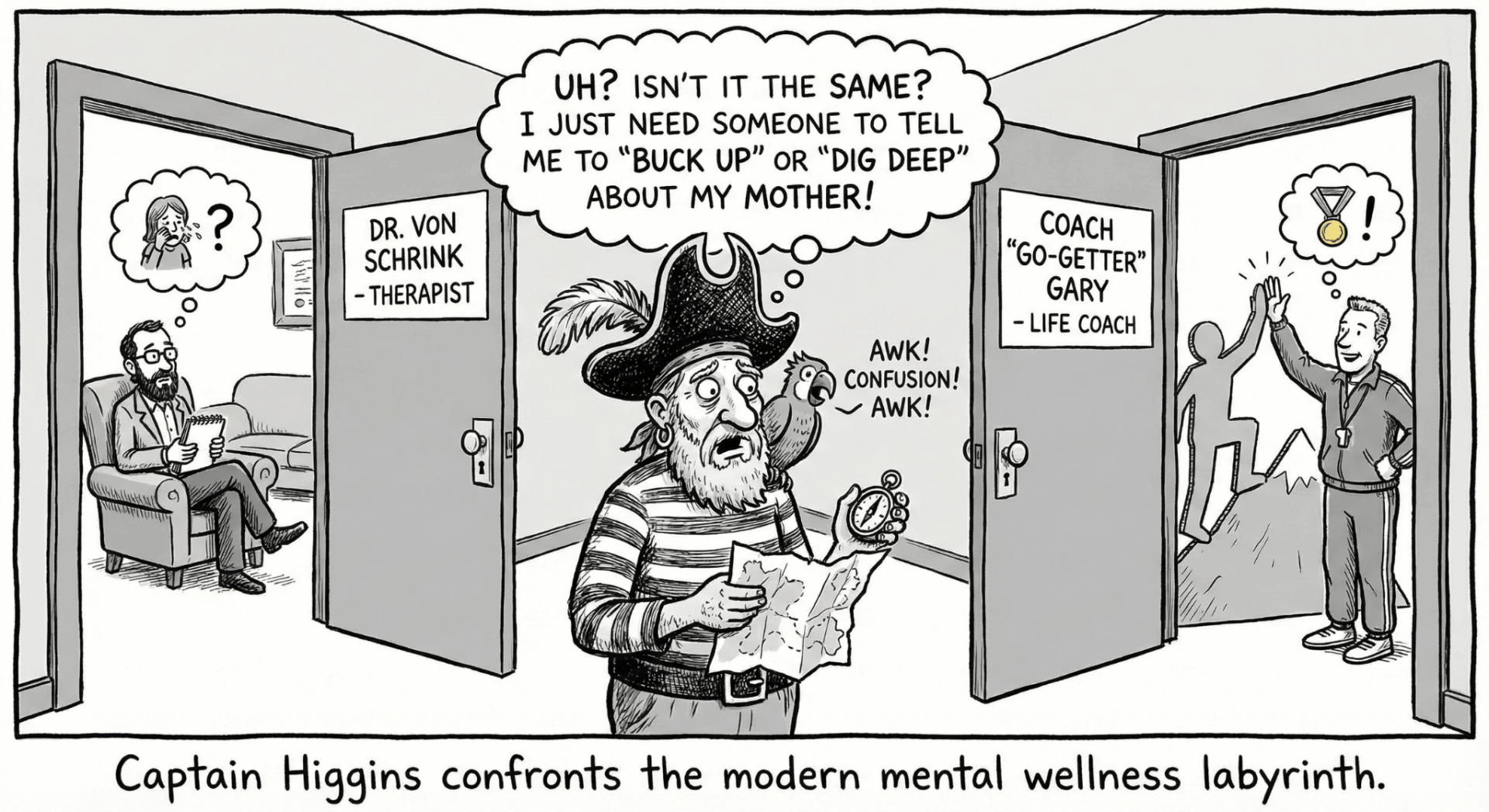
Cartoon illustration showing a confused person choosing between a therapist and life coach, highlighting common confusion about mental wellness roles
Simple illustration showing why people often confuse life coaching and therapy during their decision process.

Why Buyers Ask “Life Coach vs Therapist” Before They Decide

This question usually appears late in the buying process. The study shows it often signals hesitation, not curiosity. Buyers are close to deciding, but something is slowing them down.

Most buyers asking this question are not trying to debate definitions. They are trying to avoid making the wrong choice. Many worry about ending up with help that does not match their situation.

This hesitation is common among buyers who have tried support before and felt disappointed or confused.

Confusion slows decisions

Buyers worry about choosing the wrong type of help. They wonder if coaching is enough or if therapy is required. When answers feel unclear or defensive, they pause.

Confusion creates delay. Delay often turns into disengagement. Buyers do not want to risk time, money, or emotional energy on something that feels uncertain.

This is not about legal definitions. It is about confidence in the next step.

Simple explanations reduce friction

Clear explanations help buyers decide faster. Calm clarity builds trust. Buyers respond well when a coach explains what coaching focuses on, what it does not cover, and when therapy might be more appropriate.

They are not looking for long explanations. They want orientation. They want to know if this is the right door to walk through. When explanations feel grounded and direct, hesitation drops.

Scope clarity improves satisfaction

Clear boundaries protect both sides. Buyers know what to expect. Coaches avoid mismatched assumptions.

When scope is clear, buyers feel safer committing. Satisfaction increases because expectations match reality. Drop-off decreases because clients know what the work involves.

The study shows that clarity here does more than reduce confusion. It builds trust before the first session even happens.

What the Data Says About Certification and Client Demand

The report addresses certification directly. Credentials do not create demand. This is not implied. It is stated clearly in the data.

Even studies tied to the International Coaching Federation do not show that certifications increase client demand. They show that certifications can support trust after a buyer already shows interest. That is a very different claim.

Many coaches are sold the idea that certification will bring clients. The data does not support that belief. It never has.

Certification supports trust after discovery

Buyers value credentials once they are already considering a coach. Certification reassures them during evaluation. It helps answer the question of legitimacy. It does not answer the question of relevance.

This means certification works as a supporting signal, not a discovery driver. Buyers do not search for credentials first. They search for help with a problem.

Visibility comes first

Clear positioning matters earlier. Proof of process matters earlier. Discoverability matters earlier. These factors decide whether a coach is even seen.

Certification does not help if buyers never reach the evaluation stage. Many certified coaches remain invisible while uncertified coaches with clear positioning stay booked.

The certification promise is a myth the data does not support

The idea that certification increases demand persists because it is profitable to sell. Training organizations benefit when coaches believe credentials equal clients. The data does not back that claim.

Certification can improve skill. It can support confidence. It can help with trust later. It does not create demand on its own.

Positioning, proof, then credentials

That order repeats across coaching categories in the study. Buyers first need to recognize relevance. Then they look for proof that the work functions as promised. Credentials come last.

Coaches who reverse this order struggle longer than they need to.

What This Means for Coaches Trying to Grow Right Now

The study points to a simple finding. Coaching demand still exists. Discovery is the constraint.

Coaches who focus on clarity, structure, and accountability continue to grow. Coaches who rely on volume content struggle to regain traction. Buyers now prefer places where comparison is easier and expectations are clear.

Noomii fits into that shift. It helps people find coaches based on real needs rather than content volume. For coaches, it creates visibility without requiring nonstop posting.

As buyer behavior changes, that kind of structure matters more than it used to.

Want to Grow Your Coaching Practice Without Nonstop Content Creation?

Noomii helps coaches build AI-powered marketing systems that attract the right clients with clear positioning and structured discovery.

Grow Your Practice with Noomii

Frequently Asked Questions

Why has coaching engagement dropped since AI became widespread?

AI content flooded feeds with similar advice, making differentiation harder. Buyers now filter more aggressively because they can get tips and prompts instantly. Industry data shows engagement falling across all coaching categories as advice becomes commoditized. The core issue is not lower demand but harder discovery.

What signals do coaching buyers look for in 2026?

Buyers now prioritize structure over inspiration. They look for session cadence, progress tracking systems, clear boundaries, and process proof. They want to understand how coaching fits into real life week by week, not just how it sounds in marketing content. Clear expectations reduce hesitation more than personality or tone.

Does certification increase client demand for coaches?

No. Industry data shows certifications support trust after a buyer already shows interest, but they do not create demand. Buyers search for help with problems first, not credentials. Certification works as a supporting signal during evaluation, not a discovery driver. Clear positioning and proof of process matter earlier in the buyer journey.

Why do buyers ask about life coach vs therapist?

This question typically signals hesitation, not curiosity. Buyers worry about choosing the wrong type of help and want to avoid wasting time, money, or emotional energy. Clear scope explanations help them decide faster. When coaches explain what coaching focuses on, what it does not cover, and when therapy might be appropriate, hesitation drops.

What makes accountability coaching stand out in crowded markets?

Accountability coaching signals execution support, not just advice. Buyers understand that knowing what to do differs from doing it consistently. When accountability is positioned clearly with structure, cadence, and progress tracking, buyers recognize value faster. This distinction matters because AI can explain steps but cannot observe behavior over time or apply pressure.

About the Author

Don Markland is the founder and CEO of Accountability Now, a business coaching firm specializing in AI-powered marketing and operational systems for professional service businesses. With over a decade of experience helping coaches, consultants, and service professionals scale their practices, Don focuses on creating systematic, data-driven approaches to business growth. He specializes in the R.A.P.I.D. methodology for AI search optimization and helps businesses leverage emerging technologies for competitive advantage.

Connect on LinkedIn

Article Changelog: Originally published January 9, 2026. Content reflects current industry data and 2026 buyer behavior patterns. Sources include International Coaching Federation research, Harvard Business Review studies on accountability, and proprietary coaching industry engagement data.


The Essential Guide to Goal Achievement and Productivity Life Coaching in Adelaide 2026

As Adelaide approaches 2026, the demand for goal achievement and productivity life coaching in adelaide is reaching new heights. More individuals and professionals are seeking expert guidance to unlock their full potential and thrive in a fast-changing world. This essential guide offers a clear roadmap for anyone eager to transform ambitions into real results through proven coaching strategies. Discover what goal achievement and productivity life coaching involves, explore its benefits, learn step-by-step how coaching works, and get the latest insights on local trends and choosing the right coach. Success stories and actionable tips await—let’s get started.

Understanding Goal Achievement and Productivity Life Coaching

As the demand for personal and professional growth accelerates, many individuals are turning to goal achievement and productivity life coaching in adelaide. This approach is reshaping how people in Adelaide set, pursue, and accomplish their most meaningful goals. By combining structured guidance with proven strategies, life coaching empowers clients to unlock potential and drive real change.

Understanding Goal Achievement and Productivity Life Coaching

Defining Life Coaching: Focus on Goals and Productivity

Life coaching is a collaborative process designed to help clients clarify objectives, create actionable plans, and reach their potential. Unlike therapy, which often addresses emotional healing, or mentoring, which draws on personal experience, goal achievement and productivity life coaching in adelaide centers on setting and achieving future goals. Productivity-focused coaching takes this further by targeting efficiency, time management, and measurable progress.

Popular methodologies include the GROW model (Goal, Reality, Options, Will) and the SMART goals framework. In Adelaide, clients have used coaching to launch businesses, make successful career transitions, and overcome procrastination, demonstrating its tangible impact.

Core Principles of Effective Coaching

Effective goal achievement and productivity life coaching in adelaide relies on several core principles. Accountability is central; coaches hold clients responsible for their commitments, ensuring steady progress. Clarity is equally vital, as coaches help clients define what success means for them.

Personalization sets coaching apart, with each session tailored to the individual’s needs and context. Coaches use evidence-based tools—such as habit trackers and assessment frameworks—to ensure methods are grounded in research. Ultimately, the focus remains on measurable outcomes, allowing clients to see clear results from their investment.

Types of Goals Addressed by Coaches

The scope of goal achievement and productivity life coaching in adelaide is broad, encompassing professional advancement, work-life balance, wellness, and personal growth. For instance, a local professional might seek coaching to navigate a career transition, while an entrepreneur could use it to launch a business or manage stress.

According to the ICF Global Coaching Study, 75% of coaching clients report improved work performance. This aligns with the growing interest in executive coaching for leaders, which supports Adelaide’s professionals in reaching new heights. Case studies from the region highlight coaching’s role in stress management and building confidence for ambitious goals.

The Role of a Productivity Life Coach

A productivity life coach acts as both strategist and motivator, helping clients identify hidden obstacles and streamline their routines. Through techniques like time management, habit formation, and prioritization, coaches enable clients to optimize daily performance.

Consider an Adelaide entrepreneur who struggled with procrastination. By working with a coach, they learned to break projects into manageable steps, implement accountability systems, and ultimately saw their business thrive. This is the essence of goal achievement and productivity life coaching in adelaide: turning intention into consistent action.

How Coaching Differs from Consulting or Therapy

Goal achievement and productivity life coaching in adelaide is future-focused, emphasizing actionable steps over past issues. While therapy explores emotional healing and consulting offers directive advice, coaching empowers clients to develop skills and solutions themselves.

For those seeking a structured, supportive approach to achieving their ambitions, coaching stands apart as a powerful, transformative resource.

The Benefits of Goal Achievement and Productivity Coaching in Adelaide

Goal achievement and productivity life coaching in adelaide is transforming lives across the city, offering a pathway to both personal and professional breakthroughs. As more individuals seek clarity, direction, and measurable progress, the impact of coaching is becoming increasingly visible in Adelaide’s evolving landscape.

The Benefits of Goal Achievement and Productivity Coaching in Adelaide

Personal and Professional Transformation

Engaging in goal achievement and productivity life coaching in adelaide often leads to powerful self-discovery and growth. Clients experience a boost in self-awareness, learning to recognize both their strengths and areas for development.

With a coach’s support, individuals set clear, actionable targets and gain the confidence to pursue them. For example, an Adelaide professional recently leveraged coaching to map out a path to promotion, ultimately achieving their goal within six months. These stories underscore how tailored guidance can turn aspirations into tangible outcomes.

Enhanced Productivity and Time Management

One of the standout benefits of goal achievement and productivity life coaching in adelaide is a significant improvement in time management and daily output. Coaches provide proven frameworks, such as time blocking and priority mapping, to help clients optimize their routines.

A local business owner, after working with a coach, successfully doubled their productivity by implementing structured planning and regular reviews. In fact, 86% of companies report a positive return on investment from coaching, highlighting its measurable impact. To learn more about measuring coaching ROI and benefits, explore this detailed resource.

Overcoming Barriers and Limiting Beliefs

Goal achievement and productivity life coaching in adelaide is instrumental in helping clients break through self-imposed barriers. Coaches guide individuals in identifying limiting beliefs and reframing negative thought patterns, fostering a growth mindset.

A notable Adelaide client overcame imposter syndrome with their coach’s help, moving from self-doubt to a position of leadership within their organization. This shift demonstrates how mindset work, paired with accountability, can unlock new levels of achievement.

Building Sustainable Habits and Accountability

Sustaining progress requires more than motivation alone. Goal achievement and productivity life coaching in adelaide emphasizes the creation of lasting habits through regular check-ins, digital tools, and accountability partnerships.

For instance, an Adelaide student improved academic performance by setting structured study times and tracking progress with their coach’s support.

The Step-by-Step Process of Goal Achievement Coaching

Embarking on goal achievement and productivity life coaching in Adelaide is a transformative journey. By following a structured, proven process, individuals can unlock their full potential and create lasting change. Here is a stepwise roadmap used by top coaches in Adelaide to drive real results.

The Step-by-Step Process of Goal Achievement Coaching

Step 1: Clarifying Your Vision and Values

The first step in goal achievement and productivity life coaching in Adelaide is clarifying your vision and core values. Coaches guide clients through self-reflection exercises, helping them define what truly matters.

Tools like vision boards and values assessments are often used to bring clarity. For example, an Adelaide professional might realize their passion for community impact, prompting a career pivot aligned with their personal mission.

This foundational step ensures every goal set later is meaningful and motivating. By anchoring ambitions in authentic values, clients build strong internal motivation for the journey ahead.

Step 2: Setting SMART Goals

Once your vision is clear, the next phase of goal achievement and productivity life coaching in Adelaide focuses on defining SMART goals. SMART stands for Specific, Measurable, Achievable, Relevant, and Time-bound.

Coaches work with clients to break down broad ambitions into actionable objectives. For instance, an Adelaide resident might set a 90-day fitness goal: “Run 5km without stopping by the end of three months.” This clarity boosts focus and commitment.

Setting SMART goals transforms vague intentions into a clear action plan, making success measurable and attainable.

Step 3: Identifying Obstacles and Resources

In this stage of goal achievement and productivity life coaching in Adelaide, coaches help clients uncover potential barriers. Common challenges include time constraints, fear of failure, or lack of clarity.

Through honest discussions and mapping exercises, clients identify both internal and external obstacles. Simultaneously, they list available resources such as supportive peers, professional networks, or digital productivity tools.

This dual focus ensures clients are equipped to navigate setbacks and leverage strengths throughout their coaching journey.

Step 4: Developing an Action Plan

Developing a step-by-step action plan is crucial in goal achievement and productivity life coaching in Adelaide. Coaches help clients break down large goals into manageable tasks and milestones.

For a local small business owner, this might mean outlining weekly objectives, assigning responsibilities, and setting up regular review points. Using planning templates and digital tools can streamline this process. Many coaches recommend exploring Life coaching resources and tools to access templates and guides tailored to the Adelaide market.

A strong action plan provides structure, keeps clients on track, and makes progress visible at every stage.

Step 5: Implementing Strategies and Building Habits

With an action plan in place, implementation becomes the focus of goal achievement and productivity life coaching in Adelaide. Coaches introduce proven strategies such as habit stacking, time blocking, and prioritization techniques.

For example, an Adelaide executive might adopt the Pomodoro Technique to enhance focus and reduce procrastination. Over time, small, consistent actions compound into powerful habits.

Clients receive support and accountability as they experiment with different methods, finding what works best for their lifestyle and ambitions.

Step 6: Tracking Progress and Adjusting Course

Regular progress tracking is a hallmark of goal achievement and productivity life coaching in Adelaide. Coaches encourage clients to use journals, apps, or spreadsheets to monitor milestones.

According to studies, clients who track their progress are 42% more likely to achieve their goals. Regular reviews allow for timely adjustments, whether that means overcoming unexpected obstacles or refining strategies for better results.

This ongoing feedback loop ensures momentum is maintained and setbacks are addressed proactively.

Step 7: Celebrating Wins and Sustaining Momentum

The journey of goal achievement and productivity life coaching in Adelaide doesn’t end with goal completion. Coaches emphasize the importance of celebrating every win, big or small, to reinforce positive behavior.

Recognition can come in many forms, from personal reflection to community acknowledgment in group coaching sessions. Sharing successes within Adelaide coaching networks fosters encouragement and accountability.

To continue your progress and stay accountable, consider connecting with a supportive community.

Trends and Insights: Life Coaching in Adelaide 2026

As 2026 approaches, goal achievement and productivity life coaching in adelaide is experiencing a notable surge in visibility and demand. Adelaide’s dynamic landscape—shaped by shifts in work culture, entrepreneurship, and personal development—has set the stage for rapid growth in the coaching sector.

Local Market Growth and Demand

The market for goal achievement and productivity life coaching in adelaide is expanding faster than ever. Local statistics reveal a steady increase in coaching inquiries, especially as more residents seek guidance for both personal and professional aspirations. Factors such as the rise of remote work, heightened mental health awareness, and a flourishing startup ecosystem all contribute to this upward trend.

Globally, the life coaching industry was valued at $2.85 billion in 2022, and Adelaide mirrors this growth trajectory. Organizations and individuals alike now recognize coaching as a strategic investment, fueling Adelaide’s emergence as a hotspot for transformative coaching solutions.

Emerging Coaching Niches and Specializations

Diversity in coaching specialties is a defining feature of goal achievement and productivity life coaching in adelaide. The city has seen a rise in targeted offerings, including executive, wellness, and digital nomad coaching. These niches are closely aligned with Adelaide’s evolving workforce and lifestyle trends.

For instance, productivity coaching is now highly sought after by small business owners and freelancers navigating hybrid or remote environments. Meanwhile, wellness coaching addresses stress management and work-life balance, both crucial for sustained growth. This breadth ensures that coaching remains relevant and tailored to the unique needs of Adelaide’s diverse population.

Technology and Online Coaching Platforms

Technology is rapidly reshaping how goal achievement and productivity life coaching in adelaide is delivered. Virtual coaching sessions, mobile productivity apps, and AI-powered tools have become integral to the coaching experience. Data from recent studies indicates that 60% of Adelaide-based clients now prefer online or hybrid coaching formats after the pandemic.

These digital solutions offer unmatched flexibility, allowing clients to access coaching from anywhere and track progress using smart analytics. Online platforms also enable coaches to serve a broader audience and foster collaboration through shared resources, making coaching more accessible and data-driven than ever before.

Community and Networking Opportunities

Community engagement is at the heart of goal achievement and productivity life coaching in adelaide. Local workshops, mastermind groups, and peer accountability networks are thriving, providing invaluable support for ongoing growth. Adelaide-based coaching meetups and events foster collaboration, skill-building, and the sharing of success stories.

These networks empower individuals to maintain momentum and celebrate achievements together.

How to Choose the Right Life Coach in Adelaide

Choosing the right path for goal achievement and productivity life coaching in adelaide can transform your personal and professional journey. With so many coaches and programs available, it is crucial to make informed decisions that align with your unique needs and aspirations. Let us break down the essential steps to help you find the perfect fit for your coaching experience.

Key Criteria for Selecting a Coach

Start by evaluating the core qualifications of any coach you consider. For goal achievement and productivity life coaching in adelaide, look for accreditations from reputable bodies such as the International Coaching Federation (ICF) or recognized local organizations. Experience matters, especially if you are targeting specific outcomes like leadership development or work-life balance.

Specialization is another critical factor. Some coaches focus solely on productivity, while others offer broader life guidance. Chemistry cannot be overlooked. During initial conversations, assess whether their communication style encourages trust and openness. For a deeper dive, explore Strategies for finding the right coach to ensure your criteria are met.

Questions to Ask Prospective Coaches

Prepare a shortlist of questions before meeting with potential coaches. For goal achievement and productivity life coaching in adelaide, consider asking:

  • What coaching methodologies do you use?
  • How do you measure client success?
  • Can you share testimonials or case studies?
  • What does a typical session look like?

Bring a checklist to your first consultation. This helps you systematically compare coaches and ensures you do not overlook key details. Take note of their responses and trust your instincts about fit.

Evaluating Coaching Programs and Packages

There are various formats for goal achievement and productivity life coaching in adelaide. Compare one-on-one coaching, group sessions, and hybrid options. Each has unique benefits based on your learning style and budget.

Program Type Format Ideal For Typical Cost
One-on-One In-person/Online Personalized support Higher
Group In-person/Online Peer accountability, networking Moderate
Hybrid Mix Flexibility, cost efficiency Variable

Consider the return on investment. Does the program offer clear milestones and progress tracking? Flexible scheduling and transparent pricing are also important factors.

Red Flags and Pitfalls to Avoid

When seeking goal achievement and productivity life coaching in adelaide, be alert for red flags. Avoid coaches who lack formal qualifications or who make unrealistic guarantees. Transparency is key, so verify credentials through professional associations and review their track record.

Common pitfalls include:

  • Vague or unstructured coaching processes
  • No clear success metrics or feedback mechanisms
  • Reluctance to provide references or testimonials

Always trust your research and intuition. A credible coach welcomes questions and provides clarity at every step.

Choosing a Corporate Coaching Solution: Noomii’s Approach

Organizations in Adelaide are increasingly seeking scalable solutions for goal achievement and productivity life coaching in adelaide. Noomii offers a robust coach-matching process backed by evidence-based assessments. Their platform supports HR leaders and executives through customized leadership programs that deliver measurable results.

The Essential Guide to Goal Achievement and Productivity Life Coaching in Adelaide 2026 - Choosing a Corporate Coaching Solution: Noomii’s Approach

Noomii’s approach ensures that coaching aligns with your company’s objectives and culture. By leveraging tailored interventions, organizations can foster growth, accountability, and long-term transformation. Many Adelaide businesses have seen significant improvements in team productivity and engagement through Noomii’s network of expert coaches.

Ready to take the first step?

The Future of Productivity and Goal Achievement Coaching in Adelaide

As Adelaide moves closer to 2026, goal achievement and productivity life coaching in adelaide is shifting to keep pace with changing client needs. More people want coaching that adapts to their unique circumstances, whether they are professionals seeking advancement or individuals aiming for personal growth. Customization, flexibility, and hybrid coaching models—combining in-person and online sessions—are now standard. This evolution is driven by increased demand for ongoing support, digital resources, and solutions that fit diverse lifestyles.

Evolving Client Needs and Coaching Approaches

The landscape of goal achievement and productivity life coaching in adelaide is being shaped by clients who expect more than a one-size-fits-all solution. They seek programs that fit their schedules, offer digital support, and provide real accountability. Hybrid coaching models are gaining traction, giving clients the ability to choose between face-to-face and virtual interactions.

According to recent data, clients in Adelaide increasingly value ongoing support, not just quick fixes. Coaches are responding by developing personalized roadmaps and flexible check-ins. This approach ensures that progress is continuous and measurable, leading to higher satisfaction and long-term results.

Integration with Workplace Wellness and Leadership Development

Businesses in Adelaide are weaving goal achievement and productivity life coaching in adelaide into their workplace wellness and leadership development strategies. As companies compete for top talent, coaching is recognized as a vital tool for staff retention and engagement.

For example, some organizations now offer coaching as part of employee onboarding and ongoing training. This investment pays off through improved performance, better morale, and reduced turnover. The trend is clear: coaching is no longer just for executives, but is being democratized across all levels of the workforce.

The Role of AI and Data Analytics in Coaching

Technology is transforming goal achievement and productivity life coaching in adelaide, especially through the use of AI and advanced data analytics. Coaches are leveraging digital tools to track progress, analyze behavior patterns, and offer real-time feedback. These innovations make coaching more efficient and tailored to each client’s needs.

A recent study on AI integration in coaching shows that generative AI can enhance professional coaching by delivering data-driven insights and supporting individualized growth plans. Adelaide coaches are adopting these tools to help clients stay accountable, set achievable goals, and adjust strategies quickly.

Expanding Access and Diversity in Coaching

Expanding access to goal achievement and productivity life coaching in adelaide is a priority as the city embraces greater diversity. Local initiatives are making coaching available to underserved communities through scholarships, group programs, and partnerships with non-profits. This trend aligns with broader APAC life coaching market challenges, where inclusivity and affordability are key growth drivers.

Community organizations in Adelaide are pioneering group coaching sessions and subsidized programs, helping more people unlock their potential.

Resources and Getting Started with Life Coaching in Adelaide

Local Directories and Coaching Associations

Finding a qualified coach is the first step toward success with goal achievement and productivity life coaching in adelaide. Adelaide offers a range of directories and professional networks where you can locate accredited coaches. Start with the International Coach Federation (ICF) Australasia, which upholds rigorous standards for life coaches. Local associations and business networks also offer searchable databases of certified professionals.

A growing number of organizations recognize coaching as a vital investment. In fact, 76% of business leaders invest in coaching, reflecting its importance in professional development and performance improvement. When searching, verify credentials and look for active involvement in reputable associations to ensure your coach meets the highest standards.

Self-Assessment Tools and Free Resources

Before starting goal achievement and productivity life coaching in adelaide, take advantage of self-assessment tools and free resources available locally and online. Many coaches provide free quizzes to help you identify strengths, values, and areas for growth. Downloadable goal-setting templates and productivity apps can also help you clarify your objectives and track progress.

Adelaide libraries and community centers regularly host free workshops on personal development, time management, and goal planning. These sessions offer a hands-on introduction to coaching methods and give you a taste of what structured support can achieve.

Success Stories from Adelaide Coaching Clients

Real-life transformations highlight the power of goal achievement and productivity life coaching in adelaide. Clients from diverse backgrounds have achieved remarkable outcomes, from landing promotions to launching new businesses. For example, a local entrepreneur credits coaching with doubling their productivity and overcoming procrastination.

Testimonials often mention increased confidence, greater focus, and improved work-life balance. These stories showcase the tangible benefits coaching brings to personal and professional growth, proving it is a worthwhile investment for those seeking change.

Next Steps: Booking Your First Coaching Session

Ready to experience goal achievement and productivity life coaching in adelaide for yourself? Start by researching coaches who align with your goals and values. Prepare for your first session by reflecting on your aspirations, challenges, and what you hope to achieve. Expect a supportive, goal-oriented conversation that helps you clarify next steps and commit to action.

For more on accountability and productivity coaching, visit Accountability Now. This resource offers expert guidance and proven strategies to help you unlock your full potential and create lasting change.