
Leadership Development & Communication Coaching Edinburgh
Edinburgh's unique position as a hub for financial services, government agencies, and international organizations creates distinct challenges for executives seeking to enhance their leadership capabilities. The city's professional landscape demands leaders who can navigate complex stakeholder relationships, drive organizational change, and communicate with precision across diverse teams. Leadership development and communication coaching in Edinburgh has evolved to meet these specific requirements, offering tailored solutions that address the nuanced needs of Scotland's capital while maintaining global best practices.
The Strategic Imperative for Leadership Coaching in Scotland's Capital
Edinburgh organizations face mounting pressure to develop leadership capacity that aligns with both local market dynamics and international standards. The city's concentration of regulated industries, public sector institutions, and multinational corporations requires executives who can balance compliance requirements with innovation.
Leadership development and communication coaching in Edinburgh addresses several critical challenges:
- Cultural complexity: Managing diverse teams across Edinburgh's international business community
- Regulatory navigation: Leading within heavily regulated sectors like financial services and healthcare
- Strategic communication: Articulating vision across hierarchical and matrixed organizational structures
- Change management: Guiding teams through digital transformation and organizational restructuring
The most effective coaching programs recognize that Edinburgh's professional ecosystem requires a sophisticated understanding of local business culture combined with evidence-based methodologies proven across global markets.
Why Traditional Leadership Training Falls Short
Standard leadership workshops deliver generic frameworks that rarely translate to real-world application. Research demonstrates that without personalized coaching and accountability structures, approximately 87% of leadership training content is forgotten within 30 days.

Edinburgh executives need more than theoretical knowledge. They require practical frameworks adapted to their specific organizational contexts, industry pressures, and personal leadership styles. This is where precision coach matching becomes essential, pairing leaders with experienced coaches who understand their sector-specific challenges.
Evidence-Based Communication Skills That Drive Executive Impact
Communication coaching forms the foundation of effective leadership development. Edinburgh's business environment particularly values clear, strategic communication that respects organizational hierarchy while fostering innovation.
The six core principles of leadership coaching emphasize creating supportive yet challenging environments where leaders can develop authentic communication styles. These principles align with what Edinburgh executives need most: the ability to influence without authority, navigate difficult conversations, and build trust across stakeholder groups.
Essential Communication Competencies for Edinburgh Leaders
| Competency | Business Application | Measurable Outcome |
|---|---|---|
| Active Listening | Stakeholder engagement and conflict resolution | Reduced escalation incidents |
| Strategic Messaging | Board presentations and investor communications | Increased stakeholder confidence scores |
| Adaptive Communication | Cross-functional team leadership | Improved project delivery timelines |
| Feedback Delivery | Performance management and development | Enhanced team engagement metrics |
Professional coaching helps executives develop these competencies through structured practice and real-time feedback. Rather than abstract scenarios, leaders work on actual communication challenges they face in their roles.
Best practices for leadership development emphasize blended learning approaches that combine assessment, coaching, and purposeful practice. This methodology proves particularly effective for Edinburgh executives who must balance demanding schedules with meaningful development work.
Addressing Toxic Leadership Patterns Through Targeted Intervention
Edinburgh organizations increasingly recognize that toxic leadership behaviors create measurable financial and cultural damage. Toxic leaders drain organizational energy, suppress innovation, and drive talent attrition.
Leadership development and communication coaching in Edinburgh now includes specialized interventions designed to transform abrasive or ineffective leadership patterns. These programs require diagnostic precision to identify root causes rather than surface behaviors.
Common toxic patterns in Edinburgh's professional environment include:
- Micromanagement driven by risk aversion in regulated industries
- Communication styles that prioritize hierarchy over collaboration
- Decision-making processes that exclude diverse perspectives
- Failure to provide meaningful recognition or development opportunities
Effective intervention begins with validated assessments that create self-awareness. Many executives operate with significant blind spots regarding how their communication style impacts team performance. Professional coaching creates safe spaces for leaders to receive honest feedback and develop alternative approaches.
The Coaching Conversation Framework
Conducting effective coaching conversations requires specific techniques that facilitate self-discovery rather than prescriptive advice. Edinburgh executives respond well to coaching that honors their expertise while challenging limiting assumptions.
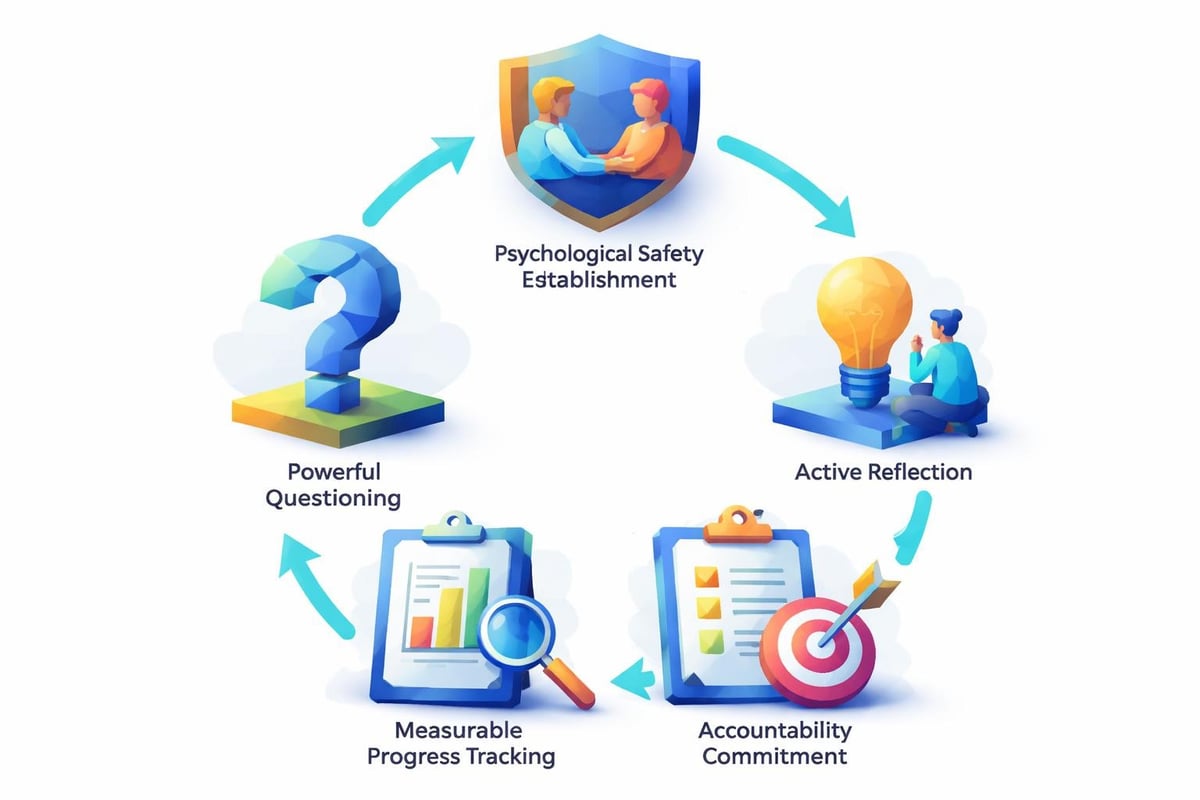
The framework includes these critical elements:
- Establishing psychological safety: Creating conditions where leaders can explore vulnerabilities
- Powerful questioning: Using inquiry to deepen self-awareness and reveal new perspectives
- Active reflection: Guiding leaders to extract insights from their experiences
- Accountability structures: Building commitment to specific behavioral changes
- Progress measurement: Tracking development against defined leadership competencies
This approach aligns with Amy Edmondson’s research on psychological safety, demonstrating that leaders must first experience safe developmental environments before they can create them for their teams.
Integrating Technology With Human Coaching Expertise
Edinburgh's technology sector and traditional industries alike are exploring how artificial intelligence can enhance leadership development. Recent research on LLM-powered coaching tools demonstrates that technology can support self-reflection and extend coaching impact between sessions.
However, technology serves as complement rather than replacement for expert human coaching. The nuance required to address complex leadership challenges demands the judgment, empathy, and contextual understanding that only experienced coaches provide.
Leadership development and communication coaching in Edinburgh effectively integrates technology through:
- Pre-session assessments and reflection tools that maximize coaching time
- Progress tracking dashboards that demonstrate development trajectory
- Micro-learning modules that reinforce coaching concepts
- Virtual coaching options that accommodate executive schedules
Organizations using top executive coaching firms benefit from platforms that combine human expertise with technological efficiency, ensuring scalable programs that maintain quality across leadership levels.
Building High-Performance Leadership Through Targeted Skill Development
Edinburgh organizations recognize that leadership effectiveness depends on mastering specific, coachable skills. Ten essential coaching skills for managers include active listening, empathy, clarity in communication, and the ability to facilitate problem-solving without imposing solutions.
These competencies prove particularly valuable in Edinburgh's collaborative business culture, where matrix structures and cross-functional initiatives require influence without direct authority.
Strategic Communication Best Practices for Edinburgh Executives
Five best practices for strategic communication in leadership emphasize preparation, authenticity, and adaptability. Edinburgh leaders must communicate effectively across diverse contexts, from formal board presentations to informal team conversations.
Professional coaching helps executives develop versatility in communication approach while maintaining authentic leadership presence. This includes:
- Stakeholder mapping: Understanding communication preferences across different audiences
- Message architecture: Structuring communications for maximum clarity and impact
- Difficult conversation navigation: Addressing performance issues and organizational changes with transparency
- Cultural intelligence: Adapting communication styles for international teams
Leadership development programs that incorporate these elements deliver measurable improvements in executive effectiveness, team engagement, and organizational performance.
Measuring Leadership Development Impact and ROI
Edinburgh organizations demand accountability from leadership development investments. Effective programs establish clear metrics before coaching begins, tracking progress against defined competencies and organizational objectives.
| Measurement Category | Key Indicators | Data Sources |
|---|---|---|
| Individual Leadership Growth | 360-degree feedback scores, behavioral assessments | Pre/post coaching surveys, stakeholder interviews |
| Team Performance | Engagement scores, retention rates, productivity metrics | HR analytics, team surveys |
| Organizational Impact | Strategic initiative success, cultural health indicators | Business metrics, employee feedback |
| Financial ROI | Cost savings from reduced turnover, productivity gains | Financial analysis, comparative benchmarking |
This data-driven approach ensures that leadership development and communication coaching in Edinburgh delivers tangible value rather than subjective impressions of improvement.
Organizations working with leadership executive coaching providers should expect quarterly progress reviews, mid-point assessments, and comprehensive program evaluations that demonstrate clear return on investment.
Sector-Specific Leadership Challenges in Edinburgh
Edinburgh's diverse economic base creates distinct leadership requirements across industries. Financial services executives navigate regulatory complexity while driving innovation. Public sector leaders balance political accountability with operational excellence. Technology companies require leadership that scales with rapid growth.

Financial Services Leadership: Edinburgh's position as a major financial center demands leaders who understand risk management, regulatory compliance, and stakeholder confidence. Communication coaching helps executives articulate complex financial concepts to diverse audiences while maintaining transparency requirements.
Public Sector Excellence: Government agencies and public institutions require leadership that aligns with mission objectives while managing limited resources. Coaching addresses the unique challenges of leading without traditional corporate incentive structures.
Technology and Innovation: Edinburgh's growing technology sector needs leaders who can attract talent, secure investment, and build scalable organizations. Development programs focus on transitioning from technical expertise to strategic leadership.
Government and Fortune 500 Coaching Requirements
Large organizations have specific requirements for leadership development programs. Government agencies prioritize structured approaches that align with procurement standards and demonstrate clear value. Fortune 500 companies require programs that integrate with existing leadership frameworks while providing differentiated value.
Leadership development and communication coaching in Edinburgh serves both segments through:
- Compliance alignment: Ensuring programs meet organizational, regulatory, and ethical standards
- Scalability: Delivering consistent quality across multiple cohorts and leadership levels
- Integration: Working seamlessly with internal talent development systems
- Measurement: Providing detailed analytics that demonstrate program effectiveness
The PRCA’s Leadership Academy in Edinburgh demonstrates this approach, offering structured programs specifically designed for communications professionals that combine theoretical frameworks with practical application.
The Role of Precision Matching in Coaching Success
Not all coaches effectively serve all leaders. Executive coaching success depends significantly on the match between coach expertise and leader needs. Edinburgh executives benefit from coaches who understand their industry context, leadership challenges, and organizational culture.
Effective matching considers multiple dimensions:
- Industry experience: Coaches with relevant sector knowledge who understand specific business dynamics
- Leadership level: Matching coaching approach to executive seniority and organizational scope
- Development focus: Aligning coach specialization with specific competency gaps
- Communication style: Ensuring compatibility in how coach and leader interact
- Cultural fit: Respecting organizational and personal values alignment
Organizations that invest in precision matching see significantly higher engagement rates and measurable outcomes compared to generic coach assignments. This approach recognizes that coaching effectiveness depends on relationship quality, not just coach credentials.
Creating Sustainable Leadership Development Systems
One-off coaching engagements deliver limited value. Sustainable leadership development requires systematic approaches that build organizational capability over time. Edinburgh organizations increasingly adopt comprehensive frameworks that integrate coaching with broader talent strategies.
Sustainable systems include these components:
- Leadership pipeline development: Identifying and developing future leaders at all organizational levels
- Succession planning integration: Using coaching to prepare leaders for expanded responsibilities
- Cultural reinforcement: Aligning leadership development with desired organizational values
- Continuous learning: Creating mechanisms for ongoing development beyond formal programs
- Knowledge transfer: Capturing and sharing leadership insights across the organization
Leadership coaching resources provide frameworks for building these systematic approaches, ensuring development investments create lasting organizational capability rather than temporary individual improvements.
The most effective programs also incorporate peer learning, where executives develop together and provide mutual accountability. This approach proves particularly valuable in Edinburgh's interconnected business community, where cross-organization learning enhances individual program value.
Adapting Leadership Styles for Modern Workplace Demands
Edinburgh workplaces in 2026 demand leadership approaches significantly different from previous decades. Hybrid work models, generational diversity, and rapid technological change require adaptive leadership styles that balance structure with flexibility.
Five coaching techniques to enhance leadership style emphasize personalization, including getting to know team members individually and adapting coaching approaches to different situations. These principles apply equally to how leaders should adjust their own styles.
Modern Edinburgh leaders must demonstrate:
- Inclusive decision-making: Engaging diverse perspectives while maintaining decisiveness
- Transparent communication: Balancing openness with appropriate confidentiality
- Empathetic leadership: Understanding individual circumstances without compromising standards
- Technological fluency: Leveraging digital tools without losing human connection
- Resilience modeling: Demonstrating adaptability in uncertain environments
Coaching helps executives develop these capabilities through experiential learning, real-time feedback, and structured reflection on leadership impact. The process creates self-awareness that enables intentional leadership choices rather than reactive patterns.
Governance and Compliance in Leadership Development Programs
Edinburgh's regulated industries require leadership development programs that align with governance frameworks and compliance standards. Financial services, healthcare, and public sector organizations must demonstrate that coaching investments meet procurement requirements and ethical guidelines.
Professional coaching programs address these requirements through:
- Documented methodologies: Clear frameworks that demonstrate evidence-based approaches
- Ethical standards: Adherence to recognized coaching certification and conduct codes
- Confidentiality protocols: Robust systems protecting sensitive leadership discussions
- Progress documentation: Regular reporting that demonstrates program value and leader development
- Outcome measurement: Quantified results that justify investment and inform program adjustments
Organizations can confidently invest in leadership development and communication coaching in Edinburgh when providers demonstrate compliance capability alongside coaching expertise. This dual competency proves essential for government agencies and highly regulated corporations.
Platforms like https://accountabilitynow.net/ provide additional frameworks for maintaining accountability throughout leadership development journeys, ensuring both individual commitment and organizational oversight.
Edinburgh's leadership landscape demands sophisticated development approaches that combine evidence-based coaching methodologies with deep understanding of local business dynamics. Investing in structured leadership development programs that emphasize communication skills, behavioral change, and measurable outcomes positions organizations for sustained competitive advantage. The Noomii Leadership Coaching program delivers precisely this combination, matching Edinburgh executives with expert coaches who understand their specific challenges while providing the accountability systems and measurement frameworks that ensure meaningful transformation.


Leave a Reply
Want to join the discussion?Feel free to contribute!