

Executive Career Coach: What They Do and How to Choose One
The transition from mid-level manager to senior executive demands more than technical expertise. It requires strategic vision, political savvy, and the ability to influence across organizational boundaries. An executive career coach provides the targeted guidance and accountability that transforms capable managers into exceptional leaders. As companies recognize the measurable ROI of coaching, investment in executive coaching has surged, with organizations prioritizing development programs that deliver concrete business outcomes.
What an Executive Career Coach Actually Does
An executive career coach partners with senior leaders to accelerate professional growth and navigate complex career transitions. Unlike traditional therapy or mentorship, this relationship centers on action, accountability, and measurable progress toward specific business objectives.
Core responsibilities include:
- Clarifying long-term career vision and strategic positioning
- Identifying leadership gaps that limit advancement
- Developing executive presence and communication skills
- Navigating organizational politics and stakeholder management
- Preparing for board presentations and high-stakes negotiations
- Managing career transitions into C-suite roles
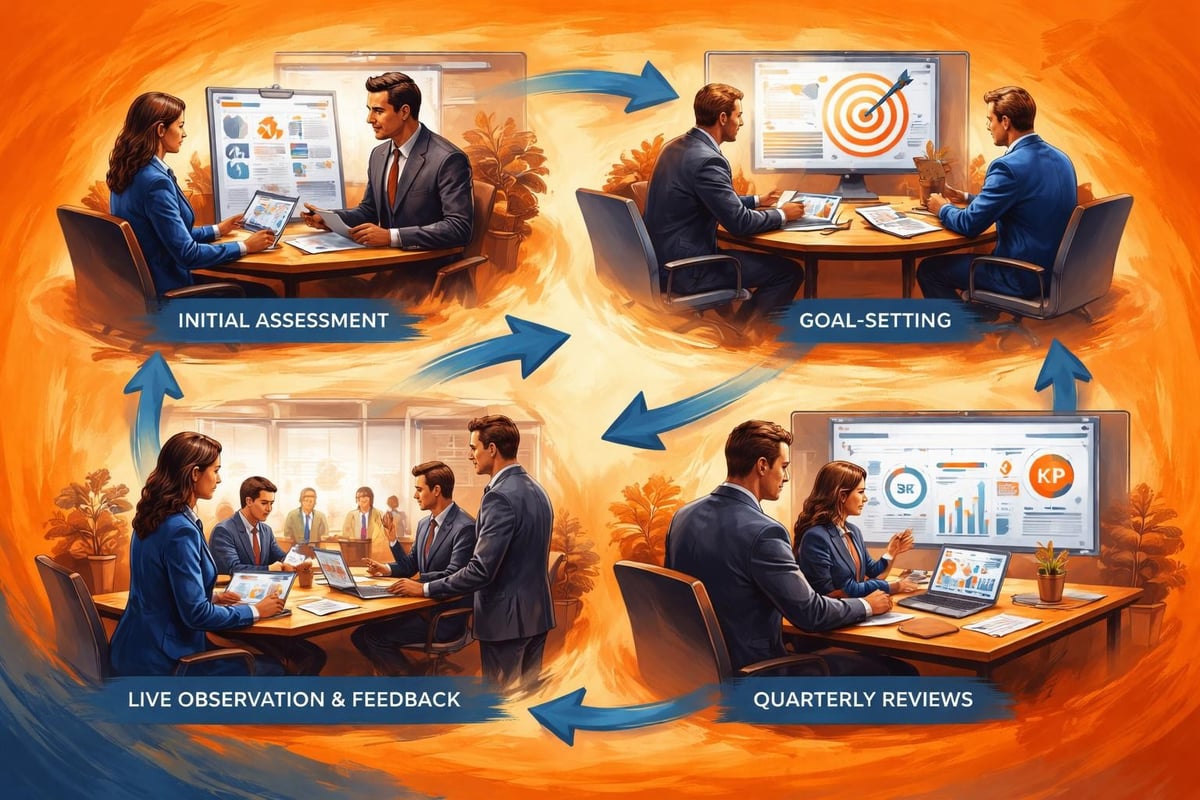
The most effective coaches integrate directly into your workflow rather than operating from the sidelines. They observe real meetings, provide immediate feedback, and help you apply new skills in actual business situations. This hands-on approach, emphasized in leadership development coaching, creates faster behavioral change than traditional coaching models.

The Business Case for Executive Coaching
Organizations now view coaching as a strategic investment with quantifiable returns. Recent executive coaching industry statistics show that companies achieve an average ROI of $7 for every dollar invested in coaching programs, with benefits including faster decision-making, improved employee retention, and stronger leadership pipelines.
Mid-market companies particularly benefit from coaching that aligns with operational realities. Rather than abstract leadership theory, practical coaching addresses immediate challenges: preparing managers to lead difficult conversations, establishing accountability frameworks, or improving cross-functional collaboration.
| Coaching Focus Area | Business Impact | Timeline to Results |
|---|---|---|
| Executive presence | Stronger board relationships, enhanced credibility | 3-6 months |
| Strategic thinking | Better resource allocation, clearer priorities | 4-8 months |
| Team development | Higher engagement, reduced turnover | 6-12 months |
| Stakeholder management | Faster approvals, smoother execution | 2-4 months |
The shift toward measurable coaching outcomes reflects growing sophistication in how companies evaluate development investments. Forward-thinking organizations now demand coaches who understand P&L dynamics, can speak credibly about business operations, and tie their work to tangible KPIs.
Choosing the Right Executive Career Coach
Not all coaches deliver equal value. The certification-heavy industry often prioritizes credentials over practical business experience, leaving executives with well-meaning coaches who lack the depth to guide complex organizational challenges.
Essential Selection Criteria
Business acumen matters more than coaching hours. Look for coaches who have held senior operational roles, managed P&Ls, or navigated the specific challenges you face. A coach who has built teams, driven revenue, or led through restructuring brings contextual wisdom that purely academic coaches cannot match.
When exploring leadership coaching services, evaluate these factors:
- Industry relevance – Does the coach understand your sector's unique pressures?
- Methodology transparency – Can they articulate their approach and expected outcomes?
- Flexibility – Do they adapt to your schedule and business priorities?
- Accountability mechanisms – How do they track progress and measure results?
- Reference checks – What outcomes have similar executives achieved?
The best coaches operate without long-term contracts, confident that visible results will retain clients. Month-to-month arrangements signal a coach's willingness to prove value continuously rather than lock you into extended commitments.
Red Flags to Avoid
Steer clear of coaches who emphasize their certifications more than client outcomes. While credentials matter, they guarantee neither business understanding nor practical impact. Similarly, avoid coaches who cannot articulate how they measure success or demonstrate ROI.
Generic coaching frameworks rarely address the nuanced challenges facing executives. Your coach should customize their approach based on your specific goals, organizational context, and leadership gaps. As highlighted in emerging coaching trends, personalization and data-driven methodologies increasingly differentiate effective coaches from ineffective ones.
The Coaching Engagement Model
Traditional coaching happens in conference rooms far from actual work. This artificial environment limits learning transfer and delays behavioral change. Modern executive career coach engagements embed coaching directly into business operations.
Effective engagement structures include:
- Live meeting coaching – The coach observes your actual team meetings, board presentations, or client negotiations, providing real-time feedback
- KPI scorecards – Progress tracking against specific metrics like decision speed, team retention, or revenue per employee
- Operating cadence support – Integration with existing management rhythms rather than separate coaching sessions
- 360 assessments – Structured feedback from peers, direct reports, and supervisors to identify blind spots
This approach, detailed in resources like AccountabilityNow, emphasizes measurable progress over theoretical discussions. You work on real challenges with immediate business consequences, accelerating skill development and demonstrating value to organizational stakeholders.
Measuring Coaching Success
Ambiguous outcomes undermine coaching credibility. Establish clear success metrics before engagement begins. Common measures include:
| Metric Category | Example KPIs | Measurement Method |
|---|---|---|
| Leadership effectiveness | 360 feedback scores, direct report engagement | Quarterly surveys |
| Business results | Revenue growth, margin improvement, customer retention | Financial reports |
| Operational efficiency | Decision cycle time, meeting productivity | Process tracking |
| Team performance | Retention rates, promotion readiness | HR metrics |
Research on executive coaching trends confirms that data-driven approaches significantly enhance coaching effectiveness. When coaches and executives align on specific, measurable outcomes, both parties maintain focus on activities that drive genuine improvement.

Coaching for Specific Career Transitions
Different career stages require distinct coaching focus areas. An executive career coach tailors their approach based on where you are and where you aim to go.
First-time VPs need help establishing credibility, building peer relationships, and shifting from tactical execution to strategic thinking. Aspiring C-suite leaders require coaching on board dynamics, enterprise-wide influence, and external stakeholder management.
Executives changing industries face unique challenges. Your domain expertise no longer differentiates you, requiring faster relationship building and demonstrated learning agility. Similarly, leaders navigating mergers, restructurings, or turnarounds benefit from coaches who understand change management and can help them maintain team stability during uncertainty.
The value of coaching extends beyond individual advancement. Organizations using comprehensive coach directory resources report stronger leadership pipelines and improved succession planning. When senior leaders develop coaching skills themselves, they multiply impact across their entire organization.
The Future of Executive Coaching
Technology integration, AI-powered feedback tools, and virtual coaching platforms are reshaping how executives access development support. Yet the fundamental value proposition remains unchanged: experienced guides who accelerate your growth, challenge your assumptions, and hold you accountable to your highest potential.
The most successful executives recognize that continued growth requires external perspective. They invest in coaches not because they lack capability, but because even exceptional leaders benefit from structured accountability and expert guidance. As professional development for senior counsel and other executives becomes increasingly competitive, coaching provides the edge that separates good careers from extraordinary ones.
Working with an executive career coach accelerates advancement by providing accountability, strategic guidance, and measurable frameworks for leadership development. The right coach combines business acumen with proven methodologies, delivering results you can track through clear KPIs. Noomii Corporate Coaching helps mid-market companies build accountable leaders through practical, hands-on coaching that ties directly to business outcomes. With month-to-month terms and results-focused engagement, we partner with executives who demand visible progress and measurable ROI from their leadership development investments.


Leave a Reply
Want to join the discussion?Feel free to contribute!