
Business Coach: Maximizing ROI for Mid-Market Companies
Mid-market companies face a unique challenge: they've outgrown scrappy startup tactics but haven't yet built the leadership infrastructure of enterprise organizations. Most companies with 25 to 500 employees struggle with accountability gaps, inconsistent execution, and managers who lack coaching skills. A business coach can bridge this gap, but only if the approach focuses on practical, measurable outcomes rather than theoretical frameworks and expensive certifications.
What Sets Effective Business Coaching Apart
The U.S. business coaching industry has grown substantially, yet many organizations see minimal return on their investment. The difference lies in execution methodology.
Traditional coaching often operates on the sidelines. Coaches meet with executives in private sessions, deliver assessments, and recommend strategies. While this approach has merit, it rarely translates into operational change across the organization. Managers return to their teams with new ideas but no systematic way to implement them.
Practical business coaching operates differently:
- Coaches participate directly in leadership meetings and team sessions
- Progress ties to specific KPIs and scorecard metrics
- Development happens in real situations, not simulated scenarios
- Results become visible within weeks, not quarters

The ROI-Driven Approach
Companies increasingly demand accountability from their investments. Business coaching delivers measurable benefits when structured correctly. A business coach focused on ROI establishes clear baseline metrics before engagement begins, then tracks improvement across multiple dimensions.
Key performance indicators might include:
- Decision cycle time (days from discussion to action)
- Manager one-on-one completion rates
- Employee engagement survey scores
- Revenue per employee
- Customer retention percentages
- Priority initiative completion rates
The coaching engagement should tie directly to business outcomes. If retention improves by 12% and the average cost to replace an employee equals 150% of their salary, the math becomes straightforward. When a business coach in Ohio helps a 200-person company reduce turnover, the financial impact can reach hundreds of thousands annually.
Building Managers Who Coach
Most mid-market companies promote individual contributors into management roles based on technical expertise. These new managers excel at their functional work but struggle to develop their teams. Research shows that coaching introduces new perspectives and challenges assumptions that hinder growth.
The Manager Development Framework
| Development Area | Traditional Training | Coaching Approach | Measurable Outcome |
|---|---|---|---|
| One-on-Ones | Annual workshop | Live observation and feedback | 90%+ completion rate |
| Difficult Conversations | Role-play scenarios | Real-time situation coaching | Reduced escalations |
| Priority Setting | Framework presentation | Weekly cadence coaching | Clear team scorecards |
| Accountability | Policy documentation | Modeling in meetings | Improved execution |
A business coach works alongside managers during actual team interactions. When a manager struggles to address performance issues, the coach doesn't schedule a future training session. Instead, they prepare the manager for that specific conversation, sometimes even sitting in to provide real-time guidance.
This approach accelerates development because learning happens in context. Managers receive immediate feedback on their coaching conversations, priority-setting discussions, and team facilitation. Within months, these managers begin coaching their own direct reports, multiplying the impact across the organization.
Operating Cadence and Accountability Systems
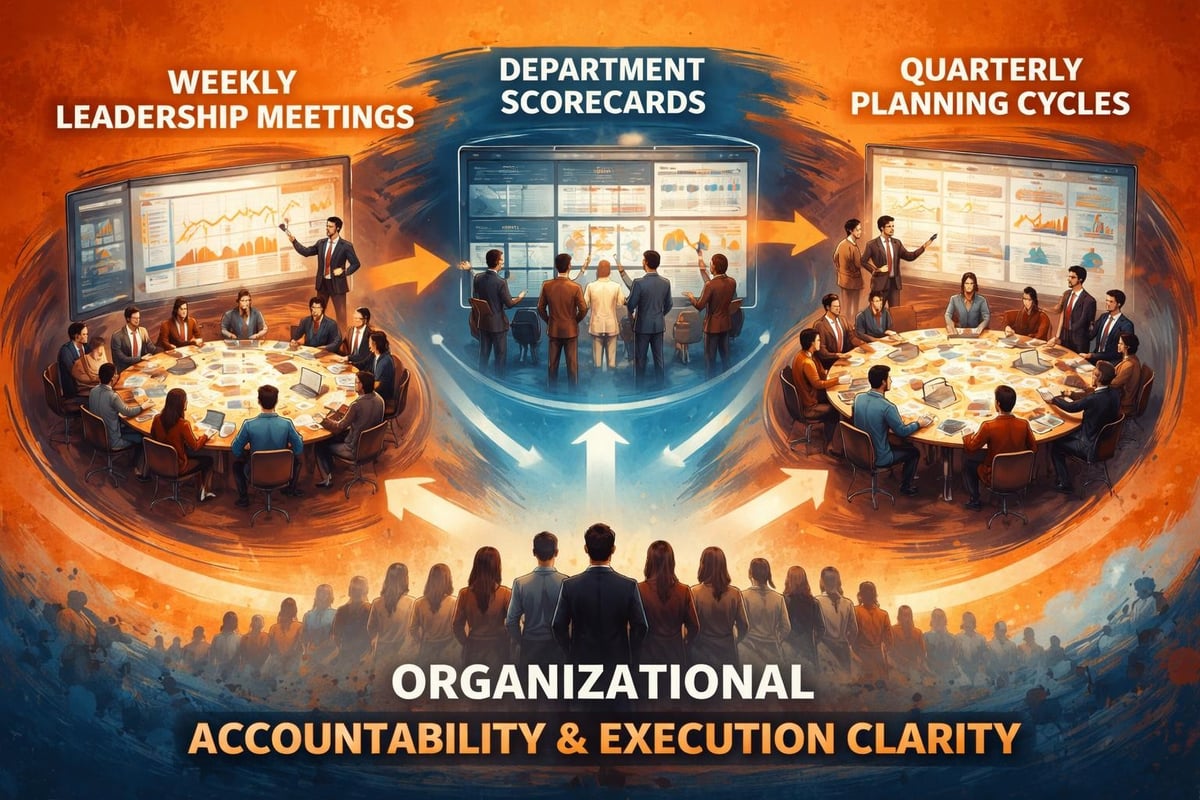
Many mid-market companies lack structured operating rhythms. Meetings happen inconsistently, priorities shift without clear communication, and teams struggle to understand how their work connects to company goals. A business coach helps establish operating cadence that creates clarity and accountability.
Essential cadence elements include:
- Weekly leadership team meetings with clear agendas
- Department scorecards tracking leading indicators
- Monthly all-hands sessions connecting teams to strategy
- Quarterly planning cycles with measurable objectives
- Regular one-on-one rhythms throughout the organization
The number of business coaching enterprises has grown significantly, but few coaches focus on operational systems. Most executives can articulate strategy, but execution breaks down in the middle. Coaches who build accountability infrastructure create lasting change.
KPI Scorecards That Drive Action
Scorecards fail when they become reporting exercises disconnected from daily decisions. Effective scorecards include both lagging indicators (revenue, profit) and leading indicators (pipeline activity, customer outreach, quality metrics). A business coach helps teams identify which metrics actually predict success and how to review them productively.
For sales organizations, this might mean tracking not just closed deals but also discovery calls completed, proposals sent, and follow-up touchpoints. For operations teams, it could include on-time delivery rates, error percentages, and process improvement initiatives launched. The coach facilitates weekly scorecard reviews, teaching leaders to ask better questions and make faster decisions based on the data.
Team Coaching and Facilitation
Individual coaching addresses personal development, but organizational results require team alignment. Business coaches who facilitate team sessions help groups navigate conflict, make collective decisions, and commit to shared priorities.
Team facilitation becomes particularly valuable during:
- Strategic planning sessions where cross-functional input is needed
- Conflict resolution when departments have competing priorities
- Major initiative launches requiring coordinated execution
- Organizational changes impacting multiple teams
- Performance improvement efforts needing cultural shifts
The facilitator role differs from traditional consulting. Rather than providing answers, a business coach helps the team surface their own insights, debate options productively, and commit to specific actions. This approach builds internal capability rather than creating consultant dependency.
Several experienced business coaches specialize in different facilitation methodologies, from strategic planning to conflict resolution. The key is matching the facilitation approach to the team's specific needs and organizational culture.
Leadership Assessment and Development
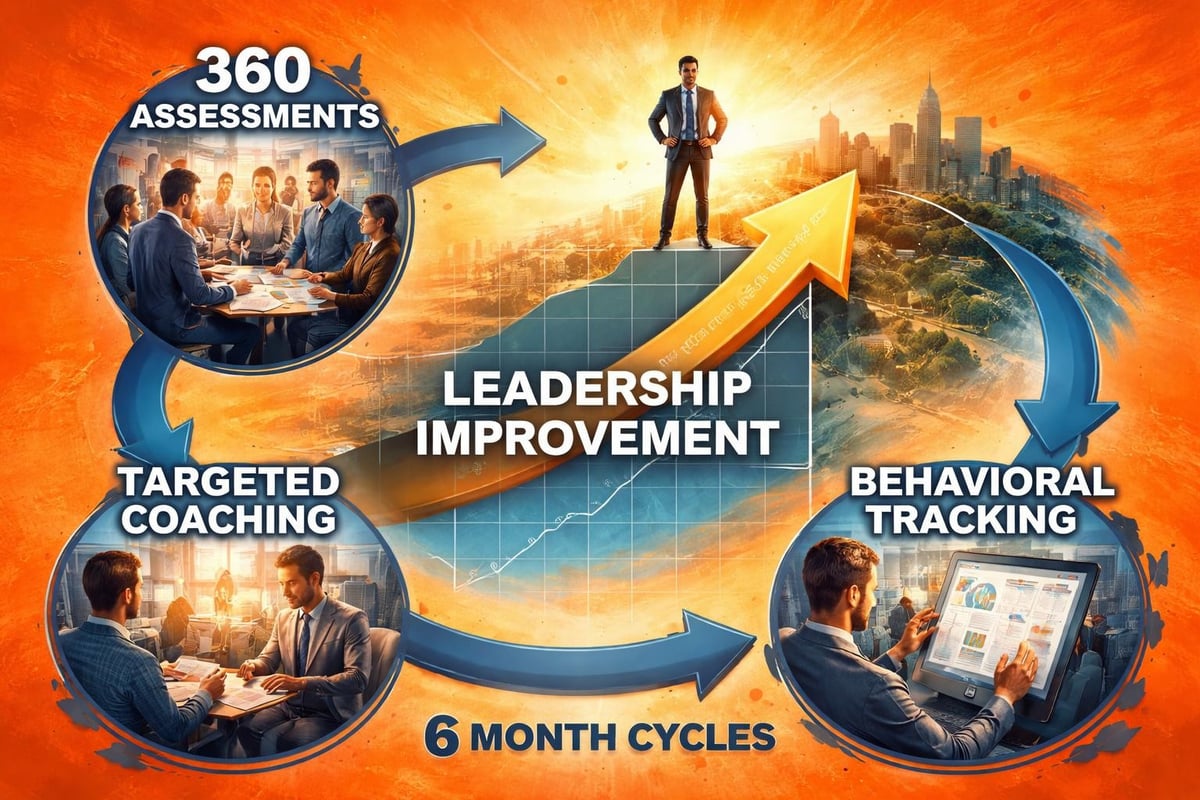
360-degree assessments provide valuable feedback, but only when tied to development plans with accountability. A business coach administers assessments, synthesizes feedback, and creates specific improvement roadmaps. More importantly, they provide ongoing coaching as leaders work on their development areas.
The Assessment-to-Action Process
Strong leadership development follows a structured path:
- Baseline 360 assessment with direct reports, peers, and supervisors
- One-on-one debrief identifying strengths and growth opportunities
- Development plan with 2-3 specific behavioral changes
- Weekly coaching sessions focused on real situations
- Progress check-ins at 90 and 180 days
- Follow-up 360 to measure perception shifts
The business coach serves as an accountability partner throughout this journey. When a leader struggles with delegation, the coach doesn't just discuss delegation theory. They review the leader's actual project list, identify delegation candidates, help craft delegation conversations, and debrief the results. This practical approach drives behavior change faster than classroom training.
Global business coaching statistics demonstrate the industry's growth, with particular expansion in leadership development services. Companies recognize that developing internal leadership capability provides better long-term returns than constantly hiring external talent.
Flexible Engagement Models
The traditional consulting model involves long contracts, large upfront fees, and rigid scopes of work. This approach creates misalignment between consultant and client interests. A better model uses month-to-month terms with performance incentives.
When coaches share risk through aligned incentives, several benefits emerge:
- Coaches remain focused on measurable business outcomes
- Companies can scale coaching up or down based on needs
- Poor fits end quickly without contract disputes
- Success gets rewarded appropriately
- Trust builds through demonstrated results
This flexibility particularly benefits mid-market companies that need to manage budgets carefully. Rather than committing to a year-long engagement with uncertain ROI, leadership can start with focused projects, measure impact, and expand if results warrant. The platform AccountabilityNow emphasizes this results-oriented approach to business development.
Organizations looking for business coaches across the United States will find varying engagement models, but the most effective partnerships align coach incentives with client success. This ensures both parties remain committed to achieving specific, measurable improvements rather than simply completing contracted activities.
Sales and Retention Coaching
Revenue growth and customer retention directly impact company valuation and sustainability. A business coach with sales expertise helps leaders build systematic approaches to pipeline development, proposal quality, pricing conversations, and renewal discussions. Building better professional relationships through coaching enhances both sales and retention outcomes.
For sales teams, coaching might address call preparation, discovery question frameworks, objection handling, or closing techniques. For account management teams, the focus shifts to expansion conversations, renewal risk identification, and executive relationship building. In both cases, the business coach works with real situations rather than generic scenarios.
The most effective sales coaching happens live. A business coach joins actual sales calls, provides immediate feedback afterward, and helps representatives refine their approach. This real-world practice accelerates skill development compared to classroom training alone.
Mid-market companies achieve breakthrough results when business coaching focuses on measurable outcomes, real-time facilitation, and manager development rather than theoretical frameworks. By establishing accountability systems, building coaching capability throughout the organization, and tying all activities to clear KPIs, companies create sustainable competitive advantages. If you're ready for practical corporate coaching that delivers visible results through live facilitation and aligned incentives, month-to-month flexibility, and systematic leadership development, explore how Noomii connects you with coaches who roll up their sleeves and drive measurable business impact.


Leave a Reply
Want to join the discussion?Feel free to contribute!