

Leadership Skills for New Managers in Geneva: 2026 Guide
Geneva stands as one of Europe's most dynamic business environments, home to countless international organizations, multinational corporations, and innovative startups. For professionals stepping into management roles in this competitive landscape, developing strong leadership capabilities isn't optional-it's essential for survival and success. The transition from individual contributor to leader demands a fundamental shift in mindset, skills, and approach, particularly in Geneva's multicultural, multilingual business ecosystem where managers must navigate complex organizational structures and diverse teams.
Understanding the Unique Leadership Landscape in Geneva
Geneva's business environment presents distinct challenges that shape the development of leadership skills for new managers in Geneva. The city hosts over 900 international organizations and thousands of NGOs, creating a workplace culture that values diplomacy, collaboration, and cross-cultural competence. New managers must adapt quickly to environments where team members might represent 15 different nationalities, speak five different languages, and bring vastly different workplace expectations.
The Geneva Centre for Security Policy provides leadership training that emphasizes adaptive leadership across boundaries, recognizing these unique demands. International organizations operating in Geneva expect managers to demonstrate exceptional communication skills, cultural sensitivity, and the ability to build consensus across diverse stakeholder groups.
Key Competencies Required in Geneva's Market
Leadership skills for new managers in Geneva extend beyond traditional management theory. The Swiss business culture values precision, punctuality, and quality, while Geneva's international character demands flexibility and cultural awareness. This combination creates specific competency requirements:
- Multilingual communication across French, English, and often German
- Diplomatic conflict resolution suitable for international teams
- Swiss regulatory compliance understanding for HR and employment matters
- Cross-cultural team building that respects diverse working styles
- Strategic stakeholder management across multiple organizational levels

Developing Self-Awareness as a Foundation
Self-awareness forms the cornerstone of effective leadership. New managers must understand their own leadership style, strengths, limitations, and unconscious biases before they can effectively lead others. This introspective work proves particularly crucial when managing diverse teams where your default communication style might not resonate with all team members.
Evidence-based leadership diagnostics provide invaluable insights into behavioral patterns, decision-making tendencies, and interpersonal dynamics. These assessments reveal gaps between how managers perceive themselves and how their teams experience their leadership. In Geneva's high-stakes business environment, such clarity prevents costly missteps and accelerates leadership development.
Implementing Regular Feedback Mechanisms
| Feedback Method | Frequency | Purpose | Best Practice |
|---|---|---|---|
| 360-degree reviews | Quarterly | Comprehensive perspective | Anonymous, structured format |
| One-on-one meetings | Weekly | Real-time alignment | Active listening, note-taking |
| Team retrospectives | Monthly | Collective learning | Psychological safety emphasis |
| Skip-level conversations | Quarterly | Unfiltered insights | Confidential, exploratory |
The leadership development coaching approach integrates these feedback mechanisms into sustained growth plans. Regular feedback loops enable managers to adjust their approach based on actual impact rather than assumed effectiveness.
Mastering Communication in Multilingual Environments
Communication complexity multiplies in Geneva's multilingual business setting. Leadership skills for new managers in Geneva must include the ability to convey clear expectations, provide constructive feedback, and inspire teams across language barriers. This requires more than fluency-it demands cultural literacy and adaptive communication strategies.
Effective managers in Geneva develop three communication layers. First, they master precision language that minimizes ambiguity across cultures. Second, they learn to recognize and respect different communication preferences-some cultures value direct feedback while others require more contextual approaches. Third, they build redundancy into critical communications, using multiple channels and confirmation mechanisms to ensure understanding.
The Geneva Institute of Business Management offers a course covering essential communication competencies for new managers, including techniques for managing diverse teams and facilitating effective decision-making processes.
Building Trust Through Transparent Communication
Trust accelerates everything in leadership. When team members trust their manager, they communicate more openly, take appropriate risks, and resolve conflicts more efficiently. New managers build this trust through consistent, transparent communication practices.
- Share the reasoning behind decisions, not just the decisions themselves
- Admit uncertainty and mistakes promptly and professionally
- Communicate bad news directly rather than sugar-coating reality
- Follow through on commitments without exception
- Create safe spaces for dissenting opinions and challenging questions
Delegation and Empowerment Strategies
The transition from individual contributor to manager requires abandoning the "I'll do it myself" mentality. Many new managers struggle with delegation, either micromanaging their teams or abdicating responsibility entirely. Effective delegation represents a learnable skill that directly impacts team performance and manager sustainability.
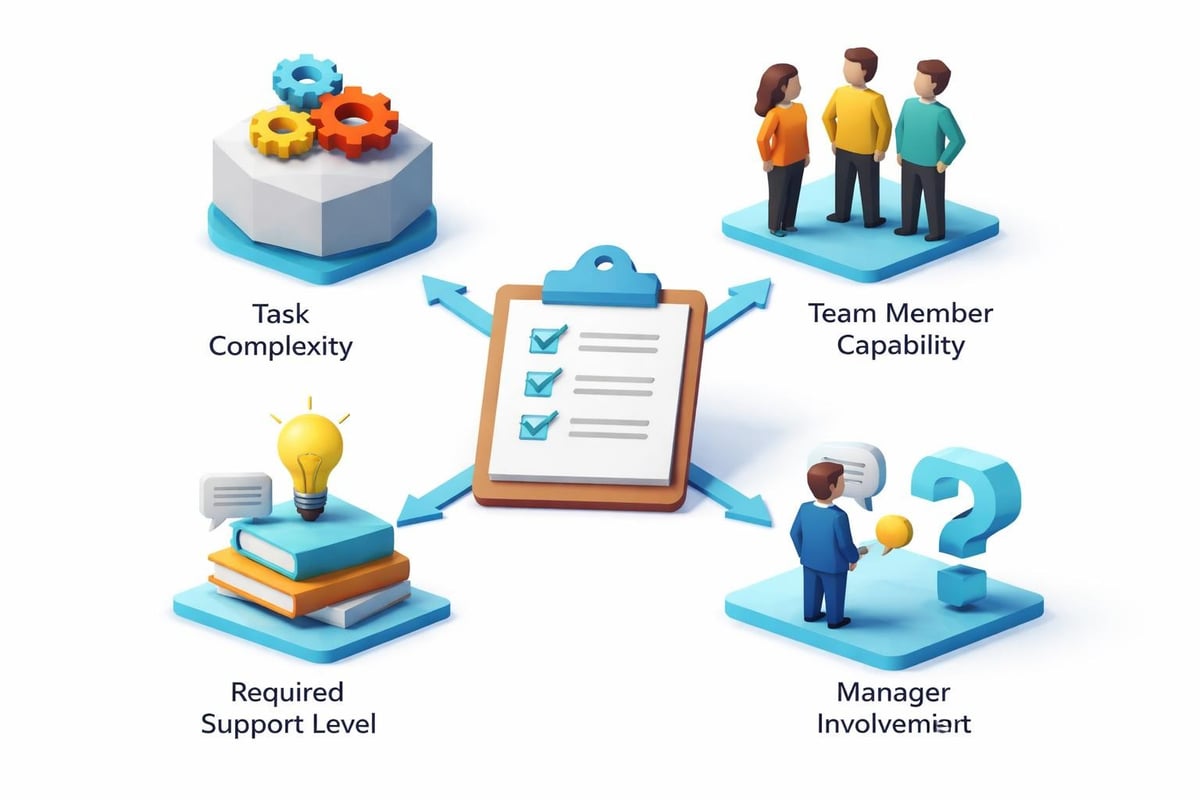
Leadership skills for new managers in Geneva must include sophisticated delegation frameworks that account for skill development, motivation, and cultural expectations around autonomy. Swiss business culture generally supports employee empowerment, but international team members may bring different expectations about managerial involvement and oversight.
The Delegation Matrix Approach
| Task Complexity | Team Capability | Delegation Level | Manager Involvement |
|---|---|---|---|
| High | Low | Directive | Heavy oversight, teaching |
| High | High | Collaborative | Strategic guidance, support |
| Low | Low | Supportive | Clear instructions, check-ins |
| Low | High | Delegative | Outcomes only, full autonomy |
This matrix helps managers calibrate their involvement appropriately. Over-involvement with high-capability team members signals distrust and stifles initiative. Under-involvement with developing team members sets them up for failure and frustration.
Navigating Difficult Conversations and Conflict
Every manager faces uncomfortable conversations-delivering critical feedback, addressing underperformance, mediating team conflicts, or communicating unwelcome decisions. How managers handle these moments defines their leadership effectiveness and shapes team culture. Avoiding difficult conversations creates bigger problems that compound over time.
Leadership skills for new managers in Geneva include conflict resolution techniques adapted for international environments. The Knowles Training Institute provides a course focusing on team motivation and performance management, including approaches for addressing challenging interpersonal dynamics.
Geneva's diplomatic culture offers both advantages and challenges for conflict resolution. The emphasis on consensus and collaboration supports constructive dialogue, but cultural norms around directness vary significantly. A feedback approach considered appropriately direct in one culture might be perceived as harsh or, conversely, too vague in another.
Preparation Framework for Difficult Conversations
- Define the specific issue with concrete examples and observable behaviors
- Clarify your desired outcome beyond venting or punishment
- Consider the other person's perspective and potential valid concerns
- Choose the right setting ensuring privacy and sufficient time
- Open with shared objectives to establish collaborative framing
- Focus on impact and behavior rather than character or intentions
- Listen actively without defending or interrupting
- Document agreements and establish clear follow-up mechanisms
Organizations dealing with toxic leadership patterns particularly benefit from managers skilled in addressing dysfunction directly while maintaining professional relationships.
Decision-Making Under Pressure
Leadership fundamentally involves making decisions with incomplete information under time constraints. New managers often struggle with decision-making, either paralyzed by analysis or rushing to judgment without adequate consideration. Developing sound decision-making processes represents critical leadership skills for new managers in Geneva.
The international business environment in Geneva frequently presents high-stakes decisions with significant consequences. Managers must balance speed with quality, intuition with analysis, and stakeholder input with decisive action. This requires explicit decision-making frameworks that bring structure to complex choices.
Decision Quality Assessment
Strong leaders distinguish between reversible and irreversible decisions. Reversible decisions warrant quick action with fast iteration based on results. Irreversible decisions demand more thorough analysis, stakeholder consultation, and scenario planning. Most decisions fall somewhere on this spectrum, and matching process rigor to decision significance prevents both analysis paralysis and reckless haste.
The Sprintzeal training program covers foundational management theories including decision-making frameworks that help new managers build high-performance teams through strategic choices.
Building and Sustaining Team Performance
Individual brilliance doesn't translate automatically into team leadership. New managers must shift from optimizing their own performance to optimizing team performance-a fundamentally different challenge. This requires understanding team dynamics, motivation factors, and performance drivers across diverse individuals.
Leadership skills for new managers in Geneva include team building approaches that respect cultural diversity while creating unified direction. High-performing teams share common characteristics: clear goals, defined roles, mutual accountability, psychological safety, and complementary skills. Creating these conditions demands intentional effort from managers.

Performance Management Beyond Annual Reviews
| Activity | Frequency | Purpose | Outcome |
|---|---|---|---|
| Goal alignment | Quarterly | Strategic focus | Clear priorities |
| Progress check-ins | Weekly | Course correction | Timely adjustments |
| Skill development | Ongoing | Capability building | Growth trajectory |
| Recognition | Real-time | Motivation | Sustained engagement |
| Formal reviews | Semi-annual | Comprehensive assessment | Career planning |
This continuous performance management approach replaces the outdated annual review model. It provides managers and team members with regular touchpoints for alignment, feedback, and development rather than concentrating discussions into high-stakes yearly events.
Strategic Thinking for Front-Line Leaders
New managers often remain tactically focused, managing day-to-day operations without developing strategic perspective. Leadership skills for new managers in Geneva must include the ability to connect operational decisions to organizational strategy, anticipate future trends, and position their teams for emerging opportunities.
Strategic thinking doesn't require abandoning operational excellence. Rather, it means understanding the broader context in which your team operates. What market trends affect your organization? How do competitive dynamics shape priorities? Which capabilities will matter most in three years? These questions inform smarter daily decisions and better resource allocation.
The coaching solutions approach helps managers develop this strategic mindset through structured reflection, scenario planning, and connection to organizational objectives. External coaching perspectives often reveal strategic opportunities that remain invisible to managers embedded in daily operations.
Developing Future-Oriented Perspective
Effective managers balance three time horizons simultaneously. They manage current operations efficiently, solve emerging problems proactively, and position their teams for future success. This requires dedicated time for strategic thinking despite urgent operational demands.
- Block strategic thinking time weekly without operational interruptions
- Study industry trends through reports, conferences, and expert networks
- Engage cross-functional colleagues to understand broader organizational dynamics
- Challenge assumptions about how work gets done and what success requires
- Experiment thoughtfully with new approaches rather than defending status quo
Emotional Intelligence and Resilience
Technical skills and strategic acumen matter, but emotional intelligence often determines leadership success. The ability to recognize and manage your own emotions while understanding and influencing others' emotions shapes every leadership interaction. Leadership skills for new managers in Geneva require exceptional emotional intelligence given the stress of multicultural team dynamics and high-stakes business environments.
Emotional resilience enables managers to handle setbacks, criticism, and uncertainty without becoming defensive or disengaged. Geneva's competitive business environment tests resilience regularly through organizational changes, market pressures, and performance challenges. Managers who develop emotional regulation skills navigate these difficulties more effectively while supporting their teams through stress.
Research demonstrates that emotional intelligence can be developed through deliberate practice. Self-awareness exercises, mindfulness practices, empathy development, and feedback integration all strengthen emotional intelligence over time.
Components of Emotional Intelligence for Managers
- Self-awareness: Recognizing your emotional triggers and patterns
- Self-regulation: Managing reactions and maintaining composure under pressure
- Motivation: Maintaining drive and optimism despite obstacles
- Empathy: Understanding team members' perspectives and emotions
- Social skills: Building relationships and navigating organizational dynamics
The executive leadership coaching model emphasizes emotional intelligence development as foundational to sustainable leadership effectiveness.
Continuous Learning and Adaptation
Leadership skills for new managers in Geneva never reach completion. The most effective leaders embrace continuous learning, actively seeking feedback, new knowledge, and skill development throughout their careers. This learning orientation becomes particularly critical in rapidly changing business environments where yesterday's best practices may not solve tomorrow's challenges.
Geneva offers exceptional learning resources for leadership development. Beyond formal training programs, managers benefit from peer learning networks, mentorship relationships, industry associations, and professional communities. The leadership skills training available through specialized programs helps managers create positive organizational change through advanced leadership capabilities.
Building a Personal Development Plan
| Development Area | Current State | Target State | Learning Activities | Timeline |
|---|---|---|---|---|
| Strategic thinking | Tactical focus | Business context | MBA courses, strategy books | 12 months |
| Conflict resolution | Avoidant | Constructive | Mediation training, practice | 6 months |
| Public speaking | Nervous | Confident | Toastmasters, presentations | 9 months |
| Data analysis | Basic | Proficient | Analytics courses, projects | 6 months |
This structured approach transforms vague development intentions into actionable plans with measurable progress. Regular review and adjustment keep development aligned with evolving leadership challenges.
Leveraging Technology for Leadership Effectiveness
Modern leadership requires technological proficiency beyond basic software skills. Leadership skills for new managers in Geneva include understanding how technology enables team collaboration, performance tracking, and strategic decision-making. The shift to hybrid work environments makes technological fluency essential for maintaining team cohesion and productivity.
Project management platforms, communication tools, data analytics systems, and collaboration software all enhance leadership effectiveness when used strategically. However, technology should support human connection rather than replacing it. Managers must balance digital efficiency with relationship building that still requires face-to-face interaction.
Geneva's international business community increasingly relies on global collaboration tools that enable teams to work across time zones and locations. Managers skilled in virtual leadership create engagement and accountability even when teams rarely gather physically.
Accountability Systems and Follow-Through
Outstanding managers distinguish themselves through consistent follow-through on commitments. Leadership skills for new managers in Geneva must include robust accountability systems that ensure nothing falls through cracks despite competing demands. Accountability frameworks provide structure for tracking commitments, measuring progress, and maintaining focus on priorities.
Effective accountability operates at three levels. Personal accountability means managers do what they commit to doing. Team accountability creates mutual commitment where colleagues support each other's success. Organizational accountability aligns individual and team efforts with broader strategic objectives.
- Document commitments immediately with specific owners and deadlines
- Review progress systematically in team meetings and one-on-ones
- Address gaps quickly without blame but with problem-solving focus
- Celebrate completion to reinforce accountability as positive rather than punitive
- Adjust unrealistic commitments transparently when circumstances change
Mastering leadership skills for new managers in Geneva requires dedication to continuous development across multiple competency areas, from emotional intelligence and strategic thinking to cross-cultural communication and accountability. The unique demands of Geneva's international business environment present both challenges and opportunities for emerging leaders committed to excellence. Noomii Leadership Coaching provides precision-matched executive coaching that accelerates leadership development through evidence-based diagnostics, customized intervention plans, and measurable results aligned with your organizational objectives, helping new managers transform challenges into competitive advantages.



Leave a Reply
Want to join the discussion?Feel free to contribute!