
Business Coaches for Entrepreneurs: How to Grow Faster
Running a growing company means juggling product development, team management, sales, and operations simultaneously. Entrepreneurs often find themselves trapped in the daily grind, losing sight of strategic priorities that drive sustainable growth. This is where business coaches for entrepreneurs step in, offering the outside perspective and accountability framework needed to break through plateaus and scale effectively. The right coaching relationship transforms scattered effort into focused execution, turning ambitious goals into measurable outcomes.
Why Entrepreneurs Seek Business Coaching
Most entrepreneurs don't lack ambition or work ethic. They lack the structured thinking and accountability mechanisms that prevent critical decisions from getting buried under urgent tasks.
Business coaches for entrepreneurs provide several core benefits that internal teams simply cannot replicate:
- External perspective free from organizational politics and bias
- Pattern recognition from working across multiple industries and business models
- Accountability systems that ensure follow-through on strategic initiatives
- Skill acceleration in areas like delegation, communication, and decision-making
- Strategic frameworks for prioritization and resource allocation
According to research on how business coaches help entrepreneurs grow, the most successful coaching engagements focus on clarity, leadership development, and execution discipline. Entrepreneurs who engage coaches report faster decision cycles and more consistent progress toward revenue targets.

The Gap Between Strategy and Execution
Many mid-market companies develop solid strategic plans during annual retreats, only to watch those plans gather dust while daily firefighting takes over. This execution gap costs businesses millions in unrealized potential.
Business coaches for entrepreneurs address this gap by embedding themselves in the operational rhythm. Rather than offering theoretical advice from the sidelines, effective coaches participate in leadership meetings, observe team dynamics firsthand, and tie every coaching conversation back to measurable business metrics.
This hands-on approach differs significantly from traditional consulting. While consultants deliver recommendations and leave, coaches stay engaged through implementation, adjusting tactics as reality unfolds.
Types of Business Coaching for Entrepreneurial Companies
Not all coaching addresses the same challenges. Entrepreneurs should understand the landscape before committing resources.
| Coaching Type | Primary Focus | Best For |
|---|---|---|
| Executive Coaching | CEO/founder development, decision-making, leadership presence | Scaling founders, first-time CEOs |
| Team Coaching | Communication patterns, meeting effectiveness, collective accountability | Leadership teams, functional groups |
| Sales Coaching | Pipeline management, conversion optimization, customer retention | Revenue leaders, account executives |
| Operational Coaching | Process design, KPI frameworks, execution cadence | Operations managers, COOs |
The most impactful engagements often combine multiple coaching types. For example, a founder might receive executive coaching while their leadership team participates in facilitated team sessions focused on cross-functional collaboration. Leadership coaches frequently work across these categories based on organizational needs.
Selecting the Right Coach for Your Business
Credentials matter less than track record and methodology fit. Some coaches emphasize mindset and personal development, while others focus relentlessly on business metrics and operational improvement.
Entrepreneurs should evaluate potential coaches based on these criteria:
- Industry relevance – Have they worked with similar business models?
- Methodology clarity – Can they articulate their coaching framework?
- Results orientation – Do they measure progress with concrete KPIs?
- Engagement flexibility – Are they willing to work month-to-month versus long contracts?
- Cultural alignment – Do their values match your organizational culture?
The top business coaches for entrepreneurs often share one common trait: they've built and scaled businesses themselves, bringing practical experience rather than purely academic knowledge.
What to Expect from Professional Coaching Engagements
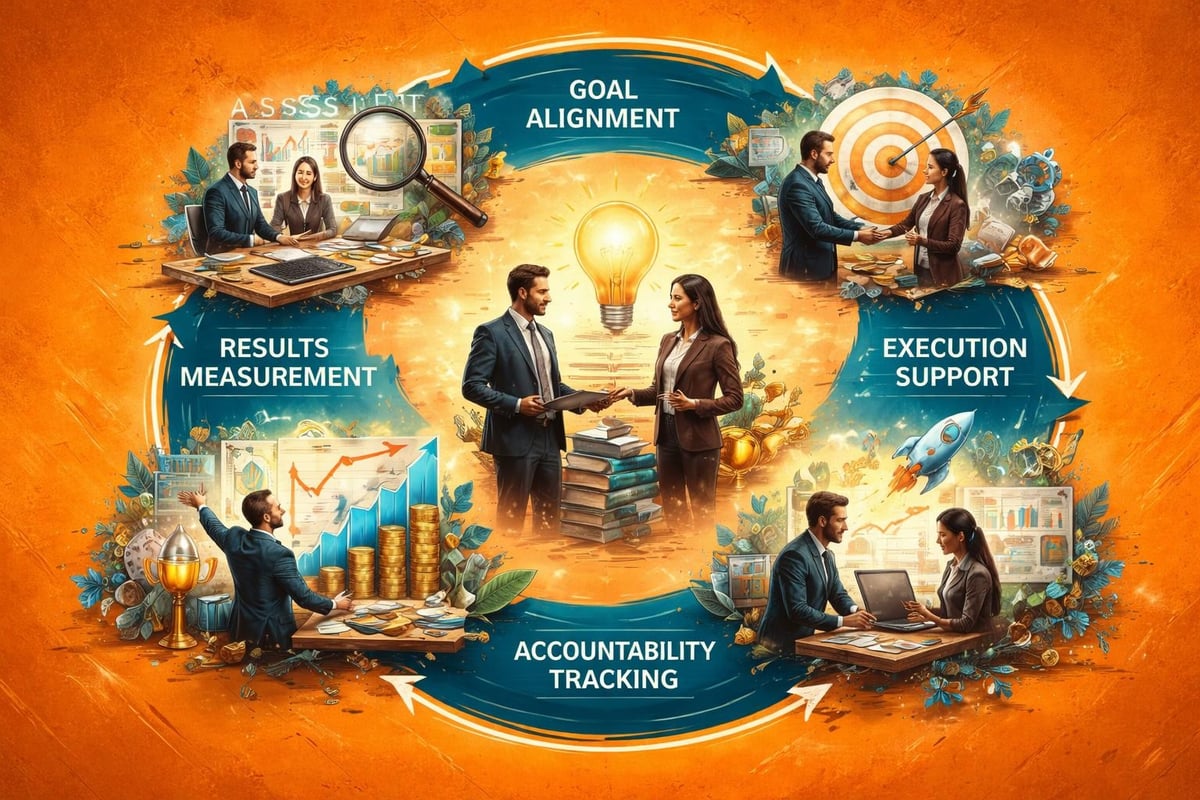
Effective business coaching follows a predictable rhythm designed to maintain momentum without overwhelming already busy leaders.
Most engagements include these core components:
- Initial assessment through 360 feedback and stakeholder interviews
- Goal setting tied to specific financial and operational metrics
- Regular sessions weekly or biweekly, typically 60-90 minutes
- Between-session accountability through assignments and KPI tracking
- Progress reviews monthly or quarterly to adjust approach
The best coaches don't just listen and ask questions. They challenge assumptions, introduce frameworks from their broader experience, and occasionally coach live during actual business situations. This real-time application accelerates learning far beyond traditional meeting-based coaching.
Measuring Coaching ROI
Skeptical entrepreneurs rightfully demand proof that coaching investments generate returns. Unlike training programs with vague outcomes, business coaching for entrepreneurs should connect directly to business performance.
Measurable outcomes include:
- Decision velocity – Time from problem identification to resolution
- Manager effectiveness – Direct report engagement scores and retention rates
- Meeting productivity – Percentage of meetings resulting in clear decisions and ownership
- Revenue metrics – Customer acquisition cost, lifetime value, conversion rates
- Team alignment – Cross-functional collaboration scores and priority clarity
Organizations that implement operating cadence and KPI scorecards alongside coaching see the clearest ROI. When every coaching conversation ties to visible metrics tracked weekly, progress becomes undeniable.
Common Challenges Coaches Help Entrepreneurs Overcome
Every growth stage presents distinct challenges. Business coaches for entrepreneurs anticipate these patterns and provide frameworks before problems escalate.
Founder-to-CEO Transition
Technical founders often struggle transitioning from individual contributor to leader of leaders. This shift requires fundamentally different skills: delegation, strategic thinking, communication cascades, and cultural stewardship.
Coaches guide this transition through structured skill development, providing feedback on leadership presence, decision-making frameworks, and team development practices. The Noomii coaching platform connects entrepreneurs with coaches specialized in these transitions.
Scaling Team Dynamics
What works with 10 employees fails at 50 and breaks completely at 200. Coaches help entrepreneurs redesign communication structures, accountability systems, and meeting rhythms to match organizational complexity.
This often involves facilitating difficult conversations about roles, clarifying decision rights, and establishing cross-functional processes. Resources on various business coaching approaches demonstrate how different methodologies address scaling challenges.
Strategic Prioritization
Opportunity abundance creates its own problems. Entrepreneurs see possibilities everywhere, leading to scattered focus and incomplete initiatives. Effective coaches impose prioritization discipline, helping leadership teams identify the vital few priorities that actually move business metrics.
This clarity work often proves uncomfortable, requiring leaders to explicitly say "no" to attractive opportunities that don't align with core strategy.
The Month-to-Month Advantage
Traditional coaching contracts lock organizations into 6-12 month commitments regardless of results. This model protects coaches but creates risk for clients.
Progressive coaching approaches embrace month-to-month terms, letting results drive renewal decisions. This structure forces coaches to deliver visible value consistently rather than coasting on long contracts.
Benefits of flexible engagement terms:
- Lower initial risk for trying coaching
- Natural checkpoints for evaluating fit and progress
- Motivation for coaches to maintain high performance
- Ability to adjust scope as business needs evolve
- Clear exit path if results don't materialize
Organizations exploring business coaches for entrepreneurs should prioritize providers comfortable with performance-based models. When coaches share risk through aligned incentives, their interests truly match client success.

Building Coaching into Organizational Culture
The most sophisticated organizations don't treat coaching as an external intervention. They embed coaching mindsets throughout their leadership culture.
This means training managers to coach their direct reports rather than simply directing them. It involves establishing peer coaching relationships across functional areas. It requires creating psychological safety where leaders can acknowledge gaps without political risk.
When founders model coaching relationships publicly, participating actively and sharing lessons learned, it signals that growth and development matter organizationally. This cultural shift often generates more value than any individual coaching engagement, as coaching multiplies throughout the organization.
Entrepreneurs interested in learning more about various coaching solutions can explore how different approaches scale across organizational levels. The goal is building self-sustaining improvement systems rather than dependency on external experts.
Business coaches for entrepreneurs accelerate growth by providing accountability, strategic clarity, and execution discipline that busy founders struggle to maintain alone. When coaching connects directly to KPIs and business outcomes rather than abstract development goals, the ROI becomes undeniable. Noomii Corporate Coaching delivers this practical approach for mid-market companies and Fortune 500 divisions, coaching live in your meetings with month-to-month terms and measurable results tied to faster decisions, stronger communication, and cleaner execution across priorities.



Leave a Reply
Want to join the discussion?Feel free to contribute!