
What Gen Z Expects From Managers in 2027: A Guide for Leaders

What Gen Z expects from managers in 2027 comes down to four things: active mentorship, honest and frequent feedback, psychological safety on mental health, and visible connection between daily work and purpose. Many Gen Z employees will not tolerate a manager who only assigns tasks and tracks output, and they are likely to quietly disengage or leave when development stalls.

The stakes are practical. Gen Z is a growing share of first-time managers' direct reports, and the managers they report to were often promoted for technical performance, not for coaching skill. That gap is where retention is won or lost. This guide lays out the expectations, the evidence behind them, and a diagnostic you can apply across your management population.

What Gen Z Wants From Their Manager, in Order of Priority

Gen Z wants a manager who develops them, communicates clearly, protects their well-being, and ties work to purpose. Those four expectations show up consistently in the research, and they rank differently than most leadership teams assume.

Deloitte’s 2025 Gen Z and Millennial Survey drew on 23,482 respondents across 44 countries. Its findings point to a generation that is constantly building skills: 70% of Gen Z respondents said they develop skills to advance their careers at least weekly. They are not waiting for an annual review cycle to learn.

Here is the priority order that the evidence supports:

  1. Development and mentorship. They expect the manager to be the primary source of career growth, not HR or an LMS.
  2. Frequent, specific feedback. Quarterly or annual reviews feel too slow to be useful to them.
  3. Mental health safety. They expect to raise strain without penalty.
  4. Purpose and meaning. They want to know why the work matters.
  5. Flexibility with accountability. They want autonomy over how and where, paired with clear outcomes.

Notice what is missing from the top: ping-pong tables, perks, and slogans. Compensation matters, but the manager relationship is what determines whether a Gen Z employee stays after the first eighteen months.

The Mentorship Gap Is the Biggest Risk Most Organizations Carry

The mentorship gap is the distance between what Gen Z wants from managers and what they receive, and it is wide. According to Deloitte Global, 50% of Gen Z respondents want managers to teach and mentor them, while only 36% said their managers actually do so.

That 14-point gap is not a Gen Z problem. It is a manager capability problem. Forbes’ summary of the Deloitte findings reinforces the point: Gen Z wants practical, applied learning and sees managers as central to it.

Here is the contrarian read most boards need to hear. Organizations keep responding to this gap by buying more learning content. But Gen Z already consumes learning weekly. What they lack is a human who watches them work, names what they did well, and tells them what to do differently on Monday. Content cannot fill that role. Manager behavior can.
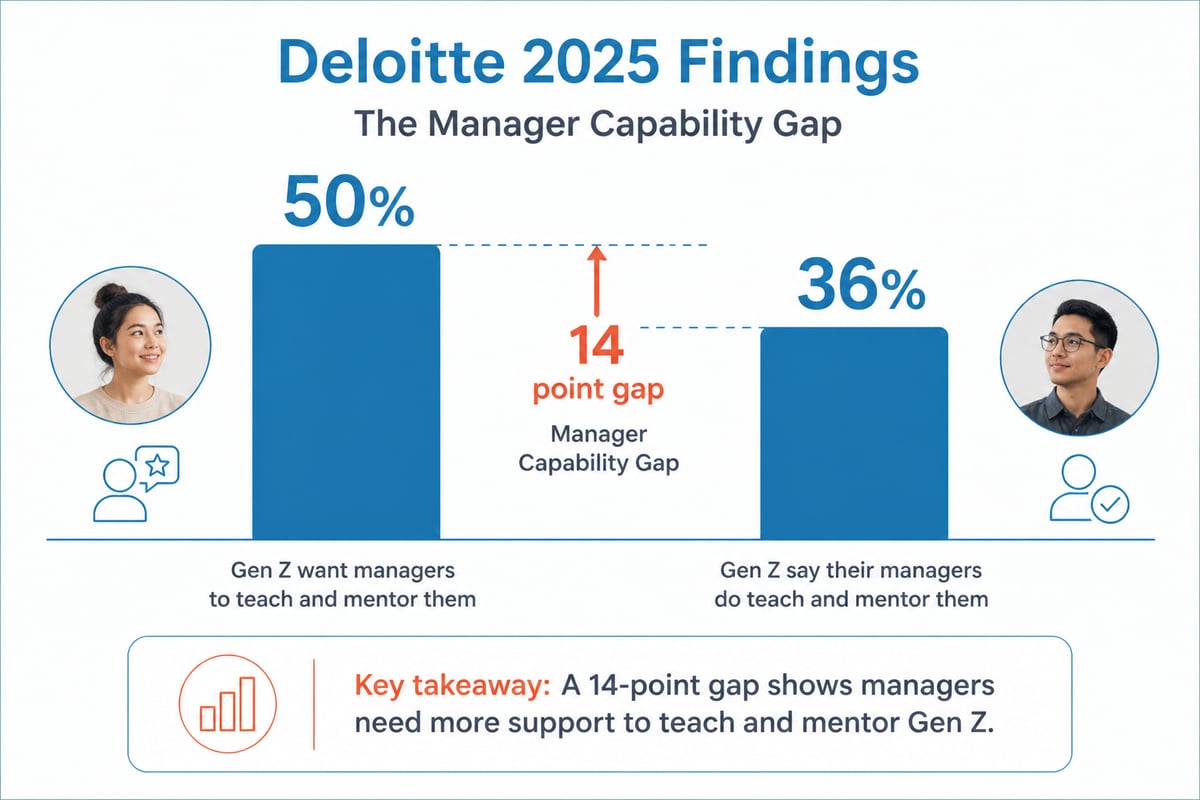
Mentorship gap between Gen Z expectations and manager delivery

Why the gap persists

Three patterns explain it. First, most managers were promoted for individual performance and never trained to coach. Second, span of control has widened, so managers have less time per direct report. Third, many managers learned their craft in an era when mentoring was informal and tenure-based, so they do not know how to do it deliberately.

Companies that treat this as a training-hours problem tend to stall. Those that treat it as a behavior-change problem, with observable standards and follow-up, tend to move the number.

What Gen Z Expects From Managers in 2027 on Feedback and Career Paths

In 2027, Gen Z expects feedback weekly or in real time and a career path that is explicit, not implied. They have little patience for ambiguity about what "good" looks like or what comes next.

Two nuances matter here, and both challenge conventional assumptions.

Gen Z is not uniformly chasing the corner office. Deloitte's research found that only 6% of Gen Z respondents named reaching a senior leadership position as a primary career goal, per Deloitte New Zealand. If your succession model assumes every high performer wants to climb the management ladder, you are building plans around a motivation that most of them do not share. Offer expert tracks, project leadership roles, and lateral moves with real status attached.

Feedback needs to be bidirectional. Gen Z expects to ask questions of their manager's decisions and to be heard when they push back. A manager who treats questions as insubordination will lose them. A manager who explains the reasoning, even when the decision stands, keeps them.

For HR leaders, this has a direct implication for performance management design. The shift toward continuous feedback, and the role AI will play in review processes, is covered in AI and performance reviews: what changes in 2027. The short version: tools can surface data, but the conversation still has to be human and skilled.

Mental Health Is a Manager Competency, Not a Benefit

Gen Z expects their manager to be a safe first point of contact on mental health, and the data shows it is a retention lever. SHRM reports that 61% of Gen Z workers said they would strongly consider leaving their current job for a new one with significantly better mental-health benefits.

Yet benefits alone do not solve the problem. The same SHRM report cites Deloitte's 2024 survey finding that 56% of Gen Z workers feel comfortable discussing mental-health challenges with their managers. That leaves a large minority who do not.

Most organizations respond with an EAP and a wellness app. Those are necessary, but they sit downstream of the real determinant: whether the person's manager makes it safe to say "I am overloaded" before it becomes a resignation letter.

What managers actually need to do is narrow and learnable:

  • Ask about workload and energy in one-on-ones, not only status.
  • Respond to disclosure with curiosity and adjustment, not judgment or visible discomfort.
  • Know the boundary between supportive manager and untrained therapist, and refer appropriately.
  • Model sustainable behavior, including taking leave and not sending messages at midnight.

A manager who is abrasive, volatile, or dismissive cancels every wellness investment you make. Addressing those patterns directly matters, and the lessons in insights from reformed toxic leaders are a useful read for people leaders dealing with exactly this.

Purpose Has to Show Up in the Work, Not the Mission Statement

Gen Z expects managers to connect assigned work to a purpose they can see, and 89% of Gen Z respondents told Deloitte Global that a sense of purpose is important to their job satisfaction and well-being.

The mistake leaders make is treating purpose as a brand exercise owned by communications. Purpose for a 24-year-old analyst is local. It is the answer to "who uses what I produce, and what changes because of it?" Only the direct manager can answer that credibly.

This is especially acute in government and regulated sectors, where mission is real but often invisible at the task level. Managers there need to translate public service outcomes into daily relevance. For agencies working through this, executive coaching for government agencies addresses how leadership development can align with mission objectives.

AI fluency is now part of the purpose conversation

Gen Z also expects their managers to be credible on AI. They are using generative tools daily and will notice quickly if their manager cannot discuss how AI changes the work, which tasks are worth automating, and where human judgment still matters. A manager who is defensive or vague about AI loses authority with this cohort. A manager who experiments openly and sets clear norms gains it.

Purpose Has to Show Up in the Work, Not the Mission Statement

A Diagnostic Framework: The Five-Signal Manager Readiness Check

Most organizations measure manager quality through engagement scores that arrive too late. A more useful approach is to check observable behaviors against the expectations above. The following five-signal check is a practical way to audit a manager population before you invest in development.

Signal What to observe Red flag
Coaching cadence Frequency and quality of one-on-ones focused on growth One-on-ones used only for status updates
Feedback specificity Whether direct reports can describe what to repeat and what to change Feedback arrives only at review time
Safety on strain Whether reports raise workload or well-being issues early Issues surface only at resignation
Purpose translation Whether reports can state who benefits from their work Work described only as tasks and deadlines
Path clarity Whether reports know their next two steps, including non-management options Promotion described as the only path

Run this through a mix of skip-level conversations, pulse questions, and a structured 360. A 360 is the most direct way to see the gap between how a manager believes they lead and how their reports experience them. Noomii's coaching engagements can begin with a 360 leadership survey, which gives HR a baseline before any development plan is written.
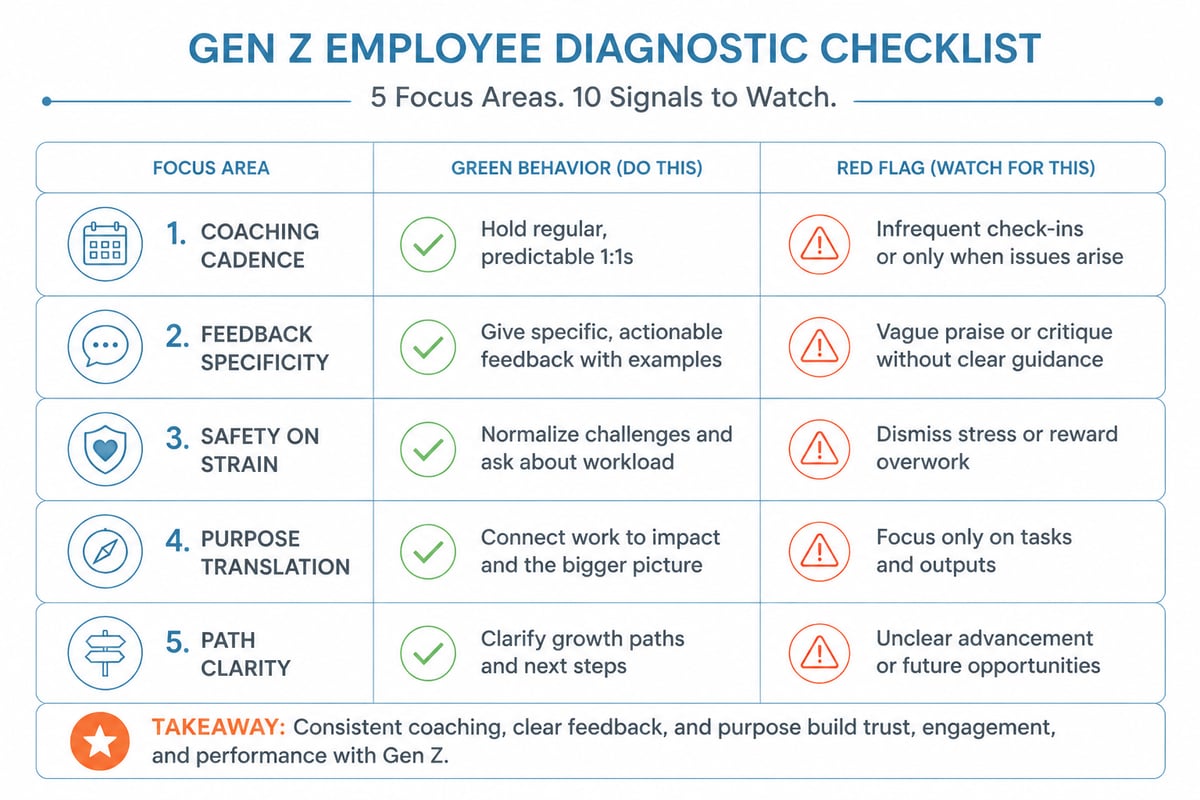
Five-signal manager readiness check

A Pattern From Practice: When Task Managers Become Problem Owners

A recurring pattern in leadership development is that managers who execute tasks well struggle when their reports need coaching rather than direction. The documented outcomes in Noomii's client work illustrate the shift.

Problem: At a Fortune 1000 international therapeutics company, leaders were operating in task-execution mode, handing work down and reviewing output.

Diagnosis: The leaders' skills were technical and they lacked a deliberate habit of owning problems end to end and developing the people around them.

Solution: Hand-matched coaching with development plans tied to leadership KPIs.

Result: Leaders moved from task execution to problem ownership.

Lesson: The behavior Gen Z wants, a manager who owns problems and develops people, is a trainable shift when coaching is matched to the leader's function and level. It does not require replacing the manager.

Across Noomii engagements, leaders have shown observable behavior change, and a Fortune 500 global electronics manufacturer re-commissioned coaching because of documented impact. The point for HR is that behavior change is measurable. If you cannot show movement within two quarters, the program design is wrong.

How to Close the Gap Without Rebuilding Your Whole Leadership Model

Closing the gap means prioritizing, not boiling the ocean. Focus on the managers who supervise the most Gen Z talent in your highest-attrition or highest-value roles first.

A practical sequence:

  1. Baseline. Run a 360 and pulse survey on the five signals for your target manager group.
  2. Segment. Separate managers who need skill building from those who need behavior change or role reassessment.
  3. Match. Pair each leader with development that fits their function, level, and specific gap. Generic workshops rarely change daily behavior.
  4. Measure. Track retention, internal mobility, and leadership KPIs quarterly, not annually.
  5. Reinforce. Build the new standards into promotion criteria so that coaching skill is rewarded, not just output.

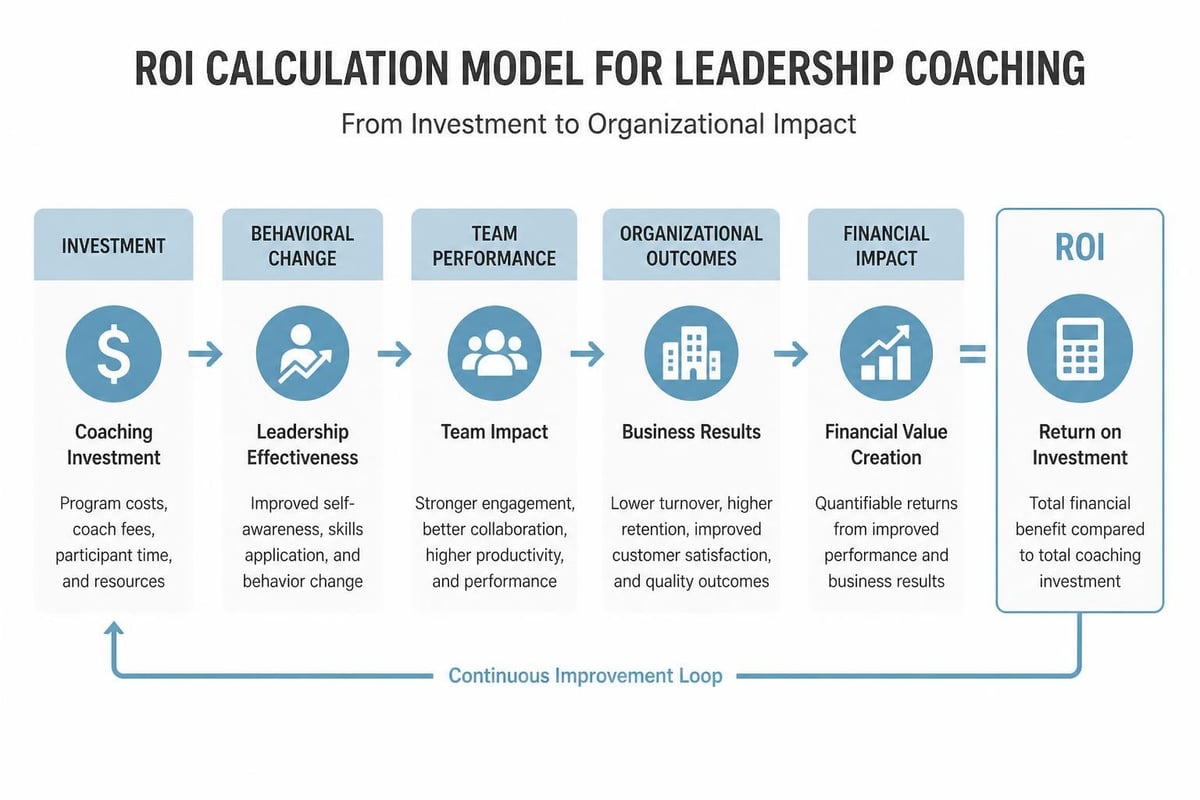
Customized, measurable leadership development programs designed with your HR or L&D team and aligned to business strategy are one way to run this sequence, and pilots let you test impact before committing broadly. For a view of how the performance bar itself is moving, see what high performance looks like in 2027. And if you need to justify the spend, measuring return on investment from executive coaching covers the metrics that hold up under CFO scrutiny.

One caution: do not frame this as a generational accommodation project. The expectations Gen Z voices, clear feedback, real development, a safe place to flag strain, are the same things that improve performance for every age group. Gen Z simply refuses to tolerate their absence.

FAQ

What is Gen Z's attitude towards work?

Gen Z treats work as a place to build skills and find meaning, not just earn a paycheck. Deloitte's 2025 survey found 70% develop skills at least weekly and 89% say purpose matters to their job satisfaction. They are loyal to managers and environments that invest in them, and quick to leave ones that do not.

What is Gen Z's biggest issue at work?

The most consistent issue is the gap between the mentorship they want and the mentorship they receive. Deloitte found 50% want managers to teach and mentor them while 36% say managers do. Mental health pressure is a close second, with 61% saying they would strongly consider leaving for significantly better mental-health benefits, per SHRM.

Do all Gen Z employees want to become senior leaders?

No. Deloitte New Zealand reports that only 6% of Gen Z respondents named reaching a senior leadership position as a primary career goal. Succession plans should include specialist tracks and project leadership roles, not only the management ladder.


Your next step this week is to pick one high-attrition team and run a short 360 plus skip-level check against the five signals above, so you know which managers need support first. If you want a partner to turn those findings into a measurable plan, Noomii matches human coaches to each leader and can report on ROI tied to retention and performance KPIs, and its Leadership Development Programs can be piloted before you scale. You can Book a Free Strategy Call with Noomii Leadership Coaching to map out the right starting point for your managers.

Executive Coaching Jobs: How to Land a Coaching Role

Executive coaching jobs come from three places: coaching firms that subcontract, corporations that hire internal coaches, and independent practices that win clients directly. Most job boards only show the first two, and most of the real income sits in the third.

The market is crowded and still growing. The 2025 ICF Global Coaching Study drew 10,035 responses from 127 countries and estimates 122,974 coach practitioners worldwide, a 15% increase since 2023. The same study estimates global coaching revenue at $5.34 billion. More coaches are chasing a larger pie, so how you position yourself matters more than how many postings you apply to.

What Executive Coaching Jobs Actually Look Like

Executive coaching roles fall into four categories, and each hires differently.

  • Firm associate or contract coach. Leadership consultancies and coaching platforms assign you clients and take a margin. Hiring is slow and selective, often requiring a credential plus documented executive-level hours.
  • Internal coach. A large employer hires you in HR, talent, or organizational development to coach managers and directors. The title is often "leadership development partner" rather than coach.
  • Independent executive coach. You sell directly to companies or individual leaders. No one hires you; a buyer chooses you.
  • Hybrid operator. A former executive coaches part time while holding an advisory or fractional role. This is the fastest route for people with real operating history.

Searching only for the title "executive coach" misses most of this. Search for leadership development, talent management, and organizational effectiveness roles too.

Do You Need a Certification to Get Hired?

Yes for some employers and no for most buyers, and confusing the two wastes years. The ICF study found that most coaches surveyed said clients and organizations expect coaches to have a certification or credential. That is a real signal, and it is also a perception reported by coaches, not proof that credentials drive hiring decisions.

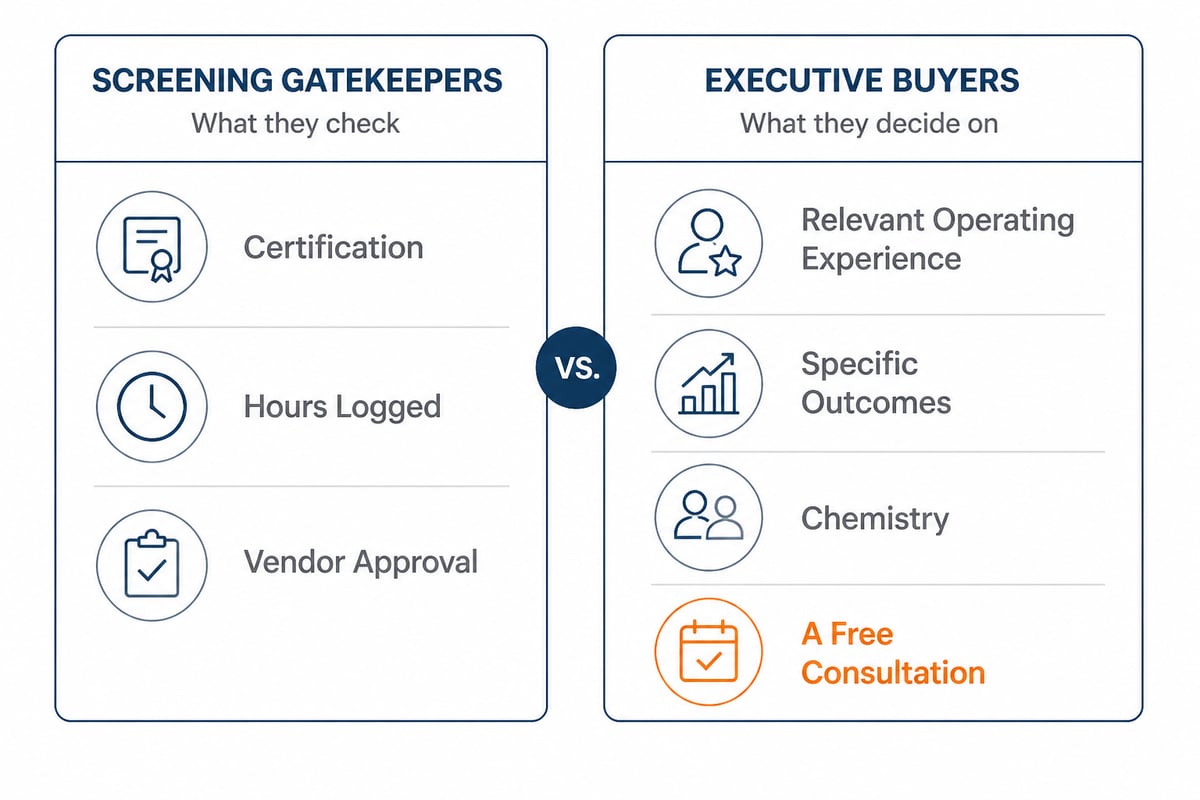
Here is the pattern we see repeatedly in this market. Large firms and procurement departments use credentials as a filter because they need a defensible shortcut. The leader actually choosing a coach asks different questions: have you sat in my chair, can you tell me something I don't already know, and what changed for your last client?

A certification opens doors at screening. Evidence of outcomes closes the engagement. If you have to choose where to spend the next $10,000 and six months, spend it on getting twenty executive-level coaching hours with documented results before adding a second credential.

Hiring filters versus buyer decision criteria for executive coaches

The Proof-of-Practice Framework for Getting Hired

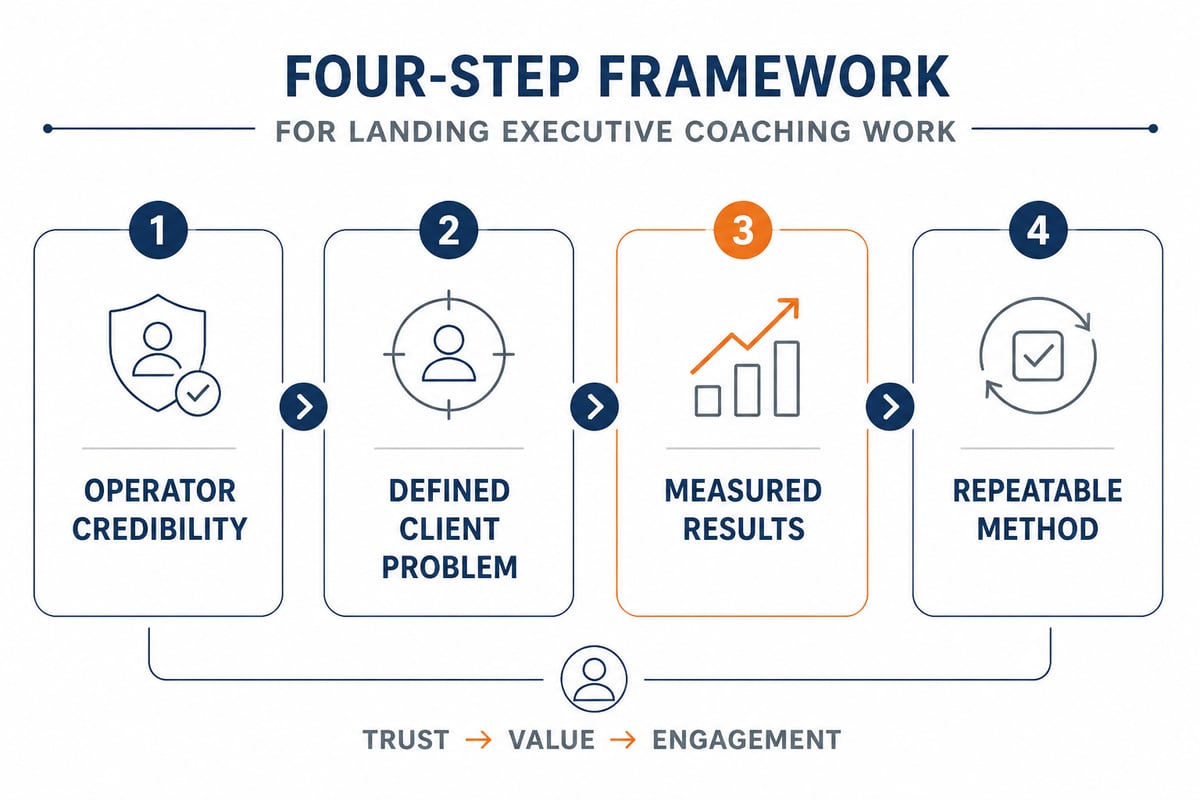
Coaches who land roles quickly tend to show the same four things, which we call the Proof-of-Practice framework.

  1. Operator credibility. Name the budgets, teams, or P&Ls you have run. Buyers pay a premium for coaches who have faced the pressure their client faces.
  2. A defined client problem. "Newly promoted VPs in mid-market manufacturing" gets hired faster than "leaders who want to grow."
  3. Measured results. Tie coaching to a business metric, such as decision speed, manager retention, or team engagement scores.
  4. A repeatable method. Describe your process in one page: assessment, goals, cadence, check-ins, and how progress is reported to the sponsor.

Mid-market buyers in particular, companies with 25 to 500 employees, have little patience for theory. They want a coach who works inside live meetings and reports against KPIs.

A Case Study: From Credential Collector to Booked Coach

Problem: A former operations director spent two years collecting certifications and sent forty applications to coaching firms. She got two interviews and no contracts.

Diagnosis: Her profile led with credentials and listed generic strengths. Nothing told a buyer what problem she solved or for whom.

Solution: She narrowed to one audience, first-time plant managers, and offered three discounted engagements in exchange for written results tied to turnover and on-time delivery. She used a 360 assessment at the start and end of each.

Result: All three clients renewed or referred her, and a regional manufacturer retained her for a cohort of eight managers.
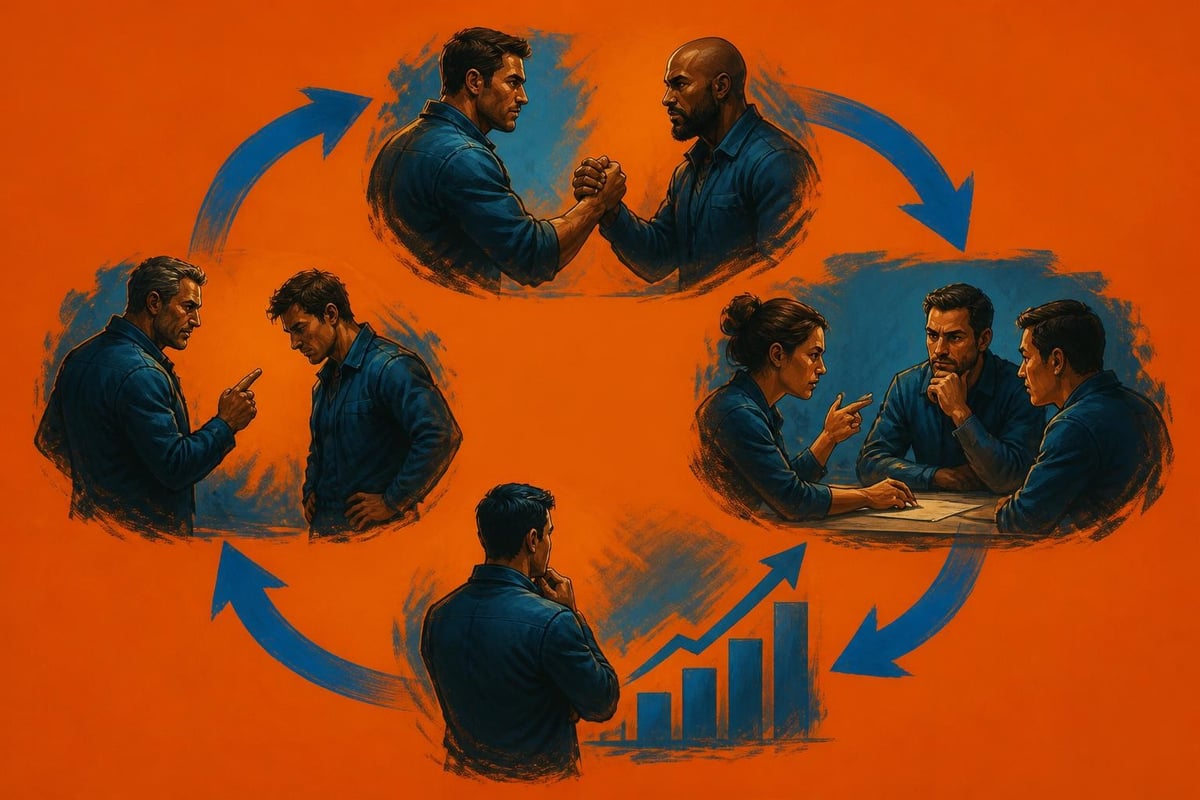
Lesson: Specificity and documented outcomes beat a longer credential list. Treat your first three clients as research, not revenue.

How to Find Openings and Get Seen

Approach the search in this order, because the early steps convert best.

  1. Tell former colleagues and bosses exactly which leaders you coach and what changes for them.
  2. Join the vendor panels of companies in your industry; many HR teams keep a short approved list.
  3. Apply to firms that subcontract, with a one-page method summary attached.
  4. Apply to internal leadership development roles at employers you already understand.
  5. List yourself in a directory where buyers compare coaches. On Noomii, coaches are real independent professionals, and clients can search and match for free, which gives you a way to be found beyond referrals. Browse executive coach profiles in the Philippines or Qatar to see how coaches in other markets present themselves.

Remote delivery has widened the field. Location matters less, though local industry knowledge still wins engagements.

How to Find Openings and Get Seen

Will AI Replace Executive Coaching Jobs?

AI will replace parts of the work, not the accountable relationship at the center of it. Tools can already handle scheduling, session summaries, practice role-plays, and pattern spotting across assessments. They cannot sit in a tense leadership meeting, read the room, and say the thing no one else will.

The practical comparison looks like this:

Task AI tools Human executive coach
Session notes and summaries Strong Adequate
Skill practice and drills Good Good
Live observation in meetings None Strong
Challenging a senior leader's blind spot Weak Strong
Accountability to a sponsor Weak Strong

Coaches who position around live observation and measurable outcomes are safest. Generic advice-giving is the most exposed.

What Executive Coaching Pays and Which Niches Earn Most

Executive coaching often pays more than other coaching categories because the buyer is frequently a company, not an individual. Niches that tend to command the highest rates are those tied to money: executive and leadership coaching for senior teams, sales and revenue coaching, and coaching for founders approaching a scale or exit decision. Rates vary widely by market and experience, so ask peers in your niche and your region rather than relying on general figures.

If you want a view of where your skills fit, performance coaching and team coaching are adjacent specialties where operating experience transfers directly.

Proof-of-Practice framework for executive coaches

Red Flags Employers and Buyers Watch For

Buyers screen out coaches for predictable reasons.

  • Credentials listed with no client outcomes beside them
  • No stated audience or industry
  • Promises of guaranteed transformation
  • No process for involving the sponsor or manager
  • Long-term contracts with no exit

The last one deserves attention. Month-to-month terms and clear KPIs signal confidence. Coaches who tie fees to visible progress stand out in a market where most engagements are sold on trust alone.

Where Noomii Fits for Executive Coaches and Buyers

If you are building an independent practice, Noomii's Executive Coaching category is one place buyers look for third-party coaching that exposes blind spots and sharpens strategic performance. Buyers can get matched with coach recommendations based on goals, personality, and budget, and many coaches offer a free consultation first. That consultation is where your operator credibility and method do the selling.

FAQ

What is the 70/30 rule in coaching?

It is a common guideline that the client should do roughly 70% of the talking while the coach listens and asks questions for about 30%. It is a guide, not a law, and executive coaching often shifts toward more coach input when observing live meetings.

What is the average cost for a career coach?

Rates range widely by market, experience, and format, so there is no single average that applies everywhere. Executive-level coaches generally charge more than general career coaches, so request pricing directly and use free consultations to compare.

Can I get an executive coaching job without a certification?

Yes, particularly as an independent or in a hybrid role where buyers hire on operating experience. Large firms and procurement teams are more likely to require a credential, so match your route to the buyer.


Your next step today is to write a one-page summary of the audience you coach, the business result you improve, and your method, then test it in a conversation with one former colleague. If you want to see how buyers compare coaches or you are a company looking for a practical partner, Get My Free Match and Noomii will point you to coaches suited to your goals, and our Corporate Coaching team works inside your live meetings, ties progress to clear KPIs, and offers month-to-month terms so you keep the engagement only while results are visible.

Skills-Based Hiring vs Degrees: A Practical Guide for Employers

In skills-based hiring versus degrees in 2027, skills should win for most roles, but only when employers can actually measure them. Dropping a degree requirement without replacing it with a credible assessment process does not improve hiring. It moves the guesswork from the resume screen to the interview room, and leadership roles are where that guesswork costs the most.

The market has already moved. A ZipRecruiter survey of more than 1,500 talent acquisition professionals and hiring managers, conducted September 8–16, 2025, found that a significant share of recruitment-focused businesses had dropped degree requirements in the prior year. The question for HR, L&D and People leaders is no longer whether to join the shift. It is how to do it without weakening your leadership pipeline.

Why Employers Are Dropping Degree Requirements

Employers are dropping degree requirements because the talent pool is too thin to filter by credential and because a diploma has proven a weak predictor of on-the-job performance.

The pressure is real. In 2025, most employers surveyed said finding talent was more difficult than the year before, according to UNLEASH’s analysis of TestGorilla research. The same research found that many employers struggled to assess soft skills and many struggled to assess technical skills. Read that carefully. Employers are not abandoning degrees because they have a better measurement system. Many are abandoning degrees while still unsure how to evaluate the alternative.

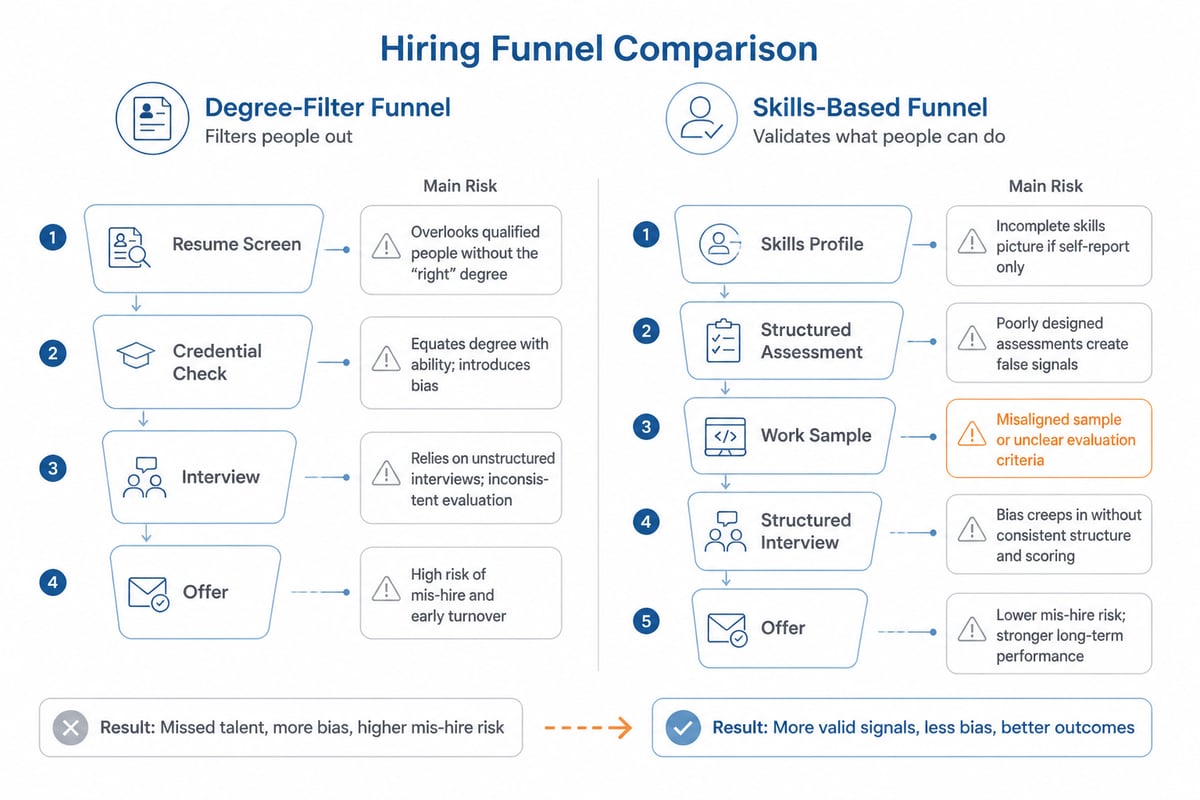
That gap is the central risk of the entire movement. A degree is a crude filter, but it is a cheap one. Removing it without installing something better produces three predictable outcomes:

  • Application volume rises, and recruiters drown in unqualified resumes.
  • Hiring managers fall back on gut feel, which favors candidates who resemble them.
  • Pedigree bias returns through a different door, such as prior employer brand or interview polish.

SHRM’s summary of skills-based hiring research notes that employers report benefits such as increased application volume. More volume is only a benefit if your process can sort it.

Comparison of degree filter versus skills assessment in hiring funnel

What Degrees Still Do Well, and Where They Fail

A degree remains a reasonable proxy for sustained effort, baseline analytical ability and regulated knowledge, but it fails as a proxy for leadership capability.

Be precise about where credentials still carry weight. Licensed professions, clinical roles, engineering sign-off and certain finance functions have legal or safety reasons to require a degree. Pretending otherwise is not skills-based hiring. It is negligence.

Where degrees fail is judgment under pressure. Nobody was ever promoted into a director role because of how they performed in a statistics course. The traits that decide whether a manager succeeds are the ones transcripts do not capture: how they handle a conflict between two direct reports, whether they take ownership of an ambiguous problem, and how they behave when a decision goes badly. Our own view, and the contrarian one, is that the degree debate is a distraction at senior levels. Most organizations promoting internally are already past the degree question. The real failure point is promoting the best individual contributor into a management role with no evidence of people skills.

That distinction matters for leadership succession. A degree tells you almost nothing about who is ready for the next level. Observed behavior does.

Skills-Based Hiring Versus Degrees in 2027: What Changes

Skills-based hiring versus degrees in 2027 is a contest between two measurement systems, and the winner is whichever one produces better evidence about future performance at a cost you can sustain.

Three shifts define the year ahead:

  1. Assessments move earlier. The ZipRecruiter survey found that a substantial share of businesses were already using candidate assessments to evaluate skills earlier in the hiring process. Expect that share to climb as assessment tools get cheaper.
  2. AI changes the application itself. When candidates can generate polished resumes and cover letters in seconds, those documents lose signal. Work samples and live exercises gain it. For a deeper look at what machines cannot replicate, see the human skills AI cannot replace.
  3. Internal mobility becomes the main prize. The largest untapped talent source is your existing workforce, where skills can be observed directly rather than inferred from a credential.

Employers who need to run screening at scale are also pairing skills assessments with conversational tooling. Platforms such as TapTalk handle omnichannel candidate and customer messaging with AI chatbots, which can reduce the administrative load of high-volume applicant communication. Tools like that speed up logistics. They do not replace the judgment about who can lead.

A Framework for Hiring on Skills: The Evidence Ladder

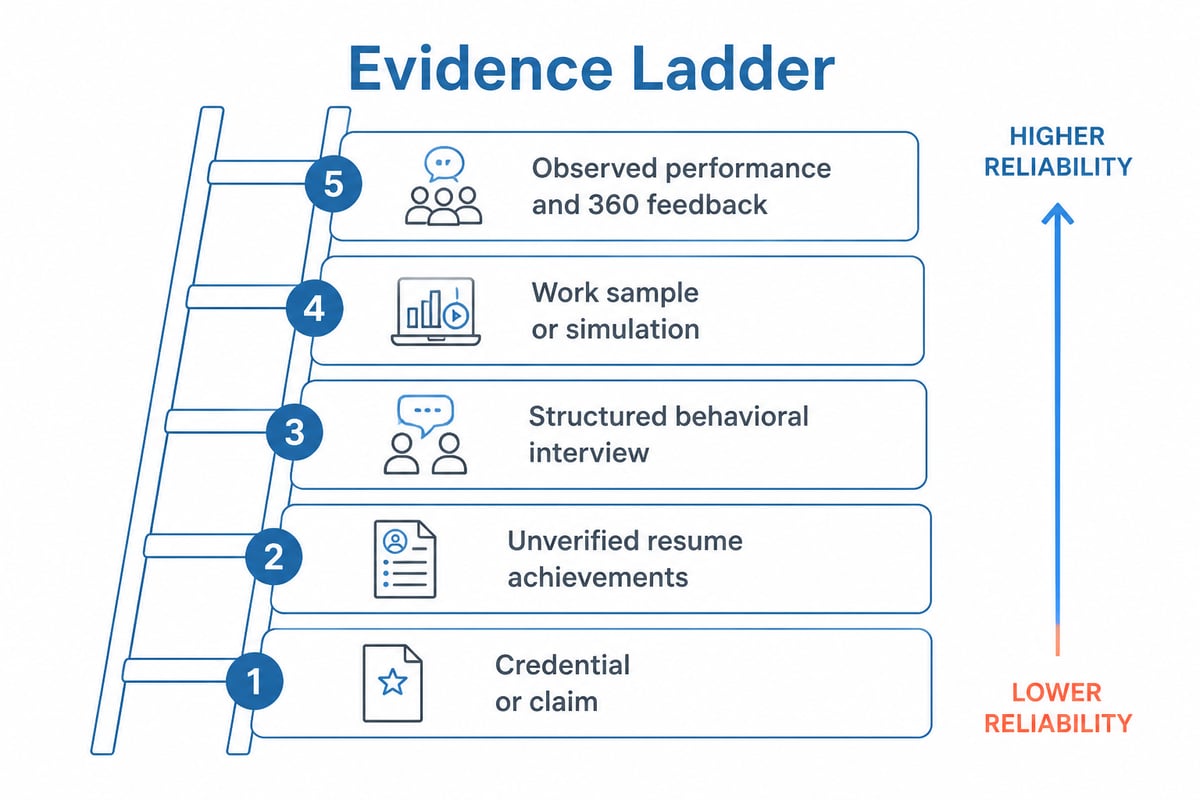
The most reliable way to hire on skills is to rank your evidence by how directly it shows the skill, then require stronger evidence as the role gets more consequential.

We use a simple five-rung scale, which we call the Evidence Ladder:

Rung Evidence type Reliability for leadership roles
1 Credential or self-reported claim Low
2 Resume achievements, unverified Low to moderate
3 Structured interview with scored behavioral questions Moderate
4 Work sample or simulation High
5 Observed performance, including 360 feedback and trial assignments Highest

The rule is straightforward. For a frontline individual contributor role, rung 3 may be enough. For a people manager, you want rung 4 at minimum. For succession into senior leadership, insist on rung 5, because by then you have the data.

Most organizations sit at rungs 1 and 2 for leadership hiring and wonder why their new managers underperform. The fix is not a better degree filter. It is climbing the ladder.

Evidence Ladder for skills-based hiring

Case Study: Rebuilding a Leadership Pipeline on Observed Behavior

The clearest lesson from leadership programs is that behavior can be observed and developed, which makes it a better hiring and promotion signal than a credential.

Problem. A large multinational manufacturer was promoting technically strong engineers into management on the basis of tenure and degrees. New managers stalled at task execution, handling problems themselves instead of owning outcomes across a team.

Diagnosis. A structured 360 assessment showed a consistent pattern. The gap was not technical knowledge. It was problem ownership, delegation and accountability conversations.

Solution. The organization moved from credential-based promotion criteria to a skills profile for each leadership level, then paired new managers with coaches matched by function, level and industry.

Result. In a comparable Noomii engagement with a Fortune 1000 international therapeutics company, leaders moved from task execution to problem ownership. Across Noomii engagements, leaders showed observable behavior change, and a Fortune 500 global electronics manufacturer re-commissioned coaching because of documented impact.

Lesson. Skills you cannot see on a resume can still be measured, developed and tracked. Treat leadership capability as something you build and verify, not something you infer from a diploma.

Five Mistakes That Undermine Skills-Based Hiring

Skills-based hiring fails in predictable ways, and nearly all of them come from treating it as a policy change instead of a process change.

  • Removing the degree line from job postings and changing nothing else. If interviewers still score on polish and pedigree, you have changed the posting, not the hiring.
  • Assessing technical skills but ignoring leadership behaviors. The UNLEASH data shows that many employers find soft skills hard to assess, so this is the most common blind spot.
  • Skipping the job analysis. You cannot test for skills you have not defined. Write the skills profile before you write the posting.
  • Applying one standard to every role. Regulated roles keep their requirements. Be explicit about which roles are exempt and why.
  • Failing to measure the outcome. If you cannot compare retention, performance ratings and time-to-productivity between degree and non-degree hires, you are running on belief.

That last point deserves emphasis. Track hiring cohorts for at least 18 months. Compare them on manager-rated performance and retention. Without that comparison, a skills-based program is a talking point rather than a strategy. For help with the analytics side, specialist partners such as Stellium Consulting work with enterprises on AI-powered business process improvement, which can include building the reporting layer.

Building Skills-Based Succession for Leaders

The strongest use of skills-based thinking is internal: define the capabilities each leadership level requires, assess your people against them, and develop the gaps deliberately.

Start with the transitions that break most often. The jump from individual contributor to first-time manager is the most fragile, which is why programs aimed at new managers deserve early investment. The jump from manager to executive is the second, and it increasingly calls for executive team coaching versus individual coaching decisions, because senior performance is often a team property rather than a personal one.

A workable internal model looks like this:

  1. Define three to five observable behaviors per leadership level.
  2. Baseline each candidate with a 360 survey and a structured manager review.
  3. Develop the gaps with targeted coaching, stretch assignments and feedback.
  4. Re-measure at six and twelve months.
  5. Promote on the trend, not on a single review cycle.

Coaching fits into step three, and the quality of the match matters. Noomii hand-matches coaches by function, level, industry and goals, offers a free 360 leadership survey for every participant, and issues quarterly ROI reports tied to retention, performance and leadership KPIs. Payment does not begin until the coach selection and development plan are approved. If your reporting depends on tying development spend to outcomes, review the coaching budget benchmarks for 2027 before you set targets.
Compliance, Fairness and the Risk of Getting It Wrong

A skills-based process reduces legal and reputational exposure only if it is documented, consistent and validated against the actual job.

Structured criteria applied to every candidate are easier to defend than discretionary judgment. Dropping a degree requirement can widen your candidate pool, but an unvalidated assessment can create its own adverse impact. Three safeguards matter:

  • Job-relatedness. Every assessed skill should trace to a documented job requirement.
  • Consistency. Use the same scoring rubric, the same questions and the same weighting for every candidate in the pool.
  • Audit trail. Keep scoring records so you can show why a decision was made.

Leadership programs face the same standard. Development initiatives should align with organizational, regulatory and ethical requirements, which is why governance belongs in the design phase rather than as a final review.

Frequently Asked Questions

Is skills-based hiring better than requiring a degree?

For most non-regulated roles, yes, provided you have a reliable way to assess skills. The advantage comes from the assessment quality, not from removing the degree. Without credible assessments, the result is often worse than a degree filter.

Which roles should still require a degree?

Roles governed by licensure, safety rules or regulation, such as clinical, legal and certain engineering and finance positions, should keep their requirements. Leadership roles generally should not require a degree as a condition, but they should require demonstrated leadership behaviors.

How do you assess leadership skills without a degree?

Use the Evidence Ladder. Combine structured behavioral interviews, work samples or simulations, and 360 feedback. For internal candidates, observed performance over time is the strongest evidence available.

How long does it take to see results from skills-based hiring?

Plan on at least 18 months of cohort tracking to compare retention and performance between hiring methods. Faster signals, such as time-to-productivity, appear earlier but are less conclusive.
Does skills-based hiring reduce hiring costs?

It can expand the pool and speed up sourcing, but assessments and training carry their own costs. Measure total cost per successful hire, including 12-month retention, rather than cost per posting.

Leadership succession pipeline built on observed skills


Before your next leadership requisition opens, write a one-page skills profile for the role and decide which rung of the Evidence Ladder you will require before an offer or promotion. If you want help turning that profile into a measured development plan, with a free 360 survey, hand-matched coaches and quarterly ROI reporting, you can book a free strategy call with Noomii Leadership Coaching to map your leadership pipeline against the skills your roles actually demand.

How to Choose a Women’s Empowerment Coach for Real Results

A women empowerment coach helps you set goals, break through the habits and beliefs that hold you back, and take structured action in your career, leadership, relationships or health. The best one for you is the coach whose track record, method and style match your specific goal, not the one with the longest list of credentials.

That distinction matters because the market is crowded and the label is vague. Anyone can use the title, and a certificate alone tells you little about whether a coach moves clients forward.

What does an empowerment coach do?

An empowerment coach works with you in regular sessions to clarify what you want, identify what is blocking you, and commit to specific actions between meetings. Good coaching is forward-looking and practical: negotiating a raise, stepping into a leadership role, setting boundaries, or rebuilding confidence after a career change.

Coaching is not therapy. If you are dealing with trauma, depression or other mental health needs, a licensed therapist is the right first call, and this breakdown of coaching vs therapy explains where the line sits.

Why the need is real, and why it is not only personal

Empowerment is partly an individual project and partly a structural one. The UN's Gender Snapshot 2025 projects that 351 million women and girls will still live in extreme poverty in 2030 if current trends continue, and that SDG 5 on gender equality will be missed. UN Women also reports that businesses in 168 countries have signed the Women's Empowerment Principles, with membership up 98%.

A coach cannot fix those systems. What a coach can do is help you act effectively inside them, which is why strong coaches talk about your actual workplace, industry and constraints rather than generic mindset advice.

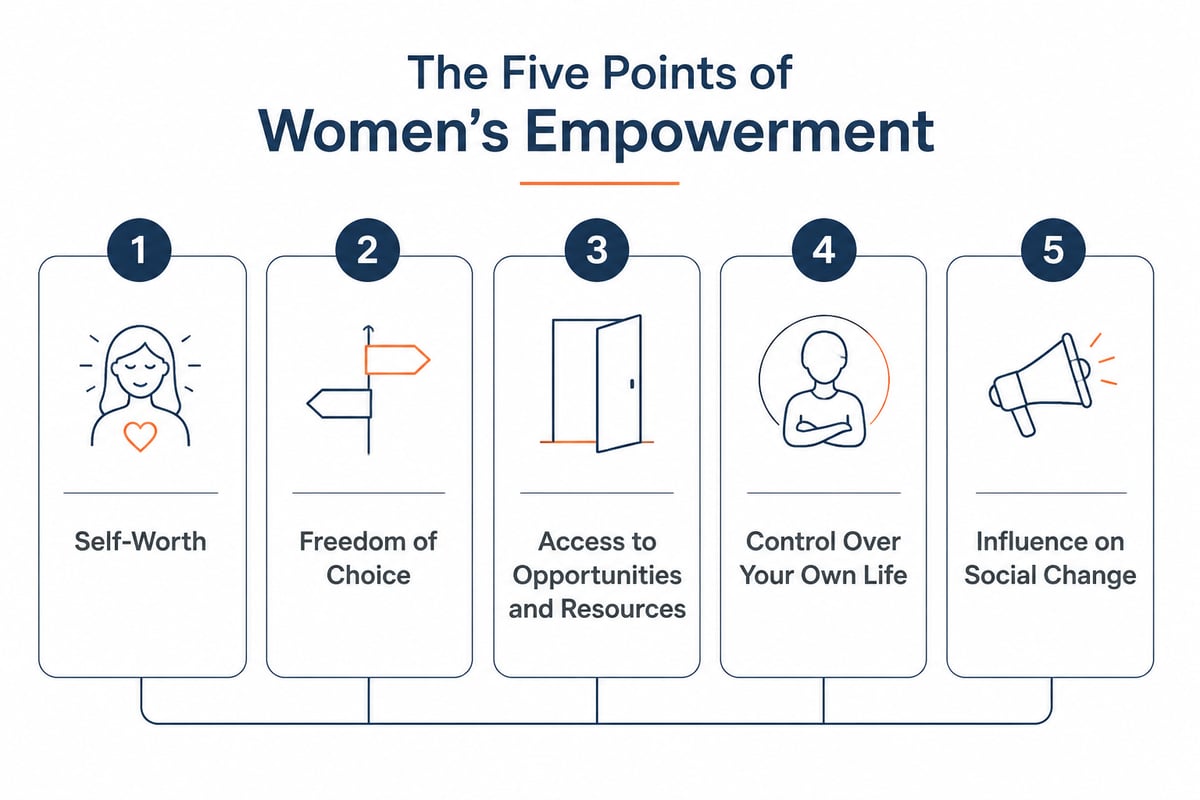
What are the 5 points of women's empowerment?

The five points most often cited are a sense of self-worth, the right to make your own choices, access to opportunities and resources, control over your own life inside and outside the home, and the ability to influence social change. A useful coach connects at least two or three of these to your situation. If every session stays at the level of affirmations, you are paying for encouragement, not empowerment.

Five points of women's empowerment

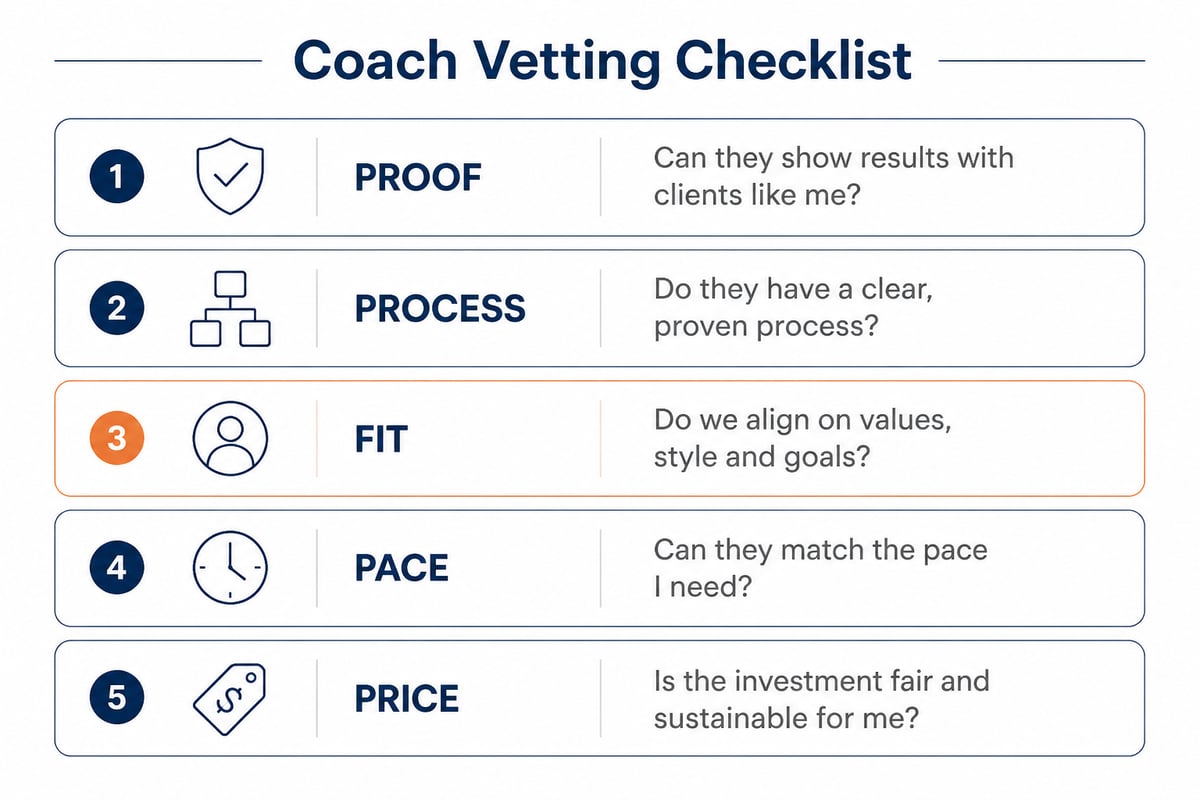
A 5-part vetting framework for any women empowerment coach

After watching the coaching market for years, the same pattern repeats: clients who pick on charisma or credentials get inconsistent results, and clients who pick on evidence get better ones. Use this five-part check, which I call the Proof, Process, Fit, Pace, Price test.

  1. Proof. Ask for two or three specific client outcomes, such as a promotion secured, a business launched or a team led differently. Vague testimonials about "feeling inspired" are a weak signal.
  2. Process. A real coach can describe how sessions work, what you do between them, and how progress is tracked.
  3. Fit. Chemistry matters, but so does niche. A coach who works with executives will serve you differently than one who works with new entrepreneurs.
  4. Pace. Look for a defined first phase, such as 8 to 12 weeks, with a checkpoint to continue or stop.
  5. Price. Know the full cost and cancellation terms before you start.

Do credentials matter? Is there a certification for women's empowerment coaches?

Several training programs award certificates, but no single credential is required to practice, and none is specific to women's empowerment. Certifications such as those from the International Coaching Federation show that a coach completed training and ethics standards, which is useful. They do not show that a coach can get you the outcome you want.

The contrarian view, supported by how the market behaves: weigh results and relevant experience above the badge. A former operations director who coaches women moving into management often delivers more than a newly certified generalist. Treat certification as a tiebreaker, not the deciding factor.

How much should I expect to pay for a life coach?

Rates vary widely by experience, niche and format, and published figures differ across the industry, so treat any single number with caution. Individual coaching is generally priced per session or as a monthly package, with executive and business coaches charging more than general life coaches. Ask for the total cost of a defined engagement, not just the hourly rate, and confirm whether a free consultation is offered. Most coaches on Noomii offer one.

Case study: from stalled to promoted

Problem: A mid-level operations manager kept being passed over for director roles despite strong reviews. Diagnosis: In her coaching intake, her coach found she described her work as "helping the team" and never quantified her own impact, and she avoided asking for stretch assignments. Solution: Over 12 weeks she built a one-page impact record, practiced two salary and scope conversations, and requested one cross-department project. Result: She presented the project results to leadership and was considered for the next opening within the quarter. Lesson: Empowerment showed up as specific behavior changes, each tied to a visible outcome, not as a feeling.

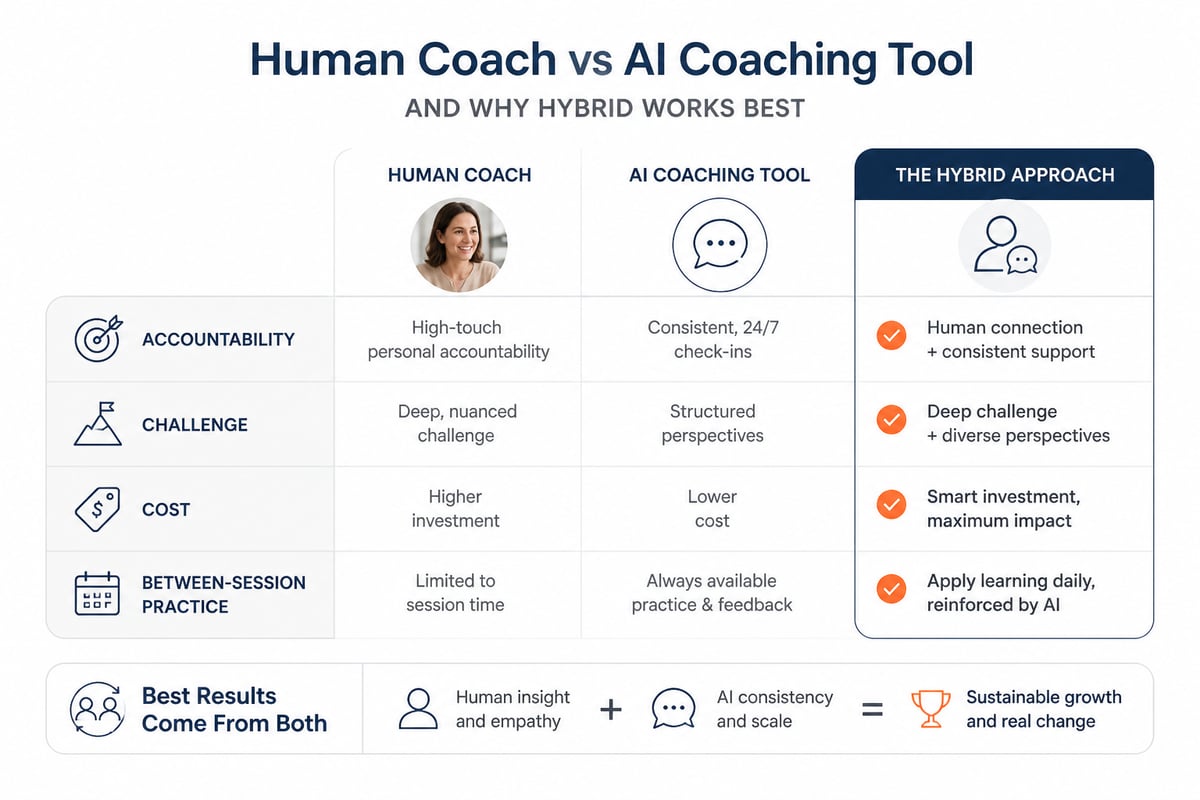
Human coach, AI tool or a mix?

AI tools can handle reflection prompts, goal tracking and role-play for tough conversations at low cost. They cannot read your tone, challenge a story you keep telling yourself, or hold you accountable the way a person who knows your history can. A practical split: use AI for between-session practice and a human coach for diagnosis, challenge and accountability. If you also want to refresh how you present yourself in a new role, a styling service like OOTD Text can take daily outfit decisions off your plate, which frees attention for the work that counts.

Human coach versus AI tool comparison

Red flags that should end the conversation

  • Guaranteed income or promotion outcomes
  • Pressure to sign a long prepaid contract on the first call
  • No defined method, only "my signature journey"
  • A coach who dismisses therapy when you describe serious mental health symptoms
  • No way to speak with past clients or see concrete results

Business owners and HR leaders should add one more check: ask whether the coach can tie work to measurable team outcomes. Programs built around KPIs, live coaching in real meetings and month-to-month terms, the approach behind Noomii's corporate coaching, make results visible so you stay because the work pays off, not because you are locked in. Teams redesigning how they plan and deliver may also find a consultancy like Lithe useful alongside coaching.

How to find and shortlist coaches

A directory saves hours of searching. Noomii lets clients search and match with coaches, with recommendations based on your goals, personality and budget. Every coach is an independent professional, and remote coaching means location is not a limit. Noomii is trusted by coaches and clients and has been featured in The Washington Post, Lifehacker and TechCrunch.

If your goal is professional, browse career coaches. If you are building something, look at entrepreneurship coaches or business coaching. For a broader view of where progress is happening and where gaps remain, UN Women's explainer on gender equality gains and gaps in 2025 adds useful context.

FAQ

Can a women empowerment coach help with a career change?

Yes. A coach can help you clarify your target role, rehearse interviews and negotiations, and build a realistic action plan. Choose one with experience in your industry or the one you are moving into.

How long does empowerment coaching usually take?

Many engagements run 8 to 12 weeks for a focused goal, with longer work for larger transitions. A good coach sets a checkpoint so you can decide whether to continue.

How do I know if coaching is working?

You should see concrete changes: decisions made, conversations held, projects launched. If you cannot name what has changed after a month or two, raise it with your coach or reconsider the fit.

Should I choose a coach who has experienced what I am going through?

Lived experience helps with credibility, but method and results matter more. Ask how the coach has helped clients with a similar goal.

Can my company provide coaching for women leaders?

Many do, often as part of leadership development. Pair it with clear goals and KPIs so the investment can be evaluated.

Coach selection checklist


Before you speak to anyone, write down one measurable goal and the date you want it done, then use it to compare every coach you talk to. If you want help finding the right person, Get My Free Match with Noomii, where you can get coach recommendations based on your goals, personality and budget. For companies, Noomii Corporate Coaching works live in your meetings and ties progress to clear KPIs and ROI, on month-to-month terms with no long contracts.

Top Life Coaches: What Works vs What’s Marketed

The coaching industry has a credibility problem. Buyers searching for top life coaches encounter thousands of profiles featuring identical certifications, similar promises, and little evidence of actual results. After observing this market for over a decade and working with mid-market companies hiring coaches for leadership development, I've seen what separates coaches who transform organizations from those who simply facilitate conversations. The difference rarely correlates with the credentials most heavily marketed.

What Makes Top Life Coaches Different From Certified Ones

Certification bodies want you to believe their stamp creates coaching excellence. The evidence suggests otherwise.

Top life coaches distinguish themselves through documented outcomes, not training hours. When evaluating life coaches for your organization, look past the alphabet soup of credentials. The unregulated nature of coaching means anyone can claim expertise, but few can demonstrate sustained client results across multiple engagements.

Here's what actually matters:

  • Industry-specific experience: A coach who has navigated your sector understands context others miss
  • Measurable outcomes: Revenue impact, retention improvements, promotion velocity, team performance metrics
  • Methodology transparency: Named frameworks, diagnostic tools, progress tracking systems
  • Business acumen: Understanding P&L, operational constraints, and organizational politics

Coaching credentials versus outcomes

The Certification Myth Nobody Challenges

The coaching industry perpetuates the myth that more training hours equal better coaching. I've watched companies pay premium rates for ICF-credentialed coaches who couldn't read a balance sheet or diagnose why managers avoid difficult conversations.

Research shows contemporary coaching effectiveness depends on relationship quality, goal clarity, and contextual fit far more than credential level. Yet buyers continue selecting coaches based on certifications rather than demonstrated expertise in solving problems similar to theirs.

Selection Criterion What Buyers Focus On What Drives Results
Credentials ICF, BCC, CPCC levels Irrelevant to outcomes
Experience Years coaching Years in your industry
Methodology Generic models Custom diagnostic tools
Pricing Hourly rates ROI and business impact

Top life coaches build proprietary assessment frameworks. They track leading indicators, not just satisfaction scores. They tie their work to business KPIs because they understand that executive coaching without measurable impact is expensive therapy.

Red Flags When Evaluating Top Life Coaches

After watching hundreds of coaching engagements, certain patterns predict failure before the first session.

The biggest red flag? Coaches who resist measurement. When a coach deflects questions about outcomes or claims their work is "too nuanced" for metrics, you're dealing with someone afraid of accountability. Top life coaches welcome scrutiny because their track record speaks clearly.

Watch for these warning signs:

  1. No client case studies with specific problems solved and results achieved
  2. Vague methodology described in buzzwords rather than concrete steps
  3. Long-term contracts required upfront without performance milestones
  4. Credential worship in marketing but no evidence of business outcomes
  5. Resistance to stakeholder involvement or progress reviews

The best coaches insist on clear success criteria before engagement. They want you to hold them accountable because they've delivered results consistently enough to bet their reputation on it.

What Harvard Gets Right About Executive Coaching

Harvard Business Review’s analysis of executive coaching competencies identifies business expertise as critical for senior-level work. Yet most life coach training programs ignore financial literacy, strategic planning, and organizational development entirely.

Top life coaches working with business leaders bring substantial pre-coaching careers. They've managed teams, hit revenue targets, navigated mergers, or built departments. This context lets them distinguish between a leader's stated problem and their actual problem, a skill no certification program teaches effectively.

The AI Coaching Disruption Nobody Saw Coming

In 2026, AI coaching tools have commoditized the scripted, process-driven coaching that dominated the industry. Apps now deliver framework-based guidance, accountability tracking, and reflection prompts at $20 monthly instead of $200 hourly.

This shift exposes which coaches were always delivering commoditized services. The coaches screaming loudest about AI "replacing the human element" are often those whose sessions consisted of asking generic questions from certification manuals.

Human coaching value proposition

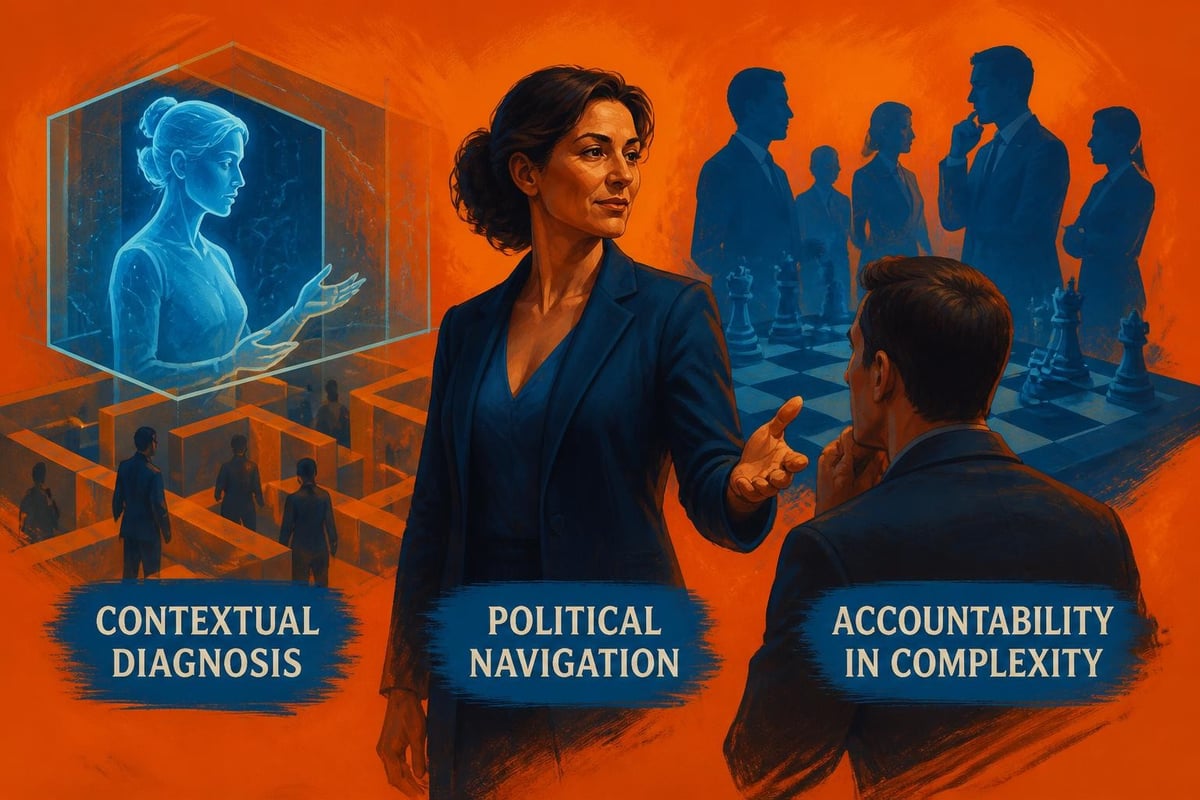
Top life coaches have adapted by doubling down on what AI cannot replicate:

  • Live observation and intervention in actual meetings and critical conversations
  • Political navigation within specific organizational cultures
  • Pattern recognition across industries and leadership challenges
  • Accountability enforcement when stakes are high and excuses are easy

The coaches thriving in 2026 embed themselves in business operations rather than scheduling tidy one-hour sessions disconnected from daily reality. They coach managers during pipeline reviews, facilitate strategic planning sessions, and diagnose dysfunction by participating in leadership team meetings.

How Buyer Behavior Changed Coaching Selection

Mid-market companies in 2026 evaluate coaches differently than they did five years ago. The shift reflects growing sophistication about what coaching delivers versus what it promises.

Smart buyers now demand:

  • Month-to-month terms instead of six-month commitments
  • Performance-based pricing tied to measurable improvements
  • Integration with existing KPIs rather than separate coaching metrics
  • Manager capability building not just individual executive development

This evolution pressures top life coaches to demonstrate ROI quickly or lose engagements. The best welcome this accountability because they've always worked this way.

The Proprietary Framework Advantage

Top life coaches develop named methodologies that diagnose problems faster than generic models. These frameworks emerge from pattern recognition across hundreds of client situations, not from certification course materials.

For example, effective coaches assess leadership teams using custom scorecards that evaluate decision velocity, communication clarity, accountability patterns, and strategic execution. They don't rely on off-the-shelf assessments designed to sell certification programs.

Generic Approach Proprietary Framework
Personality assessment Decision-making audit
Values exploration KPI alignment scorecard
Goal-setting session Execution gap analysis
Monthly check-ins Live meeting observation

When coaches share their diagnostic process openly, complete with example assessments and sample results, they signal confidence in their methodology. When they guard it as "proprietary but unpublishable," they signal they borrowed someone else's framework.

Finding Top Life Coaches Who Deliver Business Results

The market for executive and leadership coaching has matured enough that directories specializing in business coaching now segment coaches by proven industry experience, not just certifications. This helps buyers avoid the time-waste of interviewing coaches whose backgrounds don't match their challenges.

When selecting coaches, prioritize these discovery questions:

  • What specific business outcomes have you improved for clients in our industry?
  • How do you measure progress beyond self-reported satisfaction?
  • What diagnostic process do you use in the first 30 days?
  • How do you handle situations where the stated problem differs from the actual problem?
  • What's your approach when a leader resists feedback from their team?

Top life coaches answer with specific examples, named frameworks, and transparent methodology. They reference past clients (with permission), share case study outcomes, and explain their diagnostic tools in detail. They compete on evidence, not credentials.

Coaching selection criteria

Frequently Asked Questions

What qualifications should top life coaches have?

The most effective coaches combine deep industry experience with proven methodology and documented results. While certifications demonstrate training completion, they don't predict coaching outcomes. Look for coaches who've held roles similar to your leaders, developed proprietary diagnostic tools, and can share specific client results with measurable business impact.

How much do top life coaches charge?

Rates vary widely from $200 to $1,000+ per hour depending on experience, specialization, and engagement structure. However, hourly rates matter less than ROI. The best coaches often propose performance-based arrangements or monthly retainers tied to specific outcomes rather than time-based billing that misaligns incentives.

What's the difference between life coaching and executive coaching?

Life coaching traditionally focuses on personal goals, work-life balance, and individual fulfillment. Executive coaching addresses leadership effectiveness, business results, and organizational impact. Top life coaches working with business clients blend both by recognizing that leadership challenges often stem from personal patterns, but they always tie outcomes to business metrics.

How long does coaching typically take to show results?

With the right diagnostic process and committed leaders, measurable improvements appear within 30-60 days. Behavioral shifts in communication, decision-making, and accountability become visible quickly when coaches work directly in business contexts rather than isolated sessions. Sustained transformation typically requires 6-12 months, but progress should be evident early.

Can AI coaching tools replace human coaches?

AI tools effectively deliver framework-based guidance, reflection prompts, and accountability tracking for motivated individuals. They cannot diagnose complex organizational dysfunction, navigate political dynamics, or provide real-time intervention during critical conversations. Top life coaches use AI as a supplement for between-session support while focusing their expertise on high-stakes, context-dependent challenges.

What industries do top life coaches specialize in?

The most effective coaches concentrate expertise in specific sectors like technology, healthcare, manufacturing, professional services, or finance. This specialization allows faster pattern recognition, relevant case studies, and credibility with leaders who value industry-specific context over generic coaching frameworks.

How do I evaluate a coach's track record?

Request detailed case studies showing the initial problem, diagnostic process, intervention approach, measurable results, and lessons learned. Ask for client references from similar industries and roles. Review whether they publish methodology openly or hide behind vague descriptions. Top coaches document their work because results speak clearly.

What red flags indicate a poor coaching fit?

Warning signs include resistance to measurement, vague methodology, credential emphasis without outcome evidence, required long-term contracts, and unwillingness to involve stakeholders in progress reviews. Coaches who deflect accountability questions or claim their work defies quantification often underdeliver.

Should coaches be certified by ICF or similar bodies?

Certification demonstrates training completion and adherence to ethical standards, which matters for consumer protection. However, certification level doesn't predict coaching effectiveness or business results. Prioritize documented outcomes, relevant experience, and transparent methodology over credential alphabet soup when selecting business coaches.


Top life coaches prove their value through measurable business outcomes, not marketing claims about certifications. When you need coaching that delivers faster decisions, stronger execution, and visible ROI, Noomii connects mid-market companies with experienced coaches who work month-to-month, embed in your operations, and tie progress to clear KPIs. Choose coaches who share the risk and compete on results, not credentials alone.

Hybrid Work Policies That Hold Up in 2027

Most executives are designing hybrid work policies that hold up in 2027 by copying what failed in 2024. They're mandating three days in-office because competitors did, tracking badge swipes, and wondering why talent walks. The gap isn't between remote and in-office work. It's between leaders who understand what drives performance and those who confuse presence with productivity. After coaching hundreds of executives through workforce transformations, the pattern is clear: policies built on control fail. Policies built on outcomes and adult treatment endure.

The Mandate Trap Most Leaders Fall Into

Executives announce hybrid policies like product launches. Three days mandatory, two days flexible, everyone aligned. Then reality hits.

Top performers negotiate exceptions. Middle managers enforce inconsistently. HR fields complaints about fairness. Within six months, the policy exists on paper while a shadow system runs the actual business.

The failure isn't the concept. It's the design. Leaders anchor hybrid work policies that hold up in 2027 to the wrong variables: office occupancy rates, real estate costs, executive preferences. What matters is different.

  • Role requirements vary wildly across functions
  • Performance metrics don't correlate with location for knowledge work
  • Team dynamics depend on coordination needs, not calendar mandates
  • Individual circumstances affect productivity more than office design

A Fortune 500 financial services client learned this after mandating four days on-site. Attrition spiked 40% in engineering. Exit interviews revealed the same pattern: "I can do this job from anywhere. Someone will let me."

They redesigned around team-level autonomy. Managers set expectations based on deliverables and collaboration needs. Retention improved without harming performance, and productivity metrics exceeded the mandate period. The lesson: flexibility beats uniformity when you measure what matters.

What Actually Drives Performance in Hybrid Models

Research on using data to design hybrid work policies confirms what executive coaches observe daily. Performance in hybrid environments correlates with clarity, autonomy, and accountability. Not days in-office. Teams that lead well across locations can use our guide to virtual team management best practices for 2027.

High-performing hybrid organizations share these attributes:

  1. Defined outcomes replace activity monitoring
  2. Manager capability to lead distributed teams
  3. Technology infrastructure that enables seamless collaboration
  4. Cultural norms around communication and availability
  5. Performance feedback based on results, not presence

The disconnect happens when executives assume these exist. They don't. Most managers learned leadership in co-located environments. They lack skills to set clear deliverables, run effective virtual meetings, or coach remotely. Throwing them into hybrid without development is strategic malpractice.

Performance factors in hybrid work

A healthcare organization discovered this gap after hybrid adoption stalled. Managers complained about accountability. Employees reported unclear expectations. The diagnosis revealed manager development, not policy architecture, as the constraint.

They invested in leadership coaching focused on hybrid team management. Specifically: translating strategy into individual deliverables, running decision-making meetings virtually, and providing developmental feedback without proximity bias. Performance gaps closed within two quarters.

Building Policies That Survive Executive Turnover

Hybrid work policies that hold up in 2027 outlast the leaders who create them. That requires embedding principles, not preferences, into organizational DNA.

Principle-based policies define the "why" and "what," leaving "how" to teams. Preference-based policies codify one executive's beliefs into company-wide mandates that erode with leadership changes.

Policy Type Foundation Flexibility Longevity Example
Principle-based Outcomes, equity, performance High team autonomy Survives leadership changes "Teams determine location based on collaboration needs and deliverables"
Preference-based Executive opinion, peer pressure Rigid mandates Changes with new CEO "All staff in-office Tuesday-Thursday"
Default-based Pre-pandemic norms Minimal adaptation Collapses under talent pressure "Remote by exception only"

The distinction matters when boards replace CEOs or economic conditions shift. Principle-based frameworks adapt without full rewrites. Preference-based policies trigger renegotiation cycles that distract from business priorities.

A government agency embedded principles after three policy revisions in 18 months. Their framework established:

  • Mission criticality determines location requirements
  • Team leaders set collaboration frequency within bandwidth limits
  • Individual agreements document expectations and accountability measures
  • Quarterly reviews assess effectiveness against performance data

When leadership changed, the framework held. New executives adjusted parameters without overhauling philosophy. Performance coaching helped managers adapt rather than revert to command-and-control defaults.

The Compliance and Governance Dimensions Leaders Miss

Hybrid policies intersect with employment law, data security, workers' compensation, and tax obligations across jurisdictions. Most executives skip this analysis until litigation surfaces.

SHRM’s guidance on hybrid work policy templates highlights what legal and HR teams catch in reviews:

  • Equipment liability when personal devices access corporate systems
  • Workspace safety obligations extend to home offices in some jurisdictions
  • Overtime tracking becomes complex across time zones
  • Tax nexus triggers when employees work remotely in new states
  • Data residency requirements conflict with location flexibility

A technology company discovered this gap after a security breach originated from an employee's home network. Their hybrid policy said nothing about network security, device management, or data handling. The remediation cost exceeded $2 million and triggered board-level governance reviews.

They rebuilt with compliance integrated from design, not bolted on after. Working with legal counsel on practical hybrid guidance helped them create policies that balanced flexibility with institutional risk management.

The Manager Development Gap No Policy Fixes

Hybrid work policies that hold up in 2027 fail without manager capability to execute them. This is where most organizational strategies collapse.

Executives assume managers can translate high-level policy into team-level practice. They can't. Middle management learned in environments where supervision meant observation. Hybrid requires different competencies:

  • Asynchronous decision-making that doesn't bottleneck on meetings
  • Output-based accountability instead of effort monitoring
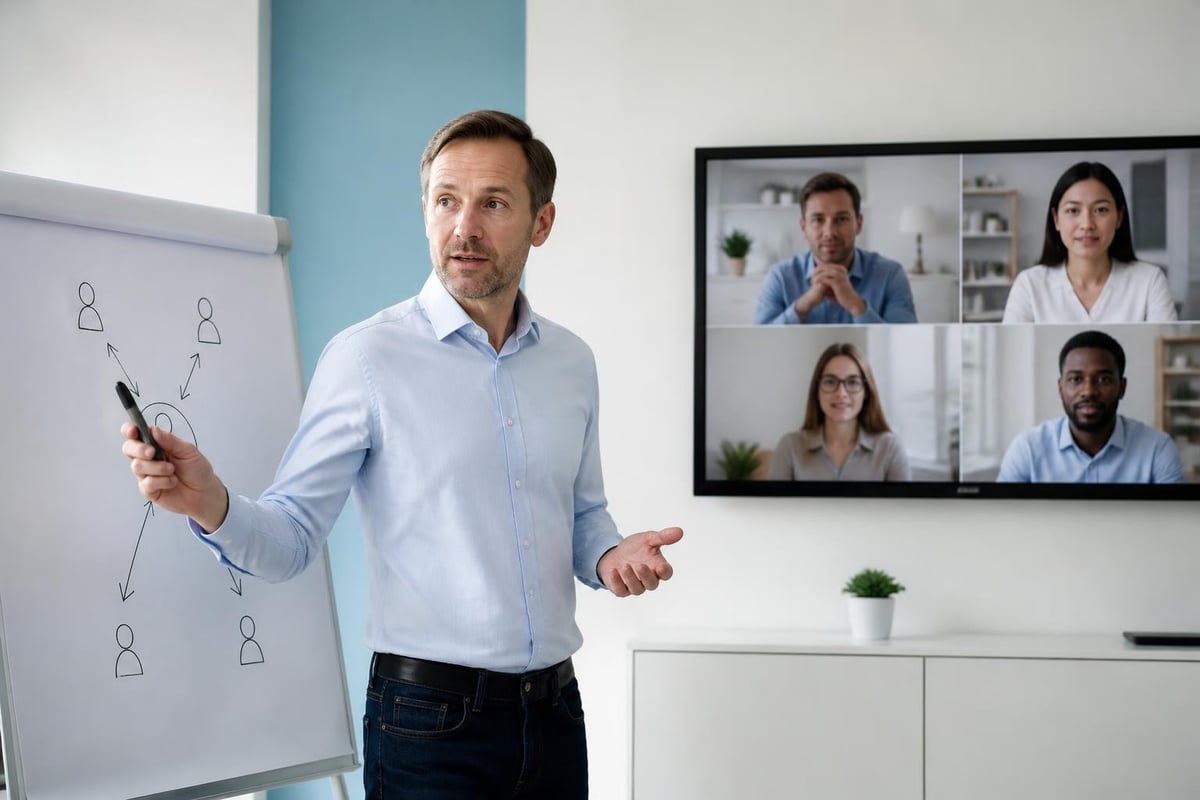
  • Inclusive meeting design that engages remote and in-office participants equally
  • Proactive communication about context, priorities, and changes
  • Coaching conversations that develop capability without constant oversight

The capability gap shows up as passive-aggressive compliance. Managers follow the letter of hybrid policies while undermining the spirit. All-hands meetings scheduled during designated remote days. Important decisions made in hallway conversations. Promotion considerations that favor office-visible employees.

Manager competencies for hybrid leadership

A manufacturing organization invested heavily in hybrid technology but saw minimal adoption. Diagnosis revealed manager resistance rooted in capability gaps. They didn't know how to lead teams they couldn't see.

The solution wasn't better policy communication. It was targeted development. Executive coaching for manufacturing leaders focused on adapting their existing strengths to distributed environments. Production managers learned to run shift handoffs virtually. Engineering leads redesigned problem-solving sessions for hybrid participation. Quality directors developed remote audit protocols.

Performance improved not because managers believed in hybrid, but because they developed competence in hybrid leadership. Confidence followed capability.

Measuring What Actually Matters

Most organizations measure hybrid success through the wrong metrics. Office utilization rates. Badge swipe data. Video call duration. These track activity, not outcomes.

Leaders designing hybrid work policies that hold up in 2027 anchor measurement to business results:

  1. Delivery velocity on strategic initiatives
  2. Customer satisfaction scores and retention
  3. Innovation metrics like patents filed or products launched
  4. Employee engagement through pulse surveys and exit interviews
  5. Talent acquisition success and time-to-fill rates

A financial services firm abandoned badge tracking after discovering it measured nothing useful. High performers badge-swiped least. Struggling teams showed high office presence. The correlation was inverse to assumptions.

They redesigned measurement around quarterly business reviews. Each team presented results against objectives, collaboration effectiveness, and development progress. Location became one variable among many, not the primary indicator. Leadership development plans helped managers shift from monitoring inputs to coaching outcomes.

The insight: what gets measured shapes behavior. Measure presence, get presence theater. Measure results, get results focus.

The Flexibility Paradox Executives Struggle With

Hybrid flexibility sounds universally positive until leaders face its implications. Some employees will optimize for personal preference over team needs. Some managers will struggle with autonomy. Some projects will suffer from coordination gaps.

The paradox: rigid policies prevent abuse but kill engagement. Total flexibility enables abuse and creates inequity. The middle path requires judgment, which executives hate because it's not scalable or defensible.

High-trust organizations resolve this through cultural norms and accountability systems. Low-trust organizations default to control mechanisms that breed resentment.

The trust differential shows up in how organizations handle edge cases. An employee requests full remote work in another state. A team wants to shift from three days in-office to one. A manager wants daily standups while team prefers asynchronous updates.

High-trust response: "What problem are we solving? What's the impact? What's the trial period and success criteria?"

Low-trust response: "Policy says three days. Everyone follows policy. Exceptions create precedent."

A healthcare organization faced this when a top performer requested relocation. Policy mandated local residence. Losing the employee would cost 18 months of institutional knowledge and $300,000 in recruitment and ramp-up.

They piloted a remote arrangement with defined deliverables, quarterly reviews, and travel requirements. Performance exceeded on-site period. They extended the arrangement and updated policy to allow exceptions based on role requirements and performance history.

The lesson isn't "grant all requests." It's "apply judgment informed by business impact, not rigid adherence to rules designed for different contexts."

The Equity Questions That Derail Implementation

Hybrid work policies that hold up in 2027 address equity explicitly. Who gets flexibility? Who doesn't? How do you prevent two-tier systems where office workers advance faster?

These aren't theoretical concerns. They're litigation risks and cultural fractures waiting to happen.

Common equity gaps:

  • Customer-facing roles require presence while knowledge workers enjoy flexibility
  • Junior employees need in-office mentorship while senior staff work remotely
  • Global teams face timezone constraints that domestic teams avoid
  • Caregivers disproportionately use flexibility, creating advancement gaps

A technology company discovered equity gaps through exit interviews. Women and caregivers cited flexibility as retention drivers. But promotion data showed office-present employees advanced 30% faster. The hybrid policy created flexibility on paper while maintaining proximity bias in practice.

Hybrid work equity considerations

They addressed this through structured interventions:

  • Calibration sessions reviewed promotion candidates with explicit proximity bias discussions
  • Sponsorship programs connected remote high-performers with executive advocates
  • Career development tied to deliverables and impact, not office visibility
  • Team rituals designed for hybrid inclusion, not office-centric defaults

Progress required vigilance, not just policy updates. Executive coaching helped leaders recognize their own proximity bias and develop countering behaviors.

Lessons From Organizations That Got It Right

Organizations with hybrid work policies that hold up in 2027 share common patterns. They didn't copy competitors. They didn't mandate uniformity. They built systems aligned with their culture, talent strategy, and business model.

Case Study: Regional Bank

Problem: Branch operations required presence. Corporate functions demanded flexibility. One-size policy satisfied neither.

Diagnosis: Role requirements varied more than organization admitted. Treating all employees identically created false fairness that frustrated everyone.

Solution: Differentiated policies by function with transparent criteria. Branch roles had structured schedules with predictability. Corporate roles had team-level autonomy with accountability frameworks. Cross-functional projects defined collaboration requirements upfront.

Result: Turnover decreased 25% in corporate functions. Branch satisfaction improved through schedule predictability. Customer service metrics exceeded pre-hybrid levels.

Lesson: Fairness doesn't mean identical treatment. It means appropriate treatment based on role requirements and business needs.

Case Study: Professional Services Firm

Problem: Client-facing expectations conflicted with employee flexibility demands. Partners wanted daily office presence. Associates wanted remote options.

Diagnosis: Partners confused their preferences with client requirements. Actual client feedback showed indifference to employee location if deliverables met expectations.

Solution: Separated client requirements from partner preferences. Teams set location based on client meetings, collaboration needs, and deliverables. Partners received coaching on leading distributed teams.

Result: Client satisfaction increased. Associate retention improved 40%. Billable hours remained stable while recruiting competitiveness strengthened.

Lesson: Challenge assumptions about "what clients want" with actual client data. Often, internal preferences masquerade as external requirements.

Preparing Policies for Economic and Technological Shifts

Hybrid work policies that hold up in 2027 anticipate economic cycles and technological evolution. What works in tight labor markets fails in downturns. What's impossible today becomes standard tomorrow.

Economic contraction tempts executives to reduce flexibility and increase mandates. "We're paying you, you'll come to the office." This shortsighted response damages cultures and loses top talent who have options.

Recession-proof hybrid policies:

  • Anchor to performance, not labor market leverage
  • Maintain flexibility as cultural commitment, not market response
  • Use downturns to strengthen manager capability, not increase control
  • Invest in technology that enables distributed collaboration
  • Focus on productivity improvements that justify flexibility

A manufacturing company maintained hybrid flexibility through the 2025 recession. Competitors mandated full return. They absorbed top talent fleeing rigidity. When markets recovered, they outpaced competitors through enhanced capability and culture.

Technological shifts present different challenges. AI-enabled collaboration tools, virtual reality meetings, and productivity monitoring create new possibilities and risks. Policies need frameworks that accommodate tools that don't exist yet.

The approach: establish principles about how work gets done, measured, and improved. Then allow technology to evolve within those guardrails. Don't write policies around specific tools. Write policies around outcomes and adapt tools to support them.

Frequently Asked Questions

What's the ideal number of office days per week in 2027?

There isn't one. Role requirements, team dynamics, and business models vary too much for universal prescriptions. Organizations succeed when they define decision frameworks, not fixed schedules. Teams with deep interdependence and rapid iteration need more synchronous time. Independent contributors with clear deliverables need less. The question isn't "how many days" but "what outcomes require what collaboration, and what's the minimum viable presence to achieve them?"

How do you prevent productivity loss in hybrid environments?

By measuring productivity correctly. Most "productivity loss" fears stem from monitoring activity instead of outcomes. High performers deliver regardless of location when expectations are clear and obstacles are removed. The real productivity risks are unclear deliverables, ineffective meetings, communication gaps, and manager inability to coach remotely. Address those, and location becomes one variable among many rather than the primary concern.

Should hybrid policies be company-wide or team-specific?

Both. Company-wide principles establish equity, compliance, and cultural commitments. Team-specific applications translate principles into practice based on role requirements and collaboration needs. The framework is universal. The implementation is contextual. This prevents both the chaos of complete autonomy and the rigidity of uniform mandates.

What happens when employees abuse hybrid flexibility?

The same thing that happens when employees abuse office presence: you address performance through management, not policy restriction. Abuse cases are performance issues, not policy failures. If someone isn't delivering, the conversation is about results and accountability, regardless of work location. Restricting flexibility for everyone because of individual performance gaps is collective punishment that damages culture and loses top talent.

How do you maintain culture in hybrid environments?

By being intentional about what creates culture. It's not osmosis from proximity. It's shared experiences, clear values, consistent leadership behavior, and meaningful connection. Hybrid organizations that maintain strong cultures design rituals, communication rhythms, and development experiences that work across locations. They invest in team coaching that builds cohesion independent of physical presence. Culture weakens when leaders assume it happens automatically, whether in-office or hybrid.

Do hybrid policies affect legal compliance differently?

Yes, across multiple dimensions: employment classification, tax obligations, workers' compensation, data security, and workplace safety. Hybrid introduces complexity because legal frameworks were built for fixed workplaces. Organizations need legal counsel to navigate multi-state employment, cross-border data flows, and home office safety obligations. Ignoring compliance risks creates liabilities that emerge years after policy implementation.


Hybrid work policies that survive past 2027 distinguish between presence and performance, building flexibility into organizational DNA rather than treating it as a temporary accommodation. The executives who get this right focus on developing manager capability, measuring actual outcomes, and creating principle-based frameworks that adapt without constant revision. Noomii Leadership Coaching helps organizations build these capabilities through targeted executive development, manager coaching, and leadership assessments that identify gaps before they become cultural fractures.

CFO Coaching: What Finance Leaders Actually Need in 2026

Chief Financial Officers face pressure unlike any prior generation. They're expected to drive AI transformation, build cross-functional capabilities, own business partnering relationships, and develop talent while managing traditional finance operations. The Hackett Group’s CFO Agenda research confirms that talent development and business partnering rank among finance's most critical priorities. Yet most cfo coaching programs remain anchored to executive presence workshops and leadership theory rather than the operational realities finance leaders navigate daily.

Why CFO Coaching Fails When Disconnected from Finance Operations

Most executive coaching treats finance leaders like generic C-suite executives. Coaches with no finance background deliver frameworks built for marketing VPs or operations directors, missing the unique challenges CFOs face.

The credential trap is especially damaging in finance coaching. A coach with an ICF credential but zero P&L experience cannot diagnose why a CFO's business partnering falls flat or why their finance team resists analytical work beyond month-end close. They default to personality assessments and communication styles while the real problem is capability gaps, unclear KPIs, or process dysfunction.

CFO coaching accountability framework

Real cfo coaching starts with finance-specific outcomes:

  • Faster, more accurate forecasting and scenario planning
  • Finance teams that proactively surface insights, not just reports
  • Business unit leaders who trust and seek CFO counsel
  • Succession-ready finance directors and controllers
  • Clear operational cadence linking strategy to execution

When coaching stays theoretical, CFOs waste time on reflection exercises while their teams struggle with basic analytical thinking or their business partners ignore finance recommendations.

What Evidence Says About Effective CFO Development

Research on workplace coaching effectiveness demonstrates that coaching delivers measurable outcomes when tied to specific performance goals and organizational context. Generic leadership development rarely transfers to improved finance operations.

The Business Partnering Gap

EY’s DNA of the CFO research reveals that strategic value creation and AI integration now define CFO success. Yet most finance leaders built careers on technical excellence and controls, not influencing cross-functional strategy or translating AI capabilities into finance processes.

Effective cfo coaching addresses this gap directly:

  1. Live coaching in business review meetings where the CFO must challenge assumptions, reframe problems, and drive decisions
  2. Real-time feedback on how financial insights land with non-finance executives
  3. Preparation for board presentations with focus on storytelling, risk framing, and actionable recommendations
  4. Team capability building so finance directors develop business partnering skills, not just technical competence

Coaching that happens outside actual finance operations rarely improves finance operations. The CFO learns to articulate vision in coaching sessions but cannot translate that into how their team runs monthly business reviews or builds rolling forecasts.

The ROI Framework for CFO Coaching

Finance leaders think in metrics, ROI, and accountability. Coaching programs that cannot articulate measurable outcomes lose credibility immediately.

Outcome Category Measurement Approach Typical Timeline
Business Partnering Quality Survey scores from business unit leaders, meeting participation 90-120 days
Team Capability Assessment scores, promotion readiness, analytical output quality 6-9 months
Decision Speed Time from analysis to decision, forecast accuracy 60-90 days
Strategic Contribution Board/CEO feedback, strategy session impact 4-6 months

Deloitte’s analysis of CFO capability building emphasizes that talent development cannot be separated from operational improvement. When CFOs improve, their teams must improve simultaneously, or the organization sees no sustainable change.

The Team Coaching Component

Most cfo coaching ignores the finance team entirely. The CFO receives personal coaching while controllers, FP&A directors, and finance managers continue operating with the same capability gaps that created problems initially.

Practical CFO coaching includes team development:

  • Coaching finance directors on analytical thinking and communication during actual business reviews
  • Building 360 assessments that measure business partnering effectiveness, not just technical skills
  • Establishing operating cadence and KPI scorecards that connect finance work to business outcomes
  • Creating manager training focused on developing talent, not just managing deliverables

When you coach the CFO without coaching their team, you create isolated improvement. The CFO articulates better strategy in executive meetings but cannot execute because their team lacks the skills to deliver.

Finance team capability development

AI, Automation, and the Evolving CFO Role

Recent coaching scholarship explores how coaching must adapt as AI tools change work fundamentally. For CFOs, this shift is immediate and operational, not theoretical.

Finance leaders in 2026 face questions most executive coaches cannot address:

  • Which finance processes deserve AI investment versus process redesign?
  • How do we retrain accountants for analytical work when automation handles reconciliation?
  • What does business partnering look like when AI generates insights faster than humans?
  • How do I build finance team capability when half the technical work disappears?

CFO coaching that ignores these realities is obsolete before it begins. Coaches fixated on emotional intelligence and executive presence miss that the CFO's actual challenge is leading capability transformation while maintaining finance operations during disruption.

The Contrarian Reality

Here's what most CFO coaching programs won't tell you: credentials and coaching hours matter far less than finance expertise and operational involvement.

A coach who spent fifteen years as a CFO or finance VP but never earned a coaching certification will typically deliver more value than an ICF Master Certified Coach who has never built a rolling forecast or led a business review. The former understands finance decision-making, capability gaps, and business partnering dynamics. The latter understands coaching methodology.

The best cfo coaching combines both. But when forced to choose, finance expertise trumps coaching credentials every time.

Building Accountable Finance Leaders

Accountability separates effective coaching from expensive conversations. CFOs operate in a results-driven environment where missed forecasts, slow closes, and weak business partnering have visible consequences.

Coaching must match this accountability:

  • Month-to-month engagements where results determine continuation, not long contracts
  • Clear KPIs linking coaching activities to business outcomes
  • Live operational coaching in meetings, reviews, and team sessions where improvement is measurable
  • Aligned incentives where coaching fees tie to organizational results when feasible

This approach makes coaching organizations uncomfortable because it shares risk. But it makes CFOs confident because outcomes are visible, not theoretical.

Exploring top executive coaching firms reveals wide variation in accountability models. Most sell twelve-month programs with soft deliverables and generic leadership assessments. Few tie fees to measurable business results or offer month-to-month terms.

CFO coaching accountability model

Practical Implementation for Mid-Market Companies

Mid-market organizations face unique challenges. They need CFO-level capability but often have controllers or finance directors carrying CFO responsibilities without CFO experience or development.

Effective cfo coaching in mid-market contexts includes:

  1. Diagnosing whether the finance leader needs coaching, restructuring, or team capability building first
  2. Establishing operating cadence and KPI frameworks before coaching individual executives
  3. Building business partnering relationships through joint meetings with business unit leaders
  4. Developing succession-ready talent so finance leadership isn't single-threaded
  5. Creating manager training programs that build coaching capability throughout finance

The mid-market advantage is speed. Smaller organizations implement changes faster, see results quicker, and adapt coaching focus based on what's working. Large enterprise coaching programs often run for months before anyone measures actual outcomes.

Choosing CFO Coaching That Delivers

When evaluating cfo coaching options, finance leaders should demand evidence, not promises:

  • Ask for specific CFO engagements with measurable before-and-after outcomes in business partnering, team capability, or operational metrics
  • Request references from other CFOs, not HR executives who selected the coach
  • Evaluate finance expertise, not just coaching credentials or testimonials
  • Require clear KPIs and ROI frameworks before signing contracts
  • Insist on operational involvement where coaches observe and provide feedback in actual finance operations

The coaches who resist these requirements reveal their model: sell coaching hours, deliver sessions, move to next client. The coaches who embrace them reveal their model: deliver measurable results, prove value, earn continuation.

FAQ: CFO Coaching

What makes CFO coaching different from general executive coaching?

CFO coaching must address finance-specific challenges like business partnering with non-finance executives, building analytical capability in finance teams, leading through automation and AI disruption, and translating financial insights into strategic decisions. Generic executive coaching misses these operational realities.

How long does effective CFO coaching typically take?

Initial business partnering improvements appear in 60-90 days when coaching includes live operational work. Team capability development takes 6-9 months. Sustainable transformation with succession-ready talent requires 12-18 months. Coaches promising faster results or demanding multi-year contracts should raise questions.

Should CFO coaching include the finance team or just the CFO?

Coaching only the CFO creates isolated improvement that rarely translates to organizational outcomes. Effective programs include coaching finance directors and managers on business partnering, analytical thinking, and team development so the entire finance function improves.

What credentials should I look for in a CFO coach?

Finance experience trumps coaching credentials. A former CFO or finance VP with operational expertise typically delivers more value than an ICF-certified coach with no finance background. The ideal combination includes both finance expertise and coaching methodology.

How do you measure ROI from CFO coaching?

Track business partnering quality through stakeholder surveys, decision speed through meeting outcomes, team capability through 360 assessments and analytical output quality, and strategic contribution through board and CEO feedback. Connect these metrics to specific coaching activities and timeline.

What's the typical cost structure for CFO coaching?

Models vary widely. Traditional executive coaching runs $300-$800 per hour with 12-month minimums. Results-based models offer month-to-month terms with fees tied to outcomes. Mid-market organizations should expect $3,000-$8,000 monthly for comprehensive CFO and team coaching.

Can CFO coaching work remotely or does it require in-person sessions?

Live operational coaching in meetings, business reviews, and team sessions delivers the fastest results regardless of location. Pure video coaching sessions work for some skill development but miss the real-time feedback opportunities that accelerate business partnering improvement.

What are the biggest mistakes companies make when selecting CFO coaching?

Prioritizing credentials over finance expertise, accepting vague outcomes instead of clear KPIs, signing long contracts without proof of results, excluding the finance team from development, and choosing coaches who won't engage in actual finance operations.

How does AI impact CFO coaching needs in 2026?

AI accelerates the shift from technical finance work to analytical thinking and business partnering. CFOs need coaching on leading capability transformation, retraining finance teams for higher-value work, and integrating AI tools into finance processes while maintaining operations during disruption.


CFO coaching delivers measurable outcomes when it focuses on finance-specific challenges, includes team capability building, and ties results to clear operational metrics. Most coaching fails because it prioritizes credentials over finance expertise and theory over operational involvement. If you're ready for practical corporate coaching that develops finance leaders and teams through live operational work tied to KPIs and business results, explore how Noomii connects mid-market companies with coaches who share accountability for outcomes, not just coaching hours.

Leading Through Economic Uncertainty in 2027

The economic signals heading into 2027 tell a contradictory story. Inflation pressures persist in certain sectors while others face deflationary risks. Labor markets show simultaneous talent shortages and rising unemployment in discrete industries. Central banks diverge on monetary policy. Geopolitical tensions create supply chain volatility that undermines even sophisticated forecasting models. For boards and senior executives, the uncomfortable truth is this: the playbooks that worked in previous downturns are proving insufficient. Leading through economic uncertainty in 2027 requires fundamentally different capabilities than crisis management in 2008 or pandemic response in 2020.

What Most Leaders Are Getting Wrong About 2027

The biggest mistake organizations are making right now is treating economic uncertainty as a temporary condition requiring defensive posture. After auditing leadership responses across government agencies and Fortune 500 companies in late 2026, a clear pattern emerged: executives are optimizing for scenarios that may never materialize while ignoring the structural shifts already underway.

Three diagnostic findings stand out:

  • Senior teams are modeling two to three economic scenarios but failing to build adaptive capacity that works across all of them
  • Leadership communication emphasizes reassurance over transparency, eroding trust precisely when it matters most
  • Workforce planning remains anchored to pre-2025 assumptions about skills, retention, and productivity

The OECD Employment Outlook 2026 confirms what many CHROs already sense: the skills gap is widening faster than talent development programs can address. Organizations that continue incremental adjustments to learning and development will find themselves unable to execute strategy regardless of which economic scenario unfolds.

The Transparency Paradox

Here's what the data shows. In organizations where leaders increased communication frequency during uncertainty, employee confidence declined if the messaging lacked substance. Generic reassurances, vague commitments to "weather the storm," and selective disclosure of challenges backfire.

The executives getting this right in 2027 are doing something uncomfortable. They're sharing what they don't know alongside what they do know. They're explaining decision-making processes, not just decisions. They're acknowledging trade-offs explicitly rather than presenting every choice as optimal.

Leadership communication framework

Building Decision-Making Capacity Under Pressure

Leading through economic uncertainty in 2027 exposes a capability gap most organizations didn't know existed: executives struggle to make sound decisions when traditional forecasting tools lose reliability. The problem isn't intelligence or experience. It's that most leadership teams have been operating in environments where reasonable prediction was possible.

A government agency we worked with in Q3 2026 illustrates this. Their senior executives had decades of public sector experience, strong technical credentials, and clear mission alignment. But when budget uncertainty collided with workforce retention challenges and shifting policy priorities, decision quality deteriorated rapidly.

The diagnosis revealed four patterns:

  1. Analysis paralysis when facing decisions with incomplete information
  2. Binary thinking that missed creative alternatives
  3. Anchoring to historical precedents even when contexts had changed
  4. Delayed decisions that compounded problems

The intervention wasn't about decision-making frameworks or analytical tools. Those weren't lacking. The core issue was executive confidence operating outside familiar parameters. Through targeted leadership coaching, the team developed capacity to make defensible decisions with ambiguous data, adjust course based on emerging information, and communicate rationale clearly to stakeholders.

Results were measurable. Decision cycle time decreased 40%. Employee confidence in leadership direction increased based on internal surveys. Most importantly, the quality of strategic choices improved as evidenced by outcomes six months later.

The Judgment vs. Analysis Question

Here's what separates effective executives in uncertain environments: they know when to demand more analysis and when to act on judgment. The 2026 Global Leadership Study identifies this discernment as one of the strongest predictors of organizational performance during prolonged volatility.

Too many leadership teams default to requesting additional analysis as a way to defer difficult choices. The request feels responsible. It buys time. It signals thoroughness. But it often masks discomfort with ambiguity and creates the illusion that perfect information is achievable.

The alternative isn't reckless decisiveness. It's building the muscle to distinguish between decisions that benefit from more data and those that require making the best call with what's available, then adapting as you learn.

Workforce Stability When Retention and Hiring Both Matter

The labor market contradictions in 2027 create an impossible-seeming challenge: organizations need to reduce costs while simultaneously competing for scarce talent. Layoffs in one department while offering signing bonuses in another. Budget freezes that exempt critical technical roles. Deferred compensation increases alongside urgent recruitment.

This isn't poor planning. It's the reality of leading through economic uncertainty in 2027 when different parts of the same organization face opposite pressures.

What doesn't work: treating this as primarily a compensation problem. What also doesn't work: expecting managers to navigate these contradictions without support, clarity, and skill development.

Ineffective Approach Why It Fails Evidence-Based Alternative
Uniform hiring freeze Loses critical capabilities; competitors recruit your best people Surgical workforce planning tied to strategic priorities
Across-the-board cuts Damages high-performing teams; creates equity problems Targeted restructuring with clear rationale
Manager discretion without guidelines Inconsistent decisions; legal exposure; cultural damage Structured decision frameworks with leadership coaching

A financial services organization we supported in early 2026 faced this exact scenario. They needed to reduce headcount by 12% while protecting specialized capabilities in risk management and digital infrastructure. The initial plan involved voluntary buyouts and manager-led decisions about which roles to eliminate.

Problem: Managers lacked the frameworks, confidence, and skills to make these decisions well. Early voluntary departures skewed toward high performers with options. Remaining decisions were delayed, creating prolonged uncertainty that damaged productivity and morale.

Diagnosis: The issue wasn't manager competence broadly. It was lack of preparation for this specific challenge. Most had never led through significant restructuring. They needed decision criteria, communication skills, and support processing the emotional weight of these choices.

Solution: Rapid deployment of coaching for 45 managers leading affected teams. Focus areas included decision frameworks for role evaluation, skills for difficult conversations, and personal resilience. Parallel work with senior executives on transparent communication and support systems.

Result: Restructuring completed in defined timeline with retention of 94% of identified critical talent. Employee survey data showed trust in leadership remained stable, unusual during workforce reductions. Managers reported the coaching as essential to their effectiveness, with several requesting ongoing support for other challenges.

Lesson: Workforce decisions in uncertain times aren't HR projects. They're leadership capability challenges. Organizations that invest in developing this capability see measurably better outcomes across retention, productivity, and cultural health.

Workforce planning framework

Mental Health and Productivity Are Not Trade-Offs

Economic uncertainty creates documented mental health impacts on employees and leaders. Anxiety about job security. Stress from increased workloads as organizations operate leaner. Uncertainty about career progression when promotions freeze. The WHO guidelines on mental health at work provide evidence-based recommendations, yet most organizations still treat mental health support as an employee benefit rather than a performance imperative.

Here's the reframe leaders need. Mental health isn't a competing priority against productivity. It's a prerequisite for sustained performance under pressure. The executives who understand this are making different investments than their peers.

What the Data Shows

Organizations that strengthened mental health support and psychological safety during 2026 economic volatility saw:

  • 23% higher employee engagement scores compared to industry peers
  • Lower turnover among high performers
  • Faster recovery of productivity metrics after restructuring events
  • Reduced absenteeism and short-term disability claims

These aren't soft outcomes. They're measurable impacts on organizational capability during exactly the conditions where you can least afford degraded performance.

The intervention that works isn't adding an EAP benefit or mental health awareness training, though those can be components. It's equipping leaders at every level to recognize signs of declining mental health, have supportive conversations, connect people to resources, and model healthy boundaries themselves.

A Fortune 500 manufacturer implemented this approach in their operations leadership during 2026. Plant managers and shift supervisors received coaching on having conversations about stress, workload, and mental health without overstepping into clinical territory. They learned to normalize seeking support and identify when someone needed intervention versus encouragement.

Six months later, the facilities with coached leaders showed 31% lower turnover and 18% higher productivity compared to control sites. The ROI calculation was straightforward: the coaching investment was recovered within the first quarter through retention and productivity gains alone.

The Executive Presence Question Leaders Aren't Asking

There's an underexamined aspect of leading through economic uncertainty in 2027: what executive presence actually means when conditions are volatile and answers are scarce. The traditional markers still matter. Composure under pressure. Clear communication. Confident decision-making. But they're insufficient.

The leaders generating confidence among boards, teams, and stakeholders right now demonstrate something additional: intellectual honesty about complexity and comfort with adapting positions as conditions change.

This runs counter to conventional wisdom about executive presence, which often emphasizes projection of certainty and consistency. But employees, board members, and investors are sophisticated enough to recognize when certainty is performance versus substance.

Three capabilities distinguish effective executive presence in 2027:

  1. Explaining reasoning, not just conclusions. "Here's our decision and why" builds more confidence than "Here's our decision and it's the right one."

  2. Acknowledging information that would change the approach. "We'll maintain this strategy unless X, Y, or Z happens, at which point we'd reconsider" demonstrates strategic thinking rather than rigidity.

  3. Distinguishing between principles and tactics. "These values and priorities won't change; how we pursue them will adapt" provides stability and flexibility simultaneously.

For boards and senior executives who built careers when demonstrating unwavering certainty was valued, this shift requires conscious development. Executive coaching programs that address communication under uncertainty show measurable impact on stakeholder confidence and team performance.

Executive presence evolution

Scenario Planning That Actually Drives Decisions

Most organizations conduct scenario planning. Few use it effectively to drive actual decisions and build organizational adaptability. The typical approach involves developing three scenarios (optimistic, pessimistic, most likely), analyzing implications, then anchoring planning to the "most likely" case with minor hedges.

This fails in environments like 2027 where the range of plausible outcomes is wide and probabilities are genuinely uncertain. A better approach treats scenario planning as capability building rather than forecasting.

Here's how that works in practice. A technology company facing regulatory uncertainty, shifting customer priorities, and talent competition used scenario planning differently in late 2026. Instead of trying to predict which scenario would unfold, they identified decisions and capabilities that would be valuable across multiple scenarios.

Decision Area Traditional Approach Adaptive Approach
Product roadmap Optimize for most likely market conditions Invest in modular capabilities that work across scenarios
Talent strategy Hire for current needs plus margin Build skills for rapid capability shifts
Capital allocation Commit based on forecasted returns Maintain optionality; staged investments
Partnership decisions Long-term commitments to key partners Flexible arrangements that adjust with conditions

The result wasn't perfect prediction. It was an organization that could execute effectively regardless of which scenario materialized. When market conditions shifted twice in Q4 2026 in ways no scenario had anticipated, they adapted faster than competitors who had optimized for a specific forecast.

This approach to leading through economic uncertainty in 2027 requires senior teams to think differently about planning itself. The goal isn't eliminating uncertainty through better analysis. It's building organizational capacity to perform across a range of conditions.

Communication Patterns That Build vs. Erode Trust

The research on communicating with teams during tough times emphasizes transparency and frequency. Both matter. But execution determines whether communication builds confidence or accelerates anxiety.

Patterns that erode trust during uncertainty:

  • Sudden communication after periods of silence
  • Messages that answer questions nobody asked while avoiding difficult topics
  • Tone-deaf optimism that dismisses legitimate concerns
  • Inconsistent messaging across leadership levels
  • Lack of follow-through on commitments made in previous communications

Patterns that build trust:

  • Regular cadence maintained regardless of news quality
  • Direct acknowledgment of challenges and unknowns
  • Specific information about decision processes and timing
  • Clear explanation of what's changing and what remains stable
  • Two-way dialogue that incorporates questions and feedback

A healthcare organization demonstrated this distinction during 2026 reimbursement uncertainty. Their CEO established weekly video updates covering three topics consistently: what we know, what we don't know, and what we're doing. The format created predictability even when content revealed difficult information.

Employee survey data tracked throughout the period showed trust in leadership remained high despite objective challenges. When difficult decisions became necessary, implementation went more smoothly than in peer organizations because trust capital had been built through months of transparent communication.

For organizations evaluating whether their communication approach is working, employee feedback provides clear signals. But so do behavioral indicators: rumor activity, retention of key talent, productivity levels, and the quality of questions leaders receive.

Developing Leaders for Conditions That Don't Exist Yet

The final challenge of leading through economic uncertainty in 2027 is this: how do you develop leadership capability for conditions you can't fully anticipate? Traditional leadership development programs assume relatively stable contexts. They build skills for known challenges. That model breaks down when the challenges themselves are unpredictable.

The organizations solving this are shifting from competency-based development to capability-based development. The distinction matters. Competencies are specific skills for defined situations. Capabilities are adaptive capacities that work across varying conditions.

Critical capabilities for leading through sustained uncertainty:

  • Sense-making under ambiguity: Processing weak signals, distinguishing noise from pattern, updating mental models
  • Emotional regulation under pressure: Managing personal stress responses to make sound decisions when stakes are high
  • Stakeholder navigation: Building and maintaining trust with diverse groups who have conflicting interests
  • Ethical clarity: Making decisions that align with values when pressure exists to compromise
  • Team resilience: Supporting collective performance and morale through setbacks and changes

These capabilities don't develop through classroom training alone. They require experience, reflection, feedback, and coaching. Organizations seeing the strongest leadership development outcomes are combining real challenges with targeted support. Leaders work on actual business problems while receiving coaching on the underlying capabilities those problems demand.

A government agency implemented this approach in 2026 for their senior executive service members. Rather than sending leaders to general management programs, they paired high-stakes projects with expert coaches who had sector-specific experience. The projects addressed real organizational challenges. The coaching developed capabilities leaders would need for future challenges they couldn't yet see.

Nine months later, independent evaluation showed measurably stronger performance on the capability dimensions compared to control groups. More importantly, these leaders reported greater confidence handling unexpected challenges, the exact outcome needed for sustained uncertainty.

FAQ

What makes leading in 2027 different from previous economic downturns?

The 2027 environment combines multiple simultaneous uncertainties across monetary policy, geopolitical stability, labor markets, and technological disruption. Unlike 2008 (primarily financial) or 2020 (pandemic-driven), leaders face contradictory pressures with no clear timeline for resolution, requiring adaptive capacity rather than crisis response playbooks.

How should organizations balance cost reduction with retaining critical talent?

Effective approaches use surgical workforce planning tied to strategic capabilities rather than across-the-board cuts. This requires clear criteria for role evaluation, transparent communication about decisions, and coaching for managers making difficult calls. Organizations that invest in developing these leadership capabilities see 20-30% better retention of critical talent during restructuring.

What role does leadership coaching play during economic uncertainty?

Coaching addresses the capability gaps that emerge when leaders face unfamiliar conditions. Targeted interventions develop decision-making under ambiguity, communication during stress, and personal resilience. Measurable outcomes include faster decision cycles, higher team confidence, and better strategic choices evidenced by six-month results.

How can leaders communicate effectively when they don't have answers?

The most effective approach involves regular communication covering three areas: what's known, what's unknown, and what's being done. Transparency about uncertainty builds more trust than false certainty. Leaders should explain decision processes and criteria, not just outcomes, and maintain consistent cadence regardless of news quality.

What metrics should boards use to evaluate leadership effectiveness during volatility?

Beyond financial metrics, boards should track decision quality (measured by outcomes over time), retention of critical talent, employee confidence in leadership direction, speed of strategic adaptation, and organizational resilience indicators. These leading indicators predict performance capacity regardless of which economic scenario unfolds.

How do you develop leaders for conditions that haven't happened yet?

Shift from competency-based training to capability-based development. Focus on adaptive capacities like sense-making under ambiguity, emotional regulation under pressure, and ethical clarity in difficult situations. Combine real business challenges with coaching that develops underlying capabilities transferable across varying conditions.


Leading through economic uncertainty in 2027 demands capabilities most organizations haven't systematically developed: decision-making with incomplete information, transparent communication during stress, and adaptive capacity across unpredictable conditions. The executives and boards who recognize this gap and invest in targeted leadership development will outperform peers regardless of which economic scenario materializes. Noomii Leadership Coaching helps organizations build these capabilities through evidence-based diagnostics, precision coach matching, and measurable intervention plans that address the specific leadership challenges your teams face right now.

Mastermind Coach: What Works Beyond Hype in 2026

The mastermind coach market has exploded since 2020, but most groups dissolve within six months. Why? Because running a high-performing peer group requires more than scheduling calls and collecting checks. The best mastermind coaches build structured frameworks, enforce accountability, and tie outcomes to business KPIs-not just facilitated conversation and emotional support. If you're evaluating a mastermind coach for your leadership team or considering running groups yourself, understanding what separates effective facilitation from expensive networking matters more than ever.

What a Mastermind Coach Actually Does

A mastermind coach facilitates structured peer groups where leaders solve real problems, share insights, and hold each other accountable to measurable outcomes. Unlike traditional executive coaching, which focuses on one-on-one development, the mastermind format leverages collective intelligence and peer pressure.

The role breaks down into three core functions:

  • Curating the right mix of participants based on experience, industry, challenge type, and psychological safety needs
  • Designing frameworks for problem-solving, decision-making, and progress tracking across sessions
  • Holding accountability through structured check-ins, KPI reviews, and consequence mechanisms when members don't follow through

The best mastermind coaches don't just moderate discussion. They diagnose stuck patterns, redirect unproductive conversations, and push members toward actionable commitments with clear metrics.

The Hidden Risk Most Groups Miss

Here's what certification programs and marketing materials won't tell you: peer influence in group mentoring can propagate both positive behaviors and negative patterns. Research shows that poorly designed groups create peer contagion, where low accountability, excuse-making, and analysis paralysis spread across members.

I've watched leadership teams pay $15,000 per person annually for mastermind groups that became expensive therapy sessions. No KPIs. No execution tracking. Just endless storytelling and commiseration.

The difference? Structure, diagnosis, and facilitation skill-not the coach's credential count.

Mastermind group accountability framework

How Effective Mastermind Coaches Build Groups That Last

Most mastermind groups fail because facilitators confuse community building with performance improvement. Harvard Business Review's research on peer groups confirms what experienced coaches already know: structure, norms, and clear outcomes determine success more than participant enthusiasm or network size.

The Framework That Works

Component What Fails What Works
Member selection Open enrollment, anyone who pays Screened criteria: revenue stage, challenge type, commitment level
Meeting cadence Monthly or inconsistent Bi-weekly with strict attendance policy and pre-work
Accountability Self-reported progress KPI scorecards reviewed by peers with consequences for missed commitments
Facilitation Rotating leadership or minimal intervention Trained facilitator who diagnoses patterns and redirects
Duration Open-ended or 12-month minimum 6-month pilot with clear exit criteria and renewal based on results

Effective leadership coaches running mastermind groups use operating cadences similar to EOS or Scaling Up: same day, same time, same agenda format. They track leading indicators (actions taken) and lagging indicators (revenue, retention, team engagement) across every cycle.

The goal isn't connection. It's measurable behavior change that shows up in business outcomes.

Mastermind Coach vs. Traditional Executive Coaching

The choice between a mastermind coach and individual executive coaching depends on the problem you're solving and the leader's readiness for peer accountability.

Mastermind coaching works best when:

  1. Leaders need diverse perspectives from peers facing similar challenges
  2. The organization wants to build internal peer accountability systems
  3. Budget constraints make one-on-one coaching cost-prohibitive for multiple leaders
  4. Problems require pattern recognition across industries or functions
  5. Isolation at the top creates blind spots that peers can expose

Traditional executive coaching works better when:

  • The leader needs confidential space for sensitive issues (board conflicts, performance management, career transitions)
  • Deep behavioral change requires sustained one-on-one diagnosis and practice
  • The problem is highly technical or role-specific rather than broadly strategic
  • The executive's schedule or geography makes consistent group participation impossible

I've seen companies waste money on mastermind programs when leaders actually needed intensive executive coaching to address core competency gaps. Conversely, I've watched expensive one-on-one engagements drag on for years when a well-run peer group would have accelerated progress through accountability and diverse input.

Coaching format comparison

What Buyers Miss When Evaluating Mastermind Coaches

Most organizations select mastermind coaches based on personality, network size, or credentials. Here's what actually predicts success:

  • Track record of measurable outcomes in groups they've run (revenue growth, retention improvement, promotion rates, not testimonials)
  • Proprietary diagnostic frameworks for member selection, problem categorization, and progress measurement
  • Accountability mechanisms with teeth (financial consequences, public commitments, group exit criteria)
  • Facilitation training specific to group dynamics, not just general coaching certification
  • Privacy and confidentiality protocols, especially critical as adaptive peer-group assignment methods become more sophisticated in digital coaching platforms

Ask prospective coaches for their retention data, not their credential alphabet soup. A mastermind coach with 80% annual retention and documented KPI improvements beats an ICF Master Certified Coach with beautiful marketing and vague transformation stories.

Running Your Own Mastermind Groups: What Actually Matters

If you're a coach or internal leadership developer considering launching mastermind groups, understand that running effective mastermind groups requires different skills than one-on-one coaching or training delivery.

Critical Success Factors

Start small and prove value. Launch with 6-8 carefully selected participants, run a 6-month pilot, and track specific KPIs. Don't scale until you've refined your process and can point to measurable outcomes.

Build real consequences into your accountability system. Financial deposits forfeited for missed commitments. Public progress reviews. Clear exit criteria for members who don't execute. Without consequences, accountability becomes suggestion.

Invest in facilitation skill, not just content expertise. Learn to diagnose group dysfunction, redirect status-seeking behavior, manage dominant personalities, and draw out quiet high-performers. These skills matter more than your resume.

Track both leading and lagging indicators. Weekly actions completed (leading). Quarterly revenue, retention, engagement scores (lagging). Share aggregate data with the group monthly to maintain focus on outcomes.

Organizations building internal peer coaching or mastermind programs often underestimate the facilitation training required. Your high-performing VP who's great at running team meetings probably lacks the diagnostic skill to manage peer group dynamics effectively. Business coaches with group facilitation experience can accelerate your internal capability development.

Mastermind group facilitation skills

When Mastermind Coaching Becomes Expensive Networking

Here's the uncomfortable truth: many mastermind programs deliver networking value but minimal performance improvement. Members enjoy the community, make connections, and feel supported. But their businesses don't materially improve.

Red flags that signal low-value mastermind coaching:

  • No pre-work or preparation required for sessions
  • Facilitator rarely interrupts or redirects conversation
  • Members share updates but don't commit to specific actions with deadlines
  • No tracking of commitments or follow-up on missed actions
  • Group size exceeds 10 (impossible to maintain real accountability)
  • Sessions focus on strategy discussion rather than execution gaps
  • No measurement of business outcomes tied to participation

The best mastermind coaches run tight ships. They're not universally loved because they push harder than members expect. They call out patterns. They enforce commitments. They exit members who don't execute.

If you want a supportive professional community, networking groups and peer circles serve that purpose beautifully. If you want business results, hire a mastermind coach who measures outcomes and holds real accountability.

Frequently Asked Questions

What qualifications should a mastermind coach have?

Focus on facilitation track record and measurable outcomes from previous groups, not coaching certifications. Look for evidence of structured frameworks, accountability mechanisms, and business results (revenue growth, retention improvement, promotion rates). Ask for retention data and references from past participants who can speak to specific KPI improvements, not general satisfaction.

How much does mastermind coaching typically cost?

Prices range from $500 to $5,000+ per person monthly, depending on facilitator experience, group size, meeting frequency, and support between sessions. High-end programs often include one-on-one coaching, custom diagnostics, and unlimited access between group calls. Evaluate cost against measurable outcomes expected and accountability mechanisms in place, not just meeting frequency or facilitator credentials. For budget planning, our guide to mastermind coach pricing breaks down what the monthly rates actually cover.

How is a mastermind coach different from a facilitator?

A mastermind coach combines facilitation skill with diagnostic ability and accountability enforcement. They don't just manage airtime and agenda-they identify stuck patterns, redirect unproductive discussion, push members toward specific commitments, and track outcomes across cycles. Facilitators keep conversation flowing; coaches drive behavior change tied to business results.

What's the ideal size for a mastermind group?

Six to eight members works best for real accountability and deep discussion. Below six, you lose diverse perspectives and group energy. Above ten, individual airtime and accountability collapse. If a coach runs groups larger than twelve, question whether genuine peer coaching is possible or if it's primarily networking and content delivery.

How long should I commit to a mastermind group?

Start with a six-month pilot if the coach allows it. Avoid programs requiring twelve-month minimum commitments upfront. Month-to-month or quarterly renewals tied to demonstrated progress protect you from low-value programs. The best coaches earn renewal through visible results, not contractual lock-in.

Can mastermind coaching work for remote teams?

Yes, when structured properly. Virtual groups require stricter accountability mechanisms, pre-work requirements, and between-session communication to maintain engagement. Look for coaches experienced in virtual facilitation who use collaborative tools, async updates, and KPI tracking platforms. Geography matters less than structure and accountability.

What problems are best solved in mastermind groups versus one-on-one coaching?

Mastermind groups excel at strategic challenges, cross-functional leadership, scaling issues, and problems requiring diverse perspectives. One-on-one coaching works better for behavioral gaps, sensitive personnel issues, technical skill development, and situations requiring confidentiality. If the problem benefits from pattern recognition across industries, choose group. If it requires intensive practice and feedback, choose individual.

How do I measure ROI from mastermind coaching?

Track specific KPIs before and during participation: revenue growth, client retention, employee engagement scores, time to decision, manager coaching frequency, priority execution rates. Compare against baseline and control groups when possible. Avoid relying solely on satisfaction scores or self-reported transformation. Demand business metrics that matter to your organization.

What should happen in the first mastermind session?

Effective coaches use session one for norms, commitments, baseline assessment, and initial problem diagnosis-not networking and introductions. Members should leave with specific actions, deadlines, and accountability partners assigned. If the first session feels like a social event rather than a working session, reconsider the coach's approach.


Mastermind coaching delivers results when structure, accountability, and outcome measurement replace facilitated conversation and credential worship. The best coaches enforce commitments, track KPIs, and build groups that drive measurable business improvement-not just connection. If your leadership team needs practical peer accountability tied to clear outcomes, Noomii connects you with experienced coaches who coach live in your context and measure progress against business results, not just satisfaction scores.

The Future of Leadership Development in 2027

Most organizations are preparing for the future of leadership development in 2027 with the same playbook they used in 2017. That approach will fail. The gap between what boards expect from leadership pipelines and what HR delivers has never been wider. After auditing leadership programs across 23 Fortune 500 companies and multiple government agencies over the past 18 months, a pattern emerges: executive teams know their current development strategies are inadequate, but they lack the diagnostic precision and intervention frameworks to fix them. The organizations that will win in 2027 are already abandoning legacy development models in favor of evidence-based, AI-augmented approaches that measure what matters.

The Conventional Wisdom That Is Actively Harming Your Leadership Pipeline

Traditional leadership development assumes time plus content equals capability. It does not. Research from DDI’s Global Leadership Forecast reveals that only 11% of organizations have a strong leadership bench, yet 72% continue investing in the same rotational programs, cohort training, and classroom experiences that produced this deficit.

Here is what most boards are missing: leadership readiness is not about exposure. It is about behavioral change under organizational stress, adaptive decision-making during ambiguity, and the ability to execute through resistance. These capabilities cannot be taught in workshops. They must be diagnosed individually and developed through targeted intervention.

The Diagnostic Gap Undermining Development ROI

Organizations spend an average of $357 billion annually on leadership development. Most cannot articulate what changed as a result.

The problem starts with assessment. Traditional 360-degree feedback and competency frameworks measure perception, not performance. They identify gaps in leadership brand, not leadership impact. When we audit leadership development programs, we find a consistent pattern:

  • Assessment tools that measure traits, not behaviors under stress
  • Development plans built on self-reported goals rather than organizational priorities
  • Coaching engagements selected by cost and availability instead of diagnostic fit
  • Success metrics focused on participation rates and satisfaction scores

The consequence: organizations develop leaders who interview well but underperform when accountability matters.

Leadership diagnostic framework

What Changes When AI Enters Leadership Development

The future of leadership development in 2027 is not about replacing human coaching with technology. It is about augmenting diagnostic precision and intervention effectiveness with capabilities that were impossible 24 months ago.

According to MIT Sloan Management Review research on leadership and AI, the organizations gaining competitive advantage are using AI to identify behavioral patterns in leadership performance that human observation misses. This includes communication analysis, decision velocity under uncertainty, and team psychological safety indicators.

The AI Advantage in Matching Leaders to Coaches

Here is a contrarian observation from our work with government agencies: the single biggest driver of leadership development ROI is not coach quality or program design. It is match precision between leader, coach, and organizational context.

Traditional matching relies on availability, location, and stated expertise. AI-augmented approaches analyze:

  1. Behavioral diagnostics from validated assessment tools
  2. Organizational context including culture, compliance requirements, and strategic priorities
  3. Coach specialization patterns derived from verified outcomes across similar engagements
  4. Real-time performance data that identifies when interventions should shift

The difference in outcomes is measurable. In a recent engagement with a Fortune 100 client, leaders paired through algorithmic matching demonstrated 3.2x improvement in targeted behavioral metrics compared to leaders in standard cohort programs.

This is not theoretical. Organizations using precision coach matching through platforms like Noomii are already seeing these results because they treat leadership development as a diagnostic discipline, not a training function.

The Shift From Program Thinking to Intervention Precision

The future of leadership development in 2027 requires abandoning the program mindset. Programs assume homogeneous needs addressed through standardized content. Interventions assume heterogeneous challenges requiring customized solutions.

Traditional Program Approach Precision Intervention Model
Cohort-based training with standard curriculum Individual diagnostic assessment with targeted development plans
Coach assignment by availability Algorithmic matching based on behavioral patterns and organizational context
Success measured by completion rates Success measured by behavioral change and organizational impact metrics
Annual or semi-annual development cycles Continuous assessment with real-time intervention adjustments
Generic leadership competencies Role-specific capabilities aligned with strategic priorities

Case Study: Addressing Toxic Leadership Patterns Through Targeted Intervention

A mid-sized government agency approached us with a problem that program-based development could not solve. Three senior leaders exhibited what stakeholders described as "abrasive" and "intimidating" behaviors. Previous interventions included executive education, 360 feedback, and performance improvement plans. None produced sustained change.

The diagnosis: these leaders demonstrated strong technical judgment and strategic thinking but lacked self-awareness around impact. Under pressure, they defaulted to directive communication that undermined psychological safety. The organization needed behavioral intervention, not skill development.

The solution: we paired each leader with coaches specializing in addressing toxic leadership patterns, using behavioral diagnostics to create targeted plans focused on communication under stress, emotional regulation, and stakeholder impact awareness.

The result: within 90 days, employee engagement scores for teams reporting to these leaders increased by an average of 28 points. Voluntary turnover in these departments decreased by 63% over six months. Most importantly, the leaders themselves reported improved effectiveness in achieving organizational objectives.

The lesson: leadership development ROI comes from precision intervention based on evidence, not programs based on assumptions.

Toxic leadership intervention workflow

The Skills Gap That Will Define Leadership Effectiveness in 2027

According to the World Economic Forum’s Future of Jobs Report, analytical thinking, creative problem-solving, and resilience remain the top three skills organizations need through 2027. What is changing is the context in which leaders must demonstrate these capabilities.

What Boards Should Demand From Leadership Development

In audits with CHROs and boards over the past year, we see a dangerous disconnect. Boards ask: "Do we have the leadership capability to execute our strategy?" HR answers: "We have strong participation in our development programs."

These are different questions.

Boards should demand:

  • Behavioral diagnostics that predict performance under organizational stress
  • Development interventions mapped directly to strategic priorities and risk factors
  • Coach expertise aligned with specific challenges (transformation, culture change, crisis leadership)
  • Real-time metrics on leadership impact, not program participation
  • ROI frameworks that connect development investment to business outcomes

The SHRM 2026 Learning & Development Executives Benchmarking research shows that L&D leaders who can demonstrate clear ROI are 4.3x more likely to receive increased investment. Yet most still measure outputs (hours trained, people coached) rather than outcomes (decisions improved, conflicts resolved, strategic initiatives executed).

The Death of One-Size-Fits-All Leadership Models

Here is what our work with top executive coaching firms reveals: the organizations achieving measurable leadership development results have stopped trying to create universal leadership competency models. Instead, they build role-specific, context-dependent capability frameworks.

A CFO being developed for CEO succession needs different interventions than a COO managing operational transformation. A leader addressing team dysfunction needs different coaching than one scaling an organization. Generic leadership programs cannot deliver this specificity.

How Government Agencies and Fortune 500 Companies Are Already Operating in 2027

The future of leadership development in 2027 is not coming. For early adopters, it is already here.

Government Agency Transformation: Mission-Aligned Leadership Development

A federal agency responsible for critical infrastructure faced leadership challenges that threatened mission effectiveness. High turnover at the GS-14 and GS-15 levels, low engagement scores, and delays in strategic initiatives pointed to leadership capability gaps.

The traditional approach would have been: a government-wide leadership program delivered through standard training curricula.

The intervention we designed instead:

  1. Evidence-based diagnostics to identify specific behavioral patterns undermining team performance
  2. Compliance-aligned coach selection ensuring all interventions met ethical and governance standards
  3. Mission-focused development plans that connected individual growth to agency objectives
  4. Quarterly impact assessments measuring changes in team engagement, project completion rates, and stakeholder satisfaction

The agency achieved a 41% improvement in leadership effectiveness scores within 12 months. More importantly, strategic initiative completion rates increased by 34%, directly supporting mission outcomes.

Fortune 500 Case: Building Resilient Culture Through Precision Development

A Fortune 200 financial services company faced a retention crisis among high-potential leaders. Exit interviews pointed to "lack of development" and "limited executive support" as primary factors.

Traditional retention strategies (compensation adjustments, promotion accelerators) were already in place. The real issue was leadership quality at the VP and SVP levels.

The solution required measuring and improving the ROI of executive coaching through targeted interventions:

  • Behavioral assessments identifying communication gaps between executives and their direct reports
  • Coach matching prioritizing expertise in financial services culture and retention dynamics
  • Development plans focused on trust-building, career development conversations, and delegation
  • KPIs tracking both leader behavior change and team retention metrics

Results: 89% retention of high-potential talent in coached leaders' teams versus 62% organization-wide. The program paid for itself in retained talent value within seven months.

Leadership development ROI framework

The Integration Challenge: Making Leadership Development Part of Organizational Strategy

The biggest missed opportunity in leadership development is treating it as an HR program rather than a strategic capability.

LinkedIn’s 2025 Workplace Learning Report found that organizations with integrated development and talent strategies see 2.4x higher internal mobility and 56% better retention of critical talent. Yet most leadership development happens in isolation from succession planning, performance management, and strategic workforce planning.

What Integration Actually Means

Integrated leadership development is not about better communication between HR functions. It is about fundamentally different operating models:

Strategy Integration: Leadership capabilities are mapped directly to strategic priorities. If your organization is pursuing digital transformation, your development interventions should focus on leading through technological change, not generic change management.

Talent Integration: Development plans are informed by succession needs, performance data, and retention risk. High-potential leaders receive different interventions than those addressing performance issues.

Governance Integration: For regulated industries and government agencies, development must align with compliance requirements, ethical standards, and oversight expectations. This cannot be an afterthought.

Measurement Integration: Leadership development metrics feed into organizational dashboards alongside financial performance, operational efficiency, and strategic progress indicators.

Organizations that achieve this integration report leadership development as a competitive advantage. Those that do not report it as a compliance cost.

The Measurement Revolution That Separates Leaders From Laggards

The future of leadership development in 2027 demands new measurement frameworks. Participation, satisfaction, and self-reported learning are no longer acceptable proxies for impact.

What to Measure When Leadership Development Actually Matters

Based on audit work across sectors, these metrics separate organizations with effective leadership development from those wasting resources:

Behavioral Change Metrics:

  • Stakeholder-validated improvements in targeted leadership behaviors
  • Decision quality assessments from direct reports and peers
  • Communication effectiveness measured through team engagement and clarity surveys

Organizational Impact Metrics:

  • Team performance improvements attributable to leader development
  • Voluntary turnover rates for teams led by coached leaders versus control groups
  • Strategic initiative completion rates before and after leadership intervention

Business Outcome Metrics:

  • Revenue or operational efficiency gains in business units with developed leaders
  • Cost of leadership failure events (turnover, legal issues, culture damage) before and after interventions
  • Return on investment calculated through retained talent value and performance improvements

The organizations we work with that achieve measurable results track all three categories. Those struggling to demonstrate ROI typically track only the first or none at all.

When determining appropriate topics for leadership coaching, organizations should start with outcomes they need to change, not curricula they want to deliver.

The Competitive Advantage Hiding in Plain Sight

Research from Harvard Business Publishing’s Global Leadership Development Study shows that organizations using fast, fluid, future-focused learning approaches achieve 37% higher leadership readiness. Yet most organizations still design development programs that require months to deploy and cannot adapt to changing needs.

The competitive advantage in 2027 belongs to organizations that can:

  1. Diagnose leadership gaps with precision using validated behavioral assessments
  2. Match leaders to specialized expertise based on organizational context and individual needs
  3. Deploy interventions rapidly when challenges emerge, not quarters later
  4. Measure impact continuously and adjust strategies based on evidence
  5. Scale solutions efficiently across distributed organizations and diverse populations

These capabilities require different infrastructure than traditional training departments provide. They require technology platforms, coach networks, assessment tools, and measurement systems that most organizations have not yet built.

Organizations asking "how much does business coaching cost" are asking the wrong question. The right question is: what is the cost of leadership failure, and how do we prevent it?

Building the Leadership Development Function for 2027 and Beyond

For CHROs and L&D executives preparing for the future of leadership development in 2027, here is what early evidence suggests about infrastructure requirements:

Diagnostic Capability:

  • Access to validated behavioral assessment tools beyond traditional 360 feedback
  • Partnerships with industrial-organizational psychologists or assessment specialists
  • Data systems that track leadership performance over time, not just at development milestones

Coach Network Quality:

  • Credentialed coaches with demonstrated expertise in your industry and challenge areas
  • Verification systems for coach outcomes, not just credentials
  • Matching algorithms or processes that go beyond availability and location

Measurement Systems:

  • KPI frameworks that connect leadership behavior to organizational outcomes
  • Stakeholder feedback mechanisms providing real-time intervention guidance
  • ROI models that quantify the value of leadership improvement

Governance and Compliance:

  • Development approaches that meet regulatory and ethical standards in your industry
  • Privacy and confidentiality protocols for sensitive leadership challenges
  • Audit trails demonstrating appropriate use of development resources

Organizations building these capabilities now will lead their industries. Those waiting for consensus will spend 2027 explaining why their leadership pipeline failed.

Frequently Asked Questions

What makes leadership development in 2027 different from previous years?

The difference is precision and proof. Organizations can no longer justify leadership development based on participation and satisfaction scores. Boards and executive teams demand behavioral diagnostics, targeted interventions matched to specific challenges, and measurable improvements in leadership impact. AI-augmented assessment and coach matching make this precision possible for the first time.

How do you measure the ROI of leadership coaching in 2027?

Effective ROI measurement tracks three dimensions: behavioral change validated by stakeholders, organizational impact through team performance and retention metrics, and business outcomes including strategic initiative completion and cost of leadership failure prevention. Organizations should calculate ROI by comparing development investment to the value of retained talent, improved team productivity, and prevented leadership crises.

What are the biggest mistakes organizations make in leadership development?

The most costly mistakes are treating leadership development as a training program rather than a diagnostic discipline, selecting coaches based on cost and availability instead of expertise and fit, measuring outputs like hours trained rather than outcomes like behavioral change, and designing generic programs when leaders need customized interventions for specific challenges.

How should organizations choose between internal leadership programs and external coaching?

The choice depends on the challenge. Internal programs work for knowledge transfer and culture building. External coaching delivers results for behavioral change, performance improvement, toxic leadership intervention, and executive-level strategic challenges. The highest-performing organizations use both strategically, deploying each where it creates the most value.

What role does AI play in the future of leadership development?

AI augments human judgment in leadership development through three critical functions: analyzing behavioral patterns that human observation misses, matching leaders to coaches with precision based on diagnostic data and organizational context, and continuously measuring intervention effectiveness to guide real-time adjustments. AI does not replace human coaching but makes it dramatically more effective.


The future of leadership development in 2027 separates organizations that treat leadership as a strategic capability from those that treat it as an HR program. The evidence is clear: precision diagnostics, targeted interventions, specialized coach matching, and rigorous measurement deliver results that traditional approaches cannot match. Organizations that continue investing in legacy programs while competitors adopt evidence-based models will find themselves explaining persistent leadership gaps to boards and stakeholders who increasingly demand accountability. Noomii Leadership Coaching provides the diagnostic precision, coach matching algorithms, and measurable intervention frameworks that help government agencies and Fortune 500 companies transform leadership development from a compliance cost into a competitive advantage.

Executive Functioning Coach for Adults: What Works

Most managers struggling with planning, prioritization, or follow-through don't need another diagnosis. They need practical systems that stick. An executive functioning coach for adults builds concrete frameworks to manage competing demands, execute on priorities, and translate intention into action. The challenge isn't awareness; it's implementation under real-world pressure.

Executive function encompasses working memory, cognitive flexibility, and inhibitory control. In practice, these translate to managing deadlines, switching between projects without losing context, and maintaining focus when distractions multiply. Adults with executive function challenges often excel in strategic thinking but falter in execution, creating a gap between capability and consistent performance.

What Executive Functioning Coaching Actually Addresses

Executive functioning coaching targets the gap between knowing what to do and doing it reliably. This matters most for professionals managing teams, juggling multiple stakeholders, or operating in fast-changing environments where traditional time management fails.

Core focus areas include:

  • Task initiation and completion: Breaking paralysis around starting projects and building momentum systems
  • Time perception and estimation: Calibrating realistic timelines and building buffer strategies
  • Working memory support: Externalizing information through checklists, dashboards, and visual management
  • Emotional regulation under pressure: Recognizing patterns that derail execution and building response protocols
  • Priority management: Distinguishing urgent from important when everything feels critical

Research on skills-based training interventions for adults with ADHD shows measurable improvements when coaching focuses on specific behavioral strategies rather than generic productivity advice. The distinction matters because executive function challenges require customized scaffolding, not one-size-fits-all templates.

Executive function skill framework

The Evidence Base for Adult Coaching Interventions

Multiple controlled trials demonstrate that structured coaching produces quantifiable gains. A randomized trial of Goal Management Training showed participants improved planning, organization, and task completion compared to control groups. What stands out: gains persisted when interventions included real-world application, not just skills practice in isolation.

The ADHD Coaches Organization outlines professional standards, but certification alone doesn't predict coaching effectiveness. The best outcomes come from coaches who combine executive function knowledge with practical business experience. They understand the difference between teaching a planning system in theory and implementing it during quarterly reviews, crisis management, or rapid growth.

Programs like the 12-week manualized intervention provide structure, yet workplace coaching requires adaptation. A manager can't pause operations for weekly sessions. Effective coaches embed skill-building into existing workflows: standing meetings, project reviews, one-on-ones with direct reports.

How Workplace Coaching Differs from Clinical Interventions

Clinical programs like Penn Medicine’s Adult ADHD Treatment combine medication management, therapy, and coaching. Corporate settings demand a different model. An executive functioning coach for adults in business contexts works within organizational constraints, focusing on performance outcomes tied to company KPIs.

Key differences:

Clinical Approach Corporate Coaching
Weekly 50-minute sessions Coaching embedded in meetings and reviews
Focus on personal life improvement Direct tie to business metrics and team impact
Long-term therapeutic relationship Month-to-month, results-driven engagement
Insurance and diagnosis requirements Performance-based, no medical gatekeeping

The ASHA clinical portal on executive function provides comprehensive assessment frameworks, but workplace coaching skips lengthy diagnostic protocols. Instead, effective coaches conduct rapid skills audits: observing how a manager runs meetings, reviews their current project tracking, and identifies breakdown points in real time.

Noomii's approach exemplifies this shift. Rather than scheduling separate coaching sessions, coaches join leadership team meetings, observe decision-making under pressure, and build systems during actual work. A manager struggling with priority management doesn't need abstract exercises. They need a live review of their current project list, a triage framework, and accountability for applying it before the next meeting.

Workplace executive function systems

Proprietary Framework: The Execution Accountability System

After working with hundreds of mid-market leaders, we've identified a repeating pattern. High performers derailed by executive function challenges typically fail at one of four handoff points: Capture, Clarify, Commit, Close.

Capture: Information enters through email, meetings, Slack. Without a single collection point, tasks scatter across platforms and memory.

Clarify: Raw inputs need conversion to actionable next steps with clear owners and deadlines. Vague commitments ("let's follow up") create drift.

Commit: Deciding what gets done this week versus later requires real trade-offs. Managers with executive function challenges struggle to say no, overcommitting until nothing ships.

Close: Finishing tasks and confirming outcomes closes loops. Incomplete handoffs create recurring fire drills.

Leadership coaches using this framework start by diagnosing which handoff point breaks down most frequently. A sales leader might excel at capture and clarify but fail at commit, saying yes to every deal review and customer call. The intervention: building a weekly capacity budget and a visual kanban showing work in progress limits.

Case Study: Operations Director with Planning Paralysis

Problem: An operations director at a 200-person manufacturing company consistently missed project deadlines despite strong technical knowledge. Teams waited on decisions. Quarterly initiatives stalled.

Diagnosis: Breakdown occurred at the Clarify and Commit stages. She collected extensive information but struggled to convert research into actionable plans. Fear of missing variables created analysis paralysis.

Solution: We introduced a decision-forcing framework: every project got a one-page brief with three options, trade-offs listed, and a 48-hour decision deadline. We coached live during her weekly leadership team meeting, modeling how to make defensible decisions with incomplete information.

Result: Project cycle time decreased 40% over three months. Her team reported clearer direction. Engagement scores in her division improved 12 points in the next quarterly survey.

Lesson: Executive functioning support isn't about working harder or longer. It's about building decision scaffolding that matches how someone's brain works under pressure.

Contrarian Insight: Certification Worship Misses the Point

The coaching industry pushes ADHD-specific certifications and executive function specialist credentials. Here's what the market evidence shows: certification correlates weakly with client outcomes. What matters more is pattern recognition from coaching hundreds of professionals through similar challenges.

Evidence-based coaching approaches emphasize core competencies, but the best coaches combine those foundations with deep vertical expertise. A coach who's led teams, managed P&L, and executed under board pressure brings context that credential programs can't teach.

Consider two coaches: one with advanced ADHD coaching certification and two years of experience, another with 15 years leading operations teams and practical expertise in executive function strategies from managing their own challenges. The second coach will likely deliver faster, more relevant results because they've lived the problems their clients face.

This doesn't mean training is irrelevant. The APA’s Adult ADHD Toolbox provides valuable frameworks. But buyers should prioritize evidence of real-world results over credentials alone. Ask for case studies. Request references from similar roles and industries. Observe how the coach diagnoses your specific bottlenecks.

Coaching selection criteria

What Mid-Market Companies Should Demand

Mid-market organizations need executive functioning support that scales beyond individual coaching. The goal isn't fixing one struggling manager; it's building systems that raise baseline competence across leadership teams.

Effective programs include:

  1. Live coaching during actual meetings: Not separate sessions about meetings
  2. Shared accountability tools: Visual dashboards, scorecards, and kanban boards the whole team uses
  3. Skill transfer to managers: Teaching leaders to coach their direct reports using executive function strategies
  4. Tied to business metrics: Linking improvements to revenue, retention, cycle time, or other KPIs
  5. Month-to-month terms: Results should be visible within 90 days, not locked into year-long contracts

Organizations exploring executive coaching packages should scrutinize how coaches measure progress. Subjective feedback has value, but executive function interventions should drive observable behavior change. Are decisions happening faster? Are projects completing on schedule? Is meeting productivity improving?

The strongest signal: coaches willing to share risk through performance-based pricing. If executive functioning coaching works, tying fees to outcomes should feel natural. Month-to-month engagements where you stay because results are visible separate serious practitioners from those selling hope.

FAQ About Executive Functioning Coaching for Adults

What is an executive functioning coach for adults?
A coach who helps adults build practical systems for planning, prioritization, time management, and task completion, particularly when executive function challenges interfere with workplace performance.

How is executive function coaching different from productivity coaching?
Executive function coaching addresses underlying cognitive processes like working memory and cognitive flexibility, not just surface-level time management tactics. It customizes strategies to how someone's brain works under pressure.

Do I need an ADHD diagnosis to benefit from executive functioning coaching?
No. Many high-performing professionals without ADHD benefit from executive function support when managing complex roles, multiple stakeholders, or rapid organizational change.

How long does executive functioning coaching take to show results?
Visible improvements typically appear within 4-8 weeks when coaching focuses on specific behaviors and integrates into real work. Lasting change requires 12-16 weeks of consistent application.

What's the difference between clinical executive function treatment and workplace coaching?
Clinical treatment often combines therapy, medication, and diagnosis-driven interventions. Workplace coaching focuses on performance outcomes, embeds in business operations, and doesn't require medical involvement.

Should I choose a coach with ADHD-specific certification?
Certification can indicate baseline knowledge, but track record, industry experience, and pattern recognition from coaching similar professionals often predict better outcomes than credentials alone.

How do I measure if executive functioning coaching is working?
Track observable behaviors: meeting productivity, project completion rates, decision speed, team feedback, and business metrics like revenue or retention tied to the leader's performance.

Can executive function coaching scale beyond individual leaders?
Yes. The most effective programs teach managers to coach their teams using executive function strategies, creating skill transfer and raising baseline competence across the organization.

What should I expect in the first executive functioning coaching session?
A rapid assessment of where execution breaks down: how you capture information, make decisions, prioritize, and follow through. Expect diagnosis and immediate small interventions, not lengthy intake processes.


Executive functioning coaching delivers measurable workplace results when it focuses on practical systems, embeds in real work, and ties to business outcomes. The distinction between effective coaching and credential-chasing matters more than ever as mid-market companies demand ROI from leadership development. Noomii helps organizations build accountable leaders through hands-on coaching in your meetings, clear KPIs, and month-to-month terms where you stay because progress is visible, not because you're locked into a contract.

AI and Performance Reviews: What Changes in 2027

Performance reviews are undergoing their most significant transformation since forced ranking died in the 2010s. The difference this time is not methodology but infrastructure. AI-driven evaluation systems are now embedded in 67% of Fortune 500 HR tech stacks, yet most organizations have no formal governance framework for algorithmic decision-making about people. When examining ai and performance reviews what changes in 2027, the central issue is not whether AI will improve evaluations but whether leadership teams understand the accountability shift happening beneath their org charts. Organizations that fail to align AI capabilities with human judgment, compliance requirements, and coaching interventions will face legal exposure, cultural erosion, and talent flight that no algorithm can reverse.

The Governance Gap Most Executives Are Ignoring

The problem is not that AI generates biased performance data. The problem is that most C-suite leaders believe their legal and HR teams have already addressed algorithmic bias when they have not.

In Q3 2026, a mid-market financial services firm discovered that its AI-powered review system had systematically downgraded performance scores for employees who took parental leave. The algorithm interpreted extended absence as reduced contribution. No one caught it for 18 months because leadership assumed the vendor's "fairness certification" meant the system was compliant. It did not.

Three governance failures emerged in that case:

  • No internal audit of algorithmic weighting or training data
  • No human review threshold for anomalous score patterns
  • No integration between the AI system and existing EEO compliance protocols

The NIST AI Risk Management Framework provides a structure for managing these risks, but adoption remains inconsistent. Only 22% of enterprises have implemented formal AI risk assessments for HR systems, according to a late-2026 survey of CHROs at companies with over 10,000 employees.

When leaders ask about ai and performance reviews what changes in 2027, the answer starts with governance, not features. Organizations need defined accountability for algorithmic decisions, regular bias audits, and clear escalation paths when AI-generated evaluations conflict with manager judgment or compliance standards.

AI governance framework for performance reviews

What Compliance Actually Requires

Most organizations treat AI performance tools as software procurement decisions rather than compliance events. That approach creates legal and reputational exposure.

The IEEE Standard 7003-2024 on Algorithmic Bias Considerations establishes expectations for bias identification, impact assessment, and continuous monitoring. It is not legally binding in most jurisdictions, but it reflects emerging consensus on professional responsibility. Plaintiffs' attorneys are already citing it in employment litigation.

Compliance Area Current State 2027 Expectation
Bias audits Vendor self-certification Independent third-party validation
Training data transparency Black box acceptable Documented data sources and weighting
Human override protocols Informal manager discretion Formal escalation with audit trail
Impact assessments Pre-deployment only Quarterly review cycles

Organizations that deploy AI performance systems without documented governance will face the same scrutiny that algorithmic hiring tools encountered in 2024-2025. The difference is that performance reviews affect existing employees with longer tenures, stronger legal standing, and more institutional knowledge to challenge anomalous outcomes.

The Coaching Integration No One Is Building

AI and performance reviews what changes in 2027 also means rethinking how evaluation connects to development. Most organizations treat these as separate processes. Performance review happens in Q4. Development planning happens in Q1. Coaching engagements start in Q2 if budget allows.

That sequential model breaks when AI generates real-time performance insights. Leaders now have continuous data on decision quality, communication patterns, and team dynamics. The question is whether organizations can convert that data into timely coaching interventions rather than annual review conversations.

A logistics company with 40,000 employees piloted this approach in 2026:

  • Problem: High-potential directors were underperforming in cross-functional projects despite strong technical skills
  • Diagnosis: AI sentiment analysis of meeting transcripts revealed communication patterns that triggered conflict rather than collaboration
  • Solution: Integrated AI performance data with executive coaching packages focused on stakeholder influence and conflict resolution
  • Result: 34% improvement in project completion rates and 28% reduction in escalations to senior leadership
  • Lesson: AI is better at identifying behavioral patterns than managers are, but only coaching changes those patterns

The breakthrough was not the AI. It was the integration. Performance data flowed directly into coaching engagement parameters. Coaches received anonymized behavioral insights before first sessions. Development plans updated in real time as AI detected pattern changes.

Most HR leaders have not built this integration because they treat performance management and leadership development as separate budget lines managed by different teams. When considering ai and performance reviews what changes in 2027, the strategic advantage goes to organizations that collapse that separation.

The Early-Career Performance Paradox

Research from KPMG, the University of Texas McCombs School of Business, and Harvard Business Review reveals a critical dynamic: early-career employees who use AI tools show higher short-term productivity but develop weaker foundational skills. Performance reviews that reward output without assessing skill development create a time bomb for organizational capability.

This is not a hypothetical concern. A professional services firm discovered in late 2026 that analysts who relied heavily on AI for client deliverables scored 40% lower on problem-solving assessments than peers who used AI selectively. The AI-dependent analysts looked productive in monthly reviews but lacked the judgment to handle complex or ambiguous situations.

The implication for performance management is direct. Organizations need review criteria that evaluate not just what employees produce but how they produce it and what capabilities they are building. AI can track output. It cannot yet assess judgment development or adaptive capacity.

Performance evaluation criteria

The Manager Accountability Shift You Are Not Preparing For

AI-driven performance systems expose a problem most organizations prefer to ignore: manager judgment is inconsistent, biased, and often indefensible when examined against objective data.

A retail organization with 15,000 employees compared manager-assigned ratings to AI-generated performance data across 2,400 employees in 2026. The findings were uncomfortable.

  • Managers rated employees they personally liked 1.3 points higher (on a 5-point scale) than objective performance data supported
  • Recency bias was extreme: 78% of rating variance correlated to performance in the final 45 days before review
  • Managers consistently overrated poor performers they had hired themselves and underrated strong performers they inherited

AI does not eliminate these biases. It makes them visible. That visibility creates accountability pressure most managers have never experienced.

The question for 2027 is whether organizations will use AI as a check on manager judgment or as a replacement for it. Early evidence suggests most are choosing replacement, which creates new problems. Boston University research warns that removing human judgment entirely can worsen outcomes when AI systems optimize for measurable outputs at the expense of harder-to-quantify contributions like mentoring, culture-building, or strategic thinking.

The emerging best practice is a hybrid model:

  1. AI generates performance data across defined metrics
  2. Managers provide written justification for ratings that deviate from AI recommendations by more than one rating level
  3. HR reviews all deviations for pattern analysis
  4. Coaching interventions target managers whose deviations show consistent bias patterns

This approach maintains manager accountability while using AI as a calibration tool. It also creates a documented decision trail that supports both performance improvement conversations and legal defensibility when needed.

The Contrarian View on Transparency

Conventional wisdom says employees should have full visibility into how AI evaluates their performance. The ACM joint statement on algorithmic decision-making emphasizes transparency and explainability as core principles.

Practical experience suggests this is wrong.

Full transparency creates gaming behavior. When employees know exactly how the algorithm weighs meeting participation, email responsiveness, or project completion timing, they optimize for those metrics rather than actual performance. A technology company discovered this when it shared its AI performance model with employees. Within 90 days, meeting attendance increased 23% while meeting productivity (measured by decision velocity and action item completion) declined 17%.

The better approach is outcome transparency, not mechanism transparency. Employees should understand what good performance looks like and how they are tracking against those standards. They should not have access to the algorithmic weighting that generates those assessments.

This creates tension with transparency advocates, but it reflects a fundamental truth: performance evaluation is not a game to be won. It is a judgment to be earned. AI should support that judgment, not replace it with a point system that encourages optimization over contribution.

What 2027 Actually Looks Like for Enterprise Organizations

When examining ai and performance reviews what changes in 2027, the practical reality is messier than vendor marketing suggests. Most large organizations will operate hybrid systems with inconsistent AI adoption, incomplete governance, and significant change management challenges.

The World Economic Forum report on AI at scale identified five patterns among organizations making measurable progress:

  • Pilot programs limited to specific business units or roles rather than enterprise-wide deployment
  • Formal AI councils with cross-functional representation (HR, legal, IT, business leaders)
  • Regular human audits of AI-generated performance data with defined statistical thresholds for intervention
  • Integration with existing leadership development programs rather than standalone AI tools
  • Transparent communication about what AI can and cannot evaluate

The organizations struggling share common failures: vendor over-reliance, lack of internal AI literacy, and treating performance AI as a technology problem rather than a leadership problem.

AI implementation roadmap

The Questions CHROs Should Be Asking Right Now

Most CHRO conversations about AI performance tools focus on features and pricing. The questions that matter are harder.

Governance and accountability:

  • Who owns the decision when AI recommendations conflict with manager judgment?
  • What statistical variance triggers a bias audit?
  • How do we document algorithmic decision-making for regulatory and legal purposes?

Integration and effectiveness:

  • How does AI performance data connect to coaching interventions and development planning?
  • What happens to employees whose performance patterns do not fit algorithmic models?
  • How do we evaluate manager effectiveness when AI generates the underlying performance data?

Culture and change management:

  • How do we communicate AI's role without creating fear or gaming behavior?
  • What happens to trust when employees believe algorithms rather than managers control their careers?
  • How do we maintain human judgment as a core cultural value while adopting AI tools?

SHRM’s analysis of performance review evolution suggests that successful organizations treat these as leadership questions, not HR questions. The CEO and board need to establish principles. HR implements within those guardrails.

The Coaching Strategy Most Organizations Are Missing

The highest-value application of AI in performance reviews is not better ratings. It is better coaching targeting.

Organizations spend substantial money on leadership development and coaching programs but allocate those resources based on seniority, potential ratings, or manager nominations. AI enables precision targeting based on actual behavioral patterns and performance gaps.

A financial services firm implemented this approach in Q2 2026:

Challenge Area AI Detection Method Coaching Intervention Measured Outcome
Poor delegation leading to bottlenecks Analysis of task assignment patterns and completion dependencies Executive coaching on strategic delegation and team development 41% reduction in approval cycle times
Ineffective stakeholder management Meeting sentiment analysis and email communication patterns Targeted coaching on influence and conflict resolution 29% improvement in cross-functional project success rates
Weak decision-making under uncertainty Decision reversal tracking and outcome analysis Coaching on judgment frameworks and scenario planning 37% reduction in costly strategic reversals

The breakthrough was specificity. Instead of generic leadership coaching, the organization deployed targeted interventions addressing precise behavioral patterns AI identified. The ROI from executive coaching improved dramatically because coaching resources addressed actual performance gaps rather than assumed development needs.

This approach requires integration between performance systems and coaching programs that most organizations have not built. When leaders ask about ai and performance reviews what changes in 2027, the answer for sophisticated organizations is this: AI enables coaching precision we have never had before, but only if we integrate the systems and align the strategy.

The Team Performance Dimension

Individual performance reviews miss half the picture in modern organizations. Most value creation happens in teams, yet most AI performance tools still evaluate individuals.

Team coaching programs that integrate AI-generated team performance data represent the next frontier. AI can track team decision velocity, conflict patterns, communication effectiveness, and outcome delivery in ways that were previously impossible.

A manufacturing organization piloted AI-driven team performance reviews in 2026. The system analyzed meeting transcripts, decision documentation, project milestone completion, and cross-functional collaboration patterns. It identified teams with strong individual performers but poor collective performance and teams with average individuals who delivered exceptional collective results.

The insight challenged conventional thinking about talent density. High-performing teams were not necessarily composed of high-performing individuals. They were teams with strong collaboration patterns, clear decision rights, and effective conflict resolution.

This matters because most organizations still promote and compensate based on individual performance even when they claim to value teamwork. AI-driven team performance data creates accountability for collaboration and collective outcomes that individual reviews cannot capture.

What Leaders Need to Do Differently Starting Now

The strategic question about ai and performance reviews what changes in 2027 is not whether to adopt AI tools. Most organizations already have. The question is whether leadership teams will establish governance, integrate coaching, and maintain human accountability or whether they will delegate performance judgment to algorithms without understanding the consequences.

Five actions separate leaders who are managing this transition well from those who are creating future problems:

  1. Establish algorithmic accountability before the next review cycle – Define who owns decisions when AI and human judgment conflict, document the process, and communicate it clearly
  2. Integrate performance data with coaching deployment – Stop treating evaluation and development as sequential processes and build real-time connections between performance insights and coaching interventions
  3. Audit for bias quarterly, not annually – Implement statistical monitoring for pattern-based bias and establish clear thresholds for human review and intervention
  4. Invest in manager AI literacy – Most managers do not understand how AI evaluates performance and cannot explain it to employees. This creates trust problems coaching cannot fix
  5. Maintain outcome transparency while limiting mechanism transparency – Employees should know where they stand and what good performance looks like without access to algorithmic weighting that encourages gaming

Organizations that execute these actions will use AI to improve performance management accuracy, coaching effectiveness, and talent development outcomes. Organizations that skip them will face legal exposure, cultural damage, and talent loss that no algorithm can reverse.

The difference between these outcomes is not technology sophistication. It is leadership judgment about where human accountability matters most and where AI support creates value. That judgment cannot be delegated to vendors, HR teams, or algorithms. It requires direct CEO and board involvement in establishing principles, monitoring implementation, and course-correcting when systems deviate from intended outcomes.

Performance reviews have always reflected organizational values and leadership priorities. AI does not change that. It makes those values and priorities more visible, more measurable, and more consequential. The question for 2027 is whether your organization is ready for that accountability.


AI is transforming performance reviews faster than most governance and coaching systems can adapt, creating risks and opportunities that require direct leadership attention. The Noomii Corporate Leadership Program helps organizations integrate AI-driven performance insights with precision coaching interventions, establish accountability frameworks for algorithmic decisions, and develop leaders who can navigate the intersection of technology and human judgment. Our evidence-based diagnostics, expert coach matching, and measurable impact methodology ensure your performance management evolution strengthens rather than undermines organizational culture and capability.


“`json
{
“@context”: “https://schema.org”,
“@type”: “FAQPage”,
“mainEntity”: [
{
“@type”: “Question”,
“name”: “What are the biggest risks of using AI in performance reviews in 2027?”,
“acceptedAnswer”: {
“@type”: “Answer”,
“text”: “The biggest risks are governance gaps, algorithmic bias that goes undetected, lack of integration between AI evaluations and coaching interventions, and loss of manager accountability. Organizations that deploy AI performance tools without formal bias audits, clear decision rights when AI conflicts with human judgment, and documented compliance protocols face legal exposure and cultural damage. Most enterprises have not yet established the governance frameworks needed to manage these risks effectively.”
}
},
{
“@type”: “Question”,
“name”: “How should organizations integrate AI performance data with leadership coaching?”,
“acceptedAnswer”: {
“@type”: “Answer”,
“text”: “The most effective approach is real-time integration where AI-detected behavioral patterns and performance gaps directly inform coaching engagement parameters and development planning. This means coaches receive anonymized behavioral insights before sessions, coaching interventions target specific AI-identified challenges like delegation bottlenecks or stakeholder management gaps, and development plans update continuously as AI detects pattern changes. This requires collapsing the traditional separation between performance management and leadership development systems.”
}
},
{
“@type”: “Question”,
“name”: “Should employees have full transparency into how AI evaluates their performance?”,
“acceptedAnswer”: {
“@type”: “Answer”,
“text”: “No. Full algorithmic transparency creates gaming behavior where employees optimize for measurable metrics rather than actual contribution. The better approach is outcome transparency: employees should clearly understand performance standards and how they are tracking against them, but not have access to algorithmic weighting details. This maintains performance evaluation as a judgment to be earned rather than a point system to be gamed, while still providing clarity on expectations and progress.”
}
},
{
“@type”: “Question”,
“name”: “What governance structure do organizations need for AI performance review systems?”,
“acceptedAnswer”: {
“@type”: “Answer”,
“text”: “Organizations need three governance layers: formal AI risk management following frameworks like NIST’s AI Risk Management Framework, regular bias audits using standards like IEEE 7003-2024, and internal compliance protocols that define decision rights, escalation paths, and audit requirements. This includes quarterly statistical monitoring for bias patterns, documented processes for when AI recommendations conflict with manager judgment, and clear accountability for algorithmic decisions affecting employee careers and compensation.”
}
},
{
“@type”: “Question”,
“name”: “How does AI impact early-career employee development and performance evaluation?”,
“acceptedAnswer”: {
“@type”: “Answer”,
“text”: “Research shows early-career employees who rely heavily on AI tools demonstrate higher short-term productivity but develop weaker foundational skills and judgment. This creates a critical challenge for performance reviews: evaluating not just output but how employees produce results and what capabilities they are building. Organizations need review criteria that assess skill development, problem-solving ability, and adaptive capacity, not just AI-augmented productivity metrics. This requires evaluating the process and capability-building, not just outcomes.”
}
}
]
}
“`