
Leadership Coaching Programs for Biotech Teams: A Guide
Effective coaching programs for biotech leadership teams start with a diagnostic of how the team actually works together, pair each leader with a coach who understands life sciences, and track behavior change against business metrics such as retention and decision speed. Generic leadership curricula rarely survive contact with a clinical-stage company, where scientific rigor, regulatory pressure and capital constraints shape every leadership decision.
For HR, L&D and People leaders, the question is not whether to coach. It is how to build a program that produces observable change in scientists-turned-executives and cross-functional leaders, and how to prove it to a CEO and board. This guide covers what makes biotech leadership distinct, the program design that holds up, and the measurement discipline that keeps funding intact.
Why Biotech Leadership Needs Its Own Coaching Approach
Biotech leadership differs from general corporate leadership because leaders are promoted for scientific or technical excellence, then asked to run cross-functional organizations under regulatory and financial pressure that punishes slow or fragmented decisions.
Three conditions shape the work:
- Expertise-driven promotions. The best researcher or clinical lead becomes a VP with little preparation for managing conflict, setting priorities across functions, or influencing without authority.
- Binary, high-cost outcomes. A trial readout, an FDA interaction or a financing window compresses decision cycles. Leadership flaws that a stable business can absorb become expensive here.
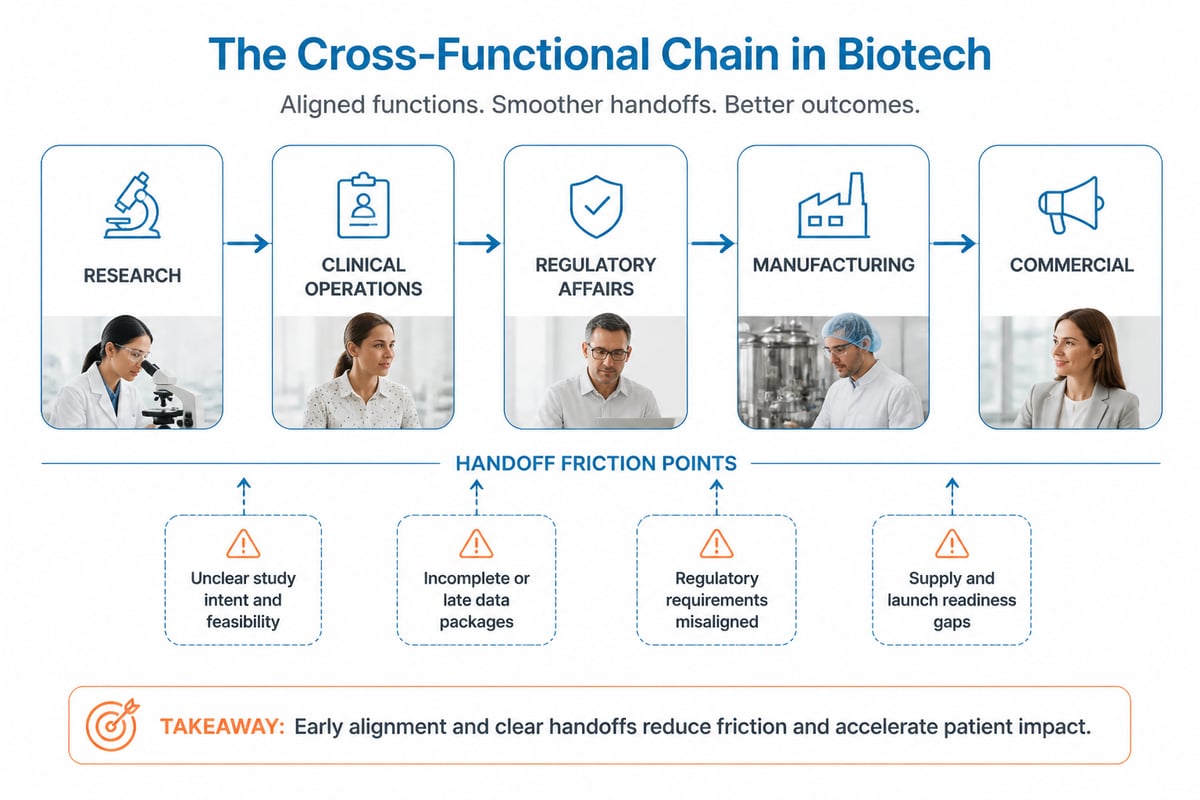
- Constant cross-functional dependency. Research, clinical operations, regulatory, manufacturing and commercial teams must move in sequence, and each speaks a different professional language.
The workforce data points the same direction. A 2024 survey of more than 500 pharmaceutical, biotech and CRO leaders and frontline workers found that most senior leaders expected cross-functional roles to increase and cited cross-functional training as a workforce need, according to Parexel. When leaders expect more cross-functional work, the quality of the leadership team becomes the constraint, not the quality of any single scientist.
What Strong Coaching Programs for Biotech Leadership Teams Include
Strong coaching programs for biotech leadership teams share five components: an evidence-based diagnostic, deliberate coach matching, a written development plan, structured stakeholder involvement, and defined success metrics set before coaching begins.
A diagnostic before any session
Coaching without a baseline is a conversation, not an intervention. A 360 survey surfaces the gap between how a leader believes they operate and how peers, direct reports and board members experience them. In biotech, that gap is often widest on decision ownership, tolerance for ambiguity and cross-functional collaboration.
Coach matching by function, level and industry
A coach who has never worked near regulated product development spends the first three sessions learning vocabulary the leader needs spent on behavior. Matching on function, seniority, industry and goals is the single biggest quality lever in program design, and it is the step buyers most often delegate carelessly.
A development plan the sponsor has approved
The plan should name two or three behaviors to change, the business situations where those behaviors will be tested, and the people who will notice. Approval by the leader, the sponsor and the coach before engagement starts prevents the drift that kills coaching ROI.
Stakeholder check-ins
Short, structured conversations with the leader's manager and peers keep coaching tied to real work. They also produce the evidence you will need later.
Defined measures
Agree on leadership KPIs, retention indicators and performance outcomes up front. If you cannot say what should be different in two quarters, the program is not ready to launch.
Common Leadership Problems in Biotech Teams
The leadership problems coaching solves most reliably in biotech are decision bottlenecks, scientist-to-manager transitions, unresolved executive conflict and weak cross-functional trust.
| Problem | How it shows up | Coaching focus |
|---|---|---|
| Decision bottleneck | Leaders defer calls until data is "complete" | Decision criteria, comfort with calculated risk |
| Task-level leadership | VPs still do the work of their direct reports | Delegation, problem ownership |
| Executive team friction | Functional heads protect their own timelines | Shared priorities, conflict resolution |
| Siloed communication | Regulatory and clinical learn of changes late | Cross-functional cadence, influence skills |
| Scaling stress | Founding culture strains at 150 to 500 people | Culture, accountability, succession readiness |
The task-level leadership pattern deserves special attention. In one engagement with a Fortune 1000 international therapeutics company, leaders moved from task execution to problem ownership. For a biotech, that shift is the difference between a VP who needs the CEO in every meeting and one who carries a program independently.
A Diagnostic-First Framework: The Four-Gate Program Design
A diagnostic-first coaching program moves through four gates, and a team should not advance to the next gate until the current one is documented. This is a practical sequence for People leaders, not a vendor requirement.
- Gate 1, Baseline. Run a 360 assessment on each participant and a team-level read on how the group makes decisions. Capture the business problem in one sentence per leader.
- Gate 2, Match and approve. Select coaches with relevant function and industry experience. Confirm the development plan with the leader and sponsor before any commitment of fees.
- Gate 3, Coach in the work. Run structured one-to-one cycles tied to live decisions: a pipeline prioritization, a reorganization, a partnership negotiation. Hold stakeholder check-ins at set intervals.
- Gate 4, Prove and decide. Re-measure against the baseline, report against agreed KPIs, and decide whether to extend, redirect or close.
Most failed programs skip Gate 1 or Gate 4. They begin with enthusiasm and end with anecdotes, which is not evidence a board will fund again.
Individual Coaching, Team Coaching and Cohorts Compared
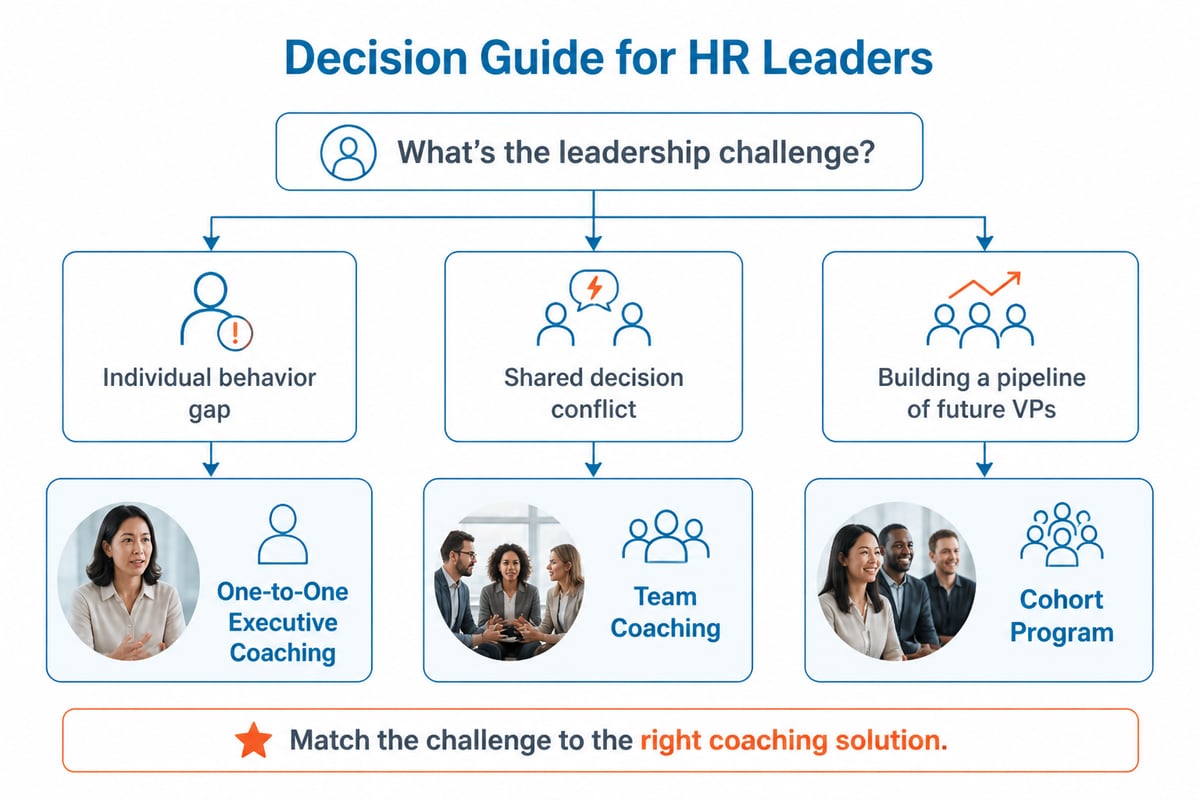
The right format depends on the problem: individual coaching for behavior change, team coaching for shared decision patterns, and cohort programs for building a bench.
- One-to-one executive coaching suits a leader with a specific behavioral gap, a new C-suite role or succession readiness. It is the deepest format and the easiest to tie to a 360 baseline.
- Team coaching suits an executive team that argues about priorities or hands off poorly. It works on the system rather than the person, and it requires a sponsor willing to hear uncomfortable findings.
- Cohort programs suit high-potential scientists and directors being prepared for VP roles. They build shared language across functions at lower cost per head, with less personalization.
The usual error is using a cohort curriculum to solve an individual problem, then concluding coaching does not work. A leader who avoids conflict needs a coach hand-matched to that pattern, not a workshop on feedback models.
Skills Biotech Leaders Need Most in 2026
The most valuable coaching targets for 2026 are cross-functional influence, comfort leading through technology change, and decision-making under uncertainty.
The same Parexel survey found that about half of biopharmaceutical leaders named AI experts among the top roles they expect to need to fill in the next three to five years, and that most cited innovative trial approaches as a training need. The leadership implication is easy to miss. Leaders will be managing teams built around skills they did not grow up with, using trial designs that change faster than standard operating procedures.
Coaching cannot teach a CMO machine learning. It can help a CMO lead a team that includes data scientists, set expectations without false certainty, and make decisions when the evidence base is moving. Those are behavioral skills, and they are coachable.

A Contrarian View: Do Not Start With the Highest-Potential Leaders
Many organizations aim coaching budgets at their stars first. In biotech, the better first investment is often the leaders who sit at the handoff points between functions, such as the head of clinical operations or the regulatory lead.
The logic is operational. A star researcher who improves by 10% improves one program. A cross-functional connector who improves by 10% reduces friction across every program that touches their function. Start with the leaders whose behavior most affects the speed of others, then expand to succession candidates once the baseline data shows where the real gaps sit.
Measuring Results: What to Report to the CEO and Board
Coaching ROI should be reported as changes in behavior and business indicators against a pre-agreed baseline, reviewed on a quarterly cadence rather than at the end of a long engagement.
Useful measures include:
- Change in 360 ratings on the two or three targeted behaviors
- Retention of coached leaders and their direct reports
- Time to decision on named, recurring decisions
- Sponsor and stakeholder assessment of observable change
- Leadership KPIs tied to the leader's operating goals
Noomii's reported engagement results illustrate what this evidence can look like: Noomii Leadership Coaching describes its coaching as rated highly for goal alignment, support and accountability, and reports observable behavior change in the leaders it has coached. In one engagement with a Fortune 500 global electronics manufacturer, the client re-commissioned coaching because of documented impact, which is a strong signal a buyer can look for.
Treat any vendor's figures as a starting point for your own baseline, not a substitute for it.
How to Choose a Coaching Partner for a Biotech Leadership Team
Choose a partner based on how it matches coaches, how it measures, and whether it can coordinate delivery across your sites, not on the size of its coach roster.
Ask these questions in procurement:
- How are coaches sourced, interviewed and matched to each leader, and can we see the match rationale?
- Is there a leadership diagnostic included, and who owns the data?
- When do fees begin, and is there a gate where we approve the coach and plan first?
- What does reporting look like at 90 days, and what is it tied to?
- Can delivery be coordinated across countries if our sites and leaders are distributed?
For organizations with leaders across regions, multi-coach coordination matters. Noomii has coordinated multi-coach delivery across five countries, and its coaches are hand-matched by function, level, industry and goals, with no payment until coach selection and the development plan are approved. Its Executive and Leadership Coaching for Organizations service is built around a free 360 leadership survey, behavior frameworks, stakeholder check-ins and quarterly ROI reporting. For specifics on scope and engagement structure, speak with the team directly rather than assuming a standard package.
If you are sorting out which topics suit coaching versus training, this overview of what topics are appropriate in leadership coaching is a useful reference for aligning sponsors before you brief vendors.
Frequently Asked Questions
What are coaching programs for biotech leadership teams?
They are structured engagements that pair biotech leaders or executive teams with trained coaches to change specific leadership behaviors, such as decision ownership, cross-functional collaboration and conflict resolution. Good programs begin with a diagnostic and end with measured results.
How long does leadership coaching take to show results?
Observable behavior change is typically assessed over multiple coaching cycles, with progress reviewed quarterly. Exact timelines depend on the goals and the engagement design, so confirm structure with your provider.
Should we coach the whole executive team or individuals?
Use individual coaching for personal behavior gaps and team coaching for shared decision patterns or conflict. Many biotech companies combine both, starting with a baseline to see which problem is actually present.
How do we measure coaching ROI in a pre-revenue biotech?
Use leading indicators: 360 rating change, retention, decision speed and stakeholder assessment. Revenue is the wrong lens before commercialization, so tie results to retention and leadership KPIs instead.
Do coaches need a life sciences background?
Sector familiarity speeds progress, because the leader spends session time on behavior instead of explaining context. Matching by function, level and industry is a reasonable requirement.
What is a realistic first step for a People leader?
Run a 360 assessment on a small group of leaders at key cross-functional handoff points, then use the results to define the business case for a wider program.
Start by choosing three to five leaders who sit at your riskiest cross-functional handoffs and running a 360 baseline on them before you brief any vendor. If you want a partner that hand-matches coaches, reports quarterly against retention and leadership KPIs, and starts with Executive and Leadership Coaching for Organizations, the team can walk you through how that would work for your leadership structure. To pressure-test your plan with people who build these programs, Noomii Leadership Coaching offers a way to book a free strategy call and map your first cohort.


Leave a Reply
Want to join the discussion?Feel free to contribute!