

Leadership Coaching for Hospital Systems: What to Know
Leadership coaching for hospital systems is structured, one-to-one development for executives, physician leaders and nurse managers, built to change specific leadership behaviors that affect safety, retention and operating results. It works when it starts with diagnostic data, pairs each leader with a coach who understands clinical environments, and measures behavior change rather than satisfaction with sessions.
Hospital systems are not ordinary corporate environments. Authority is split between administrators and clinicians, decisions carry patient-safety consequences, and many senior leaders were promoted for clinical excellence, not for managing other people. That combination creates predictable gaps, and generic leadership training rarely closes them. This article covers who needs coaching, what the research says about leader and frontline perception gaps, how to build a program, and how to judge whether it worked.
Who Are Hospital Executives, and Who Needs Coaching?
Hospital executives are the senior leaders who run a health system's operations, finances, clinical quality and strategy, typically the CEO, COO, CFO, chief medical officer, chief nursing officer and chief people officer. Coaching reaches well beyond that group, and the highest-leverage participants often sit one or two levels below.
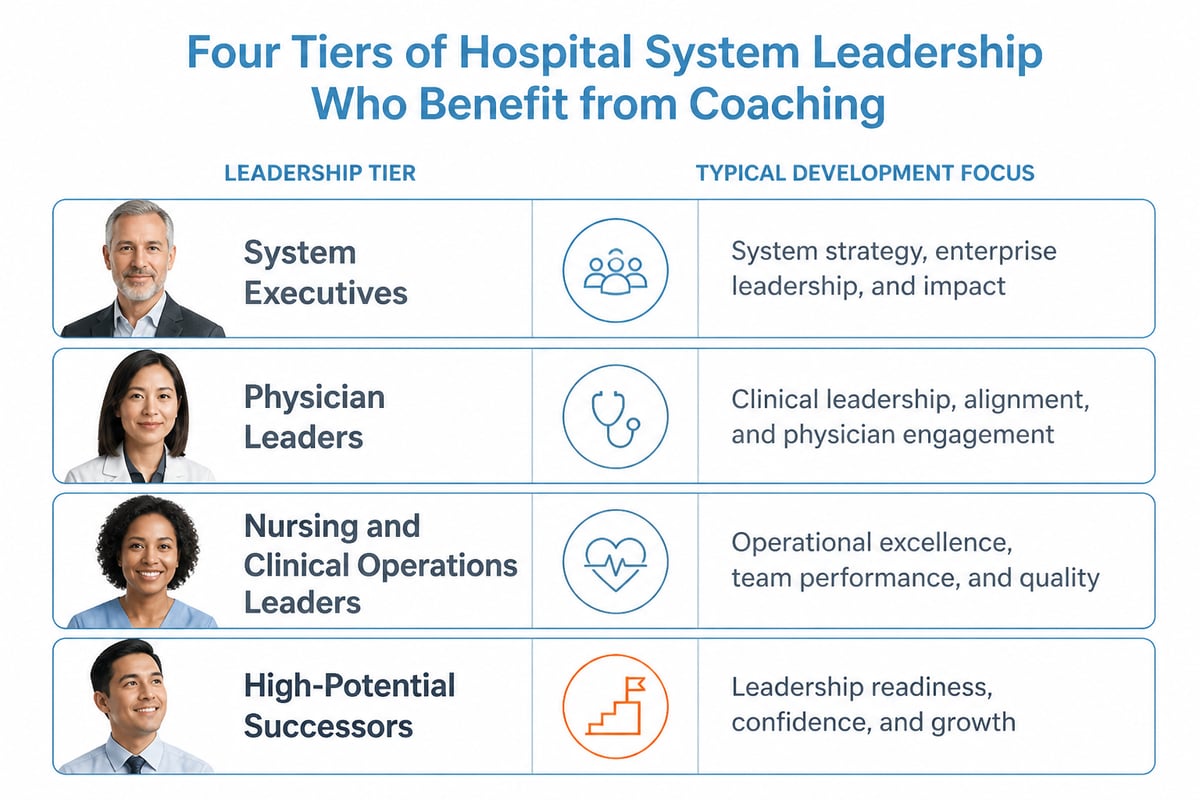
A realistic coaching population in a hospital system includes four groups:
- C-suite and system executives, who set culture and carry board accountability
- Physician leaders, such as department chairs, medical directors and chiefs of staff, who lead peers they cannot easily direct
- Nursing and clinical operations leaders, including CNOs, directors and unit managers, who sit closest to staffing and turnover pressure
- High-potential successors, the people your succession plan depends on over the next three to five years
The physician leader deserves particular attention. A newly appointed department chair often has no management training, no formal authority over compensation or scheduling in the traditional sense, and a peer group that expects collegiality, not direction. Coaching gives that leader a private place to practice difficult conversations before having them.
Why Hospital Systems Need a Different Coaching Approach
Hospital systems need a different approach because their leadership failures show up as safety events, turnover and burnout, not just missed targets. The cost of a communication breakdown between a service line chief and a nurse manager is not abstract.
AHRQ's primer on the leadership role in improving patient safety makes the case that organizational leadership shapes safety outcomes through the culture it sets and the priorities it funds. That framing matters for HR. If leadership behavior drives safety culture, then leadership development is a patient-safety investment, not a soft-skills expense.
There is also a perception problem worth taking seriously. Research summarized in AHRQ PSNet's periodic issue on safety culture describes differences in how hospital leaders and frontline workers perceive patient-safety culture. Where executives and frontline staff see the culture differently, that gap can go unnoticed. Leaders cannot correct what they cannot see.
Three structural features make hospitals distinct:
- Dual authority. Clinical and administrative leaders share decisions, so influence matters more than rank.
- Always-on operations. Leaders have almost no protected time, which means coaching must fit around shifts and crises.
- Promotion by clinical skill. The best surgeon or nurse is not automatically the best leader of surgeons or nurses.
How to Do Leadership Coaching in a Hospital System
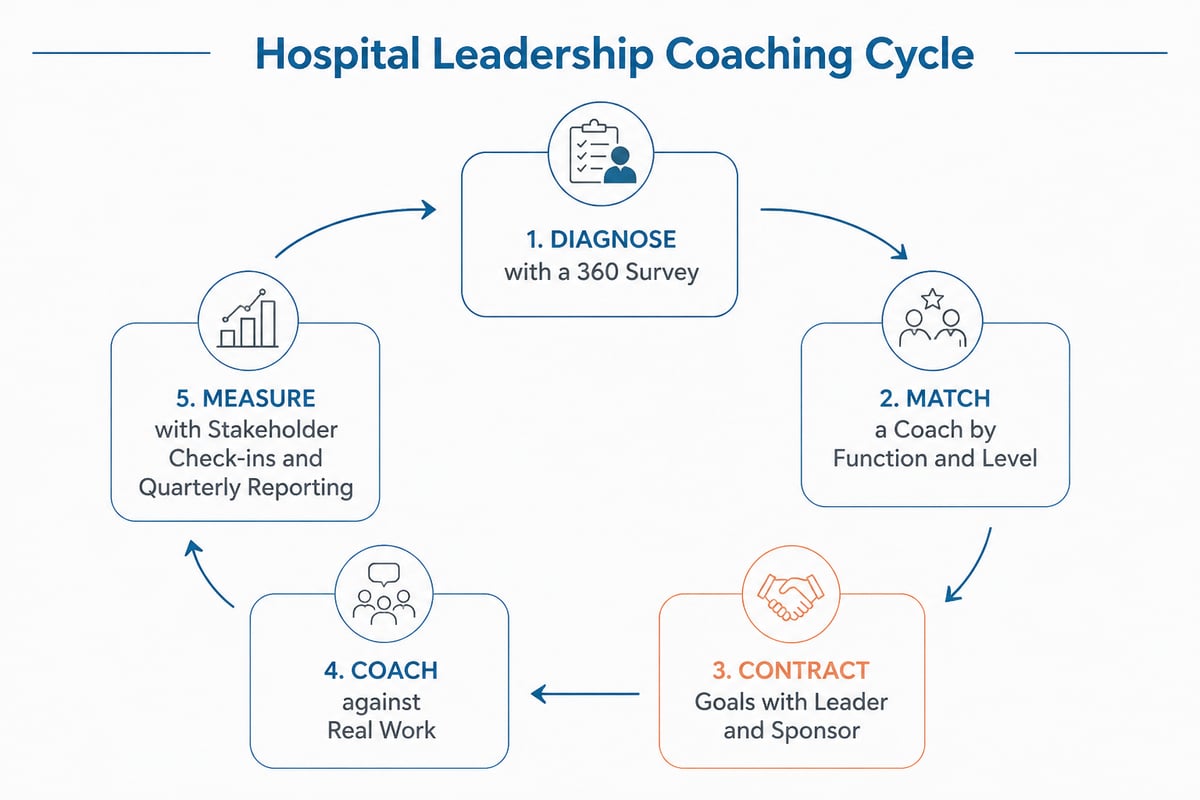
The sound way to run leadership coaching in a hospital system is a five-step cycle: diagnose, match, contract, coach, and measure. Skipping the first step is the most common reason programs produce pleasant conversations and no change.
Step 1: Diagnose before you assign anyone
Start with a 360 assessment so the coaching targets observed behavior, not the leader's self-image. Include direct reports, peers, physicians and nursing staff in the rater pool where it is appropriate. In a hospital, the gap between how a leader sees themselves and how clinical staff experience them is usually the real development agenda.
Step 2: Match on function, level and context
A coach who has only worked with technology executives will struggle to understand why a CNO cannot simply "delegate more" on a short-staffed unit. Match on function, seniority, industry exposure and the leader's goals. Noomii's approach is hand-matched human coaches selected by function, level, industry and goals, and coaches are not paid for until the coach selection and development plan are approved, which lowers the risk of a poor fit.
Step 3: Contract with the leader and the sponsor
Define two or three behavioral goals, name who the stakeholders are, and agree on what will be shared with the organization and what stays confidential. Hospital leaders are rightly cautious about anything that feels like evaluation.
Step 4: Coach against real work
The best sessions use live material: a board presentation, a service line conflict, a retention problem on a specific unit. Coaching tied to actual decisions transfers faster than coaching about leadership in general.
Step 5: Check in with stakeholders and measure
Mid-engagement check-ins with the people who work with the leader confirm whether others see change. This is where most internal programs go quiet, and it is where credibility is earned.
What Is the 70/30 Rule in Coaching?
The 70/30 rule in coaching is a guideline that the coachee should do roughly 70 percent of the talking while the coach speaks about 30 percent, mostly asking questions. The principle is that leaders change when they reach their own conclusions, not when they are told what to do.
For hospital leaders, the rule has a practical edge. Clinicians are trained to diagnose and prescribe quickly, and they often expect a coach to do the same. A good coach resists that pull. The ratio is a guide, not a law, and a coach will sometimes need to offer a direct observation or a framework. But a coach who dominates the conversation is consulting, not coaching, and the leader will not own the result.
How to Be a Good Leader in Healthcare
A good healthcare leader reliably does four things: sets a clear standard for safety and respect, builds trust across clinical and administrative lines, makes sound decisions under uncertainty, and develops the people who report to them. Everything else is a refinement of those four.
Coaching is useful because each one is a behavior that can be observed and practiced:
- Setting the standard means addressing disrespectful behavior from high-volume clinicians quickly and consistently, even when the revenue consequence is uncomfortable.
- Building trust means closing the loop when staff raise concerns, so people see that speaking up leads somewhere.
- Deciding under uncertainty means naming what is known and unknown, then acting without waiting for perfect information.
- Developing others means treating every one-to-one with a direct report as a development opportunity, not a status update.
AHRQ maintains a resource hub on patient-safety culture, leadership, governance and TeamSTEPPS that gives HR and clinical leaders shared tools and language for these topics, which helps coaching goals connect to frameworks the organization already uses.
A Measurement Framework for Hospital Leadership Coaching
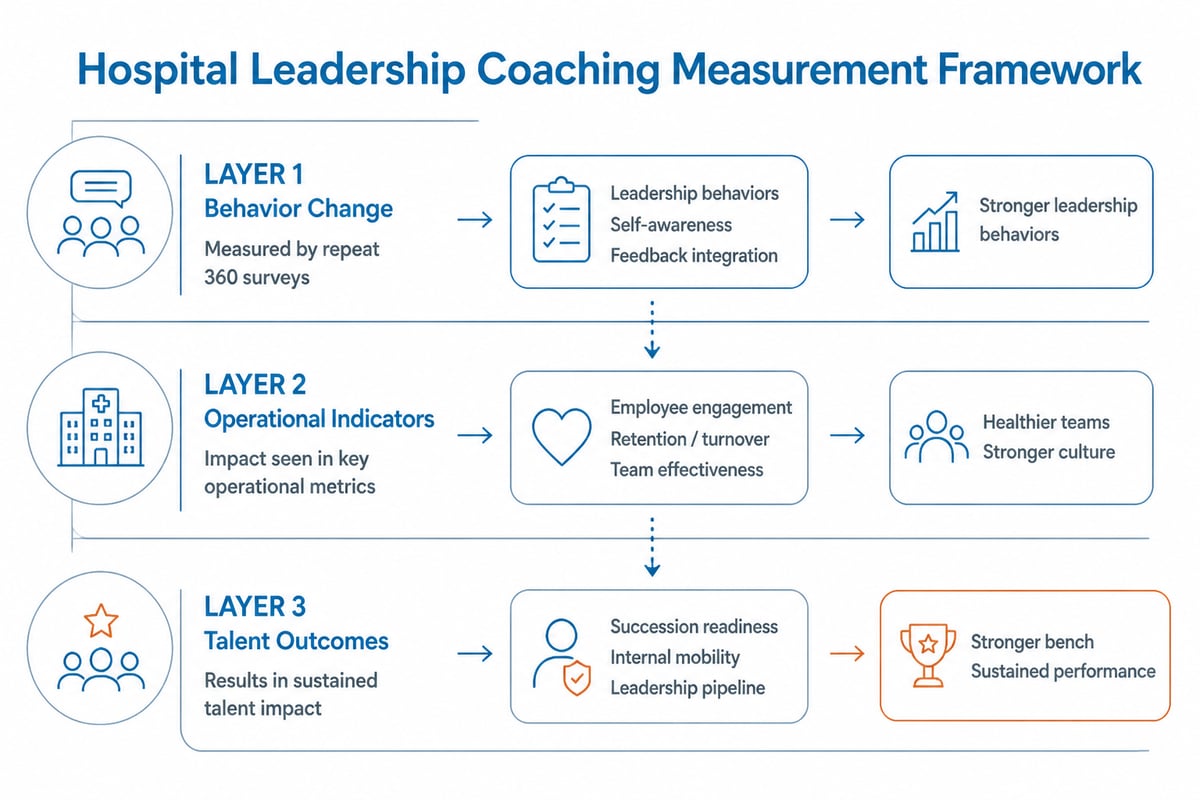
The most defensible way to evaluate coaching in a hospital system is to track three layers of evidence: behavior change, operational indicators, and retention of the leaders and teams involved. Satisfaction scores alone will not survive a finance review.
| Layer | What to track | Typical source |
|---|---|---|
| Behavior | Change in 360 ratings on the two or three goals set at the start | Repeat 360 survey, stakeholder check-ins |
| Operations | Engagement, turnover and vacancy rates on units led by participants | HRIS, engagement surveys |
| Talent | Readiness of successors, promotion and retention of high-potential leaders | Succession plan reviews |
Set the baseline before the first session. Without it, any improvement is an anecdote.
Noomii's organizational coaching reports ROI quarterly against retention, performance and leadership KPIs, and every participant receives a free 360 leadership survey. Noomii's own reporting describes coaching effectiveness, senior-leader professionalism ratings and observable behavior change, so treat these as a reference point for the kind of evidence you should request from any provider.
A Contrarian Take: Coach the Pairs, Not Just the Individuals
Most coaching programs treat each leader as a separate case, but hospitals often fail at the seams between leaders. The administrator and the physician chief who cannot agree on a staffing model, or the CNO and the CFO who read the same budget differently, generate more damage than any one weak manager.
A stronger design identifies the three or four critical leadership pairs in your system and coaches both people with shared goals and a coordinated plan. This is harder to run, because it requires a provider that can manage several coaches working toward a common outcome. Noomii describes coordinated multi-coach delivery across global teams, which is the same coordination skill a multi-hospital system needs when its leaders sit in different facilities and regions.
Evidence From Comparable Engagements
Noomii's materials do not include hospital-specific case studies, so the closest evidence comes from adjacent regulated and complex industries. Two engagements illustrate what to look for in outcomes.
Fortune 1000 international therapeutics company. Noomii reports that leaders moved from task execution to problem ownership after coaching. The behavior shift that matters most in clinical and life-science settings is accountability for outcomes, which is the same shift a hospital needs from managers who currently wait for direction.
Fortune 500 global electronics manufacturer. Noomii reports that this organization re-commissioned coaching engagements because of documented impact. Repeat commissioning is a stronger signal than a satisfaction survey, because budget owners only renew what they can defend.
Neither case is a hospital, and you should say so when presenting them internally. They are useful because the pattern, measurable behavior change followed by renewal, is what a hospital CHRO should demand.
How HR and L&D Leaders Should Select a Provider
Choose a provider on five criteria, and ask for evidence on each:
- Diagnostics first. Does the engagement begin with a 360 or comparable assessment, and is it included?
- Matching method. Are coaches selected for your leader's function, level and context, or assigned from a bench?
- Risk structure. Can you approve the coach and the development plan before committing spend?
- Reporting cadence. Will you receive regular, KPI-linked reporting you can take to the executive team?
- Coordination at scale. Can the provider run many engagements across sites without losing consistency?
For systems building a multi-leader program, Executive and Leadership Coaching for Organizations from Noomii structures 1:1 coaching cycles around a free 360 survey, hand-matched coaches, behavior frameworks, stakeholder check-ins and quarterly ROI reporting. Details on scope and pricing are best confirmed with Noomii directly.
If your systems also include pharmaceutical or life-science partnerships, Noomii's page on leadership development for pharmaceutical companies shows how it frames sector-specific work. For a view of how it positions senior-level programs, see its executive leadership coaching page, and its overview of leadership development and coaching covers the broader program structure. HR teams deciding what belongs in a coaching agenda can also review what topics are appropriate in leadership coaching and how to choose a coach.
Common Mistakes That Waste Coaching Budgets
Most failed programs share the same few errors:
- Coaching the wrong people. Spending on executives while ignoring the physician chiefs and unit managers who shape daily culture.
- No baseline. Starting without a 360 or engagement data, then having nothing to compare against.
- Treating coaching as remediation. If participation signals trouble, strong leaders will avoid it and weak ones will resent it.
- Ignoring confidentiality. Leaders will not be candid if they believe sessions feed performance reviews.
- Reporting activity instead of change. Sessions completed is not an outcome.
A board or CEO sponsor who asks one question, "What behavior is different, and who says so?", keeps a program honest.
FAQ
What is leadership coaching for hospital systems?
It is structured one-to-one development for hospital executives, physician leaders and nurse managers, focused on specific leadership behaviors such as decision-making, communication across clinical and administrative lines, and accountability. It differs from training because it is tailored to the individual and tied to real work.
How long should a hospital leadership coaching engagement last?
The right length depends on the goals and the leader's role. Define two or three behavioral goals up front and plan check-ins with stakeholders partway through, then set the timeline with your provider based on those goals.
How do you measure the ROI of leadership coaching in a hospital?
Compare a baseline 360 and engagement data against repeat measures, and track turnover, vacancy and succession readiness for the units and leaders involved. Quarterly reporting tied to retention, performance and leadership KPIs makes the case easier to defend.
Is coaching confidential in a hospital setting?
It should be, with clear agreement at the start about what is shared with the organization. Typically the leader and sponsor agree on goals and progress themes while specific conversations stay private.
Who should be prioritized for coaching first?
Start with leaders whose behavior most affects safety culture, retention and succession: new physician leaders, nurse managers with high turnover on their units, and high-potential successors for critical roles.
What is the difference between coaching and mentoring for healthcare leaders?
A mentor shares personal experience and advice from a similar career path. A coach asks questions and holds the leader accountable to goals, and does not need to have held the same role.
Pull the last 12 months of turnover and engagement data for your physician leaders and nurse managers, then pick the three leadership pairs whose friction costs you the most. With that baseline in hand, you can design a program around evidence instead of intuition, and Book a Free Strategy Call with Noomii Leadership Coaching to talk through how hand-matched coaches, a free 360 survey and quarterly ROI reporting could fit your system.


Leave a Reply
Want to join the discussion?Feel free to contribute!