
Leadership Development for Pharmaceutical Companies: A Practical Guide
Leadership development for pharmaceutical companies works when it is built around the sector's real pressures: long R&D cycles, strict regulation, scientific talent promoted into management, and a fast shift toward digital operations. Generic programs fail here because they teach leadership in the abstract while your leaders make decisions inside a compliance-heavy, cross-functional, high-stakes system. The practical answer is a diagnostic-led, coaching-supported approach that targets specific behaviors, ties them to business outcomes, and measures change on a schedule.
Why Pharma Leadership Is Different
Pharma leadership is different because the cost of a leadership failure is measured in delayed trials, quality events and lost talent, not just in missed quarterly targets. Leaders operate inside layers of governance, and the most capable scientists and engineers are frequently promoted because of technical excellence, not because they have managed people through ambiguity.
The commercial backdrop raises the stakes. In a Deloitte survey of 150 life-sciences C-suite executives conducted in August and September 2024, 75% were optimistic about the industry's prospects for 2025, and 68% expected revenue increases. Optimism is not a leadership plan. The same survey found that a substantial share of executives, nearly 40%, emphasized improved R&D productivity as a priority for countering declining industry returns. Productivity is a leadership problem as much as a scientific one: it depends on how well leaders make decisions, resolve conflict between functions and take ownership of problems that cross organizational lines.
Four features make the sector distinct:
- Regulated decision-making. Leaders must act decisively while documenting rationale for auditors and regulators.
- Long feedback loops. A leadership behavior today may not show up in a clinical or commercial result for years, so measurement has to focus on leading indicators.
- Technical-to-managerial promotions. Principal scientists, plant engineers and clinical leads move into people leadership with little preparation.
- Matrixed delivery. Drug development runs through R&D, regulatory, quality, manufacturing, medical and commercial teams, none of which report to one another.
The Leadership Gaps That Cost Pharma the Most
The costliest leadership gaps in pharma are ownership, cross-functional trust and the capacity to lead through technology change. These show up in different forms at different levels, and a program that does not distinguish between them wastes budget.
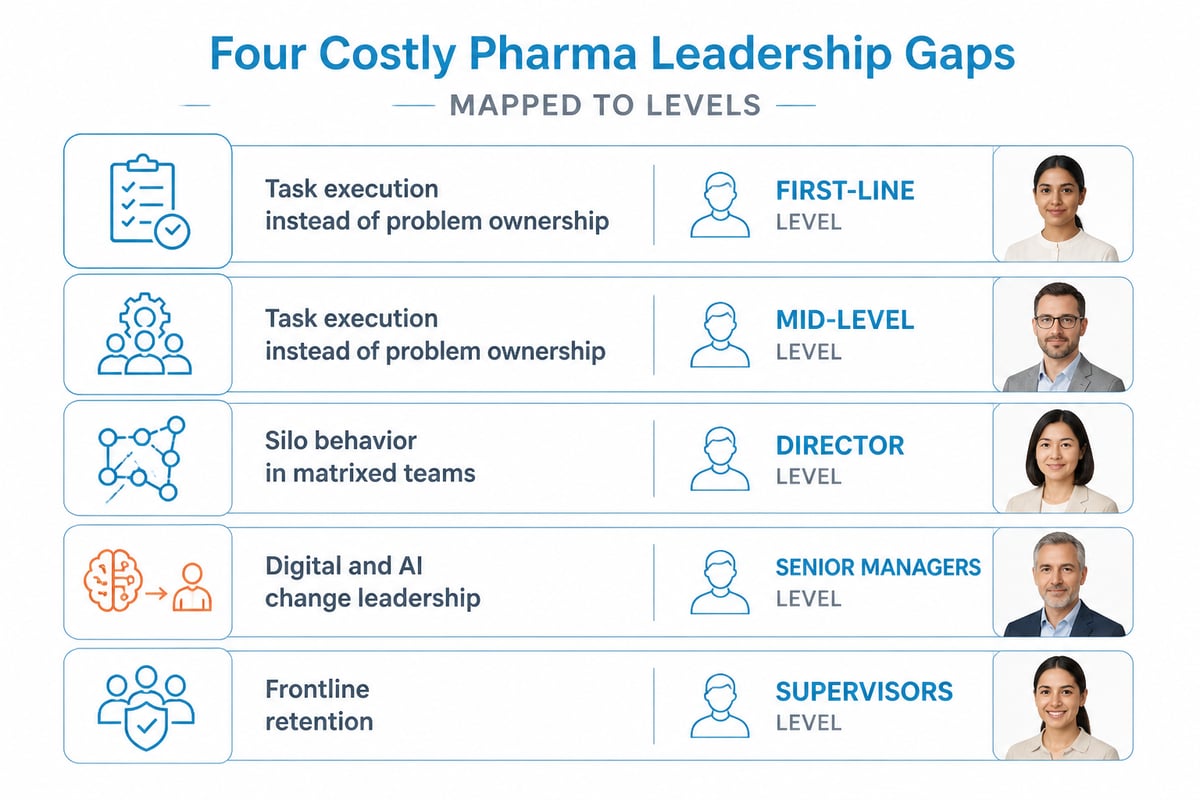
Task execution instead of problem ownership. In regulated environments, people learn to follow procedure carefully. That discipline is valuable until it becomes a habit of waiting for direction. A documented example from Noomii's work: leaders at one international therapeutics company moved from task execution to problem ownership. That shift matters because ownership is what keeps issues from bouncing between quality, manufacturing and regulatory affairs.
Silo behavior in matrixed teams. When a program stalls, the cause is rarely a lack of technical skill. It is usually a trust or communication failure between functions. Deloitte's perspective on life-sciences workforce skills and multidisciplinary collaboration points to autonomy and cross-disciplinary work as areas where leadership practices will need to adapt.
Digital and AI readiness. Many surveyed life-sciences executives told Deloitte they were closely monitoring generative AI or digital transformation as emerging trends. Monitoring is the easy part. Leading a team through changed workflows, new data responsibilities and role uncertainty is the hard part. An ISPE article reports that most biopharma supply-chain leaders see a need to upskill or reskill their workforce to support digital transformation. Someone has to lead that reskilling, and it is first-line and mid-level managers.
Retention at the front line. The same ISPE article, citing a 2024 UKG Workforce Institute survey, puts the cost of replacing one skilled frontline worker in the thousands to tens of thousands of dollars. Weak first-line leadership is one of the most controllable drivers of that cost.
A Four-Stage Framework for Leadership Development for Pharmaceutical Companies
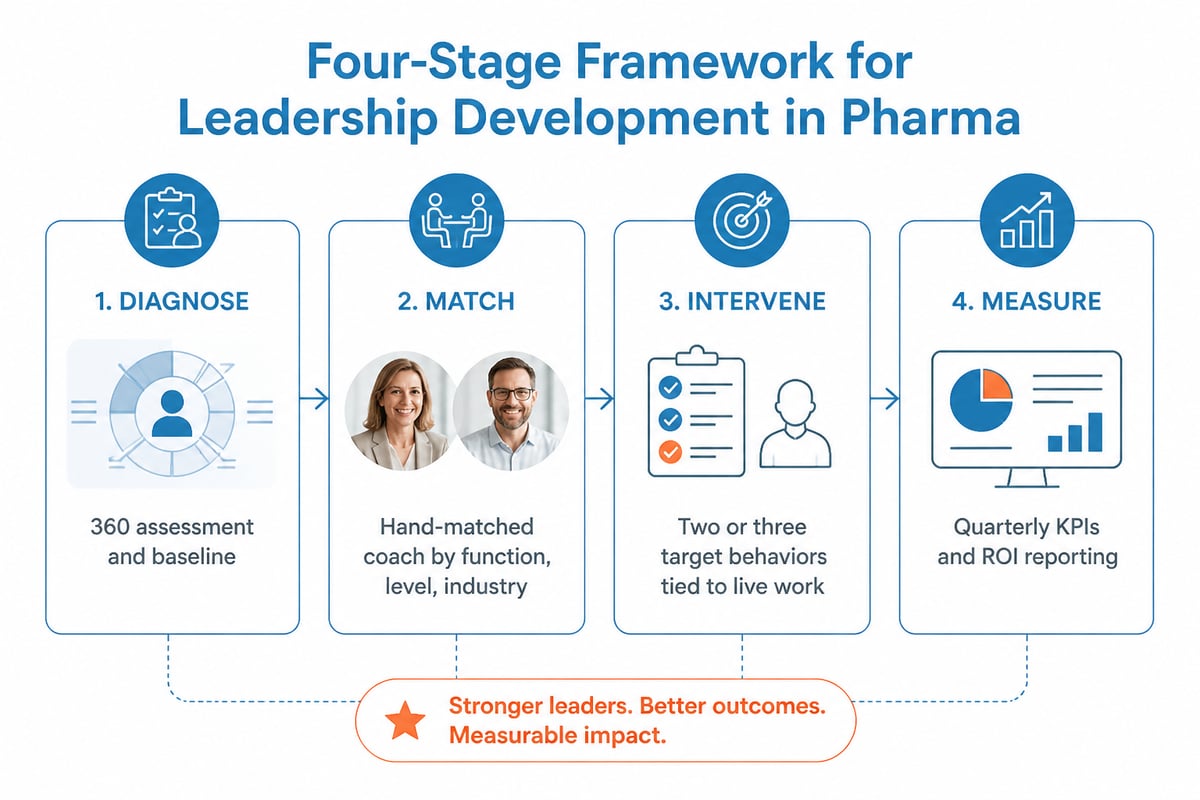
A workable framework for leadership development for pharmaceutical companies has four stages: diagnose, match, intervene and measure. Each stage produces something a CHRO or board can inspect, which is the discipline most programs lack.
Stage 1: Diagnose
Start with evidence, not assumptions. A validated 360 assessment across a leader's manager, peers and direct reports shows behavioral patterns that self-assessment hides, such as how a brilliant scientist is actually experienced by the team. Aggregate the results by function and level to see where gaps cluster. Noomii provides a free 360 leadership survey for every participant, which gives HR a baseline before any coaching budget is committed.
Stage 2: Match
Coach selection decides whether the program works. A leader running a global manufacturing network needs a different coach than a first-time manager in clinical operations. Matching on function, level, industry and goals matters more than coach credentials alone. At Noomii, coaches are sourced, interviewed and hand-matched to each leader's needs, and there is no payment until the coach selection and development plan are approved.
Stage 3: Intervene
Build a plan per leader, tied to two or three behaviors, not a generic curriculum. Examples for pharma: making decisions faster within a quality framework, running cross-functional meetings that end in commitments, giving direct feedback to senior scientists, and leading teams through a systems or process change. Coaching works best when paired with real work, such as a live program review or a site transformation, so behaviors are practiced where they count.
Stage 4: Measure
Set KPIs before the first session. Combine leading indicators (360 behavior changes, engagement pulse results, manager effectiveness scores) with lagging ones (retention in the leader's team, cycle times, audit and deviation trends where attributable). Review them quarterly.
Coaching, Workshops or Both?
Coaching and workshops solve different problems, and the choice should follow the problem. Workshops build shared language across a cohort. Coaching changes individual behavior in context. Most pharma organizations need both, in a deliberate sequence.
| Approach | Best at | Weakness | Pharma use case |
|---|---|---|---|
| Classroom or virtual workshops | Shared vocabulary, scale | Behavior rarely changes without follow-through | Onboarding new people managers across sites |
| One-on-one executive coaching | Behavior change, accountability | Harder to scale without coordination | Directors, VPs and high-potential successors |
| Multi-coach coordinated delivery | Consistency across regions | Needs strong program governance | Global teams spanning several countries |
| Peer cohorts | Cross-functional trust | Depends on facilitator quality | R&D, quality and commercial leaders together |
The conventional view says leadership training fails because of poor content. In practice, the common failure is the absence of behavior change after the content. Noomii has written about leadership development without behavior change, and the point holds in pharma: if a program cannot show observable change in how leaders act, it has produced attendance, not development.
What the Evidence Looks Like in a Coaching Engagement
Credible evidence from a coaching engagement is behavior change documented by the people who work with the leader, plus business metrics reported on a fixed cadence. Noomii reports the following from its engagements: 8-9/10 coaching effectiveness ratings across goal alignment, support and accountability; 10/10 coach professionalism ratings from senior leaders; and observable behavior change reported for its leaders after engagement. It also coordinates multi-coach delivery across several countries, and clients have re-commissioned coaching engagements after documented impact.
Here is a hypothetical example in the Problem, Diagnosis, Solution, Result, Lesson format, illustrating the pattern described above.
- Problem: Leaders in a regulated organization may execute assigned tasks well but not own the problems behind them.
- Diagnosis: Assessment and coaching conversations can reveal a pattern of waiting for direction in a procedure-heavy culture.
- Solution: Individual coaching focused on problem ownership, with development plans tied to real work.
- Result: Leaders can move from task execution toward problem ownership.
- Lesson: In regulated companies, ownership has to be coached explicitly, because the surrounding system rewards compliance with procedure and can quietly discourage initiative.
Building the Program Around Succession
Pharma succession planning succeeds when development is aimed at the specific roles you cannot afford to leave empty, not at a broad "high potential" label. Identify the 15 to 30 roles whose vacancy would stall a program, a site or a market, then name two or three internal candidates per role and build development plans against the gap between each person and the role.
A practical sequence:
- Map critical roles across R&D, quality, manufacturing, medical, regulatory and commercial.
- Assess readiness with a 360 and a structured review with the business leader, not only with HR.
- Pair each successor with a coach who has operated at the target level in a comparable function.
- Assign a stretch problem that matches the next role, such as leading a cross-site initiative or a regulatory remediation.
- Review progress quarterly with the sponsoring executive and adjust.
For HR and L&D teams that want a customized structure around this, Noomii's Leadership Development Programs are designed with your HR, L&D or People team and aligned to business strategy, with pilot programs available. A pilot is the sensible way to test fit before committing a full population.
Executives in adjacent regulated sectors face similar patterns, and Noomii's perspective on executive coaching for medical device companies is a useful parallel for leaders managing compliance, innovation and talent at once.

Governance, Compliance and Ethics in Development Programs
A leadership program in pharma must be defensible to compliance, legal and the board, which means documented objectives, confidentiality rules and ethical boundaries from day one. Coaching conversations touch sensitive topics, including team conflict, performance concerns and sometimes quality or conduct issues, so the program needs clear protocols for what stays confidential and what must be escalated.
Set these before launch:
- Confidentiality boundaries agreed among the coach, the leader and the sponsor.
- Escalation paths for conduct or safety concerns that surface in coaching.
- Alignment with your code of conduct and any regulatory expectations on training records.
- Data handling for assessment results, including who sees individual versus aggregate data.
Toxic leadership deserves specific attention. In high-pressure scientific environments, brilliant individuals sometimes get a pass for behavior that drives out talent. Noomii's discussion on how organizations handle toxic leadership is worth reviewing if this pattern exists in your organization. Left alone, it becomes an attrition and retention cost that no training budget recovers.
Measuring ROI Without Overclaiming
ROI in leadership development should be reported as a set of linked indicators, not a single number, because attributing a clinical or commercial result to one coaching engagement is not credible. Be honest with your CFO about what can and cannot be isolated.
Measure at three layers:
- Behavior: 360 re-assessment at 6 and 12 months, compared with the baseline.
- Team health: engagement pulse results, regretted attrition and internal promotion rates for the leader's team.
- Business: cycle time, deviation or rework trends, and project milestone delivery, interpreted as contributing evidence rather than proof.
Noomii provides quarterly ROI reports tied to retention, performance and leadership KPIs, which lets HR present a consistent view to executives over time. Whatever provider you use, agree the metrics in advance and resist the urge to add new ones after results arrive. That is how credibility is lost.
For teams that publish content to document and share their leadership development work, tools such as RankPill can help plan and publish SEO articles to a company site, and Prompt Hero.Ai offers practical AI tutorials and copy-and-paste prompts that L&D teams can use to draft program communications and learning materials faster. Both are optional supports, not substitutes for the program design above.
Common Mistakes to Avoid
Most pharma leadership programs fail for predictable reasons, and each is avoidable with decisions made at the design stage.
- Starting with content instead of diagnosis. Buying a curriculum before you know your gaps guarantees a mismatch.
- Treating all leaders as one audience. A site head and a first-time lab manager need different development.
- Skipping the sponsor. If the business leader does not review progress, the program becomes an HR activity.
- Ignoring succession. Development unconnected to the roles you must fill is a benefit, not a strategy.
- Measuring attendance. Completion rates say nothing about whether leaders behave differently.
If you are earlier in your thinking, the overview of leadership development and the practical guide to a leadership development program provide the foundational structure that this sector-specific approach builds on.
FAQ
What is leadership development for pharmaceutical companies?
It is the structured process of building the leadership capability that pharma organizations need, including decision-making in regulated settings, cross-functional collaboration, people management for technical experts and change leadership. It typically combines assessment, coaching, cohort learning and measured outcomes.
Why does pharma need a different approach than other industries?
Pharma leaders work under heavy regulation, long development timelines and matrixed structures, and many are promoted from technical roles. These conditions make generic leadership training less effective than programs tailored to the sector's constraints.
How long does it take to see results from leadership coaching?
Behavior change can often be observed within the first engagement cycle, but timelines depend on the goals and the leader's role. Agree on 360 re-assessment points and quarterly reviews so progress is documented rather than assumed.
How should HR measure the ROI of leadership development?
Use linked indicators across behavior, team health and business outcomes, such as 360 changes, retention and engagement, and operational trends. Avoid claiming that one coaching engagement caused a clinical or commercial result.
Should we start with a pilot?
A pilot is a low-risk way to test coach matching, measurement and sponsor engagement before scaling. Choose a cohort tied to a clear business need, such as a site leadership team or a set of succession candidates.
How does coaching differ from training for pharma leaders?
Training builds shared knowledge across a group, while coaching targets individual behavior change in the context of the leader's real work. Most effective programs sequence both.
Your next step is to pick one critical role in your succession plan and run a 360 on its two most likely successors, so you have a baseline before spending on development. From there, Noomii's Leadership Development Programs can be shaped with your HR or L&D team and piloted on that cohort, with coach selection and the development plan approved before any payment. If you want to test this approach on your own leadership pipeline, Book a Free Strategy Call with Noomii Leadership Coaching and map the first pilot together.


Leave a Reply
Want to join the discussion?Feel free to contribute!