

The Cost of Toxic Leadership to Your Business
The cost of toxic leadership to the business shows up in turnover, disengagement, legal exposure, and stalled succession, and most of it never appears as a line item. A single toxic leader can quietly drain more value than their individual results create, because the damage is spread across the people who report to them, the peers who work around them, and the talent pipeline that avoids them.
This is a measurement problem as much as a behavior problem. HR and L&D leaders are often asked to prove that a leadership issue is expensive before anyone will act. The sections below give you the evidence, a way to price it, and a view of where the real losses hide.
What toxic leadership actually looks like in a mid-market or large company
Toxic leadership is a pattern of behavior, repeated over time, that damages the people and performance of the team being led. A bad quarter or a blunt style does not qualify. Public humiliation, credit-stealing, unpredictable mood, retaliation against dissent, and mixed messages that leave teams guessing all do.
The pattern matters because it is common. A 2025 iHire survey of U.S. workers and employers found that most employees had experienced a toxic workplace, and most of that group attributed it to poor leadership or management. Those numbers should reframe the conversation. If most employees have lived through it, your organization is more likely to have a toxic leader than to be free of one.
The same survey found something HR leaders can act on. Among employees who had experienced a toxic workplace, most reported poor organizational communication, and most of that group encountered mixed or inconsistent leadership messages. Inconsistent messaging is easy to dismiss as a communication gap. In practice it is often a leadership behavior problem wearing a communication label.
The direct costs: turnover, replacement, and lost productivity
The most visible cost of a toxic leader is attrition, and it is also the one most often understated. In the iHire data, more than half of respondents said they had quit a job because of a negative work environment. That is a large share of the workforce voting with its feet.
Replacement cost is only the start. Consider what leaves with a departing employee:
- Institutional knowledge that was never documented
- Client and stakeholder relationships built over years
- Productivity during the vacancy and the ramp-up of the replacement
- Manager time spent on recruiting, onboarding, and rework
- Morale among the people who remain and absorb the workload
Engagement data shows the scale of the broader drag. Gallup reported that global employee engagement fell from 23% to 21% in 2024, and estimated the decline cost the world economy $438 billion in lost productivity. Gallup's figure covers all causes, but managers drive the bulk of the variation in team engagement, so a toxic manager is one of the more concentrated sources of that loss inside your own walls.
The number that matters for your board is local. What does one toxic leader cost across a team of twelve? That calculation is the next section.
A practical framework: the Toxic Leader Cost Ledger
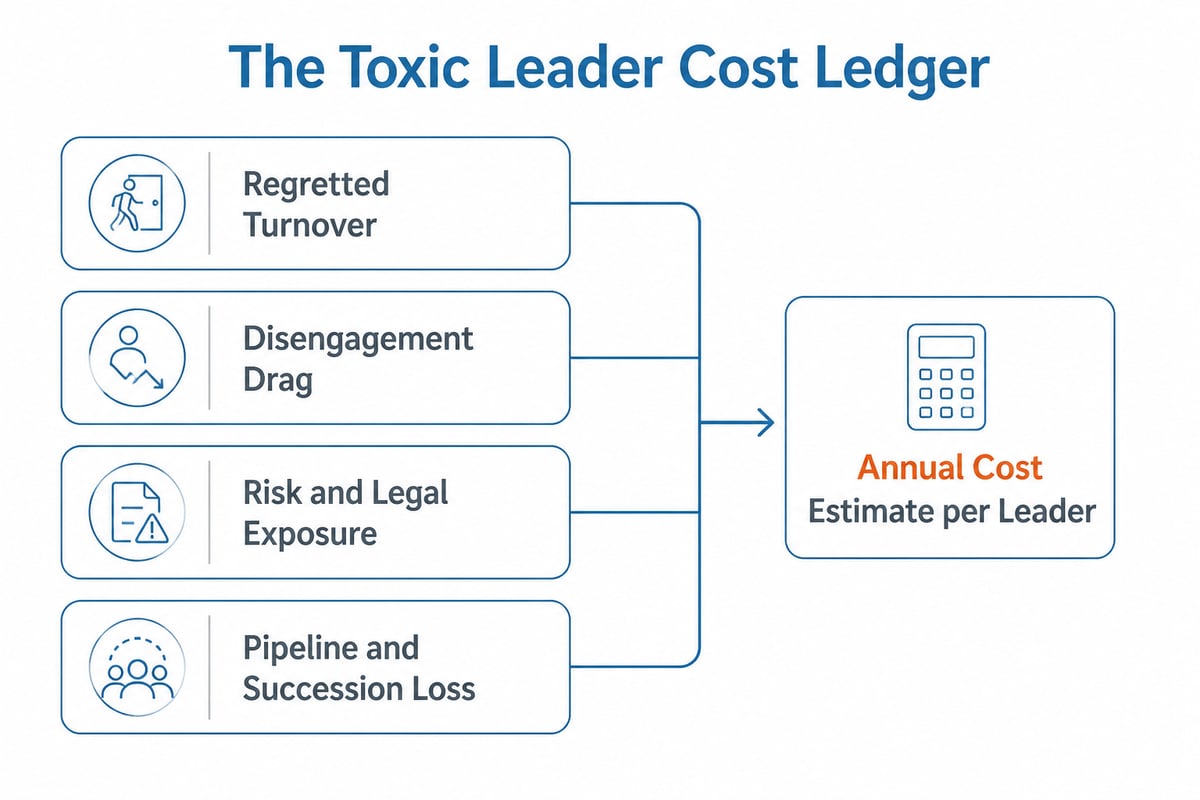
You can price the cost of toxic leadership to a business with a four-bucket ledger built from data you already hold. This is a working method, not a precise science, and its value is that it replaces "we think it's bad" with a number a CFO can challenge and refine.
Bucket 1: Regretted turnover
Count the people who left a specific leader's team in the last 24 months, then isolate the ones you would have kept. Multiply by your own fully loaded replacement cost, which finance can supply. Compare that rate to the company average. The gap is the leader's excess attrition.
Bucket 2: Disengagement drag
Use pulse or engagement survey data for the team against the company median. A team scoring well below median is paying a productivity tax even if nobody has resigned. Apply a conservative productivity discount to payroll for that team and state your assumption openly.
Bucket 3: Risk and legal exposure
List formal complaints, ethics hotline reports, grievances, and investigations tied to the leader. Add the HR and legal hours spent on each. Where a pattern exists, flag the contingent liability even if the amount is unknown. Boards care about unquantified exposure more than HR teams expect.
Bucket 4: Pipeline and succession loss
Track how many high-potential employees requested transfers away from the leader, declined roles under them, or left within a year of being assigned to them. This bucket is the hardest to see and often the largest, because it removes your future leaders before you have named them.
Run the ledger on your top three suspected problem leaders. In most organizations, one of them will show a cost that exceeds their compensation. That is the moment the conversation with the executive team changes.
Why high performers who are toxic cost more than they deliver
The conventional view holds that a toxic leader who hits the number is a tolerable trade. The ledger usually shows the opposite. Results that arrive through fear tend to be front-loaded and fragile, and the costs arrive later, on someone else's budget.
Three patterns repeat across organizations:
- The cost is exported. The leader's revenue lands in their P&L. Attrition, rework, and complaint handling land in HR, peer departments, and the next leader's team.
- Dissent disappears. Teams stop raising problems early, so issues surface late and expensive. Our own analysis of psychological safety in the workplace covers why silence is a leading indicator of failure.
- Tolerance becomes culture. Once a toxic leader is protected because of performance, everyone learns what the organization actually rewards. A conversation hosted by Noomii on why organizations tolerate toxic leadership explores how that tolerance takes hold.
The contrarian point for boards is simple. A leader's results should be audited net of the costs they create elsewhere. A toxic executive who looks like a top performer on the scorecard may be one of the most expensive people on the payroll. For a closer look at this dynamic, see the hidden cost of toxic executives.
The indirect costs that rarely reach the dashboard
Indirect costs are the ones that never get a code in the general ledger, yet they shape the next three years of performance. Four deserve attention from People leaders.
Decision quality. When leaders punish bad news, information flows upward filtered. Strategic decisions get made on cleaner data than reality supports.
Innovation and ownership. Teams under a toxic leader protect themselves instead of solving problems. They wait for instructions and avoid risk. This is the opposite of the behavior shift you want when you ask employees to take ownership.
Employer brand. Departing employees talk, post, and review. A leader with a trail of exits can affect your ability to hire into an entire function.
Change fatigue and resistance. Initiatives led by leaders who have lost trust meet resistance that looks like pushback on the change itself. The pattern shows up clearly in leadership mistakes behind return-to-office resistance, where the real friction is trust in leadership, not the policy.
Early warning signals HR can monitor before the damage compounds
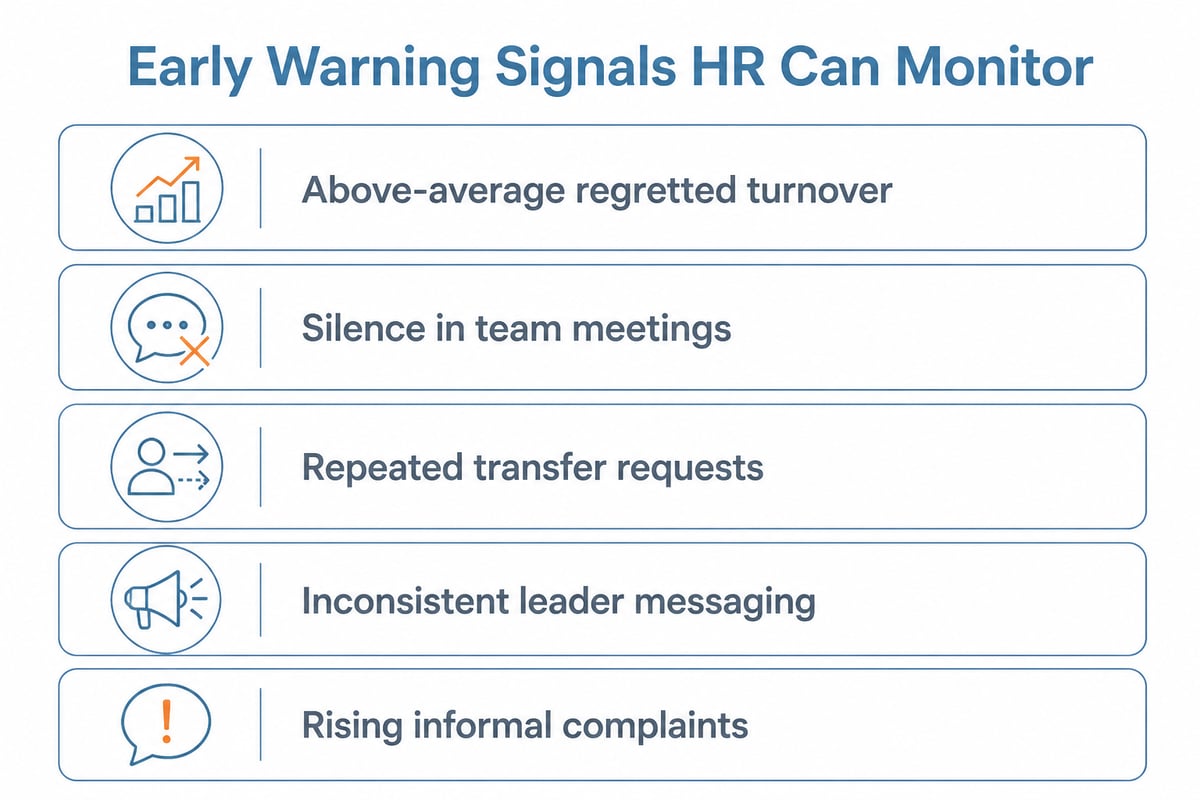
You can detect a toxic leader earlier than the first resignation if you track a handful of leading indicators. Most organizations already collect the data but review it in separate silos.
| Signal | Where it lives | What it suggests |
|---|---|---|
| Regretted attrition above company average | HRIS exit data | Excess cost concentrated under one leader |
| Low engagement on trust and voice items | Pulse surveys | Teams afraid to speak up |
| Transfer requests away from one leader | Internal mobility records | Talent pipeline leakage |
| Repeated informal complaints, no formal ones | HRBP notes | Fear of retaliation |
| Conflicting messages to different groups | Skip-level conversations | Inconsistent leadership communication |
The final signal connects back to the iHire finding on mixed messages. If a leader tells two groups different things, the cause may be avoidance or manipulation, and both are patterns worth testing in a 360 review. For a longer checklist, review the warning signs of leadership failure.
Case study: from task execution to problem ownership
A real engagement illustrates how diagnosis changes outcomes. The Problem, Diagnosis, Solution, Result, and Lesson below follow a pattern Noomii saw with a Fortune 1000 international therapeutics company.
- Problem: Leaders in the business were executing tasks assigned from above but not taking ownership of problems. Escalations were frequent and decisions slow.
- Diagnosis: Leadership behaviors, not skill gaps, were the constraint. Leaders were operating in a culture where raising a problem could be risky and taking initiative went unrewarded.
- Solution: Leaders were hand-matched with coaches by function, level, industry, and goals, each working against a defined development plan with stakeholder involvement.
- Result: Leaders moved from task execution to problem ownership, and the organization saw observable behavior change.
- Lesson: When the cost is behavioral, the intervention has to be behavioral and specific to each leader. Training everyone on the same content rarely changes how a particular person leads.
A second signal comes from a Fortune 500 global electronics manufacturer, which re-commissioned coaching engagements because of the documented impact of the first. Repeat commissioning is a stronger indicator of value than a satisfaction score, because it means a budget owner saw enough to spend again.
What it takes to fix it: assessment, coaching, and accountability
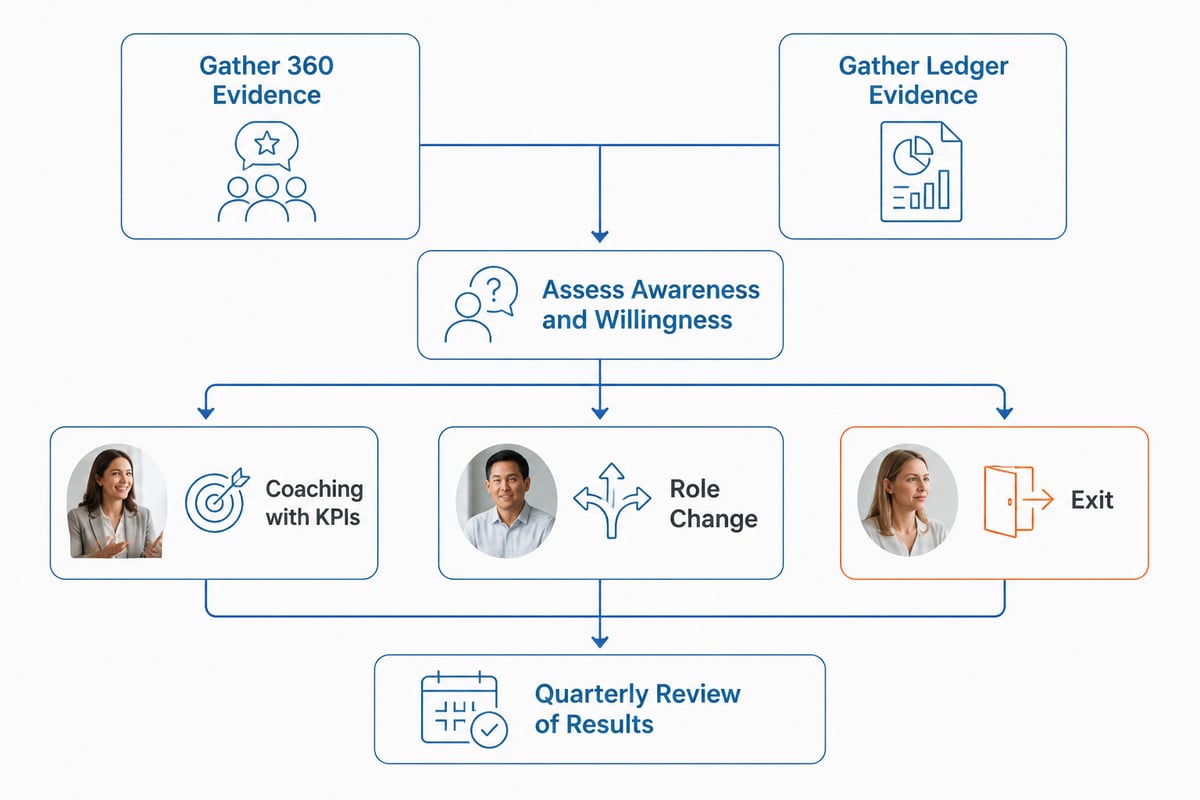
Fixing toxic leadership requires evidence of the behavior, a clear standard, and sustained support, in that order. Skipping the first step is the most common failure. Leaders are told they are "difficult" without data, and they dispute the diagnosis.
A workable sequence looks like this:
- Baseline with a 360. Collect observations from direct reports, peers, and managers. Specific behavioral feedback is harder to dismiss than general impressions.
- Set behavior-level goals. Define what changes, how it will be observed, and by whom.
- Pair the leader with the right coach. Fit by function, level, and industry matters more than coach credentials alone.
- Involve stakeholders carefully. Stakeholder feedback accelerates change, though it has trade-offs, covered in the pros and cons of involving stakeholders when coaching toxic leaders.
- Report on results. Track retention, engagement, and performance on a fixed cadence so the investment is visible.
Not every case is coachable. Some leaders will not change, and the right call is removal. Coaching works best where there is awareness, willingness, and a credible consequence if behavior does not shift. The question of when coaching beats other responses is addressed in when coaching is the better choice.
For organizations running this at scale, Executive and Leadership Coaching for Organizations from Noomii builds each engagement around a free 360 leadership survey for every participant, hand-matched coaches, and quarterly ROI reporting tied to retention, performance, and leadership KPIs. In reported outcomes, leaders showed observable behavior change after engagement, and senior leaders rated coach professionalism highly. Coordinated multi-coach delivery has also been run across several countries, which matters when the leaders you need to develop sit in different regions.
How to make the case to your CFO and board
The strongest case for acting on toxic leadership is a priced one. Walk into the room with the ledger for one named leader, the comparison to company averages, and the cost of the proposed intervention. Boards respond to specifics.
Frame the investment against a known alternative. The cost of coaching is small beside the regretted turnover of a single senior team, and it is worth confronting the question directly: is coaching worth the cost? The answer depends on measurement, which is why the ROI problem in leadership coaching is really a reporting problem.
Three points tend to land with executive teams:
- Risk is unpriced. Complaints, investigations, and regulatory attention carry exposure that grows with delay.
- Succession depends on it. If your best emerging leaders avoid certain bosses, your pipeline is shaped by those bosses. This ties directly to the leadership pipeline crisis.
- Inaction is a decision. Tolerating a known pattern signals the standard. Leaders and employees both read it.
Organizations also underestimate how much an external partner helps with credibility. Internal HR is often too close to the relationship to deliver the message. A third-party diagnostic and a matched coach change who owns the conversation.
What the cost of toxic leadership to the business means for 2026 planning
Planning for 2026 means treating leadership quality as a measurable risk, not a soft topic. With engagement declining globally and a majority of workers reporting toxic experiences, the baseline expectation should be that problem leaders exist in your organization and that some are still hidden by strong output.
A practical 90-day agenda for People leaders:
- Run the Toxic Leader Cost Ledger on your three highest-concern leaders.
- Pull leading indicators into a single monthly view for HR and the executive team.
- Commission 360 assessments for leaders where the ledger shows excess cost.
- Decide, case by case, between coaching, role change, and exit, and document the criteria in advance.
- Report results quarterly against retention, engagement, and performance.
For leaders whose behavior is the problem, the path back starts with accountability. This guide to rebuilding team trust is a useful starting point for leaders willing to repair their own impact, and a discussion on the effects of toxic leadership on psychological safety shows why trust, once lost, takes deliberate effort to rebuild.
Organizations that run structured change programs also benefit from process rigor outside of leadership development. Performance-focused consultancies such as Nero and Associates work on reducing manual workload and supporting employee wellbeing, which can ease the pressure that makes poor leadership behavior worse.
FAQ
How much does a toxic leader cost a company?
There is no universal figure, because cost depends on team size, seniority, and attrition. The reliable approach is to calculate it locally: excess regretted turnover, disengagement drag against company median, complaint handling and legal exposure, and lost high-potential talent. Most organizations find that one toxic leader of a mid-sized team costs more than that leader's compensation.
What are the signs of a toxic leader?
Common signs include above-average regretted attrition, silence in meetings, repeated transfer requests, retaliation against dissent, credit-taking, and inconsistent messages to different groups. In the iHire survey, most employees who reported poor communication in a toxic workplace had encountered mixed or inconsistent leadership messages.
Can a toxic leader change?
Some can, particularly when they have awareness of their impact, a willingness to change, and a clear consequence if they do not. A 360 assessment provides the evidence, and a matched coach provides sustained support. Where a leader rejects the feedback or the behavior is severe, role change or exit is the right response.
Should we remove a toxic leader who hits their targets?
Audit their results net of the costs they create: turnover, disengagement, complaints, and lost pipeline talent. In many cases the net contribution is negative. Keeping them also signals to the organization what behavior is rewarded.
How do we measure the return on addressing toxic leadership?
Track regretted turnover, engagement on trust and voice items, complaint volume, internal mobility, and performance against baseline. Review these quarterly and compare to the Toxic Leader Cost Ledger you built before the intervention.
Start this week by running the four-bucket cost ledger on the one leader your HR business partners worry about most, and bring the number to your next executive team meeting. If the ledger confirms what you suspected, Executive and Leadership Coaching for Organizations gives you hand-matched coaches, a free 360 survey for every participant, and quarterly ROI reporting to act on it, and you can Book a Free Strategy Call with Noomii Leadership Coaching to talk through which leaders to start with.



Leave a Reply
Want to join the discussion?Feel free to contribute!