

When Coaching a Toxic Leader Will Not Work: Warning Signs
Coaching a toxic leader will not work when the leader denies the problem, refuses accountability, or is coached only to avoid consequences. In those cases, coaching delays the decision your organization already needs to make, and the people who report to that leader pay for the delay.
That is a hard statement for a profession built on belief in human change. Coaching works for many leaders with abrasive habits. But HR and L&D leaders who treat it as a default remedy for every toxic manager end up spending budget on engagements that were doomed in week one. The skill is knowing which cases are coachable before you commit.
What Makes a Toxic Leader Different From a Difficult One
A toxic leader causes sustained harm to people through behavior they could change but choose not to, while a difficult leader is demanding, blunt or awkward but does not damage the people around them. The distinction decides whether coaching is a reasonable bet.
A demanding executive who sets a high bar and gives direct feedback is not toxic. A leader who humiliates people in meetings, punishes dissent, takes credit, and spreads fear is. Intent matters less than pattern and impact: if the harm is repeated, the label fits regardless of what the leader believes about themselves.
The scale of the problem is not small. The Workplace Bullying Institute's 2024 U.S. Workplace Bullying Survey found that 32.3% of adults reported being directly bullied at work, an estimated 52.2 million workers. Managers are often the source: in Victoria, Australia, 13.3% of public-sector employees experienced bullying in 2024, and among them 45.2% identified a manager or supervisor as the source.
Most of these leaders are not coachable in the moment the problem surfaces. Some become coachable once the stakes are real and clear. That is the window you are trying to identify.
Eight Warning Signs That Coaching a Toxic Leader Will Not Work
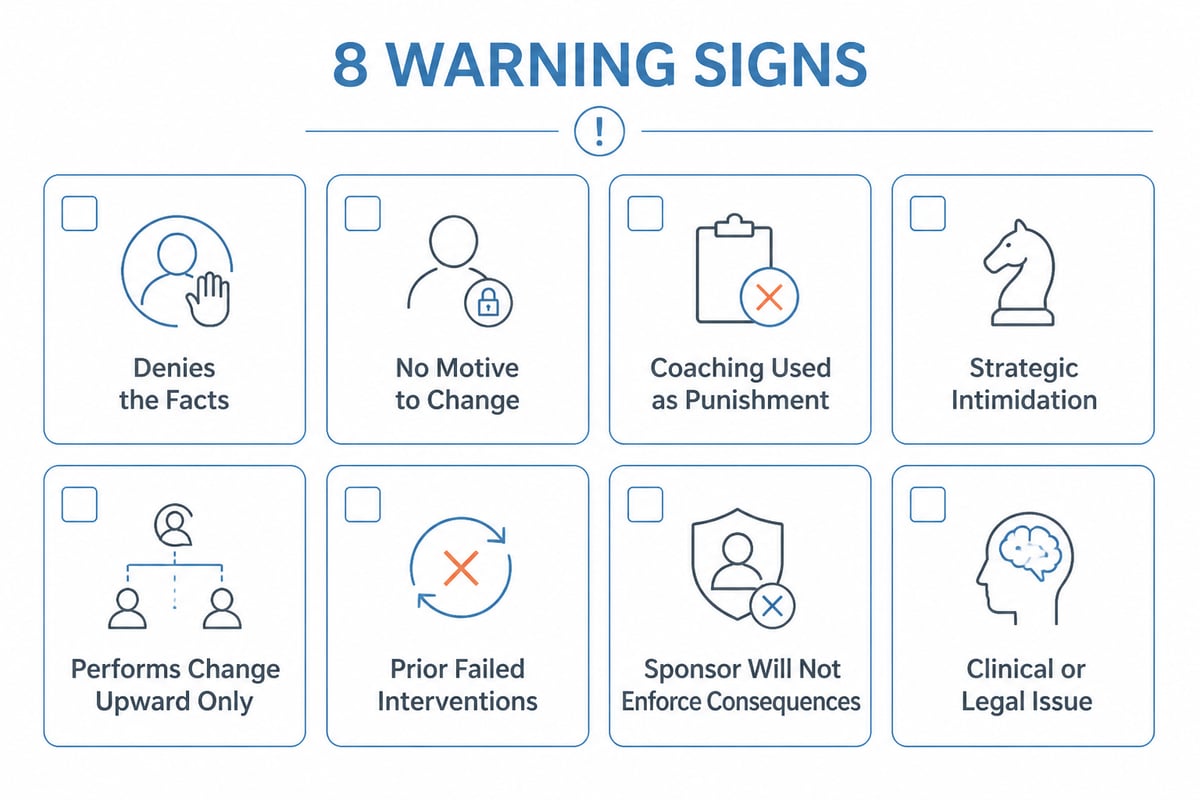
Coaching fails predictably when one or more of these conditions are present. Treat them as screening criteria before you sign an engagement, not as post-mortem findings.
- The leader does not accept the facts. They dispute the 360 data, attack the people who gave feedback, or insist that complaints are a "performance problem" on the team's side.
- There is no personal motive to change. The leader sees no cost to the behavior, often because results are strong and the organization has rewarded them for years.
- Coaching is positioned as a punishment or a paper trail. If the real plan is to build a file for termination, say so. Calling it development fools no one, least of all the coach.
- The behavior is strategic, not reactive. Fear is the management system. The leader gets compliance and speed from intimidation and sees no reason to trade that for something harder.
- The leader performs change for the sponsor and reverts with the team. Executive-facing charm paired with downward cruelty is a classic pattern. Coaching conversations get great reviews while direct reports see nothing different.
- Prior interventions have already failed. A second round of coaching with the same leader, the same sponsor and the same lack of consequences is a repeat of the first.
- The sponsor will not enforce consequences. If the CEO or business-unit head protects the leader, the leader knows it. No coach can out-influence a boss who signals that nothing will happen.
- The underlying issue is clinical or ethical, not behavioral. Harassment, discrimination, retaliation and conduct that triggers legal duties belong in investigation and compliance channels. Substance use or a mental health crisis belongs with qualified clinicians, and coaching is the wrong tool when therapy is needed.
One sign alone does not always disqualify a leader. Three or more almost always do.
Why Organizations Keep Coaching Leaders Who Will Not Change
Organizations coach toxic leaders who cannot be helped because coaching is the lowest-friction option, not the most effective one. It feels humane, it avoids litigation risk in the short term, and it lets decision-makers say they acted.
There is also a performance trap. Toxic leaders are frequently high producers, and the business case for keeping them is easy to write. Lynn Harrison explores this tolerance dynamic in a Noomii fireside chat on why organizations tolerate toxic leadership, and it matches what many HR leaders describe privately: the leader's numbers become a shield.
The cost side of the ledger rarely gets the same rigor. A 2025 survey of 1,781 workers and 504 employers by iHire found that 78.7% of surveyed employees cited unethical, unaccountable or unsupportive leadership as a feature of a toxic workplace. Attrition, lost discretionary effort and quiet disengagement are real costs, even when they do not appear on the toxic leader's scorecard.
Consider the contrarian point: the leader's strong results are often a reason to move faster, not slower. The more the organization depends on one person's output, the more fragile the team becomes, and the more damaging a delayed decision gets.
A Readiness Test for Deciding Before You Commit
A coaching readiness test asks four questions about the leader and the organization before any money is spent. This is a simple screening process, and HR leaders can run it in a week.
| Test | Pass looks like | Fail looks like |
|---|---|---|
| Awareness | Leader can describe specific behaviors and their effect on others | Leader names only the complainers' flaws |
| Motive | Leader names a personal reason to change that is not just keeping the job | Leader is waiting it out |
| Sponsor | Executive sponsor commits to defined consequences and a review date | Sponsor wants it "handled quietly" |
| Scope | Behavior is within coaching territory | Conduct involves legal, clinical or ethical breaches |
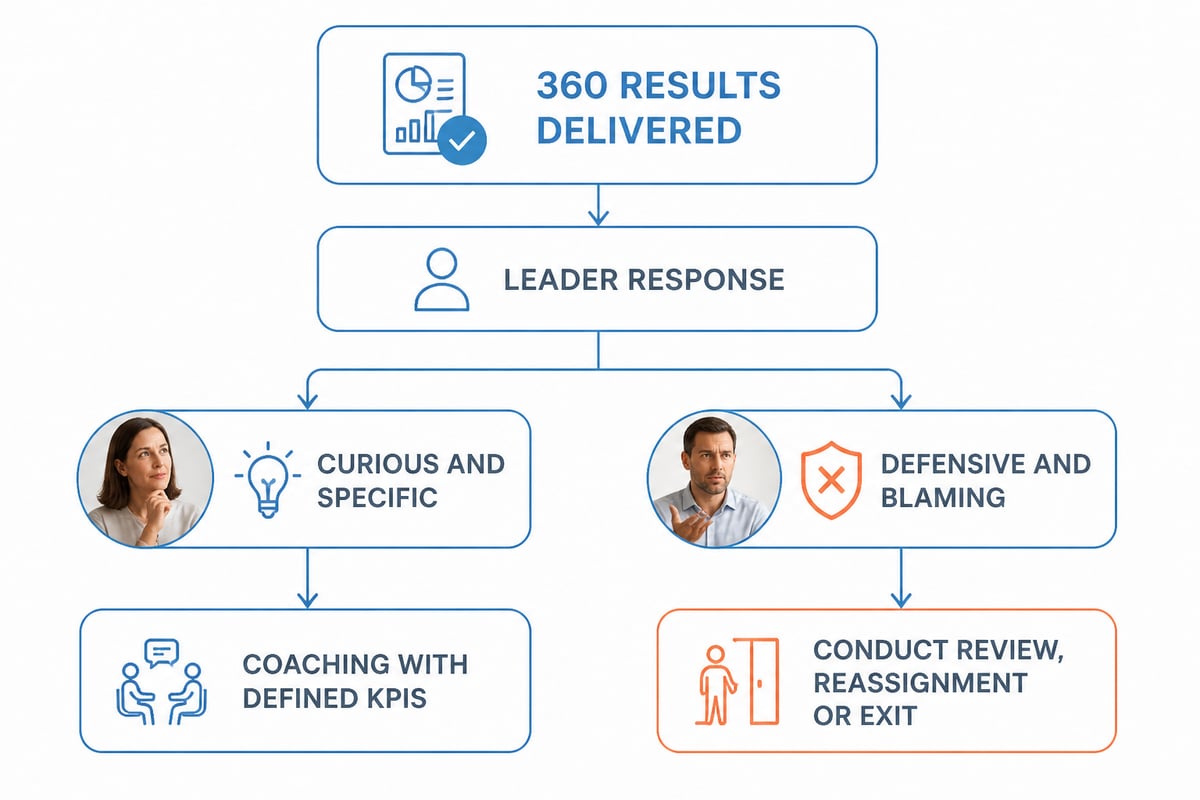
Run the 360 first. A structured assessment gives the leader and sponsor the same data and removes the "this is just one person's opinion" defense. Noomii provides a free 360 leadership survey for every participant, and how the leader reacts to those results is often the most predictive signal you will get. Defensiveness at that stage is informative. So is curiosity.
Then make the conditions explicit. Define what observable change looks like, who will confirm it, and what happens if it does not occur. Stakeholder involvement matters here, and it has trade-offs worth understanding, which Noomii covers in its piece on the pros and cons of involving stakeholders when coaching toxic leaders.
Two Cases: One Coachable, One Not
The difference between a coachable and an uncoachable leader is rarely visible from the leader's title or track record. It shows up in how they respond when the data lands. These two composite cases illustrate the pattern, drawn from situations commonly seen in large-organization coaching engagements.
Case one: the leader who wanted to know
Problem: A VP of operations in a large manufacturer had a pattern of public criticism. Two high performers had resigned in a year.
Diagnosis: The 360 showed a clear gap between how the VP saw their style ("high standards") and how the team experienced it ("fear of being wrong"). Critically, the VP asked for the verbatim comments and read them twice.
Solution: A hand-matched coach with manufacturing experience worked on three specific behaviors: how feedback was delivered, how errors were handled in meetings, and how decisions were explained. Skip-level check-ins tracked change.
Result: Direct reports described observable differences within two quarters, and the sponsor saw retention stabilize.
Lesson: Early curiosity about the data predicted success better than any performance rating did.
Case two: the leader who wanted a witness
Problem: A senior director in a regulated services firm was known for retaliation against dissenters. Two prior coaching attempts had ended with glowing coach reports and no change in team behavior.
Diagnosis: The director treated coaching as an audience to be managed. The sponsor, a close ally, had never defined consequences.
Solution: The organization stopped coaching and moved to a formal conduct review.
Result: The review surfaced documented retaliation, and the director exited. Two team members who had been quietly job-hunting stayed.
Lesson: The third coaching round would have bought another year of damage. The decision to stop was the intervention.
When Coaching a Toxic Leader Will Not Work: Alternatives to Consider
When coaching a toxic leader will not work, the organization has four realistic options, and each demands a different owner and timeline.
- Formal conduct process. If behavior involves harassment, discrimination or retaliation, route it to HR, legal and compliance. Coaching cannot substitute for an investigation and should never run in parallel in a way that muddies it.
- Role change. Some leaders do real damage as people managers but contribute as individual experts. Moving them out of a management role removes the harm without losing the skill. This only works if the move is not a quiet promotion.
- Final-warning structure with a time limit. Coaching can still be part of this, but the consequence is real and dated. The coach is a resource, not a rescue.
- Separation. When trust is broken and the sponsor will not enforce standards, exit protects the team. It also tells everyone else what the organization actually tolerates.
Do not forget the team. While a decision is pending, protect the people reporting to the leader: give them an alternate escalation path, check in with skip-level conversations, and document patterns. Noomii's guide to what happens when coaching is not worth it is a useful companion for the sponsor who is wavering.
Culture has a long memory. When employees see a known toxic leader shielded by results, they conclude that the stated values are optional. That damages psychological safety well beyond the leader's own team, a point Martijn Sjoorda develops in a fireside chat on toxic leadership and psychological safety.
What Coachable Looks Like, and How to Structure It Right
When the readiness test passes, coaching can work, and the structure around it determines the outcome. The leaders most likely to change are those who feel real discomfort at the gap between intent and impact.
Noomii's own reported results come from engagements built this way. Across its work, 100% of leaders showed observable behavior change after engagement, and senior leaders gave coach professionalism a 10/10 rating. A Fortune 500 global electronics manufacturer re-commissioned coaching engagements because of documented impact, and leaders at a Fortune 1000 international therapeutics company moved from task execution to problem ownership. These outcomes depend on the pre-work: matching, baseline data and defined KPIs.
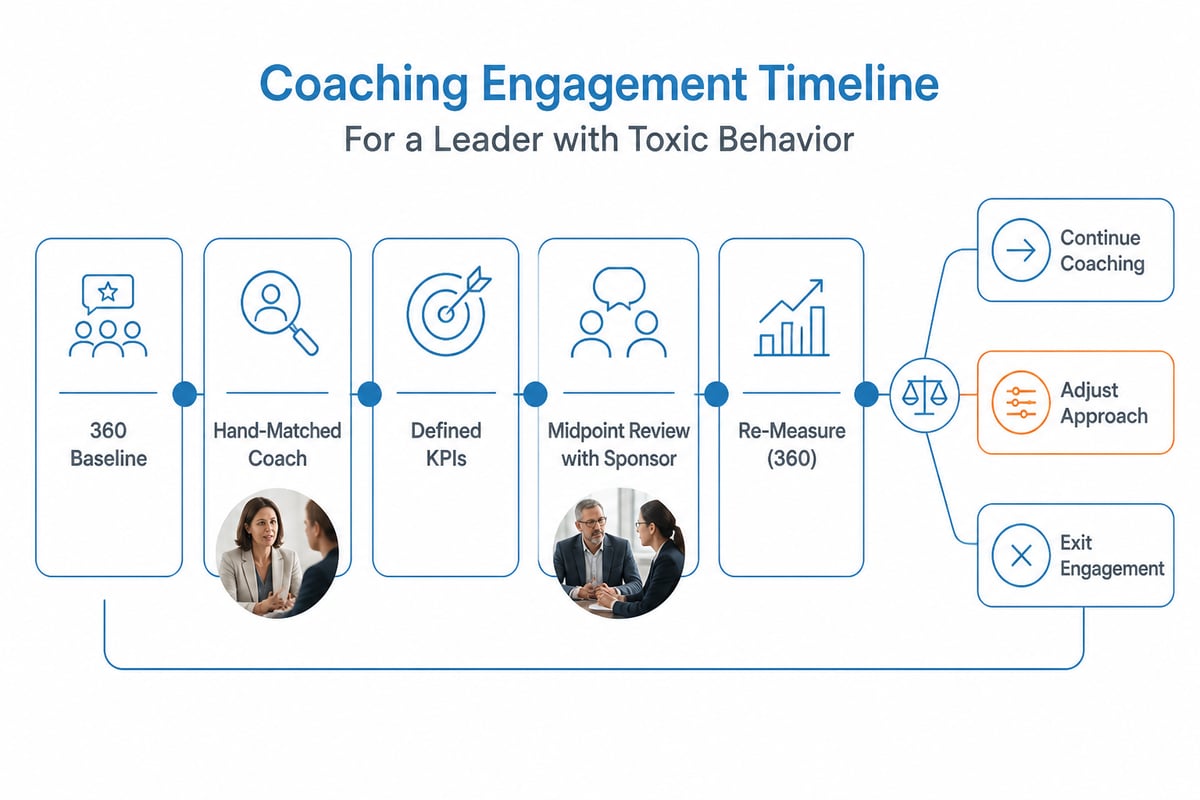
Four design choices separate effective engagements from performative ones:
- Hand-matched coaching. Matching by function, level, industry and goals matters because a coach who understands the leader's operating context is harder to dismiss.
- A baseline and a re-measure. Use the 360 to set the starting point and repeat it to verify change from the team's perspective, not the leader's.
- Defined KPIs tied to retention and performance. If the engagement cannot be connected to turnover, engagement or leadership metrics, you cannot tell whether it worked.
- A decision date. Set a review point in advance, with the sponsor present, where continue, adjust or exit is a live option.
Organizations that want structured 1:1 cycles with this kind of rigor can look at Executive and Leadership Coaching for Organizations, which is built around a free 360 survey, hand-matched coaches, stakeholder check-ins and quarterly ROI reporting. Noomii also sources and interviews coaches for each leader, which lowers the cost of finding out early that the match or the readiness is wrong.
For leaders who are self-aware enough to do their own repair work, rebuilding team trust after toxic behavior is a realistic goal, and insights from reformed toxic leaders show what the turning point tends to look like.
Frequently Asked Questions
Can you coach someone who does not think they are toxic?
Rarely, at least not at the start. Coaching depends on the leader accepting that a gap exists. Structured 360 data sometimes breaks through denial, but if the leader still rejects the findings after seeing them, the odds of meaningful change are low and the organization should consider other options.
How long should you give coaching before deciding it is not working?
Set the review date before the engagement begins, typically at a defined midpoint tied to observable behaviors. Waiting for the end of a long engagement to judge progress is a common mistake. Early signals from direct reports and skip-level conversations matter more than the leader's self-report.
Should coaching run alongside an HR investigation?
Generally no. If there are credible allegations of harassment, discrimination or retaliation, the investigation comes first and should be kept separate. Coaching can follow, but only after the process concludes and with clear conditions.
What if the toxic leader is a top performer?
Strong results do not change the readiness test. They often increase the sponsor's reluctance to enforce consequences, which is one of the strongest predictors of failure. Decide based on behavior and impact, and weigh the retention and engagement cost of keeping the leader as seriously as you weigh the revenue.
Who should sponsor the coaching engagement?
The leader's direct superior, with HR as a partner. The sponsor must be willing to define change criteria, review progress and act on the result. A sponsor who is personally aligned with the toxic leader is a risk factor on its own.
Start this week by pulling the 360 or engagement data on the leader you are worried about and testing it against the four readiness questions: awareness, motive, sponsor and scope. If the answers point toward coachability, Noomii Leadership Coaching can match the leader with a coach, run the baseline survey and report on retention and performance KPIs each quarter, so you can Book a Free Strategy Call to decide whether coaching, a conduct process or a role change is the right path before you spend anything.


Leave a Reply
Want to join the discussion?Feel free to contribute!