

Signs of Toxic Leadership HR Should Never Ignore
The signs of toxic leadership HR should never ignore are fear-based control, retaliation against people who speak up, concentrated turnover under one manager, public humiliation, and a pattern of strong results that leadership uses to excuse damaging behavior. Any one of these deserves attention. Two or more together mean the problem has moved from a personality issue to an organizational risk, with legal, financial and cultural consequences.
Most HR teams do not miss toxic leaders because they lack information. They miss them because the information arrives in fragments: an exit interview here, a skip-level comment there, a quiet complaint that gets withdrawn. The work is connecting those fragments early enough to act.
Why toxic leaders stay in place longer than they should
Toxic leaders survive because their results mask their behavior and because the people best positioned to report them are the ones with the most to lose. A leader who hits revenue targets while burning through staff looks like a high performer on a quarterly scorecard. The cost shows up later, in backfill spend, lost institutional knowledge and a bench of successors who refuse to step up.
Gallup’s 2025 report found that global manager engagement fell over the past year, while engagement among individual contributors stayed flat. Managers are the transmission layer for culture. When they are disengaged or stressed, the behaviors that follow, such as withdrawal, irritability and control, land on their teams first.
There is also a structural reason. Many organizations promote people for individual output and then hand them authority over others with no development. The conversation on why organizations tolerate toxic leadership with Lynn Harrison makes the point that tolerance is usually a choice made through inaction, not a failure of detection.
Fear-based control and intimidation
Leading through fear is the clearest early signal, and it rarely looks like shouting. More often it looks like a team that has gone quiet in meetings.
Watch for these patterns in how people describe the leader:
- Team members say they "check the mood" before bringing up bad news.
- Mistakes are punished publicly, so problems get hidden until they become crises.
- The leader reverses decisions without explanation and treats questions as disloyalty.
- Direct reports describe walking on eggshells, or use the same phrase independently.
The business consequence is slower information flow. Leaders who rule by fear are often the last to learn about risks in their own function, because nobody wants to deliver the message. Noomii’s analysis of how toxic leadership destroys innovation covers how suppressed dissent shuts down the experimentation that growth depends on.
Retaliation and silencing of complaints
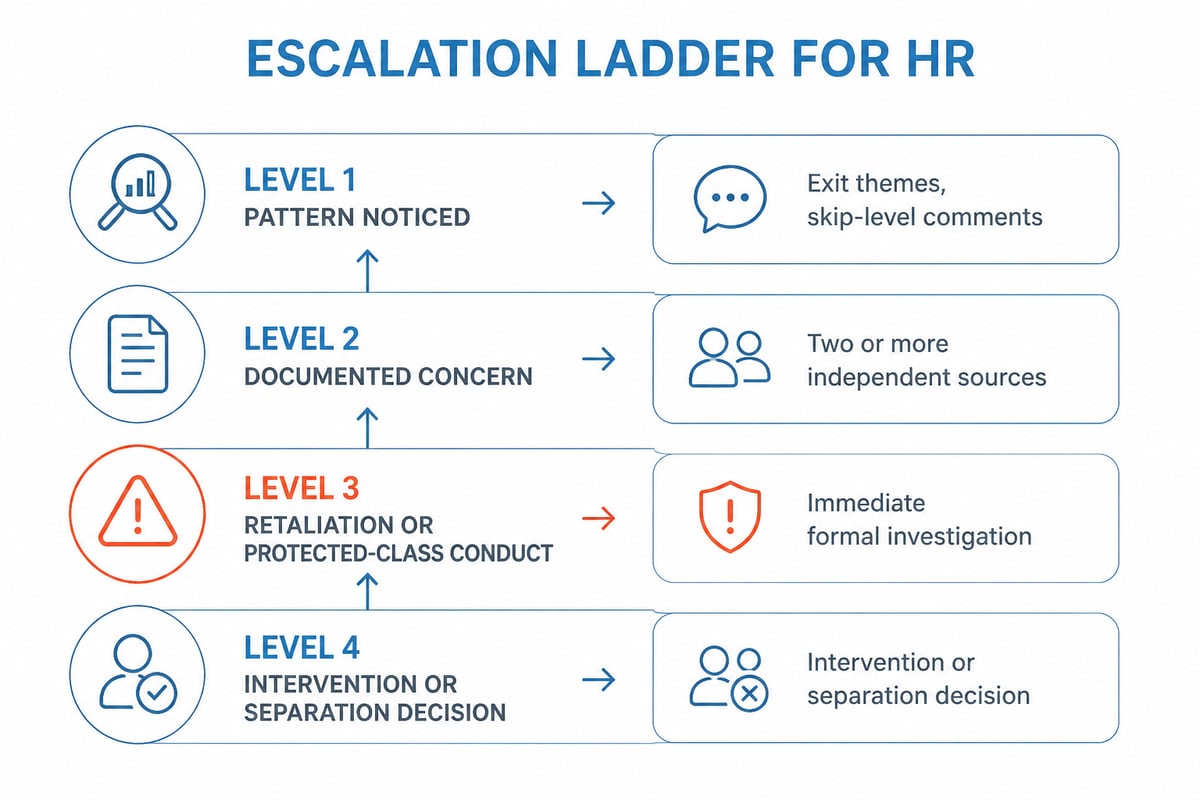
Retaliation is the sign that should trigger immediate escalation, because it converts a behavior problem into a legal exposure. If someone raised a concern and then lost projects, was excluded from meetings, or received a sudden negative review, treat that sequence as a serious event until proven otherwise.
The U.S. Equal Employment Opportunity Commission states that harassment becomes unlawful when enduring the conduct is a condition of continued employment, or when it is severe or pervasive enough to create an intimidating, hostile or abusive environment (EEOC). The same agency recommends that employers maintain an effective complaint process, train managers and employees on anti-harassment, and take immediate and appropriate action when someone complains. Its guidance on retaliation clarifies that protections extend to people who report concerns or take part in an investigation, with examples of prohibited treatment.
Toxic behavior is not always unlawful. But the way a leader responds to being reported is where the legal line is most often crossed.
Turnover and absence patterns concentrated under one leader
Concentrated attrition is a useful data signal HR already owns. Company-wide turnover can look healthy while one leader's team loses people at a much higher rate than peers.
Pull these cuts quarterly, by manager, not by department:
- Voluntary exits within 12 months of a hire date or a reporting-line change.
- Internal transfer requests away from a specific team, which often precede resignations.
- Sick leave and unplanned absence clustered around one manager.
- Exit interview language that repeats across unrelated departures, such as "no trust," "micromanaged" or "didn't feel safe."
Exit interviews can be a weak early warning system, since people leaving for a reference may not be fully candid. Internal transfer requests and skip-level conversations with current staff often arrive sooner. If your detection depends on exit data alone, you may be learning about the problem after the damage is done.
Credit-taking, blame-shifting and favoritism
A leader who consistently claims credit upward and pushes blame downward is eroding accountability, even if nobody files a complaint. Favoritism compounds it. When promotions, high-visibility assignments or flexibility go to a small inner circle regardless of performance, the rest of the team concludes that the rules are personal.
This matters for succession. High potentials who work under this leader stop taking risks or leave. HR then discovers during talent review that a function has no ready successors, and assumes the pipeline is thin when the real cause is that the leader is blocking it.
Ask in calibration sessions: who from this leader's team has been promoted or moved laterally in the past three years, and how does that compare with peer leaders? A flat record is a finding.
Public humiliation, gossip and boundary violations
Public humiliation, gossip about team members and contact that ignores boundaries are conduct signals that HR can verify directly. They tend to be witnessed by many people, which makes them easier to document than private mistreatment.
The behaviors to log include:
- Berating or mocking someone in a meeting or group chat.
- Sharing confidential performance or personal information to build alliances.
- Expecting responses at all hours and penalizing people who set limits.
- Comments about identity, health or family circumstances.
The World Health Organization's guidance on mental health at work recommends manager training that helps supervisors recognize and respond to workers experiencing emotional distress, strengthen open communication and active listening, and understand how workplace stressors affect mental health (WHO). The inverse is also instructive. A manager who lacks those skills, or who actively undermines them, becomes a workplace stressor in their own right.

The Signal Stack: a framework for deciding when to act
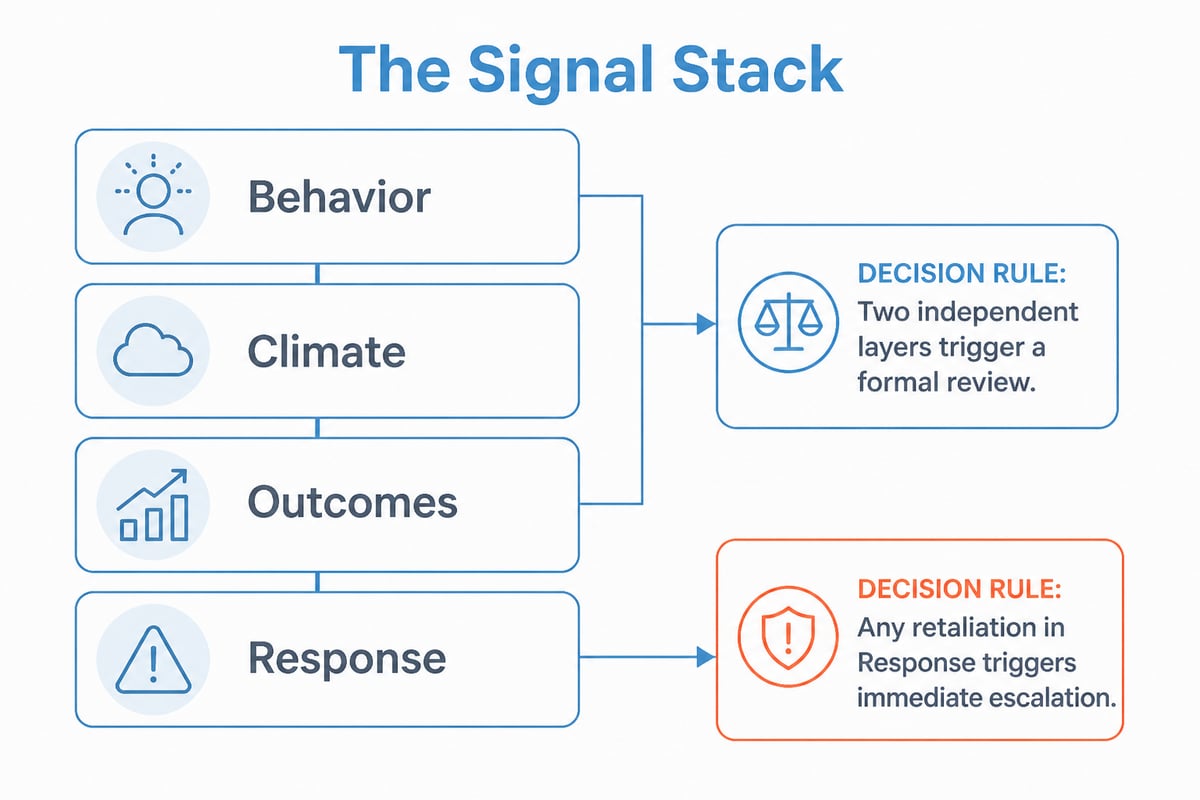
HR rarely has one decisive piece of evidence, so a simple scoring approach prevents both overreaction and delay. A signal stack groups what you see into four layers and sets a threshold for action.
| Layer | What it captures | Example evidence |
|---|---|---|
| Behavior | What the leader does | Public humiliation, retaliation, reversals |
| Climate | How the team feels | Engagement comments, 360 themes, silence in meetings |
| Outcomes | What the data shows | Concentrated turnover, absence, stalled promotions |
| Response | How the leader handles feedback | Defensiveness, retaliation, or genuine change |
The rule of thumb: evidence in any two layers from independent sources justifies a formal review, and any retaliation signal in the Response layer justifies immediate escalation regardless of the others. The Response layer is the one most teams neglect. A leader who accepts hard feedback and changes is a coaching candidate. A leader who punishes the messenger is a risk.
Case example: the high performer nobody wanted to report
A hypothetical scenario, illustrating patterns that are common in many organizations, shows how the signal stack might work in practice.
Problem. A regional director consistently exceeded sales targets. Over 18 months, his team lost a large share of its people. Leadership attributed it to a competitive market.
Diagnosis. HR compared his attrition against peer directors and found it ran well above theirs. Two transfer requests cited "culture." A skip-level conversation surfaced public criticism of junior staff and a pattern of reassigning accounts from anyone who disagreed with him. A 360 survey confirmed low trust scores from direct reports, while his peers and manager rated him highly.
Solution. HR documented the behaviors, separated the facts from the reputation, and offered a structured coaching engagement paired with explicit expectations and a 90-day review. The leader was told plainly that retaliation against anyone who participated in the review would be treated as a separate violation.
Result. Within the following review cycles, direct-report trust scores moved up, voluntary exits slowed, and some high potentials who had been planning to leave stayed.
Lesson. The signal was in the people data the entire time. Sales numbers were hiding it, and the 360 gap between how he was seen upward and how he was seen downward was the clearest indicator.
What HR should do when the signs line up
When the signal stack points to a real problem, the response should be fast, documented and proportionate. Delay is the most expensive option, because every month of inaction teaches the team that nothing will happen.
- Preserve and document. Record dates, witnesses and specific behaviors, not conclusions.
- Protect reporters. Remind the leader and their management chain in writing that retaliation is prohibited, and monitor assignments and reviews for the people involved.
- Investigate where conduct may be unlawful. Do not route harassment or discrimination concerns through a coaching track.
- Separate coachable from non-coachable. Reserve development for leaders who show insight and willingness. Persistent denial or retaliation points toward role changes or exit.
- Measure after intervention. Track turnover, 360 scores and engagement for that team at 90 and 180 days.
The question of whether a toxic leader can change deserves a straight answer. Some can, especially those whose behavior stems from stress, a lack of management training or blind spots nobody ever named. Noomii's discussion of insights from reformed toxic leaders describes what that change looked like from the inside. Others will not, and the evidence from the Response layer tells you which is which.
How coaching fits, and where it does not
Coaching works when the leader is willing and the organization sets clear expectations, and it fails when it is used to avoid a hard decision. For leaders in the coachable group, a structured program with stakeholder input and measured outcomes is more reliable than a one-off training day.
Noomii’s executive and leadership coaching for organizations is built around that discipline: a free 360 leadership survey, hand-matched coaches, behavior frameworks, stakeholder check-ins and quarterly ROI reporting tied to retention, performance and leadership KPIs. Noomii's reported results include observable behavior change in leaders after engagement, and a Fortune 1000 international therapeutics company saw leaders move from task execution to problem ownership. For a deeper look at the inputs, see Noomii's piece on the pros and cons of involving stakeholders when coaching toxic leaders.
Coaching is not a substitute for investigation. If conduct crosses into harassment or retaliation, the formal process comes first.
Building detection into the system
The most useful shift is moving from reacting to individual complaints to monitoring leadership quality as a standing metric. That means manager-level dashboards, regular skip-level conversations, 360 data reviewed alongside performance, and a clear path for people to raise concerns without fear. Noomii's overview of the warning signs of leadership failure is a useful companion for calibrating what to track.
It also means asking an uncomfortable question in talent reviews: would we promote this person if we weighed how they treat people as heavily as what they deliver? If the honest answer is no, the signs of toxic leadership HR should never ignore are already visible in your own succession decisions.
FAQ
What are the earliest signs of toxic leadership?
The earliest signs are usually climate signals rather than formal complaints: a team that goes quiet in meetings, people hiding bad news, internal transfer requests away from one manager, and repeated phrases like "walking on eggshells" in conversations with HR. Turnover concentrated under one leader is the strongest early data signal.
How can HR tell a tough boss from a toxic one?
A tough boss holds high standards and applies them consistently and respectfully. A toxic leader uses fear, humiliation or retaliation to control people. The test is how the leader responds to feedback and whether team members feel safe disagreeing with them.
Is toxic leadership illegal?
Not always. Harassment, discrimination and retaliation are unlawful, but rudeness and poor management often are not. The EEOC defines unlawful harassment as conduct that becomes a condition of continued employment or is severe or pervasive enough to create a hostile environment. HR should investigate any conduct that may meet that standard and treat retaliation as a priority.
Can a toxic leader change?
Some can, particularly leaders who lack management training or have blind spots no one has named. Change is more likely when the leader accepts the feedback, expectations are explicit, and progress is measured. Leaders who deny the problem or retaliate against reporters rarely change.
What data should HR track to spot toxic leadership?
Track voluntary turnover and internal transfer requests by manager, absence patterns, 360 feedback gaps between upward and downward ratings, promotion rates within each team, and recurring themes in engagement comments and exit interviews.
This week, pull voluntary turnover and internal transfer requests by manager for the past 18 months and flag any leader whose rate runs well above their peers. If the pattern points to a leader who is coachable, a structured engagement with a baseline 360 and measured outcomes gives you evidence instead of opinion, and Noomii Leadership Coaching can help you set that up, so you can book a free strategy call to talk through your highest-risk leaders.



Leave a Reply
Want to join the discussion?Feel free to contribute!