

How Middle Managers Start Toxic Culture and How to Fix It
Toxic culture starts with middle management because managers are the layer where stated values meet daily behavior, and where pressure from above gets converted into how people are actually treated. Executives write the values. Middle managers decide which ones are enforced, which are ignored, and which are quietly punished.
That is an uncomfortable finding for boards and CHROs, because the usual instinct is to look upward. Culture problems do start at the top in many organizations, and our own writing on how culture problems start at the top makes that case. But the top sets the weather. The middle determines what employees experience on a Tuesday afternoon. If you only audit the C-suite, you will miss where most of the damage is actually done.
Why the middle layer carries so much cultural weight
Middle managers carry disproportionate cultural weight because they control the daily conditions of work for most employees: assignments, feedback, recognition, workload and access to leadership. A frontline employee may see a senior executive twice a year. They see their manager every day.
The data supports this. Gallup’s global workplace research has repeatedly found that managers account for a large share of team engagement. Gallup's more recent findings on declining manager engagement, covered by HR Dive, suggest that slide is linked to a weaker employee experience. When managers disengage, their teams tend to absorb it.
Three structural facts explain the leverage:
- Managers translate strategy into behavior. A vague directive from above becomes a specific demand, a specific deadline and a specific tone.
- Managers filter information in both directions. What leadership hears about morale and what employees hear about strategy both pass through this layer.
- Managers model what advancement looks like. Team members copy the behaviors that appear to get rewarded.
The jsbenefitsgroup analysis of middle managers and organizational destiny makes a similar point about how change succeeds or stalls in this layer. The same mechanics apply to culture, only in reverse when the layer is unhealthy.
What defines a toxic culture?
A toxic culture is one where fear, disrespect, exclusion or unchecked abusive behavior shape how people work, and where those patterns are tolerated or rewarded by the organization. The defining feature is not a single bad person. It is a system that lets harmful behavior continue without consequence.
Practical markers include:
- High-performing people leave while problem managers stay
- Employees stop raising problems because it has cost them before
- Information is hoarded and credit is contested
- Turnover and absenteeism cluster under specific managers
- HR complaints are resolved quietly, then repeat
Notice that none of these require a villain in the executive suite. They require a middle manager with power over people and an organization that has stopped noticing. Our deeper look at toxic leadership covers the behavioral patterns in detail.
How middle managers start toxic culture: the five mechanisms
Middle managers start toxic culture through five repeatable mechanisms, and none of them depend on malice. Most trace back to pressure, poor preparation or unchecked habits.
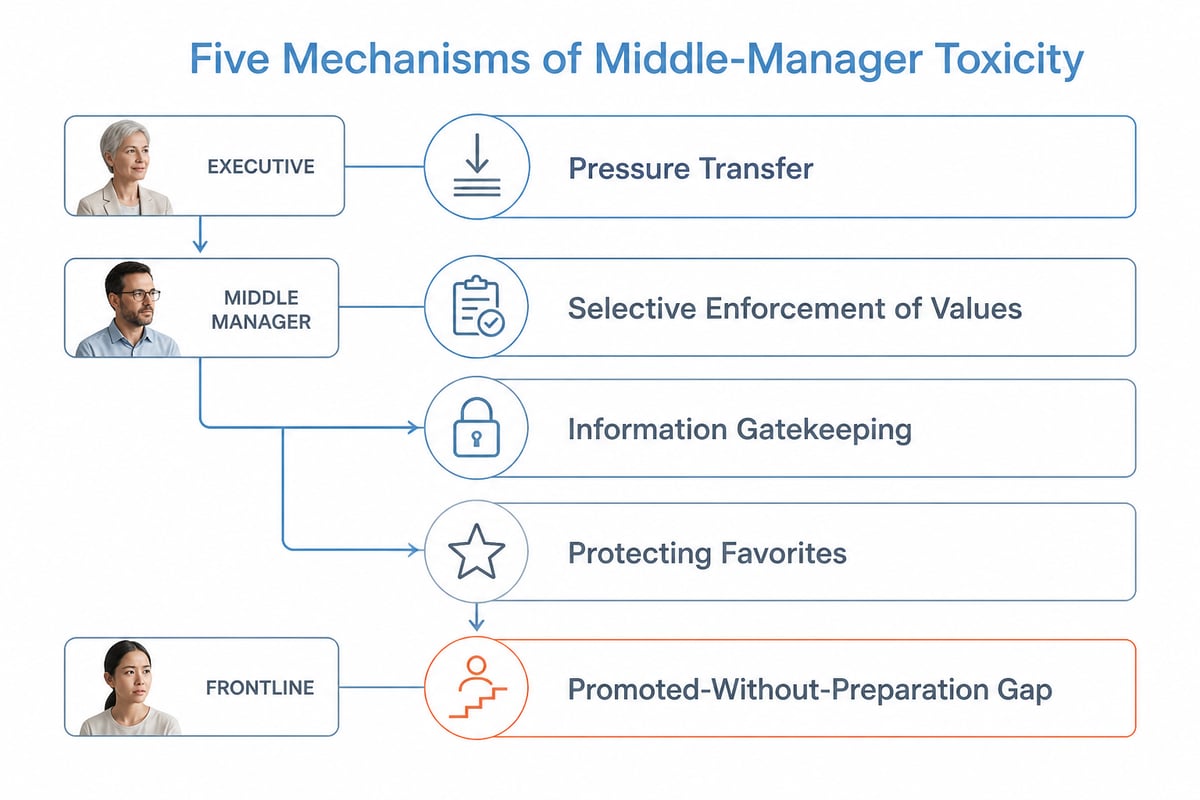
1. Pressure transfer
When executives push aggressive targets with no support, middle managers often pass the stress down unfiltered. Sharp tone, last-minute demands and public blame become the release valve. Leadership sees results and assumes the approach works.
2. Selective enforcement of values
A company can print respect on every wall. If a manager tolerates a top-performing jerk because the numbers are good, the team learns the real rule within a week. Culture is whatever gets tolerated, and managers are the ones doing the tolerating. This is also why toxic leaders survive far too long in organizations that claim to have zero tolerance.
3. Information gatekeeping
Managers who control access to leaders, context or opportunities can build small fiefdoms. Employees learn that proximity to the manager matters more than quality of work. Trust erodes, and so does psychological safety.
4. Protecting favorites
Uneven standards are among the fastest ways to poison a team. When two people behave the same way and only one is corrected, everyone notices. Fairness is a cultural signal, and managers send it constantly.
5. The promoted-without-preparation gap
Most middle managers were promoted for technical excellence, not for leading people. They received a title, a team and a budget, but rarely training in feedback, conflict or inclusion. They default to whatever their own former bosses modeled, including the bad habits. This is why leadership development without behavior change so often fails to move culture: the content gets delivered but the daily conduct stays the same.
The contrarian view: it is not always a people problem
The conventional response to a toxic manager is to coach or remove the individual. That is sometimes right, and often incomplete. Frequently the manager is responding rationally to the incentives and constraints the organization has created.
Consider what leadership is asking of the middle layer in 2026: absorb restructuring, do more with fewer people, drive AI adoption, hold margins and keep engagement scores up. Many managers are being squeezed from both sides, and manager burnout is rising. A manager under that pressure who snaps at a team is a symptom as much as a cause.
This matters because the fix differs. If the cause is a skills gap, you build skills. If the cause is an incentive that rewards output at any cost, no amount of coaching will hold. If you want to understand how the broader organization contributes, our fireside chat on why toxic leadership is tolerated is worth a listen.
A related point for 2026: technology will not rescue this. Teams are experimenting with AI for feedback and engagement analytics, but AI will not fix a toxic culture when the root cause is how a manager treats people.
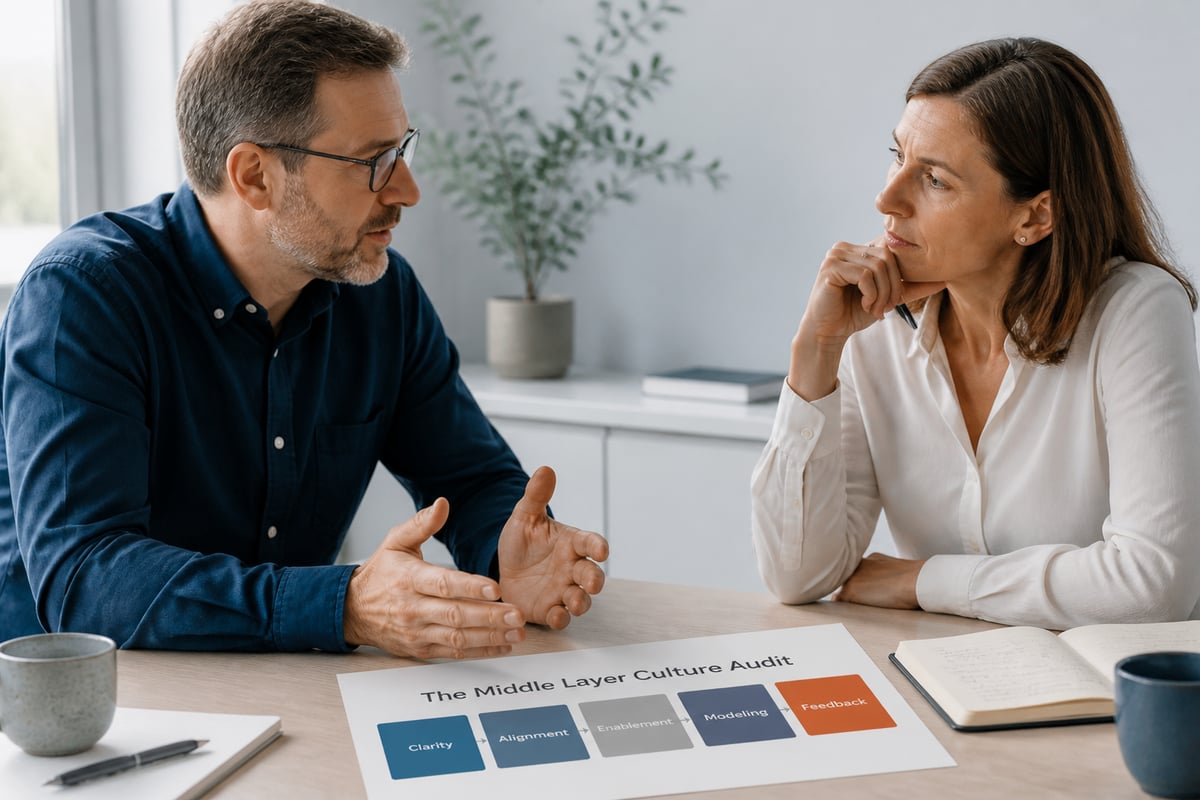
A diagnostic framework: the Middle Layer Culture Audit
A useful audit tests four dimensions across your manager population rather than relying on a single engagement score. Averages hide the managers who matter most.
| Dimension | What to measure | Warning sign |
|---|---|---|
| Behavior | 360 feedback on respect, fairness and feedback quality | Large gap between self-rating and team rating |
| Outcomes | Turnover, internal transfers out, absenteeism by manager | Clusters under specific managers |
| Voice | Whether issues are raised and what happens after | Low reporting, or reporting followed by retaliation |
| Incentives | What managers are rewarded and promoted for | Results rewarded regardless of method |
Run it by manager, not by division. A healthy division average can contain two or three managers whose teams are in distress. The point is to find the pockets before they spread.
A case example: problem, diagnosis, solution, result, lesson
The following pattern is illustrative of the type of work Noomii does with enterprise clients.
Problem. A global manufacturer with several hundred people managers saw strong executive-level survey results but persistent attrition among high performers in two regions.
Diagnosis. A 360 assessment showed that a cluster of mid-level managers scored well on delivery and poorly on trust. They were promoted for output, rewarded for output and had never been shown another way to lead.
Solution. The organization shifted from generic training to individualized coaching matched to each manager's profile, paired with a development plan tied to specific team-level indicators.
Result. In Noomii's work with a Fortune 500 global electronics manufacturer, documented impact led to repeat engagements being re-commissioned. A Fortune 1000 international therapeutics company saw leaders move from task execution to problem ownership.
Lesson. Training teaches. Coaching changes behavior when it is individualized, tied to the manager's real team and measured against outcomes the business already cares about.
What are the signs of a disrespectful or bad manager?
The clearest signs of a disrespectful manager are patterns, not single incidents: public criticism, dismissing input, taking credit, inconsistent standards and retaliation when challenged. One bad day is human. A pattern is culture.
Among the qualities of a bad manager that HR leaders see most:
- Avoids difficult conversations until problems become crises
- Plays favorites and applies rules unevenly
- Micromanages or, alternatively, disappears entirely
- Takes credit and deflects blame
- Reacts to bad news with anger, so bad news stops arriving
- Cannot give specific, usable feedback
- Treats people as capacity rather than as individuals
Types of managers are often grouped into four broad styles: autocratic, democratic, laissez-faire and coaching or visionary. None is automatically toxic. Each becomes toxic when it is applied rigidly regardless of the situation or the person.
How to fix it: a sequence that works
Fixing a culture that has been shaped by its middle layer requires acting on selection, support, accountability and measurement together. Doing only one rarely holds.
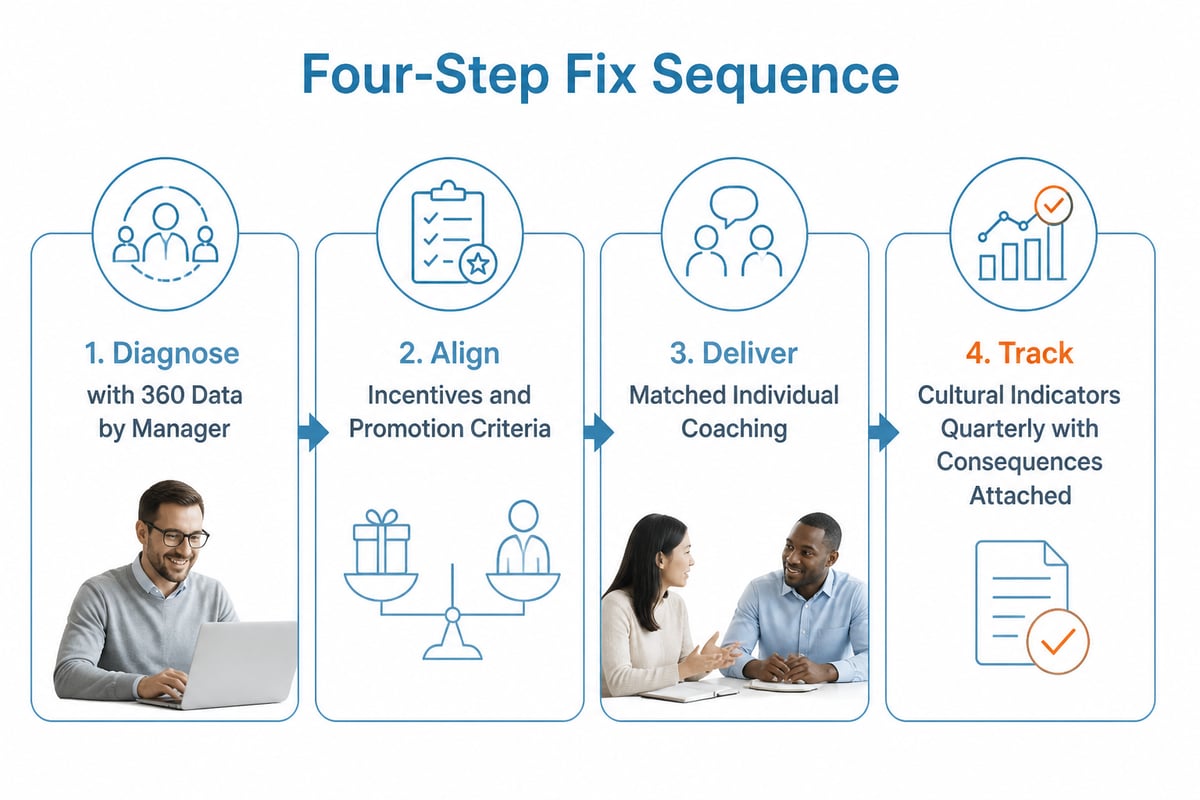
- Diagnose with behavioral data. Use validated assessments and 360 feedback to see how each manager actually leads, not how they describe themselves.
- Change what gets rewarded. Add leadership behavior to promotion and bonus criteria. If method never affects pay or advancement, it will not change.
- Match development to the person. A manager who avoids conflict and one who intimidates need different interventions. Generic workshops treat both the same.
- Involve stakeholders carefully. Feedback from direct reports and peers improves coaching, though it carries risks if mishandled. Our piece on the pros and cons of involving stakeholders when coaching toxic leaders covers how to do this well.
- Attach consequences. Coaching works best when leaders know that change is expected and tracked. Without that, coaching becomes a way to delay hard decisions.
- Measure and report. Track retention, engagement and leadership KPIs on a set cadence and show leadership the results.
For organizations that need to formalize this, Noomii's Leadership Development Programs are built with your HR, L&D or People team as customized, measurable development plans for each leader, aligned with business strategy, and pilot programs are available. Noomii pairs leaders with coaches who have sector expertise and specialized skills, and tracks leadership growth through defined KPIs and ROI-focused metrics.
Where senior leaders go wrong
Senior leaders most often go wrong by treating the middle layer as a delivery channel rather than as the culture itself. A few patterns repeat:
- Cascading values by memo. A values rollout without manager-level behavior change is decoration.
- Promoting the highest performer without a readiness check. The cost shows up in the team's turnover, not in the manager's scorecard.
- Ignoring the squeeze. Asking managers to do more with less while demanding better culture produces exactly the behavior leaders say they want to avoid.
- Waiting for complaints. By the time HR hears about it, good people have already left, often quietly.
Tolerating a high-output manager who damages people has a price. We have written about the hidden cost of toxic executives, and the same economics apply one level down, where there are simply more of them. The effect on innovation is also real, since fear-based cultures kill innovation by making people stop proposing anything risky.
FAQ
Why does toxic culture so often trace back to middle managers?
Middle managers control the daily experience of most employees, including workload, feedback and recognition. They also translate executive pressure into behavior, so stress and standards flow through them first. When this layer is unprepared or incentivized to prioritize output over people, the culture reflects it.
Can a toxic middle manager be coached, or should they be removed?
Both are valid, and the right choice depends on willingness, severity and impact. Managers with skill gaps and real motivation to change often improve with individualized coaching tied to measurable team outcomes. Where behavior is abusive or the person resists change, removal protects the team and signals what the organization will not tolerate.
How do you measure whether a middle manager is damaging culture?
Combine 360 feedback, team-level turnover and absenteeism, internal transfer patterns and whether employees raise issues without fear. Look by individual manager rather than by division average, because averages hide the outliers. Track the results quarterly so trends are visible before people leave.
Start this week by pulling turnover and internal transfer data by individual manager, then compare it against their 360 results to find the two or three pockets where culture is breaking down. If those patterns point to leaders who need real behavior change rather than another workshop, Noomii's Leadership Development Programs can build measurable, individualized plans with your People team, and you can book a free strategy call with Noomii Leadership Coaching to talk through where your own middle layer stands.


Leave a Reply
Want to join the discussion?Feel free to contribute!