

Life and Relationship Coach: A Guide to Coaching Clients
A life and relationship coach helps clients set goals, change habits, and improve how they connect with partners, family, friends, and colleagues. The work is forward-looking and practical. It is not therapy, and a good coach says so on the first call. This guide covers how coaching clients actually works, what separates results from talk, and how to pick a coach or build a coaching practice on solid footing.
What Does a Life and Relationship Coach Actually Do?
A life and relationship coach partners with clients to define what they want, find what is blocking them, and commit to specific actions between sessions. The International Coaching Federation defines coaching as a partnership with clients in a thought-provoking, creative process that helps them maximize personal and professional potential. Notice what is missing: diagnosis, treatment, and advice about your past.
In practice, a session might cover a stalled career move that is straining a marriage, or a client who avoids hard conversations at home and at work. The coach asks questions, reflects patterns, and holds the client to what they said they would do.
The Frame Most Coaches Never Name: The Four-Step Client Loop
Most coaching fails because it has no structure, so the sessions feel good and nothing changes. A simple named process fixes that. I call it the Four-Step Client Loop:
- Baseline: Rate five life areas and three key relationships from 1 to 10, with a one-line reason for each score.
- Target: Pick one measurable outcome for 90 days, such as "two uninterrupted evenings a week with my partner."
- Experiment: Assign one behavior change per week, small enough to complete.
- Review: Re-score at weeks four and twelve and compare against the baseline.
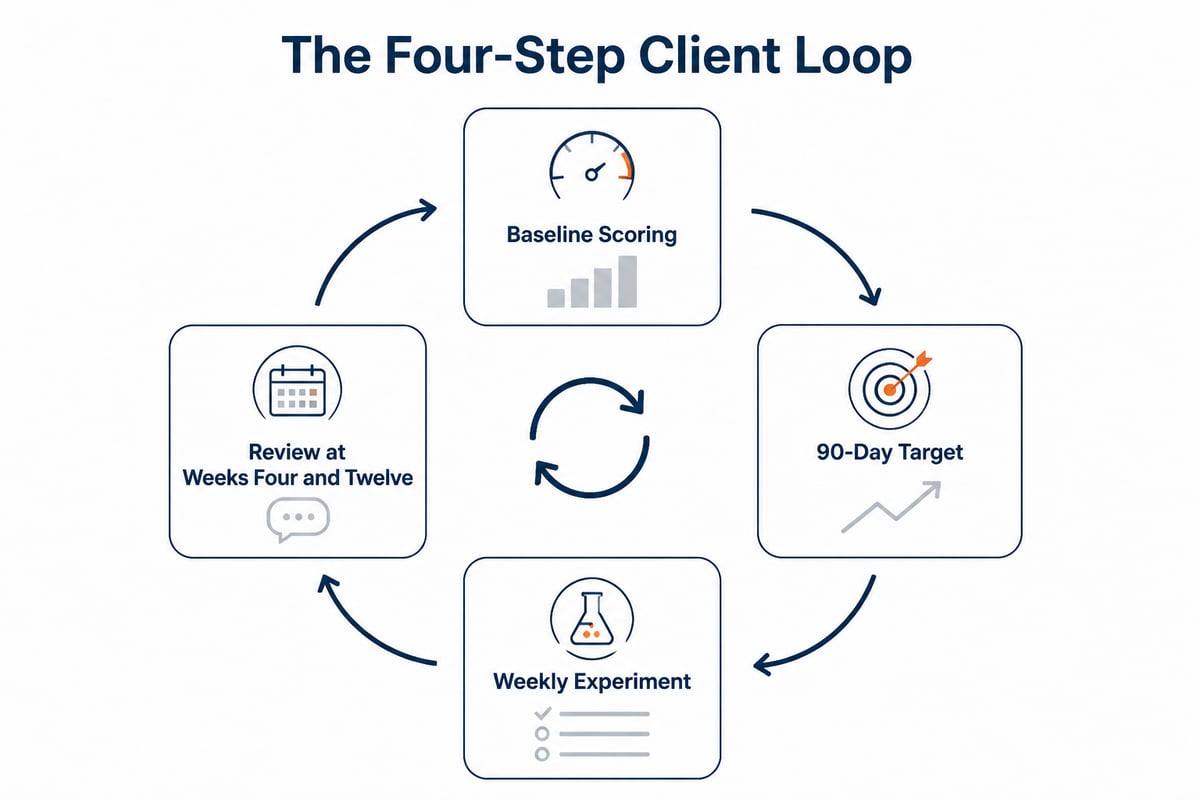
Corporate coaching often works this way, with scorecards and KPIs. Personal coaching deserves the same discipline.
Case Study: The Executive Who Could Not Switch Off
Problem: A founder of a 60-person company described constant fights with his partner and said his team "never stepped up."
Diagnosis: The baseline scores showed the same pattern in both places. He solved every problem himself, so his team waited for answers and his partner felt like another item on his list.
Solution: The coach set one experiment per week. First, he asked two questions before offering any answer in meetings. Second, he blocked a phone-free dinner twice a week.
Result: By week twelve, his relationship score rose and managers began owning decisions he used to make. These are illustrative outcomes, not a published study.
Lesson: Life and relationship problems often share one root behavior. Coaching one behavior changes both.
How Do You Restart a Relationship That Has Stalled?
You restart a stalled relationship by agreeing on one small, specific change both people can see, rather than announcing a fresh start. Big declarations collapse within weeks. Coaches usually begin with three moves:
- Name what each person misses, in concrete terms ("we used to walk after dinner").
- Pick one shared ritual and protect it for 30 days.
- Schedule a short weekly check-in with a fixed agenda: what worked, what felt hard, what to adjust.
If trust was broken by betrayal, abuse, or untreated depression, coaching is the wrong tool. That belongs with a licensed therapist.

Coaching vs. Therapy: Where the Line Sits
The line sits at treatment. Coaches work with people who are functioning and want to move forward. Therapists treat mental illness and trauma. The ICF core competencies include distinguishing coaching from psychotherapy and referring clients to other professionals when appropriate. A coach who never refers anyone out is a red flag.
Noomii publishes a clear explainer on coaching vs. therapy if you are unsure which fits. If you are dealing with trauma or a diagnosed condition, start with a therapist, not a coach.
Common Relationship Advice That Holds Up, and Advice That Does Not
Advice that holds up is specific and behavioral. Advice that fails is vague or built on slogans.
Holds up:
- Raise issues early, in one sentence, before resentment builds.
- Ask for what you want instead of hinting.
- Separate the problem from the person ("the budget is tense," not "you are careless").
Does not hold up:
- "Never go to bed angry." Tired people argue badly, and sleeping on it often works better.
- "Communication fixes everything." Talking more about a values conflict can deepen it.
Coaches also help clients challenge a partner well. Challenge the behavior and its effect, state your own need, and ask for one change. "When plans change without notice, I feel unimportant. Can we agree to text by noon?" works. A list of grievances does not.
What Is the Hardest Time in a Relationship for Couples?
The hardest stretches tend to be major transitions: the first years with young children, career upheaval, caring for aging parents, and the empty-nest shift. No single study pins one exact month, so treat any claim of a precise "danger year" with suspicion. What the transitions share is a loss of routine and a rise in stress. Coaches help couples redistribute load and rebuild shared time.
How to Choose a Life and Relationship Coach
Choose on evidence of client outcomes, fit, and ethics, not on certificate count. Many strong coaches hold credentials, but a certificate alone proves training completion, not results. Ask for:
- A clear description of their method and how progress is measured.
- A written agreement covering fees, scope, and confidentiality. Practical guidance on this appears in coaching ethics resources.
- Two or three client scenarios similar to yours, with outcomes.
- A stated policy on when they refer clients to therapy.
The ICF Code of Ethics organizes ethical standards into five areas, including client agreements, confidentiality, conflicts of interest, and professional integrity. A coach who cannot discuss these is not ready for you.
AI tools can prompt reflection at 2 a.m., but they cannot notice that your voice changed when you mentioned your father. Use them for journaling, not for accountability.
Noomii lists independent human coaches and can help match you based on your goals, personality, and budget. Many coaches offer a free consultation, and remote sessions remove location limits. For couples and family dynamics, start with Relationship Coaching, or browse the wider life coaches directory. If you work with a team and want leaders who coach well, see leadership coaching.

If You Are the Coach: Keep Your Practice Credible
Credibility comes from documented outcomes and clean boundaries. Keep baseline and review scores for every client, with permission. Write a one-page agreement. Build a referral list of therapists. Generic "life coaching" is crowded, so narrow your audience, such as founders balancing a company and a marriage, and the proof you collect will carry your marketing.
Good coaching also respects the whole person. Clients who sleep badly or ignore their body often stall, so some coaches partner with providers like ChiropracticResults, which lists clinics by measurable patient outcomes. Others encourage clients to create meaning outside work, even through something as simple as contemporary art in the spaces they live in. Neither replaces coaching. Both support it.
FAQ
How long does it take to see results from a life and relationship coach?
Most clients notice small shifts within four to six weeks if they complete weekly experiments. A 90-day target with a re-score at week twelve gives a fair read on progress.
Can a coach save a failing marriage?
A coach can help two committed people improve habits and communication. If there is abuse, infidelity crisis, or mental illness, a licensed therapist is the right first step.
Do I need a certified coach?
Certification shows training, not results. Weigh credentials alongside client outcomes, method clarity, ethics, and fit.
Is a free consultation worth taking?
Yes. It lets you test the coach's questions, judge rapport, and ask how they measure progress before paying anything.
Is online coaching as effective as in-person?
For goal-setting and accountability, video sessions work well for most clients. Choose based on the coach's fit, not their zip code.
Start today by writing your own one-page baseline: five life areas, three key relationships, each scored 1 to 10, and one 90-day target. If your team's leaders carry the same patterns into the workplace, Noomii Corporate Coaching works live in your meetings and ties progress to clear KPIs on month-to-month terms. You can explore coach options through Noomii to see which fits your goals.


Leave a Reply
Want to join the discussion?Feel free to contribute!