
Mindful Leadership Training: A Guide for Managers
Mindful leadership training teaches managers to notice their own reactions, pause before responding, and make deliberate choices under pressure. It works best when it is practiced inside real meetings and decisions, not in a weekend retreat that fades by Wednesday. This guide covers what the training includes, what the evidence supports, and how to tell a useful program from an expensive one.
What Mindful Leadership Training Actually Teaches
Mindful leadership training builds three skills: attention control, emotional awareness, and deliberate response. That is the whole job. Everything else is packaging.
Most programs cover some mix of the following:
- Attention practice: short, structured sessions that train a manager to stay on one topic instead of drifting to the inbox mid-conversation.
- Reaction awareness: spotting the physical and mental signals that precede a snap judgment, a sharp email, or an interrupted report.
- Perspective-taking: deliberately considering what a direct report or peer is experiencing before deciding.
- Application drills: using these skills in actual one-on-ones, performance reviews, and conflict conversations.
The last item separates programs that change behavior from programs that produce nice feelings. If the training never touches your calendar, it will not touch your results.
What the Research Supports
The evidence is real but narrower than the marketing suggests. A 2025 randomized controlled trial of a six-week mindfulness-based program with 97 managers, 47 trained and 50 on a waitlist, reported significant improvements in empathy, mindfulness, and wisdom among the trained managers.
The effect also travels down the org chart. A 2024 quasi-field experiment found a significant difference in employees’ social mindfulness in the intervention group at the second measurement. And a 2025 study of 578 employees reported that employee mindfulness was positively associated with self-efficacy, work engagement, and thriving at work.
Read those results carefully. They show that mindfulness changes how managers and teams relate to each other. They do not prove that any given vendor's program will raise your revenue. Promising a direct profit lift from meditation is where credible programs and brochures part ways. For a wider view of the literature, Springer maintains a topic overview on mindfulness in workplace dynamics covering leader-follower relationships.
A Simple Framework: Notice, Pause, Choose, Review
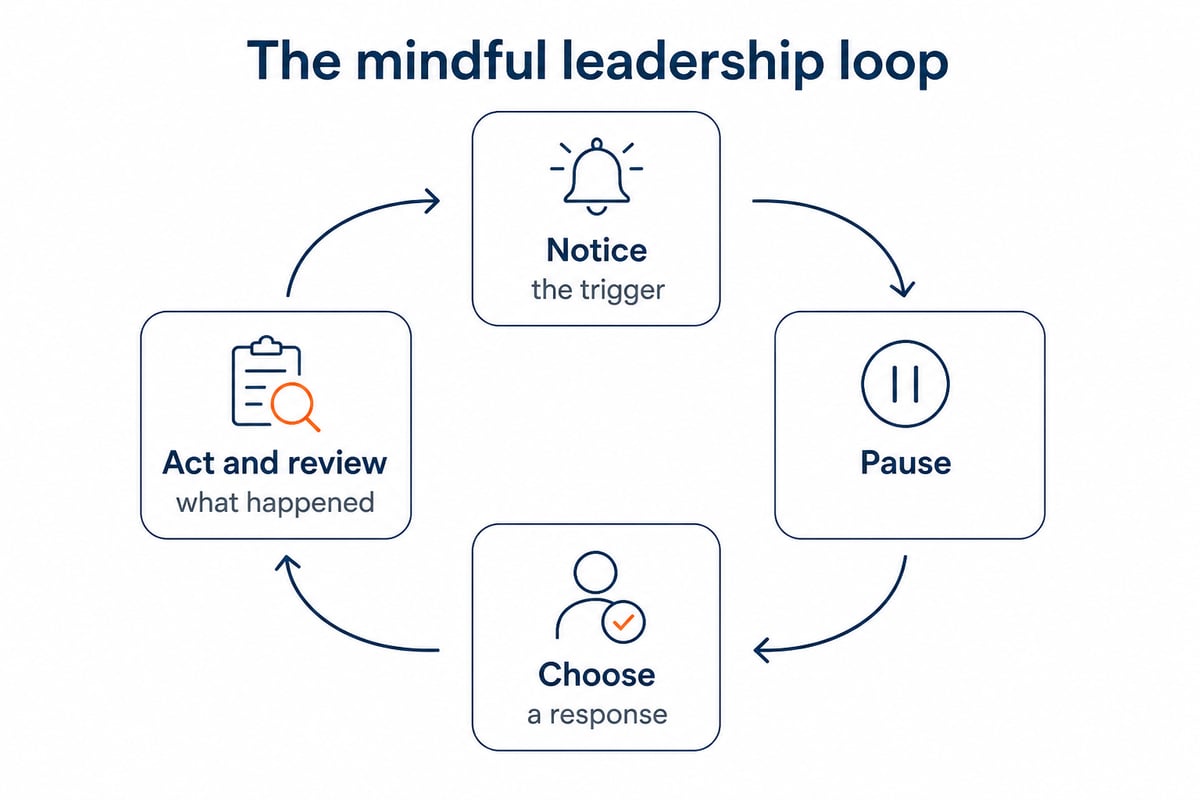
Managers retain frameworks they can run in under ten seconds. This one, which I call the Four-Beat Loop, maps onto every high-stakes moment a manager faces.
- Notice. Catch the trigger: a missed deadline, a challenge to your plan, a bad number on the dashboard.
- Pause. Take one breath before speaking. One. Not a ritual.
- Choose. Ask what outcome you want from this conversation, then pick the response that serves it.
- Review. After the meeting, spend two minutes noting what you did and what you would repeat.
The review step is the one that gets dropped, and it is the one that compounds. Without it, you have a calming habit. With it, you have a feedback system.
Case Study: The Manager Who Interrupted
Problem: A director at a 150-person services firm kept losing her best analysts. Exit interviews used the phrase "never feels heard."
Diagnosis: A 360 assessment showed the pattern clearly. She interrupted in roughly every status meeting, finishing sentences and redirecting to solutions before people had laid out the problem. She believed she was being efficient.
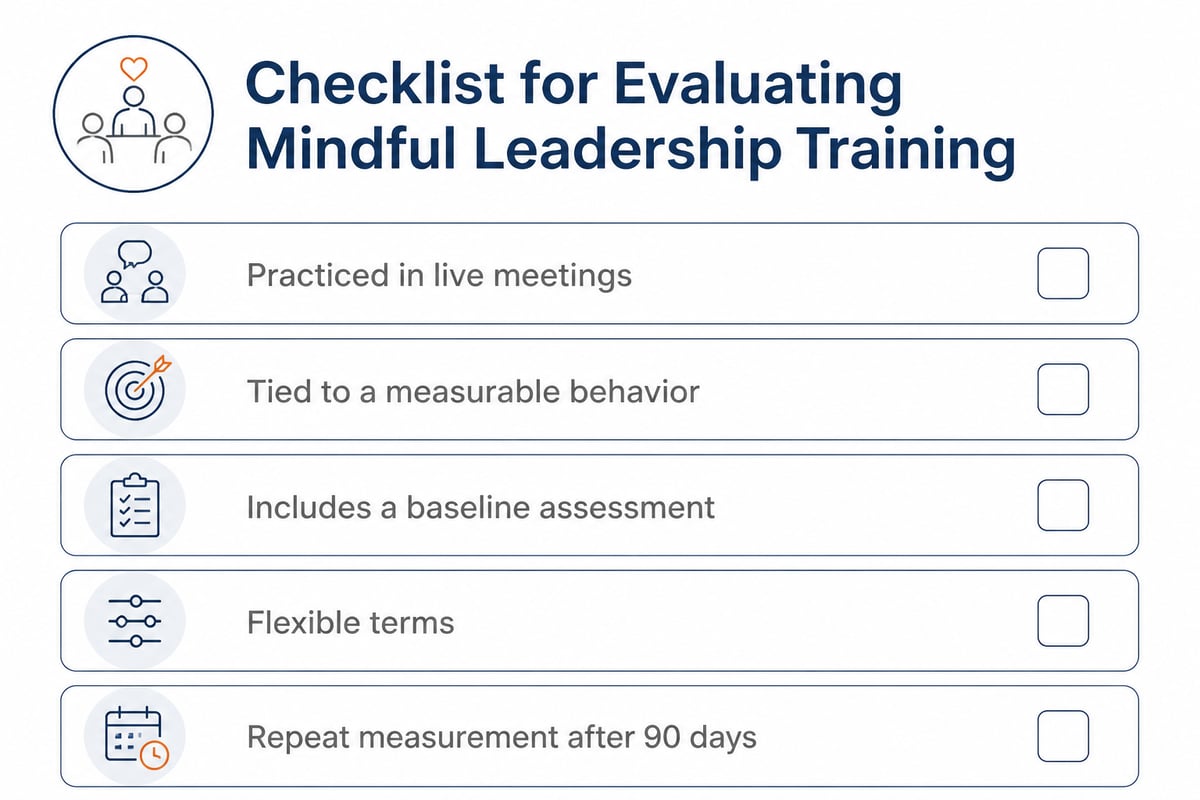
Solution: She practiced the Four-Beat Loop in weekly one-on-ones, with a coach observing a live meeting each month and flagging the moments she cut people off.
Result: Over the following months, her direct reports began presenting problems more fully, and some flight-risk analysts stayed. These are illustrative composite details, not a controlled study.
Lesson: The skill was never abstract. It was one specific habit, caught in a real meeting, by someone watching.

Mindful Leadership Training vs. Standard Management Training
Standard management training transfers knowledge: how to delegate, how to run a review. Mindful leadership training targets the state you are in when you apply that knowledge. A manager who knows the delegation model but is flooded with stress will still micromanage.
The two work best together. Teach the technique, then train the attention to use it under load. A program built around leadership coaching, usually starting from a 360 assessment, is a practical way to connect the two, because the coach works from your actual feedback rather than a generic curriculum.
The Contrarian Take: You Don't Need a Credential-Heavy Program
Buyers often assume the trainer's certifications predict results. They do not. A facilitator can hold five mindfulness credentials and never have sat in a tense budget meeting. What predicts results is whether the work happens on live material: your meetings, your team, your KPIs.
Be skeptical of programs that rely on the following:
- Long retreats with no follow-through in the workplace
- Vague outcomes such as "greater presence" with no measure attached
- Long contracts that lock you in before you can judge the work
- Trainers who cannot describe a before-and-after for a specific behavior
A sound program defines success in advance. For example: fewer interruptions in staff meetings, faster decisions on escalated issues, or improved scores on a repeat 360 assessment.
How to Roll It Out Across a Management Team
Start with a baseline, because you cannot show improvement without one. Run a 360 assessment or a short pulse survey on listening, responsiveness, and decision quality.
Then keep the practice small and scheduled. Five minutes at the start of leadership meetings works better than a quarterly offsite. Pair managers up for accountability. Track two or three behaviors, not twenty.
For practical depth, the book The Mindful Leader offers a framework and everyday examples. If your managers are also leading groups rather than individuals, team coaching applies the same attention skills to how a whole team runs its meetings and handles disagreement. Mindfulness is a skill for leaders and teams, not a treatment. Anyone dealing with trauma or a mental health condition should work with a licensed therapist rather than a leadership program.
Frequently Asked Questions
What is mindful leadership training?
It is structured development that teaches managers to direct their attention, recognize their reactions, and respond deliberately, using real workplace situations as practice material.
How long does it take to see results?
Studies like the six-week managerial trial measured changes within weeks, but durable habits usually need a few months of repeated practice and review.
Is it the same as meditation?
No. Meditation can be one component, but the goal is behavior at work: how you listen, decide, and give feedback.
Does mindful leadership training improve team performance?
Research links mindfulness to engagement, self-efficacy, and thriving at work, though results depend on how well the training is applied and measured.
Can AI tools replace a human coach for this?
AI tools can prompt reflection and remind you to practice, but they cannot watch you interrupt someone in a live meeting. Observation by a person is the harder part to replace.
Do I need a certified mindfulness teacher?
A certification is not a reliable signal. Ask for examples of behavior change and how the person works inside real meetings.
How do I measure whether it worked?
Pick two or three observable behaviors, take a baseline through a 360 or pulse survey, and repeat the measurement after 90 days.
Is it worth it for small and mid-sized companies?
Yes, often more so, since a single manager's habits shape a larger share of the culture in a company of 25 to 500 people.
Who should skip it?
Anyone seeking treatment for mental illness or past trauma should pursue therapy instead, since leadership training is not a clinical intervention.
Your next step is to pick one recurring meeting this week and run the Four-Beat Loop in it, noting what changes. If you want an outside observer to make that practice stick, Noomii can match you for free with an independent coach based on your goals, personality, and budget, and Noomii Corporate Coaching works live in your meetings with month-to-month terms and KPIs tied to results, so Get My Free Match and start with a free consultation.



Leave a Reply
Want to join the discussion?Feel free to contribute!