
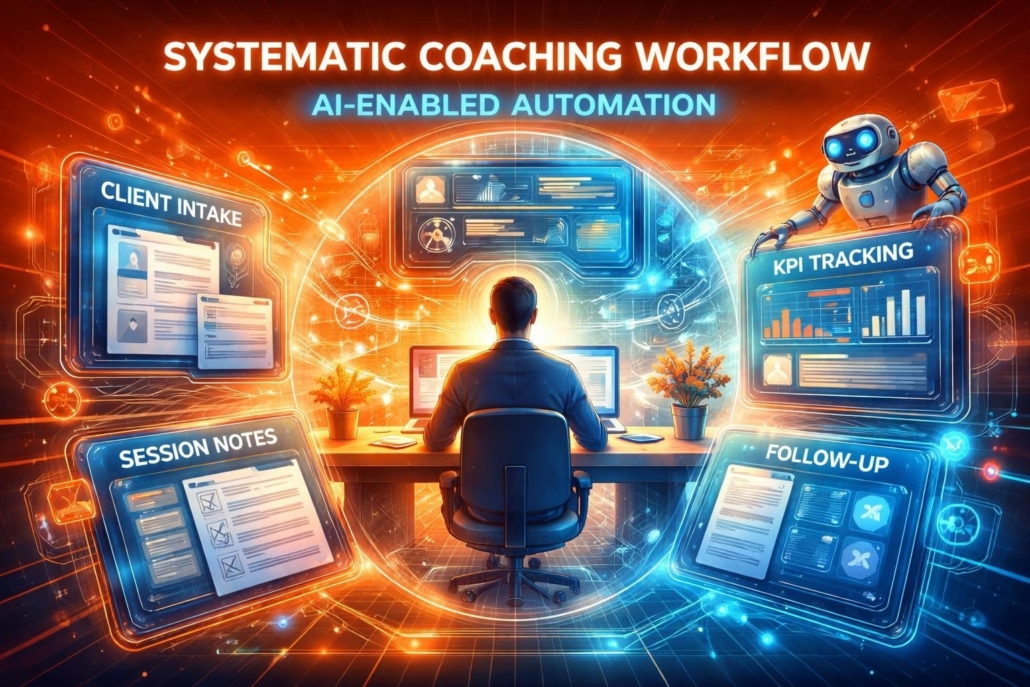
Claude Prompts to Build Coaching Systems That Scale
Coaching businesses thrive on structure, but building robust systems takes time most coaches don’t have. Whether you’re managing executive development programs, leadership assessments, or team facilitation, the administrative overhead can pull focus from what matters: delivering measurable client results. Using claude prompts to help coaches build systems offers a practical solution, enabling you to automate repetitive tasks, standardize processes, and scale operations without sacrificing quality or personal touch.
Why Systems Matter for Coaching Organizations
Every successful coaching practice runs on invisible infrastructure. Business coaches who scale beyond individual sessions rely on documented intake processes, session templates, follow-up sequences, and client progress tracking. Without these systems, growth stalls or quality deteriorates.
Mid-market companies seeking corporate coaching need partners who demonstrate operational excellence. When you use claude prompts to help coaches build systems, you signal professionalism and readiness to handle complex engagements. You create repeatable workflows that deliver consistent outcomes, whether you’re coaching one manager or facilitating leadership development across 50 employees.
The Hidden Cost of Manual Processes
Manual documentation drains productive hours. After every coaching session, you face note-taking, action item tracking, follow-up email drafting, and progress report generation. Multiply this across multiple clients, and you’re spending 10-15 hours weekly on administration rather than coaching.
Systems eliminate this friction. Well-crafted prompts transform Claude into your operations assistant, handling documentation while you focus on client transformation.

Essential Claude Prompts for Building Coaching Systems
The best practices for prompt engineering emphasize clarity, context, and role definition. When developing claude prompts to help coaches build systems, you need templates that deliver consistent output across varied scenarios.
Client Intake and Assessment Workflows
Start with a comprehensive intake prompt that transforms raw client information into structured profiles:
Prompt: “You are an executive coaching intake specialist. Based on the following client responses, create a detailed coaching profile including: primary objectives, current challenges, leadership style assessment, team dynamics, success metrics, and recommended coaching approach. Format as a structured brief suitable for session planning.”
This single prompt standardizes how you process new clients, ensuring nothing falls through cracks regardless of engagement size.
Session Documentation Templates
Effective accountability structures require detailed session records. Use this systematic approach:
| Documentation Element | Prompt Function | Output Format |
|---|---|---|
| Session summary | Capture key discussion points | Structured bullets |
| Action commitments | Track client accountability items | Dated task list |
| Progress indicators | Measure against KPIs | Metric table |
| Follow-up items | Schedule next touchpoints | Calendar entries |
Prompt: “Transform these session notes into a professional executive coaching recap including: key insights discussed, action items with owners and deadlines, progress on previous commitments, observable behavioral shifts, and recommended focus areas for next session.”
Automating Your Coaching Operations
Beyond individual sessions, scaling coaching practices requires systems that handle complex organizational scenarios. Claude prompts to help coaches build systems excel at creating operational frameworks for team coaching and leadership development programs.
Team Coaching Session Frameworks
When facilitating team sessions, consistency matters. Develop a prompt that structures facilitation guides:
Prompt: “Create a 90-minute team coaching session plan for addressing [specific challenge]. Include: opening question, main discussion framework, breakout activity instructions, decision-making protocol, action item capture method, and closing commitment structure. Format for easy facilitation.”
This transforms preparation time from two hours to fifteen minutes while maintaining quality standards comparable to manual planning.
Leadership Assessment Processing
360-degree feedback generates massive data. Systemize the analysis:
- Data synthesis: Convert raw survey responses into leadership themes
- Gap identification: Highlight discrepancies between self-perception and team feedback
- Development prioritization: Rank improvement areas by impact and feasibility
- Action planning: Generate specific behavioral experiments tied to assessment insights

Building Content and Marketing Systems
Creating coaching content systematically establishes thought leadership. Use claude prompts to help coaches build systems that generate consistent educational material for prospects and clients.
Thought Leadership Production
Prompt: “Based on this coaching session theme [insert topic], create: one LinkedIn post highlighting a leadership insight, three discussion questions for manager training, one case study framework demonstrating business impact, and two follow-up conversation starters for ongoing coaching relationships.”
This single prompt produces five content assets from one coaching insight, multiplying your marketing efficiency.
Lead Generation Workflows
Generating coaching leads requires systematic outreach. Develop prompts that personalize at scale:
Prompt: “Draft a personalized outreach email to [company name] addressing [specific business challenge visible in recent news/earnings]. Reference their situation, connect to measurable coaching outcomes we deliver (faster decisions, stronger execution, higher retention), and propose a specific next step. Tone: professional, results-focused, no fluff.”
Combine this with lead qualification prompts that score prospects against your ideal client profile, focusing effort where ROI potential is highest.
Implementing Your System Stack
Successful executive coaches don’t just collect prompts. They build integrated systems where outputs from one prompt feed into the next, creating seamless operational flow.
The Five-Layer System Architecture
- Client acquisition layer: Lead qualification, outreach personalization, discovery call preparation
- Onboarding layer: Intake processing, contract generation, kickoff session planning
- Delivery layer: Session documentation, progress tracking, accountability follow-up
- Measurement layer: KPI dashboard creation, ROI reporting, stakeholder updates
- Growth layer: Client success stories, referral request templates, expansion opportunity identification
Each layer connects through standardized data formats, ensuring information flows without manual transfer. When you use AI for business coaching strategically, these systems compound efficiency gains across your practice.

Advanced System Optimization Techniques
As your systems mature, refine prompts based on actual outputs. The prompt engineering best practices emphasize iteration. Track which prompts generate usable first drafts versus those requiring heavy editing.
Building Prompt Libraries
Organize your claude prompts to help coaches build systems into categorical libraries:
- Client management prompts: 12-15 variations covering different coaching scenarios
- Content creation prompts: 8-10 templates for various marketing channels
- Assessment processing prompts: 5-7 frameworks for different evaluation types
- Program design prompts: 6-8 structures for workshops, training modules, and facilitation guides
Version control matters. When a prompt consistently delivers better results, archive previous versions but maintain access for reference. This creates institutional knowledge independent of individual memory.
Integration with Existing Tools
Your systems should complement, not replace, existing platforms. Claude excels at generating content that populates your CRM, project management software, or communication tools. Design prompts with output formats matching your tech stack requirements.
For companies using psychological safety frameworks, create prompts that translate session insights into safety metric tracking suitable for your existing dashboards.
Measuring System Effectiveness
Systems justify themselves through measurable impact. Track these metrics:
| Metric | Before Systems | With Systems | Target Improvement |
|---|---|---|---|
| Admin hours/week | 12-15 | 3-5 | 70% reduction |
| Client onboarding time | 4-6 hours | 1-2 hours | 65% reduction |
| Session prep time | 45-60 min | 15-20 min | 70% reduction |
| Follow-up completion rate | 60-70% | 95%+ | 35% improvement |
When entrepreneurship coaching clients ask about operational leverage, these numbers tell the story. Systems free capacity for revenue-generating activities while improving client experience through consistency and thoroughness.
Building scalable coaching systems transforms how you deliver value, whether you’re developing individual leaders or facilitating team transformations. Using claude prompts to help coaches build systems creates repeatable processes that maintain quality while freeing your focus for strategic client work. If you’re ready to move beyond administrative overhead and deliver corporate coaching with measurable KPIs and visible ROI, Noomii offers month-to-month executive coaching, leadership development, and team facilitation that ties directly to business outcomes. We coach live in your meetings, track progress against clear metrics, and stay because results are undeniable.


Leave a Reply
Want to join the discussion?Feel free to contribute!