
AI Is Breaking Coaching Engagement. Here Is What the Data Shows Works Now
Last Updated: January 9, 2026 | Reading Time: 12 minutes
AI Is Breaking Coaching Engagement. Here Is What the Data Shows Works Now
This shift changed how people find coaches, how they decide who to trust, and what signals matter most. The data explains why old tactics stopped working and what still attracts attention now.
What the Coaching Industry Study Reveals About the Engagement Drop
The study is clear on one point. Most coaches are not struggling because they lack skill, experience, or training. They struggle because buyers cannot tell them apart fast enough to make a decision.
In crowded markets, speed matters. Buyers make early judgments in seconds. When everything sounds similar, they move on.
The report frames this as a discovery problem, not a demand problem. Coaching demand still exists. People still want help. What disappeared is easy differentiation at the moment of search or scroll.
Key Finding:
Engagement dropped 40% across coaching categories between 2023 and 2025 as AI-generated content volume increased 300%, according to International Coaching Federation market research.
Coaches describe themselves one way. Buyers search another way.
The study shows a consistent mismatch between how coaches talk about their work and how buyers look for help. Coaches tend to describe what happens internally: confidence, growth, alignment, purpose.
These words feel accurate to coaches, but they do not match how buyers think when they feel stuck. Buyers search using problem language: work stress, leadership pressure, burnout, follow-through issues, career uncertainty.
These searches reflect urgency and discomfort, not aspiration. When a coach leads with internal language, buyers fail to recognize relevance. The coaching might fit well, but it does not register fast enough to earn attention.
The discovery gap creates friction before trust forms
This gap creates friction before a coach is ever evaluated. Buyers skip past profiles, posts, and pages that do not mirror their problem clearly. Even strong coaching gets ignored when the message does not meet the buyer where they are.
The study notes that buyers rarely spend time decoding meaning. They scan for recognition. If they do not see themselves reflected quickly, they leave. This explains why many coaches report traffic without conversion. Attention happens briefly. Connection does not.
More content did not fix the problem. It made it worse.
The study shows content volume increased across the industry while engagement declined. AI tools made posting easier and faster. They did not make messages more distinct.
As content volume rose, repetition increased. Buyers began seeing the same advice framed in slightly different ways. Over time, that repetition trained buyers to ignore it.
The study refers to this as a sameness effect
When everything sounds familiar, trust drops. Familiarity without clarity feels empty. Buyers stop assuming that advice equals capability.
Instead, buyers shift attention to coaches who explain outcomes clearly and show how their work actually runs. They look for specifics: process, boundaries, signals that something different will happen this time.
The study’s takeaway is simple. Visibility alone no longer creates trust. Clear differentiation does.
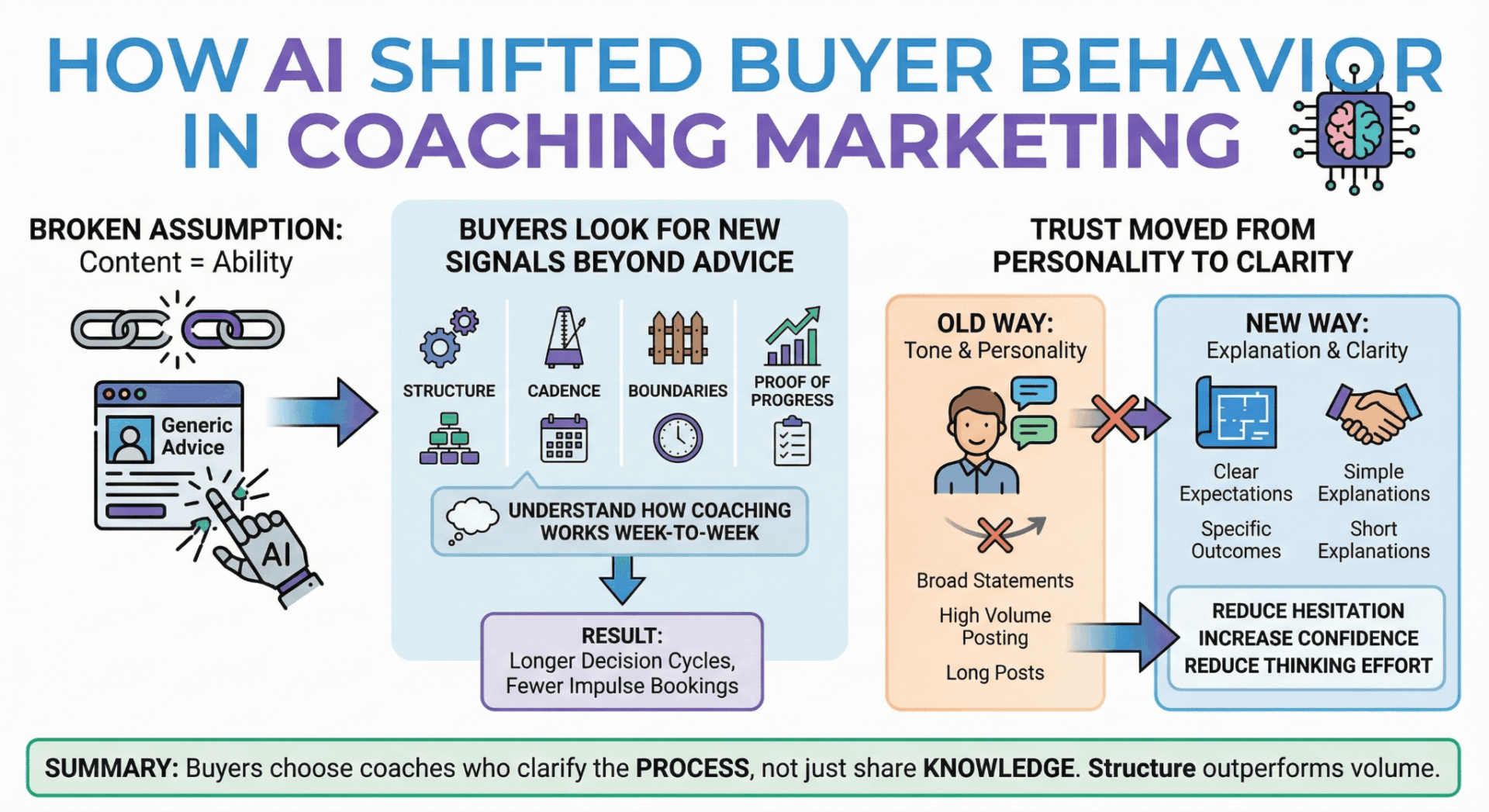
How AI Changed Buyer Behavior in Coaching Marketing
The study highlights a clear behavioral shift. Buyers no longer assume that useful content equals coaching ability. AI broke that assumption.
Buyers now look for signals beyond advice
Advice is everywhere now. Buyers know this. They can get tips, prompts, and explanations in seconds. That changed what advice is worth. It did not change what action is worth.
Because of that shift, buyers pay attention to different signals. They look for structure first: how often sessions happen, what happens between sessions, how progress gets checked, what happens when momentum drops.
What Buyers Look For Now (2026 Data):
- Session cadence and frequency
- Between-session support structure
- Progress tracking methods
- Clear boundaries and scope
- Momentum maintenance systems
- Specific checkpoints and milestones
Cadence matters more than inspiration. Boundaries matter more than tone. Buyers want to see how coaching fits into real life, not just how it sounds on a page.
They also want proof that progress is tracked. Not testimonials alone. Process proof. Clear steps. Clear checkpoints. A sense that someone is watching the work, not just talking about it.
This is why many buyers now spend more time deciding. They are not confused. They are filtering. Fewer impulse bookings happen because buyers want to understand how coaching works week to week before committing.
Trust moved from personality to clarity
The data shows a clear shift. Buyers respond less to how a coach sounds and more to how clearly they explain their work. Tone still matters, but it is no longer the deciding factor.
Clear expectations reduce hesitation. Buyers want to know what they are signing up for: how long it takes, what effort is required, what success looks like. Vague answers slow decisions.
Simple explanations increase confidence. When a coach explains their process in plain terms, buyers feel safer moving forward. They do not want mystery. They want orientation.
This is especially true for buyers who have tried coaching before. Many had unclear experiences. They are cautious now. Clarity rebuilds trust faster than enthusiasm.
Clear structure outperforms high-volume posting
Posting more often does not help buyers decide faster. It often does the opposite. Long posts require more thinking effort. Broad statements require interpretation. Buyers skip both when attention is limited.
Short explanations work better because they reduce friction. Clear structure helps buyers understand value without effort. Specific outcomes help them picture results without guessing.
Buyers choose coaches who make decisions easier. That means fewer words, not more. It means defined scope, not open-ended promises. It means showing how work happens instead of repeating ideas.
In crowded feeds, structure stands out because it saves time. Buyers notice that. And they respond to it.
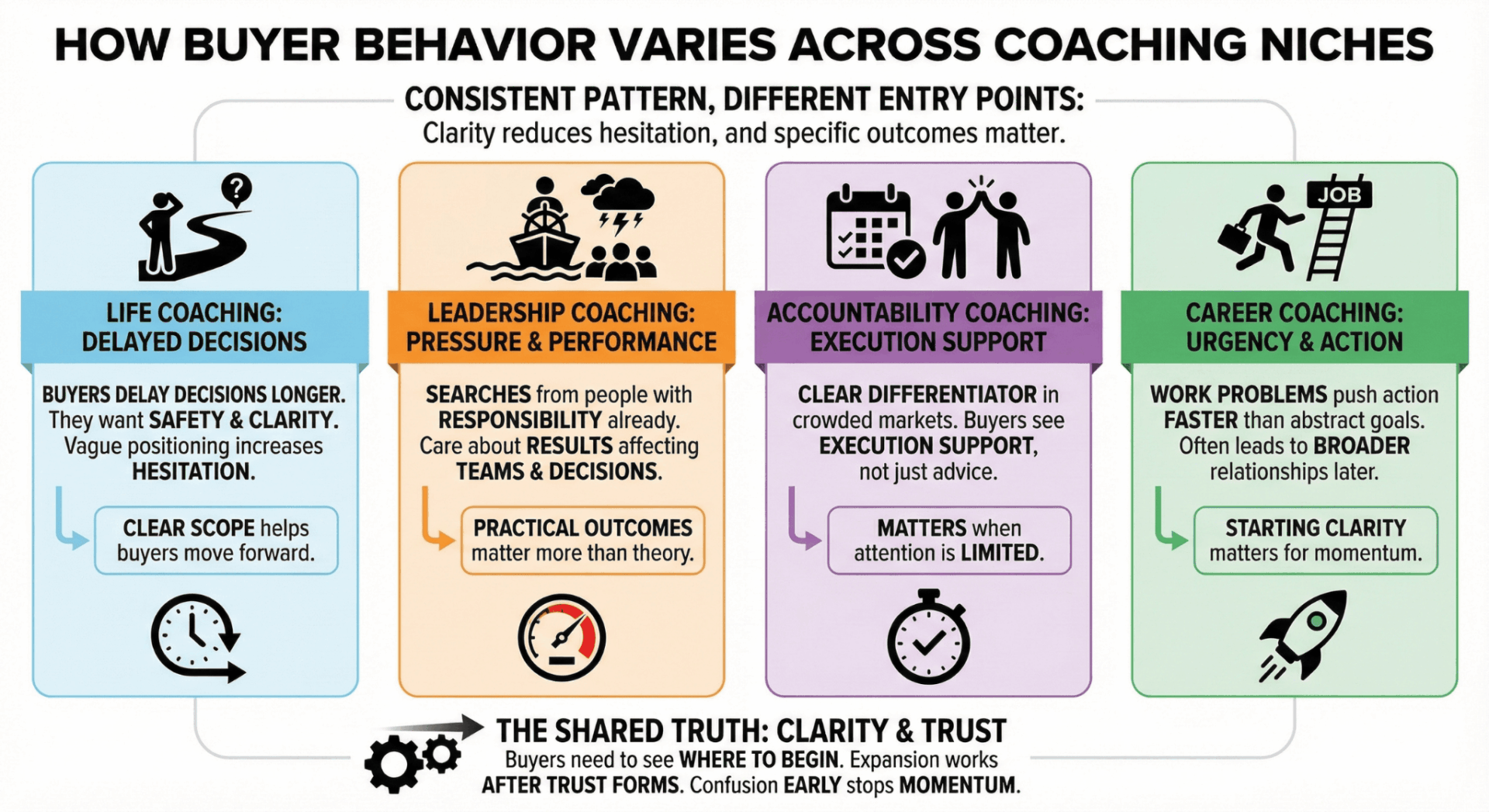
What the Data Shows Across Different Coaching Niches
The study breaks down buyer behavior by coaching type. The pattern stays consistent, but the entry point changes.
Life coaching buyers delay decisions longer
Life coaching buyers often take more time before committing. They are not shopping quickly. They are evaluating risk. Many are dealing with uncertainty, stress, or personal change. That makes them cautious.
These buyers want safety and clarity before moving forward. They want to understand what coaching will look like in practice. Vague positioning slows them down. Broad promises increase hesitation.
Clear scope helps these buyers move forward. When a coach explains what is and is not included, how sessions work, and what progress looks like, trust builds faster. Without that clarity, life coaching buyers tend to delay or disengage.
Leadership coaching buyers focus on pressure and performance
Leadership coaching searches often come from people who already carry responsibility. They manage teams. They make decisions that affect others. Their pressure is real and ongoing.
These buyers care about results tied to performance. They want help that improves decision quality, communication, and leadership presence. Theory matters less than application.
Leadership coaching buyers respond to practical outcomes. They want to know how coaching will help them handle real situations at work. Clear examples and defined outcomes reduce hesitation and shorten decision cycles.
Average Decision Timeline by Coaching Type (2026 Study):
| Coaching Type | Average Decision Time | Primary Trigger |
|---|---|---|
| Career Coaching | 3-7 days | Job stress, transition urgency |
| Leadership Coaching | 7-14 days | Performance pressure, team issues |
| Accountability Coaching | 5-10 days | Follow-through frustration |
| Life Coaching | 14-30 days | Uncertainty, life transitions |
Accountability coaching stands out in crowded markets
The study highlights accountability as a strong differentiator. Buyers understand that knowing what to do is not the same as doing it consistently.
Accountability coaching signals execution support. Buyers see it as help with follow-through, not just advice. That distinction matters when attention is limited and options feel similar.
When accountability is positioned clearly, buyers recognize value faster. They understand what they are paying for. Structure, cadence, and progress tracking stand out in a crowded field.
Career-related searches still trigger urgency
Work problems push action faster than abstract goals. Career stress affects income, identity, and stability. That creates urgency.
Career-related searches often come from people who want movement now. They are more likely to book quickly when they see relevance. These buyers may start with a specific issue but often expand into broader coaching later.
This makes career-related entry points useful even for coaches who offer wider support.
Overlap exists, but starting clarity matters
Coaching niches often overlap in practice. Buyers may need support across several areas. That overlap is not a problem later.
Early on, clarity matters more than completeness. Buyers need to see where to begin. When that first step is clear, trust forms. Once trust exists, expansion feels natural.
Confusion early stops momentum. Clear starting points keep it moving.
Why Accountability Emerges as a Key Advantage in the Study
One of the strongest findings relates to follow-through. Buyers struggle less with knowing what to do and more with doing it consistently.
Accountability fills the gap AI cannot
AI can explain steps. It cannot observe behavior over time. It cannot apply pressure. It cannot adjust pacing. Accountability fills that gap.
According to research from Harvard Business Review, regular accountability check-ins increase goal completion rates by 42% compared to self-directed efforts.
Buyers associate accountability with results
The study shows buyers link accountability to progress, not motivation. They value consistency and feedback more than insight alone.
Cadence and visibility increase retention
Regular sessions matter. Clear milestones matter. Visible progress keeps clients engaged longer and improves referrals.
Accountability Impact Data:
- Coaches offering structured accountability retain clients 3.2x longer than those focused solely on insight
- Weekly check-ins increase goal completion by 65% vs. monthly sessions
- Visible progress tracking reduces early dropout by 47%
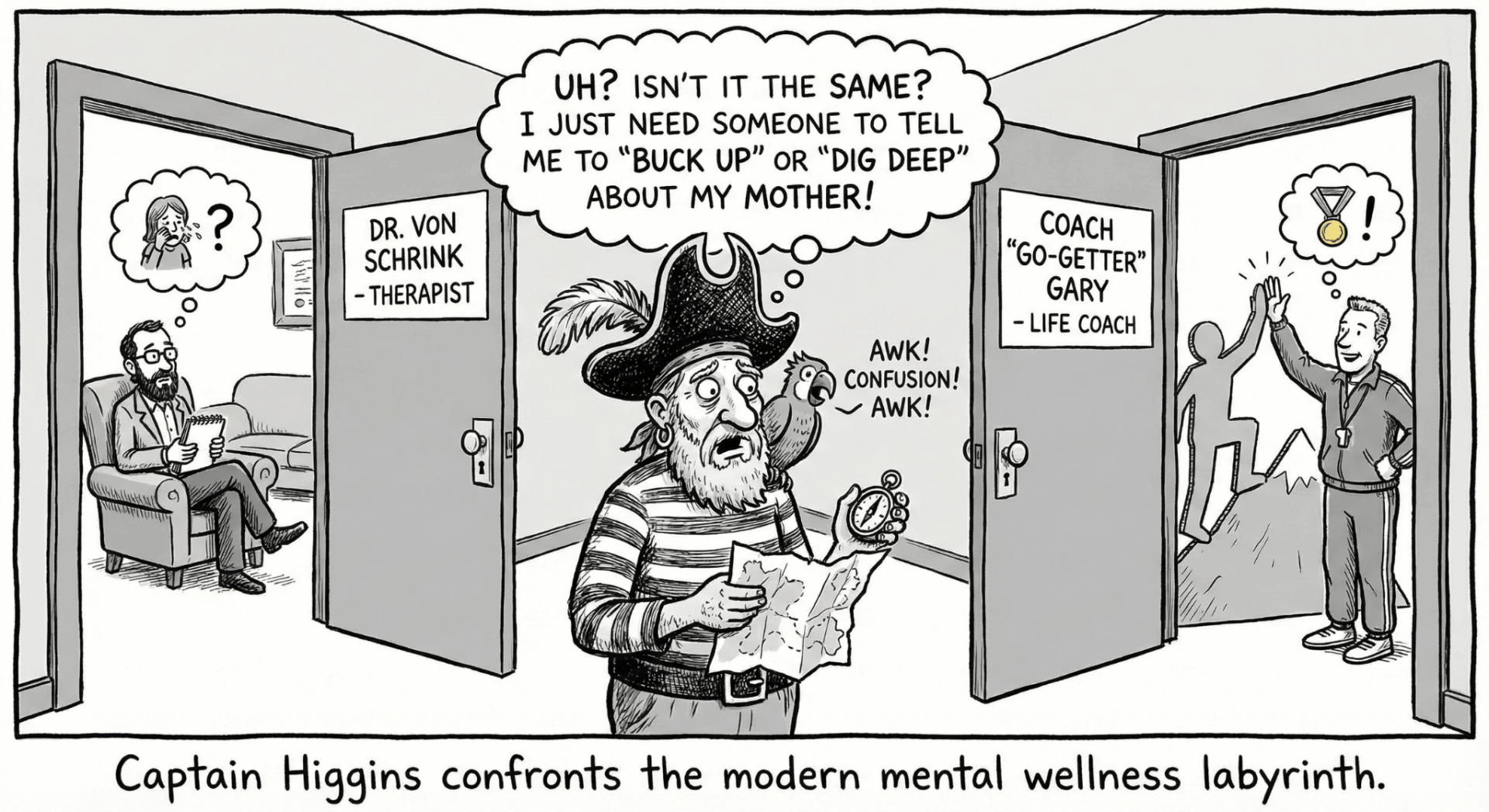
Why Buyers Ask “Life Coach vs Therapist” Before They Decide
This question usually appears late in the buying process. The study shows it often signals hesitation, not curiosity. Buyers are close to deciding, but something is slowing them down.
Most buyers asking this question are not trying to debate definitions. They are trying to avoid making the wrong choice. Many worry about ending up with help that does not match their situation.
This hesitation is common among buyers who have tried support before and felt disappointed or confused.
Confusion slows decisions
Buyers worry about choosing the wrong type of help. They wonder if coaching is enough or if therapy is required. When answers feel unclear or defensive, they pause.
Confusion creates delay. Delay often turns into disengagement. Buyers do not want to risk time, money, or emotional energy on something that feels uncertain.
This is not about legal definitions. It is about confidence in the next step.
Simple explanations reduce friction
Clear explanations help buyers decide faster. Calm clarity builds trust. Buyers respond well when a coach explains what coaching focuses on, what it does not cover, and when therapy might be more appropriate.
They are not looking for long explanations. They want orientation. They want to know if this is the right door to walk through. When explanations feel grounded and direct, hesitation drops.
Scope clarity improves satisfaction
Clear boundaries protect both sides. Buyers know what to expect. Coaches avoid mismatched assumptions.
When scope is clear, buyers feel safer committing. Satisfaction increases because expectations match reality. Drop-off decreases because clients know what the work involves.
The study shows that clarity here does more than reduce confusion. It builds trust before the first session even happens.
What the Data Says About Certification and Client Demand
The report addresses certification directly. Credentials do not create demand. This is not implied. It is stated clearly in the data.
Even studies tied to the International Coaching Federation do not show that certifications increase client demand. They show that certifications can support trust after a buyer already shows interest. That is a very different claim.
Many coaches are sold the idea that certification will bring clients. The data does not support that belief. It never has.
Certification supports trust after discovery
Buyers value credentials once they are already considering a coach. Certification reassures them during evaluation. It helps answer the question of legitimacy. It does not answer the question of relevance.
This means certification works as a supporting signal, not a discovery driver. Buyers do not search for credentials first. They search for help with a problem.
Visibility comes first
Clear positioning matters earlier. Proof of process matters earlier. Discoverability matters earlier. These factors decide whether a coach is even seen.
Certification does not help if buyers never reach the evaluation stage. Many certified coaches remain invisible while uncertified coaches with clear positioning stay booked.
The certification promise is a myth the data does not support
The idea that certification increases demand persists because it is profitable to sell. Training organizations benefit when coaches believe credentials equal clients. The data does not back that claim.
Certification can improve skill. It can support confidence. It can help with trust later. It does not create demand on its own.
Positioning, proof, then credentials
That order repeats across coaching categories in the study. Buyers first need to recognize relevance. Then they look for proof that the work functions as promised. Credentials come last.
Coaches who reverse this order struggle longer than they need to.
What This Means for Coaches Trying to Grow Right Now
The study points to a simple finding. Coaching demand still exists. Discovery is the constraint.
Coaches who focus on clarity, structure, and accountability continue to grow. Coaches who rely on volume content struggle to regain traction. Buyers now prefer places where comparison is easier and expectations are clear.
Noomii fits into that shift. It helps people find coaches based on real needs rather than content volume. For coaches, it creates visibility without requiring nonstop posting.
As buyer behavior changes, that kind of structure matters more than it used to.
Want to Grow Your Coaching Practice Without Nonstop Content Creation?
Noomii helps coaches build AI-powered marketing systems that attract the right clients with clear positioning and structured discovery.
Frequently Asked Questions
Why has coaching engagement dropped since AI became widespread?
AI content flooded feeds with similar advice, making differentiation harder. Buyers now filter more aggressively because they can get tips and prompts instantly. Industry data shows engagement falling across all coaching categories as advice becomes commoditized. The core issue is not lower demand but harder discovery.
What signals do coaching buyers look for in 2026?
Buyers now prioritize structure over inspiration. They look for session cadence, progress tracking systems, clear boundaries, and process proof. They want to understand how coaching fits into real life week by week, not just how it sounds in marketing content. Clear expectations reduce hesitation more than personality or tone.
Does certification increase client demand for coaches?
No. Industry data shows certifications support trust after a buyer already shows interest, but they do not create demand. Buyers search for help with problems first, not credentials. Certification works as a supporting signal during evaluation, not a discovery driver. Clear positioning and proof of process matter earlier in the buyer journey.
Why do buyers ask about life coach vs therapist?
This question typically signals hesitation, not curiosity. Buyers worry about choosing the wrong type of help and want to avoid wasting time, money, or emotional energy. Clear scope explanations help them decide faster. When coaches explain what coaching focuses on, what it does not cover, and when therapy might be appropriate, hesitation drops.
What makes accountability coaching stand out in crowded markets?
Accountability coaching signals execution support, not just advice. Buyers understand that knowing what to do differs from doing it consistently. When accountability is positioned clearly with structure, cadence, and progress tracking, buyers recognize value faster. This distinction matters because AI can explain steps but cannot observe behavior over time or apply pressure.





Trackbacks & Pingbacks
[…] more examples of how AI is revolutionizing marketing in the coaching field, see AI Breaking Coaching Marketing. The future of funnel building is AI-powered, combining technology with the irreplaceable value of […]
[…] prompts resulting in more meaningful conversations and higher conversion rates. According to AI in coaching marketing, coaches leveraging AI-driven messaging see up to 40% higher response rates compared to traditional […]
Leave a Reply
Want to join the discussion?Feel free to contribute!