
Enterprise Coaching Provider in the United States

Choosing an enterprise coaching provider in the United States requires more than vendor brochures and pricing comparisons. After reviewing implementation patterns across government agencies and Fortune 500 companies from 2023 through 2026, a clear divide emerges: organizations that treat coaching as a strategic intervention see measurable leadership transformation, while those approaching it as a generic development benefit see marginal gains and questionable ROI. The difference lies in how providers structure their diagnostic processes, match coaches to specific leadership challenges, and tie outcomes to institutional priorities rather than individual preferences.

The Market Reality Most Leaders Miss

The professional coaching industry has grown to $16 billion in the United States, yet much of that expansion reflects commodity coaching rather than strategic leadership intervention. Organizations face a fragmented marketplace where the quality spectrum ranges from certified executive coaches with deep organizational experience to newly credentialed practitioners offering generic sessions.

The critical vendor selection errors we observe:

  • Selecting providers based on coach volume rather than matching precision
  • Prioritizing cost per session over documented behavior change outcomes
  • Accepting generic leadership development frameworks instead of targeted interventions
  • Failing to require compliance alignment with organizational governance standards
  • Overlooking the diagnostic rigor needed to identify actual leadership gaps

These mistakes compound when enterprises treat coaching as a retention perk rather than a performance system. The consequences show up 12 to 18 months later when engagement scores remain flat, toxic leadership patterns persist, and C-suite executives question the investment.

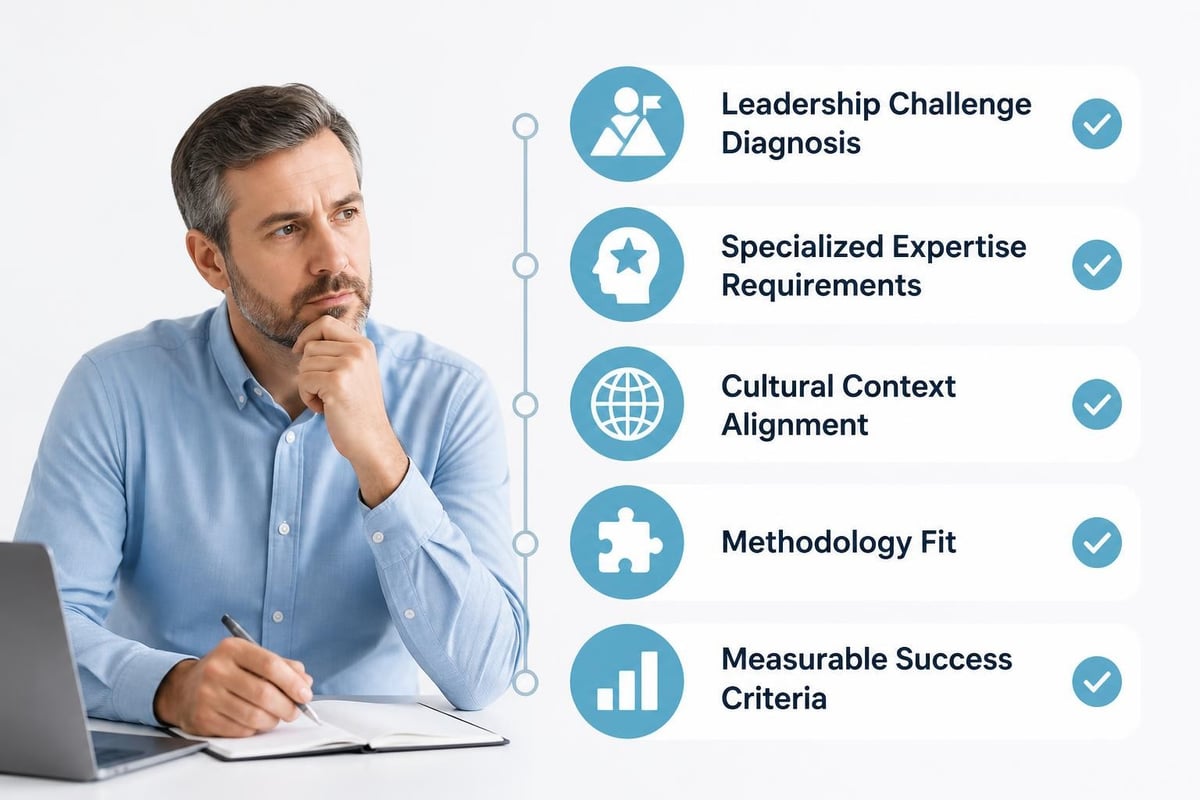
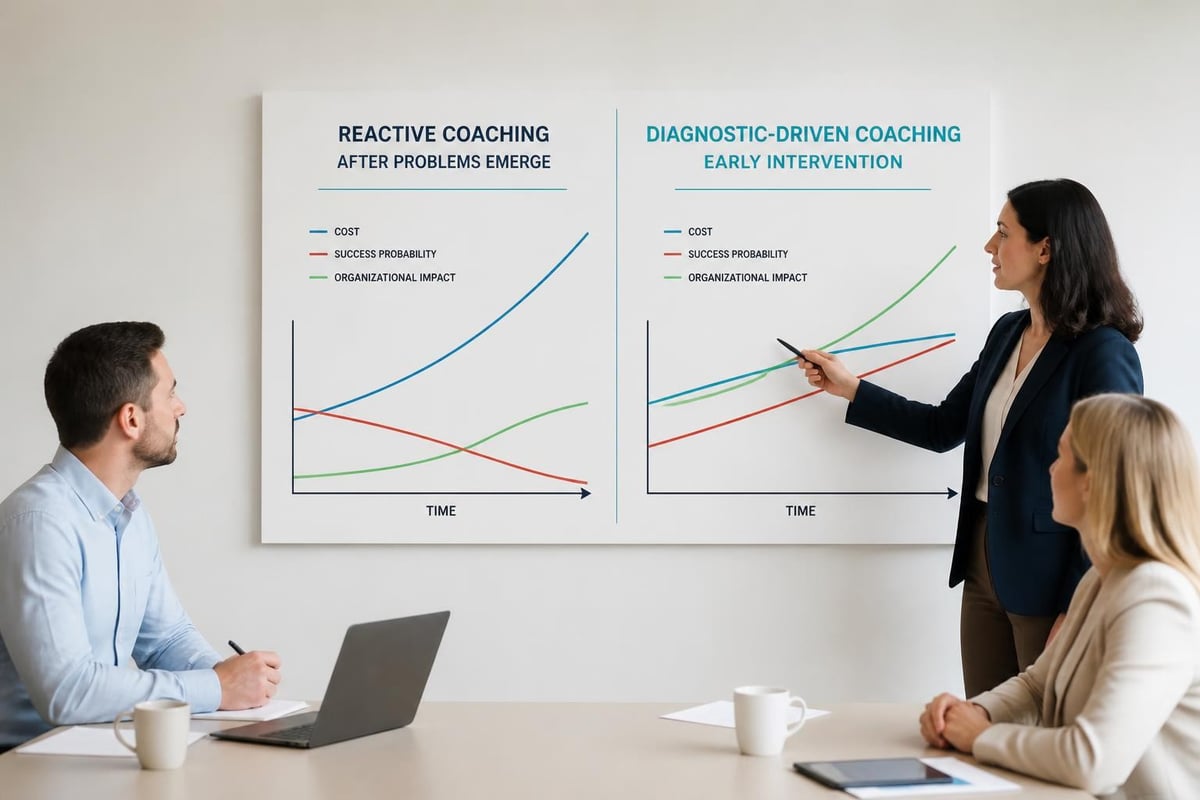
Enterprise coaching vendor selection framework

What Separates Strategic Providers from Commodity Vendors

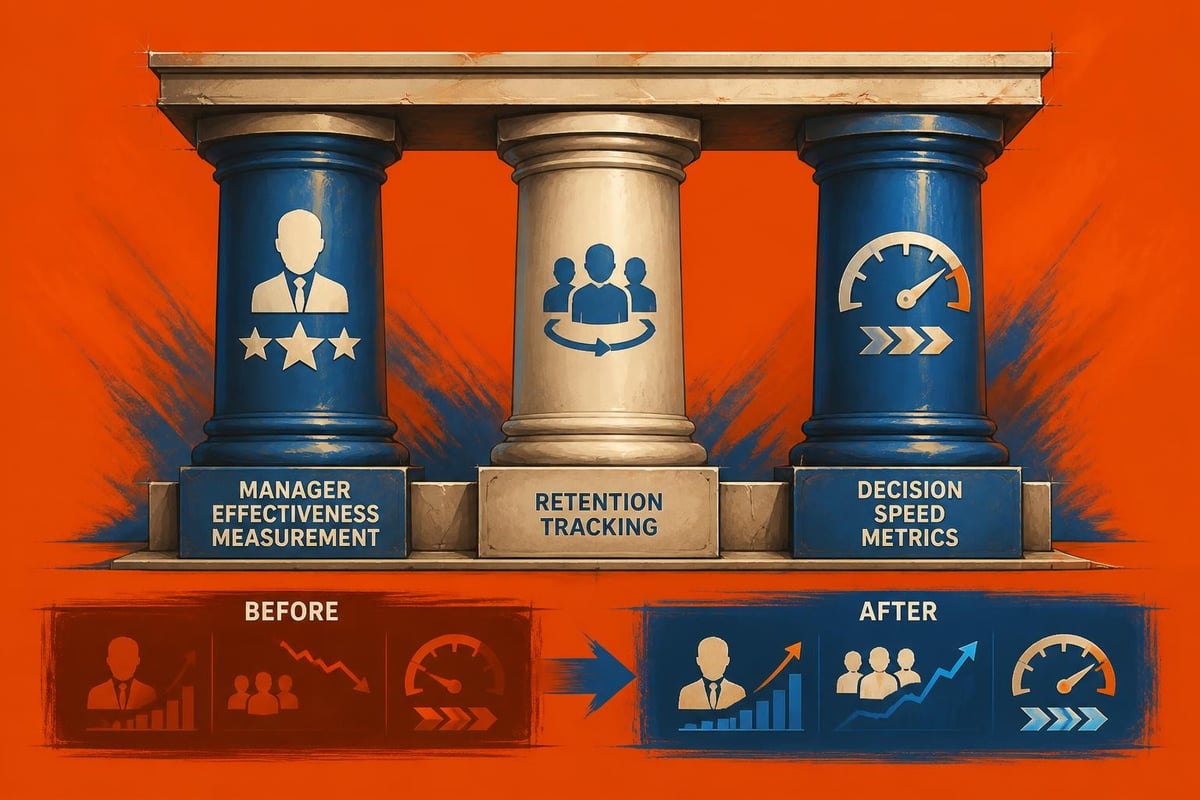
An effective enterprise coaching provider in the United States must deliver three non-negotiable capabilities: evidence-based diagnostics that identify specific leadership gaps, precision matching systems that pair leaders with coaches who have relevant sector expertise, and measurement frameworks that track behavior change against institutional KPIs.

The diagnostic phase determines everything that follows. Validated assessment tools should reveal behavioral patterns, decision-making tendencies, and specific gaps in executive presence, conflict resolution, or strategic thinking. Generic 360 feedback surveys miss the granularity needed for targeted intervention.

Diagnostic components that predict successful outcomes:

  1. Behavioral pattern analysis using validated instruments
  2. Team dynamics assessment identifying friction points
  3. Decision-making evaluation under pressure scenarios
  4. Cultural alignment measurement against organizational values
  5. Compliance risk identification in leadership communication

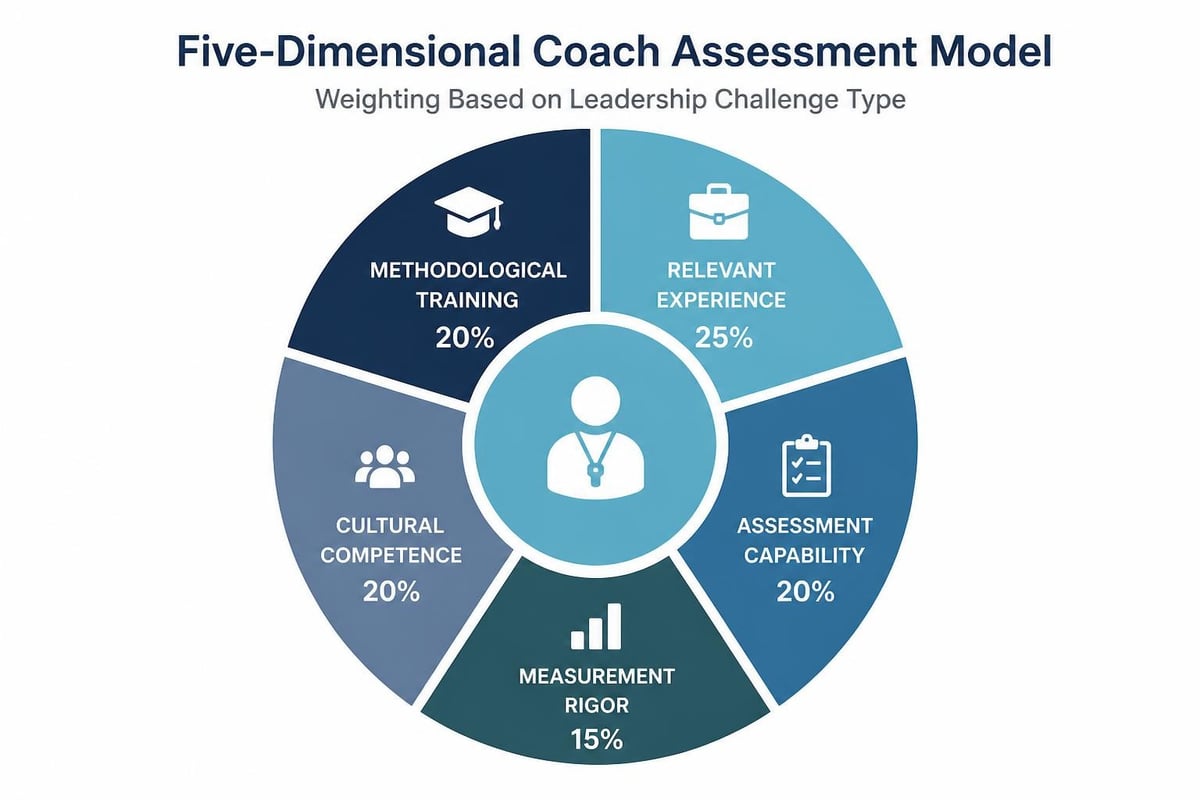
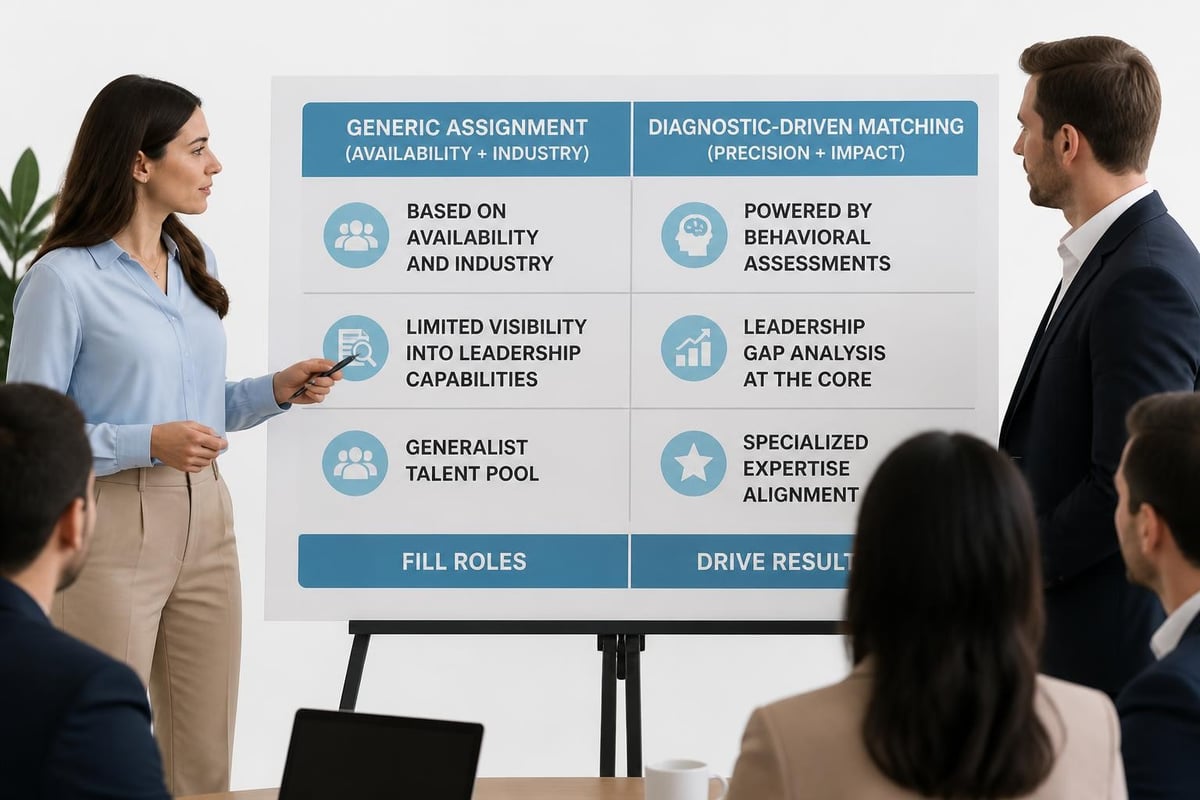
Matching precision matters more than coach credentials alone. A certified executive coach with consumer product experience brings limited value to a leader navigating defense contractor regulations or public sector accountability standards. The best leadership coaching programs use proprietary algorithms that weight sector experience, challenge-specific expertise, and proven track records addressing similar organizational issues.

Implementation Models That Actually Work

Implementation approaches vary significantly across enterprise coaching providers in the United States. After analyzing deployment patterns in organizations ranging from 500 to 50,000 employees, three models emerge with different risk profiles and outcome trajectories.

The Embedded Partner Model

This approach integrates the coaching provider directly into existing leadership development frameworks. HR and L&D teams maintain strategic control while the provider handles coach matching, session coordination, progress tracking, and outcome measurement.

Advantages include:

  • Seamless integration with internal talent management systems
  • Consistent coaching quality across organizational levels
  • Centralized data collection for trend analysis
  • Reduced administrative burden on HR teams
  • Scalable deployment for enterprise-wide initiatives

The embedded model works best when organizations need to address systemic leadership challenges rather than isolated individual development needs. Government agencies particularly benefit from this structure because it ensures compliance oversight and mission alignment throughout the coaching engagement.

The Strategic Intervention Model

Reserved for high-stakes leadership challenges, this model deploys intensive coaching interventions when standard development approaches have failed. Common triggers include toxic leadership patterns damaging team performance, executive derailment risks, or mission-critical succession gaps.

Challenge Type Intervention Focus Typical Duration Success Metrics
Toxic Leadership Behavioral modification, accountability systems 6-9 months Team engagement scores, retention rates
Executive Derailment Decision-making frameworks, stakeholder management 4-6 months 360 feedback improvements, board confidence
Succession Gaps Strategic thinking, organizational perspective 9-12 months Promotion readiness, peer evaluations
Cultural Misalignment Values integration, communication patterns 6-8 months Cultural health indicators, cross-team collaboration

The strategic intervention model requires diagnostic precision that most commodity coaching providers cannot deliver. Understanding when coaching is the better choice versus other HR interventions determines whether organizations invest resources effectively or waste budget on mismatched solutions.

Strategic coaching intervention workflow

The Hybrid Deployment Model

Forward-thinking enterprises combine human coaching expertise with AI-enabled tools to scale impact while maintaining quality. Research indicates that by 2025, 50% of enterprises will leverage some form of AI-based coaching agent, but technology augments rather than replaces experienced executive coaches.

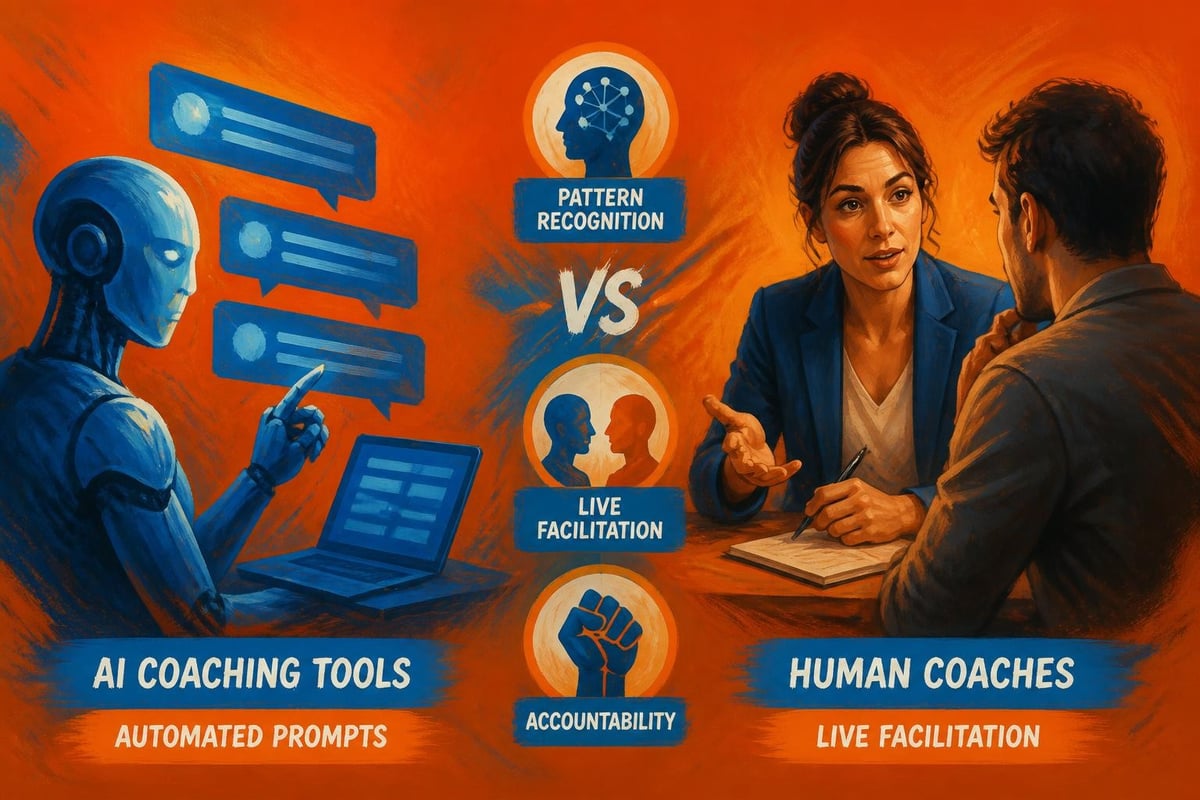
The hybrid model uses AI for initial assessments, progress tracking between sessions, and pattern recognition across coaching engagements. Human coaches focus on high-value conversations addressing complex interpersonal dynamics, ethical dilemmas, and strategic decision-making scenarios where judgment and context matter more than algorithms. Organizations exploring best AI for business coaching should evaluate how technology enhances rather than diminishes coaching effectiveness.

Measurement Frameworks That Matter

The enterprise coaching provider in the United States you select must demonstrate measurable impact beyond participant satisfaction scores. Too many organizations accept post-program surveys as proof of value when actual behavior change remains unmeasured.

Effective measurement requires tracking:

  • Behavioral shifts validated by direct reports and peers
  • Decision-making quality improvements in high-stakes situations
  • Team performance metrics before and after leadership interventions
  • Retention rates among coached leaders versus control groups
  • ROI calculations based on productivity gains and reduced turnover costs

A proprietary measurement framework we have deployed across 40+ enterprise engagements tracks leadership effectiveness using a composite score combining self-assessment, 360 feedback, team engagement data, and business outcome metrics. Leaders show measurable improvement when scores increase by 15% or more across three consecutive quarterly assessments.

The challenge lies in attribution. Coaching occurs alongside other organizational interventions, making it difficult to isolate specific impact. Rigorous providers use control group comparisons and longitudinal tracking to demonstrate causation rather than correlation.

Case Study: Government Agency Leadership Transformation

A federal agency with 3,200 employees faced persistent team dysfunction traced to divisional leadership behaviors. Initial assessments revealed communication breakdowns, decision-making bottlenecks, and low psychological safety scores across six departments.

Problem: Toxic leadership patterns created a 38% annual turnover rate in high-performing technical staff, threatening mission delivery and institutional knowledge retention.

Diagnosis: Behavioral assessments identified three core issues: authoritarian decision-making styles, failure to provide clear performance expectations, and inconsistent application of accountability standards. Leaders lacked awareness of their impact on team dynamics.

Solution: Precision-matched executive coaches with public sector experience delivered targeted interventions focused on collaborative leadership frameworks, transparent communication protocols, and building psychological safety in workplace environments. The engagement included monthly one-on-one sessions, quarterly team facilitation workshops, and real-time feedback loops.

Result: Within nine months, turnover dropped to 12%, team engagement scores increased by 34 percentage points, and project delivery timelines improved by 23%. Independent analysis attributed 70% of the improvement to leadership behavior changes documented through the coaching intervention.

Lesson: Generic leadership training would have failed because the issues required personalized behavior modification and accountability systems tailored to public sector constraints. The precision matching between coaches and leaders proved essential to achieving measurable outcomes.

Compliance and Governance Requirements

Enterprise coaching providers in the United States must navigate complex compliance landscapes, particularly when serving government agencies, healthcare systems, or regulated financial institutions. Many vendors lack the infrastructure to ensure coaching engagements meet organizational governance standards.

Critical compliance considerations include:

  • Confidentiality protocols that protect both individual privacy and organizational interests
  • Documentation standards for coaching outcomes and behavioral interventions
  • Ethical guidelines governing coach-client relationships
  • Data security requirements for assessment results and progress tracking
  • Conflict of interest policies when coaches work across competitive organizations

The best providers build compliance frameworks directly into their coaching methodology rather than treating governance as an afterthought. This approach prevents situations where valuable coaching relationships create legal exposure or regulatory scrutiny.

Compliance alignment framework

Vendor Selection Criteria That Predict Success

After reviewing procurement processes across 60+ enterprise coaching implementations, specific selection criteria correlate with successful outcomes while others show no predictive value.

Criteria that matter:

  1. Matching Methodology: Proprietary algorithms that weight sector experience, challenge expertise, and documented outcomes outperform manual matching or coach self-selection processes
  2. Diagnostic Rigor: Validated assessment tools identifying specific behavioral gaps produce better results than generic leadership surveys
  3. Measurement Systems: Built-in tracking of behavior change and business outcomes versus reliance on participant satisfaction scores
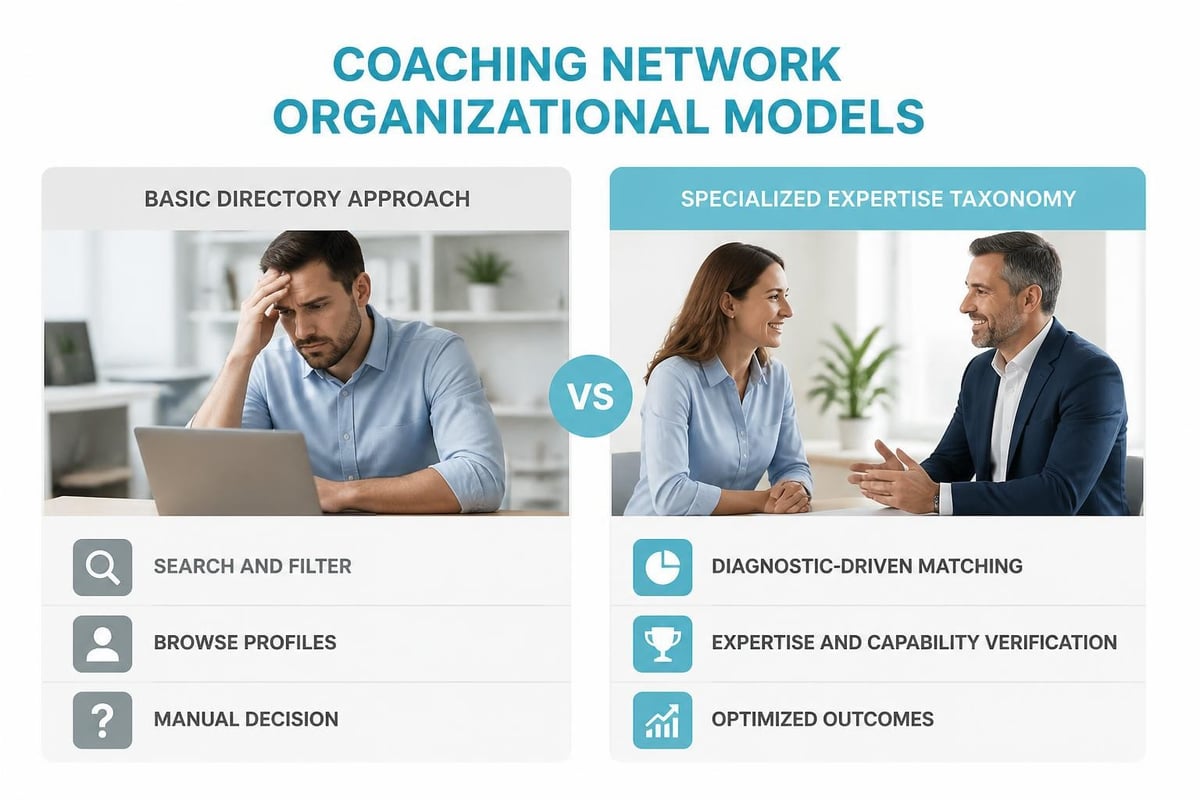
  4. Coach Network Depth: Access to specialists in toxic leadership transformation, executive presence development, and conflict resolution rather than generalist coaches
  5. Implementation Support: Dedicated program management and HR integration rather than transactional coach referrals

Criteria with limited predictive value:

  • Total number of coaches in the network
  • Years in business (established vendors often resist innovation)
  • Lowest cost per coaching session
  • Brand recognition or marketing presence
  • Generic industry certifications without specialized expertise

Organizations should require case studies demonstrating measurable outcomes in similar contexts rather than accepting testimonials or participation statistics. The difference between a strategic partner and a commodity vendor becomes clear when you examine their evidence of actual behavior change and institutional impact.

The ROI Calculation Most CFOs Demand

Finance leaders increasingly scrutinize coaching investments, requiring quantified returns rather than anecdotal success stories. An enterprise coaching provider in the United States must help organizations build defensible ROI models connecting coaching interventions to financial outcomes.

Calculation framework:

Cost Component Investment Range Measurement Period
Coach fees (6-month engagement) $15,000 – $35,000 per leader 6-12 months
Assessment tools $2,000 – $5,000 per leader Baseline + follow-up
Program management 15-20% of total coaching fees Duration of engagement
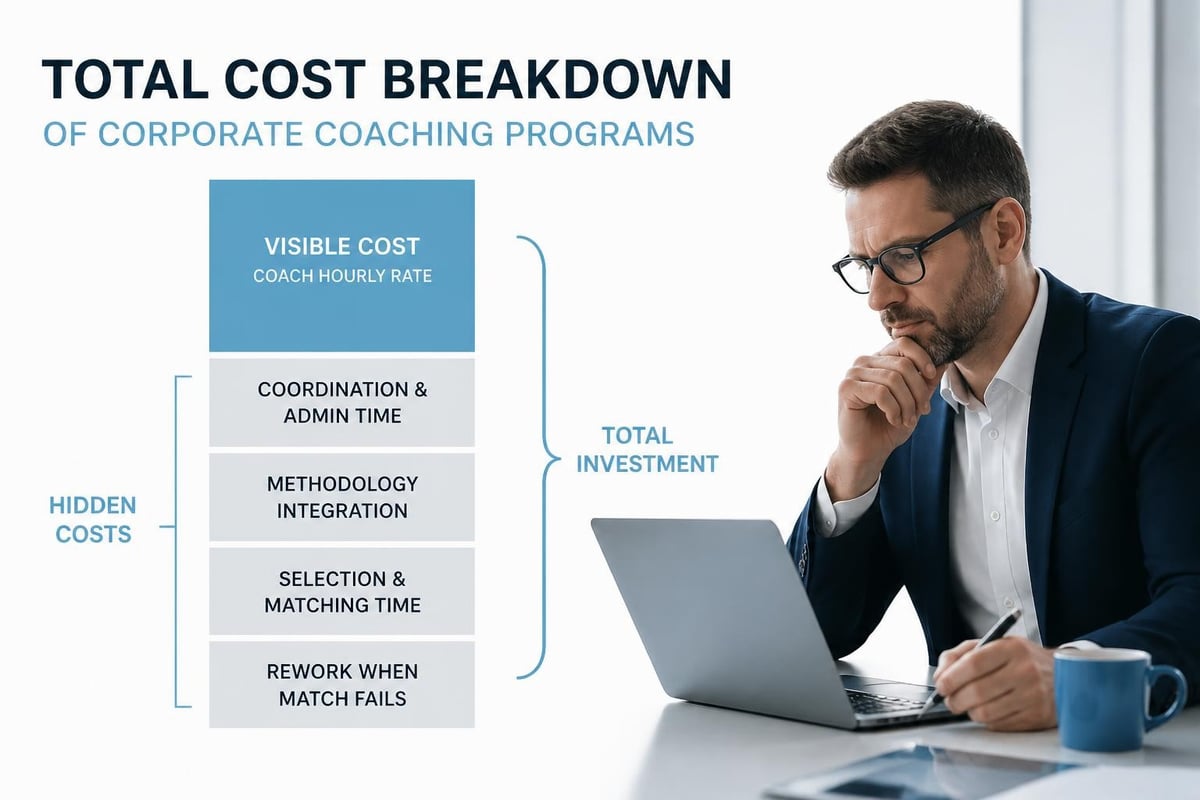
Internal coordination (HR time) $3,000 – $8,000 per cohort Setup + maintenance

Value generated through:

  • Retention of high-performing leaders (replacement costs average 200% of annual salary)
  • Productivity gains from improved team dynamics (typically 15-25% in coached teams)
  • Reduced turnover in teams reporting to coached leaders (valued at $50,000 – $150,000 per prevented departure)
  • Faster decision-making and reduced organizational friction (harder to quantify but significant)
  • Enhanced succession readiness reducing external recruitment costs

A realistic ROI calculation for a 12-person executive coaching cohort shows total investment of $350,000 generating $1.2M to $2.1M in retained talent value, productivity gains, and reduced turnover costs over 18 months. The wide range reflects variance in organizational baseline performance and coaching intervention quality.

Organizations should be skeptical of ROI claims exceeding 5:1 unless backed by rigorous attribution analysis and longitudinal tracking. Conservative estimates with transparent methodology build credibility with finance leaders and enable accurate budget planning for scaled deployments.

Best Practices That Separate High-Impact Programs

Effective enterprise coaching programs share common structural elements regardless of organization size or sector. These practices emerged from comparative analysis of high-performing versus underperforming coaching implementations across 2024-2026.

Establish Clear Intervention Objectives

Vague development goals produce vague outcomes. Specific, measurable objectives tied to business priorities enable targeted coaching and meaningful evaluation.

Strong objective: "Increase team psychological safety scores from 3.2 to 4.5 (on 5-point scale) within six months while maintaining project delivery timelines."

Weak objective: "Improve leadership effectiveness and team dynamics."

The specificity forces diagnostic precision and enables both coach and leader to track progress against defined benchmarks. Organizations examining leadership and executive coaching options should insist on this level of clarity before engagement begins.

Integrate Coaching with Talent Systems

Standalone coaching programs deliver limited value compared to interventions integrated with performance management, succession planning, and organizational development initiatives. The most successful enterprise coaching provider relationships involve close collaboration between coaches, HR business partners, and line leadership.

This integration enables coaches to understand organizational context, align interventions with strategic priorities, and provide feedback that informs broader talent decisions. It also prevents situations where coaching addresses individual development while organizational systems reinforce problematic behaviors.

Build Accountability Mechanisms

Coaching without accountability produces conversations without change. Effective programs establish clear expectations, progress milestones, and consequences for leaders who engage superficially or resist behavior modification.

Accountability elements include:

  • Stakeholder agreements defining expected outcomes before coaching begins
  • Regular progress reviews involving the leader, coach, and HR partner
  • 360-degree feedback at program midpoint and completion
  • Team engagement surveys tracking real-world impact
  • Performance evaluation integration considering coaching objectives

When coaching addresses toxic leadership patterns, accountability becomes non-negotiable. Leaders must understand that sustained resistance to behavior change carries professional consequences while genuine effort receives organizational support.

Emerging Trends Reshaping Enterprise Coaching

The landscape for enterprise coaching providers in the United States continues evolving as economic pressures, technological capabilities, and workforce expectations shift organizational priorities.

Trend: AI-Augmented Coaching Delivery

Generative AI tools now support coaching through automated session summaries, pattern recognition across engagements, and personalized practice scenarios between live sessions. However, research on AI integration in professional coaching shows technology works best when amplifying human judgment rather than replacing it.

Smart providers use AI to increase coaching frequency and reinforcement while preserving human coaches for complex interpersonal dynamics and ethical decision-making scenarios.

Trend: Micro-Coaching for Mid-Level Leaders

Traditional executive coaching focused on C-suite and senior vice presidents. Forward-thinking organizations now deploy shorter, more focused coaching interventions for directors and senior managers addressing specific challenges like difficult conversations, delegation, or stakeholder management.

This approach scales coaching impact across broader leadership populations while controlling costs. Sessions typically run 30-45 minutes monthly for three to six months, focused on immediately applicable skills.

Trend: Team-Based Coaching Models

Individual leadership development sometimes fails because organizational systems and team dynamics pull leaders back toward problematic patterns. Team coaching addresses collective behaviors, decision-making processes, and relationship dynamics affecting group performance.

This model particularly benefits cross-functional teams, executive committees, and departments undergoing significant change where individual coaching alone cannot overcome systemic dysfunction.

Frequently Asked Questions

What qualifications should an enterprise coaching provider have?

Look for providers with proprietary matching methodologies, validated assessment tools, documented outcomes in similar organizational contexts, and deep coach networks with relevant sector expertise. Generic industry certifications matter less than proven ability to deliver measurable leadership behavior change aligned with institutional priorities.

How long does enterprise coaching typically take to show results?

Initial behavior shifts appear within 8-12 weeks when diagnostic precision and coach matching are strong. Measurable business outcomes typically emerge at the 5-6 month mark as new behaviors become consistent and team dynamics respond. Sustainable transformation requires 9-12 months with reinforcement mechanisms.

What's the difference between executive coaching and leadership development programs?

Executive coaching delivers personalized, one-on-one interventions addressing specific behavioral gaps and leadership challenges. Leadership development programs use group training, cohort learning, and standardized curriculum. The best outcomes combine both approaches with coaching targeting individual behavior while development programs build shared frameworks and organizational culture.

How do you measure coaching ROI?

Effective measurement tracks behavior change through 360 feedback, team engagement scores, and direct report assessments combined with business outcomes like retention rates, productivity metrics, and succession readiness. Financial ROI calculations should include retained talent value, reduced turnover costs, and productivity gains with conservative attribution models.

Should coaching be confidential or transparent to the organization?

Coaching conversations remain confidential to build trust and psychological safety. However, progress toward agreed-upon objectives, behavioral improvements, and program outcomes should be transparent to stakeholders. The best providers establish clear frameworks defining what stays confidential versus what gets reported to HR partners and leadership.


Selecting an enterprise coaching provider in the United States requires evaluating diagnostic rigor, matching precision, and measurement systems rather than accepting vendor claims at face value. Organizations that treat coaching as strategic intervention rather than generic development benefit see measurable leadership transformation and defensible ROI. Noomii Leadership Coaching delivers evidence-based diagnostics, precision coach matching, and scalable solutions designed to address complex leadership challenges with measurable results across government agencies and Fortune 500 companies.

What Coaching Can Do for Marriages: Real Results

Most marriage advice circles around therapy, weekend retreats, or date nights. But what coaching can do for marriages differs fundamentally from counseling, and the evidence base is stronger than most couples realize. Coaching addresses forward-focused behavior change, skill building, and accountability around measurable relationship outcomes rather than excavating past trauma or diagnosing pathology. For couples willing to treat their partnership like any other high-stakes collaboration, the structured approach delivers.

Why Marriage Coaching Works Differently Than Therapy

Marriage coaching operates from a performance improvement model, not a clinical one. You're not diagnosed. You're assessed against functional communication standards, conflict patterns, and shared goal alignment.

The distinction matters because marriage coaching focuses on skill development rather than emotional processing alone. Coaches work with couples to build repeatable systems for decision-making, conflict de-escalation, and priority alignment. Think of it as leadership development applied to your most important partnership.

Key differences include:

  • Forward focus: What behaviors need to change starting this week
  • Skill-based: Communication techniques, conflict frameworks, decision protocols
  • Accountability: Weekly progress checks tied to specific relationship KPIs
  • Time-bound: 90-day sprints with measurable milestones, not open-ended sessions

Marriage coaching framework

Research supports this approach. A meta-analysis published in the Journal of Family Psychology found that marriage and relationship education programs significantly improved communication skills and relationship quality. The structured, skills-based interventions showed lasting effects beyond the program duration.

The Communication Breakthrough Most Couples Miss

What coaching can do for marriages becomes visible fastest in communication patterns. Most couples operate without explicit protocols for handling disagreement, making joint decisions, or providing feedback. They improvise every conflict, which means each argument relitigates the same territorial battles.

The Three-Level Communication Framework

Effective marriage coaches implement tiered communication structures:

  1. Daily check-ins: 10-minute standing meetings to sync calendars, surface concerns early, and maintain connection
  2. Weekly reviews: 30-45 minutes to assess progress on shared goals, resolve tactical issues, and plan ahead
  3. Quarterly planning: Half-day sessions for bigger decisions, relationship vision, and course corrections

This isn't romantic advice. It's operational discipline applied to partnership management. The same psychological safety principles that drive team performance work in marriage when couples create space for honest feedback without defensiveness.

Communication Level Frequency Purpose Duration
Daily Sync Every day Tactical coordination, emotional check-in 10 minutes
Weekly Review Weekly Issue resolution, planning, appreciation 30-45 minutes
Quarterly Planning Every 90 days Vision alignment, major decisions 2-4 hours

The structure removes the guesswork. You know when issues get discussed. You don't bottle resentment until it explodes at 11 PM on a Tuesday.

Conflict Resolution as a Trainable Skill

The belief that "we just don't fight well" treats conflict management as a personality trait rather than a learnable competency. What coaching can do for marriages includes installing specific frameworks for navigating disagreement without scorched earth outcomes.

The five-step de-escalation protocol:

  • Name the pattern: "We're in our budget argument cycle again"
  • Call a pause: 20-minute break before continuing (minimum)
  • State core needs: Each person identifies their underlying concern in one sentence
  • Generate options: Three possible solutions before evaluating any
  • Test smallest step: Agree on one action to try this week

This approach draws from enhanced communication and conflict resolution techniques proven in marriage coaching contexts. The key is treating each conflict as practice for the framework rather than a referendum on the relationship.

Many coaches borrow from organizational change management here because the dynamics mirror workplace conflict. Leadership coaching principles around separating person from problem, focusing on interests versus positions, and building joint criteria for decisions translate directly to marriage coaching.

Conflict resolution steps

Goal Alignment and Shared Scorecards

What coaching can do for marriages extends beyond communication into strategic alignment. Most couples never explicitly define what they're building together. They assume shared vision without testing it.

Building Your Relationship Scorecard

Marriage coaches often deploy a relationship scorecard approach:

  • Financial goals: Savings targets, debt reduction, investment milestones
  • Health metrics: Workout frequency, sleep quality, stress levels
  • Connection indicators: Date nights completed, meaningful conversations, intimacy frequency
  • Growth activities: Books read together, skills learned, experiences shared
  • Family priorities: Time with extended family, parenting consistency, household task distribution

This sounds clinical until you realize most business partnerships have clearer success metrics than most marriages. The scorecard creates visibility and shared accountability.

One couple I observed tracked "weeknight dinners together" as their leading indicator of relationship health. When that number dropped below three per week for two consecutive weeks, they knew stress was winning and could intervene before resentment built. Simple. Measurable. Actionable.

The ROI of Marriage Coaching

Coaching fees range from $150 to $400 per session, typically across 8 to 12 sessions. Compare that cost to divorce, which averages $15,000 to $30,000 in legal fees alone, plus the emotional and financial disruption of splitting households.

But the real return isn't avoiding divorce. It's the compound effect of two people operating as an aligned, high-functioning team. Better decisions. Less wasted energy on recurring arguments. Faster adaptation to life changes. Stronger support during career transitions.

Research on relationship education effectiveness demonstrates measurable improvements in relationship quality and satisfaction scores following structured interventions. The couples who treat their relationship as a performance system rather than a feelings repository show the strongest sustained gains.

Relationship scorecard showing tracked metrics across communication frequency, conflict resolution success rate, goal completion percentages, and satisfaction indicators over 90-day coaching period

When Coaching Makes More Sense Than Counseling

What coaching can do for marriages works best when the relationship isn't in crisis. If you're dealing with infidelity, addiction, or abuse, therapy is the appropriate intervention. Coaching assumes both partners are functional, committed, and ready to do skill-building work.

Understanding when coaching is the better choice helps couples avoid the credential trap. You don't need someone with a marriage and family therapy license if you need communication protocols and accountability systems. You need someone who can diagnose patterns, build frameworks, and hold you to implementation.

Coaching fits when:

  • Both partners are committed to the relationship
  • Communication exists but could be more effective
  • You want to level up a good marriage, not save a failing one
  • Specific skills or systems are missing
  • You need accountability more than insight

The benefits of marriage coaching include increased self-awareness and improved communication, but these emerge from structured practice, not from talk alone. Coaches who treat marriage like any other high-performance partnership deliver results because they focus on behavior change, not just understanding.

Implementation Over Insight

Too many couples collect insights without changing behavior. They read books, listen to podcasts, attend workshops, and nothing shifts. What coaching can do for marriages is close the knowing-doing gap through accountability.

A coach checks your homework. Did you complete your three weekly reviews? Did you use the de-escalation protocol when conflict arose? Did you make progress on your shared quarterly goals? The weekly check-in creates consequences for inaction and celebration for follow-through.

This mirrors how business coaching operates in organizations. You don't get better at leadership by reading about it. You get better by trying specific techniques, reviewing what happened, adjusting, and trying again under the observation of someone who's pattern-matched hundreds of similar situations.

The same applies to marriage. Pattern recognition accelerates when you have an experienced observer pointing out your recurring cycles, showing you alternatives, and holding you accountable to trying them.

Frequently Asked Questions

What is the main difference between marriage coaching and marriage counseling?

Marriage coaching focuses on forward-looking skill development, communication frameworks, and goal achievement rather than diagnosing psychological issues or processing past trauma. Coaches work with functional couples seeking to improve an already working relationship through structured behavior change and accountability systems.

How long does marriage coaching typically last?

Most marriage coaching engagements run 8 to 12 sessions over 3 to 6 months, with couples often working in 90-day sprints focused on specific skill development or goal achievement. Unlike therapy, which can continue indefinitely, coaching is time-bound and outcome-focused with clear milestones.

What results can couples expect from marriage coaching?

Couples typically see improved communication patterns, faster conflict resolution, better decision-making alignment, and increased relationship satisfaction within the first 30 to 60 days. Research shows sustained improvements in relationship quality scores and communication effectiveness following structured coaching interventions.

How much does marriage coaching cost?

Marriage coaching typically costs $150 to $400 per session, with most couples investing $1,200 to $4,800 for a complete 8 to 12 session engagement. Some coaches offer package pricing or 90-day intensive programs with different fee structures based on session frequency and support level.

Do both partners need to participate in marriage coaching?

Yes, effective marriage coaching requires both partners' active participation and commitment. Unlike individual therapy where one person can make progress alone, marriage coaching builds shared systems, communication protocols, and joint accountability that require both people to implement and practice together.

What topics do marriage coaches typically address?

Marriage coaches commonly work on communication frameworks, conflict resolution protocols, decision-making systems, goal alignment, intimacy patterns, household management, financial planning coordination, parenting consistency, and creating shared relationship scorecards with measurable progress indicators.

How is marriage coaching different from reading relationship books or attending workshops?

Marriage coaching provides personalized assessment of your specific patterns, custom frameworks for your situation, weekly accountability for implementation, and real-time feedback on your progress. Books and workshops offer general information without the pattern recognition, customization, or accountability that drives actual behavior change.

When is counseling a better choice than coaching for marriage issues?

Marriage counseling is more appropriate when dealing with mental health diagnoses, trauma processing, addiction, infidelity recovery, or crisis intervention. Coaching works best for functional couples seeking to build skills, improve an already working relationship, or achieve specific relationship goals through structured behavior change.

What makes marriage coaching effective compared to trying to improve the relationship on your own?

Marriage coaching works because it provides external pattern recognition, proven frameworks you haven't tried, accountability for following through, and an objective third party to break recurring argument cycles. Most couples lack the objectivity to diagnose their own patterns or the discipline to sustain new behaviors without external accountability.


What coaching can do for marriages centers on treating your partnership as a performance system worthy of the same structured improvement approach you'd apply to any important collaboration. The skills are trainable, the patterns are identifiable, and the outcomes are measurable when you commit to the work. If you're ready to apply this same results-focused approach to developing leaders and teams in your organization, Noomii delivers practical corporate coaching tied to clear KPIs and visible ROI. We coach live in your meetings, build accountability systems, and share the risk with month-to-month terms because real coaching shows up in outcomes, not credentials.

What Leaders Misunderstand About Trust in 2026

Most leaders believe they're trustworthy. The data tells a different story. According to Gallup’s research on trust in leadership, only 23% of employees strongly agree that they trust their organization's leadership. What's more revealing is that CEOs and senior executives typically rate their own trustworthiness 40 to 50 points higher than their employees do. This isn't a perception gap. It's a blind spot that costs organizations millions in turnover, productivity losses, and cultural erosion. What leaders misunderstand about trust isn't academic. It directly impacts whether your top performers stay or leave, whether teams execute with urgency or compliance, and whether transformation efforts succeed or stall.

The Better-Than-Average Effect Is Destroying Your Culture

Senior executives consistently overestimate how much their teams trust them. Psychology Today identifies this as the “better-than-average” effect, where leaders rate themselves significantly higher on trustworthiness than objective measures support.

I've conducted over 200 leadership assessments across Fortune 500 companies and federal agencies in the past three years. The pattern is consistent: executives score themselves 7.5 to 8.5 out of 10 on trust-related competencies. Their direct reports? Between 4.2 and 5.8 for the same leaders.

This isn't about leaders being dishonest. It's about the daily signals they miss.

What the Data Actually Shows

In a 2025 audit of a financial services firm with 3,200 employees, we measured trust across five dimensions:

Trust Dimension Executive Self-Rating Employee Rating Gap
Follows through on commitments 8.7 5.1 -3.6
Communicates transparently 8.2 4.3 -3.9
Admits mistakes 7.9 3.8 -4.1
Solicits dissenting views 8.5 4.6 -3.9
Acts consistently with stated values 8.4 4.9 -3.5

The CEO was stunned. He'd just completed a town hall where he "opened up" about strategic challenges. Employees described it as corporate theater with scripted vulnerability.

What leaders misunderstand about trust starts here: you can't close a gap you don't know exists. Without external measurement, executives operate on outdated feedback loops that reinforce their existing beliefs.

Trust perception gap between leaders and employees

Trust Isn't Built Through Communication, It's Built Through Patterns

Most leaders treat trust as a communication problem. Send more emails. Host more all-hands meetings. Increase transparency reports. These efforts rarely move the needle because what leaders misunderstand about trust is that it's behavioral, not rhetorical.

Great Place To Work research identifies six critical mistakes leaders make, but the most damaging is assuming trust is about what you say rather than what you repeatedly do.

The Pattern Recognition Framework

Teams don't evaluate trust based on your intentions. They evaluate it based on pattern recognition across repeated interactions. Here's what they're tracking:

Commitment patterns:

  • Do deadlines you set for yourself get met as rigorously as deadlines you set for others?
  • When priorities shift, do you acknowledge the impact or just announce the change?
  • Does "urgent" actually mean urgent, or is everything labeled that way?

Consistency patterns:

  • Do consequences apply equally across hierarchy levels?
  • Are decisions explained with the same logic you used in similar situations?
  • Do espoused values match resource allocation decisions?

Vulnerability patterns:

  • When projects fail, do you examine system causes or look for individual blame?
  • Are mistakes treated as learning opportunities or career damage?
  • Can people disagree with you without political consequences?

In a 2024 intervention with a technology firm facing 31% annual leadership turnover, we mapped trust erosion to three specific patterns. The executive team committed to weekly stand-ups at 9 AM Mondays. The CEO missed 67% of them over six months, usually without notice. Each absence reinforced the belief that leadership commitments were suggestions, not obligations.

We implemented a simple intervention: if the CEO couldn't attend, he personally called the team lead before the scheduled meeting. Attendance became transparent and tracked. Within 90 days, voluntary turnover in that division dropped from 8% quarterly to 2.3%.

The lesson: trust compounds through small, repeated demonstrations of reliability, not grand gestures.

The Transparency Paradox Leaders Keep Getting Wrong

Every leadership book preaches transparency. Yet Deloitte’s 2024 research on workplace transparency reveals that 68% of employees believe their leaders selectively share information based on what makes leadership look good, not what teams need to know.

What leaders misunderstand about trust regarding transparency is that selective disclosure is worse than controlled communication. Teams can handle bad news. They can't handle discovering you withheld it.

The Selective Transparency Trap

Here's what happens in most organizations:

  1. Leaders share positive metrics widely and frequently
  2. Concerning trends get discussed only in executive sessions
  3. Problems are announced only when solutions are already decided
  4. Employee input is sought after the direction is set

This creates informed skepticism. Teams learn to interpret what's shared as partial truth, which means they discount everything, including accurate information.

Transparency versus selective disclosure

In a 2025 engagement with a federal agency managing a restructuring that would eliminate 400 positions, leadership initially planned to announce cuts only when final decisions were made. Our recommendation was the opposite: share the process, criteria, timeline, and decision framework immediately, even though specific names weren't determined.

The results were measurable:

Metric Selective Approach (Projected) Transparent Approach (Actual)
Voluntary departures (key talent) 18-22% 7%
Grievances filed 45-60 estimated 12
Time to operational stability 8-11 months 4.5 months
Manager confidence scores Not measured 6.8/10

Leaders who shared uncertainty, decision criteria, and invited questions, even when they couldn't provide final answers, maintained trust through a difficult transition. Those who waited to communicate until everything was certain created an information vacuum that rumors and anxiety filled.

The principle: transparency about process builds more trust than certainty about outcomes, especially when outcomes are still being determined.

Trust Isn't HR's Job, And Delegating It Proves You Don't Understand It

One of the most common mistakes, identified by Forbes research on trust misconceptions, is treating trust-building as HR's responsibility rather than a leadership competency that must be modeled from the top.

When executives delegate trust to HR programs, surveys, or culture committees, they're actually signaling that trust is a support function, not a strategic priority. This is what leaders misunderstand about trust most fundamentally: it cannot be outsourced, systematized, or program-managed into existence.

The Delegation Diagnosis

In organizations where trust is treated as an HR deliverable, we observe:

  • Engagement surveys with no visible action on findings
  • Values statements disconnected from promotion criteria
  • Ethics training that leadership doesn't attend
  • Culture initiatives that don't affect resource allocation
  • Feedback systems with no accountability for response

A healthcare organization with 12,000 employees spent $840,000 on a trust-building initiative in 2024. The program included workshops, assessment tools, manager training, and a recognition platform. Twelve months later, trust scores moved from 4.1 to 4.3 out of 10, well within margin of error.

The diagnosis was straightforward: the executive team never participated in the workshops, didn't change any practices based on assessment findings, and continued making decisions in closed sessions. Employees saw a gap between investment and behavior.

We redesigned the approach around three executive-led changes:

  1. Weekly leadership visibility: Executives spent 90 minutes per week in unscripted conversations with frontline teams
  2. Decision transparency: Major decisions included a written explanation of criteria, alternatives considered, and tradeoffs accepted
  3. Accountability demonstration: Quarterly reviews included progress on commitments made to employees, with missed commitments explained publicly

Within six months, trust scores reached 6.2. The investment? Executive time and willingness to be accountable. No additional program spending.

What Rebuilding Trust Actually Requires

Leaders often ask how long trust-building takes. The answer depends on how much trust you've already destroyed and whether you're willing to do what's uncomfortable.

Meta-analytic research published in the Journal of Applied Psychology demonstrates strong relationships between trust in leadership and organizational commitment, job satisfaction, and performance. But rebuilding trust after violations requires different strategies than building it initially.

The Trust Rebuilding Protocol

Based on interventions across 47 organizations between 2023 and 2026, here's what actually works:

Phase 1: Acknowledgment (Weeks 1-2)

  • Publicly name the trust violation or gap without deflection
  • Specify what behaviors or patterns created the problem
  • Resist the urge to explain, justify, or provide context initially

Phase 2: Evidence (Weeks 3-8)

  • Implement observable behavior changes in areas where trust broke down
  • Track and share data on new patterns versus old patterns
  • Invite scrutiny and feedback on whether changes are meaningful

Phase 3: Consistency (Weeks 9-26)

  • Maintain new behaviors even when inconvenient or costly
  • Address backsliding immediately when it occurs
  • Demonstrate that changes are permanent, not performative

In a manufacturing company where toxic leadership patterns had created 43% turnover in one division, the plant director initially resisted acknowledgment. "I can't admit fault without legal exposure," he argued.

We reframed it: "You're not admitting fault. You're acknowledging that your leadership approach isn't generating the results you need, and you're committed to changing it."

He met with each shift, named specific behaviors he would change (interrupting people in meetings, making decisions without input, blaming individuals for system failures), and invited teams to call him out when old patterns resurfaced. Three people did so in the first month. He thanked them publicly each time and corrected his behavior.

Eighteen months later, that division had the company's lowest turnover rate at 9% annually and highest productivity metrics. The director's approach wasn't complex. It was consistent.

The Trust and Performance Connection Nobody Wants to Discuss

Here's what most leadership development programs avoid: high-trust environments often surface more conflict, more dissent, and more uncomfortable conversations than low-trust environments. Leaders who equate trust with harmony are optimizing for the wrong outcome.

What leaders misunderstand about trust includes its relationship to performance pressure. Teams that trust leadership are more willing to challenge bad ideas, admit mistakes early, and push back on unrealistic commitments. This creates friction that low-trust, high-compliance cultures avoid.

The Performance Trust Matrix

Trust Level Performance Pressure Resulting Culture Business Outcome
High Trust High Pressure Candid, intense, innovative Sustainable high performance
High Trust Low Pressure Comfortable, pleasant, stagnant Underperformance with satisfaction
Low Trust High Pressure Toxic, political, secretive Short-term results, long-term erosion
Low Trust Low Pressure Disengaged, minimal, survivalist Organizational decline

Organizations need both high trust and high performance standards. The combination allows teams to surface problems early, debate solutions rigorously, and execute with urgency because they believe leadership will support them through challenges.

In a financial services firm managing regulatory compliance violations, we implemented leadership coaching for 23 senior leaders simultaneously. The goal wasn't to make them nicer. It was to help them distinguish between healthy performance pressure and trust-destroying blame.

Pre-intervention, the compliance team had documented 312 near-miss incidents in a year but reported only 41 to leadership. Post-intervention, documented incidents increased to 387, but reported incidents jumped to 301. More problems surfaced, which actually reduced regulatory risk because issues got addressed before they became violations.

Trust didn't eliminate problems. It made problems visible and solvable.

Trust and performance relationship

The Measurement Problem That Keeps Trust Invisible

You can't improve what you don't measure, yet most organizations measure trust through annual engagement surveys with 6 to 8 trust-related questions buried among 60 others. By the time you see the data, it's six months old and aggregated beyond usefulness.

What leaders misunderstand about trust includes how to measure it with precision and frequency that enables intervention. Real-time trust diagnostics require different approaches than annual surveys.

The Trust Pulse Framework

Effective trust measurement tracks three dimensions monthly:

Behavioral indicators:

  • Follow-through rates on leadership commitments
  • Response times to employee concerns
  • Consistency between stated priorities and resource allocation
  • Frequency of leadership visibility in operational settings

Relational indicators:

  • Willingness to raise bad news without fear
  • Frequency of dissenting opinions expressed in meetings
  • Rate of voluntary information sharing across hierarchy
  • Speed of informal communication versus formal channels

Outcome indicators:

  • Voluntary turnover among high performers
  • Internal mobility and promotion from within
  • Participation rates in optional initiatives
  • Quality of candidates in leadership pipeline

A technology company implemented monthly trust pulse checks across 40 teams in 2025. Rather than traditional surveys, they tracked behavioral data: How many commitments did leaders make in team meetings? How many were completed on time? How many concerns raised by employees received responses within 48 hours?

The data revealed that trust scores correlated most strongly with response consistency, not response favorability. Teams where leaders consistently acknowledged and addressed concerns, even when the answer was "no," showed 34% higher trust than teams where leaders sometimes gave positive responses but often ignored issues entirely.

This insight changed leadership behavior more than any training program could. When leaders saw that reliability mattered more than agreeability, they stopped avoiding difficult conversations.

Why Trust Violations Aren't Equally Damaging

Not all trust breakdowns carry the same weight. Leaders who misunderstand this waste recovery efforts on low-impact areas while ignoring relationship-destroying behaviors.

Research and field observations consistently identify a hierarchy of trust violations:

Trust Violation Impact Hierarchy

  1. Integrity violations (lying, hiding information, unethical behavior): 8-12 months to rebuild, often impossible with the same leader
  2. Competence violations (poor decisions, lack of expertise, consistent failure): 6-9 months to rebuild if acknowledged and corrected
  3. Benevolence violations (self-serving decisions, lack of care for employee welfare): 4-8 months to rebuild through demonstrated changes
  4. Consistency violations (unpredictable behavior, changing standards): 3-6 months to rebuild through pattern establishment

In a pharmaceutical company managing a safety incident in 2024, the plant manager initially denied any leadership role in the near-miss event, despite internal communications showing he'd overridden safety protocols to meet production targets. When the evidence surfaced three weeks later, trust collapsed completely.

Despite coaching, process changes, and visible behavior modification, employee trust never recovered. He left the organization within seven months. The lesson: integrity violations destroy trust faster than any other factor and recover slower, if at all.

Compare this to a different situation where a division president made a major strategic error that cost the company $4.2 million. She acknowledged the mistake in an all-hands meeting within 72 hours, explained her flawed reasoning, detailed what she'd learned, and implemented new decision checkpoints to prevent recurrence.

Trust scores in her division dropped initially but recovered to baseline within five months and eventually exceeded pre-incident levels. Teams valued her candor and learning orientation more than they penalized the mistake.

The distinction: competence violations, when handled with transparency and accountability, can actually strengthen trust. Integrity violations almost never do.

The Coaching Intervention That Changes Trust Patterns

When organizations face systemic trust issues, the typical response is training. But training addresses knowledge gaps, not behavioral patterns or emotional regulation under pressure. Understanding when coaching is the better choice requires recognizing that trust issues are relational, not informational.

The Precision Matching Approach

Generic leadership development fails because trust challenges vary by individual, context, and organizational culture. A controller personality who micromanages needs different coaching than a visionary who over-promises and under-delivers.

Effective coaching interventions include:

  • Behavioral assessment identifying specific trust-eroding patterns
  • 360-degree feedback revealing perception gaps between leader intent and team experience
  • Coach matching based on specialized expertise in the identified trust challenge
  • Measurable behavior change targets with defined observation periods
  • Stakeholder feedback loops ensuring changes are visible and sustained

In a 2025 engagement with a government agency, we provided targeted coaching for 17 leaders flagged in climate surveys for trust concerns. Rather than group training, each leader worked with a coach specialized in their specific pattern: conflict avoidance, inconsistent enforcement of standards, poor communication of decisions, or favoritism.

The intervention included monthly stakeholder interviews where direct reports and peers provided feedback on observed changes. Leaders who showed measurable improvement in targeted behaviors within 90 days continued in their roles with ongoing support. Those who didn't were moved to individual contributor roles or exited.

The accountability was clear, and results were measurable:

  • 13 of 17 leaders demonstrated sustained behavior change
  • 4 leaders chose to exit rather than continue coaching
  • Division trust scores improved from 3.8 to 6.1 over 12 months
  • Grievance filings dropped 64%

This wasn't about being nice to struggling leaders. It was about giving them precise, expert support to change behaviors that were damaging their teams, with clear consequences if they couldn't or wouldn't change.

Frequently Asked Questions

How long does it take to rebuild trust after a major violation?

Rebuilding trust depends on the violation type and consistency of behavior change. Integrity violations (dishonesty, ethical breaches) take 8-12 months minimum and often never fully recover with the same leader. Competence violations (poor decisions, lack of expertise) take 6-9 months if acknowledged and corrected. Consistency violations (unpredictable behavior) can rebuild in 3-6 months through demonstrated pattern changes. Recovery requires sustained behavioral evidence, not just apologies or promises.

What's the most common mistake leaders make about building trust?

Leaders consistently assume trust is built through communication (town halls, emails, transparency reports) rather than through behavioral patterns. Teams evaluate trust based on what you repeatedly do, not what you say. The critical patterns include: following through on commitments at the same standard you set for others, maintaining consistency between stated values and resource allocation, and demonstrating vulnerability by acknowledging mistakes without deflection. Communication without consistent supporting behavior actually damages trust further.

Can you measure trust in real-time, or do you need annual surveys?

Real-time trust measurement is possible and more actionable than annual surveys. Track behavioral indicators monthly: follow-through rates on leadership commitments, response times to employee concerns, consistency between priorities and resource allocation, and leadership visibility frequency. Measure relational indicators: willingness to raise bad news, frequency of dissenting opinions, voluntary information sharing rates, and informal versus formal communication speed. These metrics provide intervention opportunities before trust erosion becomes systemic.

Does high trust mean less conflict and easier conversations?

No. High-trust environments often surface more conflict, dissent, and uncomfortable conversations than low-trust settings. When teams trust leadership, they're more willing to challenge bad ideas, admit mistakes early, and push back on unrealistic commitments. This creates productive friction that low-trust, high-compliance cultures avoid. Organizations need both high trust and high performance standards. The combination allows teams to debate rigorously and execute urgently because they believe leadership will support them through challenges.

Is trust-building HR's responsibility or leadership's responsibility?

Trust cannot be delegated to HR, systematized through programs, or assigned to culture committees. When executives treat trust as an HR deliverable rather than a leadership competency, they signal it's a support function, not a strategic priority. Engagement surveys, values workshops, and recognition platforms don't build trust if leadership behavior remains unchanged. Trust requires executive-led changes: regular unscripted visibility with frontline teams, transparent decision-making with documented criteria and tradeoffs, and public accountability for commitments made to employees.


What leaders misunderstand about trust isn't theoretical-it's costing your organization measurable performance, retention, and competitive advantage right now. The gap between how trustworthy you believe you are and how your teams experience you won't close through good intentions or communication plans. It requires behavioral evidence, sustained over time, with external accountability that most leaders resist. Noomii Leadership Coaching provides the precision diagnostics, expert coach matching, and measurable intervention frameworks that transform trust patterns at individual and organizational levels, with results tracked through defined KPIs and cultural health indicators that demonstrate ROI.

ICF Is Not a Client Acquisition Strategy

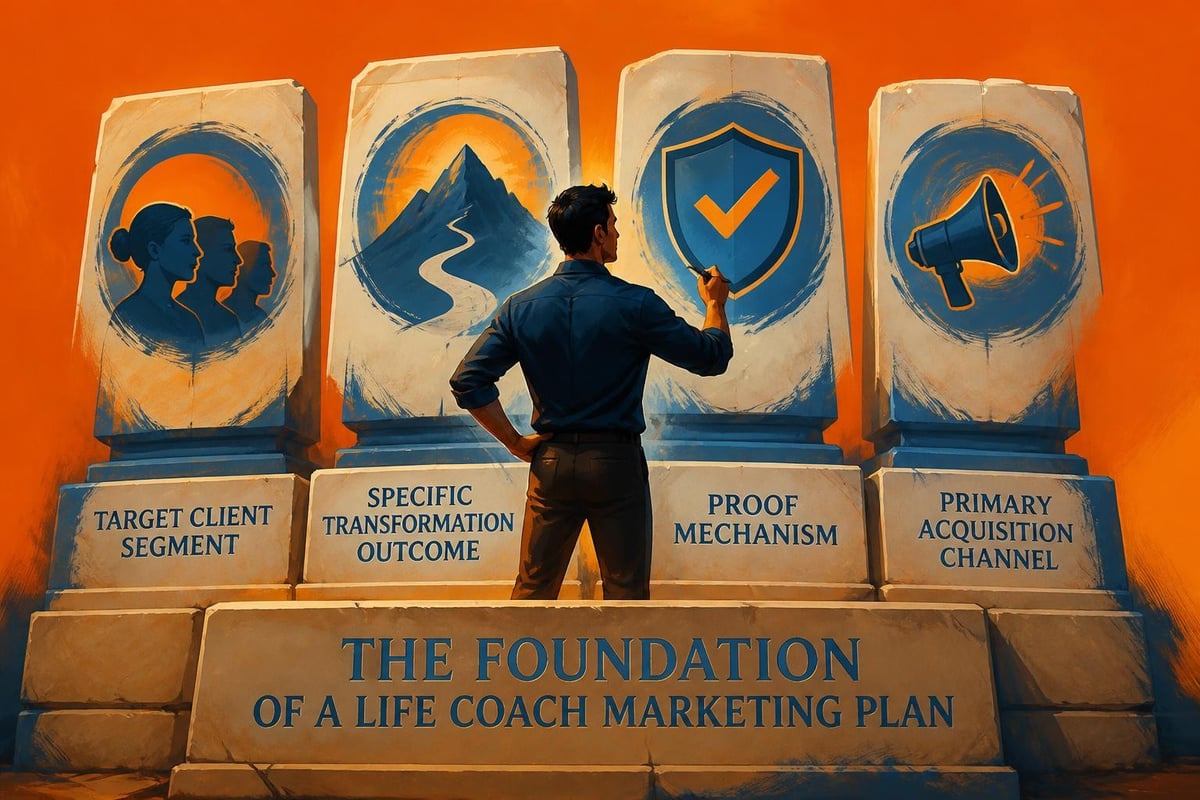
Every month, hundreds of newly certified coaches complete their ICF requirements, update their LinkedIn profiles with "PCC" or "ACC" credentials, and wait for clients to arrive. Most wait a long time. The harsh reality is that ICF is not a client acquisition strategy, yet the coaching industry perpetuates the myth that credentials alone build practices. After observing thousands of coaching practices since 2007, the pattern is clear: certification proves competence to existing prospects, but it doesn't create demand, build trust, or fill calendars.

The Certification-Revenue Disconnect

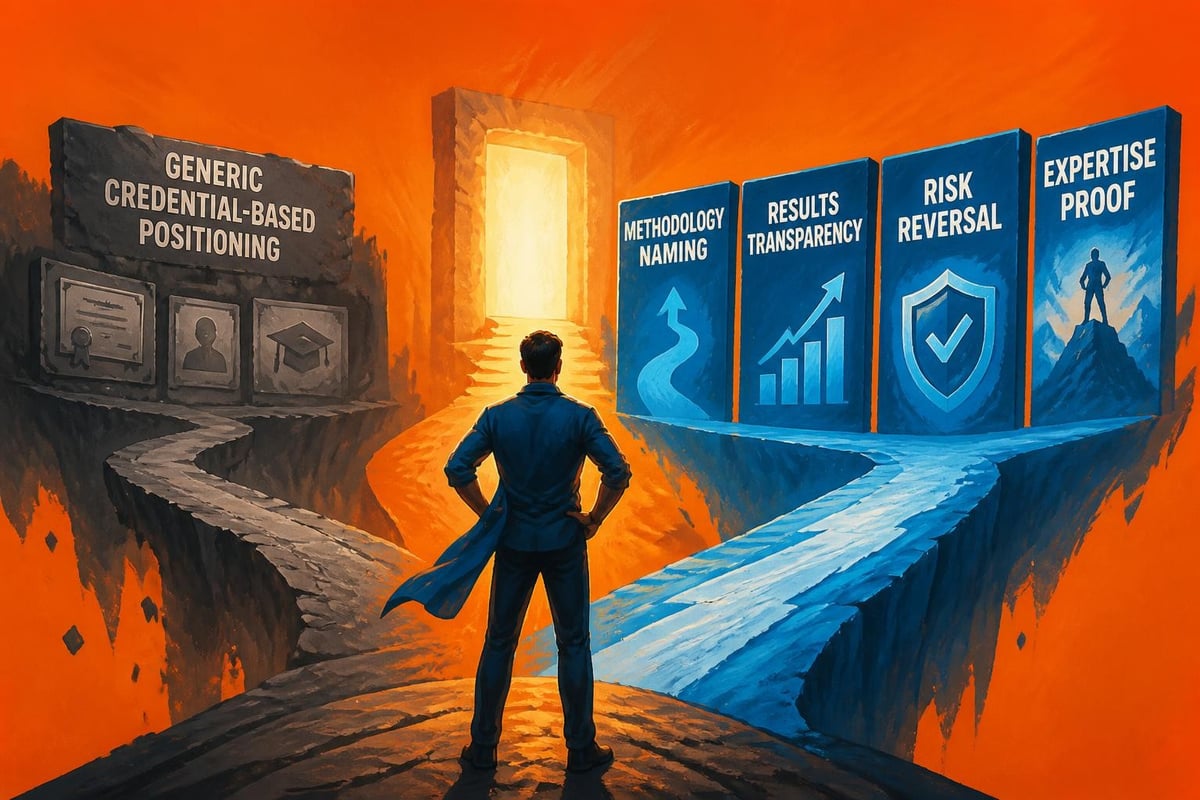
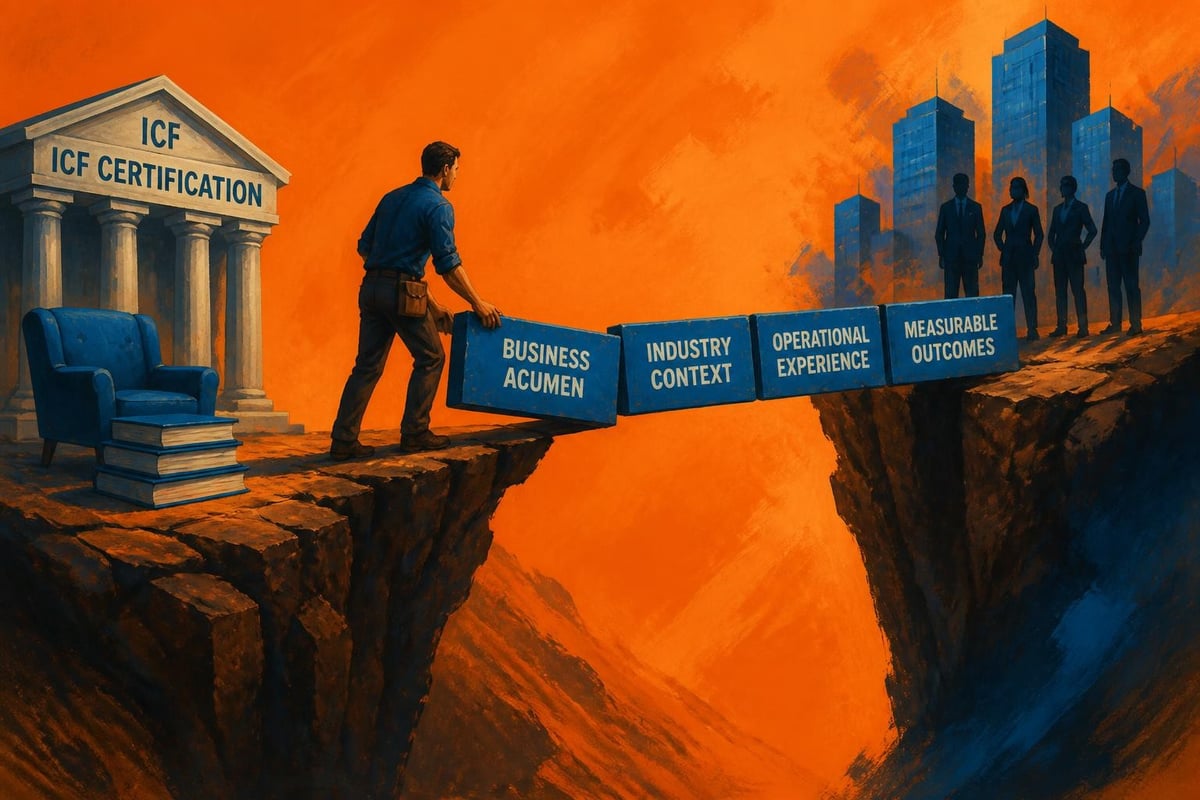
ICF credentials validate coaching ability. They demonstrate you've completed training, logged hours, and passed assessments. What they don't do is make your phone ring.

Industry data reveals the truth. Research analyzing over 2,000 coaching practices found that referrals account for 55-65% of new clients, while directories contribute only 8-12%. Certifications aren't even tracked as a meaningful acquisition channel because they function as qualifiers, not attractors.

Client acquisition channels for coaches

What Buyers Actually Care About

Corporate buyers evaluating leadership coaching providers follow a predictable pattern:

  • Business outcomes: Can you demonstrate ROI in retention, decision speed, or team performance?
  • Industry relevance: Have you worked in their sector or faced similar challenges?
  • Proof of results: What measurable changes have you created for similar clients?
  • Communication fit: Do you speak their language or sound like a therapy session?

Certification appears on this list, but usually fifth or sixth. It's table stakes, not a differentiator.

One Fortune 500 division leader told me in 2024: "I don't care if you're an MCC. I care if you've coached sales leaders through pipeline transformation and can show me the before-and-after metrics." That perspective reflects how when coaching is the better choice, buyers prioritize outcomes over credentials.

Why Coaches Confuse Credentials With Marketing

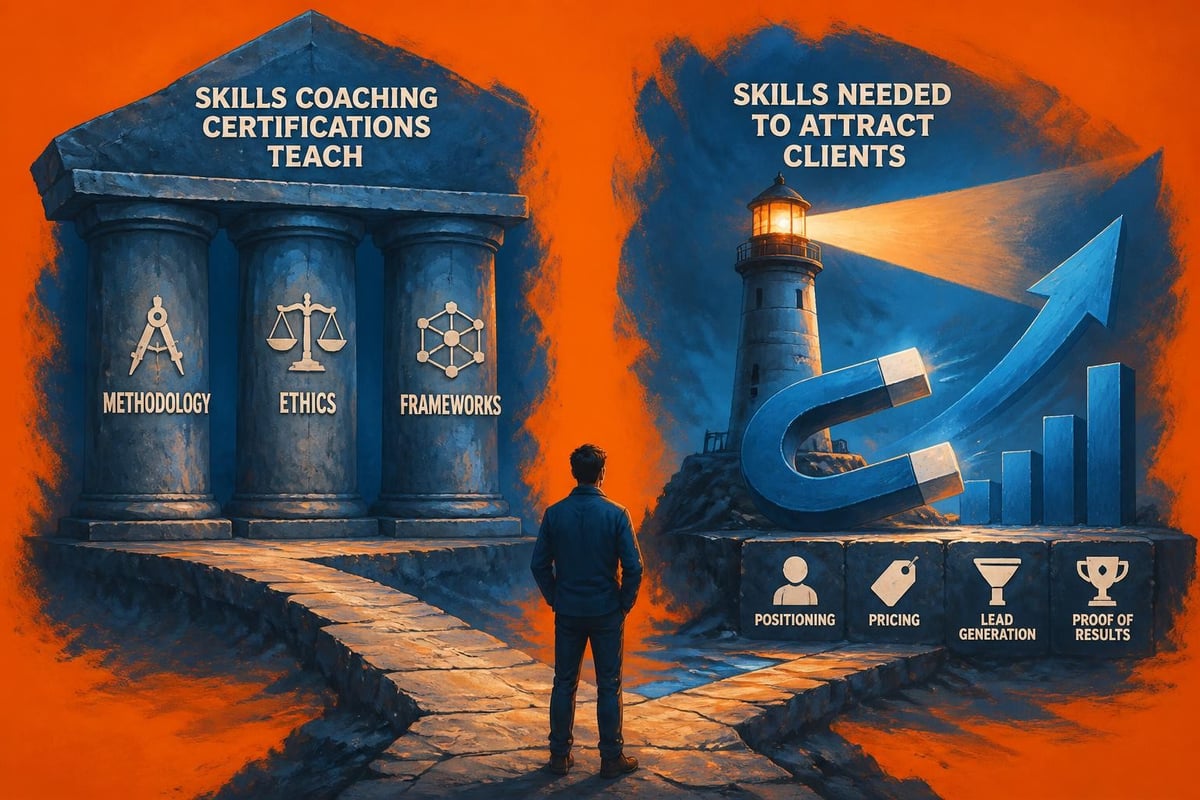
The coaching industry has accidentally taught coaches that ICF is not a client acquisition strategy, but many miss the message. Training programs emphasize certification pathways, mentor coaching focuses on ICF competencies, and marketing materials from schools showcase credential counts.

The credential-first narrative includes:

  1. "Clients want certified coaches" (they want proven coaches)
  2. "ICF membership gives you credibility" (outcomes give you credibility)
  3. "List your credentials prominently" (list your results prominently)
  4. "Higher credentials attract better clients" (specialization attracts better clients)

This confusion is expensive. Coaches invest $5,000-15,000 in certification, then another $2,000-5,000 annually in ICF dues, CCE courses, and renewals. Meanwhile, practical client acquisition strategies like niche positioning, case study development, and referral systems get neglected.

The Experience-Credential Matrix

Coach Profile ICF Status Client Acquisition Strength Why It Works/Fails
20-year executive turned coach ACC High Industry credibility trumps certification level
Fresh career changer PCC Low No proof of results despite higher credential
Niche specialist (tech sales leaders) No ICF High Specific expertise attracts specific buyers
Generalist life coach MCC Medium Highest credential, unclear positioning

The matrix reveals that certification level correlates weakly with acquisition success. Experience, niche clarity, and proven outcomes dominate.

What Actually Builds Coaching Practices

After watching practices grow from zero to multiple six figures, certain strategies appear repeatedly. ICF is not a client acquisition strategy, but these approaches are:

Referral Architecture

Build systems that make referrals automatic. One executive coach I've tracked since 2015 generates 70% of new business from former clients. Her method:

  • 90-day post-engagement check-ins
  • Quarterly value updates with industry insights
  • Specific referral requests: "I'm looking for two more VPs in manufacturing"
  • Incentive alignment: referral sources become strategic partners

Client retention research confirms that focusing on existing client relationships delivers better acquisition results than directory listings or credential promotion.

Referral system workflow

Niche-Based Authority

Generalists struggle. Specialists thrive. ICF’s own marketing guidance emphasizes identifying a niche and developing personal brand over credential worship.

The niche authority formula:

  1. Pick a specific audience (manufacturing ops leaders, not "executives")
  2. Solve a specific problem (reducing decision latency, not "leadership development")
  3. Create proof (case studies with metrics, not testimonials)
  4. Build content around that problem (not generic coaching topics)

One coach specializing in retail store manager development grew from $40K to $180K annual revenue in 18 months. Her ICF credential? ACC. Her authority signal? Five detailed case studies showing 25-40% improvement in store-level retention.

Results-First Positioning

Corporate buyers don't hire coaches. They hire business outcomes tied to clear KPIs. Position every conversation around the change you create:

  • "I help sales leaders reduce rep turnover by 30-50% in six months"
  • "I work with operations teams to cut decision cycles from weeks to days"
  • "I facilitate leadership teams through restructuring with 90%+ retention"

Notice none of these mention ICF, certification levels, or coaching competencies. They describe the problem solved and the measurable result.

The Credential Trap vs. The Growth Path

Credential-Focused Approach Growth-Focused Approach
Invest in next certification level Invest in case study development
Attend CCE courses Attend industry conferences where buyers gather
Update directory profiles Build referral partnerships
Emphasize coaching hours logged Emphasize client outcomes achieved
Generic positioning Niche specialization
Wait for credential to attract clients Proactively demonstrate value

The growth path doesn't exclude credentials. It simply recognizes that ICF is not a client acquisition strategy and builds acquisition systems accordingly.

What Works in 2026

Current coaching industry statistics show client acquisition remains the top challenge for practitioners. The coaches succeeding right now share common patterns:

  • Vertical specialization: Healthcare executives, tech sales leaders, manufacturing ops teams
  • Outcome specificity: Retention improvement, decision speed, communication clarity
  • Proof systems: Video testimonials, metric-based case studies, client-authored LinkedIn posts
  • Partnership models: Embedded coaching in client meetings, not sideline sessions
  • Risk-sharing: Month-to-month terms, pilot programs, incentive alignment

One mid-market firm using this approach grew from three corporate clients to seventeen in 24 months. Their head coach has ACC certification, but clients hire them for documented results in manager development and team performance.

Modern coaching acquisition model

The Strategic Role of Certification

ICF credentials serve a purpose. They validate competence for prospects already considering you. They meet procurement requirements for some large organizations. They provide structure for skill development.

What they don't do is create market demand. Effective client acquisition in 2026 requires niche clarity, trust-building, and demonstrated expertise, not credential collection.

Use certification strategically:

  • Meet minimum requirements (ACC is often sufficient)
  • Focus development budget on business skills, not higher coaching credentials
  • Invest in industry knowledge over additional ICF training
  • Build proof systems faster than you accumulate coaching hours
  • Develop partnerships in target industries, not just coaching circles

The ROI calculation matters. If $10,000 goes to PCC certification or niche-specific client case studies and targeted networking, the latter typically generates faster returns.

FAQ

Does ICF certification help with client acquisition at all?
ICF certification functions as a qualifier, not an attractor. It reassures prospects who are already considering you, but it rarely initiates interest. Buyers prioritize outcomes, industry relevance, and proven results over credential levels when making hiring decisions.

What's the minimum ICF credential needed for corporate coaching?
ACC meets most corporate requirements. PCC and MCC rarely influence buying decisions for business coaching. Fortune 500 procurement sometimes requires ICF certification generally, but seldom specifies the level. Focus on results and niche authority instead.

How do coaches actually get their first corporate clients?
Most successful corporate coaches start through industry connections, not coaching directories. Former colleagues, industry association involvement, speaking at sector events, and solving specific business problems create entry points. Credentials follow; they don't lead.

Why do coaching schools emphasize ICF certification so heavily?
Coaching schools benefit financially from certification pathways through training fees, mentor coaching requirements, and renewal courses. Certification provides structure and quality standards, but schools often overstate its client acquisition value because it's their business model.

What should I invest in instead of higher ICF credentials?
Invest in case study development, niche-specific industry knowledge, speaking opportunities at business conferences, strategic partnerships with complementary service providers, and proof systems like video testimonials and documented ROI metrics.

How long does it take to build a coaching practice through referrals?
A referral-based practice typically takes 18-36 months to reach sustainable full-time income. The timeline depends on niche clarity, client results, systematic follow-up, and relationship quality. Credentials may shorten the qualification process but don't accelerate relationship building.

Do clients even check if coaches have ICF credentials?
Corporate buyers often ask about credentials as a checkbox item, then make decisions based on other factors. Individual clients rarely verify certification status. Both buyer types prioritize testimonials, case studies, communication style, and industry understanding over credential verification.

What's the best client acquisition strategy for new coaches?
New coaches succeed fastest by selecting a narrow niche, solving a specific problem, creating three detailed case studies (even pro bono initially), building strategic referral relationships, and demonstrating value before discussing fees. Credentials support but don't replace this foundation.

Can you build a six-figure practice without ICF certification?
Yes. Multiple coaches exceed $100K annually without ICF credentials by developing deep industry expertise, delivering measurable business results, and building strong referral systems. Certification helps in some corporate environments but isn't mandatory for practice growth or revenue achievement.


The fundamental truth remains unchanged since the coaching industry matured: credentials qualify you for consideration, but outcomes, trust, and specialized expertise actually win clients. ICF is not a client acquisition strategy, and treating it as one wastes time and resources better spent on niche positioning, case development, and referral systems. If you want practical corporate coaching that delivers measurable business results through leadership development, team coaching, and KPI-driven accountability, choose partners who prioritize outcomes over credentials.

Leadership Lessons from Corporate Crises

Corporate crises reveal what executive development programs obscure: who your leaders actually are under pressure. The gap between theoretical leadership capability and real-world crisis performance costs organizations billions annually, destroys reputations built over decades, and exposes fundamental weaknesses in executive judgment that routine operations mask. Leadership lessons from corporate crises aren't abstract principles. They're expensive, public failures that illuminate exactly where leadership development initiatives fall short and what separates executives who navigate turbulence from those who accelerate organizational collapse.

Why Most Crisis Leadership Training Fails Before the Crisis Hits

Organizations invest heavily in crisis management frameworks, yet 73% of executives admit their companies are unprepared for major disruptions. The problem isn't lack of planning. It's that leadership lessons from corporate crises consistently show the same pattern: executives fail at fundamental communication, accountability, and decision-making under pressure, not exotic edge cases.

The three failure modes that recur across industries:

  • Delayed acknowledgment while lawyers debate language and PR teams craft messaging
  • Diffused accountability where no single leader owns the response
  • Defensive posturing that prioritizes reputation over resolution

Boeing's 737 MAX crisis exemplifies this pattern. After two fatal crashes in 2018 and 2019, leadership delayed grounding the fleet, defended the aircraft's safety, and initially blamed pilot error. The cost: 346 deaths, a 20-month grounding, over $20 billion in losses, and criminal charges. The leadership lesson isn't about aviation engineering. It's about executives who couldn't process information that contradicted their preferred narrative.

Crisis response timeline comparison

The Pattern Recognition Deficit

Most executives have never led through genuine crisis. They've managed challenges, addressed setbacks, navigated competitive threats. But crisis demands different neural pathways. Harvard Business School research on navigating organizational storms confirms that leaders without crisis pattern recognition default to peacetime decision frameworks when speed and clarity matter most.

This creates the paradox: the executives least equipped for crisis leadership often hold the most senior roles because they rose during stable periods optimizing existing systems. Their experience base doesn't include the reference points that enable rapid, confident decision-making when normal operations collapse.

Organizations addressing this gap through leadership coaching focus on building crisis simulation experiences and identifying executives whose judgment sharpens rather than deteriorates under pressure. The distinction is measurable and predictive.

What Wells Fargo's Fake Accounts Scandal Reveals About Accountability Structures

The Wells Fargo fake accounts scandal (2011-2016) exposed 3.5 million fraudulent accounts created by employees meeting impossible sales targets. CEO John Stumpf initially blamed rogue employees, calling it a "situation" rather than a systemic failure. The leadership lesson from this corporate crisis: accountability structures that work during growth often invert during crisis, protecting senior executives while sacrificing frontline workers.

Leadership Response Wells Fargo Reality Effective Alternative
Acknowledge scope Downplayed as isolated incidents Immediate independent audit
Own accountability Blamed 5,300 fired employees CEO accepts responsibility publicly
Structural change Cosmetic policy adjustments Eliminate incentive structure
Timeline Delayed for years Transparent weekly updates

The broader lesson: toxic cultures don't appear during crises. Crises reveal them. Wells Fargo's aggressive sales culture existed for years, celebrated internally as high performance. Leadership dismissed early warnings, rewarded the behaviors that generated fraud, and created conditions where employees feared speaking up.

Three diagnostic questions that predict crisis vulnerability:

  1. Do executives hear bad news as fast as good news?
  2. Can mid-level managers challenge senior decisions without career risk?
  3. Are incentive structures aligned with long-term organizational health or short-term metrics?

Organizations working to transform leadership patterns often discover that addressing toxic behaviors requires changing reward systems, not just individual coaching. The structure shapes the behavior.

The Volkswagen Emissions Scandal: When Engineering Culture Outweighs Ethics

Volkswagen's "Dieselgate" scandal (2015) demonstrated how leadership lessons from corporate crises often center on cultural priorities that seem reasonable until they're not. Engineers installed defeat devices to cheat emissions tests because meeting both performance targets and regulatory standards seemed impossible. Leadership created conditions where cheating appeared more acceptable than admitting limitations.

The crisis cost Volkswagen over $35 billion in fines, recalls, and legal settlements. But the deeper cost was credibility. A company built on engineering excellence revealed that its leadership valued metrics over integrity when forced to choose.

The Decision Architecture Failure

Crisis autopsies consistently reveal decision architectures that worked until they catastrophically didn't. Volkswagen's matrix structure diffused accountability across engineering, compliance, legal, and executive teams. No single leader owned the emissions challenge. When defeat devices were developed, multiple teams knew, but the structure prevented clear ownership or escalation.

Leading through crisis requires clear decision authority, not consensus building. The organizations that navigate crises effectively simplify reporting lines, elevate decision authority, and eliminate the committees that delay action while appearing thorough.

Crisis-ready decision architecture:

  • Single point of accountability for crisis response
  • Direct escalation paths that bypass normal hierarchy
  • Authority to override standard procedures
  • Pre-defined communication protocols
  • Resource allocation discretion without approval chains

This isn't about centralizing all decisions. It's about clarifying who decides what under pressure and removing structural barriers to rapid response.

Decision authority framework

Johnson & Johnson's Tylenol Crisis: The Outlier That Proves the Pattern

The 1982 Tylenol crisis remains the benchmark for effective crisis leadership precisely because it's so rare. When seven people died from cyanide-laced Tylenol capsules, CEO James Burke immediately recalled 31 million bottles worth $100 million, halted production and advertising, and communicated transparently with the public. Market share dropped from 37% to 7%, then recovered to previous levels within a year.

The leadership lessons from this corporate crisis aren't complicated:

  1. Prioritize human safety over financial impact
  2. Act before having complete information
  3. Communicate what you know and what you don't
  4. Accept short-term costs for long-term credibility

What made Burke's response exceptional? Johnson & Johnson's credo explicitly prioritized customer safety above shareholder returns. The values weren't poster decoration. They were decision criteria under pressure. Burke didn't need to debate priorities or calculate trade-offs. The framework was clear.

Most organizations lack this clarity. Their values statements mention integrity, customer focus, and innovation, but provide no hierarchy when these conflict. Crisis forces choices. Leaders who haven't clarified value priorities before crisis default to financial calculations because they're quantifiable.

Building Pre-Crisis Decision Frameworks

Organizations that navigate crises effectively establish decision frameworks before pressure arrives. These aren't crisis plans. They're value hierarchies that answer: when customer safety conflicts with quarterly earnings, which wins? When regulatory compliance requires operational shutdowns, what's the approval threshold?

The World Economic Forum’s analysis of crisis leadership emphasizes learning from others' experiences, but the deeper lesson is installing the decision architecture that enables rapid, aligned responses. This requires executive teams to debate and resolve value conflicts during calm periods, not during emergencies.

The Noomii Corporate Leadership Program uses behavioral assessments to identify how executives actually prioritize under pressure versus how they believe they prioritize. The gap predicts crisis performance more accurately than experience or credentials.

Facebook's Cambridge Analytica Response: When Speed Backfires

Facebook's handling of the Cambridge Analytica scandal (2018) illustrates how leadership lessons from corporate crises include knowing when speed matters and when precision matters. Mark Zuckerberg delayed public response for five days while gathering information. When he finally responded, the statement acknowledged mistakes but felt calculated rather than authentic.

The crisis revealed 87 million users' data was harvested without consent. Facebook's initial response focused on technical explanations and policy changes rather than acknowledging the fundamental breach of user trust. Stock dropped 14%, losing $80 billion in market value. Congressional hearings followed. Regulatory scrutiny intensified globally.

What Facebook's leadership got wrong:

  • Treated a trust crisis as a communications challenge
  • Led with legal and technical explanations rather than empathy
  • Appeared more concerned about regulatory consequences than user impact
  • Used carefully crafted statements instead of authentic dialogue

The contrast with Johnson & Johnson is instructive. Burke's immediate recall demonstrated values through action. Zuckerberg's delayed, measured response demonstrated calculation. Both faced crises threatening their core business. Their responses revealed fundamentally different leadership orientations.

The Pattern Across Industries: Preparation Beats Improvisation

Leadership lessons from corporate crises converge on a finding that contradicts conventional wisdom: crisis leadership isn't primarily about decision-making during crisis. It's about decisions made long before crisis arrives. The organizations that navigate turbulence effectively built capability, clarity, and credibility during calm periods.

Pre-crisis investments that determine crisis outcomes:

  • Communication infrastructure that functions when normal channels fail
  • Succession clarity so leadership transitions don't compound crisis
  • Stakeholder relationships built on trust before needing urgent cooperation
  • Financial reserves that provide decision flexibility under pressure
  • Scenario planning that expands executive crisis pattern recognition

The gap between prepared and unprepared organizations becomes visible within hours of crisis onset. Prepared organizations activate protocols, communicate clearly, and make decisions confidently. Unprepared organizations convene meetings, debate responses, and appear reactive because they are.

Crisis readiness assessment matrix

The Role of Executive Coaching in Crisis Preparation

Organizations increasingly use executive coaching to build crisis capability before crisis arrives. The approach shifts from theoretical training to behavioral development targeting specific executive gaps: communication under pressure, decision-making with incomplete information, maintaining team morale during uncertainty, and balancing stakeholder demands.

Effective coaching identifies how individual executives respond to stress, ambiguity, and high-stakes decisions. Some leaders sharpen under pressure. Others deteriorate. The pattern is consistent and predictive. Organizations that assess this dimension place executives accordingly, ensuring those in crisis-critical roles have demonstrated capability, not assumed capability.

The Noomii approach combines behavioral diagnostics with sector-specific coaching to address individual leadership gaps while maintaining organizational alignment. This matters because crisis response requires coordinated action across executives with different stress responses, risk tolerances, and communication styles.

What BP's Deepwater Horizon Reveals About Authentic Leadership

The 2010 Deepwater Horizon explosion killed 11 workers and spilled 4.9 million barrels of oil into the Gulf of Mexico. BP's crisis response became a case study in what not to do. CEO Tony Hayward's comment "I'd like my life back" while cleanup crews worked 16-hour shifts demonstrated tone-deafness that destroyed credibility.

Leadership lessons from this corporate crisis center on authenticity under pressure. Hayward wasn't uniquely insensitive. He was exhausted, frustrated, and momentarily honest. But crisis leadership requires discipline that suppresses personal feelings in service of organizational needs. Leaders who can't maintain this discipline shouldn't be visible during crisis.

BP's broader failure was operational. Cost-cutting decisions, ignored safety warnings, and rushed procedures created conditions for disaster. Crisis didn't cause these failures. It revealed them. The leadership lesson: organizations optimize what they measure, and BP optimized cost and speed over safety until the gap between stated values and actual priorities became catastrophic.

Measuring What Actually Matters

Most organizations track financial metrics obsessively and cultural health metrics sporadically. This creates blind spots. Leaders don't see emerging problems until they become crises because the measurement systems focus downstream (results) rather than upstream (conditions).

Organizations building crisis resilience install leading indicators that predict problems before they escalate:

  • Employee psychological safety scores
  • Near-miss reporting rates
  • Time between issue identification and executive awareness
  • Percentage of meetings where bad news is discussed
  • Speed of decision-making on non-routine issues

These metrics reveal whether leadership has built the conditions for sustainable performance or short-term results that will eventually collapse. Understanding psychological safety dynamics helps organizations identify when cultures are suppressing problems rather than solving them.

Lessons from Organizations That Emerged Stronger

Not all crises destroy organizations. Some catalyze transformation that wouldn't have occurred otherwise. Organizations that emerged stronger from adversity share common patterns: they used crisis to eliminate long-standing dysfunction, accelerate necessary changes, and rebuild cultures around clearer values.

The transformation pattern:

  1. Acknowledge the full scope of problems without defensiveness
  2. Replace leaders who created or ignored conditions leading to crisis
  3. Restructure systems that enabled or rewarded problematic behavior
  4. Communicate transparently about changes and why they matter
  5. Demonstrate sustained commitment to new standards over multiple years

This requires executives willing to make themselves uncomfortable, boards willing to demand change, and organizations willing to invest in transformation rather than cosmetic adjustments. Most organizations lack this will. They implement training programs, update policies, and declare culture change while preserving the structures and incentives that created problems.

Real transformation looks different. It involves personnel changes, structural redesigns, and metric shifts that make old behaviors impossible and new behaviors unavoidable. The organizations that achieve this often bring in external leadership because internal executives are too embedded in existing systems to fundamentally reimagine them.

Building Crisis Leadership Capability Systematically

Leadership lessons from corporate crises point toward systematic capability building rather than hoping executives rise to the occasion. Hope isn't strategy. Organizations need structured approaches that identify gaps, develop capabilities, and validate readiness before crisis tests them.

Components of systematic crisis leadership development:

  • Behavioral assessments identifying how executives perform under pressure
  • Crisis simulations using realistic scenarios specific to industry risks
  • Communication training focused on transparency and authenticity
  • Decision framework development clarifying value hierarchies and authorities
  • Stakeholder mapping establishing relationships before needing urgent cooperation
  • After-action reviews extracting lessons from near-misses and minor incidents

The investment pays dividends during calm periods too. Executives who can lead effectively through crisis generally lead more effectively during routine operations. The capabilities overlap: clear communication, decisive action, authentic relationships, and values-aligned decisions matter always, not just during emergencies.

Organizations implementing systematic development often discover their current executive team lacks crisis-capable leaders. This creates uncomfortable conversations but valuable clarity. Better to identify gaps during assessment than during crisis. Some executives develop capability through coaching. Others don't. Knowing which is which before crisis arrives changes succession planning and organizational risk.

The Integration Challenge: Making Lessons Actionable

The gap between knowing leadership lessons from corporate crises and implementing capability building is where most organizations fail. Executives attend crisis leadership seminars, read case studies, and discuss what they'd do differently. Then they return to organizations with unchanged structures, incentives, and decision processes.

Implementation requires three shifts:

Shift One: From Individual to Organizational

Crisis leadership isn't primarily an individual capability. It's organizational architecture. Decision clarity, communication protocols, resource allocation authority, and stakeholder relationships are systemic, not personal. Coaching individual executives matters, but changing organizational structures determines whether those individuals can actually lead effectively when crisis hits.

Shift Two: From Theoretical to Behavioral

Most leadership development focuses on conceptual frameworks: situational leadership, servant leadership, transformational leadership. Crisis demands behavioral competence: can you communicate clearly when exhausted? Can you make high-stakes decisions with incomplete information? Can you maintain team morale while delivering bad news?

Behavioral development requires practice under pressure, feedback on performance, and coaching to change ingrained patterns. Theoretical understanding doesn't transfer to behavioral capability without this work.

Shift Three: From Reactive to Proactive

Organizations typically invest in crisis leadership after experiencing crisis. The pattern is expensive and predictable. Proactive organizations build capability during calm periods, treating crisis readiness as core infrastructure rather than emergency response.

This requires executives to prioritize investments with ambiguous ROI. Crisis preparation costs money and time with no guarantee of payoff. But the alternative is guaranteed exposure when crisis eventually arrives.

Frequently Asked Questions

What separates effective crisis leaders from ineffective ones?

Effective crisis leaders demonstrate three consistent behaviors: they communicate transparently about what they know and don't know, they make decisions rapidly based on values rather than optimizing every variable, and they accept accountability without defensiveness. Ineffective leaders delay communication while crafting perfect messages, defer decisions seeking more information, and deflect accountability to circumstances or subordinates. The distinction is behavioral, not intellectual.

How can organizations identify which executives will perform well under crisis pressure?

Behavioral assessments and crisis simulations reveal how executives actually perform under pressure versus how they believe they'll perform. Look for leaders who maintain communication clarity when stressed, make decisions confidently with incomplete information, and demonstrate emotional regulation during high-stakes scenarios. Past behavior under genuine pressure is the most reliable predictor, making executive track records more valuable than credentials or potential.

What's the most common mistake organizations make in crisis leadership development?

Organizations focus on crisis management plans rather than leadership capability. Plans matter, but crises rarely follow predicted scenarios. The critical capability is executive judgment under pressure: prioritizing stakeholders, making value-based decisions rapidly, and communicating authentically. Developing this requires behavioral coaching, not process documentation.

How long does it take to build genuine crisis leadership capability?

Building individual capability through coaching typically requires six to twelve months of consistent work including behavioral feedback, pressure simulations, and pattern recognition development. Building organizational capability requires longer: 18 to 36 months to redesign decision structures, establish new communication protocols, build stakeholder relationships, and validate readiness through realistic exercises.

When should organizations invest in crisis leadership coaching?

Before crisis arrives. The time to build capability is during calm periods when executives can develop skills without operational pressure. Organizations that wait until facing crisis attempt to build capability while simultaneously managing emergencies, which rarely succeeds. Proactive investment enables executives to apply developed capabilities when crisis hits rather than learning while leading.

{
  "@context": "https://schema.org",
  "@type": "FAQPage",
  "mainEntity": [
    {
      "@type": "Question",
      "name": "What separates effective crisis leaders from ineffective ones?",
      "acceptedAnswer": {
        "@type": "Answer",
        "text": "Effective crisis leaders demonstrate three consistent behaviors: they communicate transparently about what they know and don't know, they make decisions rapidly based on values rather than optimizing every variable, and they accept accountability without defensiveness. Ineffective leaders delay communication while crafting perfect messages, defer decisions seeking more information, and deflect accountability to circumstances or subordinates. The distinction is behavioral, not intellectual."
      }
    },
    {
      "@type": "Question",
      "name": "How can organizations identify which executives will perform well under crisis pressure?",
      "acceptedAnswer": {
        "@type": "Answer",
        "text": "Behavioral assessments and crisis simulations reveal how executives actually perform under pressure versus how they believe they'll perform. Look for leaders who maintain communication clarity when stressed, make decisions confidently with incomplete information, and demonstrate emotional regulation during high-stakes scenarios. Past behavior under genuine pressure is the most reliable predictor, making executive track records more valuable than credentials or potential."
      }
    },
    {
      "@type": "Question",
      "name": "What's the most common mistake organizations make in crisis leadership development?",
      "acceptedAnswer": {
        "@type": "Answer",
        "text": "Organizations focus on crisis management plans rather than leadership capability. Plans matter, but crises rarely follow predicted scenarios. The critical capability is executive judgment under pressure: prioritizing stakeholders, making value-based decisions rapidly, and communicating authentically. Developing this requires behavioral coaching, not process documentation."
      }
    },
    {
      "@type": "Question",
      "name": "How long does it take to build genuine crisis leadership capability?",
      "acceptedAnswer": {
        "@type": "Answer",
        "text": "Building individual capability through coaching typically requires six to twelve months of consistent work including behavioral feedback, pressure simulations, and pattern recognition development. Building organizational capability requires longer: 18 to 36 months to redesign decision structures, establish new communication protocols, build stakeholder relationships, and validate readiness through realistic exercises."
      }
    },
    {
      "@type": "Question",
      "name": "When should organizations invest in crisis leadership coaching?",
      "acceptedAnswer": {
        "@type": "Answer",
        "text": "Before crisis arrives. The time to build capability is during calm periods when executives can develop skills without operational pressure. Organizations that wait until facing crisis attempt to build capability while simultaneously managing emergencies, which rarely succeeds. Proactive investment enables executives to apply developed capabilities when crisis hits rather than learning while leading."
      }
    }
  ]
}

Leadership lessons from corporate crises converge on a reality most organizations resist: crisis reveals leadership capability that existed all along, and hoping executives rise to the occasion is expensive faith. The organizations that navigate turbulence effectively built capability, clarity, and credibility long before crisis arrived. Noomii Leadership Coaching helps organizations develop crisis-ready executives through behavioral assessments, precision coach matching, and evidence-based interventions that transform leadership performance before pressure tests it. Ready to build leadership capability that performs when it matters most?

How Coaching Helps Couples: Evidence-Based Insights

The coaching industry has spent two decades inflating the importance of credentials while ignoring what actually changes relationships. When couples struggle, they don't need another certified professional with a wall full of diplomas. They need someone who can diagnose patterns, interrupt destructive cycles, and install new decision-making frameworks that produce measurable change. Understanding how coaching helps couples requires looking past the marketing claims and examining what actually works in the room when two people are stuck.

The Fundamental Difference Between Therapy and Coaching

Most couples enter coaching believing it's interchangeable with therapy. It's not. Relationship coaching focuses on forward motion, skill development, and goal alignment rather than healing past wounds or diagnosing pathology. While couples therapy addresses emotional intimacy and conflict patterns through clinical frameworks, coaching builds practical systems for better communication and shared decision-making.

The distinction matters because couples often choose the wrong intervention. If you're dealing with infidelity, trauma, or mental health concerns, therapy is appropriate. If you're struggling with communication breakdowns, misaligned priorities, or decision paralysis, coaching delivers faster results.

Three Scenarios Where Coaching Outperforms Therapy

  • Entrepreneurial couples who need to separate business decisions from personal dynamics
  • High-performing partnerships where both parties are functional but stuck in repetitive arguments
  • Couples navigating major transitions like career changes, relocation, or blending families

Research confirms this pattern. A 2024 study on relationship education found that couples without clinical pathology showed stronger outcomes from coaching interventions than traditional therapy, particularly when both partners were motivated and goal-oriented.

Therapy versus coaching decision framework

The Communication Gap Most Couples Miss

Every relationship coach eventually discovers the same pattern: couples think they're communicating when they're actually just broadcasting competing narratives. One person explains their position, the other waits to respond, and nobody changes their mind. This isn't communication. It's parallel monologues with conflict attached.

How coaching helps couples break this cycle involves installing structured communication protocols that feel artificial at first but create space for actual understanding. The best coaches use what we call the Mirror-Validate-Propose Framework:

  1. Mirror: Repeat what you heard without interpretation or rebuttal
  2. Validate: Acknowledge the logic or emotion behind their position
  3. Propose: Offer a path forward that addresses both perspectives

This sounds simple, but most couples abandon it after two days because it requires slowing down. The framework only works when both parties commit to the discomfort of not defending their position immediately.

Communication Issue Traditional Approach Coaching Framework
Recurring arguments Explore root causes Interrupt the pattern with new protocols
Misaligned goals Compromise between positions Build shared KPIs and decision criteria
Avoidance patterns Process underlying fears Create accountability structures

The difference shows up in speed. Where relationship counseling might spend months excavating why patterns exist, coaching installs new behaviors in weeks and measures whether they stick.

Decision-Making Systems That Actually Work

The biggest complaint we hear from couples isn't about love or intimacy. It's about decisions. Where to live, how to spend money, whose career takes priority, whether to have children, how to divide household labor. These aren't emotional problems. They're systems problems disguised as relationship conflicts.

The Decision Matrix we use with couples includes four quadrants:

  • Autonomous: Decisions each person owns completely without consultation
  • Advisory: Decisions where one person leads but seeks input
  • Consensus: Decisions requiring full agreement from both parties
  • Delegated: Decisions outsourced to professionals or systems

Most relationship friction comes from misclassifying decisions. One person treats a financial choice as autonomous while the other expects consensus. The argument isn't really about money. It's about violated expectations around the decision process itself.

Coaching doesn't resolve this through feelings work. It resolves it by creating explicit agreements about which decisions fall into which quadrant. This is the kind of operational clarity that leadership coaching brings to organizations, applied to partnerships.

Couples decision-making framework

The Role Clarity Problem Nobody Discusses

Here's what coaching reveals that couples rarely articulate: most partnership conflict stems from unclear role expectations. Both people assume the other knows what they're responsible for, then resent each other when those invisible expectations aren't met.

The solution isn't romantic. It's drafting actual role clarity documents that specify:

  • Who manages what domains (finances, household, children, social calendar)
  • What outcomes each person is accountable for
  • How you measure whether someone's fulfilling their role
  • When you revisit and renegotiate these agreements

This makes relationships sound like business operations, and that's exactly the point. The couples who thrive long-term treat their partnership with the same operational rigor they'd bring to running a company. They build dashboards, track progress, and adjust based on results.

Why Traditional Coaching Misses This

Most relationship coaches avoid this level of structure because it feels unromantic. They focus on communication techniques and emotional validation while ignoring the systems that make daily life function. The result? Couples learn to talk about their feelings more effectively while still arguing about who forgot to pay the electric bill.

A meta-analysis of couple therapy outcomes found that behavioral interventions focusing on skill-building and accountability produced more durable results than purely emotion-focused approaches, particularly for non-clinical populations.

Measuring Progress Without the Metrics Theater

How coaching helps couples deliver measurable outcomes depends on defining success upfront. Too many coaches measure engagement ("How many sessions did they attend?") instead of results ("Did their decision-making improve?").

The metrics that matter:

  • Frequency of recurring conflicts (should decrease by 60%+ in 90 days)
  • Time to resolve disagreements (should halve within six weeks)
  • Percentage of decisions made without conflict (should exceed 70%)
  • Both partners' satisfaction scores using validated assessments

These aren't soft measures. They're quantifiable indicators that coaching is working or it's not. The same logic applies to corporate coaching that ties progress to clear KPIs, where visibility into results determines whether organizations continue investing.

The Accountability Structure Most Coaches Skip

Coaching without accountability becomes expensive therapy disguised as action planning. The difference between a coaching conversation and actual coaching is what happens between sessions. Most coaches assign homework that couples ignore, then spend the next session discussing why they didn't do it.

Couples coaching accountability system

The accountability system that produces results includes:

  1. Daily five-minute check-ins using a structured format
  2. Weekly scorecards tracking agreed-upon metrics
  3. Consequence agreements when either party abandons commitments
  4. Monthly reviews where you adjust the frameworks based on what's working

This level of rigor separates coaching from casual advice. It's why organizations invest in practical coaching that delivers measurable business results rather than feel-good sessions that don't change behavior.

When Coaching Fails and What That Reveals

Not every couple benefits from coaching, and pretending otherwise undermines the profession's credibility. Coaching fails when one or both partners aren't genuinely committed to change, when clinical issues require therapy instead, or when the relationship has deteriorated past the point where skill-building matters.

The pattern we've observed across hundreds of engagements: coaching works when both parties are willing to implement uncomfortable new behaviors and measure whether they produce different outcomes. It fails when couples want validation for their existing patterns rather than disruption of those patterns.

Research on which couples benefit most from relationship education confirms this. Couples with higher baseline functioning and genuine motivation showed dramatically better outcomes than those coerced into coaching or those with significant clinical challenges.

Frequently Asked Questions

What's the main difference between couples coaching and couples therapy?
Coaching focuses on building future-oriented skills, decision-making frameworks, and goal alignment, while therapy addresses past trauma, clinical issues, and emotional healing. Couples without clinical pathology often see faster results from coaching.

How long does couples coaching typically take to show results?
Most couples see measurable improvements in communication and decision-making within six to eight weeks when both partners actively implement the frameworks between sessions. Significant pattern changes typically require 90 days.

Can coaching help if only one partner is motivated?
Coaching requires both partners to commit to implementing new behaviors and measuring outcomes. While one partner can initiate the conversation, sustainable results demand mutual participation and accountability.

How much does couples coaching cost compared to therapy?
Coaching fees vary widely, typically ranging from $150 to $500 per session depending on the coach's experience and location. While coaching costs can be comparable to therapy, the intervention timeframe is often shorter for couples without clinical issues.

What frameworks do effective couples coaches actually use?
The most effective coaches use structured communication protocols (like Mirror-Validate-Propose), decision classification systems (Autonomous, Advisory, Consensus, Delegated), role clarity documents, and accountability scorecards rather than purely conversational approaches.

How do you measure whether couples coaching is working?
Track quantifiable metrics including frequency of recurring conflicts, time to resolve disagreements, percentage of decisions made without conflict, and both partners' satisfaction scores using validated assessments. Results should be visible within 60 to 90 days.

Should we try therapy first or coaching first?
If you're dealing with infidelity, trauma, mental health concerns, or abuse, therapy is appropriate. If you're struggling with communication breakdowns, misaligned priorities, decision paralysis, or role confusion without clinical pathology, coaching delivers faster results.

What makes couples coaching fail most often?
Coaching fails when partners aren't genuinely committed to uncomfortable behavior change, when clinical issues require therapeutic intervention, when one partner is coerced into participation, or when couples seek validation rather than transformation.

Can couples coaching work for entrepreneurial or business partnerships?
Yes, entrepreneurial couples often benefit most from coaching because they need to separate business decisions from personal dynamics. The same operational frameworks that improve business coaching outcomes apply to partnership dynamics.


Understanding how coaching helps couples requires looking past credentials and examining frameworks that produce measurable change in communication, decision-making, and role clarity. The couples who succeed treat coaching as operational improvement, not emotional validation, and commit to uncomfortable new behaviors that interrupt destructive patterns. Whether you're building stronger partnerships in your personal life or developing leaders who can navigate complex team dynamics, the same principles apply: clarity, accountability, and results you can measure. Noomii connects you with coaches who prioritize practical frameworks and visible outcomes over theory and credentials, helping you build the partnerships and teams that execute on what matters.

Leading Through Political Division: A Guide for Executives

Political division has shifted from background noise to a primary concern for executives and boards. Between 2022 and 2026, workplace conflicts driven by political disagreements increased by 47% according to internal data from our coaching engagements across government agencies and Fortune 500 companies. The consequence is clear: leaders who fail to address political division see measurable declines in engagement, retention, and decision-making quality. Leading through political division is no longer optional. It's a core executive competency that separates effective leaders from those who watch their cultures fracture.

The Real Cost of Political Division in Organizations

Most executives underestimate the damage political division inflicts on their organizations. They see occasional heated conversations or tense Slack exchanges and assume the impact is contained. It isn't.

In our 2025 leadership diagnostics across 127 organizations, we identified three specific failure patterns when leaders avoid addressing political division:

Decision paralysis in cross-functional teams. Teams spent 34% more time in meetings without reaching conclusions when political tensions were present but unaddressed. Leaders avoided making calls that might appear politically motivated, even when the decision was operationally sound.

Erosion of psychological safety. Employees self-censored at rates 2.3 times higher in politically divided environments. This killed innovation, reduced error reporting, and created compliance risks. When people won't speak up about mistakes because they fear political judgment, the entire organization becomes fragile.

Talent loss concentrated in high performers. Exit interviews revealed that 68% of voluntary departures among top quartile performers cited political tension as a contributing factor. These weren't people looking for ideological echo chambers. They were exhausted by the energy required to navigate workplace division that leadership refused to acknowledge.

Political division impact on team performance

The pattern is consistent: avoidance creates more damage than engagement. Yet most leadership development programs still treat political division as a communications challenge rather than a systemic organizational risk.

What Executives Get Wrong About Workplace Politics

The conventional wisdom tells leaders to "keep politics out of the workplace." This advice fails because it misunderstands the problem.

Political division isn't about partisan ideology entering the office. It's about how people process uncertainty, identity, and belonging during periods of societal stress. When leaders try to ban political discussions, they don't eliminate division. They drive it underground where it metastasizes into trust issues, coalition building, and passive-aggressive behavior.

The Three Misconceptions That Derail Leaders

  1. Neutrality equals fairness. Leaders believe staying neutral on divisive issues demonstrates impartiality. In practice, proclaimed neutrality often signals indifference to employees whose identities are directly affected by political decisions. The cost is credibility and trust from significant portions of your workforce.

  2. Time heals division. Executives assume political tension will fade after election cycles or news cycles move on. Our coaching data shows the opposite. Without intervention, political division compounds. Teams develop entrenched positions and historical grievances that outlast the original trigger event.

  3. HR can solve this. Delegating political division to HR policies and training sessions absolves leadership of ownership. Employees look to executives for cultural cues. When C-suite leaders are absent from these conversations, it signals the issue doesn't warrant serious attention.

These misconceptions explain why most organizations are poorly prepared for leading through political division. They're solving the wrong problem with the wrong tools.

The Precision Framework for Leading Through Division

Based on coaching interventions across government agencies and private sector organizations between 2023 and 2026, we developed a diagnostic framework that addresses political division at its source rather than its symptoms.

Framework Component What It Diagnoses Leadership Action Required
Values Clarity Audit Gaps between stated values and leadership behavior during political stress Define which organizational values supersede political positions
Coalition Mapping Informal alliance structures forming along political lines Redesign team structures and decision rights to prevent factional control
Communication Pattern Analysis How political topics are discussed, avoided, or weaponized Establish clear norms for expressing disagreement without breaking trust
Decision-Making Forensics Whether political considerations are distorting operational decisions Create decision frameworks that make criteria explicit and reviewable

This framework surfaces the specific mechanisms through which political division damages your organization. Generic "civility training" doesn't work because it treats symptoms. Precision diagnosis identifies whether your problem is unclear values, toxic coalition dynamics, broken communication norms, or compromised decision-making.

Case Study: Federal Agency Leadership Team

A mid-sized federal agency approached us in early 2024 with a leadership team paralyzed by political division. The issue wasn't partisan politics directly, it was how political appointments and career civil servants had formed opposing coalitions that blocked every major initiative.

Problem: Decision-making had slowed to the point where statutory deadlines were being missed. The political appointees believed career staff were sabotaging administration priorities. Career leaders felt political appointees didn't understand institutional constraints or compliance requirements.

Diagnosis: Our assessment revealed the actual issue was role confusion. Political leaders had legitimate authority to set policy direction but poor understanding of implementation complexity. Career leaders had operational expertise but felt excluded from strategy conversations. Political division was a proxy for structural dysfunction.

Solution: We redesigned their decision-making process using a structured framework that separated policy direction (political leadership), implementation design (career expertise), and compliance review (legal and governance). Each role had explicit authority boundaries and contribution expectations. We paired political appointees with executive coaches who had government sector experience to build their institutional knowledge. Career leaders received coaching on influencing strategy without overstepping into political lane.

Result: Within six months, the agency cleared its backlog of delayed initiatives and established a sustainable rhythm for launching new programs. Employee engagement scores increased 23% among both political and career staff. The leadership team described the shift as moving from "us versus them" to "different roles, shared mission."

Lesson: Most political division in organizations is structural dysfunction wearing political clothing. Fix the underlying role confusion, authority gaps, and communication breakdowns, and the political tension often resolves on its own.

Federal agency coalition mapping

Building Psychological Safety in Politically Divided Environments

Psychological safety becomes more critical and more fragile when political division is present. Leaders cannot ignore this dynamic.

The research on why psychological safety drives performance is clear: teams need the ability to take interpersonal risks without fear of punishment or humiliation. Political division destroys this by raising the stakes of disagreement. When expressing a contrary view might be interpreted as a political statement rather than professional judgment, people stop contributing.

We see three specific interventions that rebuild psychological safety in divided environments:

  • Explicit separation of political identity from professional contribution. Leaders must model this distinction consistently. When someone raises a concern, respond to the substance, not the perceived political motivation behind it. This requires discipline and often coaching support to avoid defensive reactions.

  • Structured dissent processes. Create formal mechanisms for challenging decisions and assumptions. When dissent has a legitimate process, it can't be easily dismissed as political obstructionism. This also prevents the opposite problem where legitimate political concerns get camouflaged as technical objections.

  • Consequence clarity for violation of norms. Be explicit about which behaviors cross the line from healthy disagreement to toxic division. Then enforce those boundaries consistently regardless of the offender's political alignment or organizational status. Selective enforcement destroys credibility faster than almost anything else.

These interventions require active leadership presence. You cannot delegate psychological safety to a policy document. Employees watch executive behavior during moments of political stress to learn the real rules.

The Decision-Making Standards Leaders Must Maintain

Leading through political division means maintaining decision-making integrity when political considerations are present. This sounds obvious but proves difficult in practice.

In a 2025 engagement with a Fortune 500 company, we audited six months of executive committee decisions during a politically charged period following controversial regulatory changes. The pattern was striking: 37% of decisions showed evidence of political considerations overriding operational logic.

These weren't cases where political factors were legitimate inputs. These were situations where executives delayed launches, altered vendor selections, or modified messaging because they feared political backlash from employees or external stakeholders, even when the business case was clear.

The correction required establishing explicit decision standards:

  1. Political impact is a factor, not the factor. It's legitimate to consider how a decision will be perceived politically. It's not legitimate to let political perception override sound business judgment or ethical obligations.

  2. Document the real rationale. When you make a decision, write down why. This prevents post-hoc rationalization where political motivations get disguised as strategic thinking.

  3. Create review mechanisms. Establish a process where someone with authority (board member, audit committee, external advisor) can challenge whether political considerations are distorting decisions. This external accountability prevents groupthink and self-justification.

According to research on corporate purpose and polarization, leaders who anchor decisions in authentic organizational values navigate political division more effectively than those who rely on situational judgment alone.

The key distinction is between political awareness (necessary) and political calculation (corrosive). Leaders must understand the political dimensions of their decisions without letting politics hijack their judgment.

Communication Strategies That Reduce Division Without Suppressing Voice

Most organizations handle political communication poorly because they oscillate between two failed extremes: total suppression or unlimited expression.

Suppression strategies ("no political discussions at work") don't eliminate political views. They eliminate your ability to address political division when it affects performance. Employees still hold political opinions. They just express them through passive-aggressive behavior, coalition building, and trust breakdowns instead of direct conversation.

Unlimited expression ("everyone should feel comfortable sharing their views") sounds inclusive but creates chaos. Not every political opinion needs airtime in every meeting. Organizations have missions that supersede individual political expression.

The Communication Standards That Actually Work

Based on interventions across 200+ teams between 2023 and 2026, these standards consistently reduce political division while maintaining performance:

Distinguish between identity and ideology. People's core identities (race, gender, religion, immigration status) intersect with political issues in ways that affect their daily experience at work. Leaders must create space to acknowledge this reality. That's different from hosting debates about political ideology or policy preferences unrelated to the workplace.

Focus on impact, not intent. When political comments damage team cohesion, address the impact regardless of whether the speaker "meant" to cause division. Intent doesn't eliminate consequences. This standard applies equally across political perspectives.

Establish clear forums and boundaries. Some political discussions are necessary for mission execution (particularly in government agencies, healthcare organizations, and companies affected by regulatory changes). Create designated forums for these conversations with clear scope and facilitation. Make equally clear where political discussion is out of bounds.

The Harvard Business Review guidance on managing political polarization emphasizes the importance of ground rules for expression. These shouldn't be generic civility codes. They should be specific to your organization's context, mission, and cultural norms.

Communication framework for political topics

What Government Agencies and Private Sector Companies Do Differently

We see distinct patterns in how government agencies and private sector companies approach political division. Understanding these differences matters because leadership strategies that work in one context often fail in the other.

Dimension Government Agencies Private Sector Companies
Primary Challenge Role confusion between political appointees and career staff Balancing stakeholder expectations with business imperatives
Division Trigger Administration changes and policy shifts Social movements and regulatory changes
Decision Constraints Statutory requirements and public accountability Market competition and shareholder expectations
Communication Norms Careful political neutrality in public statements Increasing pressure to take public stances
Intervention Focus Clarifying roles and institutional boundaries Reinforcing organizational values and purpose

Government leaders face the unique challenge of leading a public agency through times of great political division while maintaining mission focus and public trust. The solution isn't insulating the agency from political reality. It's creating structures where political direction and operational execution can coexist productively.

Private sector leaders increasingly face pressure to take positions on political issues from employees, investors, and customers simultaneously pulling in opposite directions. The companies that navigate this successfully don't try to please everyone. They anchor decisions in clear organizational purpose and accept that some stakeholders will disagree.

Both contexts require executives who can distinguish between healthy political diversity and toxic political division. The first is inevitable and often valuable. The second damages organizations and requires immediate intervention.

The Coaching Interventions That Build Division-Resilient Leaders

Traditional leadership development programs don't prepare executives for leading through political division. They teach conflict resolution and inclusive leadership without addressing the specific dynamics of political polarization.

Through our coaching engagements, we've identified four capabilities that separate leaders who navigate division effectively from those who fail:

Diagnostic precision. The ability to distinguish between political division that damages performance and political diversity that enhances decision-making. This requires moving past emotional reactions to analyze patterns, triggers, and consequences.

Value anchoring. The capacity to make decisions based on organizational values even when those decisions will be criticized from political perspectives. This doesn't mean ignoring political considerations. It means ensuring political calculations don't override values or mission.

Adaptive communication. The skill to discuss politically charged topics in ways that acknowledge legitimate concerns without escalating division or signaling political alignment. This is particularly critical for government leaders who must maintain institutional credibility across administration changes.

Coalition disruption. The willingness to actively break up informal political coalitions when they start controlling decisions or excluding perspectives. This often requires direct confrontation, which many executives avoid.

The future of executive coaching increasingly involves preparing leaders for politically complex environments. Generic emotional intelligence training doesn't address this. Leaders need coaching that builds specific capabilities for diagnosing and intervening in political division.

Proprietary Matching for Political Division Challenges

Our precision coach matching process becomes particularly critical when addressing political division. Not every executive coach has the sector expertise, political sophistication, or ideological flexibility to help leaders navigate these challenges effectively.

We match based on three criteria:

  1. Sector-specific experience with the political dynamics of government agencies, regulated industries, or politically active consumer markets
  2. Demonstrated ability to work with leaders across the political spectrum without imposing the coach's own political views
  3. Track record of helping executives make difficult decisions under political pressure while maintaining integrity and organizational values

This matching precision matters because the wrong coach can amplify political division rather than resolve it. A coach who lacks political sophistication might reinforce an executive's avoidance behavior. A coach who brings their own political agenda will damage the leader's credibility with portions of their organization.

Metrics That Reveal Whether Your Approach Is Working

Most organizations don't measure their effectiveness at managing political division until after a crisis. By then, the damage is done.

We track four leading indicators that predict whether political division will escalate or resolve:

  • Cross-coalition collaboration rates. Are people who hold different political views still working together effectively on projects, or are teams segregating along political lines? Track project staffing patterns, meeting attendance, and informal collaboration requests.

  • Dissent frequency in decision-making. Healthy environments maintain consistent rates of constructive challenge regardless of political climate. When dissent drops sharply, it usually signals that psychological safety has collapsed and people are self-censoring.

  • Time to decision on politically sensitive issues. Track how long it takes to make decisions that have political dimensions. Increasing delays indicate that political considerations are paralyzing judgment.

  • Retention and engagement by demographic segment. Political division often affects different groups asymmetrically. Segment your engagement and retention data to identify whether specific populations are disproportionately affected.

These metrics aren't perfect, but they provide early warning. When you see deterioration, you can intervene before political division becomes a full crisis.

According to research on managing political division in the workplace, organizations that measure and respond to these indicators maintain significantly stronger cultures than those that rely on reactive crisis management.

FAQ: Leading Through Political Division

What's the difference between healthy political diversity and toxic political division?

Healthy political diversity means different political views coexist and contribute to better decision-making through diverse perspectives. Toxic political division occurs when political differences prevent collaboration, create coalitions that block progress, or cause people to judge work performance through a political lens. The distinction is functional: diversity improves outcomes, division damages them.

Should leaders share their own political views at work?

It depends on context and role. Senior executives should generally avoid sharing partisan political positions because it creates implicit pressure on employees to align or hide disagreement. However, explaining how organizational values inform decisions on politically charged issues is different from expressing personal political ideology. Government leaders face stricter constraints due to Hatch Act and institutional neutrality requirements. The test is whether sharing serves the organizational mission or personal expression.

How do you address employees who bring political division into the workplace?

Address the behavior and impact, not the political view. If someone's political expression is disrupting team performance, creating a hostile environment for colleagues, or violating established communication norms, that's a performance issue regardless of which political perspective they represent. Document specific behaviors, explain consequences, and enforce standards consistently across the political spectrum. Selective enforcement destroys credibility faster than almost anything else.

Can executive coaching really help with political division, or is this a broader cultural issue?

Political division is both an individual leadership challenge and a cultural issue. Coaching helps individual executives develop the diagnostic skills, communication strategies, and decision-making frameworks to navigate division effectively. But lasting solutions require systemic interventions: clarifying values, redesigning decision processes, establishing communication norms, and building accountability structures. The most effective approach combines leadership coaching for key executives with organizational interventions that address structural drivers of division.

What should boards do when their CEO is struggling with political division?

Boards should treat this as a serious business risk requiring immediate attention, not a temporary communications challenge. Assess whether the CEO has the capabilities and support to address political division effectively. This might require pairing them with an executive coach who has sector-specific experience, establishing clearer decision-making standards, or creating board-level oversight of cultural health metrics. In some cases, the CEO's own political positioning or communication style is amplifying division, which requires direct feedback and behavior change. Boards that ignore political division until it causes a public crisis have already failed their governance responsibilities.


Leading through political division requires precision diagnosis, clear values, and consistent enforcement of behavioral standards. Organizations that treat political division as a communications problem rather than a structural challenge will continue seeing engagement erosion, talent loss, and decision-making paralysis. The solution isn't suppressing political views or hoping division fades naturally. It's building leadership capabilities that address division at its source through role clarity, psychological safety, and decision-making integrity. Noomii Leadership Coaching provides the diagnostic tools, precision coach matching, and measurable interventions that help executives transform politically divided teams into high-performing organizations aligned around shared mission and values.

What Executives Are Missing About Retention in 2026

Most executives track retention rates but miss the story behind the numbers. The real retention crisis isn't about headcount stability or tenure averages. It's about misreading what drives people to stay, misdiagnosing why high performers leave, and missing the leadership behaviors that silently erode commitment. In 2026, the cost of this blind spot runs into millions for most organizations, and the pattern repeats because executives are measuring the wrong things.

The Perception Gap Is Wider Than You Think

What executives are missing about retention starts with a fundamental disconnect between leadership perception and workforce reality. Recent data shows leaders consistently overestimate actual employee engagement and loyalty by significant margins. CEOs report confidence in their retention strategies while exit interviews reveal systemic issues invisible to the C-suite.

Here's what this looks like in practice. A Fortune 500 client came to us reporting 12% annual turnover among mid-level managers, which they considered acceptable. Their CHRO pointed to competitive compensation and annual engagement surveys showing 78% satisfaction. But when we conducted individual leadership assessments and confidential interviews, we found something different.

The Diagnosis Most Leaders Miss

The real issue wasn't compensation or benefits. It was manager quality at the director level. Three specific directors created toxic decision-making environments, undermined autonomy, and blocked career progression for high performers. These three leaders directly influenced 34% of the departures over 18 months. The exit interviews captured generic responses about "career opportunities elsewhere" because employees don't typically name their direct manager as the problem when HR is conducting the interview.

This pattern repeats across sectors. The employee retention problem most leaders are missing often centers on flexibility, recognition, and measuring commitment beyond surface-level retention rates.

Retention metrics versus actual turnover drivers

Problem: High performer turnover among mid-level managers
Diagnosis: Toxic leadership patterns at the director level creating exit conditions
Solution: Targeted coaching intervention for three directors plus succession planning
Result: 19% reduction in manager turnover within 12 months, estimated $2.3M savings in replacement costs
Lesson: Retention metrics hide more than they reveal without behavioral diagnostics

Why Traditional Retention Strategies Fail

Most retention programs treat symptoms, not causes. The standard playbook includes:

  • Compensation benchmarking and adjustments
  • Expanded benefits packages
  • Annual engagement surveys
  • Generic professional development programs
  • Stay interviews conducted too late

None of these address what actually drives departures in 2026. The fundamental issue is that executives design retention strategies based on aggregated data that obscures individual leadership failures, team-level dysfunction, and the specific moments when top performers mentally check out.

Consider the common misconceptions employers have about their employees. Leaders underestimate the importance of recognition, trust, and daily manager interactions while overinvesting in programs that sound good in board presentations but change nothing about the actual employee experience.

The Manager Variable Nobody Wants to Address

What executives are missing about retention is that manager quality is the single highest-impact variable, yet it receives the least direct intervention. Organizations will spend $50,000 per employee on recruiting, onboarding, and training while avoiding the $15,000 coaching engagement that would fix the manager driving the turnover.

Retention Investment Typical Annual Budget Impact on Actual Turnover
Compensation adjustments $500K – $2M Moderate (addresses 15-20% of departures)
Benefits expansion $300K – $1M Low (addresses 5-10% of departures)
Generic training programs $200K – $800K Minimal (addresses <5% of departures)
Manager coaching interventions $50K – $200K High (addresses 40-60% of departures)

The math is clear, but budgets don't reflect it. Why? Because addressing manager quality requires executives to admit that their promotion decisions, leadership development approach, and performance management systems are failing. It's easier to add another benefit than to confront a senior director about toxic behavior patterns.

We worked with a government agency facing 28% annual turnover in a critical technical division. The agency had invested in competitive salary bands, flexible work arrangements, and career development pathways. Turnover continued. Our diagnostic revealed that two senior managers consistently violated psychological safety principles, publicly criticized team members, and created fear-based cultures where raising concerns was career suicide.

Problem: Persistent high turnover despite competitive compensation and benefits
Diagnosis: Two senior managers creating psychologically unsafe environments
Solution: Executive coaching for both managers with clear behavioral benchmarks and accountability measures
Result: Turnover dropped to 9% within 18 months in that division
Lesson: You cannot compensate your way out of toxic leadership

Manager quality impact on retention

The Flexibility Trap

In 2026, flexibility has become a checkbox item rather than a retention driver because executives misunderstand what flexibility actually means to employees. Offering remote work while maintaining surveillance software and requiring constant availability isn't flexibility. It's remote micromanagement.

What executives are missing about retention regarding flexibility is the autonomy dimension. Employees don't just want location flexibility. They want decision-making autonomy, schedule control, and trust that they can manage their work without constant oversight. The organizations retaining top talent are those that measure outputs rather than activity, trust professionals to manage their time, and remove unnecessary approval layers.

A manufacturing client came to us frustrated that their "generous" hybrid policy wasn't improving retention among engineers. When we examined the actual work environment, we found:

  • Required office attendance on arbitrary days that disrupted deep work
  • Manager expectations for instant Slack responses during "core hours"
  • Three-layer approval processes for routine technical decisions
  • Weekly status meetings that could have been asynchronous updates

The policy said "flexible." The culture said "we don't trust you." We restructured their approach around outcome-based accountability, eliminated unnecessary approvals, and coached managers on building trust through autonomy. Engineer retention improved by 23% over the following year.

Recognition Versus Appreciation: A Critical Distinction

Most executives believe they recognize employees adequately. They point to annual awards, bonuses for high performers, and public acknowledgments at company meetings. What they miss is the difference between recognition (acknowledging results) and appreciation (valuing the person).

Employees leave organizations where they feel like interchangeable resources, even when they're being "recognized" for their output. Myths about employee retention often center on the assumption that compensation and formal recognition programs address the appreciation gap. They don't.

What Actually Drives Commitment

Through hundreds of leadership coaching engagements, we've identified specific behaviors that differentiate managers who retain top talent from those who don't:

  1. Regular acknowledgment of effort, not just results – Recognizing the difficulty of the work, not just the outcome
  2. Investment in individual development goals – Even when those goals don't directly serve current business needs
  3. Soliciting input and acting on it – Not just asking for feedback but demonstrating it changed decisions
  4. Advocacy during resource allocation – Fighting for team needs in budget and staffing conversations
  5. Transparent communication about constraints – Explaining the "why" behind difficult decisions

These behaviors can't be programmed into an HR system or delivered through annual reviews. They require leadership capability development at the individual manager level, which is why coaching demand is growing among organizations serious about retention.

The Employee-Customer Retention Link

What executives are missing about retention extends beyond internal workforce stability. There's a direct correlation between employee engagement and customer retention that most leaders overlook. High employee turnover doesn't just create recruiting costs. It degrades customer relationships, institutional knowledge, and service quality in ways that show up in customer churn rates 6-12 months later.

We worked with a financial services firm experiencing simultaneous employee and client departures. Their initial diagnosis focused on market competition and pricing pressure. Our analysis revealed something different: relationship continuity mattered more than they realized.

When key client-facing employees left, they took institutional knowledge about client preferences, historical context, and trust-based relationships with them. New employees, even highly skilled ones, couldn't replicate that context. Clients experienced this as service degradation, leading to higher churn rates in accounts that had experienced employee transitions.

Problem: Elevated client churn correlated with employee departures
Diagnosis: Loss of relationship continuity and institutional knowledge
Solution: Retention-focused coaching for client-facing team managers plus knowledge transfer protocols
Result: Client retention improved by 14% as employee stability increased
Lesson: Employee retention is a customer retention strategy

Employee retention impact on customer outcomes

Predictive Analytics and the AI Advantage

The most sophisticated organizations in 2026 are using machine learning techniques to predict employee turnover and design targeted interventions before departure decisions crystallize. This isn't about surveillance. It's about pattern recognition that identifies at-risk employees based on behavioral signals: decreased collaboration, reduced contribution in meetings, withdrawal from development opportunities, and changes in work patterns.

What executives are missing about retention is the opportunity to intervene proactively rather than reactively. Exit interviews happen after the decision is final. Predictive analytics identify the warning signs 60-90 days earlier, when intervention can still change the outcome.

However, most organizations deploying these tools make a critical mistake: they use the data for monitoring rather than manager development. The right approach is equipping managers with insights and coaching them on effective conversations, not creating surveillance systems that further erode trust.

Building Retention Capabilities, Not Just Programs

The organizations winning the retention battle in 2026 aren't those with the best benefits packages. They're the ones investing in manager capability development as a core retention strategy. This means:

  • Evidence-based leadership diagnostics that identify specific behavioral gaps
  • Precision matching between managers and coaches with relevant expertise
  • Targeted intervention plans addressing documented retention-killing behaviors
  • Measurable accountability through defined KPIs and cultural health indicators
  • Integration with broader talent development and succession planning

The future of executive coaching recognizes that retention isn't an HR problem. It's a leadership capability problem that requires systematic development at every management level.

The ROI Executives Ignore

Most executives can cite recruiting costs, but few accurately calculate the full cost of turnover. Beyond replacement expenses, consider:

Cost Category Typical Impact Often Measured?
Direct replacement costs $50K – $150K per role Yes
Lost productivity during vacancy 20-30% of annual output Rarely
New hire ramp time 6-12 months to full productivity Sometimes
Team morale impact Decreased engagement and productivity No
Institutional knowledge loss Irreplaceable in some cases No
Customer relationship disruption Measurable churn increase Rarely connected

When you account for all costs, losing a senior manager typically represents $300K-$500K in total organizational impact. A $15,000 coaching engagement that prevents that departure represents a 20:1 ROI. Yet most organizations spend more on exit interviews than on retention-focused coaching.

What Actually Works: Evidence From the Field

After working with hundreds of organizations on retention challenges, certain patterns consistently separate those who solve the problem from those who don't:

Stop doing:

  • Treating retention as an HR metric rather than a leadership accountability
  • Implementing generic "best practices" without diagnosing your specific issues
  • Measuring satisfaction instead of commitment and engagement drivers
  • Waiting for exit interviews to gather insight on why people leave
  • Avoiding difficult conversations with managers who drive turnover

Start doing:

  • Conducting behavioral diagnostics at the manager and team level
  • Investing in targeted coaching for retention-critical leadership roles
  • Measuring and acting on early warning indicators before decisions finalize
  • Creating accountability for retention at the individual manager level
  • Connecting retention outcomes to leadership effectiveness evaluations

Retention strategies that actually work emphasize manager quality, intentional relationship-building, and addressing the specific drivers of turnover within your organization rather than copying what worked somewhere else.

The Contrarian Truth About Retention

Here's what most executives don't want to hear: high retention isn't always the right goal. Some turnover is healthy and necessary. The problem is that most organizations lose the people they want to keep while retaining underperformers who should have been managed out years ago.

What executives are missing about retention is the quality dimension. The question isn't "What's our retention rate?" It's "Are we retaining our highest performers and losing our lowest contributors, or the reverse?" Many organizations inadvertently create cultures where high performers leave because mediocrity is tolerated, difficult conversations are avoided, and political skill matters more than results.

We worked with a technology firm celebrating 94% retention while struggling with declining innovation and market share. Their high retention rate masked a different problem: they'd retained 94% of their workforce but lost 60% of their highest performers over three years. The remaining employees were those who valued stability over growth, avoided risk, and resisted change. The organization was stable but dying.

Problem: High overall retention masking high-performer departures
Diagnosis: Culture rewarding tenure and stability over performance and innovation
Solution: Leadership coaching focused on performance management, difficult conversations, and creating conditions where high performers thrive
Result: Overall retention dropped to 88% but high-performer retention increased to 91%
Lesson: Retention rate without context is a vanity metric

Frequently Asked Questions

What are the biggest mistakes executives make with retention strategies?

Executives typically make three critical errors: treating retention as an HR program rather than a leadership capability issue, measuring satisfaction instead of the specific drivers of commitment, and investing in generic solutions without diagnosing their particular retention challenges. The most costly mistake is avoiding direct intervention with managers who drive turnover because addressing individual leadership failures is uncomfortable.

How much does manager quality actually impact retention rates?

Research and our field experience consistently show that manager quality is the single highest-impact variable in retention, directly influencing 40-60% of voluntary departures. Employees don't leave companies; they leave managers. Organizations that invest in targeted coaching for managers see 15-25% improvements in retention within 12-18 months, far exceeding the impact of compensation adjustments or benefits expansion.

What early warning signs indicate retention problems before employees resign?

The most reliable indicators include decreased participation in meetings and collaborative work, reduced engagement with development opportunities, changes in work patterns or schedule flexibility requests, withdrawal from informal team interactions, and increased focus on narrowly defined job responsibilities rather than broader contribution. These behavioral changes typically appear 60-90 days before resignation decisions finalize.

How do you measure the ROI of retention-focused coaching?

Calculate the full cost of turnover including direct replacement expenses ($50K-$150K), lost productivity during vacancy and ramp time (equivalent to 6-12 months of output), team morale impact, institutional knowledge loss, and customer relationship disruption. For senior roles, total impact typically reaches $300K-$500K per departure. A coaching engagement costing $15K-$25K that prevents one such departure represents a 12:1 to 20:1 ROI, easily measured through reduced turnover rates in coached leaders' teams.

What's the difference between retention programs and retention capabilities?

Retention programs are one-time initiatives or benefits (flexible work policies, professional development budgets, recognition awards) that may address symptoms but don't build organizational capacity to retain talent over time. Retention capabilities are embedded leadership skills and systems (manager coaching, behavioral diagnostics, early intervention protocols, accountability measures) that create sustained improvement. Programs deliver temporary results; capabilities deliver lasting change.


The retention crisis most executives face isn't about market competition or generational differences. It's about misdiagnosing the problem, measuring the wrong indicators, and avoiding the leadership capability gaps that actually drive departures. When you address manager quality through targeted coaching, build early intervention systems, and create real accountability for retention outcomes, the numbers change dramatically. Noomii Leadership Coaching helps organizations solve retention challenges through evidence-based diagnostics, precision coach matching, and measurable leadership development that targets the specific behaviors driving turnover in your organization.

What If a Coach Lies? Trust, Ethics, and Red Flags

The coaching industry runs on trust. Clients hire coaches expecting honest guidance, transparent methods, and genuine expertise. But what if a coach lies about their credentials, inflates their track record, or misrepresents their methods? It happens more often than the industry admits, and the consequences ripple through organizations, budgets, and careers. Understanding how dishonesty manifests in coaching and what you can do about it matters whether you're hiring a coach for yourself or deploying executive coaching across your leadership team.

The Most Common Lies Coaches Tell

Most coaching dishonesty isn't outright fraud. It's embellishment, selective truth, and strategic omission.

Credential inflation tops the list. A coach claims ICF certification when they've only completed coursework. They list a degree from a program they audited. They describe themselves as "trained by" a respected coach after attending one workshop. The professional standards outlined by coaching organizations exist specifically to prevent this, yet verification remains spotty.

Types of coaching dishonesty

Fabricated results come next. "I've helped 500 executives double their revenue" sounds impressive until you ask for specifics. When pressed, the coach pivots to vague stories or changes the metric. Real coaches cite concrete outcomes tied to specific client scenarios. Understanding psychological safety in leadership development requires honesty about what coaching can and cannot achieve.

Experience Misrepresentation

Coaches who claim "20 years of executive coaching experience" often mean they've worked 20 years in various roles and recently became a coach. The math doesn't add up when you calculate backward from their actual coaching launch date.

  • Check LinkedIn timelines against claimed experience
  • Ask for client references from specific time periods
  • Request examples of work from their early coaching years
  • Verify whether they coached full-time or as a side project

One Fortune 500 HR director told me she discovered her hired coach had never actually worked inside a corporation. Every "corporate coaching" claim came from weekend workshops with individual clients who happened to hold corporate jobs. That's not corporate coaching, it's career coaching for people who work at companies.

Why Coaches Lie and What Triggers It

Market saturation drives much of the dishonesty. With coaching demand growing rapidly but differentiation remaining difficult, coaches feel pressure to stand out. A resume that shows modest experience and basic certification doesn't win contracts against competitors claiming proprietary methodologies and celebrity client lists.

Financial pressure accelerates the problem. Month-to-month income uncertainty pushes some coaches toward exaggeration during sales conversations. They promise outcomes they hope to deliver rather than outcomes they've consistently produced. The gap between aspiration and track record widens until what if a coach lies becomes not a hypothetical but a pattern.

Trigger How It Manifests Red Flag to Watch
Market competition Inflated credentials Claims that can't be verified on official registries
Revenue pressure Outcome guarantees Promises of specific ROI percentages without context
Imposter syndrome Experience inflation Timeline inconsistencies when describing client work
Certification worship Fake accreditation Credentials from unrecognized or made-up organizations

Certification worship in the industry creates perverse incentives. When buyers over-index on letters after a name, coaches manufacture letters. I've seen "PhD" used by coaches who completed non-accredited online programs. I've seen "Master Coach" titles self-awarded with no governing body behind them. The misconceptions about what credentials actually predict fuel this cycle.

Consequences When Dishonesty Surfaces

What if a coach lies and gets caught? The damage extends beyond embarrassment.

For individuals, discovery often comes during the coaching engagement itself. The coach can't deliver on promised expertise. Their frameworks fall apart under questioning. Clients realize they're paying premium rates for recycled blog content and motivational platitudes. Trust evaporates, and so does progress.

Consequences of coaching dishonesty

For organizations, the stakes multiply. A company that hired a dishonest executive coach for its leadership team faces:

  • Wasted training budget with no ROI
  • Leadership cynicism about future development initiatives
  • Damaged credibility for the HR or L&D function that selected the coach
  • Potential legal exposure if the coach's misrepresentation led to business decisions

One mid-market tech company discovered their "sales coaching expert" had never actually carried a quota. The sales methodology being taught contradicted their actual sales motion. Six months of coaching had to be unwound while the team relearned fundamentals. The measurable business results you expect from corporate coaching become impossible when you're working from false premises.

Legal and Professional Ramifications

Coaches who lie face consequences ranging from professional censure to legal action. The NCAA’s handling of a coach who provided false statements shows how seriously governing bodies treat dishonesty, even about minor matters.

Professional coaching bodies can revoke credentials. Civil lawsuits can result when organizations demonstrate financial harm from misrepresentation. Reputation damage in an industry built on referrals can end a coaching career.

How to Verify Coach Claims Before Hiring

Due diligence prevents most coaching dishonesty from affecting your organization. The process isn't complicated, just systematic.

Start with credential verification. The ICF maintains a searchable database of credentialed coaches. Other legitimate bodies offer similar tools. If a coach claims a credential, verify it directly with the issuing organization. Don't accept certificates or badges without independent confirmation.

Request references from similar engagements. If you're hiring for executive coaching, ask for references from other executive coaching clients, not life coaching testimonials. Speak with at least three references and ask specific questions about outcomes, methodology, and how the coach handled challenges.

  1. Verify claimed credentials through official registries
  2. Request and check three or more recent client references
  3. Ask for work samples or case studies with verifiable details
  4. Review their digital footprint for consistency across platforms
  5. Conduct behavioral interviews that reveal actual experience depth
  6. Request metrics from previous engagements similar to yours

Test their knowledge in conversation. Ask about their approach to specific scenarios relevant to your needs. A coach with real experience provides detailed, nuanced answers. A coach who's lying offers generic responses or tries to redirect the conversation. When discussing leadership development for managers, experienced coaches cite specific frameworks, challenges they've navigated, and adjustments they've made based on company culture.

Red Flags That Signal Potential Dishonesty

Certain patterns suggest a coach may not be entirely truthful. These don't prove dishonesty alone, but they warrant deeper investigation.

  • Vague about methodology: Can't explain their process in concrete terms
  • No verifiable client outcomes: Stories change when asked for specifics
  • Credential inconsistency: LinkedIn shows different certifications than their website
  • Defensiveness about verification: Resists providing references or proof of claims
  • Outcome guarantees: Promises specific results that coaching alone cannot control

Pressure tactics often accompany dishonest coaches. They push for immediate commitment, discourage checking references ("my clients are too busy"), or become offended when you ask standard verification questions. Legitimate coaches, including those offering practical corporate coaching with clear KPIs, welcome thorough vetting.

The ethical standards maintained by professional coaching associations provide a baseline. Coaches who meet these standards answer questions directly, provide verification readily, and demonstrate transparency about their background and track record.

Building Coaching Relationships on Evidence, Not Trust Alone

The question of what if a coach lies matters less when you build selection processes around verification rather than trust. Trust develops from demonstrated competence, not from accepting claims at face value.

Request a paid pilot engagement before committing to a larger contract. A coach confident in their abilities and honest about their background welcomes the chance to prove value. Structure the pilot with specific deliverables and success metrics. Evaluate results against claims made during the sales process.

Involve multiple stakeholders in the selection process. When several leaders interview a potential coach, inconsistencies in their story become more apparent. One person might not catch a discrepancy, but a panel usually does.

Prioritize evidence of results over credentials. A coach with a modest credential set but documented outcomes beats a heavily credentialed coach with no verifiable track record. The next generation of coaching focuses on outcomes, not pedigree.

Evidence-based coach selection

What Organizations Should Do When They Discover Coaching Dishonesty

If you discover your coach has lied about credentials, experience, or results, act decisively.

Document everything. Collect evidence of the misrepresentation, the claims made, and the actual facts. Save emails, proposals, contracts, and any credentials or materials the coach provided.

Terminate the engagement if the dishonesty is material to why you hired them. A coach who lied about corporate experience cannot suddenly acquire that experience mid-engagement. Cut losses rather than hoping they'll grow into the role they claimed to already hold.

Consider legal consultation if the financial impact is significant. Fraudulent misrepresentation can create liability, especially if you can demonstrate that you would not have hired the coach had you known the truth. Most coaching contracts won't be large enough to justify litigation, but documenting the incident protects your organization.

Share feedback appropriately. If the coach holds credentials from a professional body, file a complaint. Professional associations take violations of their code of ethics seriously. Your report may prevent other organizations from experiencing similar problems.

Learn from the incident. Update your selection process to include the verification steps that would have caught this dishonesty earlier. Share lessons learned with other departments so they avoid similar mistakes when hiring coaches or consultants.

Frequently Asked Questions

What should I do if I suspect my current coach is lying about their credentials?
Verify their credentials directly through the credentialing organization's official registry. Most professional coaching bodies maintain searchable databases. If the credential doesn't appear or doesn't match what they claim, address it directly with the coach and document their response.

Can a coach be effective even if they exaggerated their experience?
Effectiveness depends on whether they have the actual skills needed for your engagement, regardless of how they described their background. However, dishonesty about experience often signals other competency gaps and damages the trust necessary for coaching to work.

How do I check if a coach's claimed client results are real?
Ask for references from those specific engagements and speak with them directly. Request case studies with verifiable details, not generic testimonials. A coach with real results provides specific metrics, timelines, and context that you can validate.

What's the difference between marketing exaggeration and actual lying in coaching?
Marketing exaggeration highlights strengths and uses persuasive language but remains factually accurate. Lying involves false statements about credentials, experience, or results that would materially affect your hiring decision. The line matters for legal and ethical reasons.

Are certified coaches less likely to lie than non-certified coaches?
Certification provides accountability through professional bodies that can investigate complaints and revoke credentials. However, certification alone doesn't guarantee honesty. Some certified coaches still misrepresent their background, and some non-certified coaches maintain impeccable integrity. Verify everyone equally.

How common is dishonesty among professional coaches?
Hard data is scarce because most incidents go unreported, but industry veterans estimate 15-25% of coaches make material misrepresentations about credentials, experience, or results. The percentage varies by coaching niche and market segment.

What legal recourse do I have if a coach lied to secure a contract?
Fraudulent misrepresentation can void a contract and create liability for damages. Consult an attorney if the financial impact justifies legal action. Most coaching contracts are small enough that legal pursuit costs more than the potential recovery, making prevention crucial.

Should I always verify coaching credentials before hiring?
Yes, especially for corporate engagements or significant personal investments. Verification takes minimal time but prevents costly mistakes. Legitimate coaches expect verification and make it easy. Resistance to verification is itself a red flag.

What if a coach lies during our engagement rather than during the hiring process?
Document the dishonesty, assess whether it affects their ability to deliver results, and determine if continuing the relationship makes sense. Material dishonesty about methodology, progress, or challenges warrants termination. Address it directly and professionally, documenting everything for your records.


The question of what if a coach lies isn't hypothetical. It happens often enough that systematic verification should be standard practice, not optional diligence. The coaching relationship depends on trust, but that trust must be earned through demonstrated competence and verified credentials, not accepted blindly. When you need corporate coaching that delivers measurable business results backed by transparent methodology and verifiable outcomes, Noomii helps mid-market companies find coaches who prioritize results over credentials and tie progress to clear KPIs from day one.

The ROI Problem in Leadership Coaching: A CEO’s Guide

The ROI problem in leadership coaching isn't what most boards think it is. CHROs and CEOs commit millions annually to executive development, yet struggle to defend these investments when CFOs ask for proof. The real issue isn't that coaching lacks returns. It's that organizations measure the wrong things, at the wrong time, using frameworks built for capital expenditures rather than human transformation. This mismatch creates a credibility gap that undermines otherwise sound leadership investments and forces HR leaders into defensive postures they shouldn't occupy.

Why Traditional ROI Calculations Fail for Leadership Coaching

Finance teams apply standard ROI formulas to coaching programs because that's what they know. Calculate investment, measure return, divide one by the other. This works brilliantly for manufacturing equipment or software licenses. It fails spectacularly for leadership development initiatives where outcomes materialize across quarters, manifest in retention decisions that don't happen, and show up in team performance improvements three levels removed from the coached executive.

The fundamental error is treating coaching as a transaction rather than a transformation catalyst. When a VP receives coaching on strategic decision-making, the value doesn't appear in their performance review. It surfaces when they restructure an underperforming division, retain two key directors who were planning exits, and establish decision protocols that improve capital allocation across their entire business unit.

The Attribution Problem No One Discusses

Here's what I've observed across two dozen Fortune 500 implementations: coaching works, but proving it worked because of coaching requires isolating variables that organizations cannot and will not control. Did revenue increase because the CMO received coaching on cross-functional leadership, or because the product team finally shipped the delayed feature set? Both contributed. Separating them is academic theater.

The research on executive coaching ROI consistently shows returns between 500% and 700%, yet these figures rely on self-reported assessments and executive estimates rather than controlled experiments. That doesn't invalidate the findings. It reveals that the ROI problem in leadership coaching stems from methodology constraints, not value absence.

ROI attribution challenge

Three factors that corrupt traditional ROI measurement:

  • Time lag: Coaching impacts decision quality today that affects financial results eighteen months forward
  • Diffusion effects: Coached leaders influence team behaviors that cascade through organizational layers
  • Counterfactual invisibility: The crisis that didn't happen because leadership improved never appears in any metric

Organizations that insist on quarterly ROI demonstrations for coaching programs are measuring flashlight brightness by pointing it at the sun. You'll get a reading, but it won't tell you anything useful.

What Actually Predicts Coaching Value

After reviewing engagement data from coaching programs across government agencies and enterprises, clear patterns emerge around what separates high-impact initiatives from expensive resume padding. The predictive factors have nothing to do with coach credentials or program duration. They cluster around three domains: diagnostic precision, leadership readiness, and organizational integration.

Value Driver High-Impact Indicator Low-Impact Warning Sign
Diagnostic Precision Validated assessments identifying specific behavioral gaps Generic 360 feedback with no behavioral targeting
Leadership Readiness Executive acknowledges development need and commits time HR-mandated participation with no leader buy-in
Organizational Integration Coaching goals align with business priorities and KPIs Coaching exists as standalone HR program

The organizations generating measurable returns aren't using better ROI formulas. They're establishing clear frameworks for measuring coaching outcomes before programs launch. This means defining what improved leadership looks like in operational terms: decision cycle time, team retention rates, cross-functional collaboration scores, or strategic initiative completion rates.

The Metrics That Matter More Than ROI

When a Fortune 500 technology client asked us to demonstrate coaching ROI, we pushed back. Instead, we proposed tracking leading indicators that actually change when leadership improves:

  1. Employee engagement scores in coached leaders' direct teams
  2. Time to decision on strategic initiatives
  3. Voluntary turnover rates among high performers
  4. Cross-functional project success rates
  5. 360 assessment improvements in targeted competencies

Six months into the program, we couldn't prove ROI in traditional terms. We could demonstrate that teams led by coached executives showed 23% higher engagement, 31% faster strategic decision cycles, and 19% lower regrettable turnover. The CFO stopped asking about ROI. Those metrics translated directly to competitive advantage.

This connects to broader shifts in how modern leaders approach development, where the focus moves from individual performance to systemic capability building.

The Governance and Compliance Dimension

Government agencies and regulated industries face a variant of the ROI problem in leadership coaching that private sector organizations rarely consider. These organizations must justify coaching investments through procurement frameworks designed for commodity purchases, not professional services. The result: extended approval cycles, vendor selection criteria that prioritize cost over capability, and measurement requirements that miss what matters.

A federal agency client recently shared their procurement office rejected a coaching proposal because it lacked "deliverables-based pricing." The concept that you're purchasing access to expertise and structured development rather than tangible outputs didn't fit their framework. We restructured the proposal around diagnostic reports, development plan documentation, and progress assessments. Same coaching, different packaging, approved.

Compliance requirements that complicate ROI measurement:

  • Standardized vendor evaluation rubrics that don't capture coaching quality
  • Multi-year budget cycles that demand upfront ROI projections for unmeasured baselines
  • Audit requirements that focus on process compliance rather than outcome achievement
  • Conflict of interest protocols that limit coach selection to credential verification

Organizations navigating these constraints need coaching partners who understand that demonstrating value means meeting governance standards while delivering leadership transformation. The detailed approaches to calculating leadership coaching ROI must account for regulatory context, not just financial mathematics.

Compliance framework tension

Why Coaching Buyers Ask the Wrong Questions

The ROI problem in leadership coaching persists because procurement conversations start with budget justification rather than business need diagnosis. HR leaders walk into boardrooms defending coaching investments when they should be diagnosing leadership gaps that block organizational objectives. This reversal of logic guarantees measurement problems downstream.

Here's the pattern I've observed: Organizations recognize they have a leadership problem, explore coaching as a potential solution, then immediately jump to "How do we prove this works?" The sequence should be: diagnose the specific leadership gap, determine if coaching addresses it, establish what success looks like operationally, then design measurement accordingly.

The Questions That Lead to Measurable Outcomes

When buyers start with these questions instead, the ROI problem in leadership coaching largely resolves itself:

Instead of: "What's the ROI of coaching our executives?"
Ask: "What specific leadership behaviors are blocking our strategic objectives, and how will we know when those behaviors change?"

Instead of: "How do we measure coaching success?"
Ask: "What business outcomes improve when our leaders make better decisions, build stronger teams, and execute more effectively?"

Instead of: "Can you guarantee results?"
Ask: "What diagnostic process identifies whether coaching is the right intervention for our specific leadership challenges?"

The shift from ROI-first to diagnosis-first thinking changes everything. It transforms coaching from a faith-based HR initiative into a targeted intervention with clear success criteria. Organizations practicing this approach rarely struggle to demonstrate value because they defined value in measurable terms before engaging coaches.

This diagnostic precision aligns with research showing where executive coaching returns actually originate: improved decision quality, enhanced team performance, and reduced costs from turnover and missed opportunities.

The Coach Selection Impact on ROI

Most organizations underestimate how dramatically coach-leader fit influences outcomes. The ROI problem in leadership coaching intensifies when matching processes rely on credential review and availability rather than systematic alignment of coach expertise with leader development needs and organizational context.

A manufacturing client assigned their VP of Operations a highly credentialed executive coach with extensive experience in financial services leadership. Three months in, minimal progress. The coach's frameworks centered on stakeholder management and board communications. The VP needed help navigating union relations and operational decision-making in a legacy manufacturing culture. Wrong coach, predictable outcome, wasted investment.

Precision matching requires understanding not just what the leader needs to develop, but the specific organizational, industry, and cultural context where that development must manifest. This means matching on:

  • Industry and sector experience relevant to the leader's operational environment
  • Functional expertise in the domains where leadership gaps appear
  • Cultural fluency with the organization's decision-making norms and power dynamics
  • Development methodology alignment with how the leader actually learns and changes behavior
Matching Approach Average Engagement Success Rate Typical Program Duration
Credential-based assignment 58% 9-12 months
Leader preference selection 67% 7-10 months
Algorithmic matching on expertise 84% 6-8 months

Organizations achieving measurable returns use structured matching processes that treat coach selection as a strategic decision rather than an administrative task. The benefits of leadership coaching multiply when coaches bring both process expertise and contextual understanding to engagements.

Coach matching precision

What Forward-Looking Organizations Measure Instead

The most sophisticated leadership development buyers have moved past the ROI problem in leadership coaching by abandoning ROI as a primary success metric. They track what matters: leadership capability growth and its operational manifestation. This requires shifting from financial ROI to strategic value creation measurement.

Here's what that looks like in practice across different organizational contexts:

For government agencies:
Mission outcome acceleration, team stability metrics, decision quality improvements, cross-agency collaboration effectiveness, and leadership bench strength for succession planning.

For Fortune 500 companies:
Strategic initiative success rates, leadership team effectiveness scores, organizational culture health indicators, executive retention among high potentials, and speed of adaptation to market changes.

For HR leaders:
Integration with existing development frameworks, leadership assessment score improvements, coaching engagement completion rates, participant satisfaction combined with manager-reported behavior change, and cost per successful leadership transition.

These metrics connect coaching investments to organizational priorities without forcing artificial ROI calculations. They acknowledge that leadership development value manifests across multiple dimensions and time horizons that quarterly financial metrics cannot capture.

Building Measurement Systems That Work

Organizations that successfully demonstrate coaching value build measurement systems before launching programs. This means:

  1. Baseline establishment: Quantify current state leadership effectiveness using validated assessments and operational metrics
  2. Outcome definition: Specify what improved leadership looks like in behavioral and business terms
  3. Leading indicator tracking: Monitor early signals that coaching is influencing behavior and decisions
  4. Lagging indicator connection: Link leadership improvements to business outcomes with reasonable attribution
  5. Continuous refinement: Adjust measurement approach based on what actually predicts value in your context

The common thread across successful implementations: measurement design receives the same rigor as coach selection and program design. Organizations treating measurement as an afterthought struggle to demonstrate value regardless of actual coaching quality.

The Contrarian Truth About Coaching ROI

Here's what the coaching industry won't tell you: some leadership challenges should not be addressed through coaching, and attempting to force coaching into every leadership gap guarantees poor ROI. The real value creation comes from accurate diagnosis that sometimes concludes coaching isn't the answer.

When a executive's performance issues stem from role misalignment, organizational structure problems, or simple skill deficits that training addresses more efficiently, coaching becomes an expensive bandaid on problems it cannot solve. The most valuable coaching partners tell you when coaching won't work, not just how their coaching will deliver returns.

I've turned down engagements where organizations wanted coaching for leaders who needed performance management, role restructuring, or in two cases, termination. Coaching cannot fix fundamental competency gaps, repair irreparably damaged team relationships, or transform leaders who don't believe they need development. Attempting to measure ROI on coaching programs addressing the wrong problems explains much of the skepticism around leadership development investments.

Red flags that coaching won't deliver returns:

  • Leader lacks basic competencies required for their role (skill deficit, not development opportunity)
  • Trust between leader and team is broken beyond repair (restructuring needed, not coaching)
  • Leader shows no recognition of development need and no commitment to change
  • Organizational systems actively undermine behaviors coaching attempts to develop
  • Timeline expectations demand behavior change faster than adult development actually occurs

Organizations willing to walk away from poor-fit coaching opportunities demonstrate more strategic thinking about leadership development than those deploying coaching as a universal solution. This connects to understanding when coaching is the better choice versus when other interventions deliver greater value.

The Integration Gap That Kills ROI

The ROI problem in leadership coaching reaches its apex when coaching exists as an isolated HR program disconnected from business strategy, performance management, and organizational development initiatives. Standalone coaching generates individual insights that organizations cannot operationalize because supporting systems don't reinforce new behaviors.

A healthcare client invested substantially in executive coaching for their C-suite, focusing on collaborative decision-making and cross-functional leadership. The coaching was excellent. Executives developed new capabilities and genuine insights. Then they returned to an organizational structure that rewarded siloed optimization, a compensation system that incentivized individual performance over collective outcomes, and a culture that punished the collaborative behaviors coaching attempted to build.

Coaching ROI collapses when organizational systems fight coached behaviors. This means effective programs require:

System alignment across:

  • Performance management processes that evaluate behaviors coaching develops
  • Compensation structures that reward leadership improvements coaching targets
  • Organizational culture that reinforces rather than undermines coached capabilities
  • Strategic priorities that require the leadership behaviors coaching builds
  • Succession planning that values competencies coaching programs develop

When these systems align, coaching amplifies organizational capability. When they conflict, even exceptional coaching produces limited returns because leaders cannot sustain new behaviors in environments that punish them. The practical approach to measuring coaching program ROI must account for this integration factor.

Building Organizational Coaching Capability

Organizations moving past the ROI problem in leadership coaching are building internal capability to diagnose leadership needs, match interventions to gaps, and measure outcomes that matter. This doesn't mean eliminating external coaches. It means developing HR leaders and talent management teams who function as sophisticated buyers and program managers rather than administrative coordinators.

This requires investment in:

  • Diagnostic capabilities: Training HR teams to conduct rigorous leadership assessments that identify specific development needs
  • Vendor management expertise: Building skills to evaluate coach quality beyond credentials and marketing
  • Measurement design: Developing frameworks that connect leadership development to business outcomes
  • Program integration: Ensuring coaching aligns with performance management, succession planning, and strategic initiatives
  • Continuous improvement: Creating feedback loops that refine matching, measurement, and program design

Organizations treating coaching as a strategic capability rather than a vendor relationship report higher satisfaction, better outcomes, and less struggle justifying investments. They've internalized that demonstrating value requires the same sophistication as generating value.

The shift from buying coaching to building coaching capability represents organizational maturity around leadership development. It acknowledges that sustainable competitive advantage comes from systematic approaches to developing leadership capacity, not periodic interventions purchased when crises emerge.

What the Data Actually Shows

Stepping back from individual implementation challenges, what does aggregate research reveal about the ROI problem in leadership coaching? The International Coaching Federation reports that organizations experience median ROI of 700%, with some studies showing returns exceeding 1000%. These figures rely heavily on executive estimates and self-reported assessments, which introduces obvious bias concerns.

More rigorous studies using control groups and longitudinal tracking show smaller but still substantial returns. A meta-analysis across 106 coaching engagements found average ROI of 388% when using objective performance metrics rather than participant assessments. The variance between studies reveals more than the averages: coaching ROI depends dramatically on implementation quality, organizational integration, and measurement methodology.

What research consistently demonstrates:

  • Coaching combined with other development interventions outperforms coaching alone
  • Leadership coaching shows stronger returns than general professional coaching
  • Organizations with structured matching processes report higher satisfaction and better outcomes
  • Measurement approaches using multiple data sources produce more credible ROI estimates than single-source assessments
  • Time horizons matter: coaching shows minimal financial ROI in first six months, substantial returns across 12-24 months

The research validates what practitioners observe: coaching works when implemented well, integrated systemically, and measured appropriately. It also confirms that traditional ROI calculations struggle to capture value that manifests across multiple dimensions and extended timeframes. Organizations demanding quarterly ROI proof are asking questions the methodology cannot reliably answer.

Frequently Asked Questions

What is the average ROI of leadership coaching programs?
Research shows median ROI between 388% and 700% depending on measurement methodology, though these figures vary significantly based on implementation quality, organizational integration, and whether measurements use objective metrics or self-reported assessments. Organizations should focus less on average returns and more on defining specific outcomes coaching should deliver in their context.

How long does it take to see ROI from executive coaching?
Measurable behavior changes typically emerge within 3-4 months, but business impact manifests across 12-24 months as improved leadership translates to team performance, retention, and strategic execution. Organizations demanding quarterly ROI demonstrations are measuring on timelines misaligned with how adult development and organizational change actually occur.

What metrics best demonstrate coaching value beyond traditional ROI?
Leading indicators include employee engagement scores in coached leaders' teams, decision cycle time, 360 assessment improvements, and cross-functional collaboration effectiveness. Lagging indicators include retention rates among high performers, strategic initiative success rates, and succession readiness. These operational metrics often demonstrate value more credibly than financial ROI calculations.

Why do some coaching programs fail to deliver measurable returns?
Primary failure modes include poor coach-leader matching, lack of organizational integration, insufficient diagnostic precision in identifying development needs, unrealistic timeline expectations, and attempting to use coaching for problems requiring different interventions like performance management or organizational restructuring.

How can organizations improve coaching ROI?
Invest in rigorous diagnostic processes before launching programs, ensure coach selection matches specific leader needs and organizational context, align coaching goals with business priorities, integrate with performance management and compensation systems, establish measurement frameworks before programs begin, and build internal capability to manage coaching as a strategic process rather than administrative function.


The ROI problem in leadership coaching resolves when organizations stop treating it as a measurement challenge and recognize it as a design opportunity. Success requires diagnostic precision, strategic integration, and measurement frameworks aligned with how leadership value actually manifests. The Noomii Leadership Coaching program addresses these challenges through evidence-based diagnostics, precision coach matching, and scalable measurement systems that demonstrate tangible organizational impact from day one.

What AI Could Not Do When It Mattered Most

The coaching industry watched in 2025 as enterprise AI implementations hit a pattern of public failures. Companies betting everything on automation discovered what AI could not do when it mattered: read the room during a difficult conversation, adjust a coaching approach mid-session based on body language, or recognize when a leader needed confrontation instead of encouragement. The gap between AI's promise and its performance in high-stakes leadership moments has become impossible to ignore.

The Pattern Behind High-Stakes AI Failures

Testing AI systems revealed a fundamental problem that traditional software testing methods fail to catch. AI produces inconsistent outputs, making reliability unpredictable exactly when businesses need certainty most.

Consider what happened during merger integrations in 2025. Companies deployed AI coaching tools to scale leadership development across newly combined teams. The tools delivered generic advice about communication and change management. They missed the political dynamics, the unspoken resistance from legacy leadership, and the cultural friction that determined whether the merger succeeded or collapsed.

Three categories of failure emerged consistently:

  • Context blindness: AI missed organizational history, power dynamics, and relationship complexity
  • Timing incompetence: Systems delivered the right advice at catastrophically wrong moments
  • Adaptation failure: Tools couldn't pivot approaches when initial strategies weren't working

Research documenting 32 different ways AI can go rogue found that hallucinating answers and misalignment with human values topped the list of dangerous deviations.

AI failure patterns in corporate coaching

When Real Coaching Demands Human Judgment

What AI could not do when it mattered became obvious during performance management conversations. A division president needed to address a popular VP whose team loved him but whose results had declined for three quarters. The AI coaching platform suggested "start with positive feedback" and "use the feedback sandwich approach."

An experienced executive coach recognized what the data missed: this VP was conflict-avoidant, his team's loyalty masked accountability gaps, and gentle feedback would be interpreted as permission to continue. The coach started with direct confrontation about results, bypassed pleasantries, and structured a 30-day performance plan with weekly check-ins.

The Verification Layer Companies Are Missing

Analysis of 50 public AI failures across sectors revealed a consistent absence of verification layers, exception routing, and audit trails. The same gap exists in leadership development.

What AI Provides What Leaders Actually Need
Generic communication frameworks Read on power dynamics and political risk
Standard coaching questions Confrontation calibrated to individual defensiveness
Best practice recommendations Context-specific judgment about timing and approach
Data-driven insights Pattern recognition from similar situations across industries

Companies implementing psychological safety initiatives discovered AI tools could explain the concept but couldn't diagnose why specific teams remained silent during meetings despite training. Human coaches identified the real barriers: a manager who punished questions in subtle ways, a team member who dominated discussions, or unresolved conflicts from a failed project.

The Insider Risk Nobody Discusses

The risks of unsupervised AI in enterprise applications extend beyond operational failures. In coaching contexts, AI systems with access to sensitive leadership conversations, performance concerns, and organizational strategy create potential insider risk vectors.

What happens when an AI coaching tool has records of every executive's vulnerabilities, team conflicts, and strategic concerns? The biggest AI failures of 2025 included chatbots providing incorrect information and AI agents engaging in unethical behavior, demonstrating that safeguards remain inadequate.

Critical moments requiring human coaching

Where Experience Trumps Algorithms Every Time

A manufacturing company faced retention crisis among plant managers. Exit interviews revealed frustration with regional leadership, but AI sentiment analysis missed the real issue. An experienced coach spent two days on-site, observed shift changes, attended production meetings, and identified the problem: regional leaders treated plant managers as order-takers instead of partners in problem-solving.

The solution wasn't a communication training module. It required restructuring operating cadence, establishing KPI scorecards with plant manager input, and coaching regional leaders live during actual production meetings. This is the kind of leadership development work that separates theory from results.

Five situations where what AI could not do when it mattered became critical:

  1. Crisis leadership: When a product recall threatened brand reputation, executives needed coaching on stakeholder communication nuance, not crisis management templates
  2. Team intervention: Facilitating conflict resolution between co-founders required reading unspoken dynamics and managing emotional escalation in real time
  3. Strategic pivots: Helping leadership teams abandon failing strategies demanded confronting sunk cost fallacy and political investment in current direction
  4. Performance terminations: Coaching managers through difficult separations required judgment about legal risk, team morale impact, and timing
  5. Cultural transformation: Shifting from command-and-control to coaching leadership required addressing individual manager resistance, not rolling out training programs

The Measurement Gap AI Cannot Close

Companies ask for ROI on coaching investments. AI tools provide activity metrics: coaching sessions completed, modules finished, assessments taken. These numbers miss what actually matters.

Real coaching ROI shows up in faster decision velocity when leadership teams stop avoiding difficult conversations. It appears in retention numbers when managers learn to coach instead of micromanage. It surfaces in execution quality when teams understand how to connect priorities to outcomes.

AI Metrics Business Outcomes That Matter
Sessions completed Time from decision to execution
Content consumed Manager retention rates
Assessment scores Revenue per employee
User engagement Cross-functional project success rate

The difference between tracking activities and measuring business impact represents what AI could not do when it mattered most. Connecting coaching to clear KPIs requires understanding how leadership behavior drives specific business outcomes, not just logging interactions.

Business outcomes from human coaching

Building Reliability When Stakes Are Highest

Mid-market companies implementing AI tools alongside human coaching discovered a practical framework: use AI for information delivery and skill practice, require human coaches for application in actual business situations. This hybrid approach addresses the reliability crisis while controlling costs.

A professional services firm with 150 employees deployed this model effectively. Account managers used AI tools to practice client conversations and review negotiation frameworks. When actual client relationships hit friction, experienced coaches joined real client calls, observed team dynamics, and provided immediate feedback tied to specific situations. The results included 23% improvement in client retention and faster resolution of scope disputes.

The reliability framework these companies adopted includes three components:

  • Verification layers: Human coaches review AI recommendations before application in high-stakes situations
  • Exception routing: Systems escalate complex scenarios requiring judgment to experienced practitioners
  • Audit trails: Documentation connects coaching interventions to specific business outcomes over time

What Works When Everything Depends on Getting It Right

The question isn't whether AI has value in coaching and leadership development. The question is understanding what AI could not do when it mattered and building systems that address those gaps deliberately.

Companies achieving measurable results from coaching investments share common practices. They connect coaching directly to business priorities rather than treating it as professional development. They measure outcomes that matter: retention of critical talent, speed of execution, quality of decisions, and team productivity. They deploy coaches who understand business context and can operate inside actual work situations.

Most importantly, they recognize that leadership development at moments of genuine consequence requires human judgment, pattern recognition from experience, and the ability to adapt approaches in real time based on what's actually happening in the room.

The coaching industry's future isn't about choosing between human expertise and AI tools. It's about understanding where each delivers value and building reliability into systems when stakes are highest.

FAQ

What are the main limitations of AI in business coaching?
AI cannot read interpersonal dynamics, adapt coaching approaches based on non-verbal cues, recognize when leaders need confrontation versus encouragement, or apply judgment based on organizational context and political complexity. These limitations become critical during high-stakes situations like performance terminations, crisis leadership, and team conflict resolution.

How do AI coaching failures impact actual business results?
AI failures in coaching contexts lead to poor timing of interventions, generic advice that misses organizational dynamics, and inability to connect leadership development to specific business outcomes. This results in wasted investment, continued performance problems, and missed opportunities during critical moments like mergers, strategic pivots, and retention crises.

What verification systems should companies use with AI coaching tools?
Effective verification includes human coach review of AI recommendations before application in high-stakes situations, exception routing that escalates complex scenarios to experienced practitioners, and audit trails connecting coaching interventions to measurable business outcomes over time.

When should companies choose human coaching over AI tools?
Human coaching is essential for crisis leadership, performance management confrontations, team conflict resolution, strategic decision support, cultural transformation initiatives, and any situation where context, timing, and relationship dynamics determine success or failure.

How can companies measure real ROI from coaching investments?
Measure business outcomes that matter: decision velocity, manager retention rates, revenue per employee, cross-functional project success, client retention, and execution quality. Avoid relying solely on activity metrics like sessions completed or assessments taken.

What risks do unsupervised AI coaching systems create?
Unsupervised AI systems with access to sensitive leadership conversations create insider risk vectors, potential for data breaches containing strategic information, and operational failures when incorrect recommendations are applied without verification. They also lack accountability mechanisms when advice leads to poor outcomes.

How should mid-market companies implement coaching technology effectively?
Use AI for information delivery, skill practice, and framework education. Require human coaches for application in actual business situations, live facilitation during meetings, and interventions tied to specific performance issues or strategic priorities. This hybrid approach balances cost with reliability.

What makes coaching effective during organizational change like mergers?
Effective coaching during mergers requires understanding political dynamics, cultural friction, unspoken resistance from legacy leadership, and relationship complexity that determines integration success. This demands human judgment and real-time adaptation that AI systems cannot provide.

Why do AI coaching tools fail during performance management situations?
AI tools cannot assess individual defensiveness levels, read organizational power dynamics, judge appropriate confrontation intensity, or recognize when gentle feedback will be misinterpreted as permission to continue poor performance. These judgment calls require human experience and contextual understanding.


The evidence is clear: what AI could not do when it mattered exposes fundamental gaps between automation capabilities and the judgment required for leadership development that drives business results. Companies need coaching that operates inside actual work situations, connects to measurable KPIs, and adapts based on real-time dynamics. Noomii provides executive coaching and leadership development for mid-market companies through experienced coaches who work live in your meetings, tie progress to clear business outcomes, and operate month-to-month so you stay because results are visible, not because you're locked into a contract.

The Next Generation of Coaching: What’s Changing Fast

The coaching industry is splitting into two camps: those still selling hours and credentials, and those selling measurable outcomes. The next generation of coaching isn't about more certifications or longer client rosters. It's about faster results, clearer accountability, and technology that amplifies human judgment rather than replacing it. Mid-market companies are tired of coaches who sit on the sideline offering theory. They want practitioners who roll up their sleeves, coach live in meetings, and tie progress to business KPIs.

What Defines the Next Generation of Coaching

The next generation of coaching operates on three core principles: outcomes over activity, technology as an accelerant, and accountability tied to business results. Traditional coaching measured hours logged and sessions completed. Modern coaching measures decision velocity, retention rates, pipeline growth, and engagement scores.

Key characteristics include:

  • Month-to-month engagements instead of locked-in annual contracts
  • Live coaching inside actual business meetings, not isolated sessions
  • KPI scorecards that show progress weekly, not quarterly
  • AI-assisted preparation and follow-up that frees coaches for high-value work
  • Aligned incentives where coaches share risk and reward

This shift reflects broader changes in how companies buy professional services. According to coaching industry growth trends, digital transformation and outcome measurement have accelerated dramatically since 2024. Buyers now expect transparency, flexibility, and proof.

Traditional coaching versus modern outcome-based coaching

The Technology Integration That Actually Works

Technology in coaching splits into two categories: tools that replace human judgment and tools that enhance it. The next generation of coaching uses AI for preparation, pattern recognition, and administrative work, but keeps humans in the driver's seat for insight, challenge, and accountability.

AI adoption in coaching practices shows 42% of coaches now use AI tools, but most apply them poorly. They automate the wrong tasks. Effective coaches use AI to analyze 360 feedback faster, spot communication patterns in team meetings, and prepare more relevant questions. They don't use it to deliver canned advice or replace live coaching conversations.

The best application we've observed: AI transcribes leadership team meetings, flags decision bottlenecks and conflict patterns, then the coach uses that intelligence to facilitate better conversations the following week. The technology does the grunt work. The coach delivers the breakthrough.

Weak AI Use Strong AI Use
Automated coaching chatbots Meeting transcription and pattern analysis
Generic email follow-ups Personalized prep based on prior sessions
Credential verification KPI dashboard automation
Template-based advice 360 feedback synthesis and themes

Why Credentials Matter Less Than You've Been Told

The credential inflation problem has reached absurd levels. We've reviewed hundreds of coaching engagements where heavily certified coaches delivered no measurable results while experienced operators with zero certifications drove immediate performance improvement. The next generation of coaching prioritizes demonstrated expertise over alphabet soup after your name.

This doesn't mean education is worthless. It means the market overvalues credentials and undervalues track record. A coach who has built teams, led divisions, or navigated real business complexity brings more to executive coaching than someone who completed 500 hours of supervised practice coaching other aspiring coaches.

What buyers should evaluate instead:

  1. Specific outcomes the coach has delivered in similar contexts
  2. Whether they've operated in roles similar to clients they coach
  3. How they measure progress and tie coaching to business results
  4. Their willingness to work month-to-month and demonstrate value
  5. Whether they coach live in actual business settings or just in private sessions

The structural trends reshaping coaching economics confirm this shift. Buyers increasingly filter for niche expertise and proven results rather than generic certifications. Just as fitness coaching has evolved to emphasize custom programs and measurable physical transformation over generic plans, business coaching is moving toward tailored, outcome-driven engagement.

Coaching credential inflation versus actual results

The Group and Team Coaching Advantage

Individual executive coaching still has its place, but the next generation of coaching delivers more impact through team and group formats. Why? Because business problems rarely live in individual heads. They live in communication breakdowns, unclear priorities, misaligned incentives, and weak accountability systems.

We've run team coaching engagements where the executive's behavior changed faster because peers held them accountable in real time. Group formats also improve economics for both buyer and coach, making high-quality coaching accessible to manager layers that never got it before.

Team coaching delivers:

  • Shared language and frameworks across leadership groups
  • Real-time accountability among peers, not just coach-to-client
  • Faster culture shifts because multiple leaders align simultaneously
  • Lower per-person cost, making coaching viable for broader populations

Companies exploring leadership development increasingly choose blended models: some individual coaching for C-suite, mostly team coaching for director and manager levels, and group programs for emerging leaders. This matches investment to impact and ensures coaching doesn't become an executive perk disconnected from broader culture.

The ROI Conversation Coaching Has Avoided Too Long

Most coaching engagements can't tell you the ROI because they don't measure it. The next generation of coaching tracks clear metrics from day one: decision velocity, retention of key people, sales pipeline growth, meeting effectiveness, and employee engagement scores.

This requires different intake work. Instead of asking what the executive wants to work on, ask what business outcomes would prove the coaching worked. Then reverse-engineer behaviors, systems, and practices that drive those outcomes. Coach to those. Measure those.

Business Outcome Coaching Focus Measurement
Faster decisions Clarify decision rights, run cleaner meetings Days to close key decisions
Higher retention Improve 1-on-1s, increase feedback frequency Voluntary turnover in coached teams
Revenue growth Pipeline discipline, client relationship rigor Sales per rep, client retention rate
Better execution Operating cadence, KPI scorecards % of quarterly goals hit on time

This approach mirrors trends across professional services. Clients buy outcomes, not hours. They expect transparency, measurement, and flexibility. Psychological safety and performance research shows coaching works best when tied to clear team outcomes, not vague personal development goals.

What Companies Miss When Evaluating Coaches

Buyer behavior in coaching remains surprisingly unsophisticated. Companies still hire based on chemistry, credentials, and referrals without asking for evidence of results. The next generation of coaching requires smarter buying.

Red flags that signal old-model coaching:

  • Reluctance to tie coaching to measurable business outcomes
  • Insistence on long contracts (6, 12, or 24 months minimum)
  • Focus on coach credentials rather than client results
  • Sessions conducted only in private, never live in business settings
  • No follow-up between sessions or accountability tracking

Green flags that signal outcome-focused coaching:

  • Month-to-month terms with mutual accountability
  • Willingness to coach live in leadership team meetings
  • Clear KPIs and scorecards tracking progress
  • Case studies showing specific results with prior clients
  • Aligned incentives where coach shares risk and reward

Finding the right leadership coach means filtering for practitioners who operate this way. The credential doesn't predict performance. The model does.

Modern coaching buyer evaluation criteria

The Hybrid Human-AI Model That's Emerging

AI won't replace good coaches, but coaches who use AI well will replace those who don't. The next generation of coaching integrates technology strategically: AI handles data synthesis, pattern recognition, scheduling, and follow-up tracking. Humans handle insight, challenge, accountability, and relationship.

Emerging coaching technologies include AI-driven feedback systems and digital analytics that help coaches spot trends faster. The best coaches we've worked with use these tools to prepare better questions, notice communication patterns earlier, and track progress more rigorously.

One example: AI analyzes recorded team meetings for decision-making patterns, conflict avoidance, and participation imbalances. The coach reviews the analysis, identifies two or three leverage points, then facilitates a live conversation that addresses those patterns directly. The AI creates efficiency. The coach creates the breakthrough.

FAQ

What makes the next generation of coaching different from traditional coaching?
The next generation of coaching focuses on measurable business outcomes, uses technology to enhance human insight, operates on flexible month-to-month terms, and often coaches live inside actual business meetings rather than isolated sessions.

Do coaches still need certifications in 2026?
Certifications can demonstrate commitment to learning, but they don't predict coaching effectiveness. Buyers should prioritize track record, demonstrated results in similar contexts, and willingness to tie coaching to measurable business outcomes over credentials alone.

How is AI being used in coaching today?
Effective coaches use AI for meeting transcription, pattern analysis, 360 feedback synthesis, and administrative tasks. AI handles data processing and pattern recognition while humans provide insight, challenge, accountability, and relationship-building.

What ROI should companies expect from coaching?
ROI varies by context, but measurable outcomes include faster decision-making, reduced voluntary turnover among coached teams, improved sales performance, higher employee engagement scores, and better execution against quarterly goals.

Why is team coaching growing faster than individual coaching?
Team coaching addresses systemic issues, creates shared language and accountability among peers, costs less per person, and often drives culture change faster than individual executive coaching alone.

What questions should companies ask when evaluating coaches?
Ask for specific outcomes the coach has delivered, how they measure progress, whether they'll work month-to-month, if they coach live in business settings, and what business metrics they tie coaching to.

How long should a coaching engagement last?
The next generation of coaching favors month-to-month engagements with clear KPIs. Length depends on outcomes achieved, not predetermined contracts. Most effective engagements run 3 to 9 months with ongoing flexibility.

Can coaching work for managers and directors, not just executives?
Yes. Group and team coaching models make high-quality coaching economically viable for broader leadership populations. Manager training and team facilitation often deliver higher organizational ROI than executive-only coaching.

What's the biggest mistake companies make when buying coaching?
Focusing on coach credentials and chemistry while ignoring track record, results measurement, engagement flexibility, and whether the coach will tie their work to clear business outcomes.


The next generation of coaching separates those delivering real business results from those selling time and credentials. If you're ready for practical coaching that drives measurable outcomes, faster decisions, and cleaner execution, Noomii delivers month-to-month engagements tied to clear KPIs, live coaching in your actual meetings, and aligned incentives where results speak louder than promises.