

Life Coach Marketing Plan That Delivers Real ROI
Most life coaches build marketing plans backward. They start with Instagram posts, podcast appearances, and certification badges, then wonder why calendars stay empty. The pattern repeats across thousands of solo practices: activity without traction, followers without clients, and credentials without credibility. A working life coach marketing plan starts with client outcomes, reverse engineers the path to reach buyers ready to invest, and measures results that matter, not vanity metrics.
Why Most Life Coach Marketing Plans Fail Before Launch
The coaching industry is saturated with nearly identical marketing approaches. Every coach promises transformation. Every LinkedIn profile lists certifications. Every website features testimonials about breakthrough moments. Buyers can't differentiate, so they default to price shopping or postponing decisions entirely.
Three structural problems doom most marketing efforts:
- No defined transformation: "Life coaching" is too broad. Buyers need coaching for career transitions, executive presence, relationship rebuilding, or health behavior change. Generic positioning attracts skeptics, not serious clients.
- Credential worship: Listing ICF certification, hours logged, and training programs signals investment in learning, not proof of client results. Buyers in 2026 research outcomes, success rates, and methodology before caring about acronyms.
- Channel overload: Running on LinkedIn, Instagram, TikTok, YouTube, email, podcast circuits, and speaking events simultaneously burns time without building authority anywhere.
A marketing plan for life coaching business should eliminate these weaknesses before adding channels. Define who you serve, what measurable change you deliver, and how you prove it. Everything else follows from that foundation.

Building Your Client Acquisition Engine
Marketing is not posting content. Marketing is systematically moving qualified prospects from awareness to engagement to conversion. Content marketing for coaches works when structured around problem identification, solution framing, and proof delivery, not random inspiration.
Choosing Your Primary Channel
Pick one channel where your ideal clients already spend time seeking solutions. Test it for 90 days before adding secondary channels.
| Client Type | Primary Channel | Why It Works |
|---|---|---|
| Mid-career professionals | LinkedIn articles + outreach | Decision makers research thought leadership before booking calls |
| Entrepreneurs/founders | Industry-specific communities + referrals | Trust transfers through peer recommendations |
| Corporate buyers | Speaking + case studies | Organizations vet expertise through public track record |
| Individual consumers | SEO content + discovery platforms | Buyers search problems ("career change at 40") before knowing coaching exists |
Directories like Noomii put you in front of buyers already searching for coaches, filtered by specialty and location. That intent signal converts better than cold social media followers.
Lead Magnet Reality Check
Most lead magnets (free guides, assessments, webinars) attract freebie seekers, not buyers. A working lead magnet qualifies prospects while demonstrating your methodology.
Test these formats:
- Diagnostic assessment with scored results and personalized recommendations
- Implementation worksheet that surfaces gaps the client can't fix alone
- Case study deep dive showing problem, diagnosis, solution path, and quantified results
- Live problem-solving session (group format) demonstrating your process in action
The best lead magnets create urgency by helping prospects see exactly what they're leaving on the table without expert guidance. For corporate coaching services, this might be a leadership effectiveness scorecard or team communication audit.
Measuring What Actually Matters
Vanity metrics (followers, likes, impressions) don't pay bills. Track the economics of client acquisition and lifetime value.
Core Marketing Metrics
Acquisition cost per client: Total marketing spend divided by new clients signed. Include time costs at your target hourly rate.
Conversion rate by channel: Percentage of engaged prospects (discovery calls booked) who become paying clients. Anything below 25% signals positioning or sales process problems.
Client lifetime value: Average client pays for how many sessions over what period? Retention reveals whether your coaching delivers sustained value or one-time fixes.
Return on marketing investment: Revenue from clients acquired through a channel divided by total investment in that channel. Aim for 3x minimum, 5x+ for mature channels.

Most coaches track nothing, rely on gut feel, and wonder why growth stalls. Build simple tracking from day one. A spreadsheet with lead source, close date, package sold, and revenue works better than no system.
Practical Implementation for 2026
The 2026 marketing playbook for coaches emphasizes what's working now: niche clarity, proof-first positioning, and ruthless channel focus. Generic life coaching is a race to the bottom. Specialized expertise with documented outcomes commands premium pricing and referral momentum.
Month-by-Month Launch Plan
Month 1: Define positioning and proof
- Document 3-5 detailed client case studies (problem, process, measurable result, timeline)
- Identify your specific transformation (not "better life" but "career transition in 90 days" or "executive presence for new VPs")
- Build messaging around outcomes, not credentials
- Set up tracking infrastructure
Month 2: Establish primary channel presence
- Publish one substantial piece of content weekly demonstrating your methodology
- Engage in 5 relevant conversations daily where ideal clients discuss problems you solve
- Launch lead magnet and test conversion
- Book 10 discovery calls through outreach or platform presence
Month 3: Optimize and scale what converts
- Analyze which content topics drive qualified leads
- Double down on highest-converting outreach or content themes
- Add referral request process for satisfied clients
- Consider paid amplification for proven content
Leadership coaching services and executive coaching packages often command higher fees than general life coaching because they target specific business outcomes with measurable impact. Your life coach marketing plan should reflect that positioning precision.
Competitive Differentiation in a Saturated Market
Thousands of certified life coaches compete for the same clients. Standing out requires abandoning the herd mentality around credentials and inspirational messaging.
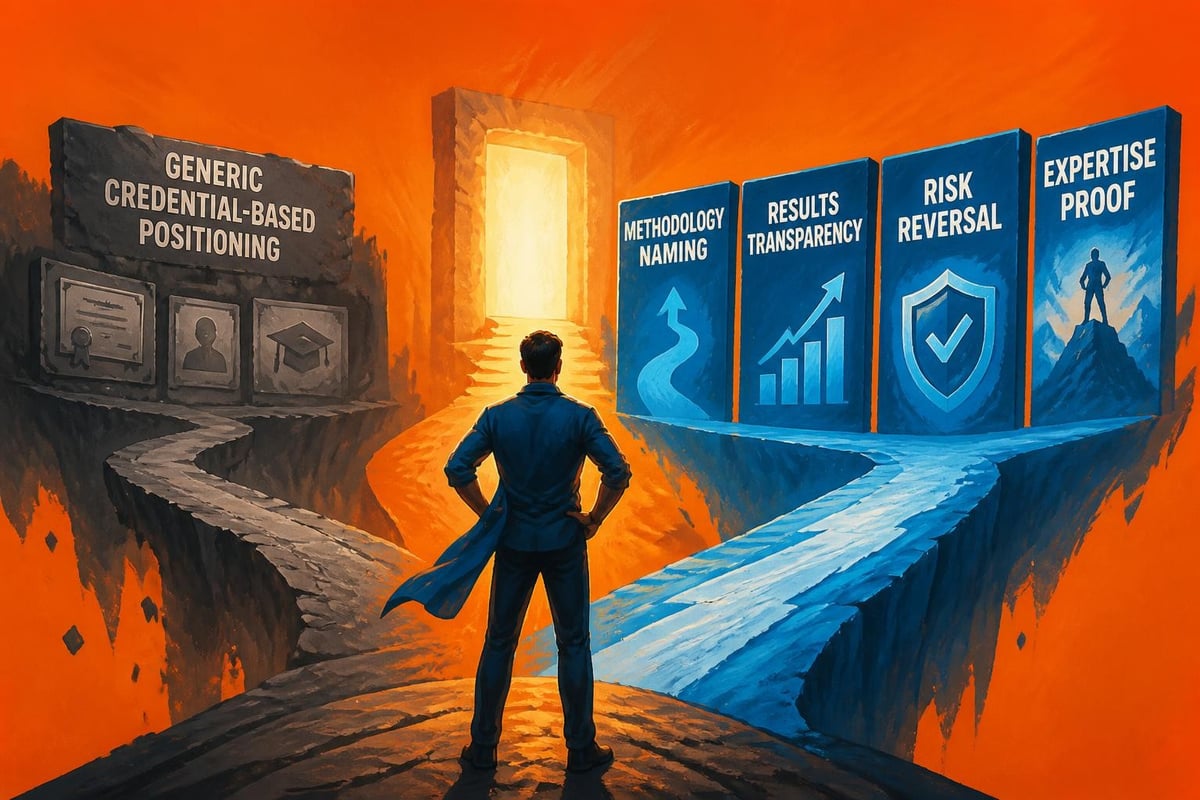
What actually differentiates:
- Methodology specificity: Name your process. "The 12-Week Career Clarity Framework" beats "helping you find your purpose."
- Results transparency: Share success rates, average time to outcome, and what percentage of clients hit their goals.
- Risk reversal: Offer results-based milestones or money-back guarantees when you're confident in your process.
- Expertise proof: Publish thinking that demonstrates pattern recognition across client situations, not motivational platitudes.
Corporate buyers especially value coaches who tie their work to business outcomes. Top executive coaching firms win contracts by demonstrating ROI in leadership effectiveness, retention, and decision quality, not by listing certifications.
Channel Mix and Content Strategy
Your life coach marketing plan needs one primary channel and 2-3 supporting channels. Primary means 60% of effort and budget. Supporting means amplification or relationship building.
| Channel Type | Examples | Best For | Typical Conversion |
|---|---|---|---|
| Owned discovery | SEO blog, YouTube, podcast | Long-term authority, compounding reach | 1-3% of engaged audience |
| Rented discovery | LinkedIn, Medium, guest posts | Borrowed audience, faster testing | 0.5-2% click to owned properties |
| Direct outreach | Email, LinkedIn DMs, partnerships | Qualified prospects, faster revenue | 5-15% booked calls if targeted |
| Paid acquisition | Google Ads, LinkedIn Ads, directory placement | Scalable if unit economics work | Varies 2-10% depending on offer |
Most coaches fail by running too many channels poorly instead of dominating one channel completely. A comprehensive marketing guide for coaching businesses emphasizes channel mastery over channel hopping.
Avoiding Common Pitfalls
Don't build your practice on rented land alone. Instagram or TikTok followers vanish when algorithms shift or platforms decline. Own your email list and your content platform.
Don't confuse effort with results. Publishing daily LinkedIn posts that generate zero discovery calls wastes time you could spend on direct outreach or SEO content that compounds.
Don't neglect the basics. A clear website explaining who you help, how you help them, what results they can expect, and how to start beats fancy funnels and automation when you're building.
FAQ
What should a life coach marketing plan include?
A working plan defines your target client segment, the specific transformation you deliver, your proof mechanisms (case studies and results), primary acquisition channel, lead generation system, conversion process, and ROI tracking metrics.
How much should I budget for marketing as a new life coach?
Start with 20-30% of revenue for marketing once you have initial clients. Before revenue, invest sweat equity in owned content and direct outreach rather than paid ads. Budget $500-2000 monthly for tools, platforms, and limited paid amplification.
Which marketing channel converts best for life coaches in 2026?
No universal answer. LinkedIn works for B2B and career coaching. SEO content works for problem-aware searchers. Referrals work when you deliver results. Test your primary channel for 90 days before declaring it works or doesn't.
How long does it take for a life coach marketing plan to generate clients?
Direct outreach can generate discovery calls within weeks. SEO and content authority build over 6-12 months. Expect 3-6 months of consistent execution before marketing momentum compounds. Most coaches quit before their efforts compound.
Should I invest in paid ads or organic content first?
Organic content first until you have proven messaging, clear positioning, and conversion process. Paid ads amplify what already works. They don't fix unclear positioning or weak offers.
How do I measure ROI on my life coach marketing efforts?
Track total marketing spend (including time valued at your target rate), clients acquired from each channel, revenue per client, and calculate cost per acquisition. Aim for client lifetime value to exceed acquisition cost by 3-5x minimum.
What makes a life coaching marketing plan different from other coaching niches?
Life coaching covers broad territory, requiring sharper positioning than specialized niches. You're competing with career coaches, executive coaches, health coaches, and relationship specialists. Your plan must define exactly which life domain and client segment you serve.
How often should I update my life coach marketing plan?
Review monthly metrics, adjust quarterly based on what's working, and do major strategic reviews annually. Markets shift, platforms change, and your expertise evolves. Rigid annual plans fail. Adaptive quarterly cycles win.
Can I build a successful coaching practice without social media?
Absolutely. SEO content, speaking, partnerships, referrals, and directories like Noomii business coaches generate clients without social media presence. Choose channels aligned with how your ideal clients actually search for solutions.
Building a life coach marketing plan that delivers requires focusing on outcomes over activity, proof over credentials, and systematic testing over guru advice. The coaches who thrive in 2026 measure what matters, double down on what converts, and eliminate what wastes time. Whether you're building a solo practice or offering corporate leadership development, Noomii connects you with clients searching for coaching expertise tied to real business outcomes and measurable results.



Leave a Reply
Want to join the discussion?Feel free to contribute!