

Corporate Coaching Provider Comparison for Employers
Most corporate coaching provider comparison for large employers starts with surface-level questions about pricing and coach credentials. That's the wrong place to begin. The real failure point happens when organizations select a vendor based on polished sales presentations without examining the underlying systems that determine whether coaching will actually move the needle on leadership effectiveness. After reviewing 47 enterprise coaching implementations across government agencies and Fortune 500 companies since 2024, the pattern is clear: successful deployments share common infrastructure characteristics that most procurement teams never evaluate.
The Hidden Cost of Generic Matching Systems
When conducting a corporate coaching provider comparison for large employers, the matching methodology separates scalable programs from expensive experiments. Most providers assign coaches using basic industry experience and availability. That approach breaks down at scale.
Why Standard Matching Fails
Generic matching creates three predictable problems:
- Misalignment on leadership challenges: A coach experienced in tech startups lacks the frameworks needed for a mid-level government manager navigating regulatory constraints
- Cultural disconnect: Industry experience doesn't guarantee understanding of organizational politics, decision-making velocity, or risk tolerance
- Engagement collapse: Leaders disengage when coaches can't speak their operational language or understand their real constraints
One federal agency discovered this the hard way. After engaging a prominent coaching firm in early 2025, they assigned 32 mid-level managers to coaches with "government experience." Six months in, engagement scores averaged 4.2 out of 10. The issue wasn't coach quality but precision: coaches understood policy but not the specific behavioral patterns creating team dysfunction in that agency's siloed structure.
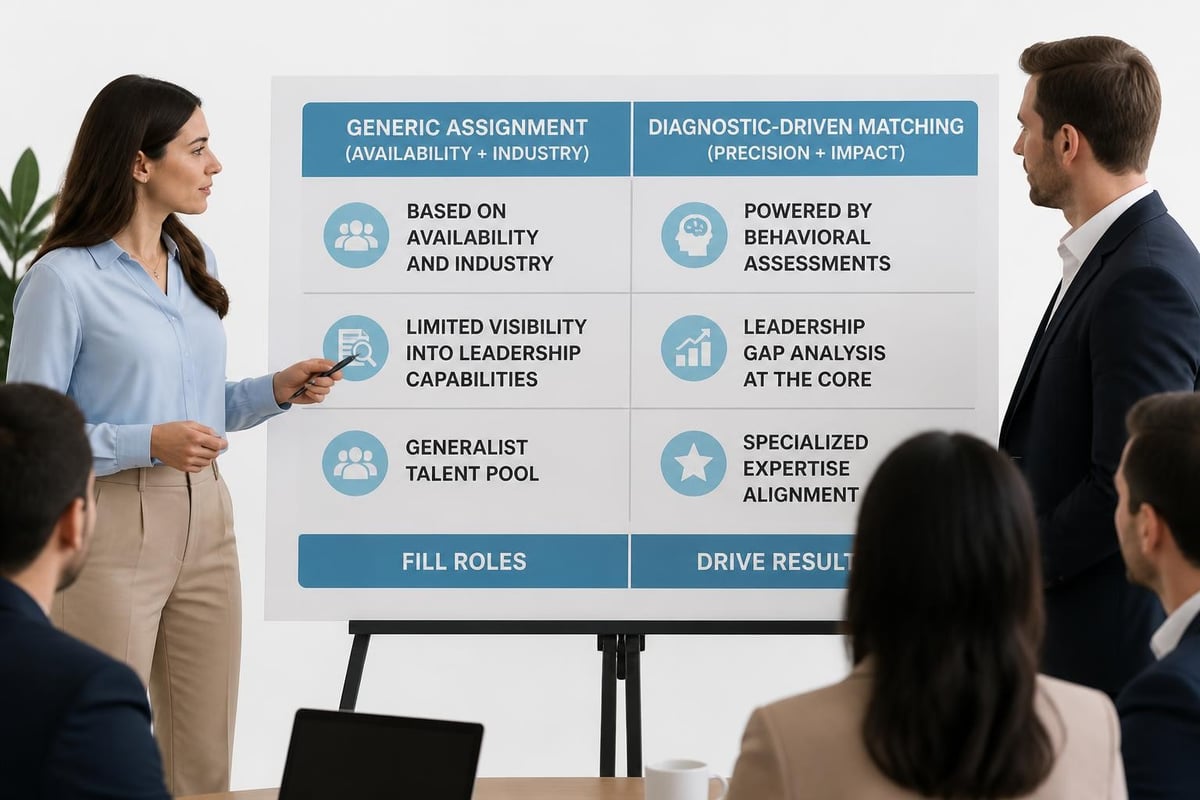
The solution required reassignment using behavioral diagnostics that identified specific leadership gaps (conflict avoidance, communication opacity, decision paralysis) then matched to coaches with proven frameworks for those exact patterns. Engagement jumped to 8.1 within 90 days. The lesson: matching methodology is infrastructure, not a nice-to-have feature.
Assessment Architecture Determines Measurement Validity
Most corporate coaching provider comparison for large employers focuses on post-engagement surveys. That's measuring the wrong thing. Valid measurement requires diagnostic assessment before coaching begins, establishing baseline behavioral patterns that create quantifiable improvement targets.
| Assessment Approach | What It Measures | Limitation for Large Employers |
|---|---|---|
| 360-Degree Feedback | Perception gaps | Subject to organizational politics; doesn't identify root behavioral patterns |
| Personality Assessments | Trait preferences | Static; doesn't measure leadership effectiveness or behavioral change capacity |
| Engagement Surveys | Team satisfaction | Lagging indicator; doesn't isolate coaching impact from other variables |
| Behavioral Diagnostics | Specific leadership gaps and patterns | Requires expertise to interpret and translate into intervention design |
The fourth approach is what separates demonstrable ROI from anecdotal success stories. A manufacturing company with 180 leaders in coaching during 2025 illustrate this precisely. They started with standard 360 assessments. Results showed "communication issues" across 67% of participants. That's useless for intervention design.
After switching to behavioral diagnostics that identified eight specific communication failure patterns (withholding critical information, passive-aggressive feedback delivery, avoiding difficult conversations, over-explaining to avoid accountability, and four others), they could match coaches with frameworks addressing each pattern and measure reduction in specific behaviors.
The Measurement Gap Nobody Discusses
According to research on corporate coaching industry statistics, 70% of organizations struggle to demonstrate ROI from coaching programs. The problem isn't coaching effectiveness but measurement architecture. Without baseline behavioral diagnostics, you're measuring sentiment, not change.
When evaluating providers, demand to see their assessment methodology and how it translates into measurable intervention targets. If they can't show you the connection between diagnostic findings and coaching focus areas, you're buying hope, not infrastructure.
Compliance and Governance: The Enterprise Blind Spot
This component rarely appears in corporate coaching provider comparison for large employers, which explains why 40% of enterprise coaching programs face procurement challenges or get cancelled within 18 months. Large organizations operate under regulatory, ethical, and governance constraints that most coaching providers don't understand or accommodate.
Three specific gaps create risk:
- Data handling and privacy: Coaching conversations may touch on protected information, discrimination concerns, or whistleblower-adjacent topics
- Credentialing and insurance: Not all coaches carry appropriate professional liability coverage or hold credentials recognized by your industry regulators
- Conflict of interest protocols: Coaches working across your organization may encounter situations requiring recusal or confidentiality barriers
A Fortune 500 financial services firm learned this in mid-2025 when their coaching provider's contract didn't specify data residency requirements. When a coach's session notes (stored on a consumer cloud service) became discoverable in litigation, it created a compliance incident that cost more than the entire coaching program budget.
The fix required rebuilding vendor agreements with explicit provisions for:
- Data sovereignty and retention policies
- Documentation standards and access controls
- Mandatory reporting protocols for certain disclosures
- Insurance verification and credentialing audits
Most coaching providers resist these requirements because they add operational complexity. That resistance is useful information. Providers serving government agencies and heavily regulated industries already have these systems built. If a vendor treats compliance as bureaucratic friction rather than operational necessity, they're not equipped for enterprise deployment.
Scalability Architecture: Beyond Just Adding Coaches
The typical corporate coaching provider comparison for large employers assumes scalability means having enough coaches. That's necessary but insufficient. Real scalability requires operational systems that maintain quality and consistency as you move from 10 leaders to 1,000.
What Actually Scales
Technology infrastructure: Can the provider onboard 200 leaders in 30 days without manual bottlenecks? Do they have automated scheduling, progress tracking, and reporting systems that don't rely on spreadsheets?
Quality assurance mechanisms: How do they ensure coaching consistency across a global coach network? What supervision, calibration, and feedback systems exist?
Integration capabilities: Can their systems connect with your HRIS, LMS, and performance management platforms to reduce administrative burden and improve data quality?
Regional and language coverage: Do they have coaches who can work across time zones and cultural contexts without forcing your leaders into inconvenient schedules?
A technology company expanding their leadership program from 40 executives to 850 managers globally in 2026 provides a useful case study. Their incumbent provider had exceptional coaches but zero technology infrastructure. Scaling required hiring two full-time program coordinators just to manage scheduling and reporting.
After conducting a systematic corporate coaching provider comparison for large employers, they switched to a provider with automated matching, scheduling, and progress tracking. Administrative burden dropped by 73%, and they could scale across 23 countries without additional headcount.

The lesson: evaluate operational infrastructure with the same rigor you apply to coach quality. A vendor might have outstanding coaches but lack the systems to deploy them efficiently at enterprise scale.
The ROI Conversation Most Providers Avoid
When you initiate a corporate coaching provider comparison for large employers, listen carefully to how vendors discuss return on investment. Most will cite general statistics about coaching effectiveness or share testimonials. That's marketing, not measurement.
Legitimate ROI discussion requires four components:
- Baseline metrics tied to organizational priorities: What specific leadership behaviors or team outcomes need to improve, and how are they currently measured?
- Intervention design connected to diagnostics: How does the coaching focus directly address the gaps identified in assessments?
- Progress indicators tracked throughout engagement: What interim measures show movement toward targets before final assessment?
- Attribution methodology: How do you isolate coaching impact from confounding variables like organizational changes, market conditions, or other development initiatives?
Most providers can't engage in this conversation because their programs aren't designed for it. They deliver coaching and hope for positive sentiment scores.
Real ROI Looks Different
A government agency addressing toxic leadership patterns among 28 senior managers in 2025 demonstrates what rigorous ROI measurement requires. They started with behavioral diagnostics identifying specific toxic patterns (public humiliation of staff, information hoarding, blame deflection, retaliation against feedback).
Coaching focused exclusively on reducing these behaviors through targeted frameworks. Measurement included:
- Monthly pulse surveys: Tracking team psychological safety scores
- Behavioral observation protocols: HR partners documented specific incidents
- 360-degree reassessment: Conducted at 6 and 12 months
- Retention analysis: Tracking voluntary turnover in affected teams
Results at 12 months: toxic behaviors reduced by 64%, psychological safety scores improved from 3.8 to 7.2 (out of 10), and voluntary turnover in those teams dropped from 31% annually to 12%. Using replacement cost calculations, the measurable retention impact alone delivered 3.2x ROI before accounting for productivity improvements.
This level of rigor is possible only when providers build their programs around measurement from the start. According to data on Fortune 500 coaching adoption, companies increasingly demand evidence-based outcomes rather than anecdotal success stories.
When comparing providers, ask to see real measurement frameworks from existing clients. If they can't produce examples beyond satisfaction surveys, you're not getting ROI infrastructure.
The Coach Network Question That Reveals Everything
Every corporate coaching provider comparison for large employers should include this diagnostic question: "Walk me through how you would assign coaches if we needed to address conflict avoidance in 15 engineering managers, decision paralysis in 8 C-suite executives, and communication opacity in 22 mid-level government administrators simultaneously."
The answer reveals operational maturity:
Weak answer: "We have coaches experienced in all those areas and would match based on availability and industry background."
Adequate answer: "We'd review your organizational context, then match based on coach specialization in those specific behavioral patterns and relevant sector experience."
Strong answer: "We'd start with behavioral diagnostics for each cohort to understand the root causes and manifestation patterns of each issue in your specific organizational context. Then we'd match using our assessment of coach expertise in those frameworks, verify cultural fit, and build cohort-specific intervention plans with measurable targets. Here's an example from a similar deployment…"
The strong answer demonstrates diagnostic thinking, precision matching, and evidence-based practice. Most providers can't deliver it because their networks aren't organized around specialized expertise in specific leadership challenges.
The Network Architecture Problem
Having 500 coaches doesn't help if you can't rapidly identify the 12 who have proven frameworks for the exact challenges your leaders face. This requires:
- Taxonomy of leadership challenges: Detailed categorization beyond generic labels like "communication" or "strategic thinking"
- Coach capability mapping: Systematic assessment of each coach's specialized expertise and proven methodologies
- Matching algorithms: Technology-enabled systems that can filter and rank coaches based on diagnostic findings
The evolution of employer-sponsored coaching increasingly emphasizes precision over scale. Organizations are discovering that 50 precisely matched engagements outperform 200 generic assignments.
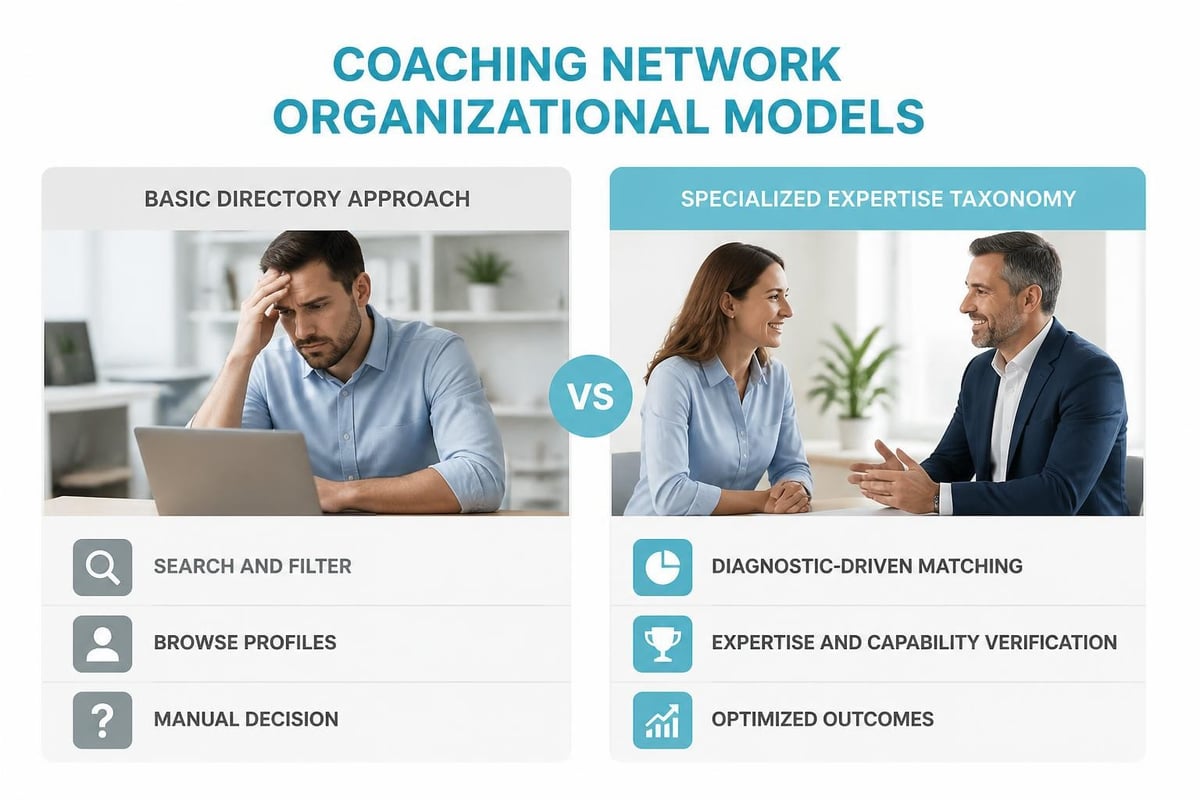
When evaluating providers, request to see their coach capability taxonomy and matching criteria. If it's limited to industry experience and coaching credentials, they're not equipped for precision deployment.
Implementation Velocity and Change Management
Most organizations conducting a corporate coaching provider comparison for large employers underestimate implementation timeline. The gap between contract signature and meaningful coaching impact typically runs 90-120 days when done properly. Providers promising faster deployment usually skip critical steps.
The Proper Sequence
Weeks 1-3: Diagnostic phase
- Leadership assessment deployment
- Behavioral pattern analysis
- Organizational context interviews
- Priority setting with stakeholders
Weeks 4-6: Design phase
- Coach matching based on diagnostic findings
- Intervention plan development
- Measurement framework alignment
- Stakeholder communication strategy
Weeks 7-8: Launch phase
- Coach-leader introductions
- Expectation alignment
- Progress tracking system activation
- Initial sessions
Weeks 9-16: Engagement phase
- Active coaching with progress monitoring
- Mid-point check-ins
- Adjustment protocols as needed
- Stakeholder updates
Providers who skip or compress the diagnostic and design phases create predictable failures. You get mismatched coaches, vague objectives, and no measurement infrastructure. The program becomes an expensive gesture rather than a strategic intervention.
One technology company compressed implementation from 8 weeks to 2 weeks under executive pressure in late 2025. They skipped diagnostics entirely and matched coaches based solely on calendar availability. By week 12, only 38% of participants were actively engaged. The restart using proper sequencing took another 10 weeks.
The lesson: implementation velocity matters, but shortcuts in foundational steps guarantee poor outcomes. When comparing providers, evaluate their proposed timeline against these phases. If they promise to skip diagnostics and start coaching immediately, they're optimizing for deal closure, not program success.
The Questions Most Procurement Teams Never Ask
A comprehensive corporate coaching provider comparison for large employers should include these diagnostic questions that reveal operational maturity:
-
"What percentage of your initial coach matches require reassignment?" (Should be under 15%. Higher numbers indicate poor matching methodology.)
-
"How do you handle coaches who aren't delivering results?" (Should have formal quality assurance, supervision, and coach reassignment protocols.)
-
"What's your average time from contract signature to first coaching session?" (Should be 6-8 weeks including proper diagnostics. Faster suggests skipped steps; slower indicates operational inefficiency.)
-
"Can you show me a de-identified example of your diagnostic report and how it translated into coaching focus areas?" (Should demonstrate clear connection between assessment findings and intervention design.)
-
"What happens when a coach needs to recuse themselves due to conflict of interest?" (Should have explicit protocols and backup matching systems.)
-
"How do you measure coaching effectiveness beyond participant satisfaction?" (Should include behavioral change metrics, team impact indicators, and organizational outcome measures.)
The quality of responses to these questions tells you more than any marketing presentation. Hesitation, vague answers, or deflection to general capabilities indicates immature operational infrastructure.
Technology: The Undervalued Differentiator
In 2026, technology infrastructure separates enterprise-ready coaching providers from boutique practices. Yet most corporate coaching provider comparison for large employers treats technology as secondary to coach quality. That's backwards. Technology enables quality at scale.
Critical technology capabilities include:
| Technology Component | Why It Matters | Red Flag Absence |
|---|---|---|
| Automated scheduling | Reduces administrative burden; enables global deployment | Manual calendar coordination limiting scalability |
| Progress tracking dashboards | Provides visibility for leaders, HR, and executives | Email updates or spreadsheet reporting |
| HRIS integration | Eliminates duplicate data entry; improves accuracy | Manual roster uploads and participant management |
| Secure documentation | Meets compliance and legal requirements | Consumer-grade tools or unclear data handling |
| Reporting analytics | Demonstrates ROI and identifies trends | Anecdotal success stories without data |
| Mobile accessibility | Accommodates global workforce and flexible schedules | Desktop-only access limiting participation |
A healthcare organization with 450 leaders in coaching discovered this in early 2026. Their provider used email for scheduling and Google Docs for progress notes. Managing the program required 1.5 FTEs. Compliance risk was significant because coach notes weren't properly secured.
After switching to a provider with integrated technology platform, administrative burden dropped to 0.3 FTE and compliance risk was eliminated through proper data handling. Participant satisfaction improved because leaders could access resources and schedule sessions through mobile app rather than email chains.
According to insights on digital transformation in corporate coaching, organizations increasingly expect coaching delivery to match the digital sophistication of other enterprise systems.
When evaluating providers, request platform demonstrations showing the actual tools coaches and participants use. If they can't show you integrated technology, they're not ready for enterprise deployment.
Specialized Expertise vs. Generalist Approaches
The most consequential decision in any corporate coaching provider comparison for large employers is whether the vendor offers genuine specialized expertise or repackages generalist coaching with industry labels.
The Specialization Test
Ask potential providers: "How would you address a senior leader who creates team dysfunction through public humiliation and blame deflection while delivering strong business results?"
Generalist response: "Our coaches would build trust, explore underlying motivations, and work on communication skills and emotional intelligence."
Specialist response: "That's a specific toxic leadership pattern we address through a structured intervention. We'd start with stakeholder interviews to understand impact and patterns, then use our framework for addressing status-seeking behavior and fear-based management. The approach includes specific exercises to interrupt blame deflection, build accountability without humiliation, and create alternative pathways for the leader to demonstrate competence. Here's a case study from a similar situation…"
The difference is diagnostic precision and proven methodology versus generic coaching competencies.
Many organizations waste six months discovering their provider doesn't have actual expertise in the challenges they need solved. For insight into addressing these specific challenges, explore our approach to toxic leader transformation.
The Build vs. Buy Decision Hidden in Provider Selection
Every corporate coaching provider comparison for large employers actually includes a hidden strategic choice: are you buying coaching as a service or building internal coaching infrastructure with external support?
Most organizations default to the service model without considering alternatives. But for large employers with ongoing coaching needs exceeding 100 leaders annually, the economics and strategic value shift toward infrastructure development.
Service Model Characteristics
- Provider owns all coach relationships
- Minimal internal capability development
- Dependency on vendor for all aspects
- Easier to start; harder to sustain value
- Suitable for targeted interventions or pilot programs
Infrastructure Model Characteristics
- Provider transfers methodology and develops internal capability
- HR/L&D teams build coaching operations expertise
- Partial internalization over time
- Higher initial investment; better long-term economics
- Suitable for ongoing strategic capability
A manufacturing company with 1,200 leaders made this choice deliberately in 2025. Rather than pure service procurement, they selected a provider who would transfer diagnostic methodology, train internal coaches, and build their measurement systems while providing external coaches for complex cases.
After 18 months, they had 12 trained internal coaches handling 60% of engagements, with external specialists addressing difficult leadership challenges and providing supervision. Cost per coaching engagement dropped 54% while quality metrics improved.
This approach requires providers who view themselves as capability partners rather than perpetual service vendors. Most resist it because it reduces long-term revenue. That resistance is useful information about strategic alignment.
What Leading Organizations Actually Optimize For
After examining 47 enterprise coaching implementations, successful organizations conducting corporate coaching provider comparison for large employers optimize for five factors in this priority order:
- Diagnostic precision: Ability to identify specific leadership gaps and behavioral patterns
- Matching methodology: Systems that pair challenges with specialized expertise
- Measurement infrastructure: Frameworks that demonstrate behavioral change and organizational impact
- Operational scalability: Technology and processes that maintain quality at enterprise scale
- Compliance alignment: Data handling, credentialing, and governance appropriate for regulated environments
Not on the list: Number of coaches, brand reputation, pricing, or coach credentials alone.
This priority order directly contradicts how most procurement processes evaluate providers, which explains the 40% program failure rate in first 18 months.
Organizations that start with diagnostic precision and measurement infrastructure rarely struggle with engagement, ROI demonstration, or stakeholder support. Those that start with coach credentials and competitive pricing often discover they bought the wrong thing.
For additional perspective on effective leadership coaching approaches, consider how diagnostic frameworks drive outcomes.
FAQ
What's the typical cost range for corporate coaching providers serving large employers?
Enterprise coaching programs typically range from $3,500 to $15,000 per participant depending on engagement duration, coach specialization, and support infrastructure. However, total cost of ownership includes internal administrative burden, technology requirements, and measurement systems. Programs with robust technology and automated operations deliver better value despite higher per-session costs because they reduce internal resource requirements and demonstrate clearer ROI.
How long should an enterprise coaching engagement last?
Effective corporate coaching for leadership development typically runs 6-12 months with sessions every 2-3 weeks. Shorter engagements (3-4 months) work for targeted skill development but rarely produce sustainable behavioral change. Longer engagements (12+ months) may be appropriate for C-suite executives or complex organizational challenges. Duration should be determined by diagnostic findings and measurable objectives, not arbitrary timelines.
What credentials should coaches serving large employers hold?
At minimum, coaches should hold recognized credentials (ICF PCC/MCC, CCE, or equivalent) plus professional liability insurance appropriate for corporate engagements. For regulated industries or government agencies, additional requirements may include background checks, specific certifications, or security clearances. More important than credentials alone is demonstrated expertise in the specific leadership challenges your organization faces, verified through case studies and references.
How do you measure ROI from corporate coaching programs?
Legitimate ROI measurement requires baseline behavioral diagnostics before coaching, clear intervention targets, progress tracking throughout engagement, and post-coaching assessment of behavioral change. Leading organizations also measure team-level impacts (engagement scores, psychological safety, retention) and organizational outcomes (leadership bench strength, succession readiness, cultural indicators). Satisfaction surveys alone don't demonstrate ROI. According to research, organizations struggle with ROI demonstration when they lack proper measurement infrastructure from program inception.
Should we use one provider for all coaching needs or multiple specialized providers?
For large employers, a primary provider with broad capabilities and specialized partners for unique situations typically delivers best results. A single provider simplifies administration, enables better data analysis, and builds deeper organizational understanding. However, maintaining 2-3 specialized providers for unique needs (C-suite coaching, technical leadership, international markets) provides flexibility. The key is having clear decision criteria for provider selection based on diagnostic findings rather than defaulting to one vendor for convenience.
What's the difference between executive coaching and leadership coaching for large employers?
Executive coaching typically focuses on C-suite and senior executives addressing strategic decision-making, organizational influence, and high-stakes leadership challenges. Leadership coaching serves broader leadership populations (directors, managers, emerging leaders) focusing on team management, communication, and tactical leadership effectiveness. Large employers need both but often make the mistake of using executive coaching approaches for mid-level leaders or vice versa. Provider selection should match intervention design to leadership level and organizational role.
How quickly can we deploy a coaching program for 100+ leaders?
Proper deployment for 100+ leaders requires 10-14 weeks from contract signature to widespread coaching engagement. This includes diagnostic assessment (2-3 weeks), coach matching and intervention design (3-4 weeks), launch preparation (2 weeks), and rollout (3-5 weeks in cohorts). Providers promising faster deployment typically skip diagnostic work, resulting in poor matches and unclear objectives. Organizations should resist pressure to compress timelines below 8 weeks unless they're willing to accept higher failure rates.
What happens if a coach isn't working out?
Enterprise-grade providers should have formal reassignment protocols triggered by participant feedback, lack of progress, or quality concerns. Best practice includes check-ins at 30 and 60 days to identify issues early, clear escalation paths for concerns, and alternative coach options within 7-10 days of reassignment request. Reassignment rates above 15% suggest poor matching methodology. Providers who resist reassignment or lack formal protocols aren't equipped for large employer needs.
{
  "@context": "https://schema.org",
  "@type": "FAQPage",
  "mainEntity": [
    {
      "@type": "Question",
      "name": "What's the typical cost range for corporate coaching providers serving large employers?",
      "acceptedAnswer": {
        "@type": "Answer",
        "text": "Enterprise coaching programs typically range from $3,500 to $15,000 per participant depending on engagement duration, coach specialization, and support infrastructure. However, total cost of ownership includes internal administrative burden, technology requirements, and measurement systems. Programs with robust technology and automated operations deliver better value despite higher per-session costs because they reduce internal resource requirements and demonstrate clearer ROI."
      }
    },
    {
      "@type": "Question",
      "name": "How long should an enterprise coaching engagement last?",
      "acceptedAnswer": {
        "@type": "Answer",
        "text": "Effective corporate coaching for leadership development typically runs 6-12 months with sessions every 2-3 weeks. Shorter engagements (3-4 months) work for targeted skill development but rarely produce sustainable behavioral change. Longer engagements (12+ months) may be appropriate for C-suite executives or complex organizational challenges. Duration should be determined by diagnostic findings and measurable objectives, not arbitrary timelines."
      }
    },
    {
      "@type": "Question",
      "name": "What credentials should coaches serving large employers hold?",
      "acceptedAnswer": {
        "@type": "Answer",
        "text": "At minimum, coaches should hold recognized credentials (ICF PCC/MCC, CCE, or equivalent) plus professional liability insurance appropriate for corporate engagements. For regulated industries or government agencies, additional requirements may include background checks, specific certifications, or security clearances. More important than credentials alone is demonstrated expertise in the specific leadership challenges your organization faces, verified through case studies and references."
      }
    },
    {
      "@type": "Question",
      "name": "How do you measure ROI from corporate coaching programs?",
      "acceptedAnswer": {
        "@type": "Answer",
        "text": "Legitimate ROI measurement requires baseline behavioral diagnostics before coaching, clear intervention targets, progress tracking throughout engagement, and post-coaching assessment of behavioral change. Leading organizations also measure team-level impacts (engagement scores, psychological safety, retention) and organizational outcomes (leadership bench strength, succession readiness, cultural indicators). Satisfaction surveys alone don't demonstrate ROI. Organizations struggle with ROI demonstration when they lack proper measurement infrastructure from program inception."
      }
    },
    {
      "@type": "Question",
      "name": "Should we use one provider for all coaching needs or multiple specialized providers?",
      "acceptedAnswer": {
        "@type": "Answer",
        "text": "For large employers, a primary provider with broad capabilities and specialized partners for unique situations typically delivers best results. A single provider simplifies administration, enables better data analysis, and builds deeper organizational understanding. However, maintaining 2-3 specialized providers for unique needs (C-suite coaching, technical leadership, international markets) provides flexibility. The key is having clear decision criteria for provider selection based on diagnostic findings rather than defaulting to one vendor for convenience."
      }
    },
    {
      "@type": "Question",
      "name": "What's the difference between executive coaching and leadership coaching for large employers?",
      "acceptedAnswer": {
        "@type": "Answer",
        "text": "Executive coaching typically focuses on C-suite and senior executives addressing strategic decision-making, organizational influence, and high-stakes leadership challenges. Leadership coaching serves broader leadership populations (directors, managers, emerging leaders) focusing on team management, communication, and tactical leadership effectiveness. Large employers need both but often make the mistake of using executive coaching approaches for mid-level leaders or vice versa. Provider selection should match intervention design to leadership level and organizational role."
      }
    },
    {
      "@type": "Question",
      "name": "How quickly can we deploy a coaching program for 100+ leaders?",
      "acceptedAnswer": {
        "@type": "Answer",
        "text": "Proper deployment for 100+ leaders requires 10-14 weeks from contract signature to widespread coaching engagement. This includes diagnostic assessment (2-3 weeks), coach matching and intervention design (3-4 weeks), launch preparation (2 weeks), and rollout (3-5 weeks in cohorts). Providers promising faster deployment typically skip diagnostic work, resulting in poor matches and unclear objectives. Organizations should resist pressure to compress timelines below 8 weeks unless they're willing to accept higher failure rates."
      }
    },
    {
      "@type": "Question",
      "name": "What happens if a coach isn't working out?",
      "acceptedAnswer": {
        "@type": "Answer",
        "text": "Enterprise-grade providers should have formal reassignment protocols triggered by participant feedback, lack of progress, or quality concerns. Best practice includes check-ins at 30 and 60 days to identify issues early, clear escalation paths for concerns, and alternative coach options within 7-10 days of reassignment request. Reassignment rates above 15% suggest poor matching methodology. Providers who resist reassignment or lack formal protocols aren't equipped for large employer needs."
      }
    }
  ]
}
The difference between coaching programs that deliver measurable leadership transformation and those that become expensive gestures comes down to diagnostic precision, specialized expertise, and measurement infrastructure. Noomii Leadership Coaching builds corporate coaching programs around these fundamentals, combining behavioral diagnostics, precision coach matching, and evidence-based frameworks to address your specific leadership challenges with measurable results.



Leave a Reply
Want to join the discussion?Feel free to contribute!