

Small Business Accountability and Mindset Coaching in Delhi
Delhi’s entrepreneurial ecosystem pulses with ambitious small business owners who face a common challenge: translating vision into sustainable execution. While the capital region offers immense market opportunities, many entrepreneurs struggle with consistency, strategic discipline, and the mental resilience required to scale operations. This is precisely where small business accountability and mindset coaching in Delhi creates transformative impact, bridging the gap between entrepreneurial ambition and measurable business outcomes.
Why Delhi’s Small Business Owners Need Specialized Coaching
The unique pressures facing small businesses in Delhi require more than generic advice or motivational speeches. Entrepreneurs navigate complex regulatory environments, fierce competition, and rapidly shifting consumer behaviors while simultaneously managing operations, finances, and team dynamics.
The accountability gap becomes particularly visible when business owners work in isolation. Without structured systems or external oversight, strategic priorities get buried under daily firefighting. Critical initiatives around business development, process optimization, and financial planning repeatedly slide off the agenda.
Research from FocusU’s corporate training programs in Delhi demonstrates that behavioral change requires consistent reinforcement and measurable checkpoints. Small business accountability and mindset coaching in Delhi addresses this need by providing entrepreneurs with regular touchpoints, progress tracking, and strategic guidance tailored to their specific industry context.
The Mindset Component: Beyond Skills to Psychology
Business coaching transcends tactical skill-building to address the psychological barriers that limit growth. Fear of delegation, perfectionism, imposter syndrome, and decision fatigue plague entrepreneurs at every stage. These mindset obstacles create operational bottlenecks that no amount of technical training can resolve.
When seeking guidance on finding a business coach in India, entrepreneurs should prioritize coaches who understand the intersection of mindset work and business strategy. The most effective coaches combine accountability frameworks with cognitive approaches that reshape limiting beliefs and build entrepreneurial resilience.
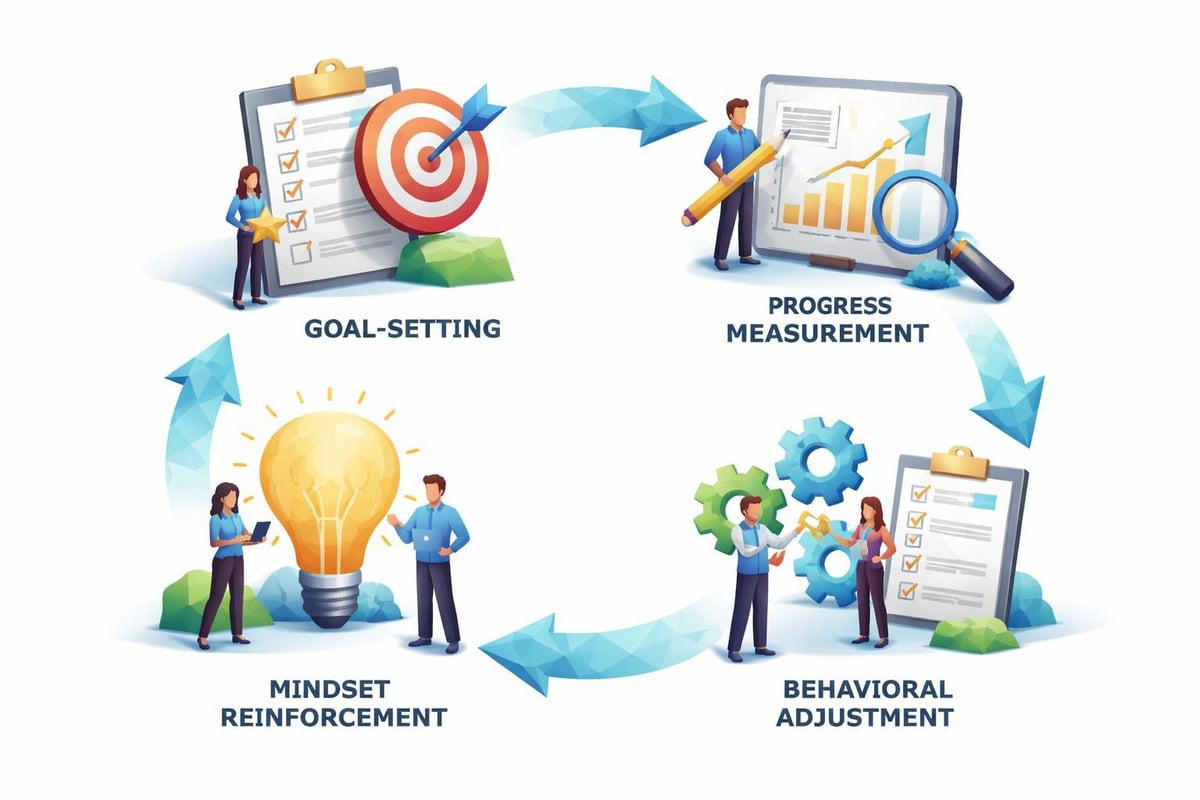
Core Elements of Effective Accountability Coaching
Professional accountability coaching operates on proven frameworks rather than ad-hoc check-ins. Understanding these components helps business owners evaluate potential coaching partnerships and set realistic expectations.
| Element | Purpose | Business Impact |
|---|---|---|
| Goal Architecture | Translate vision into measurable milestones | Clarity on priorities and resource allocation |
| Progress Metrics | Quantify advancement weekly/monthly | Data-driven decision making |
| Behavioral Tracking | Monitor execution patterns and consistency | Identifies productivity obstacles |
| Strategic Pivots | Adjust approach based on results | Agility in changing market conditions |
| Mindset Calibration | Address psychological barriers to growth | Sustainable performance under pressure |
These elements work synergistically. Goal architecture without behavioral tracking leads to aspirational planning that never materializes. Progress metrics without mindset work create performance anxiety rather than sustainable momentum.
Accountability Groups vs. Individual Coaching
Small business owners in Delhi can access accountability through different formats, each offering distinct advantages. Accountability coaching groups provide peer support, diverse perspectives, and cost-effective access to structured programs.
Individual coaching delivers personalized attention, confidential exploration of sensitive business challenges, and customized accountability frameworks that align with specific industry requirements. Many entrepreneurs benefit from combining both approaches throughout different growth stages.
The choice depends on several factors:
- Business complexity: Multi-stakeholder operations benefit from individual strategic coaching
- Learning preference: Some entrepreneurs thrive in collaborative environments, others prefer focused one-on-one work
- Budget constraints: Group programs typically offer more accessible pricing structures
- Confidentiality needs: Sensitive issues around finances or partnerships require private coaching relationships
Building Mental Resilience Through Coaching
The entrepreneurial journey tests mental fortitude constantly. Market setbacks, cash flow pressures, team conflicts, and competitive threats create sustained stress that erodes decision-making quality. Small business accountability and mindset coaching in Delhi specifically addresses these psychological dimensions.
Mindset coaching for professionals focuses on developing clarity under pressure, maintaining judgment during uncertainty, and sustaining performance through inevitable business cycles. These capabilities differentiate entrepreneurs who build lasting enterprises from those who burn out despite strong technical skills.
High-performance mindset development includes:
- Cognitive reframing techniques for managing business anxiety
- Decision-making protocols that reduce mental fatigue
- Resilience practices for navigating setbacks and failures
- Focus management strategies to maintain strategic priorities
- Confidence-building frameworks based on evidence rather than emotion
The Compound Effect of Consistent Coaching
Unlike one-time training interventions, ongoing coaching relationships create compounding benefits over time. Initial sessions typically focus on immediate operational challenges and establishing baseline accountability systems. As the coaching relationship matures, conversations shift toward strategic positioning, leadership development, and organizational culture.
This evolution mirrors how corporate leadership programs develop executives over extended engagements. The same principles of sustained development apply to small business owners who aspire to lead growing organizations.
Business owners who commit to quarterly or annual coaching engagements report significantly higher goal achievement rates compared to those pursuing sporadic interventions. The consistency creates psychological momentum and reinforces productive behavioral patterns.
Selecting the Right Coach for Delhi’s Business Environment
The coaching industry remains largely unregulated, making coach selection a critical success factor. Delhi’s market includes practitioners ranging from certified professionals with extensive business experience to motivational speakers offering generic advice.
When evaluating small business accountability and mindset coaching in Delhi, entrepreneurs should apply rigorous selection criteria:
- Verify business experience: Coaches should demonstrate practical understanding of running operations, managing finances, and leading teams
- Assess methodology: Evidence-based frameworks outperform intuition-based approaches
- Request case studies: Concrete examples of client transformations reveal coaching effectiveness
- Evaluate sector expertise: Industry-specific knowledge accelerates relevant insights
- Test communication alignment: Coaching relationships require compatible communication styles
Organizations like SASHA Business Growth demonstrate how customized coaching programs address the specific operational realities facing Delhi entrepreneurs, from navigating local market dynamics to managing seasonal demand fluctuations.
Questions to Ask Prospective Coaches
The discovery conversation reveals whether a coach can deliver measurable value to your specific situation. Prepare questions that go beyond credentials to explore practical coaching approaches.
Strategic questioning approach:
- “Describe your accountability framework and how you measure client progress”
- “What percentage of your clients achieve their stated goals within agreed timeframes?”
- “How do you address mindset obstacles that prevent business execution?”
- “What happens when a client consistently misses commitments?”
- “How do you customize your approach across different industries?”
Coaches who provide vague or overly broad responses may lack the structured methodologies necessary for driving business results. The most effective practitioners articulate clear processes while demonstrating flexibility to adapt frameworks to individual circumstances.
Integrating Coaching with Operational Systems
Accountability coaching achieves maximum impact when integrated with existing business systems rather than operating as a separate activity. This integration ensures coaching insights translate into operational improvements and sustainable behavioral changes.
Programs like those offered by JPCL Business Coaching emphasize building system-driven businesses where processes support accountability rather than relying solely on willpower. This systemic approach creates infrastructure that maintains momentum even during periods between coaching sessions.
Connecting Coaching to Business Metrics
Professional coaching relationships establish clear connections between coaching activities and business performance indicators. This connection transforms coaching from a developmental expense into a strategic investment with measurable ROI.
| Business Area | Coaching Focus | Success Metrics |
|---|---|---|
| Revenue Growth | Sales discipline, pricing strategy | Monthly revenue, conversion rates |
| Operational Efficiency | Process optimization, delegation | Cost per unit, delivery timelines |
| Team Performance | Leadership development, communication | Employee retention, productivity scores |
| Strategic Positioning | Market analysis, competitive advantage | Market share, customer acquisition cost |
| Financial Health | Cash flow management, profitability | Operating margin, cash runway |
This metrics-based approach aligns with how top executive coaching firms measure coaching effectiveness in corporate environments. The same rigor applies to small business contexts when coaches understand how to establish appropriate benchmarks for emerging organizations.
The Role of Community and Networking in Accountability
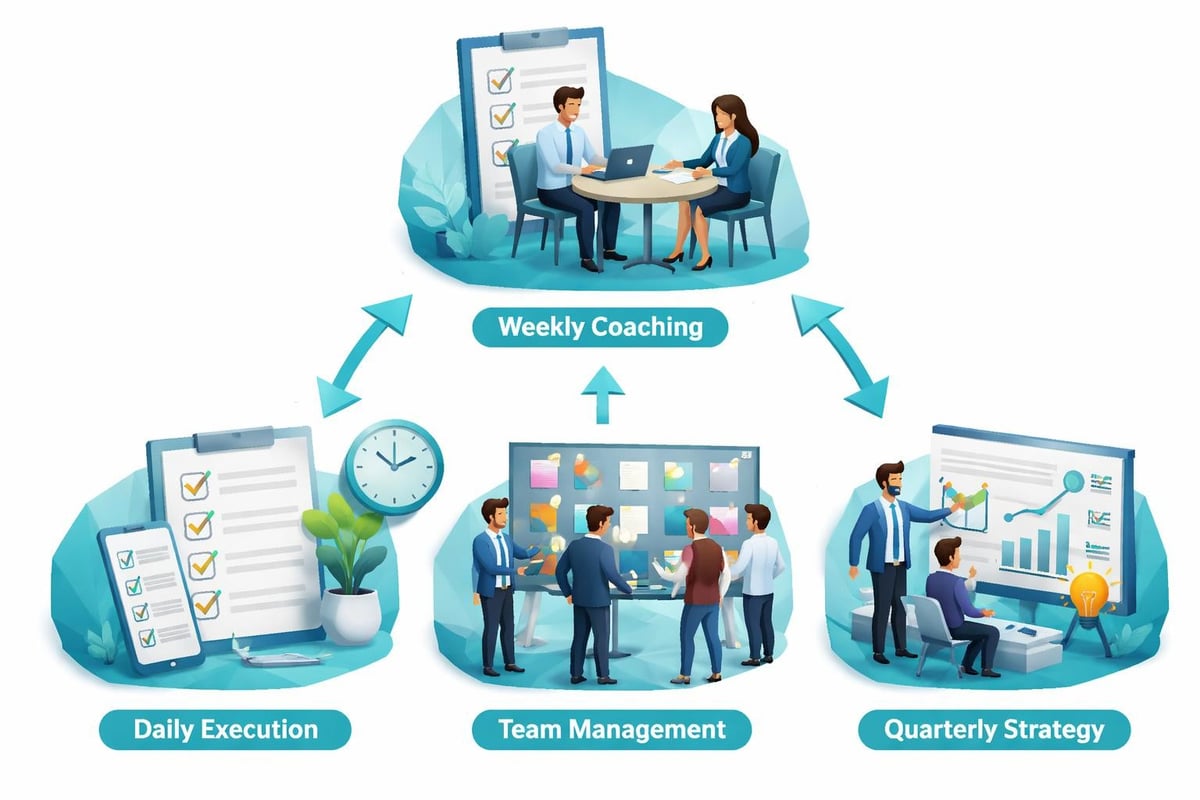
While individual coaching provides personalized guidance, entrepreneurial community connections amplify accountability through peer relationships and shared learning. Delhi’s business ecosystem offers numerous networking platforms that complement formal coaching engagements.
Organizations like SET Business Forum create structured networking environments where entrepreneurs hold each other accountable while accessing diverse expertise. These community connections provide ongoing support between formal coaching sessions and expand the resources available to business owners.
Community accountability benefits include:
- Real-time problem-solving from peers facing similar challenges
- Motivation through witnessing others’ progress and breakthroughs
- Resource sharing around vendors, strategies, and market insights
- Collaborative opportunities that expand business possibilities
- Social reinforcement of productive entrepreneurial behaviors
The combination of professional coaching and peer accountability creates a comprehensive support system. Coaches provide expert guidance and structured frameworks, while community relationships offer practical encouragement and immediate accessibility.
Balancing Multiple Accountability Sources
Entrepreneurs who engage multiple accountability sources must manage these relationships strategically to avoid conflicting advice or accountability fatigue. Clear role definition ensures each relationship serves distinct purposes.
Your coach functions as the strategic architect and primary accountability partner who maintains comprehensive understanding of your business context. Peer groups provide tactical feedback and emotional support. Mentors offer wisdom from experience in specific domains. Keeping these roles distinct prevents confusion and maximizes the value from each relationship.
Measuring Coaching ROI and Program Effectiveness
Business investments require justification through measurable returns. Small business accountability and mindset coaching in Delhi should demonstrate clear impact on business performance, not just subjective feelings of progress.
Sophisticated coaching programs establish measurement frameworks before engagement begins. These frameworks identify baseline performance across key indicators and set specific targets for improvement within defined timeframes.
ROI measurement approaches:
- Financial metrics: Revenue growth, profit margin improvement, cost reduction
- Operational metrics: Productivity increases, cycle time reduction, quality improvements
- Leadership metrics: Employee satisfaction, retention rates, team performance
- Strategic metrics: Market position, customer acquisition, competitive advantage
- Personal metrics: Decision speed, work-life balance, stress management
Organizations like Upskill SMEs India connect business owners with coaches who understand industry-specific metrics and can benchmark progress against relevant standards. This specialization ensures measurement frameworks reflect actual business realities rather than generic indicators.
When to Continue, Pivot, or Conclude Coaching
Not all coaching relationships should continue indefinitely. Effective coaching creates self-sufficiency where entrepreneurs internalize accountability systems and develop independent strategic thinking capabilities.
Regular evaluation points (typically quarterly) assess whether the coaching relationship continues delivering value proportional to investment. Signs that coaching remains valuable include consistent progress on strategic initiatives, breakthrough insights that reshape business approach, and sustained behavioral improvements.
Conversely, indicators that coaching should conclude or pivot include plateaued progress despite consistent effort, misalignment between coaching focus and evolving business needs, or achievement of original goals that defined the engagement.
Addressing Common Coaching Skepticism
Many Delhi entrepreneurs express skepticism about coaching value, often based on previous disappointing experiences with motivational programs that delivered inspiration without practical frameworks. This skepticism serves entrepreneurs well when it drives rigorous coach evaluation.
Legitimate concerns deserve direct responses. Coaching is not mentoring (coaches ask questions rather than provide answers), not therapy (focuses on business performance rather than psychological healing), and not consulting (doesn’t deliver implementation services).
Distinguishing professional coaching from alternatives:
| Service Type | Primary Focus | Deliverable | Best For |
|---|---|---|---|
| Coaching | Accountability and mindset | Behavioral change | Capable owners needing consistency |
| Consulting | Strategy and solutions | Recommendations and implementation | Specific expertise gaps |
| Mentoring | Experience sharing | Advice from similar journey | Industry-specific guidance |
| Training | Skill development | Knowledge transfer | Technical capabilities |
Programs from providers like ACLM Institute demonstrate how professional coaching combines practical business insights with psychological frameworks, addressing both the tactical and mental dimensions of entrepreneurship.
The Investment Question: Cost vs. Value
Coaching fees represent significant investments for small businesses operating on tight margins. This financial reality requires honest assessment of expected returns relative to cost.
Understanding how much business coaching costs helps entrepreneurs budget appropriately and evaluate proposals from different practitioners. Pricing typically reflects coach experience, engagement intensity, and support structure.
Rather than focusing solely on hourly rates or package prices, evaluate total cost against projected business impact. A coach charging premium rates who helps you increase revenue by 30% delivers far better ROI than an inexpensive coach whose advice creates no measurable improvement.
Scaling Through Leadership Development
As small businesses grow beyond solo operations, founders must transition from individual contributors to organizational leaders. This transformation requires fundamentally different skills and mindsets than those that launched the business initially.
Small business accountability and mindset coaching in Delhi increasingly addresses this leadership dimension, helping entrepreneurs develop the capabilities necessary to build and lead teams effectively. The shift from doing to leading represents one of the most challenging transitions entrepreneurs navigate.
Corporate leadership development programs typically focus on this exact transition, applying frameworks around delegation, team communication, performance management, and organizational culture. These same principles scale down effectively for small business contexts when coaches understand how to adapt approaches for resource-constrained environments.
Leadership competencies for growing businesses:
- Strategic delegation that maintains quality while freeing founder capacity
- Performance management systems that drive accountability without micromanagement
- Communication frameworks that align teams around shared objectives
- Culture design that attracts and retains talent in competitive markets
- Decision-making protocols that balance speed with stakeholder input
Building Accountability into Organizational DNA
The ultimate goal extends beyond individual founder accountability to creating organizational cultures where accountability operates systemically. This transition ensures business sustainability regardless of founder involvement in daily operations.
Coaches who understand organizational development help entrepreneurs design accountability into team structures, communication rhythms, and performance evaluation systems. This institutional approach creates businesses that function as mature organizations rather than founder-dependent operations.
Platforms like Accountability Now provide structured coaching focused on building these systematic approaches, helping small business owners develop the infrastructure necessary for sustained growth beyond their personal capacity limits.
Technology Tools Supporting Coaching Relationships
Modern coaching engagements leverage technology platforms that enhance accountability between sessions and provide data visibility into behavioral patterns. These tools transform coaching from periodic conversations into continuous development systems.
Project management platforms track commitment completion. Time-tracking software reveals productivity patterns. Financial dashboards provide real-time visibility into business performance. When integrated with coaching relationships, these technologies create comprehensive accountability ecosystems.
Effective coaching technology stack includes:
- Weekly goal-tracking systems with visible progress indicators
- Communication platforms for quick questions between formal sessions
- Document sharing for strategic plans and accountability frameworks
- Analytics tools measuring key business performance metrics
- Reflection journals capturing insights and behavioral observations
The integration of AI tools for business coaching represents an emerging frontier, though human coaches remain essential for nuanced understanding of psychological barriers and contextual business challenges. Technology amplifies coaching effectiveness without replacing the human relationship that drives transformation.
Virtual vs. In-Person Coaching Dynamics
Delhi’s traffic realities make virtual coaching increasingly attractive for time-constrained entrepreneurs. Video conferencing technology enables effective coaching relationships without geographic constraints or commute requirements.
Research on virtual coaching effectiveness shows minimal performance difference compared to in-person engagements when coaches adapt their approaches appropriately. The convenience factor often increases session consistency, which matters more for results than physical presence.
Some entrepreneurs prefer occasional in-person sessions combined with regular virtual check-ins, creating hybrid models that balance relationship depth with practical efficiency. The format matters less than coaching quality and accountability framework rigor.
Industry-Specific Coaching Considerations
While accountability and mindset principles apply universally, coaching approaches should acknowledge industry-specific realities. A restaurant owner faces different operational challenges than a software consultant, requiring coaches who understand relevant business models and market dynamics.
When evaluating small business accountability and mindset coaching in Delhi, assess whether coaches demonstrate familiarity with your industry’s unique characteristics. This doesn’t require coaches to have worked in your exact field, but they should quickly grasp industry economics, typical challenges, and competitive dynamics.
Industry customization areas:
- Revenue models and cash flow patterns specific to the sector
- Regulatory requirements affecting business operations
- Competitive landscape and market positioning strategies
- Customer acquisition approaches and sales cycle realities
- Operational challenges unique to the industry
Coaching platforms like Noomii’s precision matching connect business owners with coaches who possess relevant sector expertise, ensuring advice reflects actual industry conditions rather than generic business theory.
Service vs. Product Business Distinctions
Service businesses require different accountability frameworks than product companies. Service providers often struggle with capacity constraints, pricing for expertise rather than costs, and managing client relationships. Product businesses face inventory management, supply chain optimization, and distribution challenges.
Coaches should adapt accountability systems to these distinctions. Service business owners need frameworks around utilization rates, project profitability, and service delivery quality. Product entrepreneurs require systems for inventory turnover, supplier relationships, and production efficiency.
Understanding these differences ensures coaching recommendations align with actual business operations rather than applying inappropriate frameworks from different business models.
Small business accountability and mindset coaching in Delhi transforms entrepreneurial potential into sustainable business performance through structured support, evidence-based frameworks, and psychological development. The combination of strategic accountability, mindset resilience, and industry-specific guidance creates measurable improvements across revenue, operations, and leadership effectiveness. Organizations ready to implement systematic coaching approaches that drive measurable results should explore how Noomii Leadership Coaching delivers precision-matched coaching solutions that align individual development with organizational objectives, creating leaders who drive engagement, innovation, and sustained business success.


Leave a Reply
Want to join the discussion?Feel free to contribute!