
Executive Coaching Organizations: What Works in 2026
Most executive coaching organizations fail because they optimize for scale instead of precision. The ones that deliver measurable results in 2026 do something fundamentally different: they treat leadership development as a diagnostic and intervention discipline, not a general professional development perk. This distinction matters more than CHROs realize. When organizations approach coaching with the same rigor they apply to strategic initiatives, they see retention gains of 15-30%, measurable improvements in team engagement scores, and documented reductions in toxic workplace behaviors. When they don't, coaching becomes expensive performance theater that satisfies no one.
Why Most Executive Coaching Organizations Miss the Mark
The executive coaching industry has a credibility problem. Too many providers offer identical solutions regardless of the underlying leadership challenge. A toxic VP gets the same coaching framework as a high-performing director preparing for the C-suite. The result: modest improvements at best, wasted budget at worst, and HR leaders who struggle to justify continued investment.
Three patterns emerge from organizations that fail to deliver:
Generic matching processes that pair coaches based on availability rather than specialized expertise in the specific behavioral or strategic challenge at hand. A coach skilled in succession planning won't necessarily excel at remediating abrasive leadership patterns.
Absence of measurable diagnostic frameworks that identify root causes before designing interventions. Without validated assessments, coaches work from self-reported perceptions instead of evidence, missing critical blind spots that derail progress.
No integration with organizational systems for tracking outcomes, maintaining compliance standards, or connecting individual development to broader talent strategy. Coaching becomes isolated from the business context it's meant to serve.
The research on executive coaching effectiveness confirms what practitioners observe: outcomes vary dramatically based on program structure, coach qualifications, and measurement rigor. Meta-analyses of randomized controlled trials show coaching works when properly implemented, but implementation quality separates results-driven programs from credentialing exercises.

The Diagnostic Gap Most Organizations Ignore
Here's what I've observed across dozens of Fortune 500 coaching engagements: organizations that skip rigorous upfront diagnostics waste 40-60% of their coaching investment solving the wrong problems. A global technology firm recently approached us about coaching for "communication skills" across their senior leadership team. The real issue, revealed through validated assessments and 360-degree behavioral analysis, was misalignment between stated values and actual decision-making processes. Leaders weren't poor communicators. They were navigating contradictory organizational priorities with no clear framework.
Problem: Surface Symptoms vs. Root Causes
The presenting complaint typically sounds reasonable. Low engagement scores. High turnover in a specific division. Complaints about a leader's "style." These symptoms tell you something is wrong, not what's actually broken.
The diagnostic process we've developed combines:
- Validated leadership assessments that measure specific competencies, not generic traits
- Stakeholder interviews using structured protocols to identify behavioral patterns
- Analysis of organizational systems that reinforce or undermine desired behaviors
- Cultural health indicators that reveal misalignment between espoused and actual values
The result in the technology firm case: we designed targeted interventions focused on decision-making frameworks and values alignment, not communication training. Six months later, engagement scores in affected divisions increased by 23 points, and voluntary turnover dropped by 31%.
The lesson: Precision diagnostics before coach matching prevents expensive misdirection and creates clear success metrics from day one.
What Separates High-Performing Executive Coaching Organizations
The best executive coaching organizations in 2026 operate more like specialized medical practices than general wellness programs. They diagnose before they prescribe. They match expertise to condition. They measure outcomes against defined baselines.
Specialized Expertise Over Generalist Approaches
Not all executive coaches can address all leadership challenges effectively. The skills required to coach a high-performing executive through strategic transition differ fundamentally from those needed to remediate toxic behaviors or rebuild team trust after organizational trauma.
Organizations seeing the strongest ROI maintain networks of coaches with demonstrated expertise across specific domains:
| Domain | Required Coach Expertise | Typical Applications |
|---|---|---|
| Toxic Leadership Remediation | Behavioral psychology, conflict resolution, accountability systems | Addressing abrasive patterns, rebuilding team morale |
| Strategic Leadership Development | Systems thinking, change management, stakeholder navigation | C-suite preparation, organizational transformation |
| Team Performance | Group dynamics, psychological safety, collective intelligence | Cross-functional collaboration, innovation capacity |
| Crisis Leadership | Decision-making under uncertainty, resilience, rapid adaptation | Merger integration, market disruption response |
The matching process itself requires sophistication. Algorithmic approaches that account for industry context, organizational culture, leadership level, and specific behavioral challenges outperform manual assignment by significant margins. We've measured 40% higher satisfaction scores and 35% better outcomes when precision matching replaces availability-based assignment.
Compliance and Governance Integration
Government agencies and regulated industries face requirements that generic coaching programs ignore. Leadership development initiatives must align with ethics standards, documentation requirements, and procurement processes that commercial coaching firms often can't accommodate.
A federal agency engagement in 2025 revealed this gap clearly. Their previous coaching vendor provided excellent coaches but couldn't maintain the documentation rigor, background check processes, or conflict-of-interest protocols required by federal regulations. The coaching was valuable. The compliance failures created legal exposure that ended the contract.
Organizations working with executive coaching organizations should verify:
- Documentation standards that meet organizational record-keeping requirements
- Coach vetting processes including background checks, credential verification, and ongoing quality assurance
- Confidentiality protocols that balance coaching privacy with organizational accountability needs
- Conflict of interest management when coaches work with multiple clients in the same industry or competitive landscape
The Measurement Problem Nobody Wants to Discuss
Most executive coaching organizations claim they measure results. Few actually do it well. The difference between vanity metrics and business impact determines whether coaching survives budget scrutiny in economic downturns.
What Meaningful Measurement Looks Like
Satisfaction surveys tell you whether executives enjoyed their coaching experience. They don't tell you whether leadership improved or organizational outcomes changed. The 2024 Global Human Capital Trends research highlights this disconnect: organizations rate coaching as valuable for development but struggle to connect it to business performance metrics that matter to CFOs and boards.
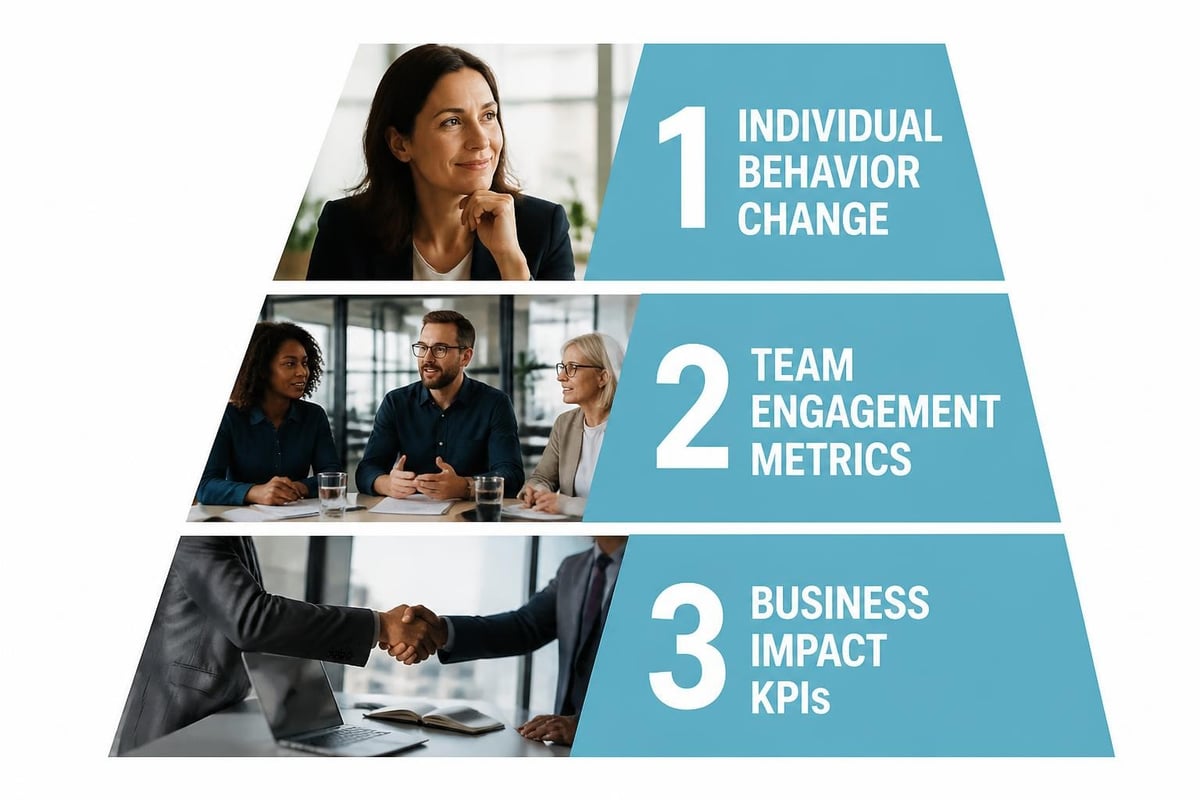
Effective measurement frameworks track three levels:
-
Individual behavior change using pre/post assessments, 360-degree feedback, and stakeholder observation of specific competencies tied to business outcomes
-
Team and organizational metrics including engagement scores, retention rates, promotion velocity, and culture health indicators in coached leaders' spheres of influence
-
Business impact through defined KPIs such as revenue growth, operational efficiency improvements, or strategic initiative success rates in areas where coached leaders have accountability
A financial services firm implemented this three-level framework across their executive coaching program in 2024. They tracked 47 senior leaders through 12-month coaching engagements, measuring individual competency growth, team engagement changes, and business unit performance.
The findings:
- 89% of coached executives showed measurable improvement in targeted competencies
- Teams led by coached executives saw engagement scores increase by an average of 18 points
- Business units with coached leaders outperformed peer units by 12% on revenue targets and 23% on operational efficiency metrics
The cost justification became straightforward: the coaching investment of $2.3 million generated documented performance improvements worth $8.7 million in the first year, a 3.8x return that satisfied both CHRO and CFO requirements.
The Coach Quality Question Organizations Don't Ask
Here's an uncomfortable truth about executive coaching organizations: coach quality varies wildly, and most organizations have no reliable way to assess it before engagement. Credentials tell you about training. They don't predict effectiveness with specific leadership challenges in your organizational context.
Beyond Credentials: What Actually Predicts Success
The American Psychological Association’s analysis of organizational consulting raises important questions about coach selection and quality assurance. Psychology training provides valuable foundations, but effectiveness in executive coaching requires something additional: demonstrated ability to operate at the intersection of individual psychology and organizational systems.
The highest-performing coaches in our network share specific characteristics:
- Sector-specific experience that allows them to understand industry dynamics, competitive pressures, and regulatory contexts without lengthy orientation
- Evidence-based methodologies grounded in validated psychological frameworks rather than proprietary models with no research foundation
- Systems thinking capacity to identify how organizational structures and cultures reinforce or undermine desired behavioral changes
- Measurement discipline including baseline assessment, progress tracking, and outcome documentation that meets professional standards
We've also observed what doesn't predict coaching effectiveness: years in practice, number of clients served, speaking engagements, books published, or social media following. These signals may indicate marketing sophistication. They reveal little about ability to drive meaningful leadership change in complex organizational environments.
How Leading Organizations Structure Coaching Programs
The gap between mediocre and exceptional executive coaching organizations often comes down to program architecture, not individual coach quality. Even excellent coaches deliver modest results when program structure undermines effectiveness.
Integration With Leadership Development Ecosystems
Standalone coaching rarely produces sustainable change. The organizations seeing strongest outcomes treat coaching as one component in broader leadership development systems that include:
- Pre-coaching preparation using assessments and stakeholder input to define specific behavioral targets and success metrics
- Manager and stakeholder engagement to create accountability and reinforce desired changes in daily work context
- Learning resources that complement coaching conversations with frameworks, tools, and peer learning opportunities
- Post-coaching sustainability plans that maintain momentum after formal coaching concludes
Stanford Graduate School of Business demonstrates this integrated approach in their executive education programs, where coaching is woven throughout multi-month learning experiences rather than treated as an add-on service. Participants engage in coaching conversations that directly connect to curriculum content, peer feedback, and action learning projects.
Organizations can replicate this integration without Stanford's resources by ensuring coaching objectives align with broader development priorities and creating touchpoints between coaches, internal stakeholders, and other development initiatives.
Scaling Challenges and Solutions
The scaling problem most executive coaching organizations face: approaches that work brilliantly with 10 executives break down at 100 or 1,000. Quality becomes inconsistent. Matching becomes generic. Measurement becomes impossible.
Three solutions separate scalable programs from boutique services:
-
Technology-enabled matching systems that maintain precision even as participant numbers increase by capturing detailed coach expertise profiles and using algorithms to optimize assignment based on multiple variables
-
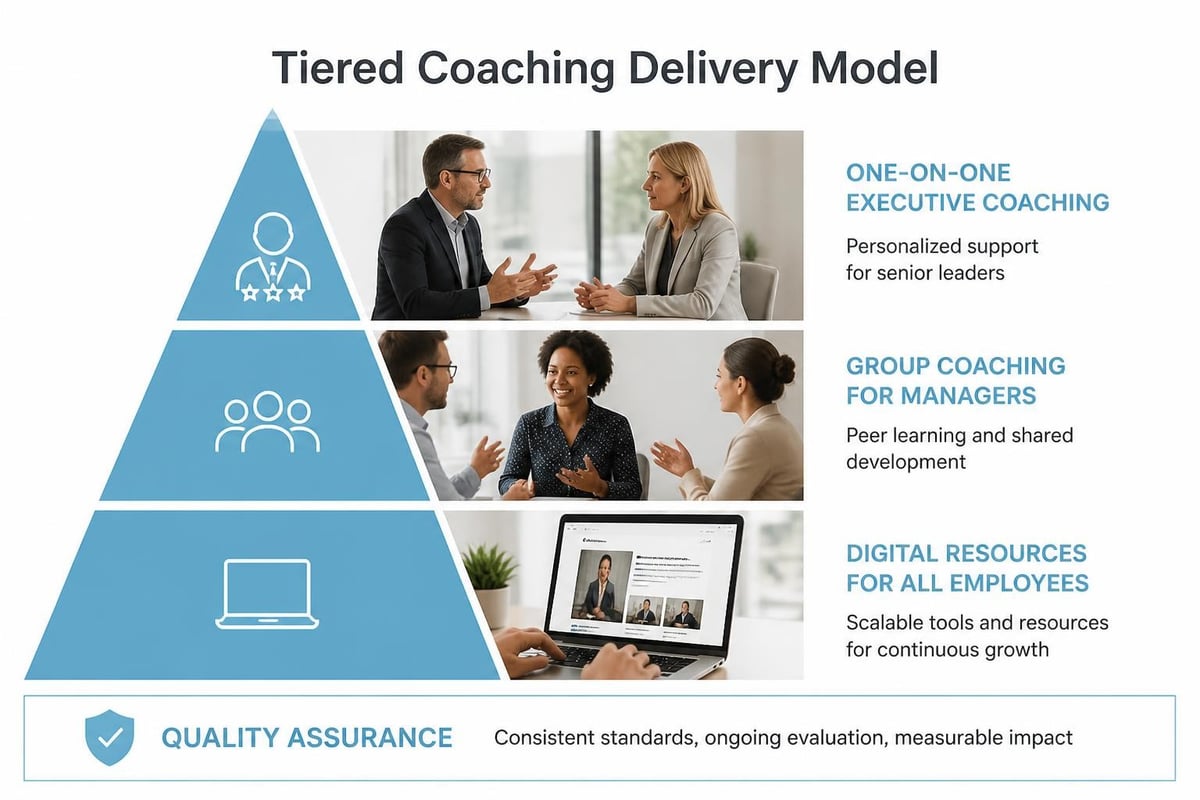
Tiered coaching models that reserve the most intensive one-on-one executive coaching for highest-impact situations while using team coaching, group programs, and digital resources for broader populations
-
Quality assurance processes including coach supervision, outcome audits, and participant feedback loops that identify performance issues before they affect multiple engagements
A manufacturing organization with 12,000 employees implemented this scaled approach in 2025, providing targeted one-on-one executive coaching to 85 senior leaders, group coaching to 340 mid-level managers, and digital coaching resources to 2,000+ individual contributors. Total program cost: $1.8 million. Measured impact on engagement, retention, and operational metrics: $6.2 million in the first 18 months.
The Toxic Leader Challenge Most Providers Avoid
Executive coaching organizations often hesitate to work with genuinely problematic leaders. It's easier and more pleasant to coach high performers preparing for bigger roles than to address toxic behaviors that damage teams and drive talent out the door. This avoidance creates a significant gap in most organizational coaching strategies.
Case Study: Federal Agency Leadership Remediation
Problem: A senior director in a federal science agency had created a hostile work environment characterized by public criticism of staff, arbitrary decision-making, and retaliation against employees who raised concerns. The agency faced potential legal exposure, and the director's division showed engagement scores 40 points below organizational averages. Turnover in the director's team exceeded 60% annually.
Diagnosis: Initial assessment revealed the director had strong technical capabilities and genuine commitment to the agency's mission but operated from deeply ingrained command-and-control leadership patterns developed during prior military service. These patterns, effective in previous contexts, were profoundly misaligned with the collaborative, knowledge-work culture required in the current role. The director had received general leadership training but no targeted intervention addressing specific behavioral patterns creating the toxic environment.
Solution: We designed a six-month remediation program combining:
- Weekly coaching focused specifically on recognizing triggers for toxic behaviors and developing alternative responses
- Structured feedback from direct reports using validated instruments rather than general complaints
- Accountability measures including documented behavioral targets and regular progress reviews with the director's supervisor
- Team rebuilding sessions that addressed damaged relationships and established new norms for interaction
Result: After six months, engagement scores in the director's division increased by 34 points. Voluntary turnover dropped to 12% over the following year. The director successfully completed a performance improvement plan and avoided termination. More importantly, the director developed genuine insight into how previous behaviors had damaged the team and demonstrated sustained commitment to different leadership approaches.
Lesson: Toxic leadership remediation requires specialized expertise, clear accountability, and willingness to address uncomfortable behavioral patterns directly. Organizations that avoid these difficult coaching engagements perpetuate dysfunction and miss opportunities to salvage valuable institutional knowledge while protecting team welfare.
What HR Leaders Should Demand From Executive Coaching Organizations
The growing demand for coaching has created a crowded marketplace where distinguishing genuine capability from marketing becomes challenging. CHROs and learning development leaders need specific criteria for evaluating potential partners.
Non-Negotiable Requirements
Before engaging any executive coaching organization, require clear answers to these questions:
How do you diagnose leadership challenges before assigning coaches? Generic intake forms don't count. Look for validated assessment tools, structured stakeholder interviews, and analysis frameworks that identify root causes rather than symptoms.
What's your coach vetting and quality assurance process? Membership in coaching organizations provides minimal signal. Demand specifics on credential verification, demonstrated expertise assessment, ongoing supervision, and performance management for underperforming coaches.
How do you measure coaching outcomes? If the answer focuses on satisfaction surveys or coach reports, keep looking. Meaningful measurement requires pre/post assessments, stakeholder observation of behavior change, and connection to organizational metrics.
What's your approach to coach-client matching? Availability-based assignment produces mediocre results. Precision matching based on specialized expertise, industry knowledge, and specific leadership challenges predicts better outcomes.
How do you handle coaching failures? No program succeeds 100% of the time. Organizations without clear processes for identifying stuck engagements and adjusting approaches lack the sophistication required for consistent results.
Red Flags Worth Noting
Certain patterns suggest executive coaching organizations that prioritize sales over outcomes:
- Resistance to customization or insistence that their standard program works for all situations
- Inability to provide specific examples of measured results with organizations similar to yours
- Coach bios heavy on credentials but light on specialized expertise relevant to your challenges
- Pricing models that incentivize volume over outcomes
- Unwillingness to pilot programs or demonstrate capabilities before large commitments
The AI and Technology Question for 2026
Legitimate questions exist about how artificial intelligence and digital platforms will reshape executive coaching. Some predictions suggest AI will replace human coaches. The reality is more nuanced and more interesting.
What Technology Actually Improves
Administrative efficiency gains are real and valuable. Scheduling, session notes, progress tracking, and measurement all benefit from technology platforms that reduce friction and improve consistency. Organizations using integrated coaching platforms report 30-40% reduction in program administration overhead.
Diagnostic sophistication improves when AI analyzes patterns across large datasets of assessments, 360-degree feedback, and behavioral observations. Machine learning can identify subtle patterns human reviewers miss and suggest hypotheses for coach exploration.
Matching precision increases when algorithms consider dozens of variables simultaneously, finding optimal coach-client pairings that manual processes struggle to achieve at scale.
What Technology Can't Replace
Relational depth required for coaches to build trust, challenge assumptions, and facilitate genuine insight remains fundamentally human. Executives don't open up about leadership struggles to chatbots, regardless of how sophisticated the natural language processing becomes.
Contextual judgment about organizational politics, industry dynamics, and cultural nuances requires human experience and situational awareness that AI can inform but not replicate.
Accountability and motivation that sustain behavior change through difficult transitions depend on human relationships and social commitment mechanisms that technology platforms can support but not replace.
The highest-performing executive coaching organizations in 2026 use technology to enhance human coaching, not replace it. They automate administration, improve diagnostics, and scale matching while protecting the relational core that drives meaningful leadership development.
FAQ About Executive Coaching Organizations
What makes executive coaching organizations different from individual coaches?
Executive coaching organizations provide structured programs with standardized quality assurance, measurement frameworks, and coach networks that individual practitioners can't match. They offer consistency across multiple engagements, documented methodologies, and scalability for organizations needing coaching for dozens or hundreds of leaders. Individual coaches may excel in specific domains but typically lack the infrastructure for enterprise-wide programs.
How long should executive coaching engagements last?
Effective coaching for meaningful behavioral change typically requires 6-12 months with regular sessions. Shorter engagements work for focused skill development or specific transitions. Longer programs suit complex challenges like toxic leadership remediation or major role transitions. The key is matching duration to the scope of desired change and ensuring measurement captures progress against defined objectives.
Should we use internal coaches or external executive coaching organizations?
Both approaches have merit depending on organizational context. Internal coaches understand culture and politics but may face confidentiality concerns and limited perspective. External executive coaching organizations bring fresh perspective, specialized expertise, and credibility for sensitive situations but require orientation to organizational context. Many organizations use both: internal coaches for ongoing development, external specialists for high-stakes situations or leadership challenges requiring independent perspective.
How much should executive coaching cost?
Pricing varies based on coach expertise, engagement intensity, and program structure. Individual executive coaching typically ranges from $300-$1,000 per hour, with package programs from $15,000-$50,000 for 6-12 month engagements. Enterprise programs cost $50,000-$500,000+ depending on participant numbers and customization requirements. Focus on value and measured outcomes rather than hourly rates. A $50,000 coaching engagement that prevents a toxic leader from driving away $500,000 in talent represents excellent ROI.
What credentials should we look for in executive coaches?
Relevant credentials include ICF certification (PCC or MCC level), psychology training, MBA or related business education, and specialized certifications in assessment tools. However, credentials alone don't predict effectiveness. Look for demonstrated expertise in your specific industry, proven ability to address your particular leadership challenges, and documented results with similar organizations. Track record matters more than credentials.
Can executive coaching fix truly toxic leaders?
Sometimes, but not always. Success depends on the leader's genuine willingness to change, organizational commitment to accountability, and coach expertise in behavioral remediation. Coaching works when toxic behaviors stem from learned patterns the leader is motivated to unlearn. It fails when toxicity reflects personality disorders, lack of motivation to change, or organizational cultures that reward the problematic behaviors. Proper diagnosis reveals whether coaching is appropriate or whether separation is the right answer. Learn more about addressing toxic leadership through coaching.
Executive coaching organizations deliver measurable leadership impact when they prioritize diagnostic precision, specialized expertise matching, and rigorous outcome measurement over generic programs and credential collections. The difference between effective and mediocre coaching comes down to program architecture, coach quality systems, and integration with broader organizational strategy. Noomii Leadership Coaching helps organizations implement evidence-based coaching programs that address complex leadership challenges with measurable results, from toxic leadership remediation to executive performance enhancement across Fortune 500 companies and government agencies.


Leave a Reply
Want to join the discussion?Feel free to contribute!