
Business Growth & Accountability Programs in Adelaide
Adelaide’s competitive business landscape demands more than traditional management approaches. Organizations across South Australia increasingly recognize that sustainable growth stems from accountability frameworks combined with strategic leadership development. Business growth and accountability programs in Adelaide provide the structured interventions necessary to transform organizational performance, whether you’re leading a government agency, scaling a startup, or managing enterprise-level teams.
Why Adelaide Businesses Need Structured Accountability Programs
The South Australian economy continues to evolve, presenting unique challenges for organizations navigating workforce transformation, regulatory compliance, and market expansion. Leaders who implement business growth and accountability programs in Adelaide gain measurable advantages over competitors relying solely on informal development approaches.
Accountability programs create systematic frameworks that translate strategic objectives into daily actions. These programs establish clear performance metrics, regular check-ins, and transparent reporting mechanisms that eliminate ambiguity around expectations and deliverables.
The Accountability Gap in Traditional Business Development
Most organizations operate with significant accountability gaps that undermine growth initiatives. Employees may understand high-level goals but lack clarity on their specific contributions or the consequences of missed targets. This disconnect creates environments where strategic plans remain documents rather than actionable roadmaps.
Common accountability failures include:
- Inconsistent follow-through on strategic initiatives
- Absence of clear ownership for critical outcomes
- Limited visibility into team performance metrics
- Weak correlation between individual actions and organizational results
- Cultural tolerance for missed deadlines and vague commitments
Structured accountability programs address these failures by creating visible systems that track progress, celebrate achievements, and identify obstacles before they derail strategic objectives. Business Growth Programs in South Australia offer frameworks that help organizations implement these systematic approaches effectively.

Components of Effective Growth and Accountability Programs
Successful business growth and accountability programs in Adelaide share core elements that distinguish them from generic training initiatives. These programs integrate assessment, planning, execution, and measurement into cohesive frameworks that deliver sustainable results.
Evidence-Based Leadership Diagnostics
Growth begins with accurate understanding of current capabilities and limitations. Advanced diagnostic tools evaluate leadership effectiveness, team dynamics, and organizational culture to establish baseline measurements. These assessments identify specific behavioral patterns, communication gaps, and decision-making weaknesses that constrain performance.
Organizations implementing psychological safety frameworks often discover that leadership behaviors inadvertently suppress innovation and honest feedback. Diagnostic assessments reveal these hidden patterns, enabling targeted interventions that transform workplace cultures.
| Assessment Type | Focus Area | Business Impact |
|---|---|---|
| Leadership Competency Analysis | Individual executive capabilities | Improved decision quality, strategic thinking |
| Team Dynamics Evaluation | Collaboration patterns, conflict resolution | Enhanced productivity, reduced turnover |
| Cultural Health Metrics | Organizational values alignment | Stronger engagement, innovation capacity |
| Performance KPI Tracking | Results against defined objectives | Revenue growth, operational efficiency |
Precision Matching and Tailored Interventions
Generic coaching programs fail because they ignore the nuanced requirements of different industries, organizational structures, and leadership challenges. The Australian Centre for Business Growth emphasizes the importance of matching business leaders with programs specifically designed for their growth stage and industry context.
Precision matching connects leaders with experienced coaches who possess relevant sector expertise and specialized skills in addressing specific challenges. A manufacturing executive facing supply chain disruption requires different interventions than a healthcare administrator managing regulatory compliance issues.
Critical matching criteria include:
- Industry sector experience and regulatory knowledge
- Specific leadership challenge expertise (conflict resolution, strategic planning, change management)
- Organizational size and complexity alignment
- Cultural compatibility and communication style
- Track record addressing similar challenges
This targeted approach ensures every coaching interaction delivers maximum relevance and practical application. Programs that integrate executive coaching frameworks with accountability structures create exponential impact by combining expert guidance with systematic follow-through.
Implementation Models for Adelaide Organizations
Business growth and accountability programs in Adelaide operate across various implementation models, each designed for different organizational needs and resource constraints.
Workshop-Based Acceleration Programs
Intensive workshop programs compress learning and planning into focused sessions that generate immediate action plans. The Small Business Fundamentals Program demonstrates how concentrated workshops build capabilities in strategic areas like financial management, marketing effectiveness, and operational systems.
These programs work exceptionally well for small to mid-sized businesses requiring rapid capability development without lengthy engagement timelines. Participants develop concrete implementation plans during workshop sessions, then receive accountability check-ins to ensure consistent execution.
Ongoing Coaching and Accountability Partnerships
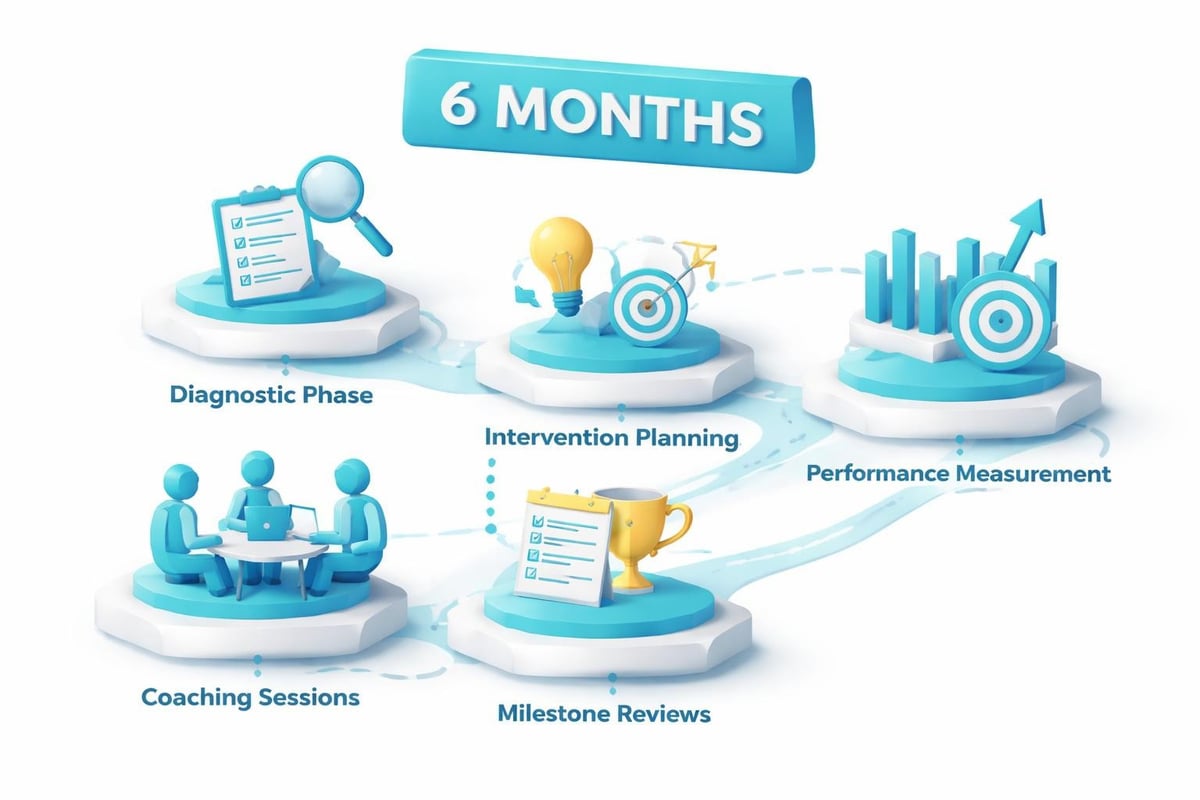
Organizations addressing complex leadership challenges or cultural transformation benefit from extended coaching relationships with built-in accountability mechanisms. These programs typically span 6-12 months, combining regular coaching sessions with performance tracking and milestone reviews.
Structured accountability programs that include daily stand-ups and weekly workshops create rhythms that embed new behaviors into organizational routines. The combination of external accountability and peer support generates momentum that sustains progress through inevitable obstacles.
Hybrid Models for Enterprise Organizations
Large organizations and government agencies require scalable approaches that accommodate multiple leadership levels simultaneously. Hybrid models combine group workshops for broad capability building with individualized coaching for key executives and team leaders.
These programs integrate compliance requirements, governance standards, and organizational policies into coaching frameworks. Government agencies particularly benefit from structured approaches that align leadership development with public service values and accountability standards.
Measuring Impact and Return on Investment
Business growth and accountability programs in Adelaide must demonstrate tangible value through measurable outcomes. Organizations investing in leadership development expect clear evidence that interventions generate meaningful business results.
Defining Key Performance Indicators
Effective measurement begins with establishing specific KPIs that connect leadership behaviors to business outcomes. These metrics should track both leading indicators (behavioral changes, skill development) and lagging indicators (financial performance, employee retention, customer satisfaction).
Essential measurement categories:
- Leadership Effectiveness: 360-degree feedback scores, decision quality metrics, strategic initiative completion rates
- Team Performance: Productivity metrics, collaboration scores, project delivery timelines
- Cultural Health: Employee engagement scores, psychological safety assessments, retention rates
- Business Results: Revenue growth, profitability improvements, market share expansion, operational efficiency gains
Organizations that implement toxic leader transformation programs often see dramatic improvements in team morale and productivity within 90 days, demonstrating how addressing specific leadership dysfunction generates measurable cultural and business impact.
Tracking Progress Through Program Milestones
Accountability programs succeed through consistent progress monitoring against defined milestones. Monthly reviews assess advancement toward goals, identify emerging obstacles, and adjust strategies based on real-world feedback.
| Month | Focus Area | Success Metrics | Accountability Mechanism |
|---|---|---|---|
| 1-2 | Assessment & Planning | Diagnostic completion, goal clarity | Baseline reports, action plan approval |
| 3-4 | Initial Implementation | Behavior changes, early wins | Weekly check-ins, peer accountability |
| 5-6 | Refinement & Scaling | Expanded application, team adoption | Monthly reviews, stakeholder feedback |
| 7-12 | Sustainability & ROI | Sustained performance, business results | Quarterly assessments, ROI calculation |
This structured approach ensures programs maintain momentum and deliver progressively expanding benefits throughout the engagement period.
Industry-Specific Applications in Adelaide
Different sectors within Adelaide’s economy require customized approaches to business growth and accountability programs that reflect their unique challenges and opportunities.
Wine Industry Growth Programs
South Australia’s wine sector faces distinct pressures around market differentiation, export expansion, and operational efficiency. The Wine Industry Association’s Business Growth Program provides specialized coaching that addresses these sector-specific challenges while building leadership capabilities.
Wine enterprise leaders benefit from accountability structures that track progress on expansion initiatives, brand development, and operational improvements while maintaining focus on quality and heritage values that define premium positioning.
Technology and Startup Ecosystem
Adelaide’s growing technology sector requires accountability programs that balance rapid scaling with sustainable business practices. The South Australian startup ecosystem provides resources for entrepreneurs, but sustained growth demands structured accountability that ensures execution keeps pace with vision.
Technology leaders often struggle with transition from founder-driven operations to professional management structures. Business growth and accountability programs in Adelaide help tech executives develop systematic leadership approaches that support scaling without compromising innovation cultures.
Government and Public Sector Leadership
Public sector organizations operate within stringent accountability frameworks that demand transparent governance and measurable outcomes. Leadership programs for government agencies must align with public service values while addressing practical challenges around team motivation, change management, and stakeholder engagement.
Programs designed for government leaders incorporate compliance requirements seamlessly into development frameworks, ensuring accountability structures reinforce rather than conflict with existing governance mechanisms. This integration creates cohesive approaches that strengthen both leadership capability and organizational integrity.
Selecting the Right Program for Your Organization
Adelaide organizations considering business growth and accountability programs face numerous options with varying approaches, costs, and commitment requirements. Making informed selections requires evaluating programs against specific organizational needs and current readiness levels.
Assessment of Organizational Readiness
Successful program implementation depends on organizational readiness across multiple dimensions. Leadership commitment, resource availability, and cultural openness to change all influence program outcomes. Organizations should honestly assess their current state before committing to intensive development initiatives.
Readiness evaluation questions:
- Does executive leadership demonstrate visible commitment to accountability and growth?
- Are adequate resources (time, budget, personnel) available to support program participation?
- Does organizational culture support honest feedback and behavioral change?
- Are clear business objectives defined that leadership development should advance?
- Do existing systems provide baseline data for measuring program impact?
Organizations scoring high on readiness indicators achieve significantly better results from structured programs than those attempting transformations without foundational elements in place.
Evaluating Program Features and Provider Capabilities
Different programs emphasize various components of the accountability and growth equation. Some focus primarily on skills training, others on strategic planning, and still others on behavioral coaching and cultural transformation. The right choice depends on which gaps most constrain your organization’s performance.
Critical program evaluation criteria include:
- Evidence-based methodologies: Programs built on validated assessment tools and proven coaching frameworks
- Customization capabilities: Ability to adapt standard approaches to your specific industry and organizational context
- Coach qualifications: Experience levels, certifications, and sector expertise of program facilitators
- Measurement systems: Robust tracking mechanisms that demonstrate progress and ROI
- Scalability: Capacity to serve multiple leadership levels and team sizes simultaneously
- Integration support: Assistance incorporating program elements into existing development systems
Organizations benefit from programs that combine structured accountability mechanisms with flexibility to address emerging challenges and opportunities as they arise during the engagement period.
Building Sustainable Accountability Cultures
The ultimate value of business growth and accountability programs in Adelaide extends beyond individual leader development to transformation of organizational cultures. Programs that embed accountability into daily operations create self-sustaining improvement systems that continue generating value long after formal interventions conclude.
Establishing Clear Ownership and Transparency
Accountability cultures require unambiguous ownership for every significant organizational outcome. Leaders must define who owns what results, establish transparent tracking mechanisms, and create regular forums for progress reporting. This clarity eliminates the diffusion of responsibility that allows critical initiatives to stall.
Transparency operates as the foundation for accountability. When performance data, progress updates, and challenge areas are visible across teams, peer accountability naturally reinforces formal structures. Organizations that embrace transparency see accelerated problem-solving as obstacles become shared challenges rather than isolated failures.
Creating Rhythms of Accountability
Sustainable accountability depends on predictable rhythms that build checking progress into organizational routines. Weekly stand-ups, monthly reviews, and quarterly strategic assessments create multiple accountability layers that catch issues at appropriate intervention points.
These rhythms transform accountability from episodic events into continuous processes. Leaders develop habits of preparation, reporting, and adjustment that become automatic rather than burdensome.
Recognizing Progress and Addressing Obstacles
Effective accountability systems balance celebration of progress with direct confrontation of obstacles and underperformance. Recognition reinforces positive behaviors and builds momentum, while honest dialogue about challenges enables timely course corrections.
Organizations implementing managing and coaching frameworks discover that combining accountability with developmental support generates superior results compared to punitive approaches. Leaders held accountable within supportive environments demonstrate greater resilience, creativity, and sustained performance improvement.
Business growth and accountability programs in Adelaide provide the structured frameworks organizations need to transform leadership effectiveness and operational performance. By combining evidence-based diagnostics, precision coaching, and systematic accountability mechanisms, these programs deliver measurable results that compound over time. Whether your organization faces challenges with toxic leadership patterns, strategic execution gaps, or cultural transformation needs, Noomii Leadership Coaching offers tailored programs that align individual development with institutional priorities. Our precision matching process connects your leaders with experienced coaches who deliver targeted interventions supported by robust accountability structures, ensuring your investment in leadership development generates tangible business results.



Leave a Reply
Want to join the discussion?Feel free to contribute!