
Strategic Business Planning for Solopreneurs in Melbourne
Running a solo business in Melbourne’s competitive landscape demands more than entrepreneurial passion and technical expertise. Strategic business planning for solopreneurs in Melbourne requires a deliberate approach that balances immediate revenue generation with long-term sustainability, leadership development, and measurable outcomes. The most successful solo operators treat their ventures as scalable enterprises, not just self-employment vehicles. They build systems, develop leadership capabilities, and create frameworks that allow them to compete effectively against larger organizations while maintaining the agility that defines solopreneurship.
Why Strategic Planning Matters More for Solo Operators
Solopreneurs face unique challenges that multi-person organizations rarely encounter. You serve as the CEO, marketing director, operations manager, and finance controller simultaneously. Without strategic planning, this juggling act becomes reactive firefighting rather than proactive growth management.
Strategic business planning for solopreneurs in Melbourne provides the structure needed to make decisions from a leadership perspective rather than an employee mindset. This distinction separates successful solo ventures from those that remain stagnant or fail within the first three years.
The Leadership Gap in Solo Ventures
Most solopreneurs possess deep expertise in their craft but lack formal leadership training. This creates blind spots in decision-making, resource allocation, and long-term vision. The comprehensive guide to strategic planning emphasizes that successful solo businesses require the same strategic rigor as corporations.
Consider these critical leadership competencies for solo operators:
- Strategic decision-making under resource constraints
- Self-accountability without external oversight structures
- Vision articulation that guides daily priorities
- Risk assessment balanced against growth opportunities
- Emotional regulation during challenging business cycles

When leadership gaps exist, even technically brilliant solopreneurs struggle to scale beyond their personal capacity. Building psychological safety within your own decision-making processes creates the foundation for sustainable growth.
Building Your Strategic Foundation
Effective strategic business planning for solopreneurs in Melbourne begins with clarity about your business model, target market, and value proposition. Without these foundational elements, tactical planning becomes guesswork.
Market Positioning and Competitive Analysis
Melbourne’s diverse economy offers countless opportunities for specialized solo ventures. However, this abundance creates intense competition within virtually every niche. Your strategic plan must answer three fundamental questions:
- Who specifically benefits from your expertise?
- What problem do you solve better than alternatives?
- Why should clients choose you over established competitors?
The Melbourne-based strategy sessions provide focused guidance for answering these questions within your specific market context. Many solopreneurs waste resources pursuing broadly defined markets rather than dominating narrow niches where their expertise creates undeniable value.
| Market Approach | Resource Efficiency | Competitive Advantage | Revenue Predictability |
|---|---|---|---|
| Broad generalist | Low | Minimal | Unstable |
| Niche specialist | High | Strong | Consistent |
| Hybrid approach | Medium | Moderate | Variable |
Financial Architecture and Resource Allocation
Strategic planning requires honest assessment of your financial position and resource allocation decisions. Solopreneurs often underinvest in strategic assets while overspending on tactical tools that deliver minimal ROI.
Your financial architecture should include:
- Operating reserves covering 6-12 months of expenses
- Strategic investment budget for skill development and market positioning
- Technology infrastructure that scales with revenue growth
- Professional support network including accounting, legal, and coaching expertise
The 24-hour business planning approach demonstrates how focused financial planning accelerates decision-making and reduces strategic drift. Solopreneurs who delay financial clarity typically struggle with pricing, profitability, and sustainable growth.
Operational Systems That Scale
Strategic business planning for solopreneurs in Melbourne must address the operational reality of limited time and attention. The systems you build today determine whether you can double revenue without doubling working hours.
Time Leverage Through Process Design
Successful solo operators systematize repeatable activities and preserve cognitive energy for high-value decisions. This requires mapping your core business processes and identifying automation opportunities.
High-priority processes to document:
- Client acquisition and onboarding workflows
- Service delivery frameworks and quality standards
- Financial management and invoicing procedures
- Marketing content creation and distribution systems
- Professional development and skill upgrading pathways
Many solopreneurs resist process documentation, viewing it as corporate bureaucracy. However, documented processes create the foundation for delegation, automation, and eventual scaling beyond solo operations.

Technology Stack Optimization
Your technology infrastructure should enable strategic priorities rather than create complexity. Evaluate each tool against three criteria: does it save time, increase revenue, or reduce risk? Tools that fail these tests consume resources without strategic benefit.
The strategic support services available to Melbourne solopreneurs emphasize technology choices aligned with business model requirements. A consulting solopreneur needs different tools than a product-based business or service provider.
Leadership Development as Competitive Advantage
While strategic business planning for solopreneurs in Melbourne often focuses on operations and finance, leadership capability separates exceptional solo ventures from mediocre ones. Investing in your leadership development creates compounding returns across every business function.
Decision-Making Frameworks Under Uncertainty
Solo operators make dozens of strategic decisions weekly without the benefit of executive teams or advisory boards. Developing robust decision-making frameworks reduces decision fatigue and improves outcome quality.
Effective solopreneurs implement structured decision processes:
- Define the decision clearly including success criteria and constraints
- Gather relevant data without succumbing to analysis paralysis
- Identify viable alternatives beyond the obvious first options
- Assess risks and opportunities for each alternative
- Make the decision with clear implementation timeline
- Review outcomes to improve future decision quality
Organizations addressing toxic leadership patterns within larger teams can apply similar frameworks to prevent self-sabotaging behaviors in solo operations. The absence of external accountability makes structured decision-making essential for solopreneurs.
Strategic Thinking Beyond Daily Operations
The most challenging aspect of strategic business planning for solopreneurs in Melbourne involves creating space for strategic thinking amid operational demands. Without dedicated time for reflection and planning, your business becomes reactive rather than intentional.
Block protected time for strategic activities:
- Monthly business reviews assessing progress against quarterly goals
- Quarterly strategic planning sessions adjusting tactics based on market feedback
- Annual vision workshops redefining long-term direction and priorities
- Weekly priority planning ensuring daily activities align with strategic objectives
The strategic planning workshops offered throughout Melbourne provide structured environments for this critical thinking work. Many solopreneurs report that external facilitation dramatically improves strategic clarity and commitment to planned actions.
Market Adaptation and Competitive Positioning
Melbourne’s business environment evolves constantly, requiring solopreneurs to build adaptation capacity into their strategic plans. Static plans fail when market conditions shift unexpectedly.
Scenario Planning for Solo Ventures
Strategic business planning for solopreneurs in Melbourne should include multiple scenarios rather than single-path projections. Scenario planning prepares you mentally and operationally for various market conditions.
Develop three scenarios for the next 24 months:
- Optimistic scenario where market demand exceeds expectations
- Realistic scenario based on current trends and conservative assumptions
- Challenging scenario where market conditions deteriorate or competition intensifies
For each scenario, identify the strategic responses you would implement. This preparation reduces decision time when market shifts occur and prevents panic-driven choices that damage long-term positioning.
Competitive Intelligence and Market Signals
Solo operators often neglect competitive intelligence, focusing exclusively on their own offerings. However, understanding competitor movements, market trends, and customer evolution informs strategic choices.
| Intelligence Source | Update Frequency | Strategic Value |
|---|---|---|
| Competitor analysis | Quarterly | High |
| Customer feedback | Ongoing | Critical |
| Industry publications | Monthly | Moderate |
| Economic indicators | Monthly | Moderate |
| Technology trends | Quarterly | Variable |
The business strategy resources available to Australian solopreneurs emphasize market awareness as fundamental to sustainable competitive advantage. Your strategic plan must incorporate mechanisms for gathering and analyzing market intelligence.
Measuring Strategic Progress
Strategic business planning for solopreneurs in Melbourne remains theoretical without measurement systems that track progress toward defined objectives. Effective metrics balance leading indicators (predictive) with lagging indicators (results-focused).
Key Performance Indicators for Solo Ventures
Choose 5-7 KPIs that directly reflect strategic priorities. Avoid vanity metrics that feel good but don’t indicate business health or progress.
Essential KPIs for most solopreneurs:
- Monthly recurring revenue or revenue per client relationship
- Client acquisition cost relative to customer lifetime value
- Operating profit margin after all expenses including owner compensation
- Strategic time allocation (percentage spent on high-value versus operational tasks)
- Client satisfaction and referral rates
- Pipeline value for next 90 days
These metrics provide early warning when strategic plans diverge from reality. The professional business plan services available throughout Australia emphasize measurement frameworks customized to specific business models and growth stages.
Review Cadences and Course Correction
Measurement without review accomplishes nothing. Establish regular review cadences that match your business cycle and complexity.
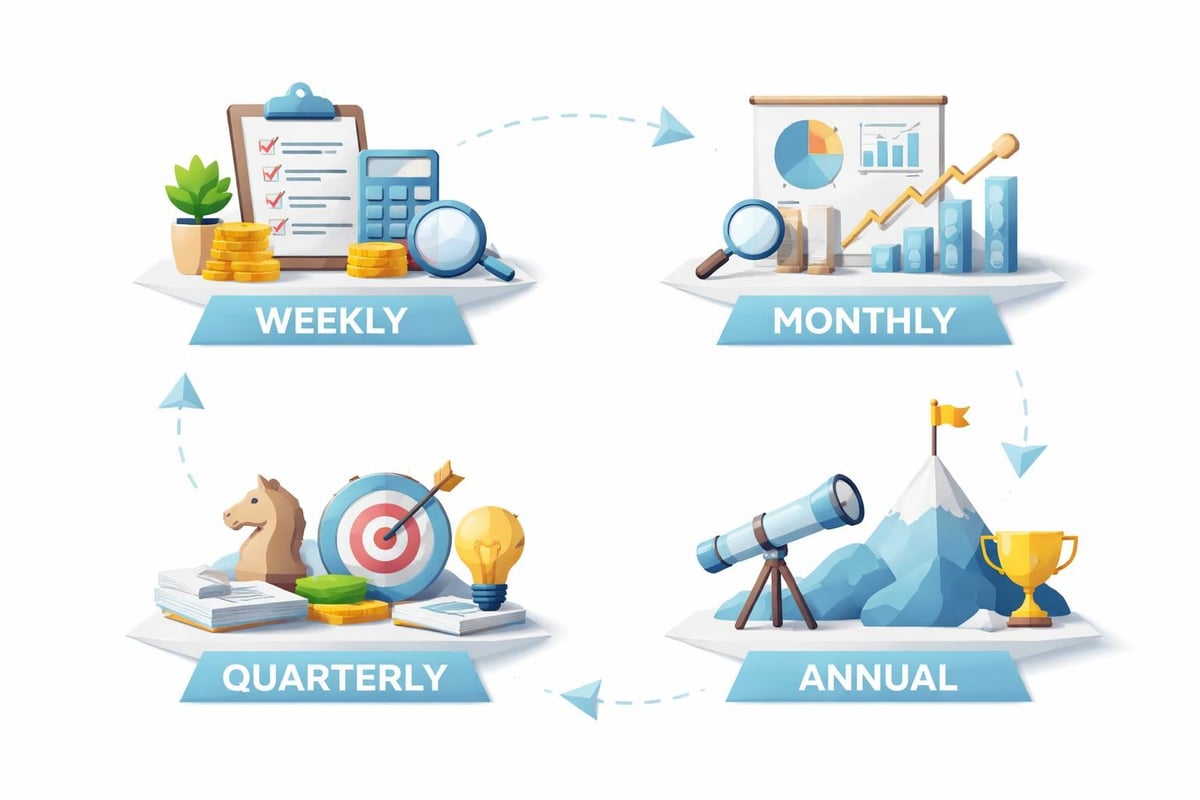
Weekly: Review financial position, client deliverables, and immediate priorities
Monthly: Analyze KPI trends, assess goal progress, adjust tactical approaches
Quarterly: Evaluate strategic assumptions, review competitive position, refine 12-month plans
Annually: Comprehensive business assessment, vision refinement, major strategic pivots
Course correction represents strategic strength, not planning failure. Markets change, personal priorities evolve, and new opportunities emerge. Your strategic plan should guide decisions while remaining flexible enough to capitalize on unexpected advantages.
Building Support Networks and Advisory Structures
Strategic business planning for solopreneurs in Melbourne benefits enormously from external perspectives and structured accountability. The isolation inherent in solo work creates blind spots that external advisors can illuminate.
Peer Networks and Collaborative Communities
Melbourne offers robust communities specifically designed for solo business operators. The Melbourne solopreneur community provides networking, knowledge sharing, and collaborative opportunities that reduce isolation while expanding strategic thinking.
Effective peer relationships offer multiple strategic benefits:
- Alternative perspectives on challenges you’re facing
- Accountability partnerships that maintain momentum on strategic initiatives
- Resource sharing including vendor recommendations and process templates
- Collaboration opportunities that expand service offerings or market access
- Emotional support during difficult business cycles
Select peer relationships intentionally based on complementary expertise, similar business maturity, and aligned values. Casual networking provides social connection but rarely drives strategic advancement.
Professional Advisory Support
Strategic business planning for solopreneurs in Melbourne reaches new effectiveness when paired with professional coaching or advisory services. External experts bring frameworks, experience, and objectivity that self-directed planning cannot replicate.
The strategy accelerator sessions designed specifically for solopreneurs provide structured approaches to common strategic challenges. These focused interventions often deliver breakthrough clarity that months of independent planning couldn’t achieve.
Professional support proves particularly valuable during:
- Business model transitions requiring fundamental strategic shifts
- Scaling decisions about hiring, partnering, or productization
- Crisis navigation when market disruption threatens viability
- Leadership development addressing personal capability gaps
- Exit planning for eventual sale, succession, or closure
Organizations working with top executive coaching firms demonstrate measurably better leadership outcomes than those relying solely on internal development. Solo operators deserve the same caliber of strategic support available to corporate executives.
Integration of Leadership and Business Strategy
The intersection of personal leadership development and business strategy creates multiplicative value for solopreneurs. Your business cannot outgrow your leadership capacity, making integrated development essential.
Personal Development as Business Investment
Strategic business planning for solopreneurs in Melbourne must allocate resources toward leadership capability building. This includes technical skills related to your service offering and the leadership competencies required to run a sustainable enterprise.
Critical development areas:
- Strategic thinking and long-term vision articulation
- Financial literacy beyond basic bookkeeping
- Marketing strategy and positioning expertise
- Sales methodology aligned with your personality and market
- Operational excellence and process optimization
- Self-management including energy, focus, and resilience
Many solopreneurs invest heavily in technical credentials while neglecting business leadership development. This creates expertise without the ability to monetize or scale that expertise effectively.
Accountability Systems That Drive Execution
Strategic plans fail without accountability mechanisms that ensure consistent execution. Solo operators lack the built-in accountability of organizational hierarchies, requiring deliberate systems to maintain commitment to strategic priorities.
Effective accountability approaches include:
- External coaching relationships with defined goals and review schedules
- Peer accountability partnerships with mutual commitment to strategic objectives
- Public commitments through content creation or community participation
- Financial stakes such as paying for programs in advance or performance-based bonuses
- Measurement dashboards with visible tracking of strategic metrics
Without accountability, even brilliant strategic plans remain aspirational documents rather than implemented roadmaps.
Adaptive Leadership for Market Evolution
Strategic business planning for solopreneurs in Melbourne requires adaptive leadership capability. The certainty of 2020 evaporated within weeks as global disruption reshaped entire industries. Similar disruptions will occur again, demanding leaders who can pivot quickly while maintaining strategic coherence.
Adaptive leadership competencies include:
- Rapid assessment of changing market conditions and their implications
- Stakeholder communication that maintains confidence during uncertainty
- Resource reallocation away from obsolete tactics toward emerging opportunities
- Emotional resilience that prevents reactive decisions driven by fear
- Strategic patience balanced with tactical urgency
Organizations focusing on building psychological safety create environments where adaptation occurs more naturally and effectively. Solo operators must cultivate this same psychological flexibility within their own thinking and operations.
Strategic business planning for solopreneurs in Melbourne transforms solo ventures from reactive service businesses into intentional growth engines with measurable outcomes and sustainable competitive advantages. The integration of leadership development with operational planning creates multiplier effects that purely tactical approaches never achieve. When you’re ready to elevate your strategic planning with precision coaching matched to your specific challenges, the Noomii Leadership Coaching program delivers evidence-based frameworks, expert guidance, and accountability systems designed for measurable leadership growth and business transformation.



Leave a Reply
Want to join the discussion?Feel free to contribute!