

What Nvidia Teaches Modern Leaders About Execution
Most leadership advice circulates the same tired playbook: set quarterly goals, conduct annual reviews, maintain chain of command, minimize risk. Meanwhile, Nvidia became the world's most valuable chipmaker by systematically ignoring these conventions. What Nvidia teaches modern leaders isn't theory. It's evidence from building a $3 trillion company through radical transparency, organizational flatness, and aggressive technology adoption that contradicts standard management doctrine.
The Flat Hierarchy That Scales
Jensen Huang manages 60 direct reports. Not 6 or 8 like your typical executive handbook recommends. Huang’s preference for a flat organizational structure eliminates traditional middle management layers that slow information flow and dilute accountability.
This isn't about being accessible or democratic. It's about information velocity. When Nvidia shifts strategic direction in response to market changes, that decision reaches execution teams in hours, not weeks. The absence of management layers means the CEO sees operational reality without filters, sanitization, or political posturing.
Why Most Organizations Can't Execute Huang's Model
The conventional objection runs predictable: "That doesn't scale. You can't manage that many people." Except Huang does, and has for years while Nvidia grew from graphics cards to AI infrastructure dominance.
The actual barrier isn't span of control. It's leader capability. Managing 60 directs requires:
- Exceptional pattern recognition to identify issues across diverse functions simultaneously
- Ruthless prioritization since you cannot provide equal attention to all reports
- Group communication mastery because one-on-ones become mathematically impossible
- Psychological safety so critical issues surface immediately, not after they metastasize
Most executives lack these capabilities because traditional hierarchies never required developing them. When you manage 7 people through weekly one-on-ones and monthly skip-levels, you never build the muscle memory for high-volume, high-context leadership.
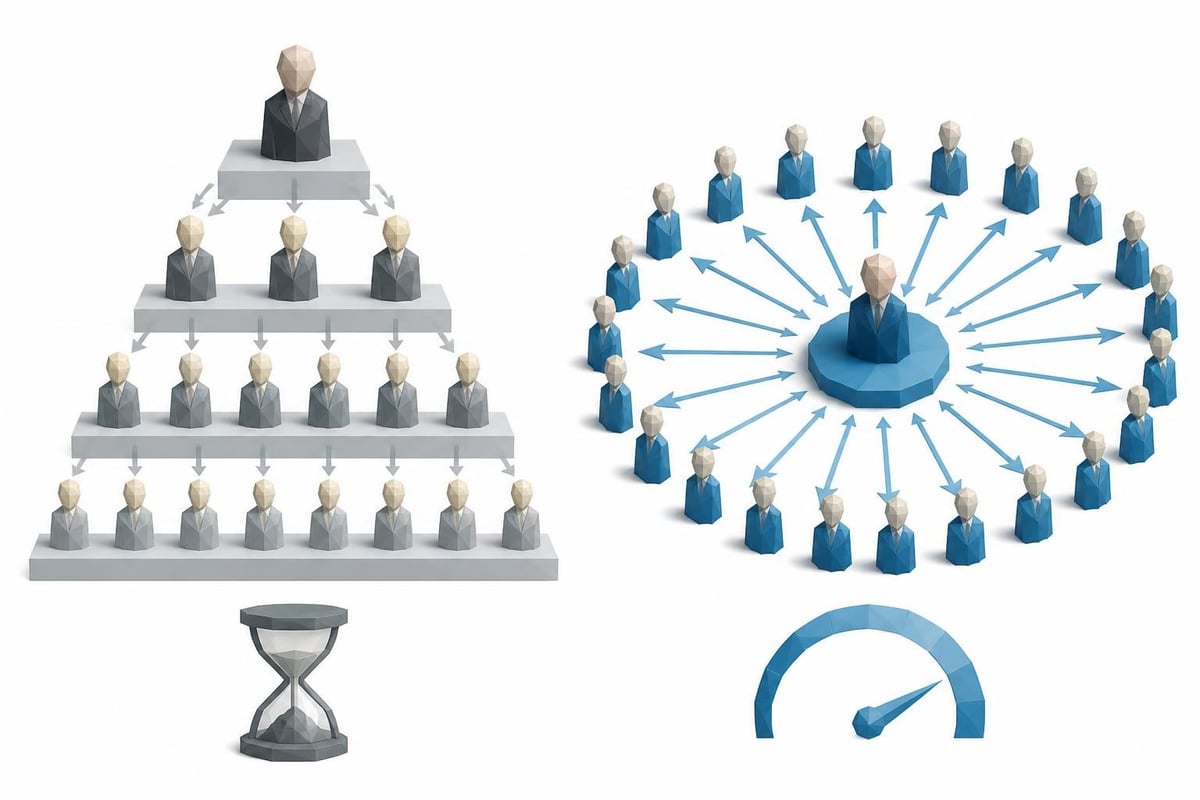
What Nvidia teaches modern leaders here is uncomfortable: your organizational chart might be protecting executive limitations rather than enabling organizational performance. Organizations navigating disruption often discover that hierarchy exists to manage fear, not work.
Feedback Without Performance Reviews
Huang delivers direct feedback constantly. Not quarterly, not annually, not during scheduled review cycles. His approach to regular, candid feedback creates an environment where correction happens immediately when issues emerge, not months later during performance review theater.
This matters because delayed feedback has compounding costs. A product decision made in January based on flawed assumptions costs exponentially more to fix in June when the formal review cycle surfaces it. By then you've invested engineering time, market positioning, and opportunity cost.
The Real Cost of Annual Review Cycles
Consider the typical enterprise review process:
| Traditional Annual Reviews | Nvidia's Continuous Feedback |
|---|---|
| Feedback delayed 3-12 months | Feedback delivered in real-time |
| Issues compound before correction | Issues corrected at emergence |
| Performance surprises common | Performance expectations continuously calibrated |
| Political narratives dominate | Observable behavior drives discussion |
| HR-mediated communication | Direct leader-to-contributor exchange |
The annual review creates incentive misalignment. Leaders stockpile feedback for formal occasions rather than addressing issues when correction matters most. Contributors optimize for review timing rather than continuous improvement.
Huang's model removes this distortion. When feedback occurs continuously, there's no performance review surprise, no manufactured crisis, no political maneuvering around rating distributions. You know where you stand because your leader told you yesterday.
What Nvidia teaches modern leaders about feedback is that the ritual of performance reviews often substitutes for actual performance management. The companies doing genuine leadership development work understand this distinction. Organizations struggling with toxic leadership patterns typically discover those patterns festered in the gaps between formal review cycles.
Zero Long-Term Planning
Huang explicitly rejects long-term strategic plans. In an industry where technology shifts can obsolete entire product lines within quarters, Nvidia operates without the traditional planning apparatus that consumes executive attention at most corporations.
This isn't chaos. It's responding to what planning actually delivers in high-velocity environments: false confidence and resource commitment to assumptions that won't hold.
What Replaces The Five-Year Plan
Without multi-year plans, Nvidia instead focuses on:
- Core capability development that creates optionality regardless of specific market evolution
- Rapid market sensing to identify emerging opportunities before competitors
- Modular product architecture allowing quick pivots without complete redesigns
- Aggressive resource reallocation unencumbered by sunk cost commitments to outdated plans
The result? When large language models created unprecedented demand for AI training infrastructure in 2022-2023, Nvidia pivoted faster than competitors still executing against 2021 data center roadmaps.
Traditional planning creates organizational debt. You make promises to boards, investors, and internal stakeholders based on assumptions. When those assumptions break, you face political pressure to execute failed plans rather than adapt to new reality. Your planning process has trapped you.
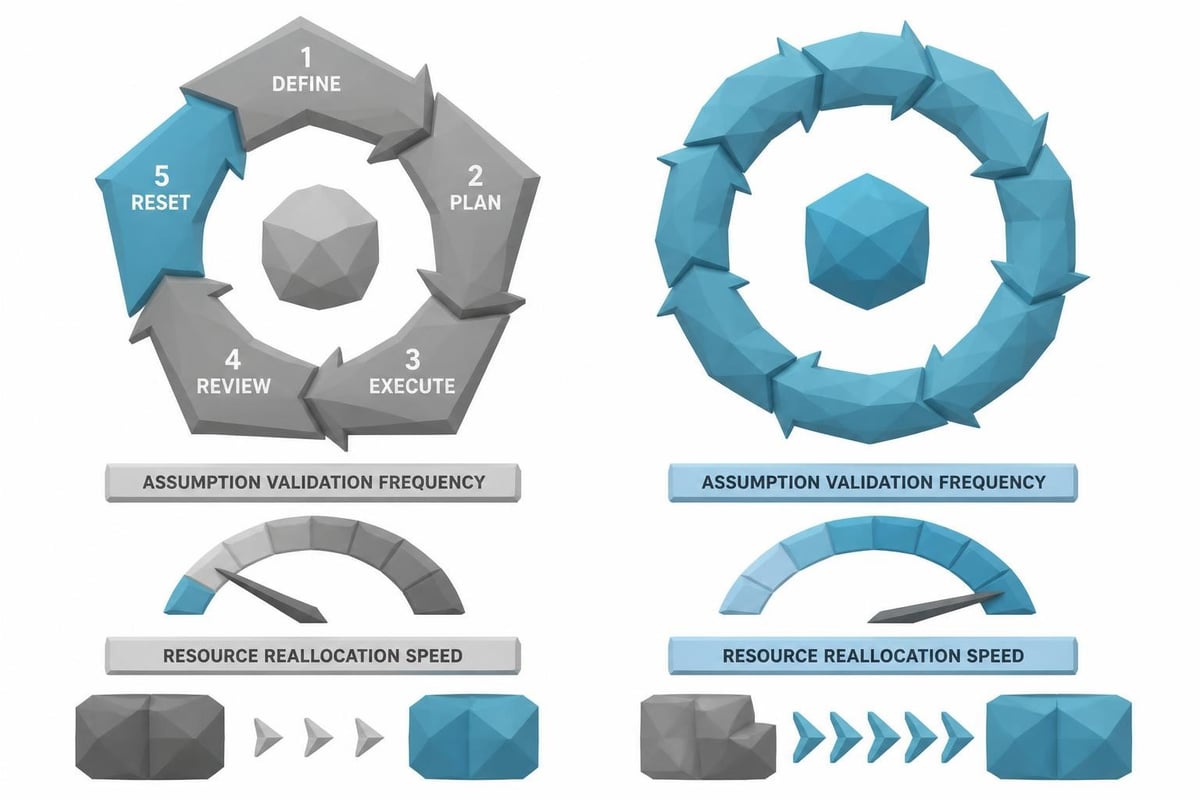
What Nvidia teaches modern leaders is that planning horizon should match assumption durability. In stable industries where customer needs and technology change slowly, longer planning makes sense. In technology, where a new architecture can obsolete your product portfolio overnight, the plan itself becomes the liability.
Demanding Excellence Without Apology
Huang’s leadership style demands perfection without the emotional cushioning that contemporary management advice prescribes. This creates problems for HR departments trained to mediate conflict and soften criticism, but it also creates products that actually work and strategies that actually execute.
The conventional wisdom says high-performing cultures require psychological safety. That's incomplete. They require safety to speak truth, not safety from accountability for results.
The Psychological Safety Misconception
Many organizations misinterpret psychological safety as protection from uncomfortable feedback or demanding standards. The actual research on psychological safety shows it means feeling safe to raise concerns, challenge assumptions, and admit mistakes without fear of punishment.
It doesn't mean your work escapes rigorous evaluation. It doesn't mean mediocre execution gets celebrated as learning opportunity. It means you can say "this approach won't work" without career consequences.
Huang's Nvidia demonstrates both simultaneously: demanding excellence while creating environment where people surface problems immediately. The combination produces better decisions faster because:
- Problems get acknowledged before they compound
- Standards remain unambiguous
- Political calculation doesn't distort information flow
- Talent self-selects toward people who want to do exceptional work
What Nvidia teaches modern leaders is that confusing psychological safety with low standards creates cultures where people feel comfortable producing mediocre results. The organizations with genuine leadership coaching capabilities distinguish between creating safety for truth and creating comfort for underperformance.
AI Adoption As Organizational Imperative
Huang reportedly challenges managers who discourage AI use, asking "are you insane?" when they slow technology adoption. This isn't AI hype. It's recognition that competitors using AI tools will outperform competitors debating AI ethics while doing nothing.
Most enterprises in 2026 remain stuck in analysis paralysis around AI. They've formed committees, commissioned studies, held workshops, and drafted policies. Meanwhile their productivity hasn't changed.
The AI Adoption Gap
Organizations face a fundamental choice:
Option A: Wait for perfect AI governance framework
- Develop comprehensive policies covering every scenario
- Train all employees on responsible AI use
- Establish oversight committees and approval processes
- Begin limited pilots in Q3 2027
Option B: Deploy AI with guardrails and iterate
- Identify high-value use cases immediately
- Provide tools and basic guidelines
- Monitor results and adjust based on evidence
- Achieve productivity gains in weeks, not years
Nvidia chose Option B. Their competitive position reflects that choice. What Nvidia teaches modern leaders about technology adoption is that perfection paralysis is indistinguishable from strategic failure.
The evidence-based approach means deploying AI where impact is measurable, monitoring outcomes, and adjusting based on results rather than predictions. Organizations seeking AI-enabled coaching capabilities discover this same pattern: the barrier isn't technology maturity, it's organizational courage.

Group Communication Over Individual Meetings
With 60 direct reports, Huang can't do weekly one-on-ones. Instead, he favors group discussions where multiple leaders hear the same context, challenge each other's assumptions, and align without sequential information cascades.
This communication model has specific advantages:
- Information consistency since everyone hears the same message simultaneously
- Cross-functional problem-solving where marketing hears engineering constraints directly
- Reduced meeting overhead by eliminating redundant one-on-one briefings
- Accelerated decision velocity through real-time debate and resolution
The tradeoff? Individual concerns get less airtime. Interpersonal dynamics require management. Some issues need private discussion.
When Group Communication Fails
This approach breaks down when:
- Leaders lack confidence to challenge ideas publicly
- Political dynamics punish dissent
- Status differences prevent honest exchange
- Personal performance issues need addressing
These failure modes explain why most organizations can't replicate Nvidia's model. The executive team lacks the trust, candor, and mutual respect required for effective group decision-making.
What Nvidia teaches modern leaders is that communication structure should match information architecture. If decisions require cross-functional input and rapid iteration, group formats outperform sequential one-on-ones. If decisions require deep personal context or sensitive feedback, individual conversations matter more.
Challenging The Doomer Narrative
Huang actively opposes AI doom rhetoric, arguing fear-based narratives block productive investment and development. This position attracts criticism from AI safety advocates but reflects practical observation: organizations paralyzed by worst-case scenarios make no progress on best-case opportunities.
The business implications matter. When leadership teams obsess over hypothetical AI risks while competitors deploy AI tools that improve actual productivity, the competitive gap compounds weekly.
The Risk Management Imbalance
Enterprise risk management often treats speculative future risks as more urgent than measurable current costs. Consider:
| Speculative AI Risks | Measurable Current Costs |
|---|---|
| Job displacement scenarios | Lost productivity from manual processes |
| Algorithmic bias concerns | Employee burnout from repetitive tasks |
| Existential AI threats | Customer service delays from understaffing |
| Privacy hypotheticals | Competitive losses to AI-enabled competitors |
Both categories deserve attention. But when organizations spend more energy debating speculative risks than addressing measurable costs, they've optimized for committee comfort rather than business results.
What Nvidia teaches modern leaders about risk is that inaction has costs that balance sheets don't capture. The opportunity cost of delayed AI adoption appears nowhere in quarterly reports, but it determines market position in three years.
Continuous Learning As Operational Requirement
Huang emphasizes constant learning, not as professional development platitude but as operational necessity. In industries where technical foundations shift continuously, what you knew 18 months ago may now be obsolete or actively wrong.
This creates specific organizational demands:
- Time allocation for skill development, not just task execution
- Psychological permission to acknowledge knowledge gaps without status penalty
- Information infrastructure providing access to current technical understanding
- Reward systems that value learning velocity alongside execution quality
Most organizations claim to value learning while their actual systems penalize it. Taking time for skill development looks like underperformance on utilization metrics. Admitting knowledge gaps creates concerns about capability. Asking questions suggests lack of expertise.
The Learning Infrastructure Gap
Organizations serious about continuous learning need:
- Dedicated learning time protected from operational demands
- Expert access through mentoring, coaching, or external resources
- Safe experimentation environments where failure teaches without business consequences
- Knowledge sharing systems that distribute insights across teams
Without these elements, "learning culture" remains aspiration rather than practice. What Nvidia teaches modern leaders is that learning happens through deliberate organizational design, not motivational speeches about growth mindset.
Companies investing in executive coaching infrastructure often discover this same pattern: meaningful development requires systematic support, not occasional workshops.
Social Norms Around Technology Change
Huang argues society needs new social norms for AI integration, suggesting we should "just go engage it" rather than debate from distance. This reflects practical wisdom: you learn technology's actual implications through use, not speculation.
For business leaders, this translates to specific actions:
- Deploy AI tools in controlled environments and observe results
- Measure productivity impact empirically rather than assuming effects
- Adjust based on evidence rather than opinion
- Share learnings across organization to accelerate adoption
The alternative is strategic paralysis where organizations debate AI implications endlessly while learning nothing. What Nvidia teaches modern leaders about technology change is that engagement produces understanding faster than analysis.
The Contrarian Leadership Framework
What Nvidia teaches modern leaders contradicts conventional management doctrine across multiple dimensions. The pattern reveals a coherent philosophy:
Conventional Wisdom: Maintain manageable span of control
Nvidia Reality: Flat hierarchies with 60+ direct reports enable information velocity
Conventional Wisdom: Annual performance reviews provide structure
Nvidia Reality: Continuous feedback enables real-time correction when it matters
Conventional Wisdom: Long-term planning creates strategic clarity
Nvidia Reality: Planning horizon should match assumption durability
Conventional Wisdom: Psychological safety requires comfort
Nvidia Reality: Safety means truth-telling freedom, not protection from high standards
Conventional Wisdom: Cautious AI adoption manages risk
Nvidia Reality: Deployment with iteration beats perfect governance planning
The framework works because it matches organizational design to actual operating environment rather than inherited management conventions. In stable, predictable industries, traditional approaches may optimize better. In technology, where change velocity exceeds planning cycles, Nvidia's model produces superior results.
Implementation Without Imitation
The critical error is copying Nvidia's practices without understanding underlying principles. Managing 60 directs works for Huang because he's developed specific capabilities over decades. Attempting the same structure without those capabilities creates chaos, not performance.
What works: Identifying which conventional practices constrain your organization, then experimenting with alternatives aligned to your specific environment.
What fails: Wholesale imitation of Nvidia's structure assuming surface practices transfer independently of capability and context.
Organizations developing leadership capabilities systematically understand this distinction. Effective leadership development builds the underlying skills that enable non-traditional structures, rather than mandating structural changes without skill foundation.
The practical application means:
- Start with capability assessment of current leadership team
- Identify specific constraints that conventional practices create
- Pilot alternative approaches in controlled environments
- Measure results against defined outcomes
- Scale what works, abandon what doesn't
What Nvidia teaches modern leaders ultimately is that business results matter more than management orthodoxy. When traditional practices enable better performance, use them. When they constrain results, challenge them. The test is always evidence, not convention.
What Nvidia teaches modern leaders challenges every assumption about organizational structure, feedback cycles, planning horizons, and technology adoption that dominates standard management thinking. The evidence shows these contrarian approaches work when leaders develop capabilities to execute them. If your organization needs to transform leadership effectiveness with precision and measurable results, Noomii Leadership Coaching provides the diagnostic tools, expert matching, and targeted interventions that build the capabilities required for non-traditional leadership models that actually perform.
FAQ
What is Jensen Huang's management style?
Jensen Huang's management style emphasizes flat organizational hierarchy with 60 direct reports, continuous real-time feedback instead of annual performance reviews, group communication over one-on-one meetings, no long-term strategic planning, and aggressive technology adoption. His approach prioritizes information velocity, immediate course correction, and organizational adaptability over traditional management conventions.
How does Nvidia's organizational structure differ from traditional companies?
Nvidia operates with significantly fewer management layers than traditional corporations. Jensen Huang manages 60 direct reports instead of the typical 6-8 recommended by management textbooks. This flat structure eliminates middle management filters that slow information flow and enables faster strategic pivots when market conditions change.
Why does Nvidia not create long-term strategic plans?
Nvidia avoids multi-year strategic plans because in high-velocity technology markets, assumptions underlying those plans become obsolete quickly. Instead, they focus on building core capabilities that create optionality, rapid market sensing, modular product architecture, and aggressive resource reallocation unconstrained by commitments to outdated plans.
How does continuous feedback differ from annual performance reviews?
Continuous feedback delivers correction immediately when issues emerge, preventing problems from compounding over months. Annual reviews create delayed feedback cycles where issues identified in January may not surface until June or later, by which time costs have multiplied exponentially through wasted execution and opportunity cost.
What does Nvidia teach about AI adoption in organizations?
Nvidia demonstrates that deploying AI with basic guardrails and iterating based on results outperforms waiting for perfect governance frameworks. Organizations that engage with AI tools immediately and adjust based on evidence achieve productivity gains while competitors remain stuck in analysis paralysis forming committees and drafting policies.


Leave a Reply
Want to join the discussion?Feel free to contribute!