

Can Coaching Make You More Money? ROI Data From 2026
The question of can coaching make you more money cuts through the credential noise and lands squarely on what matters: outcomes. After observing hundreds of coaching engagements across mid-market companies since 2008, the pattern is clear. Coaching generates measurable returns when tied to business KPIs, not when it floats as professional development theater. The difference between a 529% ROI and zero impact comes down to structure, accountability, and how coaching connects to revenue-driving behaviors. Here's what the evidence shows and what most organizations miss.
The ROI Evidence Behind Coaching Investment
Multiple independent studies confirm that executive coaching delivers quantifiable returns when executed properly. Research compiled by Stealth Agents shows coaching ROI ranging from 529% to 788%, with 86% of companies recouping their investment.
The International Coach Federation and PwC reported a 529% average return on executive coaching, while separate analysis found companies see seven times their initial investment when coaching addresses specific business outcomes.
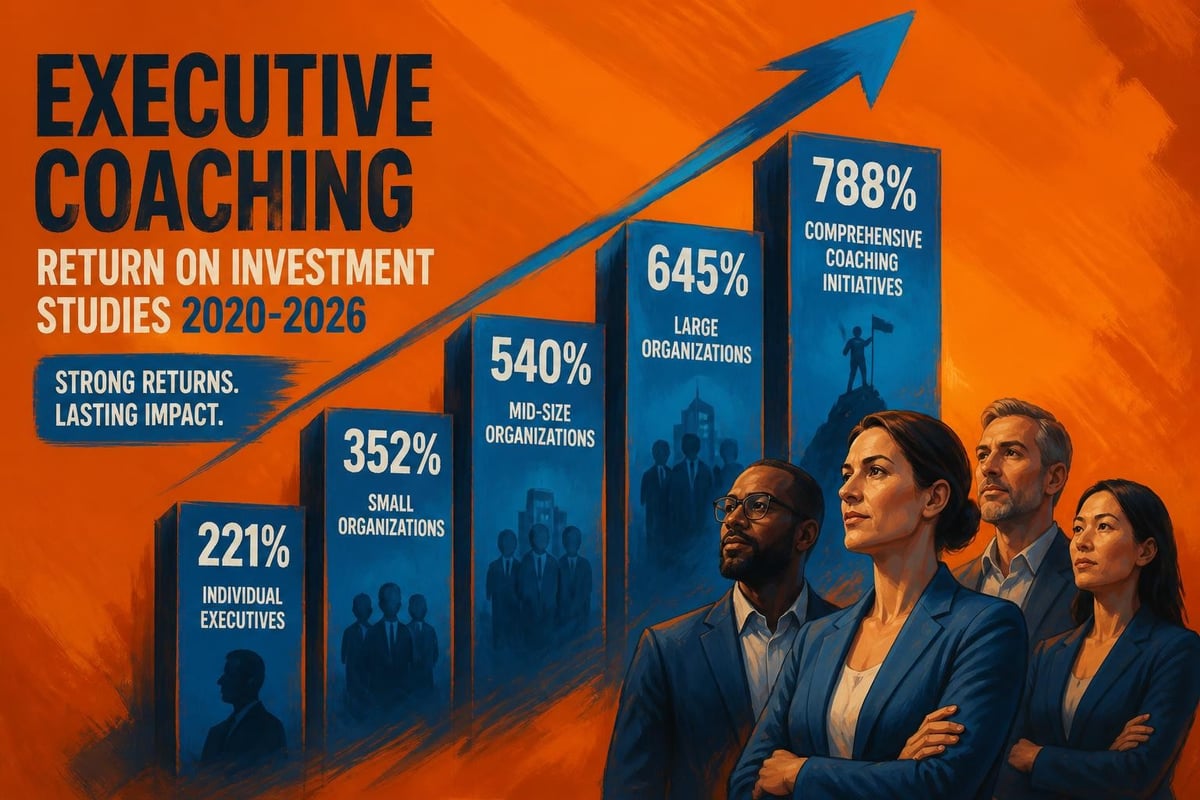
The numbers break down across several measurable areas:
- Productivity gains from faster decision-making
- Retention improvements reducing replacement costs
- Revenue increases from better sales and client management
- Operational efficiency from clearer priorities and execution
But here's what the studies don't emphasize enough: these returns require coaching that operates inside your business rhythm, not outside it. Can coaching make you more money? Only when coaches show up in your operating meetings, challenge weak forecasts, and hold leaders accountable to the behaviors that drive results.
What Separates High-ROI Coaching From Wasted Spend
Most coaching fails to generate returns because it treats symptoms instead of diagnosing root causes. A mid-market manufacturing client came to us in 2024 with flat revenue despite adding headcount. Previous coaching focused on executive presence and leadership style.
Problem Diagnosis Framework
We ran a three-week diagnostic that revealed the actual issue: their weekly leadership meeting had no KPI scoreboard, decisions lacked owners, and follow-through disappeared after 72 hours. The CEO had strong presence but zero operating cadence.
Our solution involved:
- Installing a weekly KPI scoreboard with red/yellow/green accountability
- Coaching live during their Monday leadership meetings for 90 days
- Training managers to run their own team huddles using the same structure
- Tying compensation adjustments to scorecard performance
Result: Revenue increased 34% over nine months with the same headcount. Customer retention improved from 71% to 89%. The CFO calculated coaching ROI at 612% when factoring retention savings and revenue gains.
Lesson: Coaching generates money when it fixes operational breakdowns, not personality preferences. Forbes examined whether executive coaching is worth the investment and found the same pattern: returns correlate with business-metric focus, not credential count.
The Revenue Multiplier Effect in Manager Development
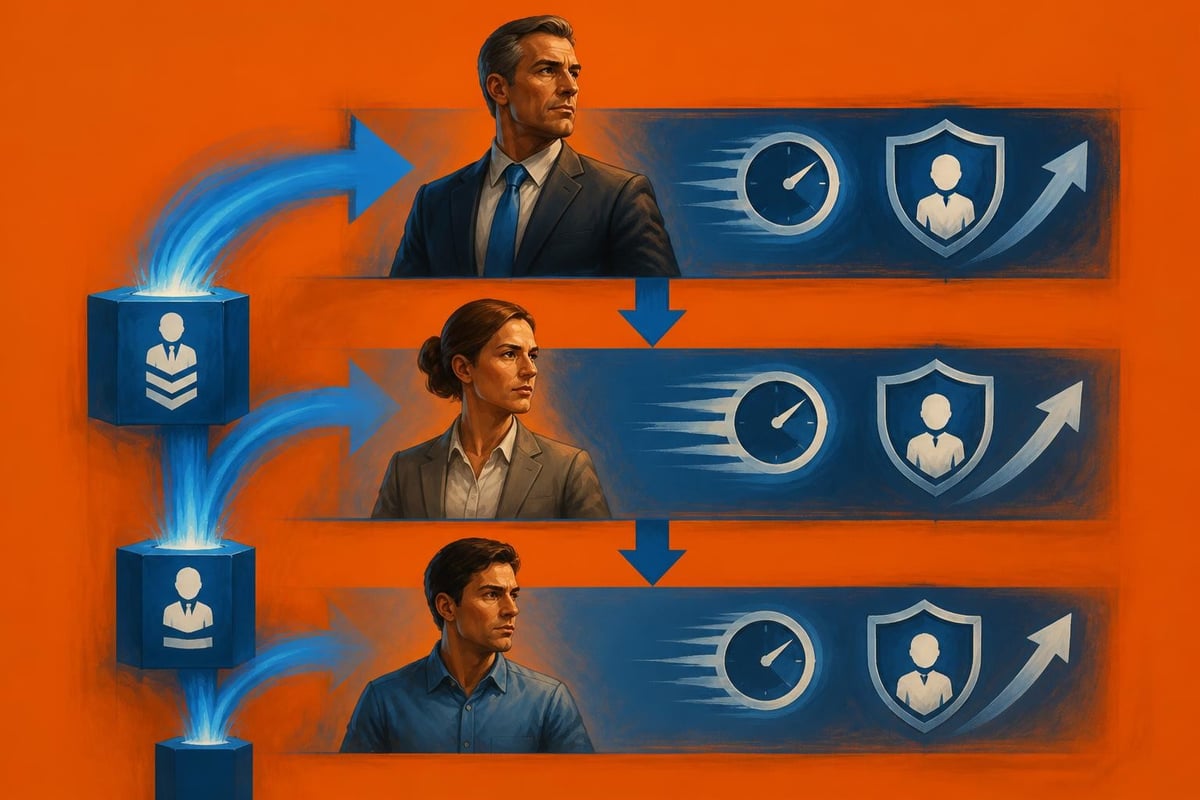
Here's a contrarian observation that challenges conventional coaching wisdom: investing in manager training produces higher organizational ROI than executive-only coaching. The math is straightforward but overlooked.
One executive impacts their direct reports. Train those direct reports to coach their teams, and you multiply the effect across 50-200 employees depending on org structure.
| Investment Level | Reach | Behavior Change Multiplier | Typical ROI Window |
|---|---|---|---|
| Executive only | 5-8 people | 1x | 12-18 months |
| Manager tier | 25-60 people | 5-8x | 6-12 months |
| Manager + teams | 100-300 people | 15-25x | 9-15 months |
A financial services client with 180 employees wanted traditional executive coaching for their three VPs. We proposed coaching the VP layer plus their 12 direct reports simultaneously, using cascading team sessions.
The 12 managers learned to run weekly one-on-ones tied to individual KPIs, which they'd never done consistently. Within five months, employee engagement scores jumped 23 points, and voluntary turnover dropped from 34% annual to 19%. The talent acquisition VP calculated they avoided $340,000 in replacement costs that year alone.
Can coaching make you more money when deployed at the manager layer? The evidence says yes, faster and broader than executive-only approaches. Training Magazine documented how coaching pays off with similar findings about the multiplier effect.
Revenue-Connected Coaching vs. Development Theater
The coaching industry has a certification obsession that actively undermines results. Buyers worship credentials while ignoring whether the coach has operated in a business similar to theirs.
Red flags that coaching won't generate revenue:
- Sessions happen off-site with no connection to actual work cadence
- No measurement beyond "satisfaction surveys" or self-reported confidence
- Coach has never run P&L, managed teams, or hit quota in a business setting
- 12-month contracts with no performance checkpoints or exit terms
- Focus on personality assessments instead of operating metrics
Green flags for revenue-generating coaching:
- Coach participates in your leadership meetings and challenges weak thinking
- KPIs and scorecards established in first 30 days with baseline measurements
- Month-to-month terms with visible results required for continuation
- Coach has operational experience in environments similar to yours
- Training includes your team applying frameworks to real projects in real time
A professional services firm hired an ICF Master Certified Coach with 4,000 hours of coaching but zero operational experience. After six months and $48,000, their leadership team reported feeling "more self-aware" but revenue targets stayed flat and project margins worsened.
They switched to team coaching that embedded in their project kickoff process, taught estimation discipline, and coached account managers on difficult client conversations. Project margins improved 11% in four months, generating $340,000 in additional profit. Same leadership team, different coaching approach.
The Hidden Revenue Leaks Coaching Should Address
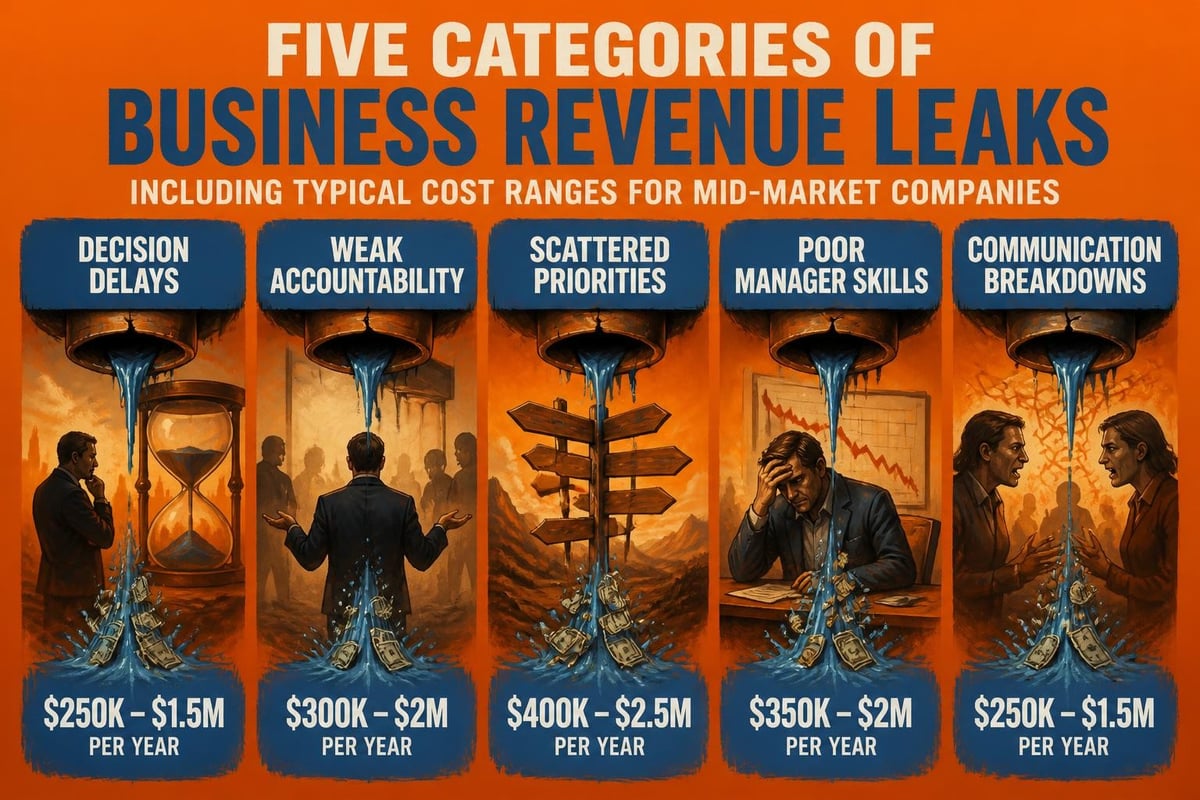
Most organizations leak revenue through predictable patterns they can't see from inside. Effective coaching identifies and plugs these leaks before adding new growth initiatives.
Common Revenue Leaks in Mid-Market Companies
Decision latency costs: The average mid-market leadership team takes 3-6 weeks to make decisions that should require 3-6 days. Each delayed decision costs opportunity cost, team momentum, and market position.
Manager capability gaps: When managers can't coach their direct reports through performance issues, companies tolerate underperformance for 6-18 months before acting. This drains productivity and frustrates top performers who carry extra weight.
Priority chaos: Leadership teams running 12-18 "top priorities" simultaneously deliver mediocre results on all of them. Coaching should force the conversation down to 3-5 priorities with clear owners and weekly tracking.
A healthcare technology client with 120 employees asked about executive coaching to improve culture. Culture wasn't their problem. They had seven strategic initiatives competing for resources, no one owned outcomes, and their weekly leadership meeting lasted 3.5 hours with zero decisions documented.
We cut initiatives to three, installed decision documentation, and coached their VP layer to run 30-minute standup meetings with their teams. Within 90 days, their customer implementation time dropped from 47 days to 28 days. Customer satisfaction jumped, expansion revenue increased, and they closed two deals they would have lost to implementation timeline concerns.
Can coaching make you more money by addressing invisible revenue leaks? Absolutely, but only when the coach knows what to look for and has lived through similar operational breakdowns.
The AI Coaching Disruption and Revenue Reality
The 2026 coaching landscape includes AI coaching tools promising scale and cost savings. The revenue question becomes: when does AI coaching generate returns versus when do you need human expertise?
AI coaching works for:
- Skill development with clear right/wrong answers
- Onboarding consistency across locations
- Just-in-time microlearning before specific tasks
- Reinforcement of frameworks already taught by humans
Human coaching required for:
- Diagnosing complex organizational dynamics
- Challenging entrenched executive blind spots
- Navigating political conflicts blocking execution
- Adapting frameworks to unique business model constraints
A retail client with 40 locations tried AI coaching for their store managers in early 2025. Completion rates were 78%, satisfaction scores were positive, but store performance metrics didn't move. Why? The AI taught generic retail management while their actual problem was managing hourly employees in a tight labor market with specific compensation constraints.
Human coaches worked with 12 store managers to develop peer accountability groups, role-play difficult employee conversations unique to their market, and build retention playbooks based on what actually worked in their stores. Turnover dropped 31% across those 12 locations within four months.
The revenue lesson: AI is disrupting coaching delivery but not strategic diagnosis or context-specific problem solving. Stack AI for scale, human coaches for revenue-critical breakthroughs.
Measuring Coaching Impact on Business Outcomes
Organizations that generate ROI from coaching measure the right things. Satisfaction surveys and Net Promoter Scores don't connect to revenue. Business metrics do.
| Metric Category | What to Track | Revenue Connection | Measurement Frequency |
|---|---|---|---|
| Execution speed | Decision cycle time, project delivery | Faster revenue capture, reduced opportunity cost | Weekly |
| Manager effectiveness | One-on-one consistency, performance conversation quality | Productivity gains, retention | Bi-weekly |
| Team alignment | Priority clarity, resource allocation efficiency | Reduced waste, focused execution | Monthly |
| Customer impact | Implementation time, satisfaction, expansion | Direct revenue and retention | Monthly |
A construction services company with 85 employees tracked these metrics before and during a six-month coaching engagement focused on their project management layer. Wegvisor’s research on coaching ROI shows similar measurement approaches across successful programs.
Their results:
- Project delivery improved from 23% on-time to 71% on-time
- Customer satisfaction scores increased 34 points
- Repeat business rate jumped from 41% to 68%
- Revenue per project increased 18% due to better change order management
Can coaching make you more money when you measure business outcomes instead of coaching process? The evidence across industries says yes, consistently.
FAQ
Q: How quickly should coaching generate measurable revenue impact?
A: Properly structured coaching should show measurable improvements in behavior and leading indicators within 30-45 days, with financial impact visible within 90-120 days. Anything requiring 12+ months to show results usually indicates coaching isn't connected to revenue-driving activities.
Q: What's the typical coaching investment for mid-market companies?
A: Executive coaching ranges from $3,500-$8,000 monthly per executive. Manager development programs run $2,000-$4,500 per participant for 90-180 day engagements. Team coaching typically costs $4,000-$12,000 monthly depending on team size and meeting frequency.
Q: Should we prioritize certified coaches or coaches with operational experience?
A: Operational experience in environments similar to yours produces better ROI than credentials alone. A coach who has run teams, hit revenue targets, and navigated organizational politics will diagnose real problems faster than someone with impressive certifications but no business operations background.
Q: How do we avoid coaching that feels good but changes nothing?
A: Require specific KPI targets within the first 30 days, insist on month-to-month terms until results are visible, and have coaches participate in actual business meetings rather than holding separate development sessions. If coaching doesn't address work that's already happening, it won't generate returns.
Q: What ROI should we expect from executive coaching?
A: Research shows 529-788% ROI when coaching ties to specific business outcomes. Realistic expectations: 15-30% productivity improvements, 20-40% retention improvements in coached populations, and 10-25% increases in revenue per employee when execution improves.
Q: Can coaching replace poor management systems?
A: No. Coaching accelerates performance within functional systems but can't compensate for broken operating cadences, unclear priorities, or absent accountability structures. Fix the management operating system first, then use coaching to optimize performance within it.
Q: How many people should we coach simultaneously for best results?
A: Coaching the executive layer plus their direct reports (typically 8-15 people) produces the best organizational impact. This creates alignment at the top and capability throughout the manager layer that multiplies across teams.
Q: What's the difference between training and coaching for ROI?
A: Training teaches skills and frameworks. Coaching ensures application to real business situations and holds people accountable for behavioral change. Maximum ROI comes from combining both: train the framework, then coach the application until new behaviors stick.
Q: When should we stop a coaching engagement that isn't working?
A: If you see no measurable improvement in agreed-upon KPIs after 60-90 days, stop the engagement. Avoid long-term contracts that trap you in unproductive coaching relationships. Month-to-month terms protect your investment and maintain coach accountability.
Can coaching make you more money? The evidence confirms yes, when coaching addresses real operational breakdowns, ties to measurable KPIs, and comes from coaches with business operations experience. The 529-788% ROI happens when organizations reject credential worship and demand accountability for results. If you want coaching that shows up in your meetings, challenges weak execution, and delivers visible business improvements month by month, Noomii connects mid-market companies with practical coaches who share the risk and tie progress to your actual KPIs and revenue goals.



Leave a Reply
Want to join the discussion?Feel free to contribute!