
We Leadership: Transform Organizations Through Collaboration
The traditional command-and-control leadership model has become obsolete in today's complex business environment. Organizations now face challenges that require collective intelligence, diverse perspectives, and shared accountability. This shift has given rise to we leadership, a collaborative approach that distributes decision-making power across teams and leverages the strengths of entire organizations rather than relying on individual heroics. This leadership philosophy recognizes that sustainable success emerges from coordinated effort, mutual trust, and collective ownership of outcomes.
Understanding We Leadership in Modern Organizations
We leadership represents a fundamental departure from hierarchical leadership structures. This approach emphasizes shared responsibility, collaborative decision-making, and collective accountability across all organizational levels. Rather than concentrating authority in a single individual or executive team, we leadership distributes power strategically throughout the organization.
The concept builds on research demonstrating that collaborative leadership enhances organizational performance by creating environments where diverse perspectives contribute to better decisions. Organizations implementing we leadership frameworks report higher engagement, faster innovation cycles, and improved adaptability to market changes.
Core Principles That Define We Leadership
We leadership operates on several foundational principles that distinguish it from traditional models:
- Distributed authority: Decision-making power flows to those with relevant expertise rather than formal titles
- Collective intelligence: Organizations tap into diverse knowledge and experience across teams
- Shared accountability: Success and failure belong to teams rather than individuals
- Transparent communication: Information flows freely across organizational boundaries
- Mutual trust: Leaders assume positive intent and create psychological safety
These principles work together to create resilient organizations capable of navigating uncertainty and complexity.

Implementing We Leadership Across Organizational Levels
Successful implementation requires deliberate strategies tailored to organizational context. The transition from traditional to we leadership doesn't happen overnight. It demands systematic change in structures, processes, and cultural norms.
Executive Leadership Transformation
Senior leaders must model collaborative behaviors before expecting others to embrace them. This means actively soliciting input from diverse sources, acknowledging uncertainty, and demonstrating vulnerability. Executives practicing we leadership create space for others to contribute meaningfully to strategic decisions.
Many Fortune 500 companies have transformed their executive coaching programs to emphasize collaborative competencies over individual achievement. These programs focus on building executives who facilitate collective intelligence rather than dictating solutions.
| Traditional Leadership | We Leadership |
|---|---|
| Top-down directives | Collaborative decision-making |
| Individual accountability | Shared team ownership |
| Competitive culture | Cooperative environment |
| Information hoarding | Transparent communication |
| Risk avoidance | Experimental mindset |
Middle Management as Collaboration Catalysts
Middle managers serve as critical bridges in we leadership systems. They translate strategic vision into operational reality while maintaining collaborative cultures. These leaders face unique challenges as they balance organizational directives with team autonomy.
Effective middle managers practicing we leadership:
- Facilitate cross-functional collaboration rather than defending territorial boundaries
- Coach team members to develop decision-making capabilities
- Create feedback loops that connect frontline insights to strategic planning
- Build trust through consistent, transparent communication
- Remove obstacles that prevent teams from achieving their goals
Research from the Community Tool Box demonstrates that middle managers trained in collaborative approaches drive higher performance and retention.
Measuring We Leadership Impact
Organizations need concrete metrics to assess whether we leadership delivers promised benefits. Evidence-based measurement separates genuine transformation from superficial changes.
Quantitative Performance Indicators
Track these metrics to evaluate we leadership effectiveness:
- Decision quality: Percentage of strategic decisions requiring reversal or significant modification
- Innovation velocity: Time from idea generation to implementation
- Employee engagement: Participation rates in collaborative initiatives and satisfaction scores
- Cross-functional collaboration: Frequency and quality of inter-departmental projects
- Leadership pipeline strength: Internal promotion rates and succession readiness
Organizations implementing comprehensive psychological safety initiatives alongside we leadership report 30-40% improvement in innovation metrics within 18 months.
Qualitative Cultural Indicators
Numbers tell part of the story. Qualitative assessments reveal deeper cultural shifts:
- Team members feel empowered to challenge ideas regardless of hierarchy
- Leaders regularly acknowledge mistakes and model learning behaviors
- Information sharing occurs naturally without formal requests
- Conflict resolution focuses on collective problem-solving rather than assigning blame
- Recognition systems celebrate team achievements over individual heroics
Addressing We Leadership Implementation Challenges
Transitioning to we leadership creates predictable obstacles. Organizations prepared for these challenges navigate transitions more successfully.
Overcoming Resistance to Distributed Authority
Senior leaders accustomed to centralized control often struggle to distribute decision-making power. This resistance stems from legitimate concerns about accountability, consistency, and risk management. Addressing these concerns requires demonstrating that we leadership actually strengthens accountability through transparency and collective ownership.
Organizations dealing with toxic leadership patterns find that we leadership frameworks naturally expose and correct problematic behaviors by distributing power away from individuals who abuse authority.
Building Collaborative Competencies
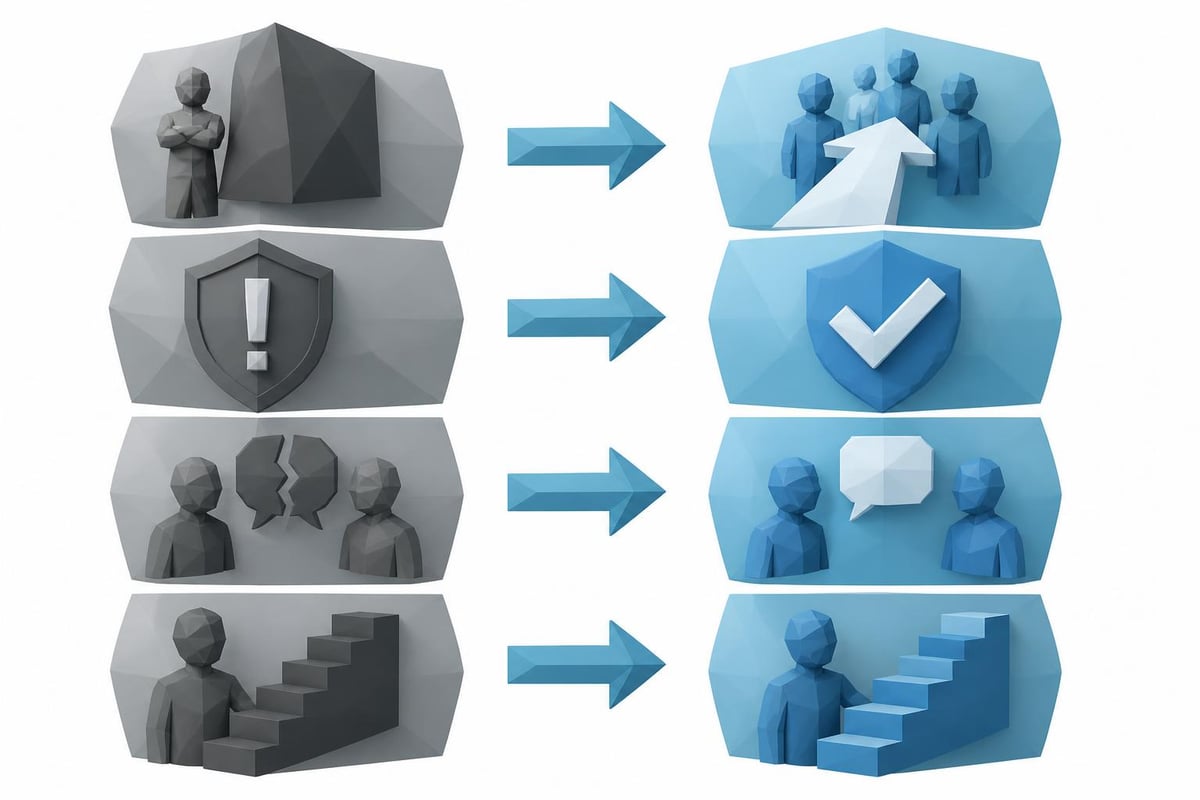
We leadership requires skills many leaders haven't developed through traditional career paths:
- Active listening that seeks understanding over agreement
- Facilitation techniques that draw out diverse perspectives
- Conflict resolution approaches that preserve relationships while addressing disagreements
- Systems thinking that identifies connections across organizational boundaries
- Adaptive leadership that adjusts approaches based on context
Professional development programs must intentionally build these capabilities. Organizations investing in targeted coaching for leadership development accelerate competency development by providing personalized support aligned with organizational goals.
We Leadership in Different Organizational Contexts
The application of we leadership principles varies based on organizational size, industry, and maturity. Understanding these contextual differences ensures appropriate implementation.
Government Agencies and Public Sector
Public sector organizations face unique constraints including regulatory requirements, political oversight, and mission-driven cultures. We leadership in government settings emphasizes collaborative governance that maintains accountability while engaging diverse stakeholders.
Government agencies implementing we leadership report:
- Improved inter-agency coordination on complex initiatives
- Higher employee morale and reduced turnover
- Enhanced public trust through transparent decision-making processes
- Better policy outcomes from inclusive stakeholder engagement
- Increased innovation within regulatory boundaries
Corporate and Private Sector Applications
Private sector organizations leverage we leadership to accelerate innovation and respond to competitive pressures. Management 30 research shows that companies practicing collaborative leadership outperform competitors on agility metrics by significant margins.
Technology companies particularly benefit from we leadership approaches. Distributed teams working on complex products require coordination mechanisms that traditional hierarchies cannot provide effectively.
Building Sustainable We Leadership Systems
Long-term success requires embedding we leadership into organizational DNA rather than treating it as a program with a defined endpoint.
Structural Enablers
Organizations must align formal structures with collaborative principles:
- Flatten hierarchies to reduce unnecessary approval layers
- Design physical and virtual spaces that facilitate spontaneous collaboration
- Create cross-functional teams with clear decision-making authority
- Establish transparent goal-setting processes that connect individual and organizational objectives
- Implement technology platforms that support asynchronous collaboration across time zones
Cultural Reinforcement Mechanisms
Structures alone don't sustain we leadership. Cultural norms and practices reinforce desired behaviors:
| Reinforcement Mechanism | Implementation Approach |
|---|---|
| Recognition systems | Celebrate collaborative achievements in performance reviews |
| Communication practices | Share decision-making processes transparently across organization |
| Learning infrastructure | Create communities of practice for peer learning |
| Leadership selection | Promote based on collaborative track record |
| Onboarding processes | Immerse new hires in collaborative culture from day one |

Integrating We Leadership with Existing Frameworks
Organizations rarely implement we leadership in isolation. Successful integration with existing leadership development initiatives creates coherent, reinforcing systems.
Complementary Leadership Approaches
We leadership works synergistically with several established frameworks:
- Servant leadership: Both emphasize empowering others over personal advancement
- Transformational leadership: Shared focus on inspiring collective achievement
- Adaptive leadership: Common emphasis on distributed problem-solving
- Systems leadership: Aligned perspective on organizational interconnectedness
Professional Coaching as Acceleration Mechanism
Executive coaching tailored to we leadership competencies accelerates individual and organizational transformation. Coaches help leaders navigate the personal challenges of moving from command-and-control to collaborative approaches.
The most effective programs combine evidence-based leadership diagnostics with personalized coaching that addresses specific behavioral patterns. This precision approach identifies exact capability gaps and develops targeted interventions.
Healthcare organizations exemplify successful integration. Interprofessional collaborative leadership in medical settings demonstrates how we leadership principles improve patient outcomes when combined with clinical excellence frameworks.
Scaling We Leadership Across Enterprise Organizations
Large organizations face unique scaling challenges when implementing we leadership. Success requires coordinated efforts across multiple divisions, geographies, and business units.
Enterprise-Wide Implementation Strategies
Scaling we leadership demands systematic approaches:
- Pilot programs: Test we leadership in specific departments before enterprise rollout
- Leadership cascades: Train executives who then develop their teams in collaborative competencies
- Community networks: Create cross-organizational communities practicing we leadership
- Shared learning platforms: Capture and disseminate best practices across business units
- Consistent measurement: Apply unified metrics to track progress organization-wide
Organizations pursuing enterprise transformation often struggle with consistency across geographically dispersed teams. We leadership frameworks address this challenge by creating shared principles while allowing local adaptation.
Technology Infrastructure Supporting We Leadership
Digital platforms enable we leadership at scale by facilitating:
- Real-time collaboration across time zones and locations
- Transparent information sharing accessible to relevant stakeholders
- Decision-making processes that capture diverse input efficiently
- Learning management systems distributing collaborative leadership training
- Analytics platforms measuring collaboration quality and outcomes
The integration of we leadership principles with technological capabilities creates amplification effects unavailable through either approach alone.
Future Directions for We Leadership Development
The evolution of we leadership continues as organizations face increasingly complex challenges requiring collective response capabilities.
Emerging Trends Shaping We Leadership
Several trends will influence how we leadership develops through 2026 and beyond:
- AI-augmented collaboration: Artificial intelligence tools supporting collective decision-making while preserving human judgment
- Global distributed teams: We leadership frameworks adapted for permanently remote and hybrid workforces
- Stakeholder capitalism: Expanded we leadership scope including customers, communities, and partners in collaborative governance
- Sustainability imperatives: Collective leadership addressing climate and social challenges requiring coordinated action
- Generational shifts: Younger workers expecting collaborative cultures driving we leadership adoption
Organizations positioning themselves at the forefront of these trends gain competitive advantages through enhanced adaptability and innovation capacity.
Continuous Evolution and Learning
We leadership represents an ongoing journey rather than a destination. Organizations committed to this approach embrace continuous learning, experimentation, and refinement. They recognize that collaborative leadership requires constant attention to changing contexts, emerging challenges, and evolving team dynamics.
The most successful implementations view we leadership as a living system that grows and adapts alongside organizational development. This perspective ensures that collaborative principles remain relevant and effective regardless of external conditions.
We leadership transforms organizations by harnessing collective intelligence, distributing decision-making power, and creating cultures of shared accountability. These collaborative approaches deliver measurable results including enhanced innovation, improved engagement, and stronger organizational resilience. The Noomii Leadership Coaching program accelerates we leadership transformation through precision coach matching, evidence-based diagnostics, and targeted interventions aligned with organizational goals. For organizations pursuing excellence through accountability and structured development, Noomii provides the expertise and frameworks needed to build confident, collaborative leaders at every level.



Leave a Reply
Want to join the discussion?Feel free to contribute!