
Leadership Mentoring and Coaching: A Practical Guide
Organizations that invest in developing their leaders see measurable improvements in execution, retention, and team performance. Yet many companies struggle to implement effective development programs that deliver tangible business results rather than just theoretical knowledge. The difference often lies in understanding how leadership mentoring and coaching work together to create lasting behavioral change tied directly to key performance indicators.
Understanding the Difference Between Mentoring and Coaching
Leadership mentoring focuses on long-term career development and knowledge transfer. A mentor typically shares their own experiences, offers guidance based on their journey, and helps mentees navigate organizational dynamics. The Center for Mentoring Excellence emphasizes that effective mentoring programs promote learning through structured relationships.
Coaching, by contrast, centers on specific performance goals and behavioral change. Coaches ask powerful questions, hold leaders accountable to commitments, and measure progress against defined outcomes. Both approaches complement each other when integrated strategically.
When to Deploy Each Approach
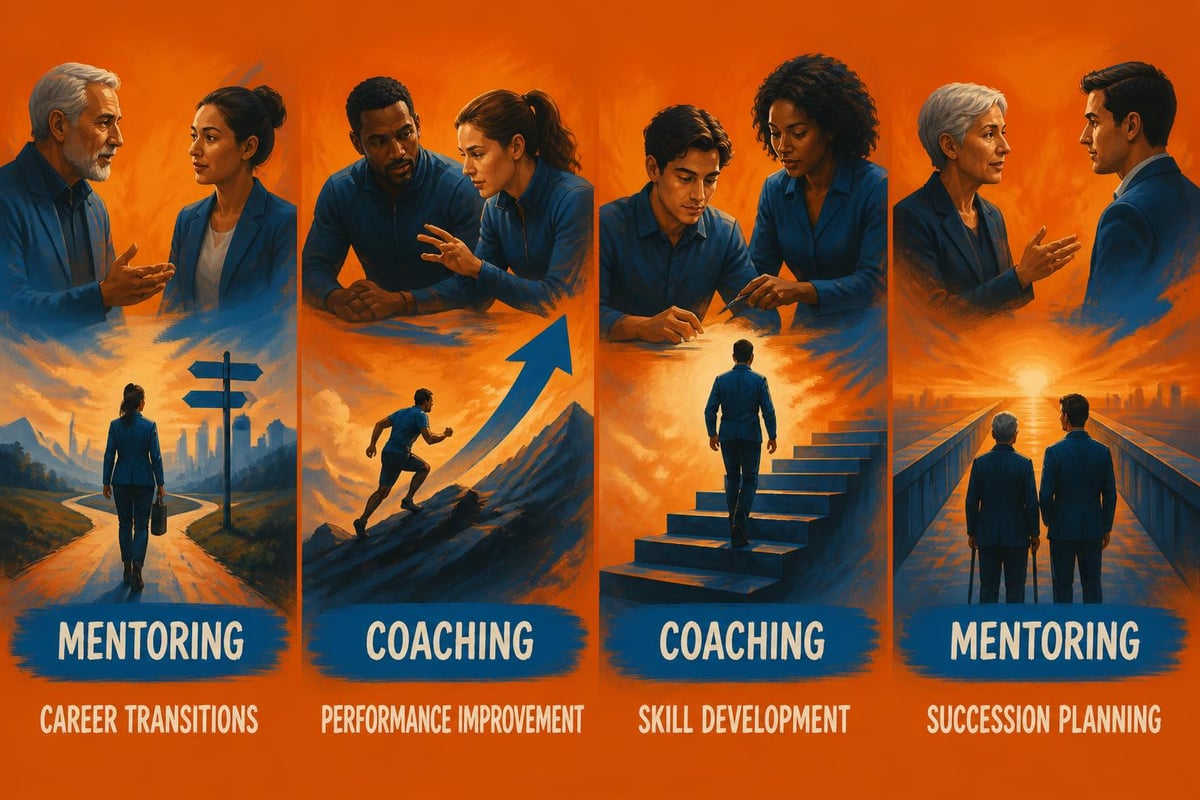
- Mentoring works best for career transitions, succession planning, and cultural integration
- Coaching drives results for performance gaps, leadership skill development, and execution improvements
- Combined approaches accelerate development for high-potential leaders facing new challenges
The National Center for Principled Leadership & Research Ethics provides valuable research on when mentoring proves most effective in organizational settings.
Building a Results-Driven Leadership Development Framework
Successful leadership mentoring and coaching programs require clear structure and accountability. Mid-market companies between 25 and 500 employees need practical frameworks that integrate into daily operations rather than abstract theories that gather dust.
| Framework Element | Purpose | Success Metric |
|---|---|---|
| 360 Assessments | Identify development gaps | Improvement in specific competencies |
| Operating Cadence | Create accountability rhythm | Meeting effectiveness scores |
| KPI Scorecards | Track business impact | Revenue, retention, or efficiency gains |
| Live Coaching | Apply learning in real situations | Decision quality and speed |
The most effective programs embed coaching directly into management meetings and strategic sessions. This live application ensures leaders develop skills while driving actual business outcomes, not just during isolated training events.
Transforming Managers Into Coaches
One critical outcome of leadership mentoring and coaching is creating a coaching culture where managers develop their own teams. This multiplier effect amplifies investment returns far beyond individual coaching engagements.
Research from the Hendricks Center on developing leadership through mentoring and coaching shows that transformative coaching requires both technique and mindset shifts. Managers must move from telling to asking, from solving to empowering.
Key Skills for Manager-Coaches
Powerful questioning replaces directive management. Instead of providing solutions, effective manager-coaches ask questions that develop critical thinking in their reports.
Active listening creates psychological safety. Team members share concerns and ideas when they feel genuinely heard rather than judged.
Accountability partnerships drive follow-through. The best manager-coaches help their people set clear commitments and review progress consistently.
Training managers to coach requires ongoing practice with feedback loops. Sherpa Coaching emphasizes process-driven approaches that build sustainable coaching capabilities. Many organizations also explore best AI for business coaching to supplement human development efforts.
Measuring ROI and Business Impact
Leadership mentoring and coaching must connect to measurable business outcomes. Companies need clear evidence that development investments drive revenue, reduce turnover, or improve operational efficiency.
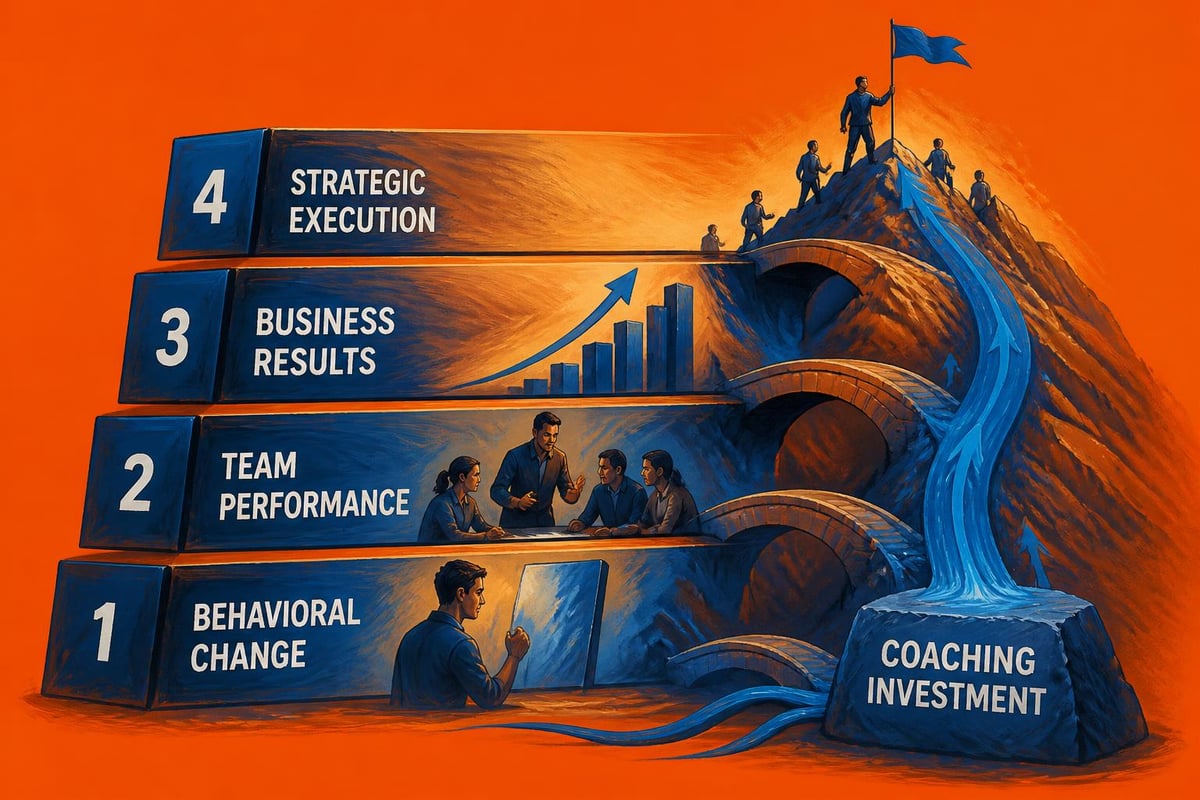
The most effective measurement frameworks track multiple levels:
- Behavioral change through 360 feedback and manager observations
- Team performance via engagement scores and productivity metrics
- Business results including revenue growth, retention rates, and margin improvement
- Strategic execution measured by goal completion and decision velocity
Month-to-month engagement models with visible results create natural accountability. When progress stalls, both coach and client can adjust quickly rather than remaining locked into ineffective long-term contracts. Organizations looking for top executive coaching firms should prioritize those willing to tie compensation to measurable outcomes.
Addressing Common Implementation Challenges
Even well-designed programs face obstacles. Understanding these challenges helps organizations prepare effective responses.
Time constraints rank as the most frequent objection. Leaders claim they cannot spare hours for development activities. The solution involves integrating coaching into existing meetings and workflows rather than adding separate sessions. Resources like AccountabilityNow.net provide practical frameworks for embedding accountability into regular business rhythms.
Skeptical participants question coaching value, especially when previous initiatives failed to deliver results. Transparency about goals, metrics, and progress creates buy-in. Live coaching that solves real problems builds credibility faster than any workshop.
Inconsistent application dilutes program effectiveness. Some managers engage fully while others participate minimally. Tying coaching to performance reviews and advancement opportunities ensures consistent engagement.
| Challenge | Root Cause | Practical Solution |
|---|---|---|
| Low participation | Unclear value proposition | Show quick wins in first 30 days |
| Poor follow-through | No accountability system | Weekly scorecard reviews |
| Superficial change | Focus on theory over practice | Coach live in actual meetings |
The Intelligent Leadership Movement offers additional insights on transforming resistance into engagement through executive coaching approaches that connect to individual motivations.
Scaling Leadership Development Across Organizations
As programs prove value with initial cohorts, companies face scaling challenges. Maintaining quality while expanding reach requires systematic approaches.
Cohort models allow multiple leaders to develop together while sharing costs. Group coaching sessions combined with individual work create peer accountability and shared learning. Many business coaches for entrepreneurs successfully use this blended format.
Train-the-trainer approaches develop internal coaching capabilities. Select high-performing managers receive advanced training to coach their peers and direct reports, multiplying program reach.
Technology integration extends coaching between sessions. Video check-ins, shared KPI dashboards, and mobile accountability tools maintain momentum without requiring constant face-to-face interaction.

Successful scaling maintains focus on business outcomes rather than participant volume. Programs that prioritize completion rates over impact metrics often create compliance rather than transformation.
Selecting the Right Development Partner
Choosing between in-house programs and external partnerships significantly impacts results. Most mid-market companies lack internal expertise to design and execute comprehensive leadership mentoring and coaching initiatives.
External partners bring objectivity, proven methodologies, and specialized expertise. The key differentiators include willingness to tie compensation to results, experience in your industry, and ability to coach live in your actual business context.
Questions to ask potential partners:
- How do you measure program success beyond participant satisfaction?
- Can you provide examples of similar companies achieving measurable results?
- What happens if we do not see progress in the first quarter?
- How do you integrate coaching into our existing meetings and workflows?
Many organizations explore directories like Noomii to identify qualified business coaches and compare approaches. Understanding how career coaching works provides insight into coaching methodologies that translate to leadership development.
The investment in leadership mentoring and coaching pays dividends through faster decisions, stronger communication, improved retention, and cleaner execution. Programs that roll up their sleeves, coach in real business situations, and tie progress to KPIs deliver results that abstract training never achieves.
Effective leadership mentoring and coaching transforms managers into accountable leaders who drive measurable business results. When programs integrate into daily operations with clear KPIs and ROI tracking, companies see faster decisions, higher retention, and stronger execution. Noomii Corporate Coaching delivers practical, results-driven development for mid-market companies through live coaching in your meetings, month-to-month terms, and aligned incentive options that tie our success to your measurable outcomes. Discover how Noomii can build accountable leaders and teams in your organization.



Leave a Reply
Want to join the discussion?Feel free to contribute!