

Why Most Certified Coaches Struggle to Grow (2026)
The coaching industry has produced more certified practitioners in 2026 than ever before. Yet a peculiar pattern persists: most certified coaches struggle to grow their practices beyond a handful of clients, regardless of how many acronyms follow their names. The gap between certification and commercial success reveals uncomfortable truths about what buyers actually value and what the market rewards.
The Certification Paradox
Coaching certifications teach frameworks, ethics, and listening techniques. They rarely teach client acquisition, positioning, pricing strategy, or the business systems that separate sustainable practices from expensive hobbies.
What certifications typically cover:
- ICF core competencies and ethics
- Coaching models and frameworks
- Supervised practice hours
- Assessment tools and methodologies
What they typically miss:
- Lead generation and conversion
- Value communication and pricing
- Niche selection and market positioning
- Operational efficiency and scalability
This gap explains why certified coaches still struggle despite investing thousands in credentials. The market doesn’t pay for certifications. It pays for results, expertise, and the ability to solve specific problems for specific buyers.

The Skills Versus Business Divide
Most certified coaches struggle to grow because they excel at coaching but fail at business. They can facilitate powerful conversations but can’t articulate their value proposition. They understand change psychology but not buyer psychology.
A 2025 analysis of coaches who achieved six-figure practices revealed a pattern: those who succeeded spent 60% of their first year on business development and only 40% on delivery. Those who struggled reversed the ratio, believing great coaching would somehow market itself.
Common Growth Barriers Nobody Mentions
The coaching industry perpetuates myths about practice growth that actively harm practitioners. Here’s what 15 years of observation reveals about challenges to growth as a coach.
| Myth | Reality | Impact |
|---|---|---|
| “Niche too narrow limits opportunities” | Generic positioning attracts nobody | Weak differentiation, price pressure |
| “More certifications = more credibility” | Buyers care about outcomes, not acronyms | Wasted investment, delayed launch |
| “If I’m good enough, clients will find me” | Marketing is mandatory, not optional | Stalled growth, inconsistent pipeline |
| “Lower prices help build my practice” | Underpricing signals low value | Wrong clients, unsustainable model |
Most certified coaches struggle to grow because they optimize for peer approval rather than client results. They chase credentials their target buyers have never heard of while neglecting the business fundamentals that generate consistent revenue.
The Content Marketing Gap
Demonstrating expertise publicly remains the most reliable path to authority and inbound leads. Yet most coaches either avoid content creation entirely or produce generic material indistinguishable from thousands of competitors.
Forbes identifies content marketing strategies that actually work for coaches, but implementation requires consistency most practitioners can’t maintain while delivering client work.
Successful coaches in 2026 publish:
- Weekly insights based on client patterns
- Monthly case studies with specific outcomes
- Quarterly contrarian perspectives on industry trends
- Consistent commentary on buyer pain points
The difference isn’t talent. It’s discipline and understanding that visibility precedes viability.
Why Corporate Buyers Ignore Certifications
Mid-market companies and Fortune 500 divisions evaluating coaches care about one thing: can you move business metrics? Certifications rarely appear in procurement criteria because buyers have learned they don’t correlate with coaching effectiveness.

When companies face challenges leaders are facing, they seek coaches who understand their business context, speak their language, and tie coaching to KPIs. A coach with 15 years in their industry beats an ICF Master Certified Coach with no relevant experience.
The ROI Conversation Most Coaches Avoid
Most certified coaches struggle to grow in the corporate market because they can’t articulate ROI in business terms. They talk about transformation, awareness, and growth. Buyers want retention rates, time to promotion, revenue per manager, and productivity metrics.
What corporate buyers ask:
- How do you measure coaching impact?
- What business outcomes can we expect?
- How does this tie to our strategic priorities?
- What’s your experience in our industry?
What most coaches answer:
- Vague references to engagement or satisfaction
- Individual transformation stories without business context
- Generic benefits applicable to anyone
- Certification credentials instead of relevant expertise
The disconnect is fatal. Companies don’t buy coaching. They buy solutions to business problems that coaching methodology happens to address.
Building Practices on Outcomes, Not Credentials
Coaches who grow sustainably in 2026 share common patterns. They position around specific outcomes for specific audiences. They demonstrate expertise through public evidence. They price based on value created, not hours delivered.
The Niche-Outcome Matrix
| Target Audience | Specific Outcome | Evidence Required | Typical Investment |
|---|---|---|---|
| First-time managers | Reduce team turnover 30% | Manager retention data | $3K-5K per cohort |
| Sales leaders | Increase pipeline conversion 20% | Revenue attribution | $8K-15K per quarter |
| Executive teams | Align on strategic priorities | Decision velocity metrics | $20K-40K per engagement |
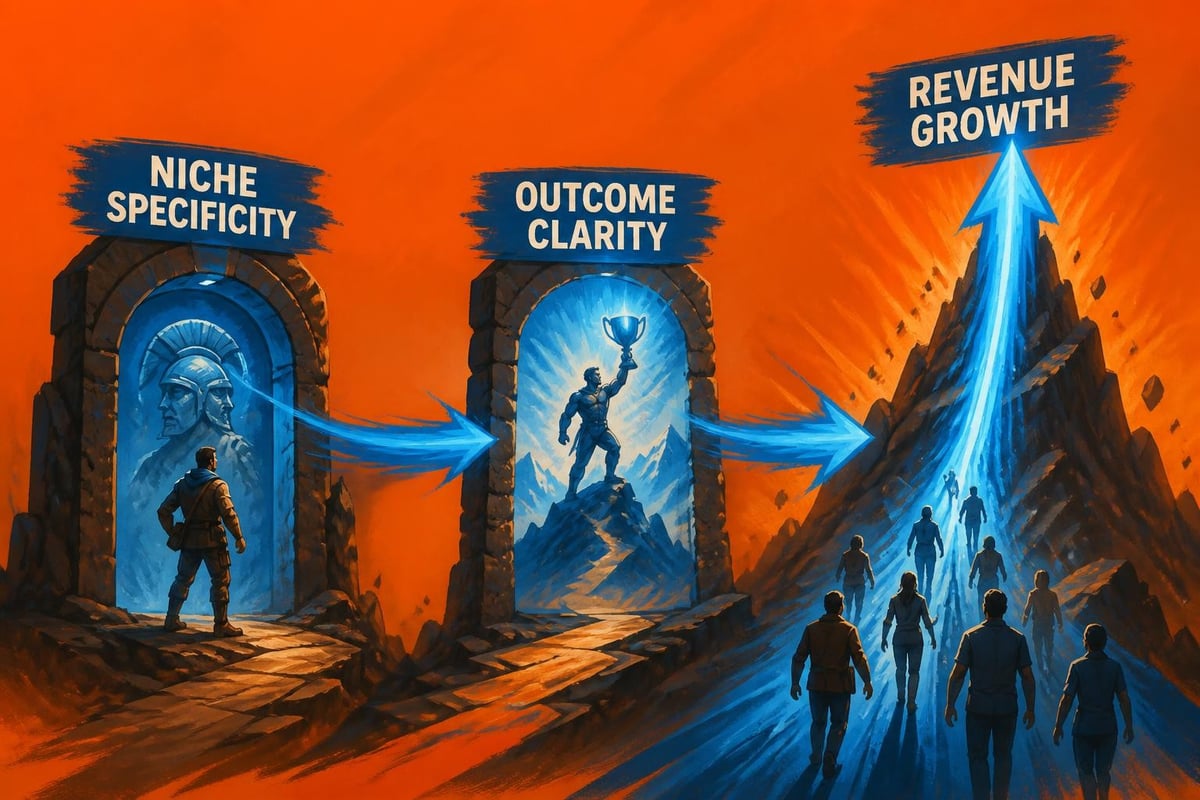
Most certified coaches struggle to grow because they resist this specificity. They want to serve everyone, which means they compel no one. The market rewards clarity and punishes ambiguity.
Growing your coaching practice requires accepting that narrower positioning paradoxically expands opportunity by making value immediately obvious to the right buyers.
The Evidence Advantage
Coaches who publish client results, anonymized case studies, and pattern observations from their practice generate inbound interest. Those who hide behind confidentiality and never demonstrate expertise rely entirely on referrals and warm networks.
Practical evidence formats:
- Before/after metrics from client engagements
- Common patterns across coaching conversations
- Frameworks developed through client work
- Industry-specific observations and trends
This content serves dual purposes: it attracts qualified leads while filtering out poor fits. Companies seeking performance coaching can immediately assess whether a coach understands their challenges.
The Business System Gap
Most certified coaches struggle to grow because they lack operational infrastructure. They manage scheduling manually, forget to follow up with prospects, have no systematic approach to generating leads, and can’t articulate what makes them different.
Building a sustainable practice requires:
- Clear positioning that answers “who do you help do what?”
- Lead generation system that runs whether you’re coaching or not
- Conversion process that moves prospects to decisions
- Delivery model that serves clients without burning you out
- Pricing strategy based on value, not market averages
These fundamentals matter more than any certification. A coach with average skills and excellent systems will outperform a brilliant coach with no business infrastructure every time.
What Actually Drives Growth
After observing thousands of coaching practices, the pattern is clear. Growth comes from expertise applied to specific problems for defined audiences, communicated through consistent public demonstration, and delivered with business discipline.
The coaches building six and seven-figure practices in 2026 didn’t get there through certifications. They got there through clarity, consistency, and commitment to measurable client outcomes. They treat coaching as a business, not a calling that should somehow be exempt from commercial realities.
Most certified coaches struggle to grow because they invested in credentials instead of capabilities, in peer approval instead of buyer understanding, in theoretical frameworks instead of practical business systems. The solution isn’t another certification. It’s accepting that coaching success requires business competence equal to coaching competence.
The uncomfortable truth is that certification guarantees nothing about commercial success. If you’re an organization seeking coaching that delivers measurable business results rather than credential collections, Noomii connects you with coaches who understand that outcomes matter more than acronyms. We help mid-market companies build accountable leaders through practical coaching tied to clear KPIs, delivered month-to-month with no long contracts, because results should be visible enough that you stay by choice.



Leave a Reply
Want to join the discussion?Feel free to contribute!