

Leadership Training Does Not Create Leaders
The uncomfortable truth about corporate leadership development is that most organizations are investing heavily in programs that don’t work. Companies spend $366 billion annually on leadership training globally, yet surveys consistently show that only 10-15% of participants report meaningful behavior change three months after completion. The diagnosis is clear: leadership training does not create leaders. What organizations buy as leadership development is often just expensive information delivery dressed up with case studies and role plays that fail to address the systemic, behavioral, and contextual factors that actually shape leadership effectiveness.
The Evidence Against Traditional Leadership Training Models
Organizations continue pouring resources into off-the-shelf leadership programs despite mounting evidence of failure. A comprehensive analysis published in Harvard Business Review found that leadership training fails when organizations treat it as an isolated intervention rather than part of a systemic change effort.
The pattern repeats across industries. A Fortune 500 technology company spent $4.7 million on a two-year leadership development program for 200 high-potential managers. Post-program assessment revealed that 73% of participants returned to their previous management behaviors within six months. The diagnosis? The program taught concepts but didn’t address the organizational systems, toxic cultural patterns, or individual psychological barriers that reinforced old behaviors.
Why Leadership Training Does Not Create Leaders in Most Cases
The failures cluster around several observable patterns:
- Content focused on theory rather than application in participants’ actual decision-making contexts
- No accountability mechanisms to ensure behavioral change after the classroom experience
- Lack of individualized intervention addressing specific behavioral gaps, limiting beliefs, or skill deficits
- Organizational culture actively punishes the new behaviors being taught
- No follow-up coaching or support during the critical implementation window
- Generic curriculum that ignores the specific challenges leaders face in their roles
A 2025 internal audit at a major financial services firm revealed that managers who completed their flagship leadership program showed no statistically significant improvement in employee engagement scores, retention rates, or team performance metrics compared to control groups. The training delivered knowledge. It didn’t create leaders because knowledge alone never changes behavior under pressure.

What Actually Creates Leadership Capability
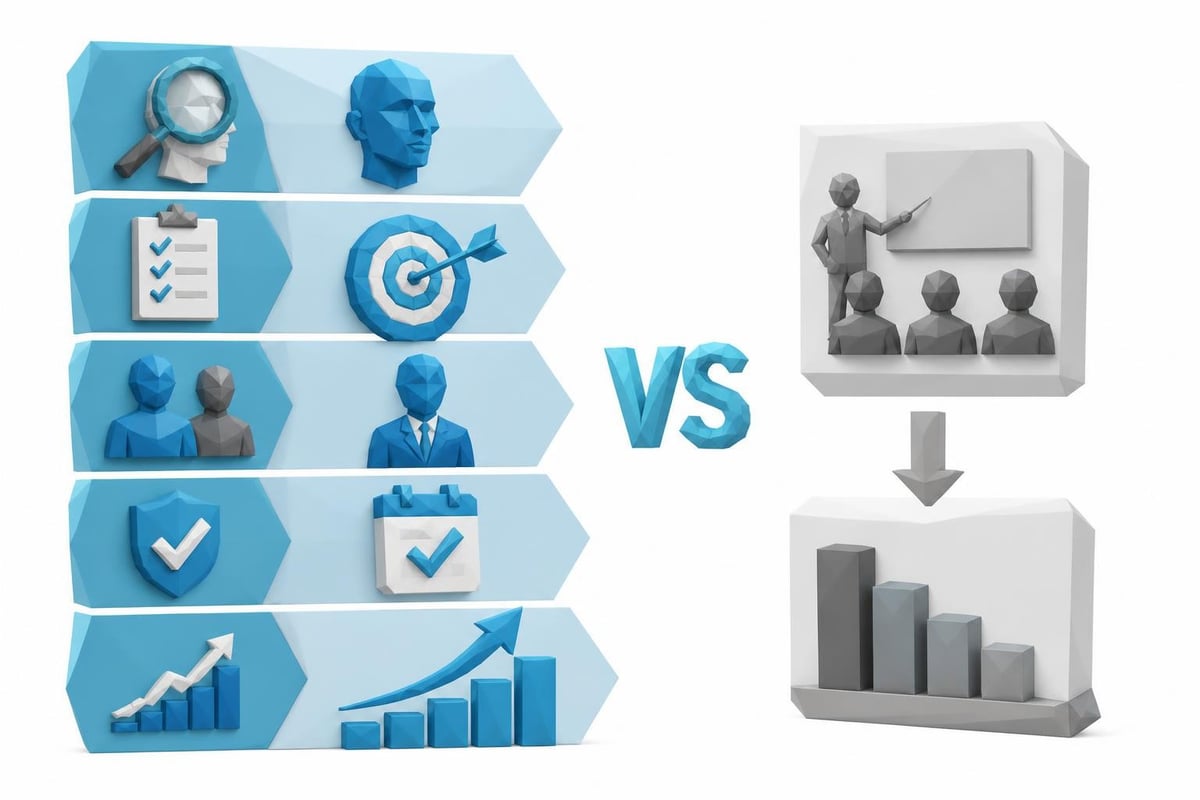
Real leadership development requires precision diagnosis and targeted intervention. Leadership training does not create leaders because it treats leadership as a generic skill set rather than a complex interplay of behavioral patterns, decision-making frameworks, emotional regulation, and contextual judgment that must be developed individually.
Organizations that achieve measurable leadership improvement follow a fundamentally different model:
- Comprehensive behavioral assessment identifying specific gaps, strengths, and derailing patterns
- Individualized development plans targeting the precise behaviors that limit effectiveness
- Expert coach matching pairing leaders with coaches who understand their specific context and challenges
- Structured accountability with defined milestones and behavioral evidence requirements
- Organizational alignment ensuring culture and systems support new behaviors
- Measurement protocols tracking actual behavior change and business impact
The Precision Coaching Alternative
A government agency facing severe morale issues and leadership credibility gaps implemented a precision coaching model in 2024. Rather than sending 50 managers through generic training, they conducted thorough 360-degree assessments, identified specific toxic patterns, and matched each leader with specialized coaches.
Problem: Department-wide engagement scores at 31%, highest turnover rate in agency history, multiple harassment complaints.
Diagnosis: Senior leaders exhibited consistent patterns of defensive communication, lack of transparency, and inconsistent decision-making that destroyed trust.
Solution: Six-month intensive coaching focused specifically on transparent communication protocols, decision-making frameworks, and conflict resolution skills. Weekly accountability sessions with assigned coaches. Monthly behavioral assessments.
Result: Engagement scores increased to 64% within eight months. Voluntary turnover decreased 43%. Zero harassment complaints filed in subsequent 12 months.
Lesson: Leadership training does not create leaders, but targeted behavioral intervention with expert support does. The difference is precision versus generic programs.
The Structural Problems With Off-the-Shelf Programs
Most corporate leadership training fails because vendors sell standardized content to maximize margins, not customized interventions to maximize impact. The business model depends on delivering the same curriculum to hundreds of organizations regardless of specific leadership challenges.
An analysis of common failures in leadership training reveals systematic design flaws:
| Failure Pattern | Why It Happens | Business Impact |
|---|---|---|
| No behavioral diagnosis | Cheaper to skip assessment | Misallocated development resources |
| Generic curriculum | Scales more easily | No relevance to actual challenges |
| Classroom-only format | Lower delivery costs | No application practice |
| No post-training support | Maximizes vendor margins | Behavior reverts immediately |
| No measurement framework | Avoids accountability | No ROI visibility |
The structural incentives in the leadership training industry work against effectiveness. Vendors profit from selling courses, not from creating behavior change. Organizations buy programs based on marketing promises rather than evidence of impact. The cycle perpetuates because leadership training fails in ways that are difficult to measure immediately.
The Hidden Cost of Training That Doesn’t Work
Leadership training does not create leaders, but it does create costs beyond the direct program fees. A mid-sized manufacturing company calculated the total cost of their failed leadership initiative:
- Direct program costs: $890,000
- Executive time invested: 3,200 hours ($640,000 estimated value)
- Lost productivity during training: $420,000
- Opportunity cost of delayed culture change: $2.1 million (estimated)
- Total investment with zero measurable return: $4.05 million
The real damage isn’t just wasted money. It’s the cynicism created when organizations announce leadership development initiatives that produce no change. Employees notice when leaders return from expensive training programs and continue the same toxic, ineffective behaviors. Fortune 500 leaders face this credibility gap when development programs become performative rather than transformational.
The Individual Factors Generic Training Ignores
Leadership effectiveness depends heavily on individual psychology, limiting beliefs, behavioral patterns, and emotional triggers that generic training cannot address. Leadership training does not create leaders because it treats all participants as identical rather than diagnosing individual barriers to effectiveness.
Real examples from executive coaching engagements:
Executive A: Technically brilliant COO who micromanages relentlessly, destroying team autonomy and innovation. Root cause: deep-seated belief that delegation equals loss of control, stemming from early career failure when trusting others led to disaster. Generic training on “effective delegation” changed nothing. Targeted coaching addressing the underlying fear and building new trust frameworks created sustainable change.
Executive B: Charismatic CEO whose conflict avoidance creates toxic ambiguity across the organization. Root cause: learned early that direct confrontation damages relationships, confusion around distinguishing productive conflict from destructive conflict. Training on “crucial conversations” provided concepts but no behavior change. Intensive coaching building specific conflict navigation skills with real-time feedback produced measurable improvement.
Executive C: High-potential VP whose defensive reactions undermine leadership credibility. Root cause: imposter syndrome and anxiety about being exposed as inadequate, triggering defensive justification when questioned. Leadership training taught “executive presence” but couldn’t address the psychological pattern. Specialized coaching on emotional regulation and cognitive reframing created the foundation for behavior change.
Why Context Matters More Than Content
The challenges leaders face are intensely contextual. A manufacturing operations leader needs different capabilities than a technology innovation leader. Government agency leaders operate under constraints that corporate executives never encounter. Leadership coaching that ignores context wastes time teaching irrelevant concepts.
Leadership training does not create leaders partly because it assumes leadership is universal. It isn’t. The behaviors that make someone effective leading rapid innovation in technology startups can destroy effectiveness leading process optimization in regulated industries. Generic programs can’t account for this variation.
The Organizational Systems That Undermine Training
Even well-designed individual development fails when organizational culture punishes the behaviors being taught. A comprehensive review of why leadership training fails identifies systemic barriers as the primary cause of ineffective programs.
Culture Eats Training Programs for Breakfast
An international consulting firm invested heavily in training leaders on collaborative decision-making and inclusive leadership. The training itself was excellent, evidence-based, and well-delivered. Yet post-program assessment showed minimal behavior change.
The diagnosis revealed the problem: The firm’s promotion and compensation systems rewarded individual performance, client acquisition, and competitive behavior. Leaders who adopted collaborative approaches found themselves losing internal political battles and missing compensation targets. The explicit training message conflicted with implicit cultural incentives.
The pattern repeats across organizations:
- Training teaches transparency while culture rewards information hoarding
- Programs promote empowerment while systems demand centralized control
- Curricula emphasize long-term thinking while incentives focus on quarterly results
- Development teaches psychological safety while environments punish vulnerability
Leadership training does not create leaders when organizational systems actively undermine what training teaches. Without addressing psychological safety at work and aligning cultural incentives, even intensive development programs fail.

The Intervention Model That Actually Works
Organizations achieving measurable leadership improvement use fundamentally different approaches than traditional training. The model requires treating leadership development as behavioral intervention, not information delivery.
Evidence-Based Diagnostics Before Intervention
Effective programs start with comprehensive assessment identifying specific behavioral gaps and patterns. This includes validated psychometric tools, 360-degree feedback from direct reports and peers, behavioral observation in actual work contexts, and analysis of leadership challenges specific to each role.
A Fortune 500 retail company implemented this diagnostic-first approach in 2025 for 150 store managers showing high turnover and low customer satisfaction scores. Assessment revealed three distinct leadership pattern clusters requiring different interventions, not one-size-fits-all training.
Cluster 1 (42% of managers): Strong operational skills, poor people development capabilities. Intervention: Coaching on delegation, feedback delivery, and career development conversations.
Cluster 2 (33% of managers): Good relationship skills, weak accountability frameworks. Intervention: Coaching on performance management, difficult conversations, and consequences delivery.
Cluster 3 (25% of managers): Defensive communication patterns undermining trust. Intervention: Intensive coaching on emotional regulation, transparency, and rebuilding credibility.
Results after six months: Turnover decreased 38%, customer satisfaction scores improved 27%, promotion readiness assessments showed 64% of participants ready for district manager roles versus 19% pre-intervention.
Precision Matching to Expert Coaches
Leadership training does not create leaders, but the right coach paired with the right leader can. Matching quality determines intervention success more than any other factor. Leaders need coaches who understand their specific industry context, have experience with their particular leadership challenges, and possess expertise in the behavioral changes required.
Generic matching fails. A technology executive struggling with innovation team leadership needs a coach with deep expertise in creative team dynamics, not just general leadership knowledge. A government agency leader facing compliance and mission complexity needs someone who understands public sector constraints, not corporate coaching frameworks.
The matching algorithm must consider:
- Industry and sector expertise relevant to leader’s context
- Specific behavioral change expertise for diagnosed patterns
- Communication style compatibility for coach-client relationship
- Cultural and diversity factors affecting trust and communication
- Availability and commitment for intensive intervention work
Organizations that achieve results invest in precision matching rather than convenience matching.
Measurement Frameworks That Drive Accountability
Programs succeed when they define clear behavioral targets and measure actual change, not satisfaction scores. Leadership training does not create leaders partly because most programs measure the wrong things.
What programs typically measure (ineffective):
- Participant satisfaction with training
- Knowledge retention on assessments
- Completion rates and attendance
- Self-reported intention to change
What effective programs measure (accountability-driven):
- Specific behavioral changes observed by direct reports
- Team performance metrics (engagement, retention, productivity)
- 360-degree feedback shifts from pre- to post-intervention
- Business outcomes tied to leadership effectiveness
- Promotion readiness and succession pipeline health
A pharmaceutical company restructured their leadership development measurement in 2024, moving from satisfaction surveys to behavioral evidence requirements. Each participant’s coach must document specific behavior changes with corroborating evidence from direct reports, peers, or supervisors. Programs that don’t produce measurable behavior change get eliminated.
This accountability shift increased program effectiveness dramatically. The percentage of participants showing sustained behavior change six months post-program increased from 23% to 71%. The company now treats leadership development as performance improvement intervention, not educational programming.
The Technology Integration Challenge
AI and automation are creating leadership challenges that traditional training never anticipated. The gap between AI potential and AI reality is a leadership problem, requiring leaders to navigate technological change, workforce adaptation, and strategic implementation simultaneously.
Leadership training does not create leaders capable of managing AI transformation because the challenges are too new and contextual for standardized curricula. Leaders need individualized coaching addressing their specific technology adoption challenges, organizational resistance patterns, and strategic decision frameworks.
Current Leadership Gaps in Technology Transformation
- Strategic judgment about which processes to automate versus augment
- Change management for workforce displacement and role evolution
- Ethical frameworks for AI governance and responsible deployment
- Communication skills explaining complex technology decisions to diverse stakeholders
- Adaptation capability as technology capabilities evolve quarterly
Generic training on “leading digital transformation” provides concepts. Specialized coaching builds decision-making capability for actual implementation challenges leaders face today.
Contrarian Insight: Stop Buying Leadership Training
The industry’s dirty secret is that most leadership development spending would deliver better ROI if redirected to other interventions. Leadership training does not create leaders in most organizational contexts because the structural barriers are too significant for individual development to overcome.
Before investing in leadership programs, organizations should audit:
Is the culture ready for leadership change? If toxic patterns are rewarded and effective leadership is punished, development programs waste money. Fix culture first.
Are leadership challenges individual or systemic? If ineffective leadership stems from unrealistic spans of control, broken processes, or impossible conflicting priorities, coaching individuals won’t help. Fix systems first.
Does the organization have capacity for individualized intervention? If budgets only allow generic off-the-shelf programs, the money is better spent elsewhere. Precision programs or nothing.
Can behavior change be measured and sustained? If there’s no accountability framework or follow-through capability, training creates cynicism, not leaders.
A manufacturing company’s CHRO made the controversial decision to cancel their annual leadership training program and redirect the $1.2 million budget to organizational redesign reducing span of control from 18 to 11 direct reports per manager. Leadership effectiveness scores improved more in six months than the previous three years of training programs combined. The constraint wasn’t leader capability. It was impossible structural conditions.
The ROI Calculation Organizations Miss
Leadership training does not create leaders in ways that generate financial returns in most implementations. Organizations fail to calculate the full ROI because they don’t measure opportunity costs and alternative uses of resources.
True ROI calculation requires:
| Cost Category | Typical Calculation | Complete Calculation |
|---|---|---|
| Direct program fees | ✓ Included | ✓ Included |
| Executive time investment | ✗ Ignored | ✓ Calculated at loaded rate |
| Lost productivity during training | ✗ Ignored | ✓ Estimated business impact |
| Implementation support needed | ✗ Ignored | ✓ Coaching, systems, culture work |
| Opportunity cost of capital | ✗ Ignored | ✓ Alternative investments considered |
| Behavior change probability | ✗ Assumed 100% | ✓ Based on evidence (typically 10-20%) |
When organizations run complete ROI calculations, most traditional training programs show negative returns. The exceptions are precision interventions targeting specific, diagnosed behavioral gaps with expert coaching, measurement accountability, and cultural alignment.
Building Capability at Scale
For enterprise organizations needing leadership development across hundreds or thousands of leaders, precision individualized approaches seem impossible. This is where most companies default to ineffective generic training. The alternative is scalable precision through technology-enabled matching, standardized diagnostic frameworks, and distributed coaching networks.
Executive coaching can scale when supported by rigorous assessment algorithms, quality coach networks with verified expertise, and measurement platforms tracking behavioral outcomes. Leadership training does not create leaders at scale, but well-designed coaching interventions can.
The scalability framework requires:
- Automated diagnostic assessment using validated tools
- Algorithm-driven coach matching based on expertise, context, and needs
- Standardized intervention protocols customized to individual patterns
- Digital accountability platforms tracking behavior change
- Aggregated analytics showing program effectiveness and ROI
Organizations implementing this model achieve both scale and precision. A Fortune 500 technology company used this approach for 800 managers across 23 countries in 2025, achieving 68% behavior change persistence at six months versus their previous 15% with traditional training.
Frequently Asked Questions
Why does leadership training fail so often?
Leadership training fails because it treats leadership as knowledge to be learned rather than behavior to be changed through intensive, individualized intervention. Most programs deliver generic content in classroom settings without addressing individual psychological barriers, organizational culture conflicts, or systemic constraints that prevent behavior change. Without precision diagnosis, expert coaching, accountability mechanisms, and cultural alignment, training creates awareness but not capability.
What’s the difference between leadership training and leadership coaching?
Leadership training delivers standardized content to groups, focusing on concepts, frameworks, and case studies. Leadership coaching provides individualized intervention targeting specific behavioral gaps diagnosed through assessment, with expert coaches who understand the leader’s context and challenges. Training assumes all participants need the same information. Coaching addresses the unique barriers preventing each leader’s effectiveness. Research consistently shows coaching produces measurable behavior change while generic training rarely does.
How can organizations measure leadership development effectiveness?
Effective measurement focuses on behavioral evidence and business outcomes, not satisfaction scores. Organizations should track 360-degree feedback changes showing how direct reports, peers, and supervisors observe different behaviors, team performance metrics including engagement, retention, and productivity, promotion readiness assessments, business results tied to leadership effectiveness, and sustained behavior change verified six and twelve months post-intervention. Measurement systems must require documented evidence, not self-reported intentions.
Is leadership development worth the investment?
Leadership development delivers strong ROI only when implemented as precision behavioral intervention, not generic training. Organizations achieving measurable returns use comprehensive diagnostics identifying specific gaps, expert coach matching based on context and expertise, accountability frameworks requiring behavioral evidence, cultural alignment ensuring systems support new behaviors, and rigorous measurement tracking actual change. Without these elements, leadership development spending typically generates negative returns. The investment question isn’t whether to develop leaders, but whether to implement programs that actually work.
What leadership challenges require individualized coaching versus training?
Complex behavioral patterns require individualized coaching including defensive communication undermining trust, micromanagement preventing delegation, conflict avoidance creating toxic ambiguity, imposter syndrome triggering defensive reactions, and limiting beliefs about leadership capability. Training can deliver frameworks for decision-making, strategic thinking models, and industry-specific knowledge. But changing ingrained behavioral patterns requires expert coaching addressing individual psychology, contextual triggers, and sustained accountability. Most leadership effectiveness issues are behavioral, making coaching more effective than training.
Leadership training does not create leaders because most programs deliver generic content without addressing individual behavioral barriers, organizational culture conflicts, or systemic constraints that actually determine leadership effectiveness. Organizations need precision diagnostic assessment, expert coach matching, and accountability frameworks that drive measurable behavior change. Noomii Leadership Coaching provides comprehensive leadership diagnostics, proprietary matching algorithms connecting leaders with specialized coaches, and measurement systems tracking behavioral outcomes and business impact to help organizations develop leadership capability that drives real results.



Leave a Reply
Want to join the discussion?Feel free to contribute!