
Can You Coach Without Certification? What Really Matters
The question “can you coach without certification” surfaces constantly in conversations with mid-market executives evaluating coaching providers. The short answer: yes, absolutely. Coaching remains largely unregulated, and no legal requirement mandates certification to offer coaching services. The longer answer reveals what actually predicts coaching effectiveness, and it’s rarely the letters after someone’s name.
The Legal Reality of Coaching Without Credentials
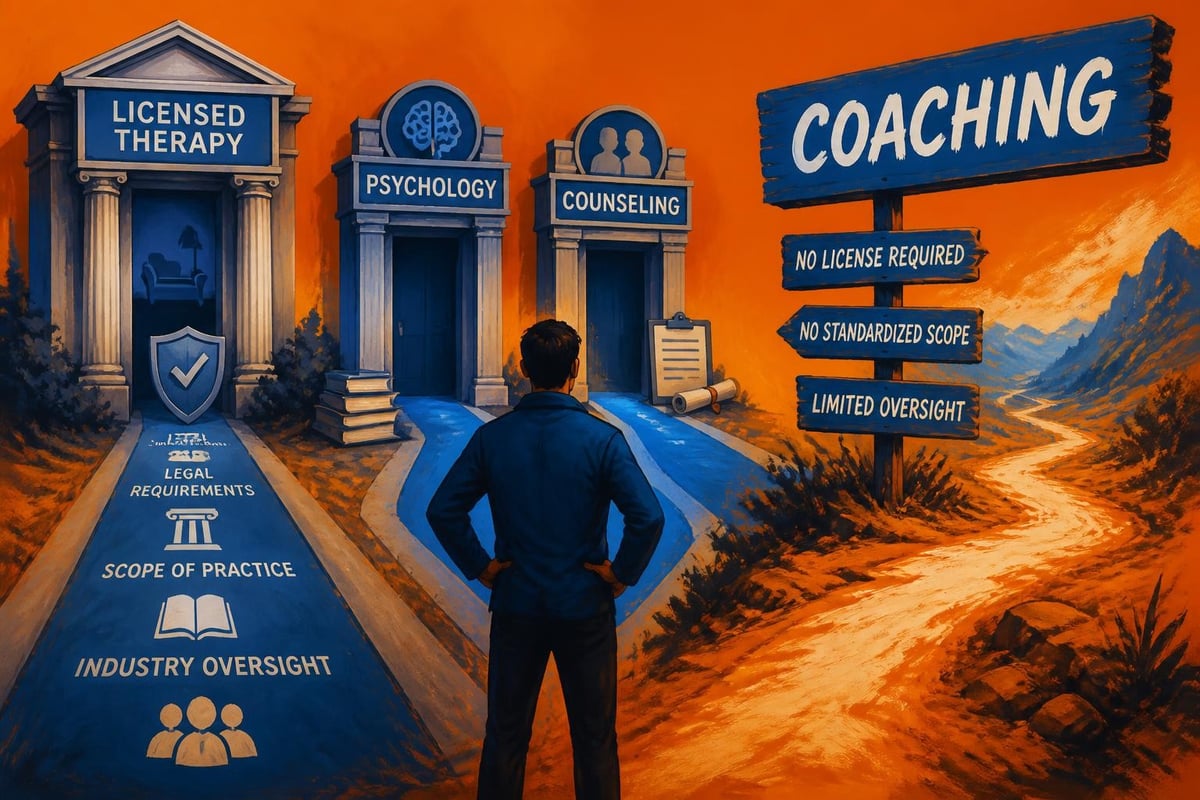
Coaching operates in an unregulated space, fundamentally different from licensed professions like therapy or law. The coaching industry’s unregulated status means anyone can legally call themselves a coach and begin working with clients tomorrow. No government body restricts entry, no standardized testing exists, and no universal licensing protects the title.
This creates both opportunity and confusion:
- Experienced operators can build practices based on expertise rather than classroom hours
- Career changers with deep domain knowledge can transition directly into coaching
- Corporate leaders can formalize their internal coaching without seeking external approval
- Buyers must evaluate coaches based on substance rather than shortcuts
The distinction between coaching and therapy matters legally. While therapy requires licensure and addresses mental health conditions, coaching focuses on goal achievement, performance improvement, and skill development. Coaches without certification who stray into therapeutic territory risk ethical and legal complications, regardless of credentials.
What Certification Actually Measures
Most coaching certifications measure hours completed, not outcomes delivered. The major credentialing bodies (ICF, EMCC, IAC) focus heavily on training hours, mentor coaching sessions, and demonstrated coaching conversations. They rarely track client results, business impact, or longitudinal success.
After reviewing hundreds of coaching engagements across mid-market companies, patterns emerge clearly. The certified coach with 200 training hours and zero corporate experience often struggles more than the former VP of Sales who understands pipeline pressure, quota stress, and territory management intimately.
Certification Gaps in Corporate Environments
| What Certification Tests | What Corporate Buyers Need |
|---|---|
| Coaching presence and active listening | Business acumen and industry knowledge |
| Adherence to coaching ethics codes | Understanding of P&L, KPIs, and ROI |
| Completion of supervised hours | Track record of measurable results |
| Theoretical frameworks | Practical application in live business scenarios |
Performance coaching in corporate settings requires context that no certification program fully provides. A coach working with a sales director needs to understand funnel metrics, conversion rates, and deal velocity, not just powerful questions and reflective listening.
The Case for Experience Over Credentials
Case Study: The Manufacturing Turnaround
A mid-market manufacturing client needed leadership coaching for their operations team. They initially requested ICF-certified coaches. We presented two options:
Option A: ICF-credentialed coach, 500+ training hours, extensive coaching experience with individuals
Option B: Former plant manager with 15 years in manufacturing operations, no certification, newer to formal coaching
They chose Option B hesitantly. Six months later, production efficiency improved 23%, safety incidents dropped 40%, and supervisor retention increased significantly. The coach understood shift handoffs, equipment downtime, and union dynamics instinctively. No certification program teaches those nuances.
The diagnosis was clear: the operations leaders needed someone who’d lived their challenges, not someone who’d studied coaching theory. The solution involved coaching directly in production meetings, creating simple scorecards tied to daily operations, and addressing real-time conflicts as they emerged. The result validated what many buyers eventually learn: relevant experience often predicts coaching success better than certification status.
When Certification Adds Value (And When It Doesn’t)
Certification serves specific purposes. New coaches benefit from structured training, ethical guidelines, and supervised practice. Clients seeking life coaching or career transitions sometimes value certification as a trust signal, especially when the coach lacks other credibility markers.
But clients prioritize results over credentials when evaluating coaching effectiveness. In corporate environments, decision makers ask different questions:
- Have you coached leaders facing situations similar to ours?
- What specific outcomes did those engagements produce?
- How do you measure progress and tie coaching to business metrics?
- What’s your experience with our industry’s unique challenges?
None of those questions get answered by certification. They require demonstrated expertise, pattern recognition across multiple engagements, and the judgment that comes from seeing what works and what fails repeatedly.

The Practical Framework for Evaluating Coaches
Whether you’re hiring a coach or deciding if you can coach without certification yourself, use this assessment framework:
Domain Expertise Assessment
- Industry Knowledge: Does the coach understand your business context deeply?
- Role Experience: Has the coach held positions similar to the coaching clients?
- Pattern Recognition: Can they quickly identify recurring challenges and solutions?
- Business Literacy: Do they speak the language of metrics, ROI, and business outcomes?
Coaching Skill Verification
- Request examples of specific client transformations with measurable outcomes
- Ask about their coaching methodology and how it ties to business results
- Evaluate their ability to challenge assumptions and surface blind spots
- Assess whether they coach live in real business situations or only in private sessions
Results Orientation
You can coach without certification successfully if you focus relentlessly on outcomes. The best coaches we’ve observed across hundreds of engagements share common traits: they tie every coaching conversation to specific business objectives, they measure progress through clear KPIs, and they adjust approaches based on what’s working.
Understanding leadership coaching costs and value often reveals that buyers pay more for certified coaches despite getting comparable or inferior results. The certification premium rarely correlates with outcome quality in corporate settings.
Proprietary Approach: The Results-First Coaching Method
Our experience coaching Fortune 500 divisions and mid-market companies led to a clear methodology that operates independently of certification status:
The Five-Layer Coaching Integration:
- Live Meeting Participation: Coach directly in operational meetings, not just one-on-ones
- KPI Scorecards: Establish clear metrics before coaching begins
- Real-Time Feedback: Address leadership gaps as they emerge in actual business situations
- Manager Development: Train leaders to coach their teams, multiplying impact
- ROI Tracking: Tie coaching outcomes to retention, productivity, and business performance
This framework emerged from observing what separates effective corporate coaching from ineffective approaches. Certification programs rarely teach live meeting facilitation, scorecard design, or ROI measurement because they focus on individual coaching conversations in isolation.
Contrarian Insight: The Certification Trap
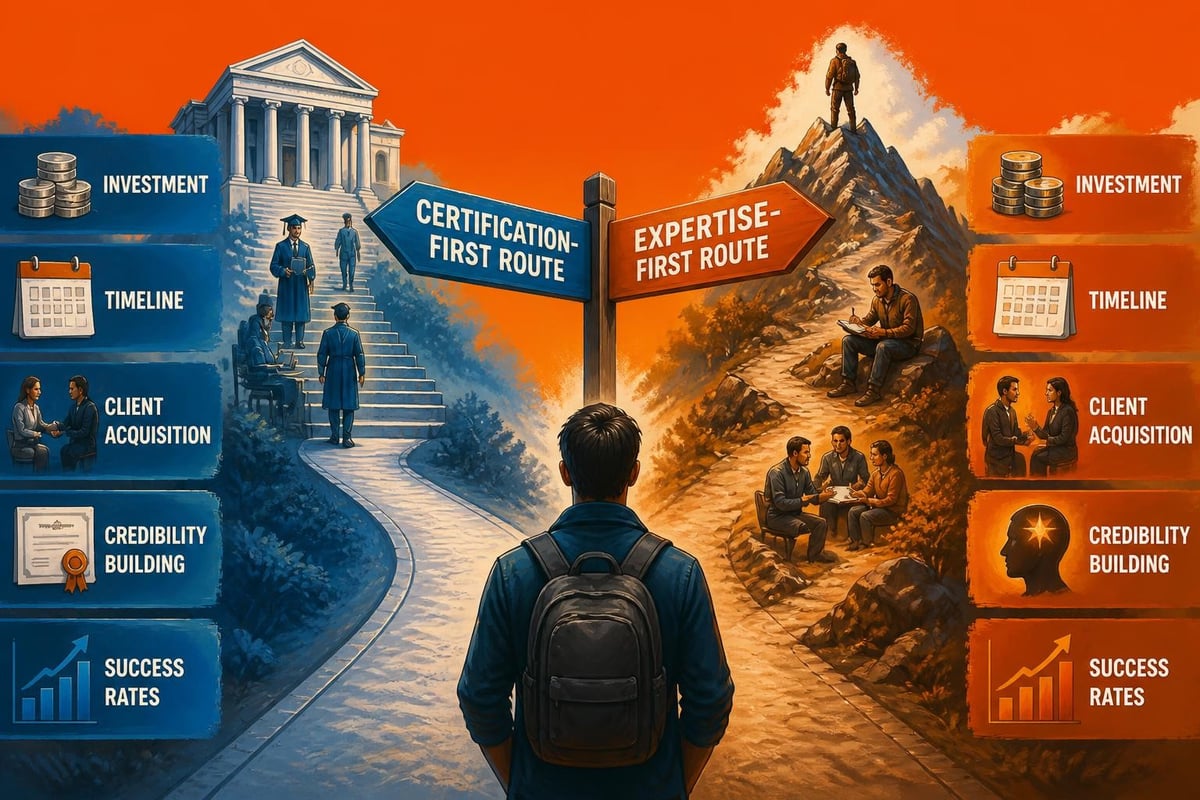
The coaching industry’s increasing focus on certification creates perverse incentives. Aspiring coaches spend thousands on training programs when they could invest that time building expertise, working with clients, and generating results. The certification-industrial complex benefits training providers more than coaches or clients.
Consider this pattern:
Newly certified coaches often struggle to find clients because certification alone doesn’t differentiate them in a saturated market. Meanwhile, domain experts who transition into coaching without certification frequently build practices faster because they bring irreplaceable knowledge and established networks.
The challenge isn’t whether you can coach without certification, but whether you can deliver results that justify client investment. Buyers increasingly recognize this distinction, especially in corporate environments where business outcomes matter more than coaching credentials.
Emerging Trends: AI and the Certification Question
AI tools entering the coaching space further complicate the certification debate. If AI can provide coaching-style conversations without any credentials, what value does human certification provide? The answer lies in areas AI cannot replicate: business judgment, contextual pattern recognition, relationship building, and real-time adaptation to complex organizational dynamics.
Smart coaches leverage technology while focusing on distinctly human contributions. Their value comes from experience applying coaching in messy, ambiguous business situations, not from completing standardized training programs.
Building Trust Without Credentials
When you coach without certification, establishing credibility requires alternative proof points:
- Client testimonials with specific outcome metrics
- Case studies demonstrating business impact
- Industry recognition from peers and professional communities
- Speaking engagements at industry events
- Published insights demonstrating expertise
- Results guarantees or performance-based pricing
Noomii’s directory includes coaches across the credibility spectrum, from extensively certified practitioners to experienced operators who built coaching practices on results alone. Both approaches succeed when focused on client outcomes.
FAQ
Can you legally coach without certification?
Yes, coaching is an unregulated profession in most jurisdictions. No legal requirement mandates certification to offer coaching services, unlike licensed professions such as therapy or law.
Do clients care about coaching certification?
Client priorities vary. Individual clients sometimes value certification as a trust signal, while corporate buyers typically prioritize industry experience, business acumen, and demonstrated results over credentials.
What’s the difference between coaching and therapy regarding certification?
Therapy requires state licensure and addresses mental health conditions, while coaching focuses on performance, goals, and skill development. Coaches must avoid therapeutic work regardless of certification status.
How much does coaching certification cost?
Accredited coaching certification programs range from $3,000 to $15,000+ depending on the provider and credential level. These costs don’t guarantee coaching effectiveness or business success.
Can experienced professionals transition to coaching without certification?
Yes, professionals with deep domain expertise often build successful coaching practices faster than newly certified coaches because they bring irreplaceable industry knowledge and established networks.
What matters more than certification in corporate coaching?
Business acumen, industry experience, track record of measurable results, ability to tie coaching to KPIs and ROI, and understanding of organizational dynamics typically predict coaching success better than certification.
How do I evaluate a coach without relying on certification?
Request specific client outcome examples, assess their industry knowledge, verify their understanding of business metrics, ask about their coaching methodology’s tie to results, and check references from similar engagements.
Is coaching certification worth the investment?
Value depends on your situation. New coaches benefit from structured training and ethical guidance. Experienced operators may find better ROI investing in client acquisition, niche expertise, or business development instead.
What credentials do Fortune 500 companies require for coaches?
Requirements vary, but Fortune 500 leaders increasingly prioritize demonstrated business results, relevant industry experience, and coaching methodologies tied to measurable outcomes over certification status alone.
The evidence is clear: you can coach without certification, and certification alone doesn’t predict coaching effectiveness. What matters is your ability to deliver measurable results, understand business context, and adapt to client needs in real time. Noomii connects mid-market companies with results-focused coaches who prioritize outcomes over credentials, offering month-to-month terms, live meeting facilitation, and clear ROI tracking. If you need corporate coaching that drives faster decisions, stronger leadership, and measurable business impact, start your search with coaches who demonstrate expertise through results, not just certifications.



Leave a Reply
Want to join the discussion?Feel free to contribute!