

Leadership Lessons from Corporate Crises
Corporate crises reveal what executive development programs obscure: who your leaders actually are under pressure. The gap between theoretical leadership capability and real-world crisis performance costs organizations billions annually, destroys reputations built over decades, and exposes fundamental weaknesses in executive judgment that routine operations mask. Leadership lessons from corporate crises aren't abstract principles. They're expensive, public failures that illuminate exactly where leadership development initiatives fall short and what separates executives who navigate turbulence from those who accelerate organizational collapse.
Why Most Crisis Leadership Training Fails Before the Crisis Hits
Organizations invest heavily in crisis management frameworks, yet 73% of executives admit their companies are unprepared for major disruptions. The problem isn't lack of planning. It's that leadership lessons from corporate crises consistently show the same pattern: executives fail at fundamental communication, accountability, and decision-making under pressure, not exotic edge cases.
The three failure modes that recur across industries:
- Delayed acknowledgment while lawyers debate language and PR teams craft messaging
- Diffused accountability where no single leader owns the response
- Defensive posturing that prioritizes reputation over resolution
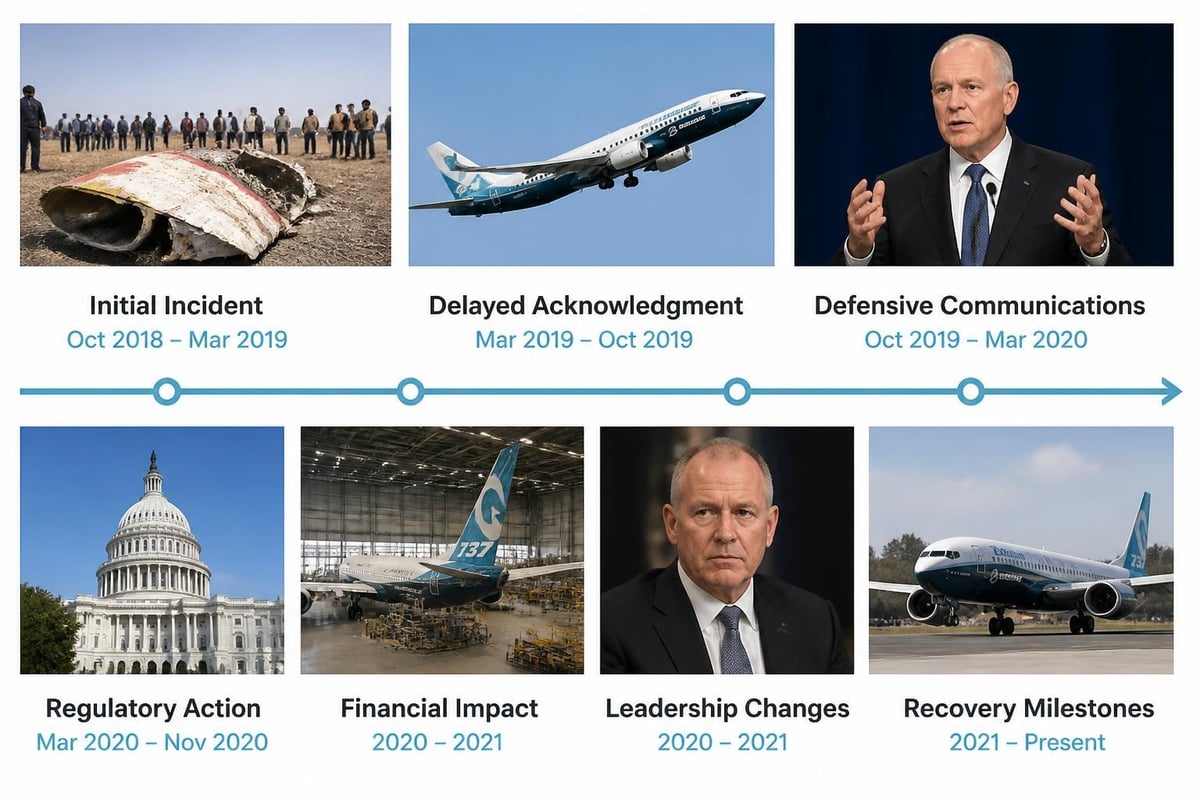
Boeing's 737 MAX crisis exemplifies this pattern. After two fatal crashes in 2018 and 2019, leadership delayed grounding the fleet, defended the aircraft's safety, and initially blamed pilot error. The cost: 346 deaths, a 20-month grounding, over $20 billion in losses, and criminal charges. The leadership lesson isn't about aviation engineering. It's about executives who couldn't process information that contradicted their preferred narrative.
The Pattern Recognition Deficit
Most executives have never led through genuine crisis. They've managed challenges, addressed setbacks, navigated competitive threats. But crisis demands different neural pathways. Harvard Business School research on navigating organizational storms confirms that leaders without crisis pattern recognition default to peacetime decision frameworks when speed and clarity matter most.
This creates the paradox: the executives least equipped for crisis leadership often hold the most senior roles because they rose during stable periods optimizing existing systems. Their experience base doesn't include the reference points that enable rapid, confident decision-making when normal operations collapse.
Organizations addressing this gap through leadership coaching focus on building crisis simulation experiences and identifying executives whose judgment sharpens rather than deteriorates under pressure. The distinction is measurable and predictive.
What Wells Fargo's Fake Accounts Scandal Reveals About Accountability Structures
The Wells Fargo fake accounts scandal (2011-2016) exposed 3.5 million fraudulent accounts created by employees meeting impossible sales targets. CEO John Stumpf initially blamed rogue employees, calling it a "situation" rather than a systemic failure. The leadership lesson from this corporate crisis: accountability structures that work during growth often invert during crisis, protecting senior executives while sacrificing frontline workers.
| Leadership Response | Wells Fargo Reality | Effective Alternative |
|---|---|---|
| Acknowledge scope | Downplayed as isolated incidents | Immediate independent audit |
| Own accountability | Blamed 5,300 fired employees | CEO accepts responsibility publicly |
| Structural change | Cosmetic policy adjustments | Eliminate incentive structure |
| Timeline | Delayed for years | Transparent weekly updates |
The broader lesson: toxic cultures don't appear during crises. Crises reveal them. Wells Fargo's aggressive sales culture existed for years, celebrated internally as high performance. Leadership dismissed early warnings, rewarded the behaviors that generated fraud, and created conditions where employees feared speaking up.
Three diagnostic questions that predict crisis vulnerability:
- Do executives hear bad news as fast as good news?
- Can mid-level managers challenge senior decisions without career risk?
- Are incentive structures aligned with long-term organizational health or short-term metrics?
Organizations working to transform leadership patterns often discover that addressing toxic behaviors requires changing reward systems, not just individual coaching. The structure shapes the behavior.
The Volkswagen Emissions Scandal: When Engineering Culture Outweighs Ethics
Volkswagen's "Dieselgate" scandal (2015) demonstrated how leadership lessons from corporate crises often center on cultural priorities that seem reasonable until they're not. Engineers installed defeat devices to cheat emissions tests because meeting both performance targets and regulatory standards seemed impossible. Leadership created conditions where cheating appeared more acceptable than admitting limitations.
The crisis cost Volkswagen over $35 billion in fines, recalls, and legal settlements. But the deeper cost was credibility. A company built on engineering excellence revealed that its leadership valued metrics over integrity when forced to choose.
The Decision Architecture Failure
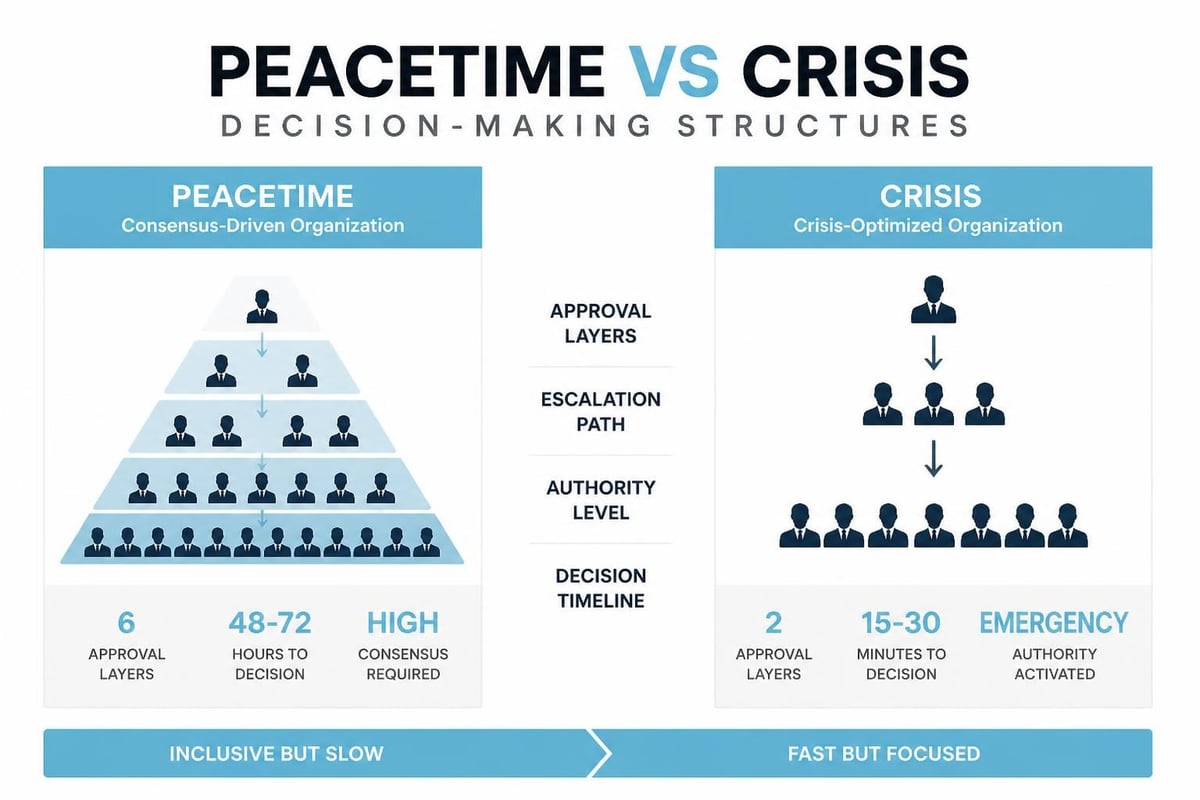
Crisis autopsies consistently reveal decision architectures that worked until they catastrophically didn't. Volkswagen's matrix structure diffused accountability across engineering, compliance, legal, and executive teams. No single leader owned the emissions challenge. When defeat devices were developed, multiple teams knew, but the structure prevented clear ownership or escalation.
Leading through crisis requires clear decision authority, not consensus building. The organizations that navigate crises effectively simplify reporting lines, elevate decision authority, and eliminate the committees that delay action while appearing thorough.
Crisis-ready decision architecture:
- Single point of accountability for crisis response
- Direct escalation paths that bypass normal hierarchy
- Authority to override standard procedures
- Pre-defined communication protocols
- Resource allocation discretion without approval chains
This isn't about centralizing all decisions. It's about clarifying who decides what under pressure and removing structural barriers to rapid response.
Johnson & Johnson's Tylenol Crisis: The Outlier That Proves the Pattern
The 1982 Tylenol crisis remains the benchmark for effective crisis leadership precisely because it's so rare. When seven people died from cyanide-laced Tylenol capsules, CEO James Burke immediately recalled 31 million bottles worth $100 million, halted production and advertising, and communicated transparently with the public. Market share dropped from 37% to 7%, then recovered to previous levels within a year.
The leadership lessons from this corporate crisis aren't complicated:
- Prioritize human safety over financial impact
- Act before having complete information
- Communicate what you know and what you don't
- Accept short-term costs for long-term credibility
What made Burke's response exceptional? Johnson & Johnson's credo explicitly prioritized customer safety above shareholder returns. The values weren't poster decoration. They were decision criteria under pressure. Burke didn't need to debate priorities or calculate trade-offs. The framework was clear.
Most organizations lack this clarity. Their values statements mention integrity, customer focus, and innovation, but provide no hierarchy when these conflict. Crisis forces choices. Leaders who haven't clarified value priorities before crisis default to financial calculations because they're quantifiable.
Building Pre-Crisis Decision Frameworks
Organizations that navigate crises effectively establish decision frameworks before pressure arrives. These aren't crisis plans. They're value hierarchies that answer: when customer safety conflicts with quarterly earnings, which wins? When regulatory compliance requires operational shutdowns, what's the approval threshold?
The World Economic Forum’s analysis of crisis leadership emphasizes learning from others' experiences, but the deeper lesson is installing the decision architecture that enables rapid, aligned responses. This requires executive teams to debate and resolve value conflicts during calm periods, not during emergencies.
The Noomii Corporate Leadership Program uses behavioral assessments to identify how executives actually prioritize under pressure versus how they believe they prioritize. The gap predicts crisis performance more accurately than experience or credentials.
Facebook's Cambridge Analytica Response: When Speed Backfires
Facebook's handling of the Cambridge Analytica scandal (2018) illustrates how leadership lessons from corporate crises include knowing when speed matters and when precision matters. Mark Zuckerberg delayed public response for five days while gathering information. When he finally responded, the statement acknowledged mistakes but felt calculated rather than authentic.
The crisis revealed 87 million users' data was harvested without consent. Facebook's initial response focused on technical explanations and policy changes rather than acknowledging the fundamental breach of user trust. Stock dropped 14%, losing $80 billion in market value. Congressional hearings followed. Regulatory scrutiny intensified globally.
What Facebook's leadership got wrong:
- Treated a trust crisis as a communications challenge
- Led with legal and technical explanations rather than empathy
- Appeared more concerned about regulatory consequences than user impact
- Used carefully crafted statements instead of authentic dialogue
The contrast with Johnson & Johnson is instructive. Burke's immediate recall demonstrated values through action. Zuckerberg's delayed, measured response demonstrated calculation. Both faced crises threatening their core business. Their responses revealed fundamentally different leadership orientations.
The Pattern Across Industries: Preparation Beats Improvisation
Leadership lessons from corporate crises converge on a finding that contradicts conventional wisdom: crisis leadership isn't primarily about decision-making during crisis. It's about decisions made long before crisis arrives. The organizations that navigate turbulence effectively built capability, clarity, and credibility during calm periods.
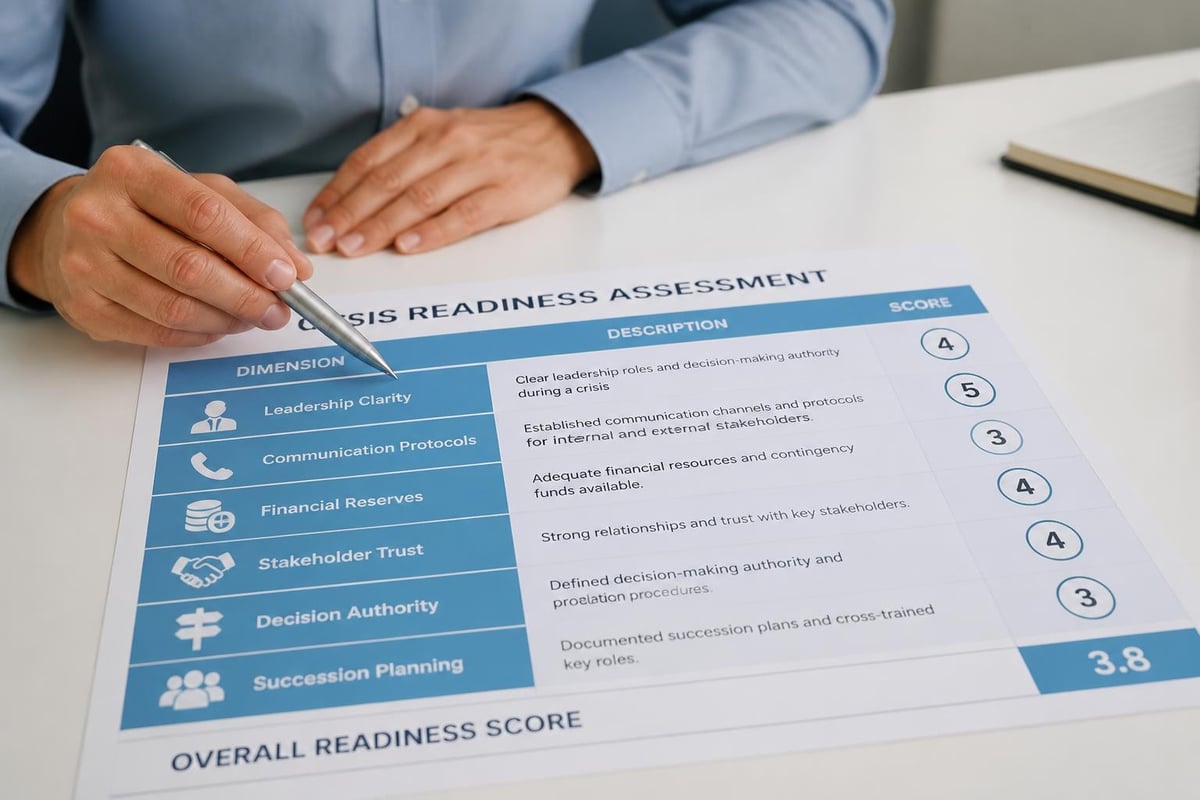
Pre-crisis investments that determine crisis outcomes:
- Communication infrastructure that functions when normal channels fail
- Succession clarity so leadership transitions don't compound crisis
- Stakeholder relationships built on trust before needing urgent cooperation
- Financial reserves that provide decision flexibility under pressure
- Scenario planning that expands executive crisis pattern recognition
The gap between prepared and unprepared organizations becomes visible within hours of crisis onset. Prepared organizations activate protocols, communicate clearly, and make decisions confidently. Unprepared organizations convene meetings, debate responses, and appear reactive because they are.
The Role of Executive Coaching in Crisis Preparation
Organizations increasingly use executive coaching to build crisis capability before crisis arrives. The approach shifts from theoretical training to behavioral development targeting specific executive gaps: communication under pressure, decision-making with incomplete information, maintaining team morale during uncertainty, and balancing stakeholder demands.
Effective coaching identifies how individual executives respond to stress, ambiguity, and high-stakes decisions. Some leaders sharpen under pressure. Others deteriorate. The pattern is consistent and predictive. Organizations that assess this dimension place executives accordingly, ensuring those in crisis-critical roles have demonstrated capability, not assumed capability.
The Noomii approach combines behavioral diagnostics with sector-specific coaching to address individual leadership gaps while maintaining organizational alignment. This matters because crisis response requires coordinated action across executives with different stress responses, risk tolerances, and communication styles.
What BP's Deepwater Horizon Reveals About Authentic Leadership
The 2010 Deepwater Horizon explosion killed 11 workers and spilled 4.9 million barrels of oil into the Gulf of Mexico. BP's crisis response became a case study in what not to do. CEO Tony Hayward's comment "I'd like my life back" while cleanup crews worked 16-hour shifts demonstrated tone-deafness that destroyed credibility.
Leadership lessons from this corporate crisis center on authenticity under pressure. Hayward wasn't uniquely insensitive. He was exhausted, frustrated, and momentarily honest. But crisis leadership requires discipline that suppresses personal feelings in service of organizational needs. Leaders who can't maintain this discipline shouldn't be visible during crisis.
BP's broader failure was operational. Cost-cutting decisions, ignored safety warnings, and rushed procedures created conditions for disaster. Crisis didn't cause these failures. It revealed them. The leadership lesson: organizations optimize what they measure, and BP optimized cost and speed over safety until the gap between stated values and actual priorities became catastrophic.
Measuring What Actually Matters
Most organizations track financial metrics obsessively and cultural health metrics sporadically. This creates blind spots. Leaders don't see emerging problems until they become crises because the measurement systems focus downstream (results) rather than upstream (conditions).
Organizations building crisis resilience install leading indicators that predict problems before they escalate:
- Employee psychological safety scores
- Near-miss reporting rates
- Time between issue identification and executive awareness
- Percentage of meetings where bad news is discussed
- Speed of decision-making on non-routine issues
These metrics reveal whether leadership has built the conditions for sustainable performance or short-term results that will eventually collapse. Understanding psychological safety dynamics helps organizations identify when cultures are suppressing problems rather than solving them.
Lessons from Organizations That Emerged Stronger
Not all crises destroy organizations. Some catalyze transformation that wouldn't have occurred otherwise. Organizations that emerged stronger from adversity share common patterns: they used crisis to eliminate long-standing dysfunction, accelerate necessary changes, and rebuild cultures around clearer values.
The transformation pattern:
- Acknowledge the full scope of problems without defensiveness
- Replace leaders who created or ignored conditions leading to crisis
- Restructure systems that enabled or rewarded problematic behavior
- Communicate transparently about changes and why they matter
- Demonstrate sustained commitment to new standards over multiple years
This requires executives willing to make themselves uncomfortable, boards willing to demand change, and organizations willing to invest in transformation rather than cosmetic adjustments. Most organizations lack this will. They implement training programs, update policies, and declare culture change while preserving the structures and incentives that created problems.
Real transformation looks different. It involves personnel changes, structural redesigns, and metric shifts that make old behaviors impossible and new behaviors unavoidable. The organizations that achieve this often bring in external leadership because internal executives are too embedded in existing systems to fundamentally reimagine them.
Building Crisis Leadership Capability Systematically
Leadership lessons from corporate crises point toward systematic capability building rather than hoping executives rise to the occasion. Hope isn't strategy. Organizations need structured approaches that identify gaps, develop capabilities, and validate readiness before crisis tests them.
Components of systematic crisis leadership development:
- Behavioral assessments identifying how executives perform under pressure
- Crisis simulations using realistic scenarios specific to industry risks
- Communication training focused on transparency and authenticity
- Decision framework development clarifying value hierarchies and authorities
- Stakeholder mapping establishing relationships before needing urgent cooperation
- After-action reviews extracting lessons from near-misses and minor incidents
The investment pays dividends during calm periods too. Executives who can lead effectively through crisis generally lead more effectively during routine operations. The capabilities overlap: clear communication, decisive action, authentic relationships, and values-aligned decisions matter always, not just during emergencies.
Organizations implementing systematic development often discover their current executive team lacks crisis-capable leaders. This creates uncomfortable conversations but valuable clarity. Better to identify gaps during assessment than during crisis. Some executives develop capability through coaching. Others don't. Knowing which is which before crisis arrives changes succession planning and organizational risk.
The Integration Challenge: Making Lessons Actionable
The gap between knowing leadership lessons from corporate crises and implementing capability building is where most organizations fail. Executives attend crisis leadership seminars, read case studies, and discuss what they'd do differently. Then they return to organizations with unchanged structures, incentives, and decision processes.
Implementation requires three shifts:
Shift One: From Individual to Organizational
Crisis leadership isn't primarily an individual capability. It's organizational architecture. Decision clarity, communication protocols, resource allocation authority, and stakeholder relationships are systemic, not personal. Coaching individual executives matters, but changing organizational structures determines whether those individuals can actually lead effectively when crisis hits.
Shift Two: From Theoretical to Behavioral
Most leadership development focuses on conceptual frameworks: situational leadership, servant leadership, transformational leadership. Crisis demands behavioral competence: can you communicate clearly when exhausted? Can you make high-stakes decisions with incomplete information? Can you maintain team morale while delivering bad news?
Behavioral development requires practice under pressure, feedback on performance, and coaching to change ingrained patterns. Theoretical understanding doesn't transfer to behavioral capability without this work.
Shift Three: From Reactive to Proactive
Organizations typically invest in crisis leadership after experiencing crisis. The pattern is expensive and predictable. Proactive organizations build capability during calm periods, treating crisis readiness as core infrastructure rather than emergency response.
This requires executives to prioritize investments with ambiguous ROI. Crisis preparation costs money and time with no guarantee of payoff. But the alternative is guaranteed exposure when crisis eventually arrives.
Frequently Asked Questions
What separates effective crisis leaders from ineffective ones?
Effective crisis leaders demonstrate three consistent behaviors: they communicate transparently about what they know and don't know, they make decisions rapidly based on values rather than optimizing every variable, and they accept accountability without defensiveness. Ineffective leaders delay communication while crafting perfect messages, defer decisions seeking more information, and deflect accountability to circumstances or subordinates. The distinction is behavioral, not intellectual.
How can organizations identify which executives will perform well under crisis pressure?
Behavioral assessments and crisis simulations reveal how executives actually perform under pressure versus how they believe they'll perform. Look for leaders who maintain communication clarity when stressed, make decisions confidently with incomplete information, and demonstrate emotional regulation during high-stakes scenarios. Past behavior under genuine pressure is the most reliable predictor, making executive track records more valuable than credentials or potential.
What's the most common mistake organizations make in crisis leadership development?
Organizations focus on crisis management plans rather than leadership capability. Plans matter, but crises rarely follow predicted scenarios. The critical capability is executive judgment under pressure: prioritizing stakeholders, making value-based decisions rapidly, and communicating authentically. Developing this requires behavioral coaching, not process documentation.
How long does it take to build genuine crisis leadership capability?
Building individual capability through coaching typically requires six to twelve months of consistent work including behavioral feedback, pressure simulations, and pattern recognition development. Building organizational capability requires longer: 18 to 36 months to redesign decision structures, establish new communication protocols, build stakeholder relationships, and validate readiness through realistic exercises.
When should organizations invest in crisis leadership coaching?
Before crisis arrives. The time to build capability is during calm periods when executives can develop skills without operational pressure. Organizations that wait until facing crisis attempt to build capability while simultaneously managing emergencies, which rarely succeeds. Proactive investment enables executives to apply developed capabilities when crisis hits rather than learning while leading.
{
  "@context": "https://schema.org",
  "@type": "FAQPage",
  "mainEntity": [
    {
      "@type": "Question",
      "name": "What separates effective crisis leaders from ineffective ones?",
      "acceptedAnswer": {
        "@type": "Answer",
        "text": "Effective crisis leaders demonstrate three consistent behaviors: they communicate transparently about what they know and don't know, they make decisions rapidly based on values rather than optimizing every variable, and they accept accountability without defensiveness. Ineffective leaders delay communication while crafting perfect messages, defer decisions seeking more information, and deflect accountability to circumstances or subordinates. The distinction is behavioral, not intellectual."
      }
    },
    {
      "@type": "Question",
      "name": "How can organizations identify which executives will perform well under crisis pressure?",
      "acceptedAnswer": {
        "@type": "Answer",
        "text": "Behavioral assessments and crisis simulations reveal how executives actually perform under pressure versus how they believe they'll perform. Look for leaders who maintain communication clarity when stressed, make decisions confidently with incomplete information, and demonstrate emotional regulation during high-stakes scenarios. Past behavior under genuine pressure is the most reliable predictor, making executive track records more valuable than credentials or potential."
      }
    },
    {
      "@type": "Question",
      "name": "What's the most common mistake organizations make in crisis leadership development?",
      "acceptedAnswer": {
        "@type": "Answer",
        "text": "Organizations focus on crisis management plans rather than leadership capability. Plans matter, but crises rarely follow predicted scenarios. The critical capability is executive judgment under pressure: prioritizing stakeholders, making value-based decisions rapidly, and communicating authentically. Developing this requires behavioral coaching, not process documentation."
      }
    },
    {
      "@type": "Question",
      "name": "How long does it take to build genuine crisis leadership capability?",
      "acceptedAnswer": {
        "@type": "Answer",
        "text": "Building individual capability through coaching typically requires six to twelve months of consistent work including behavioral feedback, pressure simulations, and pattern recognition development. Building organizational capability requires longer: 18 to 36 months to redesign decision structures, establish new communication protocols, build stakeholder relationships, and validate readiness through realistic exercises."
      }
    },
    {
      "@type": "Question",
      "name": "When should organizations invest in crisis leadership coaching?",
      "acceptedAnswer": {
        "@type": "Answer",
        "text": "Before crisis arrives. The time to build capability is during calm periods when executives can develop skills without operational pressure. Organizations that wait until facing crisis attempt to build capability while simultaneously managing emergencies, which rarely succeeds. Proactive investment enables executives to apply developed capabilities when crisis hits rather than learning while leading."
      }
    }
  ]
}
Leadership lessons from corporate crises converge on a reality most organizations resist: crisis reveals leadership capability that existed all along, and hoping executives rise to the occasion is expensive faith. The organizations that navigate turbulence effectively built capability, clarity, and credibility long before crisis arrived. Noomii Leadership Coaching helps organizations develop crisis-ready executives through behavioral assessments, precision coach matching, and evidence-based interventions that transform leadership performance before pressure tests it. Ready to build leadership capability that performs when it matters most?



Leave a Reply
Want to join the discussion?Feel free to contribute!