

How Coaching Helps Couples: Evidence-Based Insights
The coaching industry has spent two decades inflating the importance of credentials while ignoring what actually changes relationships. When couples struggle, they don't need another certified professional with a wall full of diplomas. They need someone who can diagnose patterns, interrupt destructive cycles, and install new decision-making frameworks that produce measurable change. Understanding how coaching helps couples requires looking past the marketing claims and examining what actually works in the room when two people are stuck.
The Fundamental Difference Between Therapy and Coaching
Most couples enter coaching believing it's interchangeable with therapy. It's not. Relationship coaching focuses on forward motion, skill development, and goal alignment rather than healing past wounds or diagnosing pathology. While couples therapy addresses emotional intimacy and conflict patterns through clinical frameworks, coaching builds practical systems for better communication and shared decision-making.
The distinction matters because couples often choose the wrong intervention. If you're dealing with infidelity, trauma, or mental health concerns, therapy is appropriate. If you're struggling with communication breakdowns, misaligned priorities, or decision paralysis, coaching delivers faster results.
Three Scenarios Where Coaching Outperforms Therapy
- Entrepreneurial couples who need to separate business decisions from personal dynamics
- High-performing partnerships where both parties are functional but stuck in repetitive arguments
- Couples navigating major transitions like career changes, relocation, or blending families
Research confirms this pattern. A 2024 study on relationship education found that couples without clinical pathology showed stronger outcomes from coaching interventions than traditional therapy, particularly when both partners were motivated and goal-oriented.

The Communication Gap Most Couples Miss
Every relationship coach eventually discovers the same pattern: couples think they're communicating when they're actually just broadcasting competing narratives. One person explains their position, the other waits to respond, and nobody changes their mind. This isn't communication. It's parallel monologues with conflict attached.
How coaching helps couples break this cycle involves installing structured communication protocols that feel artificial at first but create space for actual understanding. The best coaches use what we call the Mirror-Validate-Propose Framework:
- Mirror: Repeat what you heard without interpretation or rebuttal
- Validate: Acknowledge the logic or emotion behind their position
- Propose: Offer a path forward that addresses both perspectives
This sounds simple, but most couples abandon it after two days because it requires slowing down. The framework only works when both parties commit to the discomfort of not defending their position immediately.
| Communication Issue | Traditional Approach | Coaching Framework |
|---|---|---|
| Recurring arguments | Explore root causes | Interrupt the pattern with new protocols |
| Misaligned goals | Compromise between positions | Build shared KPIs and decision criteria |
| Avoidance patterns | Process underlying fears | Create accountability structures |
The difference shows up in speed. Where relationship counseling might spend months excavating why patterns exist, coaching installs new behaviors in weeks and measures whether they stick.
Decision-Making Systems That Actually Work
The biggest complaint we hear from couples isn't about love or intimacy. It's about decisions. Where to live, how to spend money, whose career takes priority, whether to have children, how to divide household labor. These aren't emotional problems. They're systems problems disguised as relationship conflicts.
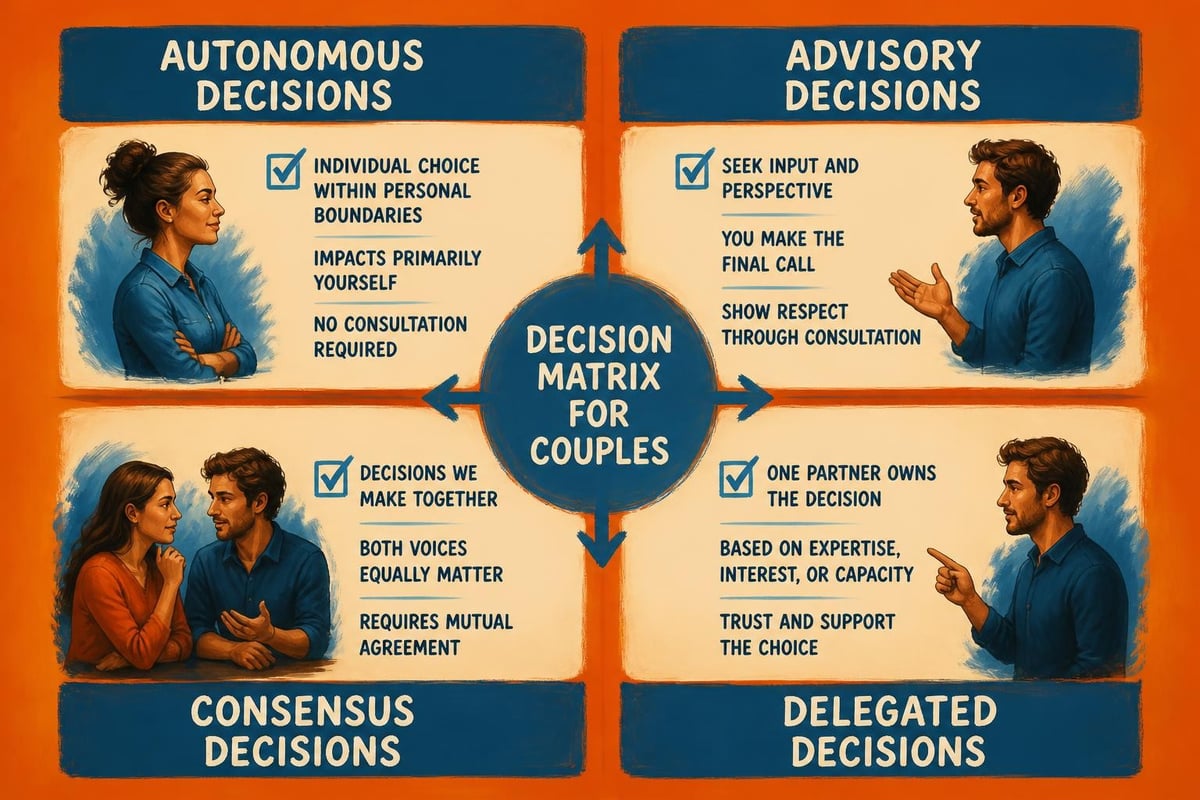
The Decision Matrix we use with couples includes four quadrants:
- Autonomous: Decisions each person owns completely without consultation
- Advisory: Decisions where one person leads but seeks input
- Consensus: Decisions requiring full agreement from both parties
- Delegated: Decisions outsourced to professionals or systems
Most relationship friction comes from misclassifying decisions. One person treats a financial choice as autonomous while the other expects consensus. The argument isn't really about money. It's about violated expectations around the decision process itself.
Coaching doesn't resolve this through feelings work. It resolves it by creating explicit agreements about which decisions fall into which quadrant. This is the kind of operational clarity that leadership coaching brings to organizations, applied to partnerships.
The Role Clarity Problem Nobody Discusses
Here's what coaching reveals that couples rarely articulate: most partnership conflict stems from unclear role expectations. Both people assume the other knows what they're responsible for, then resent each other when those invisible expectations aren't met.
The solution isn't romantic. It's drafting actual role clarity documents that specify:
- Who manages what domains (finances, household, children, social calendar)
- What outcomes each person is accountable for
- How you measure whether someone's fulfilling their role
- When you revisit and renegotiate these agreements
This makes relationships sound like business operations, and that's exactly the point. The couples who thrive long-term treat their partnership with the same operational rigor they'd bring to running a company. They build dashboards, track progress, and adjust based on results.
Why Traditional Coaching Misses This
Most relationship coaches avoid this level of structure because it feels unromantic. They focus on communication techniques and emotional validation while ignoring the systems that make daily life function. The result? Couples learn to talk about their feelings more effectively while still arguing about who forgot to pay the electric bill.
A meta-analysis of couple therapy outcomes found that behavioral interventions focusing on skill-building and accountability produced more durable results than purely emotion-focused approaches, particularly for non-clinical populations.
Measuring Progress Without the Metrics Theater
How coaching helps couples deliver measurable outcomes depends on defining success upfront. Too many coaches measure engagement ("How many sessions did they attend?") instead of results ("Did their decision-making improve?").
The metrics that matter:
- Frequency of recurring conflicts (should decrease by 60%+ in 90 days)
- Time to resolve disagreements (should halve within six weeks)
- Percentage of decisions made without conflict (should exceed 70%)
- Both partners' satisfaction scores using validated assessments
These aren't soft measures. They're quantifiable indicators that coaching is working or it's not. The same logic applies to corporate coaching that ties progress to clear KPIs, where visibility into results determines whether organizations continue investing.
The Accountability Structure Most Coaches Skip
Coaching without accountability becomes expensive therapy disguised as action planning. The difference between a coaching conversation and actual coaching is what happens between sessions. Most coaches assign homework that couples ignore, then spend the next session discussing why they didn't do it.
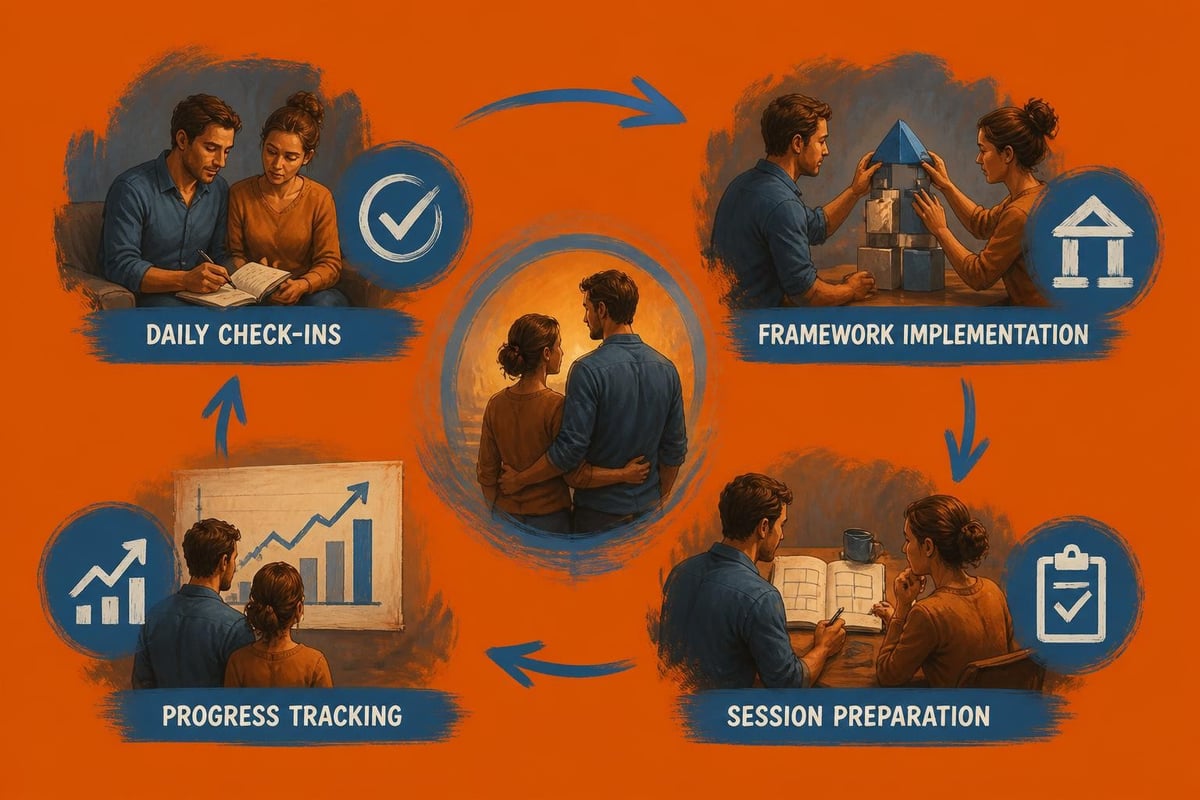
The accountability system that produces results includes:
- Daily five-minute check-ins using a structured format
- Weekly scorecards tracking agreed-upon metrics
- Consequence agreements when either party abandons commitments
- Monthly reviews where you adjust the frameworks based on what's working
This level of rigor separates coaching from casual advice. It's why organizations invest in practical coaching that delivers measurable business results rather than feel-good sessions that don't change behavior.
When Coaching Fails and What That Reveals
Not every couple benefits from coaching, and pretending otherwise undermines the profession's credibility. Coaching fails when one or both partners aren't genuinely committed to change, when clinical issues require therapy instead, or when the relationship has deteriorated past the point where skill-building matters.
The pattern we've observed across hundreds of engagements: coaching works when both parties are willing to implement uncomfortable new behaviors and measure whether they produce different outcomes. It fails when couples want validation for their existing patterns rather than disruption of those patterns.
Research on which couples benefit most from relationship education confirms this. Couples with higher baseline functioning and genuine motivation showed dramatically better outcomes than those coerced into coaching or those with significant clinical challenges.
Frequently Asked Questions
What's the main difference between couples coaching and couples therapy?
Coaching focuses on building future-oriented skills, decision-making frameworks, and goal alignment, while therapy addresses past trauma, clinical issues, and emotional healing. Couples without clinical pathology often see faster results from coaching.
How long does couples coaching typically take to show results?
Most couples see measurable improvements in communication and decision-making within six to eight weeks when both partners actively implement the frameworks between sessions. Significant pattern changes typically require 90 days.
Can coaching help if only one partner is motivated?
Coaching requires both partners to commit to implementing new behaviors and measuring outcomes. While one partner can initiate the conversation, sustainable results demand mutual participation and accountability.
How much does couples coaching cost compared to therapy?
Coaching fees vary widely, typically ranging from $150 to $500 per session depending on the coach's experience and location. While coaching costs can be comparable to therapy, the intervention timeframe is often shorter for couples without clinical issues.
What frameworks do effective couples coaches actually use?
The most effective coaches use structured communication protocols (like Mirror-Validate-Propose), decision classification systems (Autonomous, Advisory, Consensus, Delegated), role clarity documents, and accountability scorecards rather than purely conversational approaches.
How do you measure whether couples coaching is working?
Track quantifiable metrics including frequency of recurring conflicts, time to resolve disagreements, percentage of decisions made without conflict, and both partners' satisfaction scores using validated assessments. Results should be visible within 60 to 90 days.
Should we try therapy first or coaching first?
If you're dealing with infidelity, trauma, mental health concerns, or abuse, therapy is appropriate. If you're struggling with communication breakdowns, misaligned priorities, decision paralysis, or role confusion without clinical pathology, coaching delivers faster results.
What makes couples coaching fail most often?
Coaching fails when partners aren't genuinely committed to uncomfortable behavior change, when clinical issues require therapeutic intervention, when one partner is coerced into participation, or when couples seek validation rather than transformation.
Can couples coaching work for entrepreneurial or business partnerships?
Yes, entrepreneurial couples often benefit most from coaching because they need to separate business decisions from personal dynamics. The same operational frameworks that improve business coaching outcomes apply to partnership dynamics.
Understanding how coaching helps couples requires looking past credentials and examining frameworks that produce measurable change in communication, decision-making, and role clarity. The couples who succeed treat coaching as operational improvement, not emotional validation, and commit to uncomfortable new behaviors that interrupt destructive patterns. Whether you're building stronger partnerships in your personal life or developing leaders who can navigate complex team dynamics, the same principles apply: clarity, accountability, and results you can measure. Noomii connects you with coaches who prioritize practical frameworks and visible outcomes over theory and credentials, helping you build the partnerships and teams that execute on what matters.



Leave a Reply
Want to join the discussion?Feel free to contribute!