

ICF Is Not a Client Acquisition Strategy
Every month, hundreds of newly certified coaches complete their ICF requirements, update their LinkedIn profiles with "PCC" or "ACC" credentials, and wait for clients to arrive. Most wait a long time. The harsh reality is that ICF is not a client acquisition strategy, yet the coaching industry perpetuates the myth that credentials alone build practices. After observing thousands of coaching practices since 2007, the pattern is clear: certification proves competence to existing prospects, but it doesn't create demand, build trust, or fill calendars.
The Certification-Revenue Disconnect
ICF credentials validate coaching ability. They demonstrate you've completed training, logged hours, and passed assessments. What they don't do is make your phone ring.
Industry data reveals the truth. Research analyzing over 2,000 coaching practices found that referrals account for 55-65% of new clients, while directories contribute only 8-12%. Certifications aren't even tracked as a meaningful acquisition channel because they function as qualifiers, not attractors.
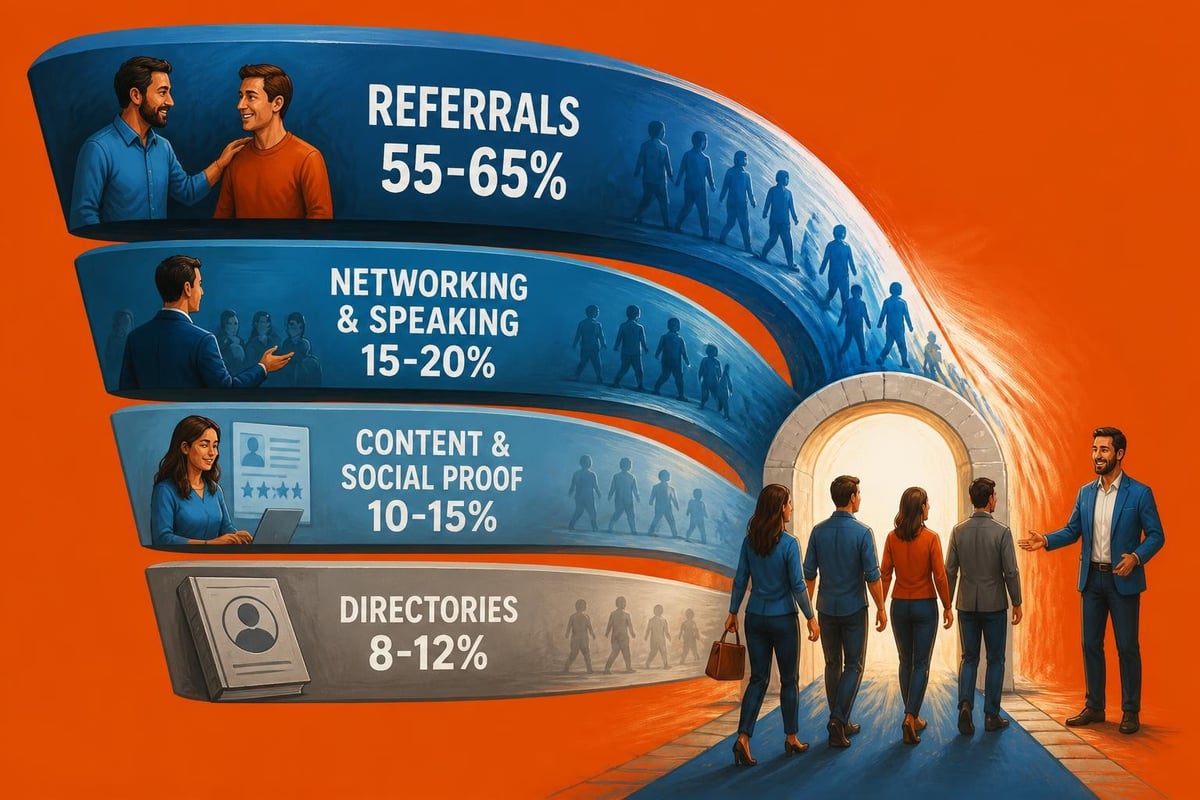
What Buyers Actually Care About
Corporate buyers evaluating leadership coaching providers follow a predictable pattern:
- Business outcomes: Can you demonstrate ROI in retention, decision speed, or team performance?
- Industry relevance: Have you worked in their sector or faced similar challenges?
- Proof of results: What measurable changes have you created for similar clients?
- Communication fit: Do you speak their language or sound like a therapy session?
Certification appears on this list, but usually fifth or sixth. It's table stakes, not a differentiator.
One Fortune 500 division leader told me in 2024: "I don't care if you're an MCC. I care if you've coached sales leaders through pipeline transformation and can show me the before-and-after metrics." That perspective reflects how when coaching is the better choice, buyers prioritize outcomes over credentials.
Why Coaches Confuse Credentials With Marketing
The coaching industry has accidentally taught coaches that ICF is not a client acquisition strategy, but many miss the message. Training programs emphasize certification pathways, mentor coaching focuses on ICF competencies, and marketing materials from schools showcase credential counts.
The credential-first narrative includes:
- "Clients want certified coaches" (they want proven coaches)
- "ICF membership gives you credibility" (outcomes give you credibility)
- "List your credentials prominently" (list your results prominently)
- "Higher credentials attract better clients" (specialization attracts better clients)
This confusion is expensive. Coaches invest $5,000-15,000 in certification, then another $2,000-5,000 annually in ICF dues, CCE courses, and renewals. Meanwhile, practical client acquisition strategies like niche positioning, case study development, and referral systems get neglected.
The Experience-Credential Matrix
| Coach Profile | ICF Status | Client Acquisition Strength | Why It Works/Fails |
|---|---|---|---|
| 20-year executive turned coach | ACC | High | Industry credibility trumps certification level |
| Fresh career changer | PCC | Low | No proof of results despite higher credential |
| Niche specialist (tech sales leaders) | No ICF | High | Specific expertise attracts specific buyers |
| Generalist life coach | MCC | Medium | Highest credential, unclear positioning |
The matrix reveals that certification level correlates weakly with acquisition success. Experience, niche clarity, and proven outcomes dominate.
What Actually Builds Coaching Practices
After watching practices grow from zero to multiple six figures, certain strategies appear repeatedly. ICF is not a client acquisition strategy, but these approaches are:
Referral Architecture
Build systems that make referrals automatic. One executive coach I've tracked since 2015 generates 70% of new business from former clients. Her method:
- 90-day post-engagement check-ins
- Quarterly value updates with industry insights
- Specific referral requests: "I'm looking for two more VPs in manufacturing"
- Incentive alignment: referral sources become strategic partners
Client retention research confirms that focusing on existing client relationships delivers better acquisition results than directory listings or credential promotion.

Niche-Based Authority
Generalists struggle. Specialists thrive. ICF’s own marketing guidance emphasizes identifying a niche and developing personal brand over credential worship.
The niche authority formula:
- Pick a specific audience (manufacturing ops leaders, not "executives")
- Solve a specific problem (reducing decision latency, not "leadership development")
- Create proof (case studies with metrics, not testimonials)
- Build content around that problem (not generic coaching topics)
One coach specializing in retail store manager development grew from $40K to $180K annual revenue in 18 months. Her ICF credential? ACC. Her authority signal? Five detailed case studies showing 25-40% improvement in store-level retention.
Results-First Positioning
Corporate buyers don't hire coaches. They hire business outcomes tied to clear KPIs. Position every conversation around the change you create:
- "I help sales leaders reduce rep turnover by 30-50% in six months"
- "I work with operations teams to cut decision cycles from weeks to days"
- "I facilitate leadership teams through restructuring with 90%+ retention"
Notice none of these mention ICF, certification levels, or coaching competencies. They describe the problem solved and the measurable result.
The Credential Trap vs. The Growth Path
| Credential-Focused Approach | Growth-Focused Approach |
|---|---|
| Invest in next certification level | Invest in case study development |
| Attend CCE courses | Attend industry conferences where buyers gather |
| Update directory profiles | Build referral partnerships |
| Emphasize coaching hours logged | Emphasize client outcomes achieved |
| Generic positioning | Niche specialization |
| Wait for credential to attract clients | Proactively demonstrate value |
The growth path doesn't exclude credentials. It simply recognizes that ICF is not a client acquisition strategy and builds acquisition systems accordingly.
What Works in 2026
Current coaching industry statistics show client acquisition remains the top challenge for practitioners. The coaches succeeding right now share common patterns:
- Vertical specialization: Healthcare executives, tech sales leaders, manufacturing ops teams
- Outcome specificity: Retention improvement, decision speed, communication clarity
- Proof systems: Video testimonials, metric-based case studies, client-authored LinkedIn posts
- Partnership models: Embedded coaching in client meetings, not sideline sessions
- Risk-sharing: Month-to-month terms, pilot programs, incentive alignment
One mid-market firm using this approach grew from three corporate clients to seventeen in 24 months. Their head coach has ACC certification, but clients hire them for documented results in manager development and team performance.

The Strategic Role of Certification
ICF credentials serve a purpose. They validate competence for prospects already considering you. They meet procurement requirements for some large organizations. They provide structure for skill development.
What they don't do is create market demand. Effective client acquisition in 2026 requires niche clarity, trust-building, and demonstrated expertise, not credential collection.
Use certification strategically:
- Meet minimum requirements (ACC is often sufficient)
- Focus development budget on business skills, not higher coaching credentials
- Invest in industry knowledge over additional ICF training
- Build proof systems faster than you accumulate coaching hours
- Develop partnerships in target industries, not just coaching circles
The ROI calculation matters. If $10,000 goes to PCC certification or niche-specific client case studies and targeted networking, the latter typically generates faster returns.
FAQ
Does ICF certification help with client acquisition at all?
ICF certification functions as a qualifier, not an attractor. It reassures prospects who are already considering you, but it rarely initiates interest. Buyers prioritize outcomes, industry relevance, and proven results over credential levels when making hiring decisions.
What's the minimum ICF credential needed for corporate coaching?
ACC meets most corporate requirements. PCC and MCC rarely influence buying decisions for business coaching. Fortune 500 procurement sometimes requires ICF certification generally, but seldom specifies the level. Focus on results and niche authority instead.
How do coaches actually get their first corporate clients?
Most successful corporate coaches start through industry connections, not coaching directories. Former colleagues, industry association involvement, speaking at sector events, and solving specific business problems create entry points. Credentials follow; they don't lead.
Why do coaching schools emphasize ICF certification so heavily?
Coaching schools benefit financially from certification pathways through training fees, mentor coaching requirements, and renewal courses. Certification provides structure and quality standards, but schools often overstate its client acquisition value because it's their business model.
What should I invest in instead of higher ICF credentials?
Invest in case study development, niche-specific industry knowledge, speaking opportunities at business conferences, strategic partnerships with complementary service providers, and proof systems like video testimonials and documented ROI metrics.
How long does it take to build a coaching practice through referrals?
A referral-based practice typically takes 18-36 months to reach sustainable full-time income. The timeline depends on niche clarity, client results, systematic follow-up, and relationship quality. Credentials may shorten the qualification process but don't accelerate relationship building.
Do clients even check if coaches have ICF credentials?
Corporate buyers often ask about credentials as a checkbox item, then make decisions based on other factors. Individual clients rarely verify certification status. Both buyer types prioritize testimonials, case studies, communication style, and industry understanding over credential verification.
What's the best client acquisition strategy for new coaches?
New coaches succeed fastest by selecting a narrow niche, solving a specific problem, creating three detailed case studies (even pro bono initially), building strategic referral relationships, and demonstrating value before discussing fees. Credentials support but don't replace this foundation.
Can you build a six-figure practice without ICF certification?
Yes. Multiple coaches exceed $100K annually without ICF credentials by developing deep industry expertise, delivering measurable business results, and building strong referral systems. Certification helps in some corporate environments but isn't mandatory for practice growth or revenue achievement.
The fundamental truth remains unchanged since the coaching industry matured: credentials qualify you for consideration, but outcomes, trust, and specialized expertise actually win clients. ICF is not a client acquisition strategy, and treating it as one wastes time and resources better spent on niche positioning, case development, and referral systems. If you want practical corporate coaching that delivers measurable business results through leadership development, team coaching, and KPI-driven accountability, choose partners who prioritize outcomes over credentials.



Leave a Reply
Want to join the discussion?Feel free to contribute!