
Group Executive Coaching: A Smarter Model for Scale
Most organizations still default to one-on-one coaching when investing in leadership development, treating executive growth as an isolated, individualized process. That assumption costs them speed, money, and the strategic advantage of peer learning. Group executive coaching changes the equation, creating conditions where senior leaders accelerate growth through shared challenge, collective intelligence, and mutual accountability. The model works because it mirrors the actual environment executives operate in: complex, relationship-driven, and shaped by how peers interpret and respond to their decisions.
Why Group Executive Coaching Outperforms Solo Models in Specific Contexts
One-on-one coaching remains valuable for highly sensitive situations, performance rehabilitation, or confidential strategic planning. But for building leadership capabilities across a cohort, group formats deliver advantages that individual coaching cannot replicate.
The peer dynamic matters. When five to eight executives grapple with the same leadership challenge, they surface blind spots faster than any single coach could. A VP struggling with delegation hears from peers who overcame the same pattern. A leader defending a decision confronts immediate, credible feedback from people operating at the same altitude. The shared context accelerates insight.
Research on peer coaching benefits confirms that leaders often trust and act on feedback from peers more readily than advice from external coaches. The credibility gap narrows when someone with comparable authority and pressure says, "I tried that. Here's what actually happened."
Cost and Scalability Realities
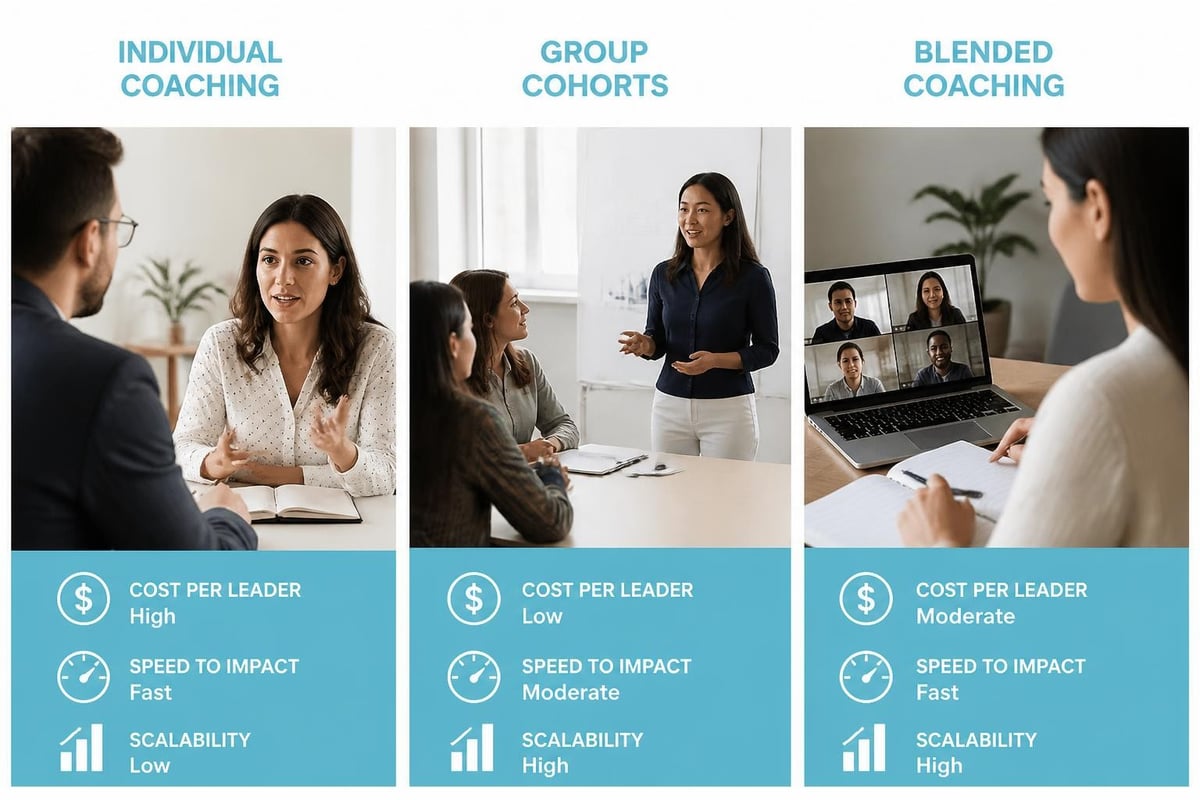
Group executive coaching costs 40% to 60% less per participant than individual engagements while covering more leaders simultaneously. For organizations facing budget constraints or needing to develop leadership bench strength across multiple tiers, the economics are compelling.
| Format | Cost Per Leader | Leaders Served | Time to Impact | Peer Learning |
|---|---|---|---|---|
| Individual | $15,000–$25,000 | 1 | 6–12 months | None |
| Group (cohort of 6–8) | $6,000–$10,000 | 6–8 | 4–6 months | High |
| Blended (group + 1:1) | $10,000–$15,000 | 1 | 4–8 months | Moderate |
The speed advantage is not theoretical. A Fortune 500 client using Noomii's leadership executive coaching program deployed group sessions across three regional VP cohorts. Leaders who previously waited six months for individual coach availability entered group cohorts within 30 days. Time to first measurable behavior change dropped from 14 weeks to 8 weeks.
How to Structure Group Executive Coaching for Results
Poor structure kills group coaching outcomes. The most common failure mode: treating group sessions as generic leadership workshops with a facilitator instead of targeted coaching interventions.
Effective group executive coaching requires three design elements.
Homogeneous Challenge, Heterogeneous Experience
Cohort members should face similar leadership challenges (leading through ambiguity, managing conflict, driving transformation) but bring diverse backgrounds and perspectives. A group of CTOs navigating organizational change benefits from different industries, company sizes, and functional expertise within the room.
One government agency assembled a cohort of division directors all managing legacy system modernization. Same pressure, different technical domains. The cross-pollination of approaches yielded solutions none would have developed alone.
Structured Reflection Protocols
Group coaching fails when it devolves into advice-swapping or venting sessions. Structured protocols keep focus on behavior change. Effective models include:
- Challenge Presentation: One leader presents a current dilemma (10 minutes)
- Clarifying Questions: Group asks questions without advice (10 minutes)
- Peer Observations: Each member shares one observation or pattern they notice (15 minutes)
- Leader Reflection: Presenting leader synthesizes what resonated (10 minutes)
- Commitment Declaration: Leader states one specific action and accountability mechanism (5 minutes)
This 50-minute cycle, repeated across cohort members over multiple sessions, generates more actionable insight than unstructured discussion.
Coach as Orchestrator, Not Lecturer
The coach's job in group settings is pattern recognition, dynamic facilitation, and bridging individual learning to collective themes. When three executives independently surface delegation anxiety, the skilled coach names the pattern, explores underlying beliefs, and guides the group toward new frameworks.
Evidence from coaching research shows that effective group coaching depends on the coach's ability to balance individual airtime, manage group dynamics, and maintain psychological safety while pushing for uncomfortable growth.
When Group Executive Coaching Fails (and How to Prevent It)
The model breaks under predictable conditions. Recognizing and preventing these failure modes determines program success.
Mismatched Authority Levels
Mixing C-suite executives with mid-level managers in the same cohort destroys candor. The power differential prevents authentic challenge. Directors self-censor in front of VPs. VPs perform rather than explore vulnerability.
The fix: Maintain cohort homogeneity within one to two organizational levels. Group Chief Officers separately from Senior VPs. Keep functional VPs in peer-level cohorts even if they report to different executives.
Absence of Pre-Work and Diagnostics
Effective group coaching begins before the first session. Leaders need validated assessments, 360 feedback, or behavioral diagnostics so they arrive with self-awareness already activated. Without pre-work, the first three sessions waste time on surface-level discovery that should have been completed independently.
Organizations using Noomii's precision matching approach start with evidence-based leadership diagnostics that identify specific behavioral patterns and development priorities. Cohort members enter group sessions prepared to work on known challenges rather than figuring out what needs attention.
No Accountability Between Sessions
The space between group sessions is where behavior change either happens or evaporates. Leaders who commit to actions in session but face zero follow-through mechanisms revert to baseline within days.
Successful programs build accountability through:
- Peer accountability partners (paired cohort members who check in weekly)
- Pre-session written updates on commitments from prior session
- Coach follow-up emails summarizing individual commitments
- Leadership stakeholder involvement (manager or CHRO receives progress updates)

Blended Models: Combining Group and Individual Coaching
The most sophisticated organizations don't choose between group and individual coaching. They combine both strategically.
A typical blended model:
- Pre-program: Individual assessment and two 1:1 coaching sessions to identify development priorities
- Core program: Six group cohort sessions (90 minutes each, bi-weekly)
- Mid-point: One individual coaching session to address private concerns or customize application
- Post-program: Two individual sessions for integration and sustainability planning
This structure captures group learning advantages while preserving space for confidential issues, personalized strategy, or situations too sensitive for group disclosure.
A randomized trial comparing group and individual coaching found that blended approaches produced superior outcomes for stress management and leadership effectiveness compared to either format alone. The combination effect appears to stem from different learning mechanisms: group coaching for social learning and perspective-taking, individual coaching for deep behavioral rewiring and emotional processing.
Measuring Group Executive Coaching Impact
Demonstrating ROI requires defining success metrics before cohorts begin. Generic satisfaction surveys prove nothing. Leaders enjoy many interventions that produce zero behavior change.
Leading Indicators (4–8 weeks)
- Frequency of peer-to-peer coaching conversations outside formal sessions
- Number of committed actions completed between sessions
- Diversity of perspectives sought when making decisions
- Self-reported confidence in handling previously avoided leadership challenges
Lagging Indicators (3–6 months)
- 360 feedback score changes in targeted competency areas
- Employee engagement scores for teams led by cohort participants
- Retention rates of high performers on participant teams
- Decision quality metrics (speed, stakeholder alignment, outcomes achieved)
One manufacturing client tracked a specific metric: time from problem identification to decision execution among plant managers. Pre-coaching average: 34 days. Post-group coaching cohort: 19 days. The behavioral shift (increased comfort with imperfect information, better stakeholder alignment) translated directly to operational speed.
Understanding why coaching demand is growing helps organizations align measurement frameworks with broader talent development strategies and demonstrate value to skeptical stakeholders.
Selecting Coaches for Group Executive Work
Not every effective individual coach can facilitate group dynamics. The skill sets differ materially.
Group executive coaching requires:
Systems Thinking Capability
The coach must track individual dynamics, interpersonal patterns, and whole-group themes simultaneously. When one leader's avoidance triggers another's frustration, the coach needs to surface that dynamic productively without blame.
Comfort with Conflict
Individual coaching allows the coach to stay in harmony with one client. Group work surfaces disagreement, competing perspectives, and interpersonal tension. Coaches who smooth over conflict too quickly rob the group of learning opportunities.
Industry and Role Credibility
Executives grant authority to coaches who understand their operational reality. Former executives, sector specialists, or coaches with deep organizational experience earn credibility faster than generalists. Noomii’s network of certified executive coaches includes practitioners with Fortune 500 leadership backgrounds, government sector expertise, and specialized knowledge in transformation contexts.
Structured Methodology
Skilled group coaches operate from proven frameworks rather than improvising session to session. Research on coaching for talent development emphasizes the importance of evidence-based approaches and clear developmental models, particularly when coaching leadership cohorts where consistency and rigor matter.
Group Executive Coaching for Specific Organizational Challenges
The format proves especially effective for particular leadership scenarios.
Transformation Leadership
When organizations face major change (merger, restructuring, digital transformation), cohorts of transformation leaders benefit from collective problem-solving. Shared challenges (resistance management, stakeholder alignment, pace decisions) generate richer discussion than isolated coaching.
New Executive Integration
Cohorts of newly promoted or externally hired executives accelerate culture learning and relationship building while developing leadership capabilities. The group provides a safe space to acknowledge uncertainty and learn organizational norms.
Toxic Leadership Rehabilitation
Addressing toxic leadership patterns often requires individual coaching for accountability and behavior modification. However, once baseline behavior improves, group coaching helps leaders practice new approaches, receive peer feedback, and rebuild trust in a controlled environment.
Succession Pipeline Development
Organizations building leadership bench strength use group coaching to accelerate high-potential development. Cohorts create peer networks that persist beyond the program, building organizational social capital while developing individual capability.

Common Objections and What They Miss
"Executives won't be vulnerable in front of peers."
This assumes executives prioritize image protection over growth. In well-designed cohorts with established psychological safety, the opposite occurs. Leaders recognize that peers face identical pressures and appreciate authentic struggle more than curated success narratives.
The key: Start with low-stakes vulnerability exercises and build trust progressively. Don't force deep disclosure in session one.
"Scheduling eight executives simultaneously is impossible."
Difficult, yes. Impossible, no. Organizations that prioritize leadership development treat cohort sessions as non-negotiable calendar blocks, scheduled six months in advance. The perceived impossibility often masks lack of executive commitment, not actual scheduling constraints.
Virtual formats expand feasibility. Ninety-minute video sessions work effectively for group coaching, particularly when leaders span geographies.
"Individual coaching provides more personalized attention."
True but incomplete. Personalization matters for specific issues. For developing widely applicable leadership capabilities (strategic thinking, stakeholder management, team development), group formats often provide more relevant learning because participants apply insights to varied contexts in real time.
The question is not individual versus group but which format fits which developmental need.
Integration with Broader Leadership Development Architecture
Group executive coaching functions most effectively as one component within a comprehensive leadership development system, not a standalone intervention.
Effective integration includes:
- Alignment with competency models and promotion criteria
- Connection to succession planning and high-potential identification
- Coordination with formal leadership programs and training
- Integration with performance management and 360 feedback cycles
- Support from direct managers who reinforce behavioral changes
Organizations treating coaching as isolated from other talent systems waste the investment. Strategic coaching solutions embedded within broader development architecture compound returns through reinforcement, visibility, and organizational alignment.
Workplace coaching research demonstrates that coaching outcomes improve significantly when organizational systems support rather than contradict coached behaviors. If group coaching emphasizes collaborative decision-making but promotion criteria reward individual heroics, behavior change will not stick.
Frequently Asked Questions
How many executives should participate in a group coaching cohort?
Six to eight participants is optimal. Smaller groups (four to five) limit perspective diversity. Larger groups (nine plus) reduce individual airtime and make scheduling harder. The sweet spot balances enough diversity for rich discussion with enough intimacy for psychological safety.
How long should a group executive coaching program run?
Four to six months with sessions every two to three weeks allows time for behavior experimentation between sessions while maintaining momentum. Shorter programs (under three months) provide insufficient reinforcement. Longer programs (over eight months) lose urgency and focus.
Can group coaching work virtually or does it require in-person sessions?
Virtual group coaching works effectively when designed properly. Use video (not phone), keep sessions to 90 minutes maximum, incorporate breakout discussions, and use collaborative tools for real-time exercises. Many organizations find hybrid models (launch in-person, continue virtually) combine relationship building with scheduling flexibility.
What happens when one cohort member dominates discussions?
Skilled coaches establish ground rules early (equal airtime, structured turn-taking) and intervene tactfully when imbalances emerge. Techniques include directed questions to quieter members, timers for speaking turns, and private conversations with dominant participants about group dynamics.
How do you maintain confidentiality in group settings?
Establish explicit confidentiality agreements at the start. What is shared in cohort sessions stays in cohort sessions. Leaders sign agreements acknowledging this commitment. For highly sensitive topics (performance issues, organizational politics, personal crises), reserve individual coaching sessions rather than forcing group disclosure.
Group executive coaching delivers measurable advantages when organizations need to develop leadership capabilities at scale, accelerate peer learning, and build collaborative cultures among senior teams. The evidence supports structured cohort models over generic group facilitation and demonstrates superior cost-effectiveness compared to individual coaching for many developmental needs. Organizations ready to move beyond one-size-fits-all approaches can explore how Noomii Leadership Coaching combines precision diagnostics, expert coach matching, and proven group coaching methodologies to transform leadership performance across entire cohorts, not just isolated individuals.


Leave a Reply
Want to join the discussion?Feel free to contribute!