

Corporate Coaching Program Cost Per Employee in 2026
Most organizations approach corporate coaching program cost per employee backwards. They start with budget constraints instead of the leadership gaps creating turnover, disengagement, and lost revenue. The result: programs designed to look affordable on spreadsheets but too diluted to solve anything. By the time boards and CHROs realize the investment failed, the best talent has already left, and the toxic patterns they meant to fix have calcified.
The corporate coaching program cost per employee varies wildly because most organizations don't know what they're buying. They compare hourly rates without understanding dosage, delivery models, or the difference between checkbox compliance training and interventions that actually shift behavior. This article breaks down what you're really paying for, where the hidden costs live, and how to structure investments that produce measurable leadership transformation.
The Real Cost Structure Most Organizations Miss
When evaluating corporate coaching program cost per employee, the line item on your P&L tells you almost nothing about actual investment. According to PwC’s 2024 Saratoga Workforce Index, Learning & Development spending per employee averages $1,308 across industries, but coaching programs represent only a fraction of that budget and the variance in effectiveness is staggering.
Here's what drives the real number:
- Coach credentials and specialization (generalist career coaches versus executive coaches with sector expertise)
- Delivery model (one-on-one executive sessions, group cohorts, or blended approaches)
- Program duration and session frequency (quarterly check-ins versus intensive transformation arcs)
- Assessment infrastructure (validated diagnostics, 360-degree feedback, behavioral tracking)
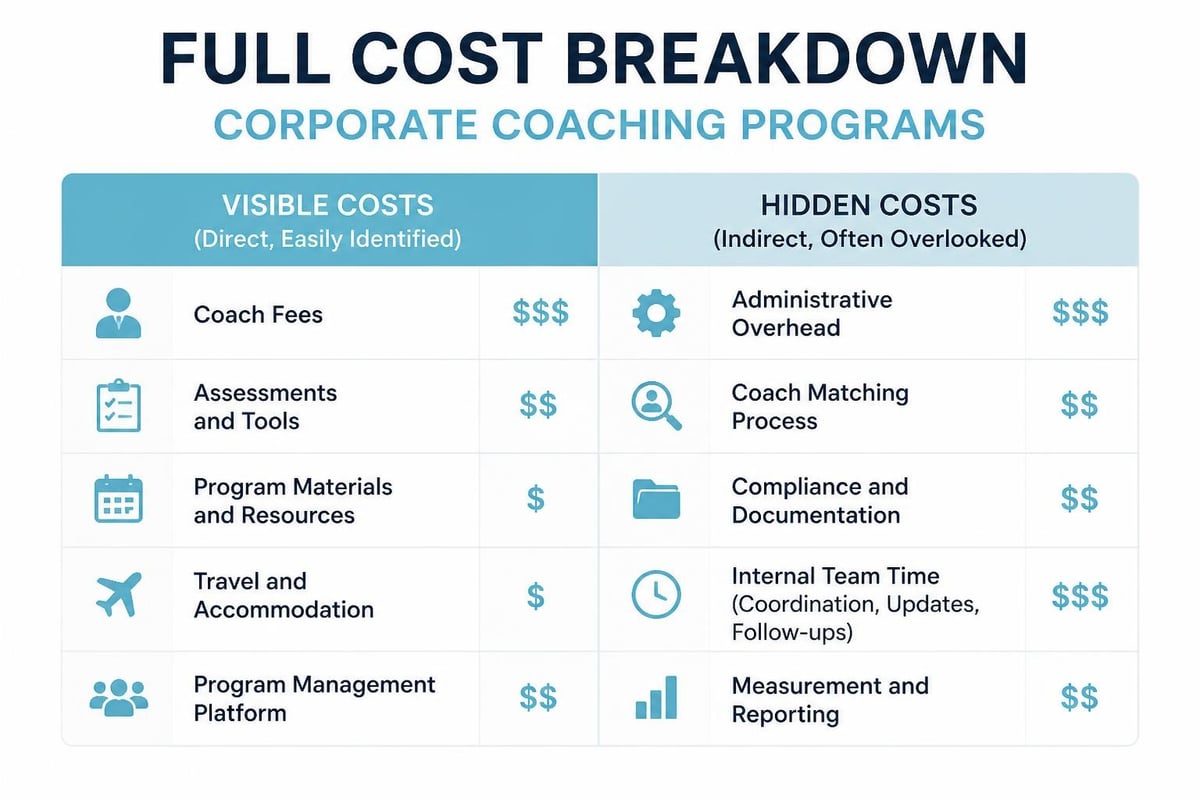
- Administrative overhead (matching, scheduling, compliance documentation, outcome measurement)
The organizations getting this wrong treat coaching as a procurement exercise. They negotiate hourly rates down, then wonder why engagement scores don't move. The ones getting it right recognize that corporate coaching program cost per employee should be benchmarked against the cost of the problems left unsolved: executive derailment, team dysfunction, regrettable turnover.
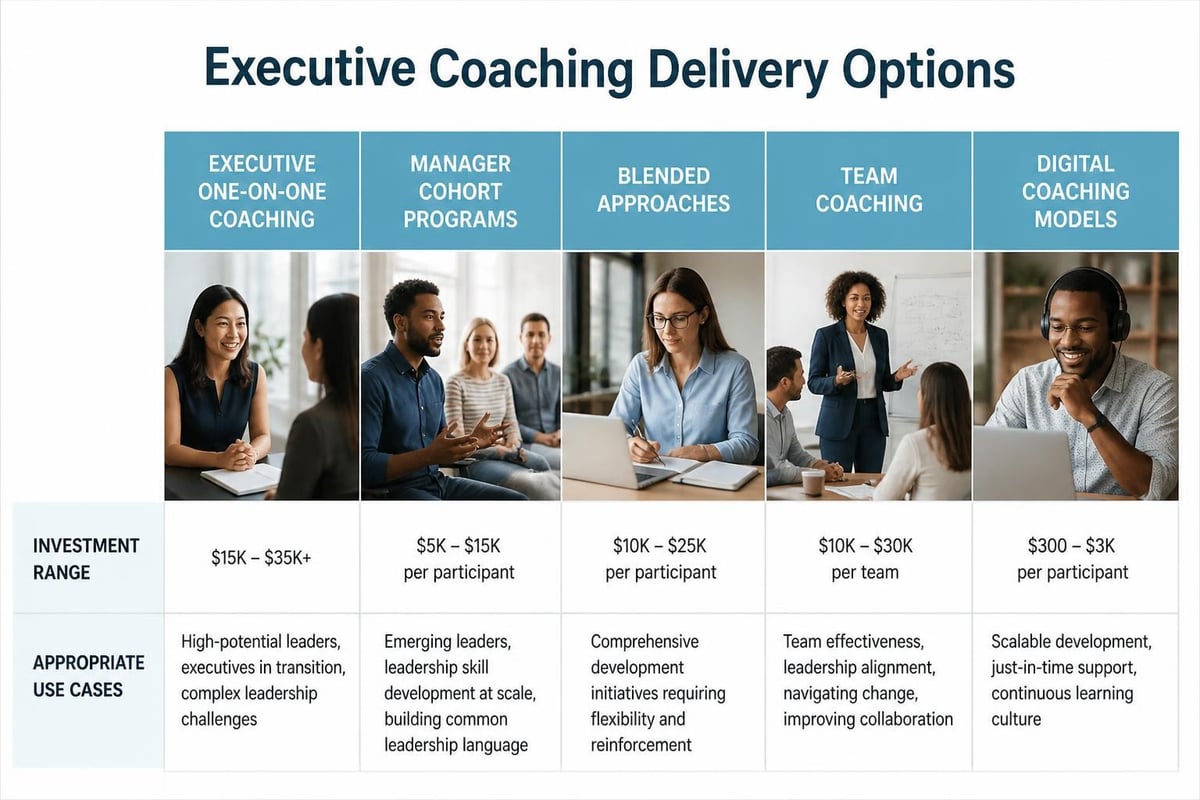
Executive Coaching Versus Scaled Programs
Harvard Business Review’s research on executive coaching documented typical per-session costs ranging from $200 to $600+ for experienced executive coaches, with engagement lengths of six to twelve months. That translates to $4,800 to $14,400+ per executive for a standard engagement.
But here's the breakdown most finance teams miss:
| Program Type | Cost Per Employee | Typical Application | ROI Timeline |
|---|---|---|---|
| Executive 1-on-1 | $8,000-$15,000 | C-suite, VP-level transformation | 9-18 months |
| Manager Cohort Coaching | $2,500-$5,000 | Mid-level leadership development | 6-12 months |
| Blended (1-on-1 + Group) | $3,500-$7,000 | High-potential leaders, succession planning | 6-15 months |
| Team Coaching | $1,200-$3,000 | Cross-functional teams, project leadership | 4-9 months |
| Digital + Light Touch | $500-$1,500 | Frontline managers, early-career development | 3-6 months |
The mistake is assuming one model fits all needs. A toxic executive destroying team morale needs intensive one-on-one intervention. Emerging leaders benefit from cohort models with peer learning. Trying to solve the first problem with the second solution burns budget without moving metrics.
What You're Actually Buying Beyond Hours
The corporate coaching program cost per employee becomes defensible when you understand what separates transformational programs from expensive conversations. Over twelve years working with government agencies and Fortune 500 companies, we've identified five components that determine whether an investment produces measurable leadership change or just makes HR look busy.
Evidence-Based Diagnostics That Identify Root Causes
Generic leadership assessments measure surface behaviors. The programs that justify higher per-employee costs use validated tools that diagnose the specific patterns causing dysfunction. When a director at a federal agency was flagged for low team engagement, surface-level feedback pointed to "communication issues." Proper diagnostics revealed the actual problem: the leader's conflict avoidance was allowing underperformers to coast while high performers burned out.
The cost difference between basic 360 feedback ($200-$400 per person) and comprehensive leadership diagnostics ($800-$1,500) matters only if you're solving the wrong problem anyway. According to Deloitte’s analysis of L&D business returns, organizations that tie development investments to specific business outcomes see 2.5 times higher revenue per employee compared to those treating learning as a compliance activity.
Precision Matching That Aligns Expertise With Challenges
The biggest waste in corporate coaching budgets is mismatched coach-client pairings. A coach with deep expertise in strategic decision-making won't effectively address abrasive leadership behaviors, and a coach specialized in conflict resolution may lack the background to guide M&A integration challenges.
High-performing programs include:
- Intake processes that diagnose specific leadership gaps (not just career goals)
- Matching algorithms or expert curation that align coach background with client needs
- Sector expertise requirements (public sector coaches understand different pressures than tech industry coaches)
- Cultural competency screening for global organizations
- Contingency plans when initial matches don't click (10-15% of pairings need adjustment)
Organizations working with top executive coaching firms pay premium rates partly for sophisticated matching processes. The alternative is cheaper but random: you save $2,000 per employee on coaching fees, then watch a $180,000 executive disengage because their coach lacks relevant experience.
The Hidden Costs That Destroy Program ROI
When CHROs present corporate coaching program cost per employee to finance committees, they typically include coach fees, assessment costs, and platform licenses. What they miss are the operational expenses and opportunity costs that double the real investment.
Administrative Burden and Compliance Documentation
For government agencies and regulated industries, coaching programs carry documentation requirements that generic providers ignore. Every session needs notes, progress tracking against defined objectives, and audit trails proving the investment aligns with development plans and organizational priorities.
The real administrative load includes:
- Initial needs assessment and goal-setting sessions (2-4 hours per participant)
- Monthly progress reviews and stakeholder updates (1-2 hours per participant)
- Compliance documentation and governance reporting (15-20% overhead on total program time)
- Crisis intervention when coaching reveals performance issues requiring HR involvement
- Program evaluation, outcome measurement, and ROI calculation
Organizations that don't build this into corporate coaching program cost per employee projections discover their internal L&D teams are spending 30-40% of their time managing logistics instead of strategic initiatives. The CIPD’s 2024 Resource and Talent Planning research found that administrative complexity is a primary reason organizations abandon coaching initiatives before seeing results.
The Replacement Cost of Failed Interventions
The most expensive coaching program is the one that fails to change behavior. When a mid-level manager continues creating hostile work environments despite six months of coaching, you've paid twice: once for the ineffective intervention, and again when their best direct reports quit.
Here's a case study that illustrates the math:
Problem: A VP of Operations at a manufacturing company had a pattern of public criticism that destroyed psychological safety on her team. Turnover in her division ran 31% annually versus 14% company-wide.
Diagnosis: Initial coaching focused on communication skills, but behavioral assessments revealed the root cause was perfectionism driven by imposter syndrome. The VP's harsh feedback was a defense mechanism against her own fear of being exposed as inadequate.
Solution: The coaching pivoted to address core beliefs and identity, not just surface behaviors. The engagement extended from six months to twelve months, increasing per-employee cost by $4,200.
Result: Team turnover dropped to 12% within eighteen months. The cost of coaching the VP ($18,000) versus the cost of replacing six experienced employees annually ($240,000+ in recruitment, onboarding, and productivity loss) made the extended investment return 13x within two years.
Lesson: The cheapest coaching program is rarely the most cost-effective. The corporate coaching program cost per employee should be measured against the cost of the problem persisting, not against last year's L&D budget.
Building a Defensible Budget Model
Finance leaders approve coaching investments when you present them in the language of risk mitigation and revenue protection, not professional development. LinkedIn’s 2024 Workplace Learning Report shows that 89% of L&D professionals believe coaching improves retention, but only 34% can quantify the impact in financial terms boards actually care about.
Cost-Per-Employee Ranges by Organizational Tier
| Organization Type | Recommended Per-Employee Investment | Primary Focus Areas | Expected Outcomes |
|---|---|---|---|
| Fortune 500 Enterprise | $3,500-$8,000 | Executive performance, culture transformation, succession planning | Reduced executive derailment, improved engagement scores, talent retention |
| Mid-Market (500-5000 employees) | $2,000-$4,500 | Manager effectiveness, leadership pipeline, change management | Lower manager turnover, faster promotion readiness, stronger teams |
| Government/Public Sector | $2,500-$5,500 | Mission alignment, stakeholder management, regulatory compliance | Service delivery improvement, staff morale, public accountability |
| High-Growth Tech | $3,000-$6,000 | Scaling leadership, strategic decision-making, innovation culture | Faster time-to-productivity, cross-functional collaboration, strategic clarity |
These ranges assume blended delivery models combining intensive one-on-one work for senior leaders with cohort-based development for broader populations. Organizations trying to deliver effective coaching below these ranges typically sacrifice either program quality or participant coverage to hit budget targets.
ROI Metrics That Justify Higher Investment
The best-run programs track leading and lagging indicators that connect coaching investments to business outcomes. When presenting corporate coaching program cost per employee to skeptical CFOs, include:
Leading Indicators (3-6 month horizon):
- Engagement score improvements in coached leaders' teams
- 360-degree feedback trend lines showing behavioral change
- Time-to-decision metrics for strategic initiatives
- Reduction in HR escalations and conflict mediation requests
Lagging Indicators (9-18 month horizon):
- Retention rates for high-potential talent in coached cohorts versus non-coached peers
- Promotion velocity for program participants
- Team productivity metrics (revenue per employee, project delivery timelines)
- Cultural health scores (psychological safety, trust, innovation climate)
According to SHRM’s research on building learning cultures, organizations that measure L&D impact through business metrics allocate 40% more budget to development programs because they can defend the investment with evidence.
Avoiding the Vendor Pitfalls That Waste Budget
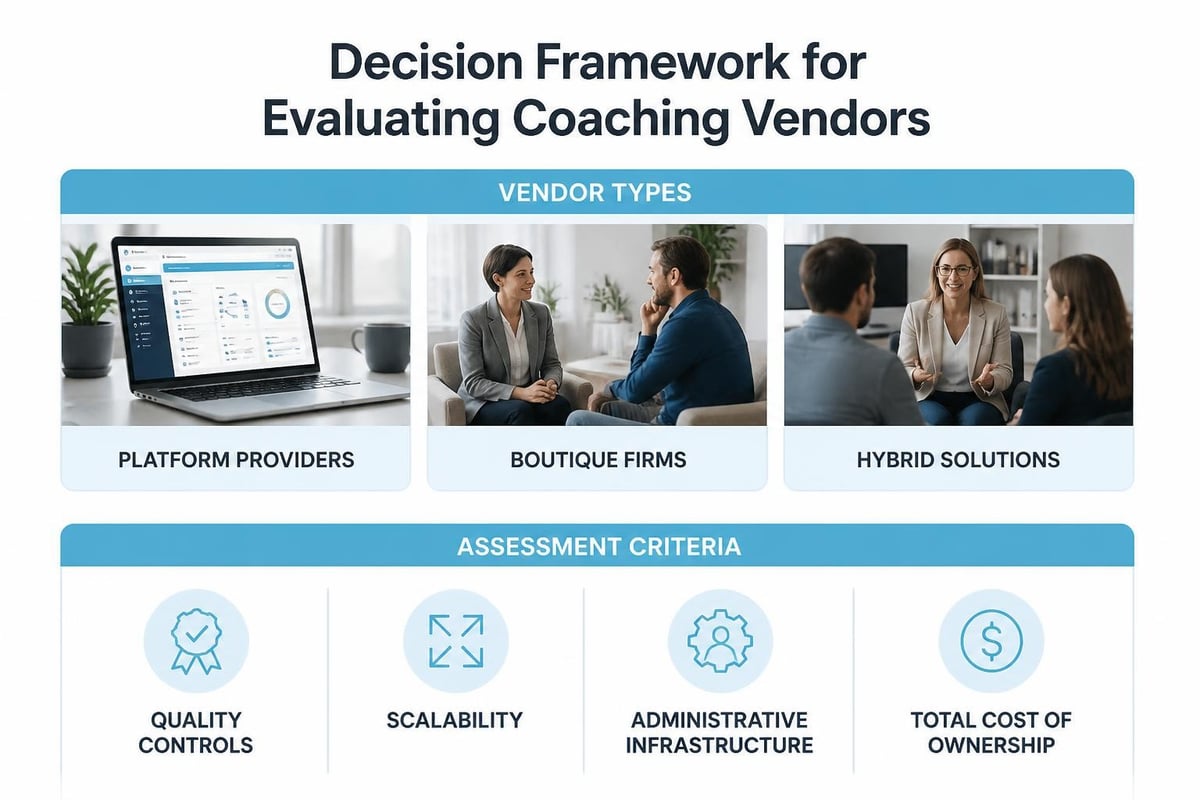
The corporate coaching market is fragmented between enterprise platforms promising scale, boutique firms offering white-glove service, and individual practitioners with variable quality. Each model has cost implications that go beyond published rates.
Platform Providers With Weak Quality Controls
Large coaching platforms advertise attractive per-employee costs ($1,200-$2,500) by offering access to thousands of coaches through self-service matching. The hidden cost is inconsistency. When participants select coaches based on profile photos and marketing copy instead of validated expertise, 30-40% of matches fail to produce meaningful outcomes.
Red flags in platform pricing:
- Unlimited coaching sessions bundled into flat fees (indicates coaches are paid poorly, attracting less experienced practitioners)
- No minimum coach credential requirements beyond basic certification
- Self-matching without expert curation or diagnostic intake
- No accountability for outcome measurement or program completion rates
Boutique Firms That Don't Scale
High-touch executive coaching firms deliver exceptional results for C-suite transformations but collapse under the operational demands of enterprise programs. When a Fortune 500 company engaged a prestigious boutique firm to coach 85 senior leaders, the program fell apart within four months because the firm lacked infrastructure for scheduling, progress tracking, and compliance reporting across time zones.
The corporate coaching program cost per employee looked reasonable at $6,500, but the internal L&D team spent hundreds of hours compensating for the vendor's operational gaps. The real cost exceeded $9,000 per employee when you factored in wasted internal resources.
The Build-Versus-Buy Calculation
Some organizations respond to high corporate coaching program cost per employee by building internal coaching capacity. This works for companies with scale (5,000+ employees) and long time horizons (3+ years to develop bench strength), but most organizations underestimate the investment required.
Building internal coaching capability requires:
- Coach training and certification for 15-20 internal practitioners ($8,000-$15,000 per person)
- Ongoing professional development and supervision ($3,000-$5,000 annually per coach)
- Reduced capacity for coaches' primary roles (20-30% time allocation to coaching duties)
- Assessment licensing and technology infrastructure ($40,000-$100,000+ setup, $20,000-$50,000 annual maintenance)
- Quality assurance, ethical oversight, and conflict-of-interest protocols
For most organizations, the break-even point is 200+ coaching participants annually. Below that threshold, external programs deliver better economics and quality.
Structuring Programs That Scale Without Dilution
The hardest challenge in corporate coaching is maintaining quality while expanding reach. When a mid-sized financial services company wanted to extend coaching beyond the executive team to all 180 managers, their initial budget model of $5,000 per employee ($900,000 total) was rejected by the board.
The solution wasn't cheaper coaches or shorter engagements. It was a tiered model that matched intervention intensity to need:
Tier 1 (15% of population): Intensive one-on-one coaching for high-risk/high-impact leaders ($12,000 per person, 27 participants, $324,000)
Tier 2 (35% of population): Blended individual and group coaching for managers leading critical initiatives ($4,000 per person, 63 participants, $252,000)
Tier 3 (50% of population): Group cohort coaching with peer learning and light individual sessions ($1,800 per person, 90 participants, $162,000)
Total investment: $738,000, with an average corporate coaching program cost per employee of $4,100. More importantly, the model allocated resources based on where leadership gaps created the highest organizational risk, not democratic distribution that treats all development needs as equal.
Governance Structures That Protect Investment
Programs fail when they lack clear accountability for outcomes. Effective governance includes:
- Executive sponsors who review progress monthly and remove barriers
- Defined success metrics agreed upon before program launch
- Quarterly business reviews with coaching vendors showing outcome trends
- Clear escalation protocols when coached leaders aren't improving
- Exit criteria that stop ineffective coaching relationships quickly rather than completing contracted sessions for optics
The organizations seeing strong returns from leadership coaching treat it like any strategic investment: they define what success looks like, measure progress rigorously, and course-correct when data shows initiatives aren't working. Those treating coaching as a retention perk or executive benefit rarely achieve measurable impact regardless of budget size.
What Makes the Investment Worth Defending
After working with over 300 organizations on leadership coaching solutions, the pattern is clear: companies that view corporate coaching program cost per employee through a risk lens instead of a benefits lens build better programs. They're not asking "What will coaching do for my leaders?" They're asking "What is leadership dysfunction currently costing us, and what's the most efficient intervention to eliminate that cost?"
The best case for coaching investment isn't engagement surveys or development theory. It's the avoided cost of:
- Executive derailments that destroy team morale and trigger talent exodus ($500,000 to $2.5 million in replacement costs, productivity loss, and institutional knowledge depletion per failed senior leader)
- Toxic leadership patterns that drive turnover in specific divisions (31% turnover versus 14% company average costs $1.2 million annually in a 50-person team)
- Strategic decision-making failures from leaders who lack executive judgment (product launches delayed 6-9 months, market opportunities missed, competitive positioning weakened)
When you frame corporate coaching program cost per employee against those failure modes, $4,000-$8,000 per participant stops looking like discretionary L&D spend and starts looking like insurance against catastrophic leadership risk.
The Current Market Reality in 2026
Economic pressures are forcing organizations to scrutinize all development spending more carefully. The companies cutting coaching budgets indiscriminately will pay for it in 2027 when their leadership pipelines dry up and their best managers leave for competitors who invested in their growth.
The companies that will win are those reallocating coaching resources toward interventions with measurable business impact. That means fewer vanity programs coaching every manager on "executive presence" and more targeted work addressing toxic leadership transformation, decision-making under uncertainty, and building psychologically safe teams that retain top performers.
The corporate coaching program cost per employee in effective programs may not decrease, but the return on that investment will become far more visible and defensible to boards demanding proof that development spending drives business results.
FAQ
What is the average corporate coaching program cost per employee in 2026?
The average ranges from $2,000 to $8,000 per employee depending on delivery model, with executive one-on-one coaching at $8,000-$15,000, blended programs at $3,500-$7,000, and cohort-based approaches at $1,500-$4,000. Organizations should benchmark costs against the specific leadership problems they're solving rather than industry averages.
How do I justify corporate coaching costs to finance leadership?
Present coaching as risk mitigation rather than professional development. Quantify the cost of leadership failures (executive derailment, toxic behavior driving turnover, poor strategic decisions) and demonstrate how targeted coaching interventions cost 5-15% of the problem they're preventing. Include measurable KPIs tied to business outcomes like retention rates, engagement scores, and productivity metrics.
What's included in corporate coaching program costs beyond coach fees?
Complete programs include diagnostic assessments ($800-$1,500 per person), coach matching and intake processes ($300-$600), administrative infrastructure for scheduling and compliance documentation (15-20% overhead), progress tracking and outcome measurement tools ($200-$400), and internal team time managing the program (typically 30-40% of one FTE per 100 participants).
Should we build internal coaching capability or hire external providers?
Build internal capability only if you have 200+ annual coaching participants, a 3+ year investment horizon, and budget for proper coach training, supervision, and quality assurance. For most organizations, external providers deliver better quality and economics, especially when sophisticated matching and specialized expertise are required.
How long should a corporate coaching engagement last?
Effective engagements for behavioral change typically run 6-12 months with sessions every 2-3 weeks. Shorter programs (3-4 months) work for targeted skill development but rarely shift deeply ingrained leadership patterns. Longer programs (12-18 months) are appropriate for executive transformations or complex challenges like toxic behavior remediation.
What ROI should we expect from corporate coaching investments?
Well-designed programs show measurable impact within 6-9 months through improved engagement scores, reduced turnover in coached leaders' teams, and faster promotion readiness. Financial ROI typically ranges from 3x to 7x investment within 18-24 months when measured through retention cost savings, productivity gains, and reduced leadership failures. Programs without defined success metrics and outcome tracking rarely demonstrate meaningful ROI.
The corporate coaching program cost per employee matters far less than whether the investment solves actual leadership problems creating measurable business risk. Organizations that match coaching intensity to need, demand outcome accountability from vendors, and measure impact through business metrics rather than participation rates build programs that finance leaders defend instead of cut. Noomii Leadership Coaching helps organizations design evidence-based coaching solutions with precision matching, validated diagnostics, and ROI tracking that demonstrates tangible leadership transformation. If you're ready to build a coaching program that justifies its cost through measurable results, we can help you structure an approach that works.



Leave a Reply
Want to join the discussion?Feel free to contribute!