

How to Choose a Corporate Coaching Provider in 2026
Most organizations treat coaching vendor selection like a commodity purchase. They request proposals, compare hourly rates, check a few credentials, and sign a contract. Then they wonder why 60% of their coaching engagements fail to deliver measurable results. The real issue isn't the coaches themselves but the flawed procurement process that treats all coaching providers as interchangeable. Understanding how to choose a corporate coaching provider requires a fundamentally different approach, one grounded in diagnostic precision, organizational alignment, and evidence-based matching rather than price and convenience.
The Selection Mistakes That Cost Organizations Millions
The most expensive coaching failures happen before the first session begins. I've audited dozens of corporate coaching programs over the past decade, and the pattern is consistent: organizations make their selection decision based on factors that have zero correlation with coaching outcomes.
Here's what actually predicts failure:
- Selecting based on brand recognition rather than specialized expertise
- Failing to define measurable objectives before engaging a provider
- Accepting a provider's standard coach roster without sector-specific vetting
- Ignoring the provider's diagnostic and matching methodology
- Skipping reference checks with organizations facing similar challenges
The consequences extend beyond wasted budget. Poor coaching can reinforce dysfunctional behaviors, erode trust in development initiatives, and create liability risks when toxic leadership patterns go unaddressed or worsen under incompetent guidance.
What Differentiates Providers in Practice
When you examine how to choose a corporate coaching provider through the lens of actual outcomes, three factors separate effective providers from expensive disappointments:
Diagnostic rigor. The best providers begin with validated assessment tools that identify specific behavioral patterns, leadership gaps, and organizational dynamics. They don't rely on intake conversations or self-reported needs. They measure.
Matching methodology. Generic coach assignment based on availability or surface-level criteria produces mediocre results. High-performing providers use structured processes to match coaches based on industry expertise, specific challenge areas, leadership level, and even personality compatibility.
Accountability architecture. Effective providers build measurement and progress tracking into their engagement model from day one, not as an afterthought when you request ROI data months later.

The Due Diligence Framework That Actually Works
Most procurement teams evaluate coaching providers using the wrong questions. They ask about coaching philosophy, years in business, and client lists. These matter, but they miss the critical factors that determine whether coaching will solve your specific problems.
Start With Your Diagnostic Needs
Before evaluating any provider, define what you need to diagnose. Are you addressing executive performance gaps, cultural dysfunction, succession readiness, or compliance risks? Each requires different assessment tools and expertise.
Ask potential providers:
- What validated assessment instruments do you use for our specific challenge?
- How do you differentiate between individual skill gaps and systemic organizational issues?
- What's your process for identifying root causes versus symptoms?
- Can you share assessment data from similar engagements (anonymized)?
The provider's response tells you everything. Vague answers about "360 feedback" or "discovery sessions" signal a lack of rigor. Strong providers name specific tools, explain their validation, and describe how findings inform coach selection and intervention design.
Examine the Coach Network and Matching Process
The quality of a provider's coach network matters far less than their ability to match the right coach to your situation. I've seen brilliant coaches produce zero value because they lacked relevant sector knowledge or experience with the specific leadership challenge at hand.
When evaluating how to choose a corporate coaching provider, dig into their matching methodology:
| Matching Criterion | Weak Provider Response | Strong Provider Response |
|---|---|---|
| Industry expertise | "Our coaches work across sectors" | "Here's our process for selecting coaches with 10+ years in your industry" |
| Challenge specialization | "All our coaches handle leadership issues" | "We match based on documented outcomes with similar challenges" |
| Assessment integration | "Coaches review assessment results" | "Assessment data drives a structured matching algorithm" |
| Client input | "You can interview coaches" | "We pre-screen based on your requirements, then facilitate selection" |
The University of Pennsylvania’s operational guidebook on coaching engagements provides excellent criteria for evaluating coach qualifications and matching processes, particularly for healthcare and government contexts where compliance and confidentiality matter.
Verify Their Intervention Design Capability
Generic coaching programs fail because they treat all leadership challenges as identical. When evaluating providers, examine their ability to design targeted interventions.
Request examples of intervention plans for challenges similar to yours. Strong providers should articulate:
- Specific behavioral objectives tied to organizational outcomes
- The coaching approach and why it fits the situation (the four styles of coaching each serve different purposes)
- Integration with existing development frameworks
- Stakeholder involvement protocols
- Escalation procedures for issues like abrasive behavior or ethical violations
Case in point: A Fortune 500 manufacturing client came to us after their previous coaching provider failed to address escalating conflict in their C-suite. The prior provider used a purely supportive coaching model when the situation required direct behavioral intervention and stakeholder management. The intervention design was fundamentally mismatched to the problem. We redesigned the approach using conflict-specific assessments, coaches with merger-integration expertise, and a structured stakeholder feedback loop. Executive alignment scores improved 47% within four months.

The Compliance and Governance Questions Most Buyers Miss
If you're in a regulated industry, government agency, or large enterprise, compliance isn't optional. Yet most organizations fail to vet providers on governance standards until after a problem emerges.
Critical Governance Criteria
Data handling and confidentiality. How does the provider manage coaching notes, assessment data, and session records? What's their policy on information sharing with HR or leadership? Ambiguous confidentiality protocols create legal exposure and undermine coaching effectiveness.
Ethical standards and oversight. What happens when a coach identifies misconduct, safety risks, or regulatory violations? Providers need clear escalation protocols that balance coaching confidentiality with organizational responsibilities.
Credential verification. Don't accept coaching certifications at face value. Check credentials through independent registries like the CPD Standards Office directory for UK-based coaches or equivalent bodies in other jurisdictions.
Insurance and liability. Verify that coaches carry adequate professional liability insurance and that the provider has appropriate coverage for their organizational work.
Alignment With Internal Frameworks
The best coaching providers integrate seamlessly with your existing leadership development architecture rather than operating as a separate initiative. When considering how to choose a corporate coaching provider, evaluate their experience working within established competency models, succession planning processes, and performance management systems.
Ask for examples of how they've adapted their approach to align with clients':
- Leadership competency frameworks
- Performance improvement processes
- Succession readiness assessments
- Cultural transformation initiatives
Providers who insist on using only their proprietary models regardless of your context will create friction and reduce adoption.
Building ROI Into the Selection Process
Most organizations try to measure coaching ROI after the fact. This approach fails because you can't measure what you didn't define upfront.
Define Success Metrics Before Vendor Selection
Effective measurement starts during procurement, not after engagement. Specify the outcomes you'll track and require providers to demonstrate their measurement capability:
Individual leader metrics:
- Behavioral change scores (360 assessments, stakeholder feedback)
- Performance improvement (goal achievement, decision quality)
- Capability development (competency growth, skill acquisition)
Team and organizational metrics:
- Engagement scores for leaders' direct reports
- Retention rates for high performers
- Cultural health indicators (psychological safety, trust scores)
- Business outcomes tied to leadership effectiveness
Program health metrics:
- Completion rates and engagement consistency
- Stakeholder satisfaction scores
- Coaching relationship quality indicators
Stanford GSB’s executive coaching survey provides valuable benchmarks for typical ROI ranges and measurement approaches across different coaching applications.
Require Demonstration of Measurement Systems
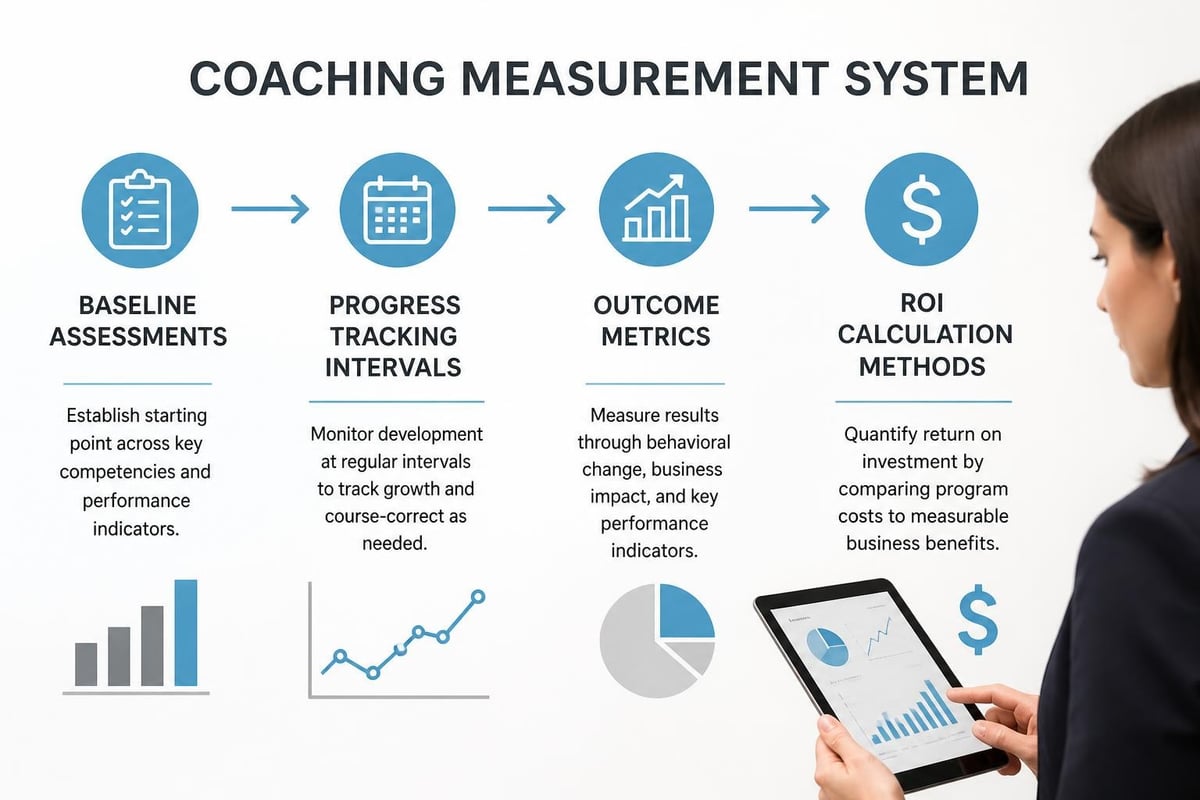
Don't accept promises of "we'll track outcomes." Require providers to show you their actual measurement systems, reporting templates, and sample outcome data from previous engagements.
Strong providers should offer:
- Pre-engagement baseline measurement protocols
- Progress tracking intervals and methods
- Real-time dashboards or reporting access
- Comparative benchmarks from similar organizations
- Post-engagement impact assessment methodology
The Questions That Reveal Provider Quality
After evaluating hundreds of coaching engagements, certain questions consistently separate sophisticated providers from those who deliver inconsistent results.
Questions About Problem-Solving Track Record
"Describe a coaching engagement where the initial diagnosis was wrong and how you adjusted." This reveals adaptability and diagnostic honesty.
"What percentage of your coaching engagements address toxic leadership, serious performance issues, or high-stakes behavioral change versus general development?" This tells you whether they have relevant expertise for difficult situations.
"Walk me through your most challenging client situation in the past year and what you learned." Generic answers signal limited real-world experience.
Questions About Their Methodology
"How do you determine whether coaching is the right intervention versus mentoring, training, or organizational redesign?" Understanding when coaching isn't appropriate demonstrates professional judgment. The HBR guide to mentors, sponsors, and coaches offers useful distinctions.
"What's your failure rate and common reasons engagements don't succeed?" Providers who claim zero failures lack credibility or accountability.
"How do you handle situations where organizational culture or leadership actively undermines the coaching work?" This reveals whether they'll be honest about organizational barriers versus taking your money despite low probability of success.
Questions About Scalability and Consistency
"How do you maintain coaching quality and consistency across 50 or 500 leaders?" Small providers often struggle to scale; large providers often sacrifice quality for volume.
"What's your coach turnover rate and how do you handle mid-engagement coach changes?" High turnover disrupts relationships and signals internal problems.
"How do you develop coaches within your network to maintain quality standards?" Strong providers invest in ongoing coach development, not just initial credentialing.
The Procurement Mistakes That Signal Trouble
Certain provider responses during procurement should raise immediate red flags:
Resistance to sharing outcome data. If a provider won't share anonymized results, assessment samples, or case studies, they either lack data or have poor results to hide.
Unwillingness to customize. Providers who insist their standard program works for everyone haven't done the diagnostic work to understand your specific challenges.
Overemphasis on coach credentials versus outcomes. Impressive credentials matter less than demonstrated results with challenges similar to yours.
Vague answers about measurement. If they can't articulate specific KPIs, tracking methods, and reporting formats, they don't actually measure outcomes.
Pressure for long-term contracts without pilot programs. Confident providers offer pilots or phased approaches that let you validate fit before major commitments.
What High-Performing Organizations Do Differently
Organizations that consistently achieve strong coaching ROI follow a different selection process than those who treat coaching as a commodity purchase.
They Start With Organizational Diagnosis
Before engaging any provider, they conduct internal analysis to identify:
- Specific leadership capabilities requiring development
- Organizational patterns enabling or constraining leader effectiveness
- Cultural factors that will affect coaching success
- Stakeholder alignment on coaching objectives and success criteria
This groundwork enables them to evaluate how to choose a corporate coaching provider based on fit rather than marketing.
They Test Provider Claims Through Pilots
Rather than enterprise-wide rollouts, sophisticated buyers start with small pilot programs that test:
- Diagnostic accuracy
- Coach quality and matching effectiveness
- Integration with internal systems
- Measurement rigor and reporting value
- Stakeholder satisfaction
Pilots should include your most challenging cases, not just cooperative high-performers. If the provider can't succeed with difficult situations in a pilot, they won't suddenly improve at scale.
They Demand Transparency
Best-in-class organizations require full visibility into:
- Individual coaching progress (within confidentiality boundaries)
- Aggregate program metrics and trends
- Coach performance variability
- Issues and escalations
- Cost per outcome achieved
When providers resist transparency, it's usually because their results don't support their marketing claims.
Building Long-Term Provider Partnerships
The relationship doesn't end with contract signature. How providers perform during implementation reveals their true capabilities.
Onboarding and Integration
Strong providers invest significant effort in organizational onboarding:
- Leadership alignment sessions to clarify objectives and success criteria
- Integration with HR systems and existing development frameworks
- Stakeholder communication and expectation-setting
- Coach briefings on organizational context, culture, and challenges
Weak providers treat onboarding as administrative paperwork rather than strategic alignment work.
Ongoing Program Management
Throughout the engagement, evaluate:
Communication quality. Do you get proactive updates or only respond when you ask? Are issues surfaced early or hidden until they become crises?
Flexibility and responsiveness. When organizational priorities shift or challenges emerge, can the provider adapt quickly?
Continuous improvement. Do they analyze program data and recommend adjustments, or just execute the original plan regardless of results?
Escalation handling. When coaching reveals serious issues like misconduct or mental health concerns, do they have clear protocols and professional judgment?
Organizations working with top executive coaching firms expect this level of program management as standard, not premium service.
When to Walk Away From a Provider
Some provider characteristics should disqualify them regardless of price or marketing appeal:
- Inability to articulate a clear matching methodology
- Unwillingness to share outcome data or references
- Coaches without relevant sector or challenge-area expertise
- Lack of professional liability insurance or ethical oversight
- Resistance to your measurement requirements
- Cookie-cutter programs that don't adapt to your context
- Marketing claims unsupported by evidence
The highest-risk decision is selecting a provider who sounds good but lacks substance. Ineffective coaching doesn't just waste budget; it can damage leaders, teams, and organizational culture while creating legal exposure.
The Harvard DCE guide to choosing professional development programs offers additional selection criteria applicable to coaching provider evaluation.
FAQ
How long should the provider selection process take?
Plan for 6-8 weeks minimum for thorough evaluation including RFP, provider presentations, reference checks, pilot design, and contract negotiation. Organizations that rush selection consistently experience poor outcomes.
Should we use a single provider or multiple providers for different needs?
It depends on your scale and challenge diversity. Single providers offer consistency and simpler management but may lack specialized expertise. Multiple providers require more coordination but can provide best-in-class capabilities for different challenges. Most mid-to-large organizations benefit from a primary provider plus specialized providers for niche needs.
How do we evaluate coaching providers when we lack internal coaching expertise?
Engage an independent consultant with coaching program expertise to support your evaluation, or partner with organizations in your industry who have mature coaching programs. Don't let knowledge gaps lead to poor decisions based solely on marketing materials.
What's a reasonable cost range for corporate coaching?
Executive coaching typically ranges from $300-800+ per hour depending on coach expertise, engagement complexity, and provider overhead. Total program costs depend on participant count, engagement duration, and services included (assessment, measurement, program management). Focus on cost per outcome achieved rather than hourly rates.
How do we know if coaching is working before the engagement ends?
Effective providers build progress checkpoints every 4-6 weeks using stakeholder feedback, behavioral assessments, and goal progress reviews. If you can't see measurable progress by the engagement midpoint, something is wrong with the coach match, intervention design, or organizational support.
Most organizations treat coaching provider selection as a purchasing decision when it should be a diagnostic and strategic partnership decision. The providers who deliver transformational results start with rigorous assessment, match coaches with precision, and build accountability into every engagement. When you need to address complex leadership challenges, Noomii Leadership Coaching combines evidence-based diagnostics, proprietary matching algorithms, and a global network of specialized coaches to deliver measurable outcomes aligned with your organizational priorities.



Leave a Reply
Want to join the discussion?Feel free to contribute!