
How to Get Certified Information Security Manager (CISM)
The CISM certified information security manager credential is ISACA's management-level security certification, and you earn it by passing one exam and proving five years of qualifying experience. If you want a title that signals you can run a security program rather than just configure tools, this is the credential built for that job. Here is the full path, plus the judgment calls that decide whether it pays off.
What does the CISM actually prove?
CISM proves you can govern and manage an enterprise security program, which is a different claim than proving technical skill. The exam tests four domains: information security governance, risk management, program development and management, and incident management. You will see few command-line questions and many questions about priorities, accountability, and business alignment.
That framing matters for your career. Many hiring managers read CISM as evidence you can sit in a budget meeting and defend a risk decision. A credential alone will not give you that skill, which is the pattern I see repeatedly: certified candidates who cannot explain a control in plain business terms stall in interviews, while experienced managers with a clear story move fast.
What are the requirements to become CISM certified?
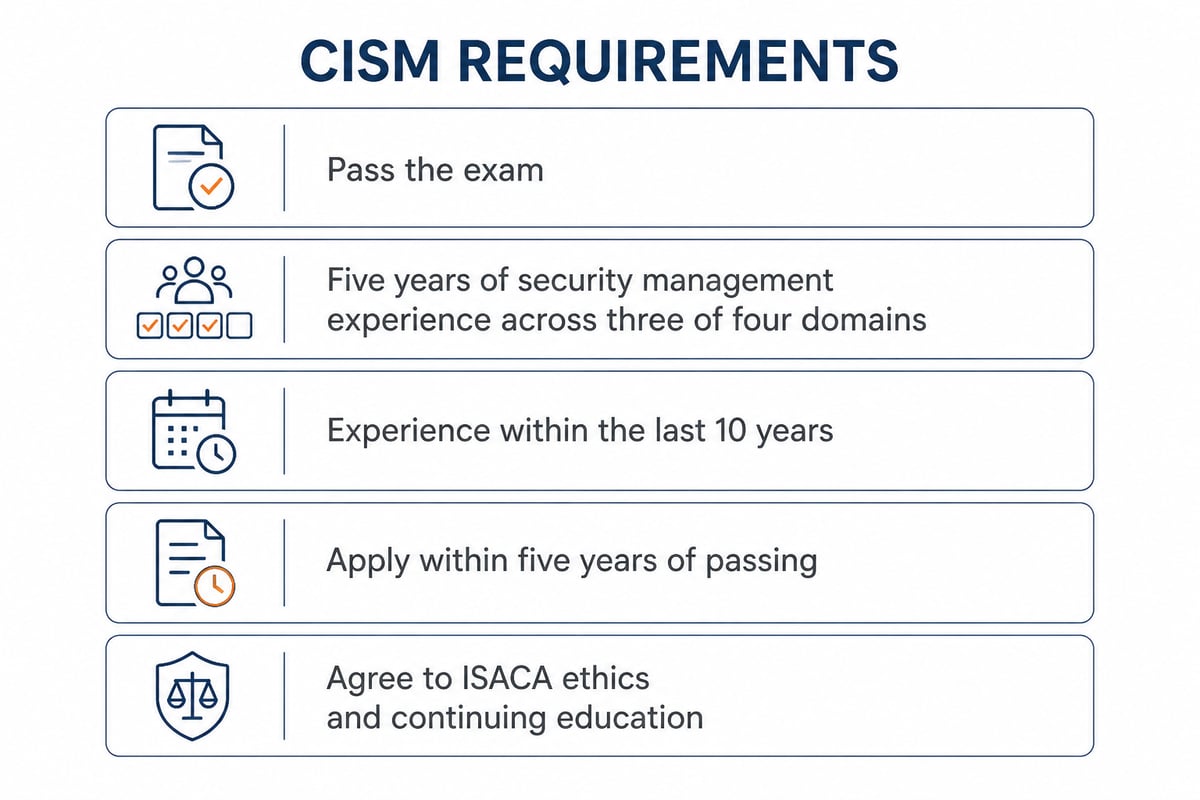
You need to pass the exam, meet the experience requirement, and agree to ISACA's ethics and continuing-education rules. Certification also involves a US$50 application fee on top of the exam itself.
The experience rule is specific. You need at least five years of professional information security management experience across at least three of the four domains, and that experience must fall within the 10 years before you apply. You can take the exam first, but you must apply for certification within five years of passing.
Is the CISM hard?
CISM is hard in a particular way: it punishes technical people who answer like engineers. Questions often present several technically correct options, and only one reflects what a manager should do first, usually the choice that aligns with business objectives, involves the right stakeholders, or assesses risk before spending money.
Candidates with real management exposure tend to find it manageable with focused study. Candidates who built their careers in hands-on roles often underestimate it. The fix is to practice thinking as an advisor to the business, not as the person fixing the problem.
How do I schedule my ISACA exam?
You register through your ISACA account, pay the exam fee, and book a testing slot through the scheduling options ISACA provides. Create the account first, choose your exam delivery method, and pick a date only after you have mapped out your study calendar.
Schedule with a deadline you can respect. A date six to ten weeks out keeps momentum without rushing. Check ISACA's current fee schedule at booking, since member and nonmember pricing differ and ISACA, not a training vendor, sets it.
How should I prepare for the exam?
Prepare in four stages, and keep the sequence in this order:
- Map your experience to the four domains so you know where you are thin.
- Study the domains with ISACA's official review materials and one structured course.
- Drill practice questions daily and write down why each wrong answer was wrong.
- Take timed full-length practice exams in the final two weeks.
A contrarian note on training: you do not need an expensive boot camp to pass. Boot camps help people who need external accountability. If you are self-directed, official materials plus a large bank of practice questions cover the same ground for less. Certification dependency is real in this field, and the credential rewards learning how to reason, not how many courses you collected.

What does a CISM certified information security manager do?
An information security manager owns the program that protects an organization's information: setting policy, running risk assessments, directing the team, managing incidents, and reporting to executives. The role sits between the technical team and the leadership team, translating each to the other.
Typical titles include security manager, director of information security, and CISO. In smaller companies, one person often covers governance, vendor risk, and incident response at once. Frameworks help here; for example, NIST's RMF Small Enterprise Quick Start Guide helps small, under-resourced organizations begin building risk-management programs. For teams that need outside help standing up OT or IT programs, Securing Things offers cybersecurity advisory and consulting services.
How do I keep the certification after passing?
You keep CISM by earning and reporting continuing education. ISACA requires at least 120 CPE hours per three-year reporting period, with a minimum of 20 hours each year. Missing the annual minimum puts your status at risk, so log hours as you go instead of cramming in year three.
Count on a steady rhythm: conferences, webinars, teaching, and relevant coursework all can qualify under ISACA's rules.
Does the credential matter more than leadership skill?
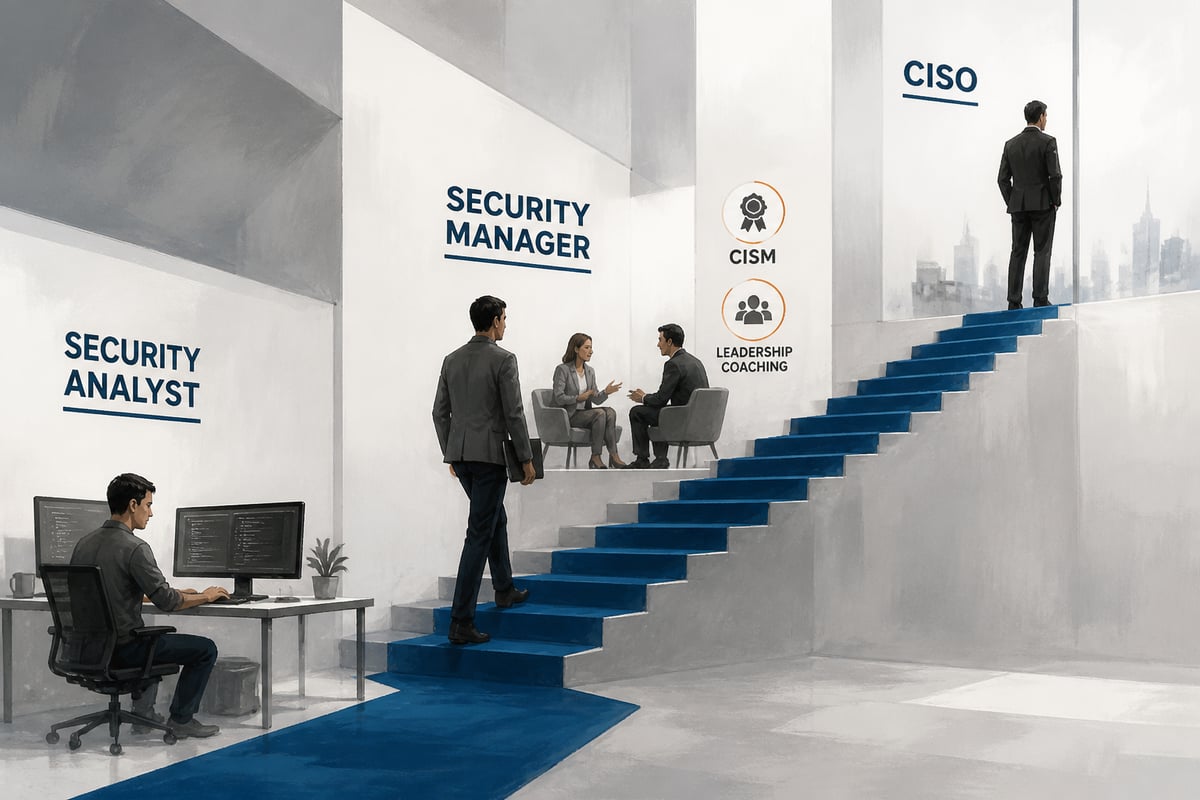
The credential opens the door, and leadership skill decides how far you walk through it. This is where certification worship breaks down. Two managers can hold identical credentials, yet one gets promoted because she runs a clean meeting cadence, coaches her analysts, and speaks in business outcomes.
Hypothetical example: a newly certified security lead is handed a team and no management training. The diagnosis is usually not a knowledge gap but a delegation and communication gap, so the useful investment becomes manager coaching and a clear scorecard of team priorities rather than another certification. If that sounds like your next step, career coaching can help you set goals and build a plan for the move into leadership. Therapy needs are a separate matter; see how coaching differs from therapy if you are unsure which fits.
Who should skip the CISM?
Skip it if your goal is deep technical specialization, such as penetration testing or cloud engineering, where hands-on credentials carry more weight. Also skip it if you are far from the five-year experience mark and have no management path ahead. Passing early is allowed, but a certification without the experience behind it will not carry the signal you paid for.
For those considering business coaches or executive coaches in Pennsylvania alongside the credential, treat coaching as the skill builder and CISM as the proof.
Frequently Asked Questions
What is the CISM certified information security manager credential?
It is ISACA's management-focused security certification covering governance, risk management, program development, and incident management.
How many years of experience do I need?
At least five years of information security management experience across at least three of the four domains, within the 10 years before you apply.
Can I take the exam before I have the experience?
Yes. You must apply for certification within five years of passing.
Is the CISM hard?
It is hard for engineers who answer technically instead of from a business perspective, and moderate for experienced managers who prepare.
How do I schedule my ISACA exam?
Register through your ISACA account, pay the fee, and choose a testing slot after setting a six to ten week study plan.
What is ISM in security?
ISM generally stands for information security management, the discipline of governing and running an organization's security program.
What is the role of an information security manager?
They set policy, run risk assessments, lead the security team, manage incidents, and report risk to executives.
How do I maintain CISM?
Earn and report at least 120 CPE hours per three-year period, with a minimum of 20 each year.
Is CISM worth it without management experience?
Rarely. The credential signals management capability, so it works best when your experience already backs it up.
Your next step is to list your security management experience against the four CISM domains and note which gaps you can close in the next six months. If the gap is leadership rather than knowledge, Noomii Corporate Coaching helps mid-market companies build accountable leaders and teams by coaching live in your meetings and tying progress to clear KPIs, on month-to-month terms with no long contracts. To explore a fit for your own career move, start with career coaching, then get my free match with a coach who suits your goals.



Leave a Reply
Want to join the discussion?Feel free to contribute!