

Leadership Development Vendors in China: How to Choose One
The best leadership development vendors in China are the ones that fit your leaders' actual gaps, your language and cultural context, and your ability to measure behavior change afterward. There is no single best provider. The market is crowded, spanning business schools, global leadership institutes, local consultancies and coaching networks, and the right choice depends on what you are trying to change and how you will prove it changed.
That matters more now because spending is climbing. IMARC Group estimates the China corporate training market was estimated at USD 58.30 billion in 2025, with a forecast of USD 116.97 billion by 2034. More money does not mean better outcomes. Buyers should treat quality and ROI measurement as a gap to close in any vendor selection, since spending alone does not show results.
What types of leadership development vendors operate in China?
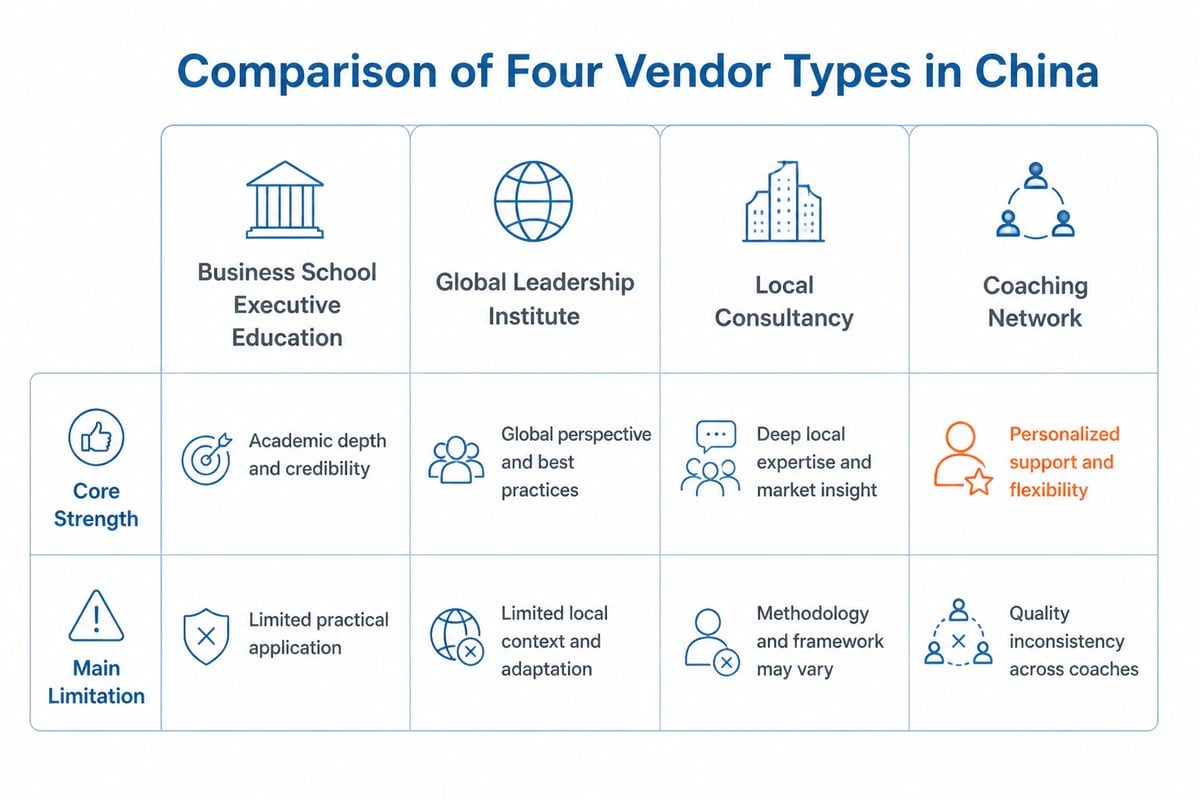
Four vendor types dominate the market, and each solves a different problem. The provider landscape spans leadership, management, digital, compliance and blended-learning services, so a vendor's category tells you more than its brochure does.
| Vendor type | What it does well | Where it falls short | Best fit |
|---|---|---|---|
| Business school executive education | Credentials, peer networks, strategic frameworks, modular programs | Cohort format limits personalization; behavior change after the classroom is rarely tracked | Cross-company cohorts of high potentials |
| Global leadership institutes with China offices | Validated programs, research base, multi-country consistency | Standardized curriculum; local adaptation varies by facilitator | Consistent global leadership language |
| Local consultancies and training firms | Language, speed, price, regional cultural fluency | Quality varies widely; limited cross-border benchmarks | Frontline and middle-management programs |
| Coaching networks | One-to-one work on specific behaviors, flexible scheduling | Requires disciplined sponsor involvement; scale depends on network depth | Executives and successors with specific gaps |
Most large organizations end up combining two types. A cohort program builds shared language, and coaching converts it into individual behavior. The mistake is buying one and expecting it to do both jobs.
How should you evaluate leadership development vendors in China?
Evaluate vendors against outcomes you can observe, not against the reputation of the faculty or the polish of the curriculum. A practical way to do this is a five-criterion scorecard, which I will call the Fit-Proof-Scale test. Score each vendor from 1 to 5 on every line, and require evidence for any score above 3.
- Diagnostic fit. Does the vendor start with an assessment of your leaders, or with a catalog? A vendor that cannot tell you what it would measure before the program begins is selling content, not development.
- Cultural and language fit. Can delivery happen in Mandarin and English, and do facilitators understand how hierarchy, face and indirect feedback shape leadership conversations in your workforce? Imported frameworks that assume Western-style open challenge to superiors often stall in the room.
- Evidence of behavior change. Ask for pre and post data tied to leadership behaviors, not satisfaction scores. A smile sheet measures the catering.
- Scalability. Can the same approach reach 20 leaders in Shanghai and 200 across regional offices without quality collapsing?
- Governance and reporting. Will you receive regular reporting linked to retention, performance and leadership KPIs, and does the vendor accept your internal compliance and data standards?
A vendor that scores high on content and low on criteria 3 and 5 is the most common trap. The program feels excellent, and a year later no one can say what moved.
What is the 70-20-10 rule, and why does it change how you buy?
The 70-20-10 rule holds that roughly 70 percent of leadership learning comes from on-the-job experience, 20 percent from relationships such as mentors and coaches, and 10 percent from formal instruction. It is a heuristic, not a law, but it exposes a budgeting problem.
Most corporate leadership budgets are inverted. They pay heavily for the 10 percent, the workshop or the cohort program, and almost nothing for the 70 percent, which is the work itself, or the 20 percent, which is structured feedback and coaching. A vendor selection process that only compares classroom offerings reinforces the imbalance.
The practical implication is to ask every vendor a pointed question: what happens on Tuesday morning after the program ends? If the answer is a certificate and an alumni newsletter, the vendor is covering the smallest slice of how leaders actually change.
Why do cross-cultural factors matter more than vendor brand?
Cross-cultural fit decides whether a program lands, and brand strength does not guarantee it. Academic work on the topic points the same way, and the question buyers should ask of every vendor is who inside the organization genuinely owns development, and who treats it as an HR event.
Three signals tell you whether a vendor has handled this well:
- Feedback design. Anonymous 360 inputs often work better than live peer critique in hierarchical teams, and a good vendor will say so before you ask.
- Sponsor involvement. Programs where a senior executive visibly co-owns outcomes outperform those run entirely by HR in most organizational settings.
- Local case material. Facilitators who rely only on Western case studies lose credibility with leaders who run businesses under different regulatory and competitive conditions.
Where do coaching-led approaches fit among leadership development vendors in China?
Coaching-led approaches fit wherever the gap is behavioral and individual rather than informational. A leader who knows what good delegation looks like but keeps hoarding decisions does not need another lecture. That leader needs someone to observe, challenge and hold them accountable over months.
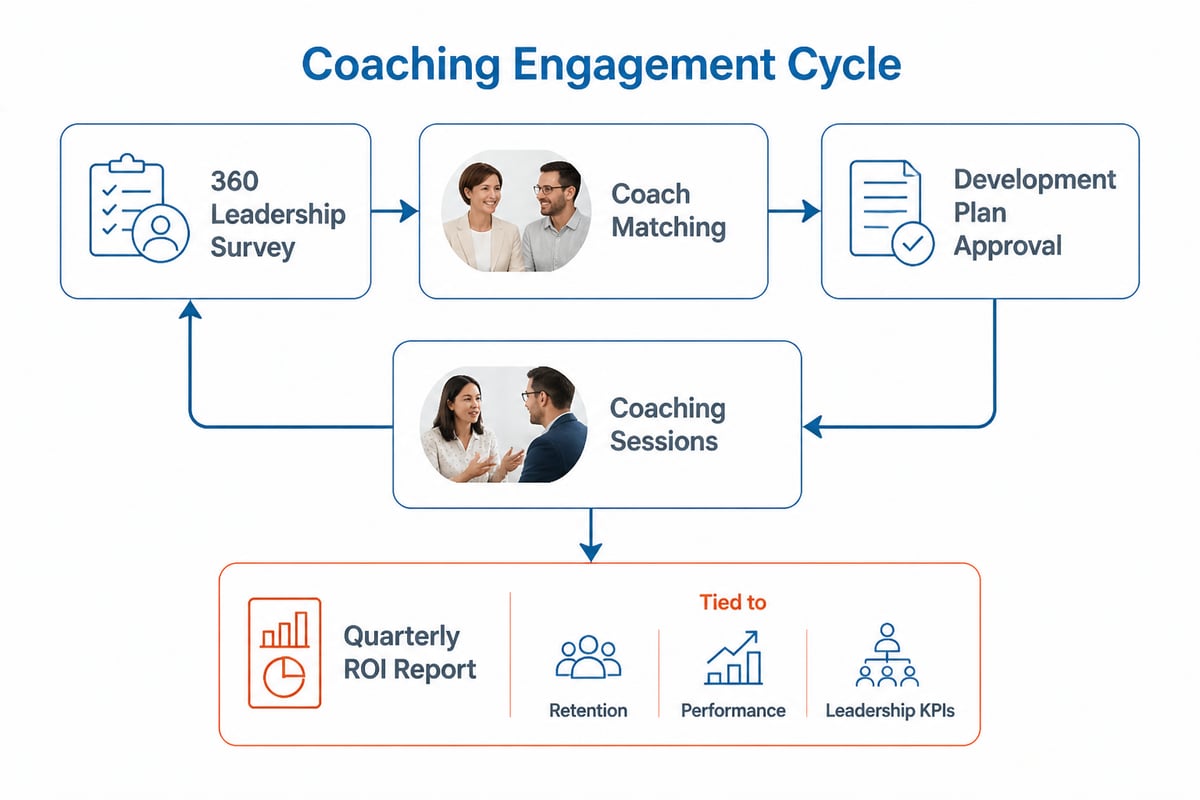
For organizations that want to see how this works in the China market specifically, Noomii maintains a profile of top leadership coaches in China, and its broader leadership coaching overview explains how engagements are structured. Noomii's approach is to hand-match human coaches by function, level, industry and goals, with coaches sourced, interviewed and matched to each leader's needs. No payment is due until the coach selection and development plan are approved, which lowers the risk of committing before fit is confirmed.
What does proof of impact look like from a vendor?
Proof of impact is documented behavior change attributed to specific interventions, reported against metrics you agreed on before the work began. Anything vaguer should lower your score.
Noomii's own reporting shows the kind of evidence worth demanding: coaching effectiveness rated 8-9 out of 10 across goal alignment, support and accountability, and coach professionalism rated 10 out of 10 by senior leaders. These figures come from Noomii itself, so treat them as a template for the questions to ask any vendor, not as a substitute for your own pilot data.
Two outcome patterns are useful because they describe the type of change that matters:
- Repeat commissioning. Repeat buying by a sophisticated client is stronger evidence than any testimonial, and Noomii reports that a Fortune 500 global electronics manufacturer re-commissioned engagements because of documented impact.
- From tasks to ownership. Noomii reports that leaders at a Fortune 1000 international therapeutics company moved from task execution to problem ownership. That is the shift most succession pipelines actually need, and it is observable by peers and managers.
Notice what these have in common. Both describe a change in how leaders behave, and both can be verified by someone other than the vendor. Use that as your standard.
What does a pilot look like when you are testing a new vendor?
A good pilot is small, time-boxed and designed so that failure is cheap and informative. Run it before any multi-year contract.
- Define three observable behaviors you expect to change, such as delegating decisions, giving direct feedback upward, or resolving cross-team conflict without escalation.
- Baseline with a 360 assessment. A free 360 leadership survey for every participant, as Noomii provides, gives you a before measurement without adding assessment cost to the pilot.
- Select 8 to 15 leaders across at least two levels and two functions, so you can see whether results hold beyond one friendly team.
- Agree on reporting cadence and metrics in writing, including who sees the data and how it ties to retention and performance.
- Set a decision gate at the end. Expand, adjust or stop, based on the baseline comparison rather than participant enthusiasm.
Noomii's Leadership Development Programs are built on this logic, with customized, measurable development plans designed alongside your HR, L&D or People team and aligned with business strategy. Pilot programs are available, which suits a cautious entry into a new market or business unit.

How do you handle multi-country and multi-coach delivery?
Handle it through a single coordinating owner who manages consistency, scheduling and reporting, so that your China cohort is not an island. Many multinationals run leadership programs in China that are disconnected from what the same company does in Europe or North America, which produces inconsistent leadership language and duplicate cost.
Look for a vendor with demonstrated multi-country delivery. Noomii reports coordinating multi-coach delivery across 5 countries, which is the kind of proof worth requesting from any provider claiming global reach. The questions to press are practical ones: how are coaches briefed on a shared competency model, how is data consolidated, and who resolves it when a coach in one region contradicts guidance from another?
What example shows the cost of choosing on reputation alone?
Hypothetical example: a manufacturer selects a prestigious executive education program for its senior managers. Satisfaction scores are high, but when the board asks whether succession readiness has improved, the only data available is attendance and survey ratings.
The diagnosis is straightforward. The company bought the 10 percent of learning that is easiest to purchase and never set up the baseline, the individual follow-through, or the reporting needed to answer the board. The lesson is that vendor selection is partly a measurement design decision. Choose the vendor whose reporting would let you answer the board's question, then evaluate content second.
What contrarian view should HR leaders keep in mind?
The conventional advice is to shortlist the largest and best-known vendors. That advice ignores how leadership change actually happens. A famous name reduces procurement risk for the buyer, but it does not reduce the risk that your leaders stay the same. Leadership development without behavior change is the costliest outcome, and it is common in programs chosen for prestige. Noomii's analysis of leadership development without behavior change makes the case that attendance and learning are not the same as change.
A second challenge to convention: do not let the vendor define success. Define it yourself in terms of retention, promotion readiness and manager-rated behavior, then ask vendors to commit to reporting against those terms.
What did AmCham China's program signal about market expectations?
It signaled that serious buyers want cohort learning anchored in strategy and market context, delivered over months rather than days. AmCham China's 2025 Leadership Development Program, as reported by IMARC, brought together 24 participants from 20 organizations for an eight-month program focused on leadership, strategy and US–China business dynamics. The format is worth noting: eight months, mixed organizations, and a specific geopolitical-commercial focus.
The implication for your selection is that duration and context-specificity are becoming baseline expectations. A two-day workshop on generic leadership themes will increasingly look thin next to programs built around the realities your leaders face. If your business is exposed to cross-border complexity, ask each vendor how their design reflects it.
FAQ
Which companies are the best for leadership development?
There is no universally best provider, because fit depends on your leaders' gaps, your workforce language and your measurement needs. Score candidates on diagnostic fit, cultural fit, evidence of behavior change, scalability and reporting, then pilot the top two before committing.
Can I find an agency to help me select a vendor in China?
Yes. Local HR advisory firms and talent consultancies can shortlist providers and manage procurement, and coaching networks can match individual coaches to leaders. Ask any intermediary how they are compensated, since commission-based advice can bias the shortlist.
How long should a leadership development program in China run?
Meaningful behavior change usually needs months, not days, with reinforcement between sessions. AmCham China's 2025 program ran eight months, which is a reasonable reference point for cohort-based design, while coaching engagements commonly run over a similar horizon with quarterly checkpoints.
Your next step is to write down the three leadership behaviors you need to change and the metrics that would prove they did, then hold every shortlisted vendor to that standard in a small pilot. If you want a partner that starts from a free 360 survey, hand-matches coaches and reports quarterly against retention and performance KPIs, review Noomii's Leadership Development Programs and then use Noomii Leadership Coaching to book a free strategy call and scope a pilot for your China leaders.


Leave a Reply
Want to join the discussion?Feel free to contribute!