
Leadership Development Providers in Qatar: What to Compare
The best leadership development providers in Qatar are the ones that can show behavior change in your leaders, not just attendance in a classroom. Compare providers on five things: how they diagnose need, who delivers, how well they fit Qatar's workforce context, how they handle governance, and how they prove results.
Most selection processes start with a course catalog and end with a price comparison. That sequence rewards the provider with the longest brochure. A stronger sequence starts with your succession gaps and works backward to the provider type that can close them.
What Types of Leadership Development Providers Operate in Qatar?
Providers in Qatar fall into four groups: university executive education units, regional training institutes, international consultancies, and coaching-led firms. Each solves a different problem, and the mismatch between problem and provider type is the most common reason programs underdeliver.
| Provider type | Strongest at | Typical limitation |
|---|---|---|
| University executive education | Credentialed content, academic rigor, cohort networking | Fixed curriculum, slow to customize |
| Regional training institutes | Accredited short courses, wide topic range, local logistics | Course-based, limited follow-through on behavior |
| International consultancies | Large-scale transformation, framework design | Cost, junior delivery teams after the sale |
| Coaching-led firms | Individual behavior change, executive transitions | Less suited to broad knowledge transfer |
The right mix usually combines two types. A classroom course builds shared language across a cohort. Coaching converts that language into daily behavior. Buying only the first is how organizations end up with certificates and unchanged meetings.
Why Qatar's Context Changes How You Evaluate Providers
Qatar's workforce priorities mean a generic global program will miss things your leaders face daily. Qatar National Vision 2030, launched in 2008, aims for Qatar to become an advanced country capable of sustaining its development, and it names human development as a pillar calling for training that helps people reach their potential and keep pace with a changing world. Qatar's national development planning also places workforce development at the centre of its long-term agenda.
Three practical consequences follow for HR and L&D leaders:
- Multicultural teams are the norm. Your leaders manage people from many countries and communication styles. A provider that teaches one cultural model of feedback or delegation will create friction.
- Succession now carries a localization dimension. Developing national talent into senior roles requires mentoring and sponsorship design, not only skills courses.
- Alignment with national priorities matters for public and quasi-public entities. Providers should be able to connect a development plan to your mission objectives and to the human-development priorities the state has set out.
Ask each provider to describe a program they adapted for a multinational workforce. If the answer is a translated slide deck, move on.
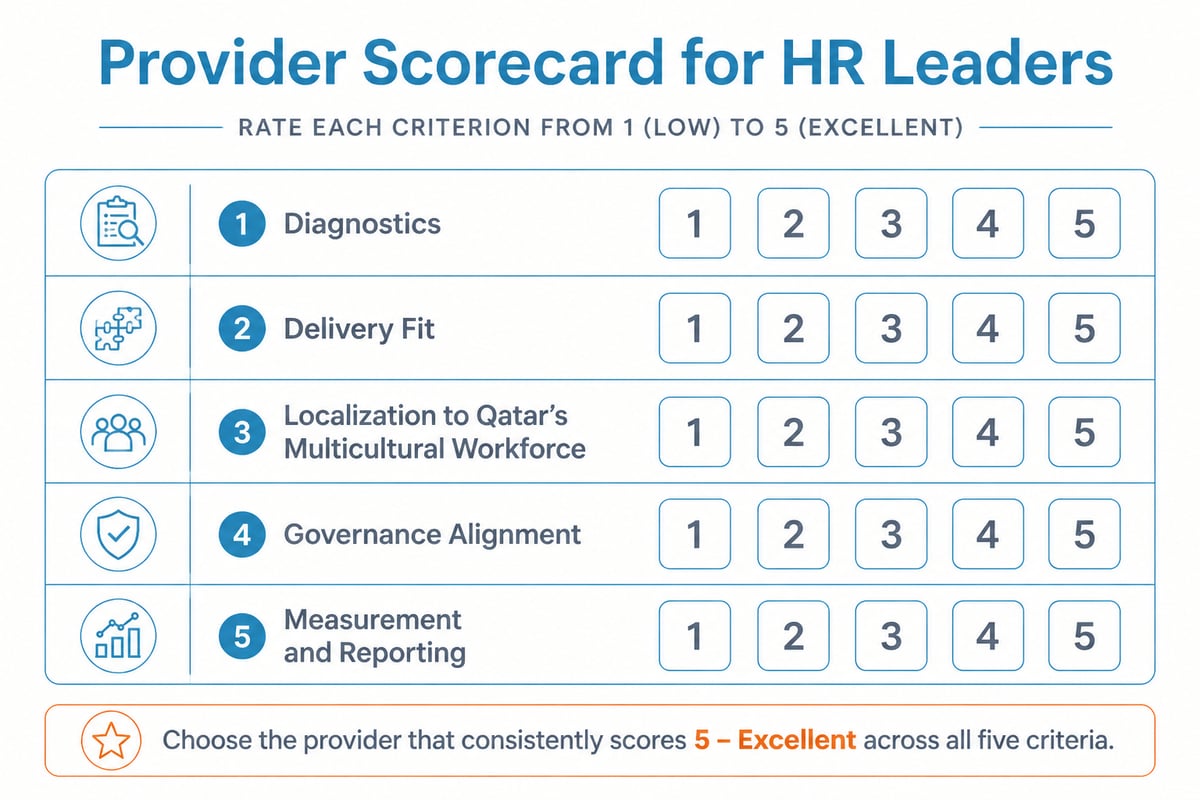
How to Compare Leadership Development Providers in Qatar: A Five-Point Scorecard
A scorecard forces the conversation away from brand and toward evidence. Score each shortlisted provider from 1 to 5 on the criteria below, and require written answers, not sales presentations.
1. Diagnostics before design
Ask what the provider measures before proposing a program. Strong providers use validated assessments, such as 360 feedback, to identify gaps by individual and team. Weak ones propose a curriculum in the first meeting. If the program was designed before anyone assessed your leaders, you are buying a product, not a solution.
2. Who actually delivers
Request the names and credentials of the people who will work with your leaders. Consultancies often sell with senior partners and deliver with junior staff. For coaching-led work, ask how coaches are selected and matched, and whether you can approve the match before committing.
3. Fit with your leaders' level and function
A newly promoted supervisor and a division head do not need the same thing. The provider should segment by level, function and goal. Generic "leadership essentials" for a mixed group tends to bore executives and overwhelm first-time managers.
4. Governance and standards
Ask how the program aligns with your internal competence framework. ISO 10015:2019 gives guidance on establishing and improving competence-management and people-development systems for organizations of any type or size, and ISO confirmed it remains current after its 2025 review. A provider familiar with it can speak to needs analysis, delivery and evaluation in a structure your auditors recognize.
5. Proof of results
Ask for the measures the provider reports against and how often. Attendance and satisfaction scores are not outcomes. Retention, performance ratings, engagement and observable behavior change are.
What Does a Provider Case Look Like When It Works?
A useful provider can walk you through a case in Problem, Diagnosis, Solution, Result, Lesson form. Here are two drawn from Noomii Leadership Coaching's client work.
Case one: a Fortune 1000 international therapeutics company.
- Problem: Leaders were competent at executing tasks but did not take ownership of problems.
- Diagnosis: The gap was behavioral, not technical, so another knowledge course would not have moved it.
- Solution: Individual coaching matched to each leader's function and goals.
- Result: Leaders moved from task execution to problem ownership.
- Lesson: When the gap is how leaders think and act, coaching outperforms content delivery.
Case two: a Fortune 500 global electronics manufacturer.
- Problem: Leadership development across multiple regions needed consistency without a one-size-fits-all approach.
- Diagnosis: Leaders needed locally relevant coaching with shared standards and reporting.
- Solution: Coordinated multi-coach delivery across five countries.
- Result: The client commissioned repeat engagements because the impact was documented.
- Lesson: Re-commissioning is the cleanest proof a program worked. Ask any provider how many clients return and why.
In Noomii's engagements, leaders have shown observable behavior change, and senior leaders have rated coach professionalism highly. Treat such claims as a prompt for your own due diligence: ask every provider, including Noomii, which measures sit behind their claims.
The Contrarian View: Course Completion Is the Wrong Success Metric
Most leadership budgets in the Gulf region are justified by completion counts, and that habit hides the real risk. A leader can finish a flawless course and return to the same decision habits, the same avoidance of hard conversations, the same unclear delegation. Organizations then conclude development "doesn't work" when what failed was the transfer from learning to behavior.
Noomii has written about this problem in its piece on leadership development without behavior change. Knowledge programs raise awareness, but behavior shifts more reliably when a leader practices new moves with feedback and accountability over time.
This changes how you buy. Instead of asking "how many leaders can you put through the program?", ask "how will you know in six months that three specific behaviors changed?" Providers who struggle with that question are selling activity.

Where Coaching Fits Next to Classroom Programs
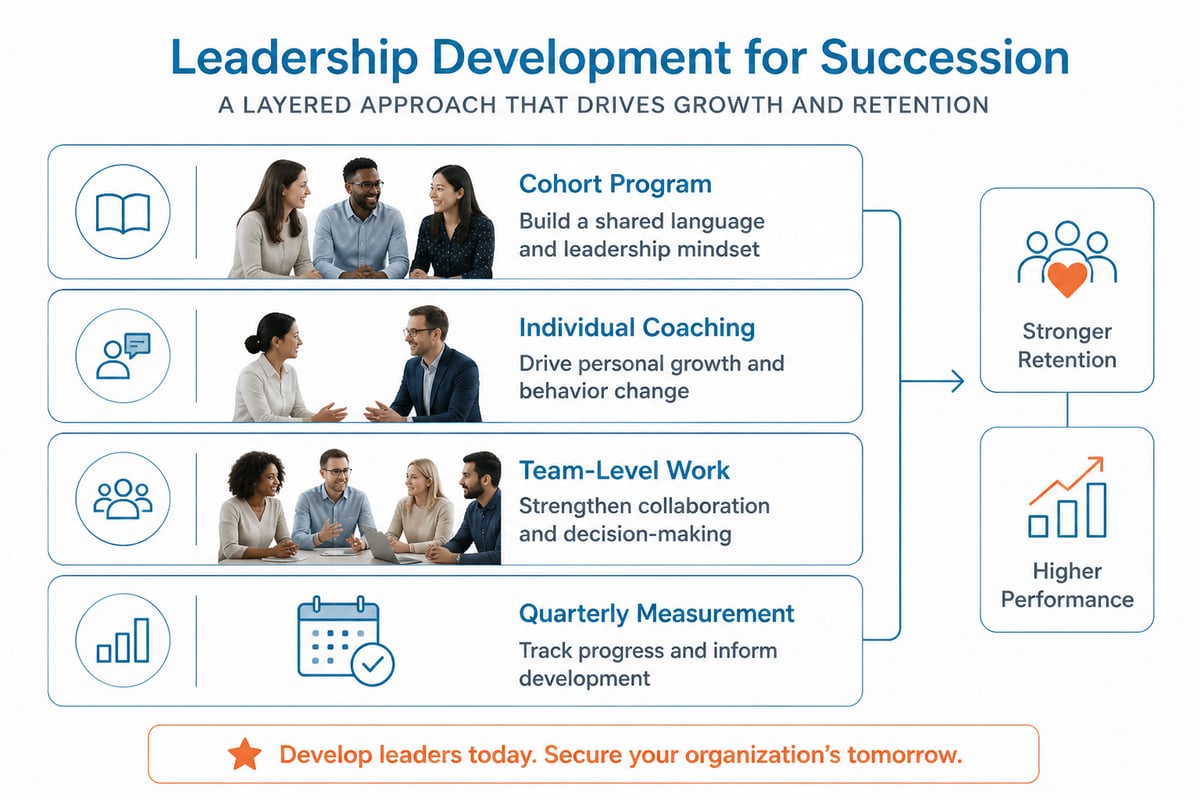
Coaching is the layer that turns a course into changed behavior, so it earns a place in any serious plan for senior and high-potential leaders. A practical split looks like this:
- Cohort programs for shared language, strategy alignment and relationship-building across departments.
- Individual coaching for executives, newly promoted leaders and succession candidates whose gaps are behavioral.
- Team-level work where the issue is how a leadership group communicates, decides or handles conflict.
- Targeted intervention where toxic behaviors or low engagement are affecting retention.
For organizations building this blend, Noomii's Leadership Development Programs are designed with your HR, L&D or People team, aligned with business strategy, with pilot programs available. A pilot is a sensible way to test any provider's fit before scaling across a division.
How to Judge Measurement Claims
Measurement claims are where providers differ most, and where HR leaders can most easily separate substance from polish. Use these tests:
- Baseline: Is there a documented starting point for each leader, such as a 360 survey? Without one, improvement cannot be shown.
- Cadence: Are results reported on a schedule you control? Quarterly reporting tied to retention, performance and leadership KPIs lets you intervene before a budget year ends.
- Linkage: Do metrics connect to business outcomes your CFO recognizes, not only to learner sentiment?
- Attribution honesty: Does the provider acknowledge what coaching can and cannot influence?
Noomii offers a 360 leadership survey as a baseline and can report progress against retention, performance and leadership KPIs. Whichever provider you choose, insist on a comparable baseline-to-report chain in the contract.
Questions to Ask on a Provider Call
Use this list in your next vendor conversation. It surfaces differences quickly.
- What do you measure before you recommend a program?
- Who delivers, and can we approve them before we commit?
- How do you adapt for leaders from many nationalities in one group?
- Which leadership gaps are you not the right provider for?
- What do you report quarterly, and to whom?
- Which clients re-commissioned work, and what documented impact led to that?
The fourth question is the most revealing. A provider who names a limit has probably thought hard about fit. One who claims to serve every need has not.
Who Should and Should Not Use This Approach
A diagnostic-led, coaching-based approach suits mid-market and large organizations with identifiable leadership gaps, a succession pipeline to protect, and HR sponsors who want measurable evidence. It is less suited to organizations seeking a single fixed-price course bundle for a small team, or to individuals looking for personal life coaching. Those buyers will find better value in a standard training catalog.
If you are weighing cost against impact, a useful reference point is how other organizations structure corporate leadership development, then run a small pilot against your own leaders' data. For wider business context on budgeting and growth decisions, the finance and business publication Alliez offers background reading on money and business topics.
FAQ
What companies have the best leadership development programs?
The best programs share traits rather than a single brand: validated diagnostics, qualified delivery, behavior-focused follow-through and reporting tied to business metrics. Judge any company against those traits using the scorecard above, and ask for documented client outcomes.
Which course is best for a job in Qatar?
It depends on the role and your current gap. For leadership roles, look for programs that combine recognized accreditation with practice on real situations, such as managing multicultural teams, change and crisis decisions. Employers value demonstrated behavior change over certificates alone.
What are the 7 leadership skills?
There is no single official list, but commonly cited skills include strategic thinking, decision-making, communication, emotional intelligence, accountability, adaptability and developing others. A 360 assessment shows which of these your leaders most need to strengthen.
Start this week by scoring your top three shortlisted providers against the five-point scorecard and asking each one the fourth question about the gaps they are not the right fit for. If coaching belongs in your mix, review Noomii's Leadership Development Programs, which are designed with your HR or L&D team and can start as a pilot, then test the fit against your own succession gaps.


Leave a Reply
Want to join the discussion?Feel free to contribute!