

Why High Performers Hire Coaches: The Real Reasons
The best leaders, founders, and executives don’t hire coaches because they’re broken. They hire because they recognize that performance at the top requires a different operating system. Understanding why high performers hire coaches reveals a pattern: they seek measurable outcomes, not motivational speeches. They want someone who challenges their thinking, sits in their meetings, and holds them accountable to the metrics that matter. This is the gap most coaching conversations miss.
The Performance Paradox That Drives Coaching Demand
High performers face a unique challenge. The skills that elevated them often become limitations. Elite executives seek coaching not for remediation but to expand capacity, refine strategy, and sharpen execution in real time.
Here’s what separates elite coaching engagements from generic programs:
- Live engagement in actual business contexts rather than abstract theory sessions
- Tied to specific KPIs like decision velocity, retention rates, or sales conversion
- Month-to-month accountability instead of locked contracts with vague promises
- Focus on business outcomes measured quarterly, not personal feelings measured never
The executives who get the most value understand coaching as a performance tool, not a development luxury. They track ROI the same way they track any other business investment.
What High Performers Actually Buy When They Hire Coaches
Most coaching marketing focuses on credentials, certifications, and process. High performers ignore this noise. They evaluate three factors: expertise from pattern recognition across industries, willingness to challenge existing thinking, and commitment to measurable results.
When you examine why successful entrepreneurs hire coaches, the pattern is consistent. Bill Gates, Eric Schmidt, and other top performers hired coaches who had been in the arena, not trainers reciting frameworks from a manual.

| What High Performers Want | What Most Coaches Offer | The Gap |
|---|---|---|
| Live coaching in meetings | Scheduled 1-on-1 calls | Context and application |
| KPI-driven progress | Reflective conversations | Measurable accountability |
| Industry pattern recognition | Generic frameworks | Relevant expertise |
| Month-to-month terms | 6-12 month contracts | Aligned risk |
This explains why high performers hire coaches who operate differently. They need partners who understand the business language, not just coaching language.
The Certification Myth and What Actually Builds Trust
The coaching industry pushes certification as a proxy for competence. High performers see through this immediately. A certification proves you completed a program. It doesn’t prove you can improve EBITDA, reduce executive turnover, or help a leadership team make faster decisions.
Real credibility comes from:
- Demonstrable results with similar companies or challenges
- Willingness to tie compensation to outcomes when feasible
- Depth of industry pattern recognition across economic cycles
- Ability to diagnose organizational dysfunction quickly and accurately
- Track record of executive-level communication and challenge
The best coaches carry battle scars, not just certificates. They’ve seen what breaks teams, what accelerates growth, and what leadership behaviors predict failure. This expertise cannot be taught in a 200-hour certification course.
When mid-market companies build psychological safety at work, they need coaches who understand how psychological safety translates to financial performance, not coaches who memorize Amy Edmondson quotes without application context.
The Five Scenarios That Trigger Coaching Investment
Why high performers hire coaches becomes clearer when you examine the triggering events. These aren’t calendar-based development plans. They’re inflection points where the cost of not having a coach exceeds the investment.
Scenario One: Scaling Leadership Teams
A founder who managed 15 people suddenly oversees 150. The management operating system that worked before now creates bottlenecks. Leadership development becomes urgent when growth velocity outpaces leadership capacity.
Scenario Two: Performance Plateaus Despite Effort
Revenue flatlines. Engagement scores drop. Executive meetings produce talk, not decisions. High performers recognize these symptoms require external pattern recognition, not harder work using the same approach.
Scenario Three: Market Disruption or Strategic Shifts
AI disruption, competitive threats, or pivots demand new thinking. The human skills AI cannot replace become differentiators, and coaches help leaders develop these capabilities faster than trial-and-error allows.

Scenario Four: Retention of Critical Talent
When your VP of Sales gives notice, or your top three managers are burned out, reactive hiring won’t solve the root cause. High performers understand the cost of career coaching versus the cost of losing institutional knowledge.
Scenario Five: Preparing for Exit or Transition
Whether preparing for acquisition, building a leadership team to run without you, or stepping into a board role, transitions require intentional skill development. Coaches accelerate what would otherwise take years.
What High Performers Demand From Coaching Engagements
The engagement model matters as much as the coach’s expertise. High performers reject rigid structures that don’t match their business reality. They demand flexibility, live application, and visible progress.
Non-negotiable requirements include:
- Monthly check-ins on agreed KPIs, not vague progress updates
- Access between sessions when critical decisions require input
- Willingness to attend leadership meetings and coach in real time
- Clear connection between coaching activities and business outcomes
- Option to terminate if results aren’t visible within 90 days
This is why understanding your reasons for wanting a coach matters. Clarity on outcomes determines whether the engagement delivers value or becomes another expense without ROI.
The Questions High Performers Ask Before Hiring
Smart buyers evaluate coaches the same way they evaluate any strategic vendor. They ask hard questions and expect evidence-based answers.
- What measurable outcomes have you delivered for companies in our revenue range?
- How do you tie your coaching to our existing KPIs and scorecard?
- What’s your approach when a client isn’t making progress?
- Can you coach our managers live in our operating meetings?
- What’s your termination policy if we’re not seeing results?
These questions separate coaches who deliver results from those who deliver sessions. High performers know the benefits of executive coaching only materialize when the coach operates as a strategic partner, not a vendor executing a curriculum.
The ROI Calculation That Justifies Coaching Investment
CFOs and boards ask the same question: what’s the return? High performers who hire coaches can answer this because they structure engagements around measurable outcomes from day one.
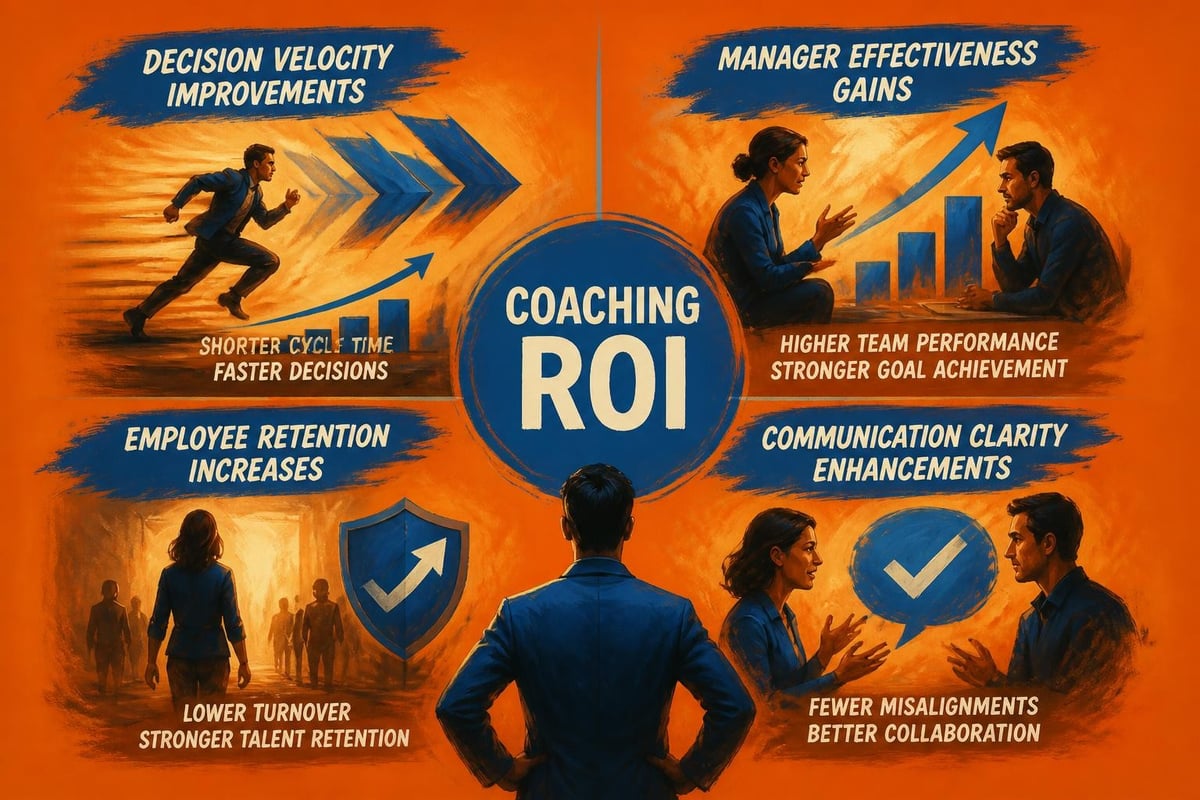
| Outcome Category | Example Metric | Typical Improvement | Business Impact |
|---|---|---|---|
| Decision velocity | Days to close strategic decisions | 40% reduction | Faster market response |
| Manager effectiveness | Direct reports saying manager coaches them | 60% increase | Stronger bench strength |
| Employee retention | Regrettable departures | 30% reduction | Lower replacement costs |
| Communication clarity | Meetings resulting in clear next steps | 50% improvement | Better execution |
When you frame coaching this way, the ROI conversation shifts from cost justification to investment evaluation. A 30% reduction in regrettable departures at a 100-person company saves $500K+ annually in replacement costs alone.
Why High Performers Choose Noomii’s Approach Over Traditional Coaching
Traditional coaching models struggle with accountability. Long contracts, theoretical frameworks, and minimal business integration create expensive workshops, not performance improvements. High performers recognize this gap.
Noomii eliminates these friction points through month-to-month terms, live coaching in actual business contexts, and direct ties to KPIs and scorecards. When a coach rolls up their sleeves and joins your operating meetings, accountability becomes automatic. When progress is measured against retention rates, decision velocity, and team engagement, ROI becomes visible.
The companies getting the best results share a pattern: they treat coaching as strategic support, not employee development programming. They demand coaches who understand P&Ls, competitive positioning, and organizational dynamics. They evaluate coaching the same way they evaluate any business investment, with clear metrics and quarterly reviews.
This approach works because it aligns incentives. When coaches share risk through aligned incentive structures and month-to-month terms, everyone focuses on the same goal: measurable business results that justify continued investment.
FAQ: Why High Performers Hire Coaches
What makes coaching valuable for high performers who are already successful?
High performers hire coaches because success at higher levels requires different capabilities than what created initial success. Coaches provide pattern recognition across industries, challenge blind spots, and accelerate skill development that would otherwise take years of trial and error. The value comes from compressed learning cycles and avoiding expensive mistakes.
How do high performers measure ROI from coaching engagements?
ROI measurement focuses on specific business metrics like decision velocity, employee retention rates, manager effectiveness scores, and communication clarity. High performers tie coaching directly to existing KPIs and scorecards, then track quarterly improvements. The best engagements show measurable progress within 90 days through metrics the business already monitors.
Why do successful executives choose coaches without traditional certifications?
Certifications prove program completion, not business results. High performers prioritize expertise from real-world pattern recognition, industry knowledge, and demonstrable outcomes over credentials. They want coaches who have navigated similar challenges, understand organizational dynamics, and can diagnose problems quickly based on experience, not frameworks memorized from a manual.
What’s the difference between coaching for high performers versus developmental coaching?
Coaching for high performers focuses on amplifying existing strengths, refining strategy, and improving execution in real business contexts. It’s performance optimization, not remediation. The coach operates as a strategic partner who challenges thinking and holds leaders accountable to measurable outcomes, rather than facilitating personal development conversations disconnected from business results.
How long should a coaching engagement last for high performers?
The best engagements operate month-to-month with clear 90-day outcome targets. This creates natural checkpoints to evaluate progress and adjust approach. Long contracts reduce accountability and create sunk-cost dynamics that keep ineffective relationships running. High performers prefer flexibility to terminate or expand based on visible results rather than locked commitments.
What scenarios typically trigger high performers to hire coaches?
Five common triggers include scaling leadership teams beyond current capacity, performance plateaus despite increased effort, market disruption requiring new capabilities, critical talent retention challenges, and major transitions like preparing for exit or stepping into new roles. These inflection points make the cost of not having a coach exceed the investment.
Should coaches attend actual business meetings or only do separate sessions?
The most effective coaching happens live in real business contexts. When coaches attend leadership meetings, operating reviews, and strategic planning sessions, they observe actual dynamics, challenge thinking in real time, and provide immediate feedback. Separate sessions create artificial environments that miss critical context and reduce application of coaching insights.
How do high performers select the right coach from many options?
Selection focuses on three factors: pattern recognition expertise across similar challenges, willingness to challenge existing thinking directly, and commitment to measurable results tied to business KPIs. High performers ask for evidence of past outcomes, evaluate communication style in initial conversations, and look for coaches willing to share risk through month-to-month terms.
What questions should executives ask before hiring a coach?
Critical questions include: What measurable outcomes have you delivered for similar companies? How do you tie coaching to existing KPIs? What’s your approach when clients aren’t making progress? Can you coach managers live in operating meetings? What’s your termination policy if results aren’t visible? The answers reveal whether the coach operates strategically or follows a rigid program.
High performers hire coaches because they understand that sustained success requires external pattern recognition, direct challenge, and accelerated learning that internal resources cannot provide. The coaches who deliver value operate as strategic partners focused on measurable business outcomes, not vendors executing generic development programs. If you’re ready for coaching that ties directly to your KPIs, operates in your actual business context, and delivers visible results within 90 days, explore how Noomii connects mid-market companies with coaches who roll up their sleeves and share accountability for outcomes. Our month-to-month terms and live engagement approach mean you stay because results are clear, not because a contract locks you in.


Leave a Reply
Want to join the discussion?Feel free to contribute!